Introduction
Depression is a common mental health problem in older adults (Prince et al., Reference Prince, Harwood, Blizard, Thomas and Mann1997; Osborn et al., Reference Osborn2003; Werner et al., Reference Werner, Stein-Shvachman and Heinik2009). According to the fifth national census in 2000, China's population aged 60 years and older was 133 million, accounting for 10.27% of the total population. In 2005, the number was 144 million and accounted for 11.03% of the population (Chen, Reference Chen2006). The United Nations Population Division (UNPD) has projected that this older population in China will account for 31% of the population by the middle of the 21st century (UNPD, 2004). Having the largest population of older adults and being one of the fastest-aging countries in the world not only places huge pressures on China's social security system but also presents social, psychological, and health problems. Depression has become one of the major health problems in the aging Chinese population (Zhao and Zhang, Reference Zhao and Zhang2001; Goh et al., Reference Goh, Low and Brodaty2010; Wu et al., Reference Wu, Li and Wang2010). A national sample survey in 2006 showed that the prevalence of mild, moderate, and severe depressive symptoms in older adults in urban areas in China was 30.9%, 9.4%, and 4.2%, respectively; and in rural areas, the prevalence of mild, moderate, and major depressive symptoms in older adults was 38.7%, 18.1%, and 7.4%, respectively (Wu et al., Reference Wu, Li and Wang2010).
As a haven for the mind, the family has important implications for an individual's psychological development (Ryan and Willits, Reference Ryan and Willits2007). Some studies have shown a strong association between family social support and depression (Mitchell and Moos, Reference Mitchell and Moos1984; Kendler et al., Reference Kendler, Gardner and Prescott2002). For example, high levels of family support is associated with more rapid recovery from depression (Goering et al., Reference Goering, Lancee and Freeman1992), while family dysfunction and a lack of support predict a longer course of depression (Miller et al., Reference Miller, Keitner, Whisman, Ryan, Epstein and Bishop1992). A 23-year follow-up study indicated that endorsement of higher family support was related to fewer depressive symptoms at baseline and to a more rapid decrease in depressive symptoms over the course of follow-up assessments (Kamen et al., Reference Kamen, Cosgrove, McKellar, Cronkite and Moos2011).
In China, as in many other parts of the world, the family is the main arena for aging adults. As a result of China's reform and opening up, rapid industrialization, and family planning policy, the Chinese family structure and function have fluctuated throughout the last several decades. In China's socio-economic environment, the traditional family structure has differentiated, with family size tending to be small and the joint or extended family disintegrating, so that the emerging families in China have become nuclear units composed of parents and their own as well as adopted children (He, Reference He2010). In rural areas with a poor social security system, where the overwhelming majority of older adults depend on their families for care, the increase in smaller and less stable family units risks undermining family networks of solidarity, which results in a greater negative impact on the physical and psychological health of the older adults (Zhang and Goza, Reference Zhang and Goza2006; Dong and Simon, Reference Dong and Simon2008).
The aim of the current study was to investigate the association between five family characteristic variables (living with spouse, living with descendant, support of family members, self-reported family economic status, and family-related negative life events) and depressive symptoms of older adults in rural China. We also wished to provide new evidence and recommendations for prevention and intervention in the area of depressive symptoms in older adults.
Methods
Participants and sampling
The study was a cross-sectional survey conducted door-to-door. Data were collected from October 2006 to April 2008 in Tuanfeng, Hubei Province, in central China. During the investigation, the gross domestic product (GDP) of Tuanfeng County ranked 67th among 80 counties in Hubei Province, whose GDP ranked 12th among 31 provinces in mainland China in 2009. This study used a stratified clustered sample design. In the group of ten townships in Tuanfeng, five townships were randomly selected, and then 22 villages were randomly selected from 94 villages. In the 22 villages, all adults aged 60 and older living at home in the past six months who were able to speak Mandarin Chinese and were willing to participate in the study were enrolled. The study population in Tuanfeng was approached with the help of the local organizations, which included the village committees and the township hospitals. In the participating villages, 724 (35.30%) of the 2,051 sampled individuals were excluded from the study. Among them, 358 (17.45%) were not at home on the day of the survey, 163 (7.95%) refused to participate, and 203 (9.90%) had a physical or mental disorder that was a barrier. Thus, 1,327 (64.70%) participants out of the 2,051 sampled were interviewed by trained interviewers. The excluded mental disorders, diagnosed by a professional psychiatrist were mainly mental retardation, schizophrenia, and so on; however, severe depression was included. Ten questionnaires were discarded because of missing data. Finally, 1,317 usable questionnaires remained, with an overall response rate of 64.21%. All participants provided written informed consent. We took measures to promote valid results, which included training interviewers before the survey and supervision during the survey procedure. Data input was done by two individuals separately.
Measures
In the current study, depressive symptoms were measured using the Beck Depression Inventory-II (BDI-II; Beck et al., Reference Beck, Brown and Steer1996). BDI-II is a 21-item rating scale that assesses the current level of affective, cognitive, motivational, vegetative, and psychomotor components of depressive symptoms. Respondents are asked to rate their choices on a severity scale of 0 to 3 for each item. Scores range from 0 to 63. The BDI-II has been used across a variety of ages and ethnic groups, and it is effective in assessing depressive symptoms (Xu, Reference Xu1991). There was some debate about which threshold should be employed. The BDI-II manual recommended that an index score less than 14 suggests no depressive symptoms, and a score of 14 or more suggests depressive symptoms (Beck et al., Reference Beck, Brown and Steer1996). While in North America, a BDI-II index score of less than 17 suggests no depressive symptoms, 17–20 suggests mild depressive symptoms, and more than 20 suggests moderate to severe depressive symptoms. But in China, there are some differences. Xu considered that if an individual's BDI-II score is equal to or more than 15, then this person has depressive symptoms, with 16 to 25 suggesting mild depressive symptoms, and more than 25 suggesting moderate to severe depressive symptoms (Xu, Reference Xu1991). In this current study, depressive symptom cut-off scores were as follows: 0–14 (no depressive symptoms), 15–25 (mild depressive symptoms), and 26–63 (moderate to severe depressive symptoms). In our research, BDI-II has demonstrated high internal consistency (BDI-II = 0.905). In addition, according to a review of research on screening tools for depressive symptoms and epidemiological studies of older adults in China (Niu and Li, Reference Niu and Li2010), BDI-II was shown to be suitable for the Chinese older population.
The family characteristics included five variables: living with spouse, living with descendant, support of family members, self-reported family economic status, and family-related negative life events. To assess support of family members, we asked respondents to rate support from five types of family members: spouse, parents, sons and/or daughters, siblings, and other relatives (e.g. sister-in-law) on a scale of 1 (this type of family member does not exist or has died) to 5 (full support from this family member) in the previous year. Then we got summation of the five scores of these five types of family members, and we divided the summation into three levels (good, fair, and bad) based on the sample mean and standard deviation. Twelve family-related negative life events (namely, serious illness in oneself, serious illness in the family, family financial difficulties, conflict with spouse, conflict with other family members, conflict with other people in the village, conflict between family members, infertility issues, problems at work or school, problems in an intimate relationship, abuse, and other events) were assessed in response to the following questions: “Has the following family-related life event happened to you? If so, did it have an impact on you in the past 12 months?” The answer “The event has never happened to you, or happened but without significant impact on you” was coded “No” (score: 0). The answer “The event happened to you and had an impact on you” was coded “Yes” (score: 1; Phillips et al., Reference Phillips, Yang, Zhang, Wang, Ji and Zhou2002).
In addition, demographic characteristics including gender, age, years of schooling (High: 7 years and above; Medium: 1–6 years; Low: 0 year), and self-perceived physical health (good, fair, and bad) were collected.
Statistical analysis
All statistical procedures were performed using the Statistical Package for Social Sciences, version 12.0 (SPSS Inc., Chicago, IL, USA) for MS Windows. Descriptive analysis was carried out for demographics data and family characteristic variables. Prevalence of mild depressive symptoms and moderate to severe depressive symptoms was calculated and compared with regard to socio-demographic characteristics, personal physical health status, and family characteristic variables. Mantel-Haenszel χ2 tests were conducted to compare depressive symptoms prevalence (per 100 older adults) between groups.
Logistic regression analysis was used to analyze risk factors (demographic variables, self-perceived physical health, and family characteristic variables as the independent variables and depressive symptoms as the dependent variable). First, crude odds ratios (ORs) and 95% confidence intervals (95% CIs) for each variable were calculated using univariable logistic regression. Second, multivariable logistic regression analysis used two models. In the first model, we controlled only for gender, age, years of school education, and physical health status. In the second model, we added family characteristic variables. The receiver operating characteristic (ROC) statistic was also calculated to evaluate the predictive efficiency of the multiple logistic regression equation. For all comparisons, differences were tested using two-tailed tests, and p-values less than 0.05 were considered statistically significant.
Results
Demographics of the study participants
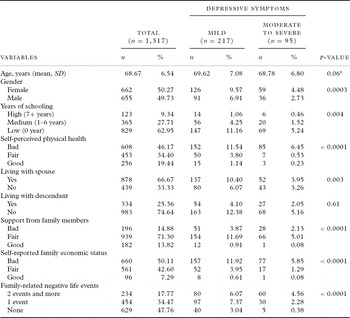
Demographics of the study participants are presented in Table 1. Their ages ranged from 60 to 92 years (mean = 68.67; SD = 6.54), and there were 655 males (49.73%) and 662 females (50.27%). With respect to level of education, 829 participants (62.95%) were illiterate, and less than 10% had completed seven years of school education or more. Almost half of the older adults (46.17%) reported bad self-perceived physical health.
Descriptive statistics for socio-demographic and family characteristics and associations with depressive symptoms of the older adults (n = 1,317)

* This p value is associated with ANOVA; all other p-values are associated with χ2 tests.
Characteristics of the participants’ family characteristics
Of the sample, more than half (66.67%) currently lived with their spouse. But only a quarter (25.36%) currently lived with their descendants (any of the following: son, daughter-in-law, daughter, son-in-law, and grandchildren). Half reported poor family economic status and less than 8% reported good family economic status. Most older adults (71.3%) had fair family support and almost 52% had experienced at least one family-related negative life event during the previous year.
Prevalence and correlates of depressive symptoms
Table 1 presents results of frequency and prevalence of mild depressive symptoms and moderate to severe depressive symptoms according to demographic characteristics, personal physical health status, and family characteristic variables. There were 312 older adults with depressive symptoms, giving an overall prevalence of depressive symptoms of 23.7 per 100 older adults (95% CI: 21.4–26.0), of whom 16.5% had mild depressive symptoms and 7.2% had moderate to severe depressive symptoms in this study. Associations between sample characteristics and depressive symptoms were assessed using Mantel-Haenszel χ2 tests and are displayed in Table 1. Almost all of the family characteristic variables (except living with a descendant), as well as gender, years of school education, and self-perceived physical health, were associated with depressive symptoms.
Univariable and multivariable logistic regression models to assess risk factors of depressive symptoms
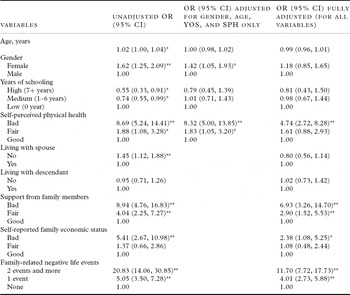
Table 2 displays the unadjusted and adjusted ORs and 95% CIs for mild and moderate to severe depressive symptoms in these older adults as a function of the measured independent variables. Results of the univariable logistic regression model suggest that all of the potential risk factors except living with a descendant were significantly associated with mild and moderate to severe depressive symptoms in this survey.
Unadjusted and adjusted associations between predictor variables and depressive symptoms among a sample of 1,317 older adults in rural Chinaa

a1 = No depressive symptoms; 2 = Mild depressive symptoms; 3 = Moderate to severe depressive symptoms.
*p < 0.05; **p < 0.01 (two-tailed test).
YOS = years of schooling; SPH = self-perceived physical health; OR = odds ratio.
In the multivariable model limited to gender, age, years of school education, and physical health status, being female had higher odds for mild and moderate to severe depressive symptoms than did being male (OR = 1.42, 95% CI: 1.05–1.93). However, when family characteristics were held equal, female gender was no longer significantly associated with mild and moderate to severe depressive symptoms (OR = 1.18, 95% CI: 0.85–1.65). Bad self-perceived physical health was associated with increased risks for mild and moderate to severe depressive symptoms in both models, with some change when family characteristics were held constant. Fair self-perceived physical health had higher odds for mild and moderate to severe depressive symptoms than did good self-perceived physical health (OR = 1.83, 95% CI: 1.05–3.20). However, when family characteristics were held equal, fair self-perceived physical health was no longer significantly associated with mild and moderate to severe depressive symptoms (OR = 1.61, 95% CI: 0.88–2.93). Bad or fair support from family was associated with higher odds for depressive symptoms when compared to good support from family. Any family-related negative life events (one event or two events and more) were associated with higher odds for depressive symptoms when compared to having no family-related negative life event. Bad self-reported family economic status was associated with increased risks for mild and moderate to severe depressive symptoms compared to good self-reported family economic status, but fair self-reported family economic status was not. Age, years of schooling, living with spouse, and living with a descendant were not associated with mild and moderate to severe depressive symptoms. Additionally, the ROC of the fully adjusted model is equal to 0.85, and the R 2 of the fully model is equal to 0.28, so the predictive efficiency of this model is adequate.
Discussion
This study showed that 62.95% of the rural older adults were illiterate, and that the proportion of older adults who had bad self-rated physical health and bad self-reported family economic status were 46.17% and 50.11%, respectively. Some 74.64% of the rural older adults did not dwell with a descendant, but 85.12% of the rural elderly had good or fair family support and care, so we may consider that although the traditional family structure was altered, most of the subjects received moderate family support and care.
This current study showed that the prevalence of depressive symptoms of older adults in this rural area of China was 23.69%, which is very close to the approximately 20% prevalence of depressive symptoms shown in some other studies in China (Zhao and Zhang, Reference Zhao and Zhang2001; Ji et al., Reference Ji, Sun, Geng and Kang2006; Xing et al., Reference Xing, Wu, Zhu, Sun, Tian and Li2006). However, it was much higher than that of some developed countries. For example, the prevalence of depressive symptoms of older adults (average age: 77.4 years) in the USA, older adults (55–85 years) in the Netherlands, and older adults (aged 75 and over) in the UK were 17.0%, 14.92%, and 7.7%, respectively (Beekman et al., Reference Beekman, Deeg, Tilburg, Smit and Hooijer1995; Osborn et al., Reference Osborn2003; Muramatsu et al., Reference Muramatsu, Yin and Hedeker2010). This difference was possibly due to differences between the participants in terms of age, education, and residence, or the fact that the prevalence of depressive symptoms in China was higher than those in other countries. Furthermore, variation in results may be partially explained by differences in designs and definitions of depressive symptoms. Nonetheless, the prevalence of depressive symptoms in rural older adults in China is clearly significant.
This study confirms that family-related life events, family support, family economic status, and self-perceived physical health status are all independently associated with depressive symptoms in older adults, as determined using the BDI-II. In the fully adjusted model, family-related negative life events was the most significant variable in predicting depressive symptoms, the second was support of family members, and family economic status was less important than support of family members. This suggests that, since the impact of family-related negative life events was the most important, interventions targeted at such events might be the most effective in preventing or counteracting depressive symptoms. Second, since under-diagnosis of depression is common (Nancy, Reference Nancy2007), it is very important to find an easily identifiable indicator. Compared with support of family members and family economic status, family-related negative life events could be more easily known and identified by community healthcare providers or social workers or volunteers, because of the interactive behavior and setting in rural China, such as houses being adjacent to each other, intertwining farmland belonging to different families, synchronization of agricultural labor, participation of whole village in marriage, funeral and other traditional festivals in rural China, and so on. Thus, family-related negative life events could be chosen as an easily identifiable indicator to find the key population likely to have depressive symptoms.
While living with a spouse was significantly associated with reduced risks for depressive symptoms in the univariable logistic regression model, this variable became insignificant in the fully adjusted model. Schum et al. (Reference Schum, Lyness and King2005) considered that older adults are at a specific developmental stage where they are encountering frequent losses and may be more prepared to cope effectively compared with younger individuals. For example, loss of a spouse may, for an older person, be more expected and in line with the later phases of life, possibly resulting in a relatively easier adjustment and acceptance (Vink et al., Reference Vink, Aartsen and Schoevers2008). However, Bruce et al. (Reference Bruce, Kim, Leaf and Jacobs1990) suggested that loss of a loved one was one of the most significant risk factors for depressive symptoms in late life.
In comparing China's traditional family with families in modern Western countries, a marked difference is that many Chinese older adults lived together with their children (including married adult children), which was due not only to socio-economic status, but also to the Chinese culture of filial piety, with the latter perhaps being more important. In rural China, the old parents usually live with their adult children, even if they are now married with children of their own. Since China's reform and opening up policy of 1979, the Chinese culture of filial piety has been influenced by Western culture. Young people's autonomy, independence, and self-awareness has been enhanced, which has led some to lose their sympathy and understanding for their parents, thus leading to weakening of filial piety (Lee and Xiao, Reference Lee and Xiao1998; Chow, Reference Chow2006). A national sample survey in 1987 of 36,755 urban and rural older adults aged 60 and over showed that the proportion of older adults living with their descendants (including son/daughter, or grandson/granddaughter) was 79.20% (Xiong, Reference Xiong1990). However, the current study showed that the proportion was only 25.36%. Although Ying and Zhang (Reference Ying and Zhang1995) considered that the benefits of multigenerational families in rural China may serve as a protective factor against mental health disorders, contrary to our expectation, living with a descendant does not appear to be associated with depressive symptoms in the current study, whether controlling for other variables or not.
According to both the unadjusted and the adjusted ORs for physical health status, we can consider that the physical health status of older adults was a risk factor for depressive symptoms, as the older adults who had bad self-perceived physical health were 4.74 times more likely to be depressed compared with those who had good self-perceived physical health. These findings are similar to the results of some previous research (Osborn et al., Reference Osborn2003). Although it was impossible to fix the cause and effect between physical health status and depressive symptoms in our study, strengthening primary healthcare in rural areas of China to improve the physical health of older adults may be a good way to decrease their prevalence of depressive symptoms.
With regard to the relationship between gender and depressive symptoms, many previous studies have indicated that the prevalence of depressive symptoms in older females was higher than that in older males. This was also confirmed in the current study with χ2 tests (Table 1). However, similar to the results reported by Osborn et al. (Reference Osborn2003) and Weyerer et al. (Reference Weyerer2008), there was no significant relationship between female gender and depressive symptoms after controlling for potential risk factors. Similar results also appeared with the effects of age and level of education: after controlling for the other potential risk factors, these associations were no longer significant.
In general, our study shows a strong correlation between being exposed to harmful family environments and depressive symptoms among the elderly. This has far-reaching implications for reducing depressive symptoms in the rural elderly. Efforts to address family risk factors, especially family-related negative life events, and to strengthen family cohesiveness must be given a higher priority than other interventions like promoting economic development, as this study provides evidence of the importance of family environments in reducing the prevalence of depressive symptoms.
Limitations
There are a few limitations of this study that must be noted. First, the overall response rate was 64.21%, indicating possible selection bias. Second, because our sample was confined to older adults in a county of a central province in China, it limited our ability to generalize findings to other populations of older adults in China or elsewhere. Third, the measures of support from family members relied entirely on self-report. As individuals’ perceptions of supportive behaviors may be biased during a depressive episode (Leskelä et al., Reference Leskelä, Melartin, Rytsälä, Sokero, Lestelä-Mielonen and Isometsä2008), the ratings of family support provided by participants may not accurately reflect the available level of support. Fourth, as with all cross-sectional studies, there is difficulty in establishing causality and temporality between independent and dependant variables. However, our findings tend to confirm much of the preceding research on depressive symptoms and family structure trends among the aging Chinese population in rural areas (Cheung et al., Reference Cheung, Cho, Lum, Tang and Yau1980).
Conflict of interest
None.
Description of authors' roles
Y. Gong undertook the data collection, participated in the data analysis, and contributed to revisions and final drafts of the paper. X. Wen undertook the data collection and performed many of the analyses and provided biostatistical expertise. C. Guan undertook the data collection and wrote the software for the analyses. Z. Wang helped to design the study and provided epidemiological investigation expertise. Y. Liang designed the study, undertook the literature searches and the data analyses, edited all author contributions, and had the main responsibility for revisions and drafts of the paper.
Acknowledgments
This study has been supported by grants from China Medical Board of New York (CMB). The authors are grateful for the technical support provided by Michael R. Phillips, Executive Director, WHO Collaborating Center for Research and Training in Suicide Prevention, and Beijing Suicide Research and Prevention Center, Beijing Hui Long Guan Hospital, Beijing, China. The authors are also thankful for survey place support provided by Dr. Xisheng Song, Director of Health Bureau of Tuanfeng City, China.
Ethical approval
The study was approved by the Ethics Committee of Public Health School, Tongji Medical College, Huazhong University of Science and Technology, Wuhan, China (No. [2006]02). Informed consent was obtained from all participants.