On March 5, 2012, the nonprofit Invisible Children posted a 30-minute film titled Kony 2012 on YouTube. The film was designed to raise awareness about the Lord’s Resistance Army (LRA)—a rebel group that was formed in Uganda in the mid-1990s—by making its leader, Joseph Kony, “famous.” The slick, high-energy film immediately went viral: it was viewed 66,000 times the first day and 9.6 million times by the end of the next day (Choney 2012); within six weeks, the film had been viewed more than 100 million times (Curtis and McCarthy 2012). The film’s message declared that viewers, many of them young people who had clicked through from Facebook, could help stop Kony and the LRA. Kony 2012 proclaimed that 2012 was the year that would see Joseph Kony brought to justice at the International Criminal Court and that the swift military support of the West could ensure this outcome.
As the film grew in popularity, particularly among secondary-school and university students, scholars and commentators were quick to point out its weaknesses, arguing that it was ahistorical and oversimplified and that it offered only tired stereotypes of Africa. This article explores these concerns by asking: How has Kony 2012 affected students’ perceptions of Africa? To answer this question, we drew on data from two sources: (1) a survey conducted at a liberal arts college, and (2) an experiment in which students who had not seen the film were asked to watch it and answer follow-up questions. We found that the film had dramatic albeit short-term effects on how students perceive Africa; however, the direction of this influence was not always expected. After viewing the film, students were not more likely to perceive Africa as underdeveloped; however, they did perceive the continent as conflict-ridden and expressed low confidence in Africans’ autonomy. We argue that the slick repackaging of entrenched stereotypes in Kony 2012 inadvertently reinforced these negative impressions, although the effects appear to have worn off quickly. This research suggests that whereas new media can educate young people about Africa, its use by activist groups may reinforce damaging stereotypes about the continent. In the following sections, we discuss the literature related to Kony 2012 and social media before describing our methods and findings.
RESPONSES TO KONY 2012
The Kony 2012 campaign received significant attention. After rapidly spreading across Facebook newsfeeds, it was quickly picked up by traditional media outlets in the United States as well as by less traditional outlets such as The Daily Show. The Kony 2012 campaign was remarkable because it was able to cut through the media “din” to grab the attention of young people and raise their concern about a distant problem in another continent. Waldorf attributes this feat to the campaign’s treatment of humanitarianism as “commodity activism” and the phenomenon of “clicktivism” (Waldorf Reference Waldorf2012, 469). Footnote 1 Karlin and Matthew (Reference Karlin and Matthew2012) argue that the nonprofit Invisible Children could launch such a wildly successful campaign only because the organization had been carefully preparing the grassroots groundwork for nearly a decade.
After a brief and largely positive reception, Kony 2012 came under sharp criticism by scholars and commentators. Soon after the film was released, novelist Teju Cole (2012) tweeted that Invisible Children was part of the “White Savior Industrial Complex,” suggesting that its theme portrayed foreigners as the rescuers of oppressed Africans. Mamdani (2012) pointed out that the film’s narrow storyline ignored the history of the Ugandan military’s highly suspect activities in northern Uganda and the environment that produced the LRA. In the months after Kony 2012 was released, additional analysis focused on its inaccurate representations of child soldiers (Drumbl Reference Drumbl2012) and lack of firsthand Ugandan perspectives (Hickman Reference Hickman2012). The film’s inaccurate portrayals and intense popularity led the Association of Concerned Africa Scholars (ACAS) outreach committee to develop online resources for teachers in all disciplines to address students’ questions (Brown et al Reference Brown, Metzler, Root and Vinck2012).
Given the popularity of Kony 2012 and the persistence of similarly misguided images in other outlets, it is important to ask what type of effects these images will have on the young people being targeted. The recent literature on social media suggests several possibilities.
Debates about the effectiveness of the movement also emerged. The film called for young people to “Cover the Night” on April 20, 2012, by affixing posters and stickers to city walls across the United States in an effort to make Joseph Kony famous. Yet, April 20 came and went without the massive public relations campaign for which Invisible Children hoped (Carroll 2012). Some commentators insisted that Kony 2012 had made a difference by drawing acclaim from members of the US Senate’s Armed Services Committee. The US government’s decision to fund Operation Observant Compass—an effort to support Central African Republic (CAR) troops in their campaign against the LRA—was also perceived as a success for Invisible Children (Hudson 2012). The CAR president has since been overthrown in a coup and the Ugandan military called off the search for Kony there due to instability (BBC 2013). Any military successes of the Kony 2012 movement were short lived. Unfortunately, the stereotypes implicit in Kony 2012 may continue to affect those who viewed the film. Although troubling, these stereotypes are not new; they reflect centuries-old perceptions of Africa.
MISPERCEIVING AFRICA
Negative and simplified understandings of African societies have persisted since the precolonial era and they thrive in the modern news media. News coverage of Africa in the United States and other Western countries is limited, and the stories that emerge tend to emphasize violence, chaos, and poverty (Donck Reference Donck1996; Kalyango Reference Kalyango2011; Wall Reference Wall2009). Other equally false—and damaging—perceptions are evident in school curricula (Marmer et al. Reference Marmer, Marmer and Sow2011; Myers Reference Myers2001; Osunde and Tlou Reference Osunde and Tlou1996) and popular culture (Kern-Foxworth Reference Kern-Foxworth1985; Magee Reference Magee2012). From childhood on, young people growing up in the West are subjected to these confused images of Africa. Disney’s animated classic The Lion King provides an excellent example: the movie presents its conveniently people-free storyline against a geographically confused mélange of backdrops including Victoria Falls, Mount Kilimanjaro, and the Sahara Desert—or is it the Kalahari?
It is clear that misrepresentations of Africa are persistent in the Global North. Yet, whereas charities’ pleas for funds have long relied on sensationalist images of starving African children, recent nonprofit efforts have been more subtle. Kony 2012 rejects the stodgy neocolonialism of the past and uses positive emotion to present a humanitarian call to arms that will depend on—and be owned by—attractive, capable, young Westerners. The “powerful spreadability” (Gregory Reference Gregory2012) of this film campaign suggests that other organizations and movements will want to emulate its features. Given the popularity of Kony 2012 and the persistence of similarly misguided images in other outlets, it is important to ask what type of effects these images will have on the young people being targeted. The recent literature on social media suggests several possibilities.
THE EFFECTS OF SOCIAL MEDIA
Social media has changed the way we share political information, and scholars have begun to explore the impact of the new media. Social media tools have increased the accessibility of information from governments (Zhang and Chan Reference Zhang and Chan2013, 74) and facilitated coordination and public discourse during crises (Makinen and Kuira Reference Makinen and Kuira2008; Slater et al. Reference Slater, Keiko and Kindstrand2012). Scholars have also considered the ability of these tools to gauge public opinion (Franch Reference Franch2013, 64) and some have argued for social media’s positive effect on political participation (Cogburn and Espinoza-Vasquez Reference Cogburn and Espinoza-Vasquez2011; Picazo-Vela et al. Reference Picazo-Vela, Gutierrez-Martinez and Luna-Reyes2012), even in authoritarian contexts (Abbott Reference Abbott2012, 352).
Whereas much of the political science work on social media suggests a portfolio of positive—if modest—effects on political engagement, some researchers caution against overstating the influence of these outlets. Governmental use of social media in Australia, for example, has promoted civic education but it has not proven an easy solution to common challenges, such as low political participation among youth (MacNamara et al. Reference MacNamara, Sakinofsky and Beattie2012, 636). Others point out that social media has had a coordinating role—but not an instigative one—in cases such as the Egyptian revolution (Barrons Reference Barrons2012) and that social media does little to promote sustained debate of political issues (Denskus and Esser Reference Denskus and Esser2013).
The response to the Kony 2012 film fits with what the literature suggests: that is, social media can expedite the delivery of information to a wide audience and prompt discussion of or engagement with a particular issue. Kony 2012 also disappeared rapidly from Facebook feeds, thereby illustrating the difficulty in using social media outlets to sustain debate over time. However, the literature does not provide a typology of social media nor does it suggest that some messages—or media—last longer than others. Our findings suggest that the effects of Kony 2012 on students’ perceptions of Africa fade over time, supporting Denskus and Esser’s (Reference Denskus and Esser2013) argument that although social media may spread messages, it does little to sustain discussion.
SURVEY DESIGN
The data used in this study are drawn from a survey of undergraduate students conducted at Whitworth University, a liberal arts institution in Spokane, Washington. The survey was conducted in late April 2012, after the Kony 2012 film had gone viral. All of the approximately 2,600 undergraduate students at Whitworth received an e-mail inviting them to complete an online, 26-question survey that included questions about their demographic characteristics, perceptions of the African continent, social media usage, and whether they had seen Kony 2012. The approximate response rate was 15% and we collected 407 usable surveys. Footnote 2
It is surprising that students’ perceptions of development in Africa did not change significantly after viewing the film. However, it had an effect on their perceptions of conflict in Africa. Given that conflict was the film’s focus, this result was expected; however, the distribution of results was unexpected.
MEASURING PERCEPTIONS OF AFRICA
To gauge the students’ perceptions of Africa, we presented them with a list of 10 general statements and asked: “How well do the following statements describe Africa and/or the people who live there?” Footnote 3 The statements measured three common stereotypes related to poverty, conflict, and African agency. We then created a scale to explore both the overall effect of demographic factors and the impact of Kony 2012 viewership on perceptions of Africa. The statements are as follows:
-
Statements about poverty:
-
(1) Most Africans are literate.
-
(2) Most Africans do not have enough to eat.
-
(3) Many African economies are growing very fast.
-
-
Statements about conflict:
-
(4) Most African countries are at war.
-
(5) Child soldiers are commonly used in Africa.
-
(6) Wars are more brutal in African countries than in other developing countries.
-
-
Statements about agency:
-
(7) It is difficult for most African countries to address conflict without the help of Western military power.
-
(8) Africans often need the help of the international community to address local problems, such as conflict and poverty.
-
(9) African countries have strong civil society sectors (e.g., nongovernmental organizations and churches).
-
(10) Famous people and American policy makers can stop conflict in Africa.
-
EXPERIMENT DESIGN
To determine the effects that the film had on students’ perceptions of Africa, we set up an experiment to measure their responses both before and after viewing the film. Of the 407 students who responded to the survey, 55% had already watched Kony 2012; 45% reported that they had not seen it. Footnote 4 We sent a second invitation to the 159 students who reported not watching the film and asked them to view it before completing an online follow-up survey, which included the same African perception questions Footnote 5 and a scale for the religiosity of respondents. Footnote 6 We received 35 usable responses from this follow-up survey. Footnote 7
Findings: Determining Which Factors Affected Perceptions of Africa
To determine which factors affected students’ perceptions of Africa, we conducted a regression using data from the pretest survey, in which a scale of the questions was the dependent variable. This regression suggests that watching Kony 2012 did not have a significant effect on students’ perceptions of Africa.
However, the regression does indicate that the students’ year in school is a strong positive indicator of their perceptions. The earlier the students were in their college career, the more likely they were to have negative perceptions of Africa. These perceptions became more positive as students progressed through college, suggesting that education works to counter the negative perceptions that many students initially have. We would expect older students to be more critical of sweeping generalizations, and this is supported by the regression.
OLS Regression Evaluating Indicators of Perceptions of Africa (Scale)

Note: ** = p < 0.01. Figures are not precise due to rounding.
The dependent variable is a scale measuring the respondents’ perceptions of Africa.
Ideology is also negatively correlated with perceptions of Africa. We see that the closer students aligned themselves with a liberal ideology, the more likely they were to view African countries and people in a positive light. Conversely, students who identified as conservative were more likely to have negative perceptions of the continent.
Although the results presented in this article demonstrate the negative effects that Kony 2012 had on students’ perceptions of Africa, they also suggest that the opposite could have been true: that is, new media could be used instead to inform, educate, and challenge stereotypes.
Although it is surprising that watching the film did not appear to have a significant impact on students’ perceptions of Africa, we suggest that this is the result of a fading effect. Students were surveyed up to six weeks after viewing the film, which allowed enough time for its effects to “wear off.” This finding is consistent with our experimental findings, described herein, that demonstrate the film’s strong initial effect. Students in the experiment were strongly affected by the film but those who had seen it several weeks earlier showed little response; this suggests that the film did not have permanent effects.
Findings: Experiment Shows Film Has Strong Immediate Effects on Perceptions of Africa
Although the initial survey did not reveal a relationship between Kony 2012 and students’ perceptions of Africa, using an experimental design allowed us to isolate the effects of the film. The experiment also reveals that the film has a strong initial impact on their perceptions. We find that watching the film appears to have an effect on perceptions of conflict in Africa and the agency of African people but no significant effect on their perception of development. Because these effects did not hold in the pretest population, we argue that the film had mixed effects: that is, it had a strong initial effect on students’ perceptions of Africa, which seem to fade over time.
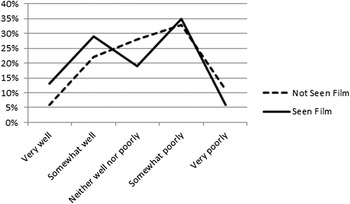
It is surprising that students’ perceptions of development in Africa did not change significantly after viewing the film. Footnote 8 However, it had an effect on their perceptions of conflict in Africa. Given that conflict was the film’s focus, this result was expected; however, the distribution of results was unexpected. We created a scale using responses to the perceptions of conflict statements and graphed students’ responses before and after watching the film. The responses suggest that watching the film had a polarizing effect on their perceptions. Before watching the film, most students rated the statements as representing Africa “somewhat poorly” (33%), although a significant portion chose “neither well nor poorly” (28%). After watching the film, 29% answered “somewhat well” and 35% answered “somewhat poorly,” whereas only 19% answered “neither well nor poorly,” which represents an 11% decrease in the middle category (see figure 1). The film appears to strengthen students’ perceptions and reduce their uncertainty about the statements.
Combined Responses to Questions about Conflict

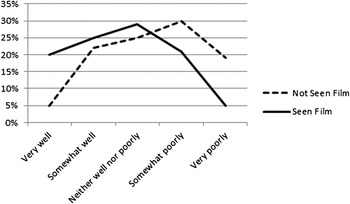
The most dramatic results of the experiment demonstrate an initial negative effect that Kony 2012 had on students’ perceptions of the agency of African people. These findings are especially interesting given the sympathetic nature of the film; the filmmakers almost certainly did not intend to portray Africans as lacking agency. Figure 2 illustrates the nearly complete reversal of students’ responses after viewing the film.
Combined Responses to Questions about Agency

We find extreme shifts at the ends of this scale: whereas only 5% of respondents thought the agency statements described Africa “very well” before viewing Kony 2012, a full 20% chose this option after watching it. A similar shift occurred at the other end of the scale: 19% chose “very poorly” before viewing, whereas a mere 5% chose this answer after viewing. A means test confirms that the difference between pretest and posttest responses is statistically significant: t(33) = -4.32, p < 0.01.
Although the results from the experiment are interesting, several factors may limit the generalizability of these findings. First, given the small sample size for the experimental portion of our research, these findings should be treated as preliminary. Second, there were two instances in which there were systematic differences between those students who were part of the posttest group and those who were not. Specifically, the former group is more religious than the latter group. However, if we divide the religiosity scale into its separate parts, there are no significant differences between the two groups. Although this is certainly an important issue, religiosity is not significantly related to students’ perceptions about Africa.
Third, there is a statistically significant difference between those who were in the posttest group and those who were not with regard to their year in school. Those in the posttest group tend to be more advanced in school relative to those not in that group. However, the mean values for both groups place each somewhere between sophomore and junior status. Consequently, although the difference in class year is worth noting it is unlikely to have dramatically altered the previously discussed relationships. Future studies could correct for these issues by increasing the sample size of the posttest group.
Fourth, it appears from the pretest results that the effect of the film was mitigated over time. If that is the case, it is important to more fully examine whether the effects wear off or whether there are significant counteracting forces that minimized the ability of the Kony 2012 movement to sell its vision of the LRA.
CONCLUSION
One of the clear goals of the Kony 2012 campaign was to mobilize and empower young people, but it had the—likely unintended—effect of portraying African states as weak and African people as unable to address problems within their own countries. The film’s critics were concerned that it promoted a simplified picture of the conflict, thereby undermining African agency. The evidence presented in this article supports this concern by showing that young viewers did adopt these negative perceptions of African agency. However, given the initial pretest results, which indicate no statistically significant difference between those who had and had not watched the film, it appears that the effects may dissipate over time. These results are at once troubling and hopeful: they suggest that inaccurate portrayals of Africa may not have an enduring effect on an individual’s understanding of the continent, but that they can have a dramatic effect in the short term.
It is important to continue asking how young people are influenced by the types of images portrayed in Kony 2012, perhaps especially because of the movement’s extreme—if short-lived—popularity. The success of Invisible Children with this medium may prompt other non-governmental organizations or movements to adopt similar methods. More work is also needed to explore the cumulative effects of exposure to misrepresentations of Africa via multiple outlets. Finally, it seems as if the student viewers—either initially or eventually—resisted these misconceptions or provided answers that indicated that they recognized the agency of Africans to address problems in their own countries. Future work should consider the factors that help students to resist and even challenge these misconceptions. Although the results presented in this article demonstrate the negative effects that Kony 2012 had on students’ perceptions of Africa, they also suggest that the opposite could have been true: that is, new media could be used instead to inform, educate, and challenge stereotypes.
Megan Hershey is an assistant professor in the department of political science at Whitworth University in Spokane, Washington. She can be reached at mhershey@whitworth.edu.
Michael Artime is a senior lecturer in the extended learning division at St. Martin’s University in Lacey, Washington. He can be reached at martime@stmartin.edu.