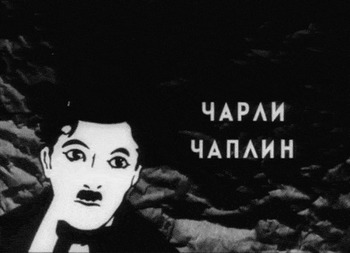
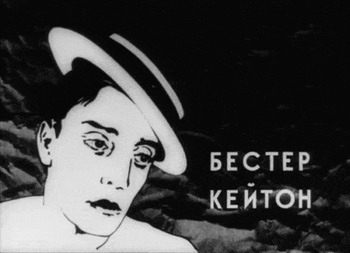
On the evening of 2 August 1934, a group of prominent Soviet men gathered at a dacha outside Moscow to screen two films, the first of which was a new Soviet production titled Jolly Fellows (Vesyolïe rebyata).Footnote 1 This film marked the debut collaboration of director Grigory Aleksandrov, who had been Sergey Eisenstein's long-time assistant director, and the composer Isaak Dunayevsky, who had already had a prolific career as a composer of revues and popular songs. As the opening credits began to roll, the titles on the screen informed the viewers that they would be watching a ‘musical comedy’.Footnote 2 For many, if not all of them, this would have been their first exposure to this new genre. These titles were soon followed by animations of Charlie Chaplin, Harold Lloyd, and Buster Keaton, presented as if they would be starring in the film (see Figures 1a–c).
Charli Chaplin (Charlie Chaplin).

Garold Lloyd (Harold Lloyd).

Bester Keyton (Buster Keaton).

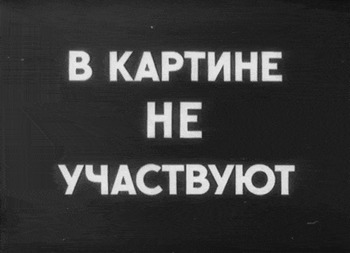
Given the immense popularity of the films of these American stars in Soviet cinemas in the 1920s, this probably came as no surprise to the viewers, though their supposed appearance in a new Soviet film may have raised some eyebrows.Footnote 3 But what came next revealed the ruse: the following title indicated that these three American stars would, in fact, ‘NOT TAKE PART IN THE FILM’ (see Figure 2).Footnote 4
‘Will not take part in the film’.

Instead, pictures of the Soviet actors playing in the film were shown. These included the already immensely popular jazzman Leonid Utyosov, Lyubov Orlova (here in her breakout role), and Mariya Strelkova. This substitution was a gimmick, to be sure, but one with a specific purpose: since American comedies – especially ones starring Chaplin, Lloyd, and Keaton – had been widely popular in the Soviet Union throughout the 1920s, Aleksandrov knew that audiences would not only be familiar with them, but also trust that he would follow a proven formula for entertainment. This time, however, the stars and the film would be Soviet.Footnote 5
But there was something else that separated this film from those of Chaplin, Lloyd, and Keaton in the 1920s: sound. And this is where Dunayevsky's role became so important. The music he wrote to accompany the opening images described above sent a message similar to the substitution of Chaplin, Lloyd, and Keaton with Soviet actors. Dunayevsky's ‘Overture’ is a rousing, driving jazz number complete with the typical instrumentation of early 1930s (Soviet) jazz: saxophones, trumpets, trombones, violins, and a rhythm section consisting of piano, banjo, tuba, and drum kit. The music is performed here, as throughout the entire film, by Utyosov's own Teadzhaz (Theatrical Jazz) band, which had become famous as much for its playing as for its onstage antics and showmanship. In this, Utyosov was heavily influenced by the American bandleader Ted Lewis, whom he had heard live on a European tour in 1927.Footnote 6
As with the invocation of the American film stars, American popular music, it seems, was to be the signature sound of the first Soviet musical comedy, though as interpreted and adapted by Dunayevsky and Utyosov. Indeed, as we will see, jazz and jazz-derived popular music play an integral role in determining the film's very style and in communicating its central message: the film tells the story of how an innocent, naïve, and classically trained shepherd-musician from the provinces, Kostya Potyokhin (Utyosov), ‘accidentally’ becomes the leader of a Moscow jazz ensemble with which, in the film's concluding scenes, he makes a triumphant premiere at the Bolshoy Theatre. Along the way there are, of course, endless jokes, gags, and twists à la Chaplin, Lloyd, and Keaton.
The film was a wild success (at least with audiences), the first of three consecutive blockbusters for Aleksandrov and Dunayevsky.Footnote 7 The American sources for the style and music of the film surely had something to do with this, but I argue that it was the way in which these were adapted to the local conditions, values, and needs of the Soviet mass viewer that makes this film so unique in the history of Soviet music and cinema. Although its makers were clearly influenced by American models, Jolly Fellows is a Soviet film – as Aleksandrov goes to lengths to demonstrate in the opening sequence – intended for the new Soviet mass audience; an audience that, according to Boris Shumyatsky (the head of the Soviet film industry at the time), needed to be entertained as much as enlightened.Footnote 8 Jolly Fellows deals with this idea head on. At a time when the Soviet Union was in the process of defining itself and its place in the modern world – when Socialist Realism had not yet been officially defined and when there were great debates about the purpose and direction of all areas of cultural production – Jolly Fellows can be understood as an attempt to refract one aspect of this experience of Soviet modernization, namely the place and purpose of music and entertainment in society, using American cinematic and musical models as the means to do so. What makes this process particularly interesting from a music-historical perspective is that the music is the key mechanism that enables this refraction, doing so on the levels of both form and content. In terms of content, the film is, as mentioned, a tale about music and musicians; the film's theme song, ‘March of the Jolly Fellow’, concerns the importance of music and fun in achieving a full life. In terms of form, the music functions largely according to Rick Altman's definition of the role of music in the film musical: in reversing the traditional audio-visual hierarchy, such that the music ‘motivates’ the images instead of vice versa, utopian spaces are opened up in which Aleksandrov and Dunayevsky can transmit the film's ideological message.Footnote 9 And even in sequences in which this definition is not strictly met, it is nevertheless clear that the world in which the main characters operate is a fully and ‘naturally’ musical one: either Kostya's actions are ‘unconsciously’ guided by (non-diegetic) music or his actions ‘unconsciously’ guide the music of his (diegetic) world. In either case, the formal interruptions that constitute the musical sequences hinge on an unrealistic relationship between the images and the music. Thus, the mechanism by which the message is most centrally communicated relies on the form of the American (i.e., modern) film musical while also using the modern technologies of sound synchronization and playback.
But not everyone agreed that the film had achieved the desired result. The film sparked an enormous controversy, which turned, it seemed, on one essential question: did Soviet viewers need entertaining comedies or ideological enlightenment? Several prominent and powerful figures came down on the side of entertainment, feeling the film was an important contribution to Soviet culture because of the optimism it engendered. Despite the influence of these figures, though, critical protest against the film was strong. While a prolonged debate in the national press was eventually won in favour of the film, it was a case of winning the battle, but losing the war. Aleksandrov and Dunayevsky's next film would have to be different, which indeed it was.Footnote 10 However, even though they eventually adapted the content of their later films more towards the official line, the style of the later films would not have been possible without Jolly Fellows. If we examine the players and their positions in the debates surrounding Jolly Fellows, however, it becomes clear that more was at stake than deciding the value of a single film. Despite the music's central role in both the content and the form of the film, for example, it ultimately played a secondary role in the controversy, except for one key moment, which it also survived relatively unscathed. Instead, music became a tool used to fight ideological battles remaining after the dissolution of proletarian arts organizations in April 1932. The apparent Americanism of the musical and cinematic style was thus outweighed by concerns for eliminating vestiges of radical proletarian elements among the cultural elite, particularly writers. By outlining the vicissitudes of the film's reception and the ambiguity of music in this process, this article thus contributes to a widening literature that seeks to nuance our understanding of Soviet (film) music of the 1930s.Footnote 11
In what follows, I first briefly sketch the context in which Aleksandrov and Dunayevsky created Jolly Fellows, highlighting particularly how notions of modernity, often drawn specifically from American models, guided many artists in both cinema and music. I then turn to the film itself to demonstrate how, building on those American models, music functions as both form and content as a means to transmit a message particular to Soviet audiences in the early 1930s. In the third and final portion of the article, I discuss the debates that surrounded Jolly Fellows and its music, some of which began even before the film was officially released, to illustrate that despite the music's central and Americanized role in the film, Dunayevsky's jazz-inspired mass songs, and, by extension, this style of popular music in general, nevertheless retained an ambiguous place in Soviet cultural discourses of the early 1930s.
Early Stalinist popular film and music
Despite what it actually achieved in reality, Sheila Fitzpatrick reminds us that the Soviet regime was one:
that had apparently successfully associated itself with progress in the minds of many of its citizens. If the Soviet worldview was not literally the only one available to Russians in the 1930s, it was the only available worldview linked with modernity. Whether or not the Soviet regime had broad legitimacy with the population, its modernizing (civilizing) mission appears to have done so.Footnote 12
A central component of this modernist Weltanschauung was a culture that reflected and refracted a particularly Soviet experience of modernity. When it came to disseminating this worldview, what better medium to turn to than cinema, that most modern, controllable, reproducible, and ‘important’ of art forms?Footnote 13 And what better way for audiences to internalize the message of a film than to leave the theatre humming the theme song in which this message is encapsulated?
It is no coincidence that in developing early popular music and cinema, Soviet artists turned to the United States for inspiration, for even though its cultural cache fluctuated, America remained (for better or worse) a source for the latest styles and techniques.Footnote 14 Although there were many types of urban popular music in the 1920s, American jazz – or what was considered to be jazz (of which more below) – was by far the most prevalent and fashionable. Valentin Parnakh, the man who brought jazz to Russia in 1922, tried to market it, for example, by arguing that it was ‘a distillation of modern man's movements and manners’.Footnote 15 Frederick Starr notes that, like so many other Western imports during this period, jazz exemplified the ‘modernism [that was] in the air’.Footnote 16 Soviet audiences finally got a taste of the ‘real thing’ with the visit of the first American jazz groups in the late winter of 1926: Sam Wooding's Chocolate Kiddies and Benny Peyton's Jazz Kings. The conductor Nikolay Malko described the arrival of Peyton's group as a ‘completely new phenomenon’, concluding that ‘it should be permissible to point out the social significance of having such an ensemble in our country, where striving for quality becomes ever more important every minute’.Footnote 17
These groups made a big splash, but the hard-line leftists saw no place for what they perceived as foreign trash. Writing in 1930 after jazz had become widespread, Lev Lebedinsky, a leader of the Russian Association of Proletarian Musicians (RAPM), remarked that:
The foxtrot represents mechanical movement only, and uses every available means to reveal this in its entirety, to expose all the complexity and monstrous force of this movement, hypnotising the listener or dancer, drawing their bodies, movements, ears, consciousness and will into the lifeless rhythm of this machine-like ticking. Clearly, this is just what modern monopoly capitalism needs: the transformation of all humanity, and of the working class in particular, into slaves of the machine and of capitalist society, reducing them to a semi-animal state, dull-witted, obedient, devoid of will and thoughts.Footnote 18
Though Lebedinsky's thoughts on the effects of jazz ran counter to those of Parnakh and Malko, he nevertheless also tied it fundamentally to a modernizing impulse. What thus mattered most to the polemicists on either side of this debate was not what the music actually sounded like, but what they believed it represented, namely an embodiment, whether positive or negative, of (American) modernism. Aleksandrov and Dunayevsky's invocation of jazz, then, regardless of its particular sound or style, was sure to be familiar to many moviegoers and sure to cause a reaction (and that it did, as we will see). But the more important point here is that it also marked their film as specifically modern. As Neil Edmunds has written about the origins of Socialist Realism in music, ‘the division between the various factions which characterized Soviet musical life was not as clear-cut as previously thought’, but what united them all was ‘the desire to take music to the masses’ and regardless of what eventually came out of this, from an aesthetic point of view it was ‘the cultural product of a country that always portrayed itself as ultramodern’.Footnote 19 It is no coincidence that composers of ‘serious’ music, especially those with modernizing impulses, such as Dmitry Shostakovich, thus also invoked jazz in some of their works of this period. Gerard McBurney has argued, for instance, that Shostakovich turned in the early 1930s to ‘the hybrid jazz-and-klezmer that was the popular staple of the time, chastushki (Russian comic songs), mass songs, pioneer songs, cheap waltzes and marches, and those syrupy tunes that every Russian knows are only sung by drunks’ because they ‘delivered into [his] hands possibilities, still modernist and of their time, but different from those offered by the experimental, non-repeating, acoustically blurred material he was more often using earlier. In short, he was becoming more interested in another kind of modernism.’Footnote 20
McBurney's description of Shostakovich's influences highlights the importance of keeping in mind that in the Soviet Union in the 1920s and 1930s, the term ‘jazz’ (transliterated as dzhaz) was, as in America and western Europe in the same period, ‘a fluid, unstable construct’, a catchall for syncopated music with various purposes, such as for dancing, accompaniment for revues or other shows at music halls, or, significantly, as entertainment in movie theatre foyers.Footnote 21 Like contemporary Soviet practice, my use of jazz thus covers a wide range of styles and genres, from ragtime to foxtrot to Dixieland mixed with Russian influences from Klezmer, Gypsy melodies, military marches, and folk music. As one writer has noted about Utyosov's style for instance, ‘the strains of an Odessa Jewish wedding were never far away’.Footnote 22 In the end, more important than any measurable stylistic features was, as we have seen, what the idea of jazz represented to Russian musicians, critics, and audiences.Footnote 23 Though referring to Germany in the 1920s, J. Bradford Robinson's description of jazz is equally appropriate to describe the situation in the Soviet Union in the 1920s: ‘jazz . . . was an all-embracing cultural label attached to any music from the American side of the Atlantic, or indeed to anything new and exciting’.Footnote 24 For some this was a welcome benefit, for others it was a problem, but nobody could deny its power.
In the 1920s and early 1930s, America also became the benchmark for Soviet cinema, as we have already seen in Aleksandrov's references to Keaton, Lloyd, and Chaplin.Footnote 25 One of the earliest to acknowledge the success of Hollywood style was the director Lev Kuleshov, who in his 1922 article ‘Americanism’ sought to defend the American influence in contemporary filmmaking by noting how it reflected modern society.Footnote 26 Unlike psychological, slow-moving contemporary Russian films, Kuleshov writes that ‘the success of American films lies in their maximum degree of cinema specificity, in the maximum amount of movement, in primitive heroism, in an organic link with contemporary life’.Footnote 27 Similarly, in 1927, the critic Adrian Piotrovsky praised ‘American comedy’, suggesting that in order to overcome the lack of a true Soviet comedy genre Soviet filmmakers ‘might construct a brilliant genre of political eccentro-comedy, firmly based on the technical achievements of American comedy’.Footnote 28 The members of the art collective FEKS (the Factory of the Eccentric Actor) likewise thought that the ‘salvation’ of Soviet music, theatre, cinema, and other arts lay in an ‘Americanization’ of all forms of art through the incorporation of ‘low’ American popular entertainment genres and styles.Footnote 29
Sergey Eisenstein also owed a great debt to the practices of Hollywood, as his early essays and films demonstrate.Footnote 30 But unlike the members of FEKS, whose vision of America was largely imagined (though no less valuable because of this), Eisenstein eventually did travel to the United States, spending the better part of 1930 in Hollywood.Footnote 31 One of his companions on this trip was his assistant director at the time, Aleksandrov. In Hollywood they became friendly with Chaplin, visited a number of studios, and took in all they could. Upon their return to Russia, Eisenstein and Aleksandrov reported to Shumyatsky that they were thinking of making a comedy film, but nothing came of this idea. Instead, Shumyatsky, an ardent supporter of popular music and cinema, asked whether Aleksandrov would consider making a filmed version of Utyosov and Dunayevsky's popular St Petersburg stage revue, Muzïkalnïy magazin (The Music Store).Footnote 32 Aleksandrov agreed and the resulting film changed the course not only of his and Dunayevsky's careers, but also of Soviet popular cinema and music.
We could look to the immense popularity of musicians such as Utyosov and Aleksandr Tsfasman to see that when it came to music the masses welcomed these influences too.Footnote 33 And Denise Youngblood has shown that when it came to cinema, the masses preferred foreign imports as well, which made up the majority of box office receipts in the 1920s.Footnote 34 This ‘cult’ of foreign films in early Soviet Russia is perhaps best encapsulated in the highly anticipated visit of Douglas Fairbanks and Mary Pickford to Moscow in July 1926. Their trip had been covered in the cinema press for weeks in advance, culminating with a four-inch headline upon arrival. They were received like royalty and had their every move tracked in the press.Footnote 35
This brief sketch demonstrates that American styles and practices, especially as embodiments of modernity, were strong influences on the creators of Soviet popular music and cinema in the 1920s and early 1930s and that Soviet audiences came to know and expect them. But when, during the Cultural Revolution, there came a clampdown from above against such foreign influences, artists did not want to abandon what had been so popular with audiences, so they had to adapt. Jolly Fellows represents one such adaptation; one in which Aleksandrov and Dunayevsky self-consciously, as we have seen, recognized their debt to American influences and made use of them, cinematically, musically, and technologically, to provide a new type of entertainment for Soviet audiences that reflected their own modernity.
Blurred lines: music as form and content in Jolly Fellows
Let us return to the screening with which we began: following the American-inspired credits, in the first scene of the film proper the viewers that night were introduced to the style that pervades the film, namely that of the film musical. In this opening scene, Kostya and a band of folk musicians march through a pastoral landscape as they perform what will become the film's theme song, ‘March of the Jolly Fellows’ (Example 1).Footnote 36
‘March of the Jolly Fellows’, piano reduction, bb. 1–21.

As they begin to play, we hear what we see on screen: an orchestra of folk instruments. But as the scene progresses, the folk orchestra is taken over by an overdubbed jazz band. Furthermore, Kostya not only sings the ‘March of the Jolly Fellows’, but also ‘plays’ various objects around him like musical instruments: at first a wooden bridge, then a fence, and finally some pots. Each of these is, ‘coincidentally’, pitched to the key of the march. Other elements in the scene are also guided by his song: a flock of sheep, a group of women, and a pair of blacksmiths bleat, sing, and pound their hammers perfectly in time and in tune to the music. Kostya's natural world, in other words, is inherently musical. This is an example of what Rick Altman calls the ‘audio dissolve’, the process by which the traditional cinematic audio-visual hierarchy is reversed: the non-diegetic music of the march soon becomes the guiding force in the diegesis and all elements of it (including the sheep) are subordinated to it.Footnote 37 In other words, instead of being accompanied by music, the image track is now ‘caused’ by the music.
The text, by the poet Vasily Lebedev-Kumach, also outlines the goal of the film, which was to offer simple joy and fun:

These words underline the optimistic and entertaining spectacle that Shumyatsky, Aleksandrov, and Dunayevsky felt Soviet audiences needed at the time. Overt Soviet ideological content is all but absent from the film; only the bourgeois woman whom Kostya at first seeks to impress, but whose maid he eventually falls in love with, represents any sort of socialist class critique. This attitude – to focus on fun entertainment rather than obvious ideological enlightenment – had been suggested and most strongly encouraged by Shumyatsky, the head (since 1933) of the Chief Directorate of the Film and Photo Industry (GUKF) and an ardent supporter of entertainment cinema and popular music.Footnote 39 Shumyatsky stated this view most clearly in a discussion about Jolly Fellows in his 1935 book, A Cinema of the Millions: ‘the victorious class wants to laugh joyfully. That is its right, and Soviet cinema must provide the viewer with this joyful Soviet laughter.’Footnote 40 One of the central means by which this was achieved within the film itself and later disseminated to audiences was via Dunayevsky's music, an amalgam of styles and influences that ultimately constituted an entirely new genre: the Soviet mass song.
There are further instances of such audio dissolves, as when Anyuta, a housekeeper played by Orlova, sings while setting a table and when Kostya sings of his unrequited love for Yelena, Anyuta's bourgeois employer. In the former case, the content of Anyuta's song text, as is typical in a film musical, reveals and determines the deeper content of Anyuta's character: we learn that she yearns for something better, namely for a man (i.e., Kostya) who will bring her the happiness she seeks.Footnote 41 She sings along to the accompaniment of a non-diegetic orchestra that had begun earlier in the scene. When Anyuta ‘hears’ the music, it suddenly ‘takes over’ the image track, as did the ‘March of the Jolly Fellows’ in the opening scene, such that the rhythm of the music determines the rhythm of Anyuta's work; indeed, she sets the plates on the dinner table with every downbeat of the waltz rhythm. According to Altman, in such
‘make-believe’ modes . . . an individual gains the right to ‘play out’ personal fantasies without submitting to the judgments normally associated with conscious behavior. The character can say and do what he/she pleases and yet in the eyes of his/her psychic censor it is as if nothing had either been said or done. Like a child playing ‘dress-up’ – like the spectator watching the film – a character can try on a role without actually assuming it.Footnote 42
In other words, through the reversal of the sound-image hierarchy in this scene, a space is opened up in which Anyuta – and, by extension, the viewer – is free to dream about a more perfect future.
Unfortunately, we soon discover that Kostya has fallen for Yelena, and so Anyuta's love must for now remain unrequited. But Yelena wants nothing to do with Kostya, so his love too remains unreciprocated. To steel himself, Kostya rests on a tree branch and begins to sing to himself.Footnote 43 Accompanied yet again by off-screen music, he expresses his thanks for at least being able to love, even if it is not returned, thereby leaving open the possibility that things could still go his way later (which they of course do). As with Anyuta's song, we now bear witness to Kostya's innermost desires in a ‘safe’ and utopian space, set off from reality by the narrative ‘interruption’ of the musical number. And because these thoughts are transmitted via song, they are much more likely to sink in with audience members (which they did, as publication statistics of the film's songs bear out). Most importantly, though, is that both the space in which this message about the importance of love is transmitted and the means by which it is done so are mediated by music. Yet even at this ostensibly heart-wrenching moment we are quickly reminded that this is a musical comedy. Just before Kostya finishes, in the final beat before the song cadences, the branch on which he is sitting breaks, sending him plummeting to the ground, adding insult to injury (or, to be more precise, injury to insult). It seems that the all-important musicality of Kostya's world has a sense of irony too. For our purposes, what is crucial in both of these cases is that in the moments in which we learn of the main characters’ true, deepest needs and desires – both tied to dreaming of a better future – the audio-visual hierarchy is reversed, and music dictates the rhythms of the ‘real’ world and the form of these scenes.
Even in other sequences where there is no strict Altmanian ‘audio dissolve’, the relationship between Kostya and his surroundings is so fundamentally musical that the linear narrative is easily suspended in favour of non-linear interruptions of (musical) spectacle, the essential defining feature of the film musical.Footnote 44 For example, after the gramophone (i.e., ‘unnatural’ recorded music) has broken at a dinner party to which Kostya was mistakenly invited, he begins to play the ‘March of the Jolly Fellows’ on his svirel (a folk recorder).Footnote 45 But because his music making is tied so closely to the ‘natural’ world, his playing rouses his herd of animals, which – in magnificently hilarious fashion – invades the dinner party, eats all the food, drinks all the liquor, and destroys not only the villa, but also Kostya's chances with Yelena. All of this is perfectly choreographed to a gallop by Dunayevsky in the style of Johann Strauss, Jr, complete with a ‘drunken’ B section.Footnote 46 Though there is no strict reversal of the audio-visual hierarchy here, yet another narrative disruption is ‘caused’ by the musicality inherent in Kostya and his world. The destruction that ensues can also be understood as a sign that trying to impress Yelena, the ‘wrong’ woman, can only lead to bad things.
Similarly, once Kostya has made it to Moscow, he finds himself, in good slapstick fashion, in a music hall, in a tuxedo, standing in front of a massive orchestra (including eight white grand pianos, twenty white harps, sixteen glitter-speckled double basses, and eight tubas) poised to begin a performance of Liszt's Hungarian Rhapsody No. 2.Footnote 47 But Kostya is far more interested in the fact that Yelena is in the audience, and so he starts to gesticulate in an effort to get her attention and to adjust his (conveniently) malfunctioning tuxedo. Each of his movements, however, is taken by the orchestra as a cue, resulting not in chaotic cacophony, as might be expected, but, in the words of one audience member, in an ‘original interpretation’ of the rhapsody. One woman weeps uncontrollably at the beauty of the music and Kostya is unanimously cheered at the conclusion (until the music hall security guard comes to take him away for impersonating the conductor who was supposed to lead the performance). The formal exposition of another musical number is thus again determined by Kostya's ‘natural’ (and in this case unintentional) musicality. And, to boot, it is as a result of this ‘successful’ performance that Kostya is invited to join the jazz ensemble he will eventually lead to the Bolshoy.
Finally, in a later scene, this new jazz ensemble, now named ‘Friendship’, is rehearsing in preparation for its grand Bolshoy debut.Footnote 48 The ensemble's name becomes rather ironic, though, when the musicians suddenly, and violently, disagree over how to play a certain phrase. In a very carefully synchronized sequence, the rehearsal derails into a massive melee, in which the musicians attack each other with their instruments in all possible manners. Each blow is precisely mickey-moused in the soundtrack by the appropriate instrument and (of course) fits perfectly into the melody and rhythm of the tune they had been rehearsing, which several musicians somehow manage to continue playing. Significantly, Kostya is not present during all of this. He had left the room earlier in the scene to investigate a strange noise coming from next door. The message is clear though: only Kostya's presence can ensure that ‘whoever goes through life with a song, will never go astray’.
Unlike the scenes examined earlier, in the three scenes just discussed music does not ‘take over’ the images in a strict Altmanian sense. We are instead well aware of the source of the music, even if the performances that ensue are in no way realistic. The important point, though, is that in each case the formal exposition of the sequence is in some way determined by Kostya's inherently musical relationship with the world around him. Even if the hierarchy between the music and images is not fully reversed here, its ‘naturalness’ is certainly called into question and it nevertheless functions as the motivational formal device in these interruptions to the narrative.
The relationship between the musical form and content of Jolly Fellows comes to fruition in the film's final scene.Footnote 49 After Kostya has finally won Anyuta's love, the focus of the scene shifts to the climactic performance of the ‘March of the Jolly Fellows’, which begins with Kostya leading his band in a jazz rendition of it. But the march is not limiting; indeed, its very purpose is to spread its message throughout the ‘countryside’ and the ‘big cities’. And so we soon hear renditions by a brass band and then by a symphony orchestra. The addition of these musical groups is important, for it underscores not only that ‘jolly’ music can come in many forms, but that it also projects an encompassing fusion of cultural forms under a single idea. As Rimgaila Salys has written, in this scene:
Kostia's folksy march is no longer marginal; it has travelled from the periphery to take its place in the sacred space of the cultural centre as mass song. He himself has moved from studying Beethoven on a provincial kolkhoz to directing a jazz orchestra in Moscow. Both popular genres have established themselves on equal footing with the classical forms residing at the Bol'shoi Theatre.Footnote 50
Salys's commentary underlines how the conditions of Kostya's world have fundamentally changed by this final scene: through music, not only has the shepherd found his true love, but also he and his ‘flock’ (Anyuta, his band, the audience in the Bolshoy, and we, the film viewers) have become stars at the Bolshoy and have learned to ‘sing and laugh like children’. The conflation of the ideal and the real is thus complete. For this reason, the audio and visual registers that were incongruous in the opening scene of the film now match: we see the instruments we hear. And while this is clearly a diegetic performance, it is nevertheless a spectacle that interrupts the narrative. As Altman reminds us, in such moments ‘the characters break out of their normal world into a realm of performance and art, a world where stylization and rhythm provide a sense of community and beauty absent from the real world’.Footnote 51 This is, perhaps, the clearest formulation of the film's ideological message.
As in the opening scene, the visual style and (modern) technology once again work hand in hand with the music to emphasize this sense of community. At one point during the performance, the camera points outward from the stage, showing Kostya and Anyuta from behind, conducting the audience, urging them to pick up the message of the march. Even more striking is the final shot of the film: the camera now shows Kostya and Anyuta from the front, singing to ‘us’, the film viewers, in direct address. The camera then pans backward in a long trick shot that first reveals the whole mass of performers on stage, then the audience, then the lobby of the theatre, and finally, having panned backward out through a window, the entire theatre itself. The symbolic message, of course, is that the march has now become universal and we, the viewers, are to take it up in our own daily lives. Like the post-synchronization techniques required to make all the aforementioned musical numbers function as they do, this final shot equally embodies the film's reliance on modern film technique and film musical style.
In the end, Shumyatsky, Aleksandrov, and Dunayevsky sought to create a new genre of Soviet cinema, one that could stand alongside the grand traditions of the Soviet avant-garde of the 1920s, but at the same time fill a genuine societal need, namely the desire for popular cinematic and musical entertainment, based on modern American models such as Chaplin, Keaton, Lloyd, Peyton, and Wooding, to name only the most directly relevant to Jolly Fellows. And they achieved this, I suggest, by making music not only the subject of what they wished to communicate, but also the formal means of doing so.
‘Thieves at work!’: the reception of Jolly Fellows and its music
Returning once again to the initial screening of Jolly Fellows, it should also be pointed out that the ‘prominent’ Soviet figures in attendance were more than incidental bureaucrats: the host was Maksim Gorky and the audience consisted of the members of the organizing committee for the upcoming Writers’ Congress. A detailed record of the evening, kept by Konstantin Yukov for his boss Shumyatsky, reported that there was general agreement that the film was ‘jolly’, but Gorky specifically had higher praise: ‘a talented, very talented picture, boldly made, one watches it happily and with great interest’.Footnote 52 In response to Gorky's compliment, the writer and party functionary Aleksey Stetsky suggested that the scene in which Kostya mistakenly conducts the music hall orchestra should be condensed. When pushed by Gorky, who found the scene ‘jolly and funny’, to explain why, Valery Kirpotin (a writer and Gorky's secretary) ‘threw back the response that this is true Americanism’.Footnote 53 Gorky quickly retorted that ‘yes, it is Americanism; however, it is our Soviet Americanism. The Americans will never dare to do such a, I would say, complete “hooliganesque” (khuligansky) series of episodes like we have in this film. Here I see true Russian boldness on a large scale.’Footnote 54 The conversation continued with a suggestion from the party functionary Pavel Yudin that ‘the film could have a harmful impact, because all Soviet filmmaking could go down the path of dumbing down cinema’. To this Gorky replied that in order to avoid the boredom and inanity of much serious Soviet cinema, bold, funny, and entertaining films like Jolly Fellows were very necessary. That a figure of Gorky's stature so strongly defended this film was no small victory for Aleksandrov and the rest of the production team. But what makes Gorky's comments about the film truly surprising is the apparent volte-face in his opinion on jazz. This is the same man who had just several years earlier likened jazz to ‘wild shrieking, whistling, clattering, howling, roaring, [and] cackling’, sung by ‘inhuman voices resembling the neighing of a horse, the grunting of a copper pig, [and] the amorous croaking of a huge frog’, accompanied by ‘an orchestra of sexually driven madmen conducted by a man-stallion brandishing an enormous phallus’.Footnote 55 We know that he watched Jolly Fellows that August day with sound – Yudin specifically mentions that the sound was ‘smooth, clear, and sufficiently loud’.Footnote 56 Gorky's changed attitude on jazz instead reflects the changing winds of opinion on the influence of American popular culture in the early 1930s in the wake of the dissolution of the radical proletarian arts groups, such as RAPM, which had vehemently opposed it.
A similarly positive reaction towards Jolly Fellows was voiced by none other than Stalin himself, who, as the ‘supreme censor’, screened nearly every Soviet film in the 1930s prior to its release.Footnote 57 Stalin first saw an incomplete version of Jolly Fellows on the night of 13–14 July 1934, just a few weeks before Gorky's viewing, with the Politburo and Shumyatsky in attendance as well.Footnote 58 Though the film was not yet completed (the creative team was still putting the finishing touches on the full version that very day), Shumyatsky reports that a ‘Homeric laughter’ nevertheless filled the room as the men watched and reacted to the opening sections, noting in particular that they liked the ‘March of the Jolly Fellows’. Stalin enjoyed the film and suggested they watch more ‘interesting pictures like this one’.
Stalin and his entourage viewed the completed film a week later. Shumyatsky, present at all such viewings with Stalin, noted that Stalin turned to Kliment Voroshilov (the People's Commissar for Defence and one of his closest advisors) during the opening scene and commented ‘with enthusiasm’ that the film was ‘marvellously thought up’.Footnote 59 As he continued to watch, Stalin ‘laughed infectiously’ and at the end concluded: ‘Good. This picture offers an opportunity for interesting, entertaining relaxation. We felt a feeling – exactly like after a day off. [This is] the first time I feel such a feeling from watching our films, among which have been notably good ones.’ After discussing some other films, Shumyatsky reported that:
later the conversation once again returned to the picture Jolly Fellows. I.V. [Stalin] rated it as notably bright, notably interesting; he emphasized the ‘good, active, bold’ acting of the actors (Orlova, Utyosov), the good ensemble of the real jolly fellows of the jazz-band. In the end, as we were already leaving, he spoke of the songs. Turning to comrade Voroshilov, he indicated that the march will speak to the masses (poydyot v massy), and began to recall the motif and to ask for the words. He indicated that the songs should be put on gramophone records.
Stalin was clearly moved by Jolly Fellows, particularly its musical component, having understood the communicative power and optimism of the genre. This optimism would find its way into official language in his famous slogan of 1935: ‘Life has become better, comrades; life has become more cheerful.’Footnote 60 Stalin was apparently not bothered by the lack of overt ideological content in Jolly Fellows for he did not object to its public release nor did he suggest any alterations to the film.
Initial critical reactions to Jolly Fellows were also rather positive. In an article in Komsomolskaya pravda in August 1934, Semyon Narinyani describes how Aleksandrov had faced the difficult task of taking ‘the best from the arsenal of the technology of contemporary sound cinema and giving the multimillions of moviegoers a film, the basic principles of which would be jolly music’.Footnote 61 And Narinyani believes that Aleksandrov succeeded in this task, noting that in the end the music ‘not only as [illustrates] the film, but emerges beyond the screen as the basis of its heroes’. Though Narinyani points out that certain critics accused Aleksandrov of ‘using American technology to necessarily push through capitalistic Hollywood ideology’, for him ‘the positive attribute of the Aleksandrovian picture is its optimistic basis. And when they ask us, for what does Aleksandrov's pictures agitate . . . we directly and proudly answer: “This film agitates for cheerfulness, fun, and good music”.’
A few days later, Georgy Beryozko also made a case, if a cautious one, for the film, this time in Literaturnaya gazeta.Footnote 62 In his review, he also pointed specifically to music as a key factor in the film's success, singling out and praising the songs as being so ‘intelligible and easy to remember’ that they are particularly instrumental in creating the film's ‘happy and optimistic atmosphere . . . [This] great joie-de-vivre makes Jolly Fellows a Soviet film.’ And though the film may not represent the ‘general path of the development of Soviet comedy’, it ‘rehabilitates laughter “per se”, good thoughtless laughter from the happy fullness of life, possible now only in the Soviet nation. Herein [lies] the main objective merit of the film.’ In the end, ‘the picture offers an hour and a half of jolly relaxation. This is still not all that we demand of the screen from a Soviet comedy, but it is already something.’
It is telling that, like Gorky and Stalin, both Narinyani and Beryozko cite music as a central reason for the film's success. They both understood that regardless of what the film was trying to say, it had effectively won over the viewer with the music, which audiences would go on singing beyond the theatre and thus continually be able to recapture the joy and optimism of the film, something critical for contemporary Soviet society. The positive reactions of Gorky, Stalin, and these two reviewers pointed, it seems, to a bright future for Jolly Fellows. But these positive responses from July and August 1934 were not universal, as Narinyani had already implied. In fact, a storm had been brewing since late June.
At the first discussion of the film in the Organizational Office (OB) of the Film Commission (Kinokomissiya) on 27 June 1934, Shumyatsky reports that a ‘completely unheard-of thing happened’.Footnote 63 Members of the OB called the film ‘counterrevolutionary’, ‘lousy, hooliganistic, [and] through and through false’. As a result, they initially rejected Shumyatsky's request to take the film to the Second Venice Film Festival, which was to be held in August 1934, demanding extensive revisions, including the removal of entire reels.Footnote 64 Only by appealing directly to Stalin was Shumyatsky able to bring the entire film to Venice, where it ‘attracted the most attention, chiefly for [its] inventiveness’. In the end, the Soviet delegation was awarded the Silver Cup for the best group submission from any country, but this was in many ways a pyrrhic victory.Footnote 65
Like members of the OB, Soviet writers were not happy with the film. Their position was voiced most clearly by Aleksey Surkov at the first Writers’ Congress in August. He did not mince his words:
Among people who make artistic policy and among those who put it into practice there has splintered off in recent years a large group of people adept at the cultivation of laughter and entertainment at any cost. As an unfortunate product of this ‘lemonade’ ideology I consider, for example, the film we have recently seen, Jolly Fellows: a film which demonstrates the apotheosis of vulgarity . . . where for the amusement of the ‘respectable public’ they mockingly parody real music; where for the same ‘noble’ goals, Utyosov's musicians, ‘overtaking and surpassing’ the heroes of American boxing, pummel each other for a tediously long time . . . Having created a wild cross between a shepherd pastoral and cheap American thrills the authors probably thought that they had honestly fulfilled the social order for laughter. But it is instead, comrades, a mockery of the viewer [and] of art.Footnote 66
Despite the brash dismissal of the film and its music, nothing came of Surkov's commentary until the tension between the opposing camps erupted in a heated debate in the national press in mid-November, still five weeks before the film's premiere.Footnote 67 No less than eleven articles were published in six different newspapers.Footnote 68 Even after the debate had been ‘officially’ decided by the end of November, several more articles appeared just before the film's 25 December premiere.Footnote 69 The sides were drawn along ideological lines: Pravda and Komsomolskaya pravda, both organs of the Party, and Izvestiya, the official paper of the Soviet government, came to the defence of the film, while Vechernyaya Moskva and Literaturnaya gazeta, the mouthpiece of the Writers’ Union, attacked it for its ideological shortcomings. The latter was particularly perplexing since Beryozko's August review in Literaturnaya gazeta had supported the film. At first the two sides honestly discussed the merits of the film itself. But eventually the debate turned ideological, questioning the very purpose and nature of cinema and popular entertainment in the Soviet Union. It became, in short, a struggle for the power to determine the direction of Soviet cultural policy in the realm of entertainment cinema and, by extension, music. Though the debates among the various arts factions had, with the April 1932 resolution, seemingly been decided against the radical proletarian groups, including RAPM and the Russian Association of Proletarian Writers (RAPP), the discussion surrounding Jolly Fellows demonstrates that the debate was not quite over yet.Footnote 70 Many of the same figures and issues resurfaced, now in the guise of a journalistic debate. Stalin's (perhaps surprising) support of the film can thus be understood as a reflection of his continued desire to eliminate radical proletarian ideologies, especially those of RAPP, from the Soviet cultural landscape.Footnote 71
As in the two August reviews, articles in Pravda and Komsomolskaya pravda argued that the film was well made and often cited Dunayevsky's music as one of the film's best and most memorable features. Indeed, one Pravda reviewer considered the music to be the ‘best made part of the film’.Footnote 72 The film's supporters maintained that comedy was a necessary genre in the Soviet Union, and believed that one ‘watches the film with interest’, that it ‘stirs up jolly laughter’ and ‘gives our viewer a charge of cheerfulness and joie-de-vivre’.Footnote 73 Although the film's defenders did admit that Jolly Fellows may have borrowed too heavily from foreign comedies or was based on a plot too far removed from Soviet reality, they ultimately maintained that it was a start in the right direction for a new kind of popular Soviet musical and cinematic entertainment.
The detractors, meanwhile, pointed out precisely these shortcomings: they felt that the film was too strongly influenced by foreign (i.e., American) films and that its ideological content (or lack thereof) did not serve the cultural and social needs of the Soviet Union.Footnote 74 For example, drawing on a quote by Aleksandrov himself, in which he explained that Jolly Fellows consists of twelve music hall attractions arranged into a ‘roughly sketched story’, Vechernyaya Moskva critic T. Rokotov bemoaned the film's formalistic ‘disregard towards story’ as its fundamental ideological flaw.Footnote 75 An unsigned editorial in Literaturnaya gazeta compared Jolly Fellows to Chapayev, the seemingly unimpeachable Socialist Realist film about a legendary revolutionary war hero, also released in 1934.Footnote 76 Whereas Chapayev ‘brings to the world great ideas and exciting images’, the editorial proclaimed, Jolly Fellows is for ‘the lovers of ideologically lacking art’ and those ‘who understand the boldness and joie-de-vivre of the new man as thoughtlessness and idleness’. With this shift into the realm of ideology, the stakes were raised, and so Shumyatsky, in his official capacity as director of the Soviet film industry, responded personally. In a letter to the editor, he voiced his concern about the more general claim that Soviet cinema suffered from a lack of ideological commitment: ‘It is very regretful’, he asserted, ‘that the organ of the Writers’ Union, instead of supporting the tendency of the cinema, becomes the mouthpiece of the very reactionary elements of the people who not only do not do anything in the cinema, but who interfere with its work’.Footnote 77 Indeed, he wondered whether Literaturnaya gazeta itself should not be counted among the ‘lovers of a lack of ideological commitment’, and demanded an ‘obligatory’ reply.
The editorial staff at Literaturnaya gazeta obliged, admitting that socialist construction was certainly entitled to cheerful, optimistic, and entertaining spectacles, but questioned whether:
entertainment is tantamount to ideological lightness, [whether] for the creation of a Soviet jolly spectacle it is necessary to eliminate the Soviet theme, [whether] to show optimism and happiness for one's own cause, for one's own country, for one's own good life – is it necessary to show the heroes of our pieces thoughtless and . . . unintelligent and to make them not do anything, but only have fun and be jolly in general and on any occasion? Does this mean that the craving of the Soviet people for beauty and comforts will be understood as a restoration of a second-class bourgeois style?Footnote 78
This cut to the heart of the matter. The crux of their position was that although the style of Jolly Fellows might have been acceptable, it lacked necessary Soviet ‘content’. Cinema should depict a Soviet man, the editorial argues, ‘who not only sings, dances, and loves, but also creates, fights, wins’.
Ultimately, with the power of the Party behind it, Komsomolskaya pravda ended the debate with a final editorial: ‘Chapayev and Jolly Fellows can coexist within the limits of cinema . . . And with that, period.’Footnote 79 Literaturnaya gazeta did not dare to respond. Indeed, although the debate flared up again briefly before the film's premiere in a series of articles published in Kino, the main cinema trade journal (which had mysteriously remained silent in November), an article in Izvestiya on the eve of the film's premiere seemingly sealed the final ‘victory’ for Jolly Fellows: ‘we all recognise the work of the director Aleksandrov as unquestionably necessary and timely’.Footnote 80 With that the air was cleared, or so it seemed.Footnote 81
Significantly, throughout the entire debate in November, hardly any negative words were spoken about Dunayevsky's music. Indeed, as mentioned, even the film's detractors often cited the power and high quality of the music, particularly its catchy melodies. This was at odds, though, with the critique that the film's formalistic structure of ‘disjointed’ American-inspired episodes did not allow for a proper ideological narrative to emerge, for, as we have seen, the music plays a central role in structuring both the form and the content of the film. It is possible that the commentators felt ill equipped to discuss questions of music – many of them, especially the detractors, were writers by profession – but as Shumyatsky pointed out in his letter to the editors of Literaturnaya gazeta, those involved in the debate were hardly cinema specialists either. Instead, the debate reveals that in the wake of the 1932 resolution on the reorganization of artistic institutions, composers and their music were, at least through late 1934, still more or less safe from direct ideological attack. But this would not last long, especially for Dunayevsky.
In February 1935, after the film had become a rousing success with audiences, a new attempt was made on behalf of Writers’ Union hardliners to regain the ideological upper hand. This time Dunayevsky was targeted directly, for supposed plagiarism: he was accused of stealing the theme of the ‘March of the Jolly Fellows’ from the Mexican folk song ‘La Adelita’, which had been used in the American film Viva Villa! (MGM, 1934), a fictionalized biopic about the Mexican revolutionary leader Pancho Villa.Footnote 82 The charge was brought by the writer Alexander Bezïmensky, who had been a member of RAPP, but became disenchanted with its supposed bourgeois tendencies, cliquishness, and over bureaucratization, and so left to form an even more militantly proletarian splinter group called Litfront.Footnote 83 It was while watching Viva Villa! at the Moscow International Film Festival in February 1935 that he noticed something strange, which he explained in an article in Literaturnaya gazeta: ‘Before me a crime was being committed. An unusual one. An enormous one. My heart stopped. My hands fell apart. My hair stood on end. Guards! Thieves at work! The Mexican farmers . . . were singing the march from Jolly Fellows.’Footnote 84 The article continues by insulting Aleksandrov's abilities as a director of comedies, but noting that ‘the only thing that is good in your film is the music. And it was stolen . . . Revolt!’ As Shumyatsky pointed out in a reply to Bezïmensky, the accusation that Dunayevsky had plagiarized the melody specifically from Viva Villa! was completely unfounded, for Dunayevsky wrote the march in December 1932, over a year and a half before Viva Villa! was released.Footnote 85 However, Shumyatsky admitted that Aleksandrov did bring the song back from Mexico (where he had worked on Qué Viva Mexico! with Eisenstein in 1931), and that the two of them sang it for Dunayevsky, who then ‘borrowed exactly two bars from it’. It was an unfortunate coincidence, he noted, that the makers of Viva Villa! decided to use the same song. The editorial staff of Komsomolskaya pravda quickly backed Shumyatsky, Aleksandrov, and Dunayevsky, writing that Literaturnaya gazeta was only using these ‘two unfortunate bars’ as a front to continue the ideological attacks against Aleksandrov.Footnote 86 In his own reply, Aleksandrov argued that the American filmmakers had the same right as he and Dunayevsky did to make use of the folk song, for the folk ‘melos’ had been used by the best composers of every period.Footnote 87
Just below Aleksandrov's letter, Dunayevsky himself answered the charges against him, explaining how the two bars from ‘Adelita’ found their way into the march. The creative team of Jolly Fellows had recommended:
that I take as a starting point the Mexican folk melos, because of its unusual joie-de-vivre and intelligibility. For stylistic reasons, before the writing of the march, I preferred to stay entirely away from Mexican melodies, but under the influence of their astonishing beauty a two-bar phrase, similar to the Mexican song that the composer of Viva Villa! used in turn in his film, crept into my music. There is no ‘theft’ here; there is a coincidental similarity of sources.Footnote 88
Noting, too, that the ‘March of the Jolly Fellows’ was composed a whole year before ‘Adelita’ appeared in Viva Villa!, Dunayevsky argues that borrowing from folklore is, in any case, not theft, for ‘the work of the great luminaries (korifeei) of music and literature fed on folk sources’. He points out that both Viva Villa! and Jolly Fellows had been shown at the Venice Film Festival in 1934 and in cities across Europe without anybody noticing the supposed similarity. Dunayevsky ends by suggesting that the charge of plagiarism was all just a smear campaign on the part of ‘philistine gossips’, for whom Bezïmensky was the mouthpiece. Dunayevsky, Aleksandrov, and Shumyatsky understood perfectly that the plagiarism itself was not the main concern of Bezïmensky's attack. The real end was the ideological upper hand; music happened to be the means in this case.
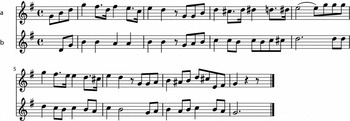
This becomes apparent if we examine the supposed plagiarism in closer detail. ‘La Adelita’ is sung in Viva Villa! in the background (in another room, to be precise) by Villa's celebrating Villistas during a scene in which Villa confronts the sister of a bourgeois landowner who refuses to side with him.Footnote 89 Though Dunayevsky never specified which ‘two bars’ he borrowed, a comparison of the two melodies (Example 2) does reveal parallels in the general melodic contour, particularly in bars 3–6, though the exactness of any real or supposed borrowings was, as mentioned, ultimately not the point. What mattered was that Bezïmensky (or perhaps some other keen-eared opponent of Jolly Fellows) had found something that could undermine the only remaining ‘good’ part of the film, the music. Here was the chance for the critics of Jolly Fellows to strike their final blow and regain the advantage. But it was not to be.
Melodic comparison of (a) ‘March of the Jolly Fellows’ (transposed for ease of comparison) and (b) ‘La Adelita’.Footnote 90

In order to settle the matter once and for all, a commission consisting of representatives from the Composers’ Union, the Filmmakers’ Union, the Writers’ Union, and Literaturnaya gazeta was formed to investigate the accusation. In a 1937 interview Dunayevsky explained how the commission had some difficulty even identifying the moment in question:
It happened like this: there exists a Mexican ditty (pesenka) and there is a similarity in the motif [of the March] . . . When the commission . . . listened three times to Viva they asked, ‘Well, where is this snippet of similarity?’ . . . Before them ran the march from Jolly Fellows and they waited for when they would be shown the moment in question. In order to save the face of this commission, at 1:30am we sent a special person to their homes with a collection of Mexican songs, in which this ‘Adelita’ was printed and in which they could find this similarity, but not in the film.Footnote 91
Once the precise spot had been pointed out and the commission listened to and viewed all songs and films in question, they concluded that ‘in the music of the march from the film Jolly Fellows and in the music of the march [sic] from the film Viva Villa! one and the same Mexican folk melody was used, thematically transformed, such that in the end we have two different independent, original works. Therefore, in the given case there cannot be talk of plagiarism.’Footnote 92
The day after the commission published its findings Shumyatsky met with Stalin and Molotov to secure their support. The final ‘victory’ for Shumyatsky and the filmmakers came the next day via an unsigned, front-page editorial in Pravda (a front-page editorial was highly uncommon for a musical issue and usually indicated a directive from Stalin). After noting the great success of the Moscow Film Festival, the anonymous author turned to Jolly Fellows and its detractors:
The monstrous accusation of plagiarism against the director Aleksandrov and the composer Dunayevsky is not based on anything and was refuted by the authoritative commission of the Central Committee's Filmmakers’ Union. It is time to stop this unprincipled persecution! Like the editor of Izvestiya, the editor of Literaturnaya gazeta is notable for his tendency towards vulgar polemics, initiating them for any reason and completely without reason. And they persist, even when their mistakes are completely obvious. Both editors have apparently forgotten the elementary rules of decency essential to Soviet newspapers.Footnote 93
As the final determination of the Party position, this editorial made it clear that Bezïmensky and Literaturnaya gazeta were on the losing side of this battle. Not long after, both issued apologies (though Dunayevsky still considered suing for slander).Footnote 94
The ‘scandal’ about Dunayevsky's alleged plagiarism is revealing, for although the Party eventually decided who ‘won’ the debate, the prolonged dialogue demonstrates not only the openness of discussion still possible in the mid-1930s, but also shows how music became a tool in the struggles for cultural and ideological power, in this case as a means to defeat remaining radical proletarian elements, represented here by Bezïmensky and the editor of Literaturnaya gazeta. However, despite the fact that Aleksandrov and Dunayevsky had Stalin and Shumyatsky on their side, and that the dissemination and reception of the ‘March of the Jolly Fellows’ faced ‘almost no limits’ in the wake of the film's success, the critical backlash had been taxing and eventually jazz would be targeted as well.Footnote 95 This began in December 1935 with the creation of the Committee on Arts Affairs (Komitet po delam isskustv), the purpose of which was to oversee the administration of, among other things, the finances, training, and publication in all branches of the arts, including jazz and (until 1938) cinema. With one fell swoop all artistic decisions were in effect brought under the aegis of a single party-minded body, resulting in a new regimentation in cultural policy.Footnote 96 The infamous Pravda critique of Shostakovich's Lady Macbeth in January of 1936 set the tone for this shift, implicating jazz as one of Shostakovich's accomplices in falling prey to formalism: ‘the author of Lady Macbeth of Mtsensk had to borrow from jazz its nervous, convulsive, epileptic music in order to give “passion” to his characters’.Footnote 97 A more thorough and widespread debate on the merits of jazz followed in November and December of the same year in editorials published in Pravda and Izvestiya.Footnote 98 Surprisingly, Pravda now came to the defence of jazz, eventually invoking the power of the Party to legitimize its position. But as with the debates surrounding Jolly Fellows, the debate about jazz became a battle over ideological power, in which music was merely a means to end. The ultimate goal in this case was the removal of the Izvestiya editorial board, especially its editor Nikolay Bukharin, who had already run foul of Stalin in other matters.Footnote 99 Even if, as Frederick Starr has claimed, Soviet jazz merely ‘survived’ throughout the 1930s by only ‘barely limp[ing] along’ and paying ‘the price of its vitality’, it did survive.Footnote 100 Jazz was never officially banned and no major jazzmen were purged.Footnote 101 Similarly, though the style of Aleksandrov and Dunayevsky's later films had to change, the musical comedy survived. The debates surrounding Jolly Fellows, Dunayevsky's plagiarism, and the fate of jazz thus demonstrate that despite their use as pawns in larger ideological battles, American-inspired popular cinema and music remained vital elements of the Soviet cultural landscape that could not simply be made to disappear. Indeed, their appearance in such debates speaks to the cultural stature they had gained, both in official circles and among the public.Footnote 102
Conclusion
Indeed, Jolly Fellows proved to be a phenomenally popular success with audiences, who flocked by the millions to see it.Footnote 103 The desire to sustain the film's optimism lived on beyond the theatre in Dunayevsky's songs, which were just as popular as the film itself. The texts of several of the film's songs, for example, were published already in April 1935 (with runs of up to 25,000 copies).Footnote 104 But people apparently wanted more than just the texts. Matthias Stadelmann writes that in the years immediately following the release of Jolly Fellows, directors of amateur, children's, and soldiers’ ensembles wrote directly to Dunayevsky requesting scores and parts so they could play his film music: ‘everybody wanted to play Dunayevsky's music, [but] nobody had parts’.Footnote 105 By the end of 1930s, six different versions of the march itself had been published, in arrangements for solo voice with piano accompaniment, solo voice with choral accompaniment, solo voice with guitar or mandolin accompaniment, wind band, and children's chorus, with thirty-eight editions of these versions alone through the 1960s.Footnote 106 Publication and recordings of other songs from the film fared well too. The popularity of the film and its music was also recognized officially: the march was, for example, sung at the May Day parade in 1935 and recorded on newsreels, and in January 1935 Aleksandrov was awarded the Order of the Red Star and Orlova was designated an ‘Honoured Artist’ of the Soviet Union.Footnote 107
Jolly Fellows and its music clearly had made an impression with the public. The impact is powerfully summarized in an anecdote that Dunayevsky recorded shortly after the film's release:
After Jolly Fellows came out I had to carry out a difficult struggle with people who were in every way opposed to the development of lively, folksy (narodnïe), Soviet songs. I remember how once, dejected in the face of ridiculous accusations, having lost confidence in the correctness of my path, I was returning home one evening via Volkhonka street after a heated dispute. The street turned out to be closed – they were building the metro. ‘Where do I go now?’ I asked. ‘You will have to go back and go across Arbat square’, a policeman politely answered. ‘Get lost’, someone inadvertently blurted out. And suddenly a young, fair female voice said: ‘Hey, citizen, you know life poorly! “Whoever goes through life with a song will never go astray”’. Having sung the song, the female metro construction worker disappeared underground. This little episode helped me. My creative path became clear. And no kind of discussions could divert me from it.Footnote 108
As we have seen, despite (or because of) the debates, the music became extremely popular, and as this anecdote attests – even if exaggerated – it spoke beyond the screen and worked its way into modern Soviet life (it is coincidental, but poetic that this anecdote involves the construction of the metro, one of the many massive Soviet modernizing public works projects of the period). Indeed, Jolly Fellows, and especially its music, not only reflected the Soviet atmosphere of the early 1930s, but also helped to shape that very atmosphere. As Nelli Shakhnazarova has written, ‘from movie screens [and] from loudspeakers [Dunayevsky's music] flitted (vparkhivala) into life and became an integral part of existence. It was sung at home, at parties, at demonstrations, [and] at student gatherings. Such popularity determined also the duality of the function of the mass song in the 1930s. As the most mobile genre, it sensitively recorded the emotional atmosphere of the period. But it also shaped that very same atmosphere.’Footnote 109 This was made possible, I suggest, via Aleksandrov and Dunayevsky's turn to the style of the (American) film musical, which, through its use of modern technology (i.e., sound synchronization), was able to create ‘unrealistic’ utopian spaces in which the film's message, also about the importance of music, fun, and entertainment, could be powerfully transmitted. This message clearly hit home with viewers and, it turns out, with critics, for whom the symbolic power of the music's ‘Soviet Americanism’ enabled it to become a means of fighting larger ideological battles.