Paediatric heart transplantation remains the gold standard therapy for children with refractory, end-stage heart failure. Though the total number of PHTs performed per year has increased over time, organ supply has not kept pace with demand. Reference Goldfarb, Levvey and Edwards1 Despite the more widespread successful use of ventricular assist devices in the paediatric heart failure population, candidates on the waitlist for PHT continue to face the longest waitlist times and highest waitlist mortality of any solid organ waitlist group. Reference Almond, Thiagarajan and Piercey2,Reference Dipchand, Kirk and Naftel3 Further reductions in waitlist mortality have been hindered by relatively small patient numbers and the diversity of patient ages, sizes, and diagnoses observed in the paediatric population. Reference Zafar, Castleberry and Khan4
The Organ Procurement and Transplantation Network requires serologic testing of all potential deceased organ donors to identify those donors who are at risk of transmitting infectious disease to organ recipients. 5 Serologic testing does not completely exclude donors who have the potential to transmit infectious diseases, as donors who are infected in the days to weeks prior to death may be in the “window period” of time when results remain falsely negative. Thus, donors with reported or observed high-risk factors (IV drug use, haemophilia, etc.) are designated as increased risk donors by the Public Health Service. 6 IRD organ transplantation has been associated with exceedingly low rates of infectious disease transmission, however, IRD organs, which may otherwise be of excellent quality, have a high discard rate. Reference Bowring, Holscher and Zhou7–Reference Khan, Green, Lytrivi and Sahulee12 The 2014 update to the PHS guidelines Reference Seem, Lee, Umscheid and Kuehnert13 expanded IRD designation by introducing additional criteria for classification of organs as IRD including new behavioural and social risk factors, as well as factors that might lead to uncertainty such as hemodilution of samples and uncertainty regarding a donor’s medical/behavioural risk factor history. These changes resulted in a near tripling of the number of organs labelled as IRD and notably, in the United States of America, potential cardiac allograft discard rates approach 50%. Reference Khan, Green, Lytrivi and Sahulee12,Reference Kucirka, Bowring, Massie, Luo, Nicholas and Segev14–Reference Sahulee, Lytrivi, Savla and Rossano17 Given the overall lower rates of high-risk behaviours in the paediatric population compared to the adult population, hemodilution likely contributes more significantly to IRD classification of grafts being evaluated for paediatric organ transplantation. Some of these grafts are therefore likely not in fact representative of increased risk but instead highlight the added challenges of serologic testing in the paediatric population. Adverse outcomes from acceptance of IRD organs have not been demonstrated and there is little evidence that donor characteristics strongly influence post-transplant outcomes. Reference Davies, Bano, Butts, Jaquiss and Kirk18–Reference Rossano, Lin and Paridon21 No prior studies have investigated the risk–benefit relationship associated with declining an IRD offer in children and adolescents listed for cardiac transplant.
To understand the impact of the acceptance or decline of IRD organ offers to paediatric candidates waitlisted for cardiac transplantation, we performed a retrospective registry analysis employing organ offer data to examine outcomes for candidates that accepted or refused IRD organ offers. Analysis of candidate outcomes from the time of organ offer decision permits superior estimation of the survival benefit associated with the acceptance of an IRD heart offer. Given continued concerns regarding waitlist mortality, specifically in candidates awaiting PHT, we sought to test the hypothesis that the decline of an initial IRD organ offer is associated with poorer outcomes in PHT.
Methods
Data source
This study was approved by the institutional review board of the Duke University Medical Center prior to data review. In this retrospective cohort study, we utilized candidate-level and donor-level data from the United Network of Organ Sharing. Reference Davies and Pizarro22 Candidate-level data were linked to data from the potential transplant recipient dataset (“match-run” file), which details the offer sequence history of organ offers with respect to the order in which each candidate is offered an allograft. Allocation of heart allografts to paediatric candidates proceeds in an urgency-based fashion, such that available allografts are offered to candidates in sequence based on geographic appropriateness, blood type suitability, and medical urgency. For each organ offer, candidates and the centres acting on their behalf must respond with a decision to accept or decline the donor organ.
Study population and design
Organs from an increased risk donor were identified via the organ procurement organisation and given the label based on PHS criteria. All candidates for PHT aged 0–17 who received an offer for isolated heart transplantation with an IRD allograft from May, 2007 to March, 2017 were identified. Candidates were included for study analysis if they received an offer for an IRD organ within the first 10 match runs. A donor sequence number of 10 match runs was chosen to incorporate the majority of accepted allografts. At sequence numbers greater than 10 match runs, there is a high rate of organ decline despite recent studies indicating comparable survival to patients accepting lower donor sequence number organs. Reference Baran, Copeland and Copeland23 Expanding the analysis beyond 10 match runs had a low yield (additional 24 accepted IRD offers and 252 declined offers). This difference is likely to be due to the high donor sequence number and not specifically to IRD status. Patients with incomplete survival data were excluded from the analysis. A total of 1067 (610 males and 457 females) listed patients met the criteria for inclusion. The study population was divided into two groups (accept and decline) based on the initial IRD offer decision. For candidates that declined multiple IRD offers, demographics and clinical characteristics at the time of the initial IRD offer were compared.
Increased risk donor offers
The UNOS Potential Transplant Recipient dataset contains information on all organ offers and includes information on the eventual recipient and all potential recipients at a higher priority on the waitlist. This constitutes the “match run” for each organ. IRD status is included in this documentation. Each offer, if declined, is accompanied by a reason for the centre’s refusal of the offer.
Statistical analysis
Statistical analysis was performed using the R software package, version 3.5.1. Variables were defined based on UNOS data collection parameters. Continuous, non-normally distributed variables were compared using Wilcoxons rank-sum test. Categorical and ordinal variables were compared using the chi-square test. Kaplan–Meier curves (logrank test, p < 0.05) and Cox regression were used for time-to-event analysis.
To estimate the risks of competing outcomes following an IRD offer, we identified candidates who initially accepted an IRD heart offer and proceeded to transplantation, and compared them to candidates who declined an initial IRD heart offer. Reference McGiffin, Naftel and Kirklin24 We followed candidates from the time of initial IRD offer until eventual transplantation, death, decompensation precluding transplantation, or removal from the waitlist. Candidate characteristics prior to transplant and their post-transplant outcomes were analysed for both study groups.
To compare patient mortality between those who accepted versus declined the IRD heart offer, we developed a Cox regression model, adjusting for candidate demographic and clinical factors. Reference Collett25 For this model, we did not rely on the proportional hazards assumption because candidates who accepted the IRD heart offer face an early hazard of perioperative mortality associated with heart transplantation, and those who refuse the offer do not. Thus, the proportional hazards assumption is violated. To ascertain the mortality hazard associated with acceptance versus refusal of an IRD heart offer, we employed a Cox model stratified on offer acceptance versus refusal, and estimated survival time in each stratum using Cox-adjusted survival. Reference Collett25 Our model adjusted for the following candidate covariates available at the time of listing: age at listing (by quartile), gender, estimated glomerular filtration rate, diagnosis group, need for ventilator, need for mechanical circulatory support, and initial waitlist status. In the stratified Cox model, differential baseline hazard functions are computed for both strata, such that the coefficients of the covariates remain the same across strata.
As a sensitivity analysis, we compared post-transplant outcomes of those who accepted the IRD heart offer to those that initially refused the IRD heart offer, but subsequently went on to accept a later organ offer regardless of IRD designation. Reference Collett25 Of those that declined an IRD heart offer but survived to accept a later offer, we compared overall survival to those that accepted the initial IRD heart offer. We hypothesised that of those that decline the IRD heart offer, some may do so with the intent to await a superior allograft offer at a later time. This analysis negates those candidates that declined the IRD offer and did not survive to accept a later offer and therefore allows a more direct comparison of organ quality to determine if IRD hearts might have increased risk. In this analysis, we estimated survival using the KaplanMeier method, measuring survival from the time of transplantation. Model covariates were the same as those described above: age at listing (by quartile), gender, eGFR, diagnosis group, need for ventilator, need for MCS, and initial waitlist status.
Results
Group characteristics
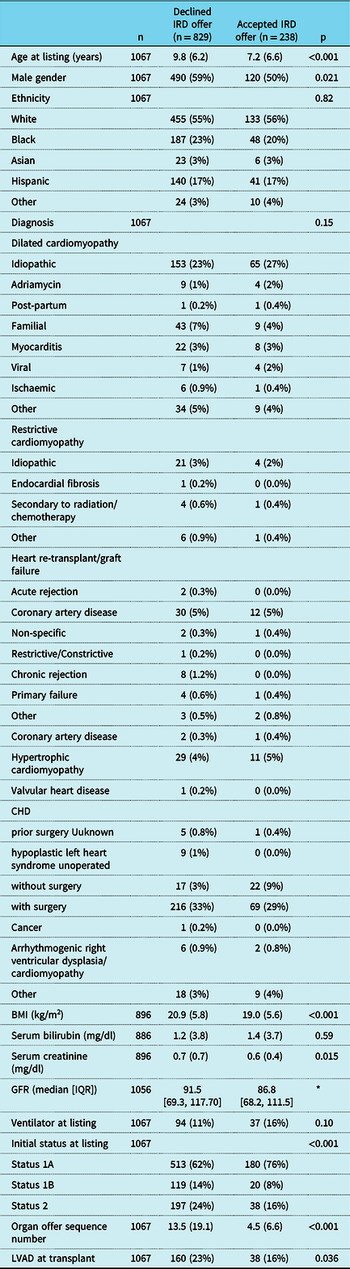
A total of 1067 paediatric IRD allografts were offered to at least 1 candidate on the waitlist for PHT. Overall, 238 candidates (22.3%) accepted the initial IRD heart offer. Reasons for refusal of IRD organs are summarised in Supplemental Table 1, with >60% reflecting concerns related to the donor quality or social history. Examination of temporal trends in IRD organ acceptance during the study period shows a general trend towards increasing rates of IRD offers and increased acceptance of IRD offers (Supplemental Fig 1). Table 1 outlines underlying cardiovascular diagnoses and characteristics analysed for both groups based on offer decision. On univariate analysis, candidates accepting the initial IRD heart offers were younger (mean 7.22 versus 9.82 years, p < 0.001), more often female (49.6% versus 40.9%, p = 0.021), and more often listed as status 1A (75.6% versus 61.9%, p < 0.001). There were no significant differences in the overall diagnostic distribution when comparing the “accept” and “decline” groups (p = 0.147) with similar frequency of dilated cardiomyopathies (41.6% for “accept” versus 42.5% for “decline”, p = 0.82), repaired and unrepaired forms of CHD (36.7% versus 38.5%, p = 0.12), and myocarditis (3.3% versus 3.4%, p = 0.98).There were also no significant differences between the two groups with regard to ethnicity. The decline group had a higher BMI (mean 20.99 versus 19.01 kg/m2, p < 0.001) and higher serum creatinine (mean 0.71 mg/dl versus 0.55 mg/dl, p = 0.016) at the time of listing although these changes may reflect the slightly older age of the decline group. The accept group was less likely to receive mechanical bridge to PHT (16% versus 22.7% with LVAD at transplant, p = 0.036). Accepted IRD organs had a higher organ offer sequence number than non-IRD organs (mean 13.48 ± 19.08 versus 4.52 ± 6.61, p < 0.001) reflecting that they were more often declined prior to final acceptance for transplant.
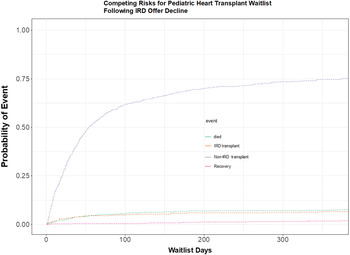
Competing risk analysis for paediatric candidates on the waitlist for heart transplantation following the decline of initial IRD heart offer.

Characteristics of candidates declining or accepting initial IRD heart offers. Values are listed as either mean (SD) or n(%) unless otherwise stated

* Denotes non-normally distributed data. BMI = body mass index; IQR = interquartile range; IRD = increased risk donor; GFR = glomerular filtration rate; LVAD = left ventricular assist device.
Outcomes following IRD offer decision
A total of 238 candidates that accepted an initial IRD offer underwent PHT. Figure 1 depicts outcomes for those candidates that declined an initial IRD offer. At 1 year following IRD offer decline, 74% of candidates underwent subsequent transplantation with a standard risk allograft, 6% underwent subsequent IRD heart transplantation, 11% were still awaiting transplantation, and 7% were removed from the waitlist. Removal of candidates was mostly due to death or decompensation that precluded transplantation (Supplemental Table 2).
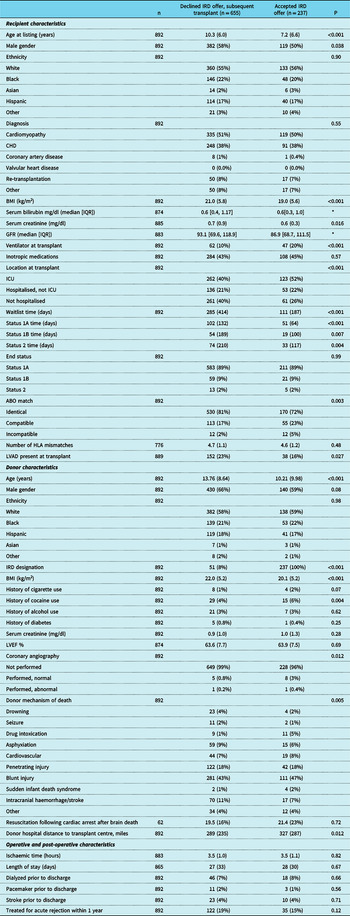
Characteristics of those that accepted the initial IRD offer versus those that declined the offer and went on to receive a subsequent transplant. Values are listed either as mean (SD) or n(%) unless otherwise stated

BMI = Body mass index; ICU = Intensive care unit; IQR = Interquartile range; IRD = Increased Risk Donor; GFR = Glomerular filtration rate; LVAD = Left ventricular assist device; LVEF = Left ventricular ejection fraction; HLA = Human leukocyte antigen.
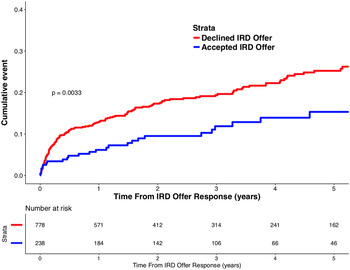
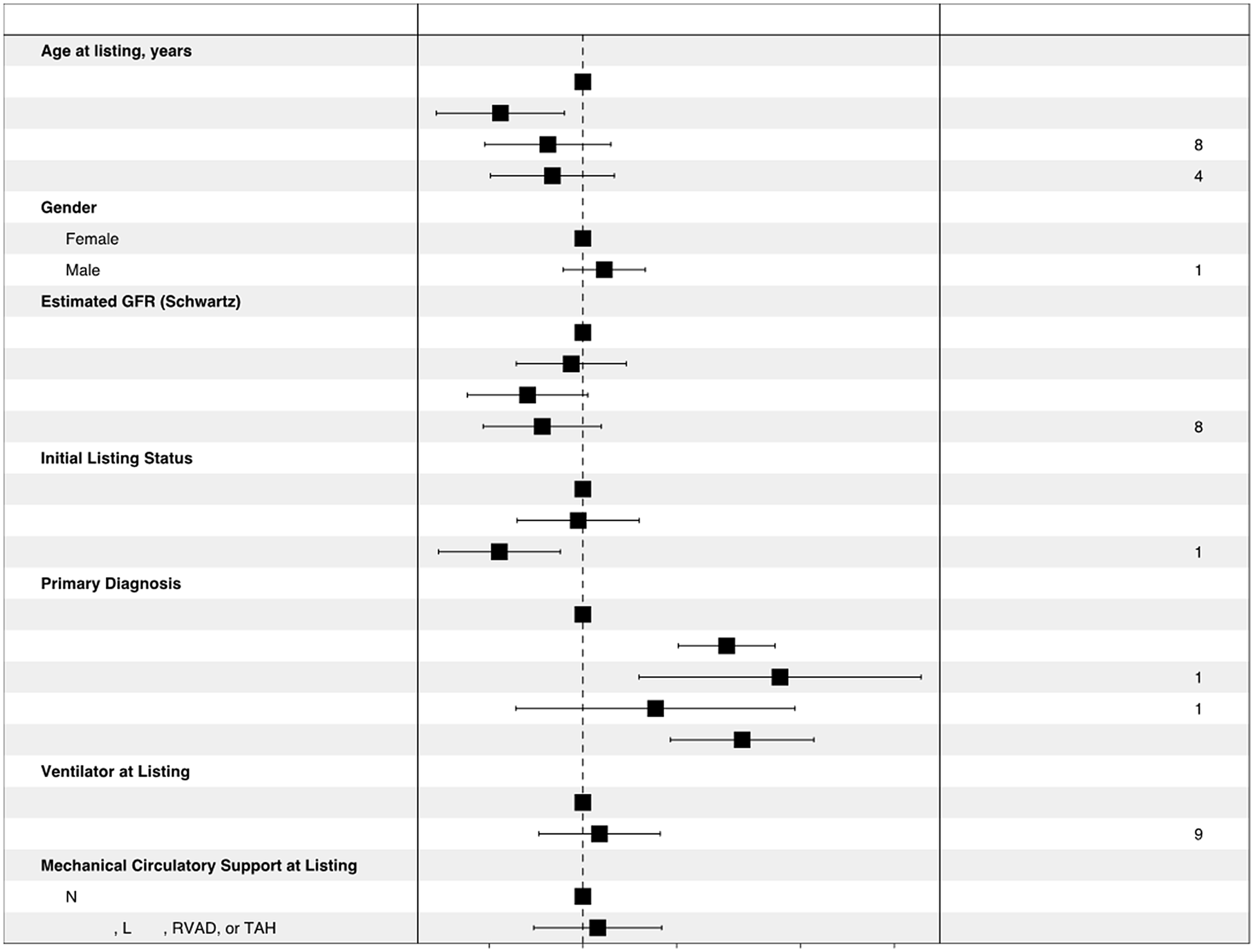
Figure 2 demonstrates adjusted cumulative mortality from the time of initial IRD offer, comparing survival for those accepting versus declining the initial offer. Candidate survival was similar in the early time period following the initial IRD offer decision. At 1 year, cumulative mortality was significantly lower for those candidates who accepted the initial IRD offer compared to those that declined the initial IRD offer (6% versus 13%, respectively), a survival benefit which was sustained through 5 years with 5-year cumulative mortality of 15% for the accept group and 25% for the decline group (p = 0.0033). After adjusting for clinically significant waitlist characteristics, refusal of an IRD offer was associated with an adjusted hazard ratio for mortality of 1.87 (95% CI 1.24, 2.81, p < 0.003) (Fig 3). There were no observed significant differences in candidate survival based on IRD organ sequence number (Supplemental Fig 2). Furthermore, there was no significant difference in outcomes when comparing IRD organ recipients with offer sequence number = 1 (i.e., organs never previously declined) versus offer sequence number > 1 (organs previously decline) (Supplemental Table 3, Fig 2).
Cumulative mortality for paediatric candidates waitlisted for heart transplantation measured from the time of initial IRD heart offer, stratified by response to the offer. IRD = Increased Risk Donor.

Cox model stratified based on IRD offer response. Baseline hazards for the groups differ due to the accept group undergoing surgery for transplantation.

Comparison of post-transplant outcomes
To evaluate the potential effects of IRD donor status on post-transplant outcomes, the study group of 238 recipients of IRD offers was compared to 655 PHT recipients that refused an IRD offer but subsequently accepted a later offer (regardless of IRD status) and underwent cardiac transplantation (Table 2). Of these groups, those that accepted the initial IRD offer were younger (mean 7.2 versus 10.3 years for refuse, p < 0.001) and more often female(50% versus 42% for refuse, p = 0.038). There were no significant differences in ethnicity or diagnosis. The accept group had significantly shorter total waitlist days (111 accept versus 285 refuse, p < 0.001) and days at Status 1A (51 accept versus 102 refuse, p < 0.001). They were also less likely to receive an identical match (72% versus 81%) and more likely to receive an incompatible match (5% versus 3%) (p < 0.003 for the match distribution). Donor characteristics in both groups were also compared. Paralleling findings in the recipients, donors for the “accept” group were younger (10.2 versus 13.8 years, p < 0.001), and had lower BMI (20.1 versus 22.0, p < 0.001). They were also more likely to have a history of cocaine abuse (6% versus 4%, p = 0.004). There were no significant differences in other behavioural risk factors and there were no significant differences between the accept and decline groups with respect to operative and post-operative characteristics tracked by UNOS.
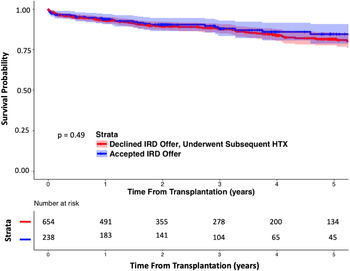
With respect to outcomes, there were no differences in the rate of treatment for acute rejection episodes within 1 year of transplantation. Survival from the time of transplantation was estimated using the Kaplan–Meier method (Fig 4) with no significant observed differences in survival between groups at 5 years (80% for refuse versus 81% for accept, p = 0.49).
Comparison of all candidates who received a transplant. No significant differences in survival are observed between the IRD accept and IRD decline groups.

Discussion
In this analysis, we examined outcomes for candidates listed for isolated PHT who received an initial IRD offer, stratifying candidates based on their response to the initial offer. We only included patients that received an IRD offer, as the overarching intent of the analysis was to compare outcomes for those patients accepting versus declining IRD organs. This offer-based study design permits a better approximation of the difficult decision facing waitlist candidates and transplant centres, as the decline of an IRD organ is not necessarily associated with an immediate, alternative offer of a standard risk allograft. When an organ offer is made, candidates and centres must weigh the competing risks of accepting an IRD offer versus refusing the offer and subsequently returning to the waitlist for an unknown period of time to await a future offer. This study demonstrates that initial refusal of IRD allografts is common in PHT but that refusal of an IRD offer is associated with increased mortality.
Waitlist mortality in PHT remains significant and the reasons for organ refusal are variable, impacted by donor and or recipient characteristics. Reference Feingold19,Reference Rizwan, Zafar and Bryant26–Reference Jeewa, Manlhiot, Kantor, Mital, McCrindle and Dipchand29 A recent analysis of multi-institutional data by Davies et al found that even the refusal of organ offers of acceptable quality, regardless of the reason for refusal, was associated with a higher risk-adjusted mortality, which was independent of eventual transplantation status. Reference Davies, Bano, Butts, Jaquiss and Kirk18 Donor organs may be declined due to factors perceived to make the organ marginal in quality. Studies examining organ quality and outcomes have failed to consistently demonstrate an association between poor outcomes and marginal donor characteristics, such as LVEF<50%, use of inotropes, or IRD status. Reference Conway, Chin and Kemna20,Reference Rossano, Lin and Paridon21,Reference Morrison, Gowda and Tumin30–Reference Mahle, Fourshee, Naftel, Alejos, Caldwell, Uzark, Berg and Kanter32
The rate of IRD organ decline and discard remains high despite low disease transmission rates following IRD graft transplantation. Reference Gaffey, Doll and Thomasson8,Reference Green, Covington, Taranto, Michaels, Wolfe and Kaul10,Reference Volk, Wilk, Wolfe and Kaul11,Reference Seem, Lee, Umscheid and Kuehnert13 To our knowledge, this is the first paediatric analysis comparing outcomes based on IRD offer acceptance versus decline. This specific method of comparison allowed for an enhanced determination of risk associated with the decline of an IRD offer. Our findings are consistent with multiple similar studies from the adult transplantation literature. Declining an IRD offer has been associated with increased mortality for adult heart transplant, adult kidney transplant, and adult lung transplant recipients. Reference Bowring, Holscher and Zhou7,Reference Cox, Mulvihill and Choi33,Reference Mulvihill, Cox and Bishawi34 Our offer-based analysis reveals a negative effect on patient outcomes when IRD organs are declined. These findings are directly relevant to the real-time decisions that patients, their families, and caregivers are faced with during their care.
The hesitancy to accept IRD organs may be secondary to the perception of undertaking significant, additional risk by accepting an IRD organ. This is possibly further exacerbated by the requirement for additional informed consent for IRD organs. Reference Moayedi, Ross and Khush15 The perception that IRD organs are lower quality is reflected by their higher organ sequence number, or position on the match run for organ acceptance. The organ offer sequence number is regarded by some as a proxy for organ quality with the observation that lower quality organs tend to be declined more frequently and thus have a higher organ offer sequence number. Reference Singh, Schecter and Towe35 However, we did not find any evidence of increased post-transplant risk with IRD organs. Moreover, increased risk is not consistent with the published literature. In 2014, Sahulee et al demonstrated that acceptance of a “high risk donor” heart by a paediatric candidate did not increase post-transplant mortality. Reference Sahulee, Lytrivi, Savla and Rossano17 Our findings are similar but reflect contemporary data following updates to the PHS classification schema that have more than tripled the number of donor hearts classified as increased risk. Reference Kucirka, Bowring, Massie, Luo, Nicholas and Segev14,Reference Pruett, Clark and Taranto16 These updates has increased the stakes for paediatric transplant centres who are already challenged with decisions regarding the appropriate allocation of donor hearts in short supply. Reference Andrews, Kane and Hendrickson28 Our data demonstrate that refusal of an IRD organ offer exposes candidates to the risk of acquiring additional morbidities as they await a subsequent offer. These morbidities, such as the need for mechanical ventilation and ventricular assist devices, can be serious and life threatening, and further decompensation on the waitlist may preclude subsequent transplantation. Waitlist mortality remains a significant concern in the paediatric population, illustrated in this analysis by the combined 18% of patients who refused initial IRD offer either remaining on the waitlist or removed from the waitlist due to death or decompensation.
Though prior studies have identified specific factors associated with increased waitlist mortality, such factors are often difficult to modify. Our findings distinguish IRD acceptance as a candidate-level, modifiable factor with the potential to significantly impact waitlist mortality. Since a significant proportion of IRD organs are ultimately discarded, increasing the use of IRDs would be one approach to increasing the total number of donor organs available for transplantation. The essentially negligible risk of disease transmission via IRD organ transplantation is heavily outweighed by the survival benefit of accepting IRD allografts in PHT. Further investigation is needed regarding the behavioural component of the organ offer decision as well as broader conversations amongst transplant providers and public health officials regarding whether the label of “increased risk” is truly warranted. Given rising waitlist numbers and high organ discard rates, such investigation is imperative.
Limitations
This study has several limitations which warrant consideration. As with any retrospective analysis, the data and conclusions are susceptible to selection bias. However, since the UNOS database tracks all candidates registered for transplantation in the United States of America, it is unlikely that patient selection bias would play a significant role in our analysis. Conversely, it is possible that the declined IRD offers identified in our study represent the highest risk IRD grafts with respect to other clinical factors. If this is the case, it is possible that increasing routine acceptance of such grafts may have an adverse effect on overall outcomes. As previously discussed, published data on the acceptance of clinically marginal quality organs would not support this hypothesis. For this analysis, the majority of IRD organs were declined due to concerns related to the donor organ such as donor organ quality or social history. Unfortunately, we do not have more specific data on the exact reasons for the decline. It is possible that there are other factors not captured in our analysis that influenced decision-making or patient outcomes, such as differences in the health of candidates who accepted or declined IRD offers. This hypothesis also seems unlikely as clinical indicators suggest that the IRD “accept” cohort actually had a higher baseline risk than the “decline” cohort. Finally, it is possible that there are centre-level differences in strategies for organ offer acceptance that may influence outcomes and that we are unable to appreciate with our nested study design.
The granularity of the data analysed in this study is limited by the variables reported to UNOS. We were unable to determine the rate of post-transplant seroconversion, as this is not directly recorded in the datasets used for analysis. Transmission rates have previously been reported to be extremely low and thus the unmeasured seroconversion rates in this study cohort are unlikely to alter our main conclusions regarding the survival benefit associated with IRD organ acceptance.
Conclusion
In conclusion, refusal of IRD allografts in PHT is common, despite high waitlist mortality. Our study demonstrates a significant and lasting survival benefit to accepting an initial offer of an IRD allograft when compared to the alternative of declining the initial IRD offer to await a subsequent offer. Increasing acceptance of IRD organs may provide an opportunity to decrease the substantial waitlist mortality seen in PHT.
Supplementary material
To view supplementary material for this article, please visit https://doi.org/10.1017/S104795112100353X.
Acknowledgements
None.
Financial support
None.
Conflicts of interest
Dr Ezekian is supported by the National Institutes of Health TL-1 Clinical and Translational Science Award (UL1TR002553).
Dr Mulvihill is supported by the National Heart, Lung, and Blood Institute (F32HL132460-02).
Dr Cox is supported by the National Institutes of Health-Funded Cardiothoracic Surgery Trials Network 5U01HL088953-05 and the National Institutes of Health TL-1 Clinical and Translational Science Award 1UL1-TR001117-01 (National Center for Advancing Translational Sciences).
Dr Hill receives support from the National Centers for Advancing Translational Sciences for his work in paediatric drug development (U01TR-001803-01).