There are no data about the future. There is no history to relate. There is merely assumption, presumption, trend analysis and speculation. Furthermore, all of those combined are likely to lead to (tentative) conclusions which quite probably rely more on whether you are an optimist or a pessimist than on anything else. That, combined with how far you believe that past performance may well in fact be a guide to the future.
So this commentary will rely on anecdote and optimism more than analysis. The past half-decade has been a pretty tough one for health and health care systems. Global financial crises, followed by global – or pretty near global – recessions, are not good for either. Money gets horribly tight. Spending growth falls, or in some cases spending is actually cut. But medical advance continues, and things have not been sufficiently bad for sufficiently long for public expectations not to go on rising.
The Organisation for Economic Co-Operation and Development (OECD) data, which currently runs only from 2009 to 2011 in comparable terms, with a spattering of 2012 data, shows a decline in the average growth of health spending across the industrialised nations to pretty near zero after a decade of 5% real (OECD 2013). The paper in this journal by David Morgan and Roberto Astolfi analyses variations in this trend among European countries.
As the papers in this issue testify, the picture has, of course, varied, country by country. There are a very few countries where, if you looked at them in isolation, you would have trouble telling that the events of 2008 had ever happened. There is a middle group, which includes the United Kingdom where spending has been heavily constrained in real terms, but there have been few actual cuts. And there are those where health care spending has really suffered – Greece, Spain, Portugal, Ireland and others, where staff pay has been cut, or co-payments hiked up, or the package on offer has been severely constrained.
Today, public spending deficits have been brought under control in many countries. But many have still to deal with the mountain of debt accumulated since 2008. The short to medium term prospects look unappetising, with talk of a decade of austerity that bodes ill for health spending and delivery.
But simply looking at where we are and making an elementary projection of current trends, only to conclude that we are all doomed, can be highly misleading.
Anecdote: Most of my journalistic life – and I started reporting on the British health system and its place in society more generally in 1974 – I have lived with the prophets of doom. But we – you and I – are still here, and health care has got immeasurably better over the succeeding four decades.
One of my very first press conferences was at the British Medical Association (BMA) where the BMA’s then secretary, Dr Derek Stevenson, a man with Rex Harrison good looks and the style of a cavalry colonel, and who smoked his way through untipped Senior Service cigarettes during his press conferences, was demanding that the then Labour government set up a Royal Commission on the National Health Service.
NHS spending – and NHS pay – had been heavily squeezed by the fall-out from the Barber boom of the early 1970s. Services were under dire pressure. Stevenson demanded a £500 million cash injection into the NHS – a massive sum when the annual budget was only £3 billion (and on that basis equivalent to around £20 billion today). In the absence of that he trailed ideas for hotel charges, top-up insurance, charges for visiting the GP, an extra health stamp, or even a sweepstake to raise more money. ‘The fundamental thing is that it can’t go on like this’, he thundered, adding, for the avoidance of doubt, that ‘morale has never been lower’. I was too young and green to realise that on virtually every day of every year since 1948, morale has never been lower. Nonetheless, it felt like a genuine crisis for the NHS – one that was soon to get worse as hospital doctors, both junior and senior, took industrial action for the first time over contracts and so-called pay beds.
Five years earlier, in the face of technological advance and rising expectations, Richard Crossman, Labour’s social services secretary, in virtually his last act in office, had presented graphs of increasing expenditure on the social services in general, and the NHS in particular, showing the rising trend of expenditure since the late 1950s. ‘If you extrapolate the curve’, he declared, ‘the prospects before us are truly terrifying’. The pressures, he said, ‘are such that they will always together be sufficient to make the standard of social services regarded as essential to a civilised community far more expensive than that community can afford … there is no limit on the social services which the nation can reasonably require except the limit that the Government imposes’.
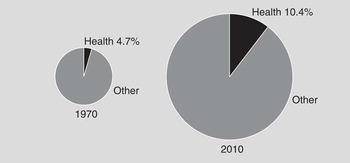
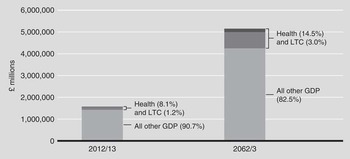
Back in 1970, health spending in the leading industrialised countries was around 5% of gross domestic product (GDP), and it had been growing fast, fuelled by an era of unprecedented medical advance. Over the previous couple of decades a vast range of new procedures and treatments had become available that we now take for granted – new vaccines, new antibiotics, the first drugs effectively to treat mental illness, joint replacements, all forms of transplantation, renal dialysis, and so on. Forward projections suggested that by 2010, health spending in countries such as the original EU 6 would have double to 10% of GDP. This was widely seen to be impossible – an unsustainable rate of growth. Yet that is precisely what happened (see Figure 1). The chief reason it did so, in virtually every developed country (in the UK health spending doubled from 4 to 8% of GDP) was that the economy grew. By 2010, these economies were roughly 2.5 times larger in real terms. So while health was taking an appreciably larger slice of total income – 10% rather than 5% – it was a larger slice of a very much larger cake. So plenty of money – more money in real terms – remained to be spent on other things. Rising expenditure on health in fact proved to be affordable. And it is entirely conceivable that the future could look very much like the past in respect of growth in the economy and health (see Figure 2).
EU six countries’ spending on health 1970 and 2010 Source: Commission on the Future of Health and Social Care in England (2014).

Future UK health and long term care spending as a share of GDP: 2012/13 and 2062/3 Notes: Figures calculated on the Office of Budget Responsibility’s highest projections for health and long-term care (LTC) spend and GDP (OBR, 2013). Source: Barker, K. Commission on the Future of Health and Social Care in England. Interim Report (2014).

Examples like this abound over the years, not just in the narrow field of health. By the early 1980s Britain’s population was starting to age significantly. The actuaries’ projections were seized on. Ageing was going to bankrupt the country. Partly because back then most pensioners were poor pensioners and relied heavily on the state for their income – two-thirds of pensioners were in the bottom 40% of the income distribution. Partly also because the support ratio – the numbers in work to support the retirees – was going to halve. We were doomed.
The value of the state pension was indeed cut in the face of these numbers. But a number of other things also happened. The various forms of the state second pension have matured and started to pay out, along with those final salary pensions that at one point 8 million people enjoyed, even if they are now almost impossible to get into. Home ownership rose on the back of a long, secular, boom in house prices. As a result median pensioner incomes today are now similar to those of the working population. Barely 10 per cent of pensioners are in the bottom 5th per cent of the income distribution. Compared to parents with children, and working age adults without children, they are the least likely group to be in the bottom fifth. Who would have predicted that in the face of those projections?
Furthermore, patterns of work are changing. During the 1990s and 2000s, those final salary schemes helped fuel a lot of early retirements (one of the many, many reasons, why they got into financial trouble). State pension age had not shifted in the face of rising longevity. Those early retirement packages have fast disappeared. State pension age is rising. And more people are indeed working on beyond it. Only 12% currently do so. But that proportion has doubled over the past 2 decades. And while working on is clearly easier for those who use brain rather than brawn, many manual jobs have become less demanding – think about working in a warehouse or distribution centre which once was heavy manual labour but is now assisted by not just trucks and pallets but by all sorts of mechanical pickers and sorters. A recent paper by Spijker and MacInnes (Reference Spijker and MacInnes2013)pointed out persuasively that the old, static, forward projection of the old age dependency ratio – measuring merely those of working age against those aged 65 or over and assume nothing else changes – is highly misleading. Look at what is actually happening, and those numbers look far less frightening – with positive implications for the economy, and by association, for spending on health and social care. More people working for longer, combined with mounting evidence that on average we are living longer and healthier not longer and sicker (Cutler et al., Reference Cutler, Gosh and Landrum2013), suggest that the sorts of projections we currently see suggesting that health and social care are going to become unaffordable may well prove no more reliable than similar gloomy prognostications from the past.
So while the next few years are clearly going to be difficult – quite possibly exceedingly difficult – the longer term future for health and indeed social care is more optimistic, at least if the past is any guide to the future. As individuals and as societies, we clearly value health. Regardless of how it is funded – individually, through social insurance or tax financing or a mix of the three – countries not only spend more on it as they get richer, but proportionately more. This makes intuitive sense. As Hall and Jones have long argued, once you are homed and fed, and have the second car or whatever other material possession or experience enriches your life, spending that enhances health, reduces disability or its effects, and which may even prolong life may well have greater utility than another home or third car (Hall and Jones, 2007).
This argument, of course, is open to the charge of Micawberism. The projections may look gloomy. But something will turn up. And any way we value all this too much to give up on spending more, let alone to agreeing to prolonged cuts in such expenditure.
The only answer to that charge is that, at least to date, something usually has turned up, and usually something that those making the projections have not quite foreseen. The ‘somethings’ may include some significant gains in productivity. It is true that to date medical advance has tended to raise health care costs. Doubtless it will continue to do so. But there are plenty of examples where it has also cut them – not just vaccines, antibiotics and treatments for mental illness, but keyhole surgery and day surgery which have allowed many more bangs for the buck. The internet has changed huge swathes of our lives. But this author at least has the sense that its potential in health care has barely begun to be exploited. Likewise, a huge investment is being made by all sorts of people in robots that one day may also have big role to play in both health and social care. And still to come is whatever will emerge out of the sequencing of the human genome – both in terms of new and potentially costly treatments, but also in terms of productivity. The cost of sequencing a human genome – which is still falling – has dropped from $10 million just six years ago to a few thousand dollars today. Where will that lead?
All of that, plus the fact that as societies we do indeed seem to value spending on health care. So there are reasons to be cheerful in the medium term, if you choose to be an optimist. To be one, you need to believe that innovation will continue, societies will adapt, and that economies will continue to grow. If those three things do not happen, then we will be in all sorts of trouble – quite aside from the problems that health and social care will face.