Patronage in the state sector is a major drag on the quality of government. As with corruption more generally, it is associated with a host of negative developmental outcomes.Footnote 1 The key feature of patronage states is that personnel practices in the public sector are governed by particularistic rather than meritocratic criteria.Footnote 2 As Kanchan Chandra points out, the use of nonmeritocratic criteria in determining personnel decisions within the state sector is especially important in circumstances where the state is a significant employer.Footnote 3 However, patronage in the state sector is important for another reason. Even when the state is not the predominant employer, because state employees depend on their political patrons for their livelihoods, they are susceptible to political interference.Footnote 4 As a result, state programs, from pensions to mining permits, can be controlled by political brokers for their own ends. Patronage in the public sector is not a necessary cause of poor quality government, but all the evidence points to its sufficiency. Yet if patronage is so damaging to long-term socioeconomic and political outcomes, how does it become institutionalized in the first place? Just as importantly, why does patronage politics persist in some cases but undergo reform in others?
According to the influential theory of Martin Shefter, patronage politics results from the capture of the state for the purposes of party building by political intermediaries.Footnote 5 This will occur where democratization precedes professionalization of the bureaucracy and mass mobilization by political parties. By design, this theory only addresses the issue of patronage in democratic states. In this article, I argue that theorists have thus far neglected the broader state-building context in which patronage is institutionalized and maintained. Drawing on the state-building process in the colonies of the British Empire, in particular India and Ceylon (Sri Lanka),Footnote 6 I put forward an alternative model of the origins of patronage politics. First, the colonial cases examined here reveal that where there were strong centrifugal and disintegrative pressures at the time when the new nation states were formed, local (or subnational) control over the distribution of patronage was institutionalized. When the tensions surrounding decolonization posed a threat to the integrity of the state, nation builders responded with a combination of repression on the one hand, and the concession of considerable patronage powers to subnational political elites on the other. The outcome was institutionalized bossism. Second, decentralized systems of patronage politics have proven more resistant to reform than centralized systems. In such cases, the main beneficiaries of patronage politics are subnational political brokers rather than the central government. This in turn means that there are multiple veto points at which the reform process can be stymied.Footnote 7 Thus, while the relative timing of democratization and bureaucratic professionalization provides part of the explanation, such an account is incomplete without an understanding of the territorial conflict between central and subnational forces inherent to a state building process that is common to both democratic and nondemocratic polities.
This article proceeds as follows. In the first section, I discuss the predominant party-building theory of the origins of patronage. While it does go some way to explaining the institutionalization of patronage, it is insufficient, especially for the postcolonial cases examined here. In the second section, I elaborate on the state-building model of the origins and persistence of patronage politics introduced above. In a third section, I draw on primary and secondary sources on the state-building process in the contrasting cases of India and Ceylon. These cases illustrate the importance of centrifugal and disintegrative pressures during the state building process in the institutionalization of patronage. The fourth section evaluates the argument with respect to broader cross-national evidence from the former British Empire. Although limited by the quality of the data available, the evidence supports the claim that the greater were centrifugal pressures at the time of decolonization, the more likely was the extensive and persistent institutionalization of patronage in both democratic and nondemocratic contexts. A final section concludes with a discussion of what this means for contemporary state building and governance.
Patronage Politics
What matters most to the operation of patronage politics is political control over the implementation of government policy. Although in the relatively programmatic states of the West where politicians worry about the design of public policy and Weberian bureaucracies impartially implement this policy as directed, in patronage states politics takes place at the level of implementation.Footnote 8 Political intervention in the bureaucracy and even the courts is used as a way to build up and maintain support among the electorate.Footnote 9 At one time, cultural and sociological explanations of the origins of patronage predominated in the social science literature,Footnote 10 though such views are now more often confined to the popular press.Footnote 11 By this logic, a formal state apparatus gripped by patronage and corruption is simply a reflection of the familial and pre-modern inclinations of their societies.Footnote 12 Patronage politics should therefore result where:
the bulk of the electorate is in a transitional stage of social modernization, in societies that have cognatic kinship structures, among groups that have a private-regarding or individualist political ethos, in cities whose electorate is ethnically heterogenous, among social classes whose orientations are more parochial than cosmopolitan, and so forth.Footnote 13
Practices such as bribery may indeed be empirically correlated with permissive social norms governing their use.Footnote 14 However, more recent evidence suggests that norms against corruption, especially favoritism of any sort, are remarkably widely held.Footnote 15 In any case, a causal relationship is not easy to discern. Permissive norms may reflect a post hoc rationalization for practices like bribery rather than a deep-seated preference for such practices.Footnote 16 Given the stickiness of culture, it is also difficult to explain why practices such as jobbery might change within a group over a relatively short span of time.
In response to what he felt were culturally determinist arguments, Martin Shefter posited a starkly revisionist ‘supply side’ explanation of the origins of patronage. To explain this behavior, Shefter looked to the formal rules governing the relationship between the elected and bureaucratic arms of the state. In his comparative research on the United States, Germany, England, and Italy, Shefter argues that where mass democratization proceeded in advance of bureaucratic professionalization, high levels of patronage followed.Footnote 17 The logic behind this claim is that where political parties use the fiscal and regulatory resources of the state to build up a base of support, they are opposed to reforms that would curtail their control over those resources. In contrast, where political parties are forced to build up support without such resources, they have to rely instead on ideological appeals and so can retain their support without the particularistic distribution of rewards. Where civil service laws prohibit political intervention in the bureaucracy, parties should eschew patronage strategies.Footnote 18 For Shefter, patronage is highly path dependent; once it has become institutionalized, it is incredibly difficult to reform.Footnote 19 As with the traditionalist explanation, Shefter's model is path dependent to the point that it is essentially deterministic. It cannot provide an ex ante account for reform in those states where patronage had become thoroughly institutionalized such as Great Britain. For the colonial cases at issue here, the predictions of the model are not well supported. The Indian Congress Party first became a mass party prior to gaining control over sources of government patronage in the late interwar period, while at the same time its bureaucracy was conspicuously autonomous; yet, once it gained power, it used patronage freely. Almost the opposite was true of the Ceylon Congress Party, which gained access to power prior to becoming a mass party, yet was much more restrained in the use of patronage.
Recent works by Anna Gyzmala-Busse and Conor O'Dwyer offer a revision to Shefter's model.Footnote 20 Both look at variation in the entrenchment of patronage during the transitional phase after the fall of Communism in Eastern Europe. Gyzmala-Busse finds that even among those cases where politicization precedes professionalization, there is variation in the degree to which they become patronage democracies. Her revision to Shefter's model is that even if democratization precedes professionalization of the bureaucracy, where there was ‘robust competition’ between political parties at the time of democratization, then patronage was bid down. A very similar view can be found in O'Dwyer's account of patronage state building in a different set of East European states. As Di Mascio et al. summarize, ‘it is the lack of partisan “checks-and-balances” within the party system that explains the prevalence of patronage’ in both of these models.Footnote 21 These models do seem to give us traction in some of the former colonial cases of concern here. In many colonies, the political sphere was dominated by a single anticolonial political party or movement. For example, in India this was the Indian Congress Party, while in Tanzania it was the Tanganyika African National Union. As Gyzmala-Busse and O'Dwyer might predict, this lack of conventional interparty competition in many colonies prior to democratization could explain the consolidation of patronage democracy following independence. However, political competition prior to independence was no guarantee of greater probity in government. In a host of colonies across Africa, Asia, and the Caribbean, there was substantial political competition. Yet, patronage became deeply entrenched.Footnote 22 This can be seen clearly in the case of Pakistan, where even though the Muslim League faced well-organized political opposition, patronage became the sine qua non for governing in postcolonial Pakistan.Footnote 23 In this respect, it hardly differs from India.Footnote 24 Conversely, even though there was an absence of political competition in colonial Botswana, it has been one of the better governed former colonies. More problematically again, in nondemocratic contexts such as Singapore where political competition was repressed entirely, the professionalization of the bureaucracy has been highly successful. In short, a definitive relationship is hard to discern.
There are three related points on which I find both the Shefter model and the Gyzmala-Busse and O'Dwyer revisions incomplete. First, none of the theories say anything about the variation in patronage in nondemocratic polities. Elites in nondemocratic polities also need the support of key stakeholders. Of course, the size and nature of this stakeholder group varies from democratic to nondemocratic contexts, but the basic logic is not that different: both democratic and nondemocratic leaders use patronage to secure political support for their state-building projects.Footnote 25 Second, existing models do not deal with the location of patronage within polities. I argue that it is of considerable importance whether control over patronage distribution rests at the national or subnational levels. Take two contrasting examples from the nineteenth century. In the United States, brokers at multiple sites – the city, the state, and the nation – all had control over some sources of patronage. In others, like Great Britain, patronage was controlled almost exclusively by the central government. Although aggregate levels of patronage in the public sector may have been comparable in both cases, it would be a mistake to conclude that they were precisely the same. Third, none pays much attention to the persistence of patronage over time. The reason that determining the institutional location of patronage is so important is that centralized systems like the British one are more amenable to reform than decentralized systems such as the American one. In decentralized patronage systems, there are veto players at multiple points who can all stymie the professionalization of the bureaucracy.Footnote 26 I address these theoretical gaps in the following section.
State Building, Centrifugalism, and Patronage Politics
I argue that what matters most for the institutionalization of patronage is state building rather than party building per se. Of course, this framework poses significant problems for theory building and testing. State building is characterized by both gradual changes over long periods as well as relatively condensed moments of substantial change.Footnote 27 For instance, while there is no doubt the French Revolution was vital in the development of the modern French state, as Alexis de Tocqueville pointed out, the republics of the nineteenth century could trace much of their institutional heritage to the long process of state building under the Ancien Regime.Footnote 28 In the French case, we might even extend it back to the political dynamics that accompanied the fall of the Roman Empire.Footnote 29 When exactly do we mark the creation of the modern state in such cases?Footnote 30 Because the process of state building in the colonial world is temporally condensed and relatively visible, it provides an excellent venue for developing and testing a state-building model of patronage democracy.Footnote 31 Surprisingly, even though research on colonial legacies has had a remarkable revival in political science in recent years,Footnote 32 decolonization as a process has been relatively neglected.Footnote 33 I argue that the emerging understanding of colonial legacies is in need of serious rethinking. While there are many aspects of institutional and political continuity between the colonial and postcolonial periods, we cannot treat decolonization as a simple transmission belt. Rather, we should view decolonization as a kind of critical juncture, during which institutions often undergo substantial subnational change. In the cases at hand, colonial elites exploited the disjuncture of decolonization to extract concessions from the central government.Footnote 34 A clear analogy can be drawn here with the end of Communism in Eastern Europe, after which patronage regimes emerged across the region. As Hale has observed with respect to Russia, ‘opportunities for regional leaders to build political machines, while not entirely independent of the past, were in fact largely new phenomena generated by the transition itself as initiated at the very top levels of Russian government’.Footnote 35
The critical variable in this account is the centrifugal or disintegrative pressures faced by colonial elites at the time the modern independent state was formed. These pressures refer to the extent to which local and regional political units functioned as rival centers of power to the prospective national government. In most colonial cases, the precise territorial contours of the post-independence state retained a degree of ambiguity through the process of decolonization. At its most extreme, these centrifugal pressures were manifested in demands for independence from the new state, as was the case with the Karen in Burma, for instance. However, these pressures did not have to go as far as threats of secession to have an impact on postcolonial state building. For some colonies, especially those in Southeast Asia, the Second World War had been especially destabilizing. Central administrative and political institutions were often damaged or dismantled during the process. This was certainly the case in the Philippines where regional elites and ambitious local bosses captured large parts of the state for themselves.Footnote 36 In the contentious process of decolonization that followed, nation builders were faced with the problem of pulling together diverse groups and somehow ensuring their loyalty to the new nation state. The greater de facto leverage regional and local power political units had, the more likely was the concession of significant patronage powers to subnational brokers in the new post-independence political structure. Operationalizing this concept of centrifugalism for empirical analysis poses a challenge. In the case studies below I treat it as a largely contingent outcome resulting from the interaction of precolonial political institutions, imperial strategy, and local elite behavior. In the quantitative analysis, I employ the formal institution of indirect rule to capture the extent to which multiple local and regional elites functioned as alternative power centers on the eve of decolonization.
Importantly, this decentralized form of patronage polity has stubbornly resisted reform. Instead of having to reform a single centralized bureaucracy, as Great Britain did in the nineteenth century, large decentralized patronage polities like the United States, India, or Brazil have been faced with the problem of public sector reform across multiple subnational sites. In short, those states that faced disintegrative and centrifugal pressures were more likely to concede powers of implementation to subnational brokers in order to buy their loyalty to the new polity. Here I deal with the two parts of this argument in turn. Why did state builders concede powers of implementation to subnational brokers? And why are such decentralized systems so resistant to reform?
To my knowledge, there is no explicit theory of the concession of patronage power to subnational political brokers. We can, however, draw some inferences from the literature on the centralization of the state more generally.Footnote 37 In addition to the long-established theoretical and empirical literature on the origins of federalism, there is now a growing body of work on the causes of new forms of political and fiscal decentralization. Perhaps the predominant explanation is the power thesis of William Riker. Riker argued that federalism resulted where military powers were not strong enough to impose unitary government by force.Footnote 38 However, given the model's weak empirical support, this power thesis has come under sustained attack in the last two decades. It is far from clear that military strength alone accounts for the construction of unitary states. Revisionist scholars have instead put forward an identity thesis, looking to factors like pre-existing ethnic, linguistic, and religious divisions, which may be said to exacerbate centrifugal pressures.Footnote 39 Yet, it is not clear why some putative groups should organize along these identities while others instead organize along cross-group class lines. That is, there is no deep primordial reason for the politicization of some identities rather than others.Footnote 40 Which nominal social distinctions (for example, religion, language, race) become politicized is a matter of historical contingency rather than structural law. Recent years have seen a move towards an institutional thesis. In his comparative study of Germany and Italy, Daniel Ziblatt argues that that centralization emerged where potential subnational units were less institutionalized.Footnote 41 Where state institutions from police forces to regulated markets existed prior to the drawing up of new constitutional forms, nation builders had little need or incentive to create centralized state institutions de novo. Instead, they could simply integrate the existing pseudo-states into the new national unit. With his coauthors, Ziblatt makes a similar case for colonial states as well. Where state-like institutions were already in existence, empire builders could pursue a strategy of incorporation, ruling territory indirectly through traditional political brokers, rather than ruling directly through newly created centralized institutions.Footnote 42
In some ways, which of these rival mechanisms is at work is not of too much concern for our purposes. The hypothesis put forward here is simply that where local and provincial political units had substantial leverage vis-à-vis the center at the time that the new postcolonial state is formed, they were more likely to gain powers of implementation over government patronage. This leverage may have been gained from the relatively greater strategic or economic value of a territory, its ethnic or religious cohesion, or the state of development of its institutions. What matters is the bargaining power that subnational actors possess at the time that the new independent polity is formed. In many cases, local elites from tribal chieftains to native governors leveraged their authority over their supporters to extract concessions from national leaders. This process has been well noted in Africa, where wielders of traditional sources of patronage were able to gain control over government resources in the transition to independence.Footnote 43 The result was a fragmented political structure in which national leaders were compelled to negotiate with subnational political elites for control of state institutions.Footnote 44 However, this process was not restricted to traditional or tribal areas. Even in relatively well-institutionalized Canada, patronage was the primary means by which the loyalty of subnational elites was bought in the building of the independent Confederation.Footnote 45 A similar story could be told for the United States, where local political machines were integrated into the national party system as part of the long state-building process of the nineteenth century.Footnote 46
Of course, it is not that more centralized states do not use patronage as part of the state consolidation process. Relatively more centralized former colonies like Botswana and Singapore also used patronage liberally, but in these states, as in Ceylon (which I analyze in more detail below), the distribution of patronage emanated from the capital. The importance of this varied location of patronage distribution lies in the contrasting practicality of reform in centralized and decentralized polities. Crucially, progressive reform in a centralized polity is more feasible than under a decentralized one. Shefter argues that a reform establishing the autonomy of the bureaucracy will occur only where a constituency exists that favors such reforms.Footnote 47 This rationalization, while plausible, is almost impossible to refute: that is, bureaucratic professionalism is established where a winning coalition supports such an outcome. Here I am more concerned with the opportunity structure faced by reformers.Footnote 48 Reforms to professionalize the public sector are easier to push through in centralized states. In more fragmented polities, in contrast, numerous vested interests can exploit their institutional roles to veto such reforms.Footnote 49 Thus, for our story, the key task is to identify where the main dispensary of patronage is located: in the center or diffused throughout the periphery.
Consider the following examples: Great Britain in the eighteenth and first half of the nineteenth century was a proto-typical patronage democracy. Merit accounted for much less than birth in the staffing of the bureaucracy.Footnote 50 Even though, as Shefter notes, administration in Great Britain was more decentralized than in many other Western states at the time, politics was highly concentrated on the Parliament. Shefter's argument regarding the coalition of interests in favor of reform during the mid-nineteenth century presupposes this centralized political apparatus. Subnational leaders did not have to be negotiated with individually for they were part of the central government in the form of the Parliament and the Lords. Thus, the centralized parliamentary system established in England from the seventeenth century laid the foundations for successful reforms in the nineteenth century.Footnote 51 The strongly centralized control of government under the prime minister made reform more feasible than in the highly fragmented institutional environment of the United States, Canada, or Russia. In the latter cases, reform was (and is) a difficult and protracted process. In the United States, the professionalization of the bureaucracy extended over more than six decades from the Pendleton Civil Service Reform Act of 1883 to the expansion of the Federal government through the New Deal and the Second World War.Footnote 52 Arguably, even today patronage persists in the United States to a far greater degree than in Britain.
Importantly, this state-building model of the origins of patronage can also account for variation in nondemocratic polities. Control over the administrative apparatus of the state is just as important for nondemocratic patrons as it is for democratic ones. Certainly, the specifics of patronage distribution differ between the two contexts. However, it is also clear that even among authoritarian (or weakly democratic) regimes, the dynamics of patronage distribution vary. Across authoritarian regimes in former colonial Asia, the extent and nature of the institutionalization of patronage varies considerably. Consider, for instance, the contrast between more centralized Singapore and more decentralized Malaysia. The party political dynamics in both states are formally similar but the Singaporean system is smaller and more centralized. As a result, reform has proceeded much more effectively.Footnote 53 As Kang describes in his comparison of corruption in the Philippines and South Korea, some more centralized forms of corruption are less damaging to long-run development.Footnote 54 I would take this argument further and contend that the high level of centralization of patronage in South Korea has made its gradual reform possible. A model focusing only on party politics in democracies would be unable to account for this variation.
Ultimately, the theory predicts that all else being equal, it is more likely that control over patronage in the public sector was vested at the subnational level in those states that faced the most extensive centrifugal and disintegrative threats at the time they were formed; consequently, because of their less centralized structure, such states should have been less able to reform their state sectors, with the result that higher levels of corruption should persist over time. This prediction prefigures the results of Treisman, Gerring and Thacker, and others who find a positive relationship between contemporary decentralization and corruption.Footnote 55 The analysis below adds to this literature by providing evidence of the historical origins of these decentralized governmental forms.Footnote 56 These related predictions are by no means obvious. A host of scholarly and policy research has argued that subsidiarity is supposed to ensure greater governmental accountability and responsiveness to the demands of citizens.Footnote 57 Corrupt local politicians should be ousted, as citizens can observe their behavior more closely and punish them for their transgressions. Thus, even if we have to careful about drawing causal inferences from the following observational data, simply establishing whether there is a positive or negative correlation between historical subsidiarity and patronage is worthwhile.
Patronage Politics in Southern Asia
This state-building model of patronage democracy leads to two predictions that I elaborate on and test in this and the following sections. First, colonies that faced greater centrifugal pressures at the time of decolonization are more likely to have institutionalized a patronage system in which subnational brokers occupy a pivotal veto role. Colonies that did not face such pressures should have concentrated the distribution of patronage resources at the central government level. Second, over the longer term, centralized polities are more likely to be successful in the reform of their public sectors. In this section, I look to the sequencing of state building, democratization, and bureaucratization in mid-century India and Ceylon to test the logic of the first part of the argument on centrifugalism and the location of patronage. In the following section, I look at variation within a broader set of cases to test the second part of the argument on the location and persistence of patronage.Footnote 58 The postcolonial cases are instructive as they illustrate in a relatively condensed period of time some of the pressures that played out over centuries in other cases. As the progress towards independence in Asia became advanced by the 1930s, native elites bargained not only with the colonial powers but with each other for dominance of the new order. Regional and ethnic units that were themselves partly produced by the colonial order and partly inherited from the pre-colonial order became the key players in the constitutional and institutional negotiations that accompanied independence.
India and Ceylon were both British colonies; both had considerable experience of democratic government; both had Westernized legal institutions, and strong, autonomous bureaucracies; and both also had significant ethno-religious and class cleavages. There were, of course, many differences. Levels of poverty and inequality were probably lower in Ceylon, while levels of literacy and life expectancy were moderately higher. More importantly, Ceylon was approximately the size of only a small Indian state. However, this latter difference is precisely the point.Footnote 59 While in late colonial India, the operative unit of government was the province, in Ceylon, centralized government had been established by the early interwar period. Interestingly, however, despite chronic ethnic tensions in the latter case that might have precipitated a federal solution, unitary, parliamentary government was instituted. Ceylon also had one of the more conspicuously professionalized bureaucracies in the developing world, at least until the 1970s.Footnote 60 Although corruption and patronage gradually crept in to Ceylonese government, it was concentrated on the capital and was more limited in scope.Footnote 61 In contrast, India remains the quintessential patronage democracy in the postcolonial world.Footnote 62 Importantly also, despite much talk of reform in India, little if anything of substance has been achieved in the face of entrenched provincial resistance.Footnote 63
India
Of all the former colonies in Asia, India might have seemed the least likely to develop into a patronage democracy. The dominant Congress party was highly professionalized, led by upper-middle-class lawyers and doctors. Its national leaders seemed genuinely motivated by the needs of their country, all of them following the moral example of M. K. Gandhi in spending years in British gaols during the anti-colonial struggle. The national leadership was committed to modernization and professionalism, seeking inspiration in the diverse developmental histories of the Soviet Union, the United States, Japan, and of course Britain. India's new leaders also inherited the remnants of the famed Indian Civil Service (ICS). The ICS was the pioneer of the Weberian bureaucracy: professionalized, well-paid, and free from political intermediation at the level of implementation. Indeed, the model for civil service education in Britain came from the colonial civil service college at Haileybury. Why then did patronage become so deeply entrenched after independence?
The institutionalization of a localized form of patronage was a result of the imperatives of state building in the context of strong centrifugal and disintegrative pressures. The Congress hierarchy faced a set of contradictory political imperatives in the 1940s; first, ironically, was the need for national unity in the face of growing centrifugal threats to the integrity of the state wrought by decolonization;Footnote 64 second was the need to secure a base of resources to support the Congress party's provincialized electoral machine that had grown strongly since the 1930s. The persistence of patronage over time also derives from this fragmented state structure. Indeed, the further de facto decentralization that followed Nehru's death in 1964 increased the power of the state bosses and along with it the entrenchment of corruption in Indian politics.Footnote 65 All efforts to reform the system thus far have floundered.
The provincialization of Indian government was centuries in the making. While I begin my account with the introduction of provincial government in the interwar period, one could go back not just to the piecemeal conquest of the subcontinent by the British, but to the prior conquest by the Mughals, and to the fragmented system of warring kingdoms that preceded it in turn.Footnote 66 The reason I begin the story in the twentieth century is that this was a critical period of institutional development in Indian history and the one in which provincialization became formalized. At the turn of the century, administrative control over British India was firmly in the hands of the colonial governor. Provincial offices were directly subordinate to the capital, but by the early twentieth century, reluctant to cede administrative control, the British instead granted limited representative government at the provincial rather than central level. The introduction of limited franchise elections at the municipal, district, and tehsil (county) levels under the so-called Morley–Minto reforms (1909) consolidated the power of an emerging class of professional politicians. Until the First World War, politics remained an elite affair but the war effort and the economic boom and bust that accompanied it greatly politicized the Indian countryside. Under the Government of India Act (1919), the British Government introduced a form of government known as diarchy, under which it would retain central control over subjects like defense, law and order, land revenue, and irrigation, while elected ministers in the provinces would have control over local government, health, education, and agriculture. Despite the limited nature of these reforms, they had important consequences. The control of the capital over the provinces was loosened and the latter gained access to land revenues. Brown writes that ‘the provincial arena of politics was greatly enriched by new resources, and its ground rules were changed by new institutions.’Footnote 67 Provincialization was further strengthened with the passage of the Government of India Act (1935). With its accession to provincial office in 1937 in seven out of eleven provinces in British India, Congress began to focus on building a mass party.Footnote 68 However, the construction of multiple provincial units rather than a cohesive national one would have important implications when it came to the state-building process after independence.Footnote 69 The elected leaders of states were loosely tied, if at all, to the leadership of the Congress.
It is crucial to note that Nehru, Patel, and the rest of the Congress Working Committee (CWC) were not just gripped by a fit of absent-mindedness when it came to the issue of bureaucratic autonomy.Footnote 70 To keep the country together, the Congress leadership had to balance the need for central control with the imperatives of electoral politics. Although from our contemporary perspective, the Balkanization of India might seem implausible, in the mid-1940s this was a real prospect. Not only did Muslim League demands for autonomy within a federal India threaten to completely emasculate the center, but the prospect of leading princely states like Hyderabad, Travancore, and Jammu and Kashmir opting for independence was far from remote.Footnote 71 Although the provinces of British India hardly saw independence as a first choice, these centrifugal pressures gave them significant leverage. The violent partitions of Punjab and Bengal only heightened the anxiety of India's national leadership. The center was simply too dependent on the backing of powerful provincial bosses to push a harder bargain. With neither the capacity nor the inclination to pursue universalistic policies, the Congress leadership instead built its party by integrating multiple layers of local patrons who would in turn mobilize their clients.Footnote 72 To retain its dominance of national planning and administration and stave off more radical demands for regional autonomy, the center had to concede control over policy implementation to the states.
It was against the backdrop of center–state posturing and provincial politicking that the Constituent Assembly of India was formed.Footnote 73 India is often described as quasi-Federal or as having a ‘unique’ federal structure. Certainly, there appears to be much greater central control than in the United States or other federations. Yet, here there is still much misunderstanding. The Constitution retained many of the key elements of the provincial structure put in place in 1935, in particular, the continued devolution of control over most areas of social policy to the states. With the passing of the Constitution, subjects of government were divided between the center and the states. The center retained control over key policy issues.Footnote 74 With respect to loans and grants for development-related expenditure, states frequently complained that they were not allowed enough latitude.Footnote 75 Yet, in practice, implementation was strictly a state affair. This gave the Chief Ministers of India's states enormous leverage over the direction of social policy after independence. There was thus significant latent potential for ‘regional bossism’ even if Nehru's charismatic authority kept it in check until his death in 1964.Footnote 76
But if Shefter is correct, why was the politicization of the bureaucracy not prevented by the formal institutional rules governing its autonomy? By the late interwar period, India had a conspicuously professionalized bureaucracy that retained its independence vis-à-vis the Indian political elite. Public service commissions (PSCs) governing appointments to the ICS were introduced first at the All-India level in 1923, and then in the provinces throughout the 1930s.Footnote 77 Given these institutional safeguards of bureaucratic autonomy, and Home Secretary Vallabhbhai Patel's impassioned defense of the civil service, it has often been assumed that the ICS, the so-called ‘steel frame’ of the British Empire in India, survived decolonization more or less intact. However, decolonization had a profound effect on the administration. To begin with, one of the infrequently mentioned facets of decolonization was the physical decimation of the ICS. As Potter has convincingly argued, the administration in some of the more peripheral areas of British India was already being rolled up by in the 1930s.Footnote 78 After the onset of the Second World War, this already strained situation was put under further pressure. Over the course of 1946–48, fully 60 percent of the ICS departed. As an example of this hollowing out, consider the United Provinces. Of the 178 ICS members in place at the end of 1945, just eighty-four remained after Independence, of whom twenty-seven were on deputation to the Government of India, service in another state (one), or on extended leave (all British servants pending retirement).Footnote 79
Yet, while the need to rebuild the capacity of the civil service rapidly might have compromised its quality, there is no necessary reason why this should have led to its political capture. For this we have to look to the relative strength of the provincial and national political units. On 20–21 October 1946, Sardar Patel convened a Conference of Provincial Premiers. G. B. Pant, the premier of Uttar Pradesh,Footnote 80 India's largest state and with its massive representation in the Lok Sabha the effective kingmaker of Indian states, objected to central control over the provincial civil service. He wanted the center to have control only over recruitment and training, and demanded ‘full control of the provinces over the service’.Footnote 81 Pant and Prakasam wanted full disciplinary authority to vest in the provinces; they noted, ‘All India services are acceptable to us only when control over them gets vested in the state government. The responsibility of the Central government should be restricted to recruitment and post-entry training…’Footnote 82 The premiers of Bengal and Punjab also pushed hard for the provincialization of the civil service, on the grounds that ‘This would ensure proper representation of communities and greater attention to local problems and on the whole be conducive to an efficient administration.’Footnote 83 While the provincial elites conceded to Patel the continued existence of the all-India service, they retained extensive discretionary powers. First, the all-India services were limited to just two of the nine originally proposed. Thus, most spheres of state activity, especially in the area of public works, would remain firmly in the hands of the provincial elite. Second, although recruitment to the IAS was largely taken out of the political sphere, ‘Decisions taken on many other matters were demonstrably respectful of the provincial susceptibilities and left substantial autonomy with the provinces.’Footnote 84 Among other issues, this applied to cadre strength, the rules of selection for the provincial service quota, benefits, leave and terms of service, and allotment of officers. Despite making considerable concessions as regards the formal structure of the administrative services, the political leadership of the states would thus attain their objectives in other ways. While IAS members could not be arbitrarily dismissed, they could be transferred to another posting for any reason, and they could be suspended on one third pay for extended periods.Footnote 85 For the chief minister and cabinet of a state in the Indian Union, these were significant sticks to hold over civil servants. In this way disagreeable civil servants were easily marginalized and the rest soon made to toe the line.Footnote 86 Thus, while there were formal rules that sought to preserve the integrity and neutrality of the ICS, in practice, this often did not occur.
In order to keep Congress's multiple factions within the party fold, the national leadership conceded the principle of provincial control over the key elements of the patronage machine: the bureaucracy and government expenditure. What occurred was the parallel development of an increasingly bureaucratized center but a progressively more politicized periphery. The deep penetration of patronage into Indian politics was the result of the imperatives of postcolonial state building in the face of strong centrifugal and disintegrative pressures, which in turn led central leaders to concede control over implementation to provincial and local politicians. The result has been the stubborn persistence of patronage politics despite India's significant economic growth, improvements in health and literacy, increased lower caste political participation, administrative decentralization, and robust inter-party political competition in recent decades.Footnote 87
Crucially, reform of this system has proven extraordinarily difficult. Even where there appears to have been political will in the capital to reform the system from time to time, the center has been virtually powerless to control corruption in the states. Throughout the 1950s and 1960s, commissions of inquiry were launched in the attempt to improve the quality of governance. Yet, with little interest in really taking on the party bosses, Nehru largely turned a blind eye to corruption at the state level. Indira Gandhi attempted to remake the political system in the 1970s, not least through the imposition of authoritarian rule from 1975 to 1977. Yet, in the end, her attempt at centralization in the face of highly entrenched local power centers in the states was a failure. The introduction of quotas, or reservations, across the public sector in the 1990s opened up new sources of patronage and corruption that could be exploited by state leaders.Footnote 88 The new round of decentralization at the sub-state level in the same period similarly created many new brokers, albeit at a smaller scale.Footnote 89 It is true that since 2005 there exists Right to Information (RTI) legislation that could in theory limit the scope for politicians and bureaucrats to engage in corrupt activity. However, it remains unclear whether the autonomy of the enforcement agencies will persist and whether they have the capability to tackle higher level corruption. More generally, while new federal programs utilizing information technologies may lower corruption in some arenas,Footnote 90 patronage remains generally rampant in the public sector.Footnote 91
Ceylon
If the entrenchment of patronage democracy in India appears as the norm in former colonies, the relatively muted development of patronage in Ceylon in the 1950s and 1960s is a notable exception. There is little doubt that political interference in the bureaucracy increased over the course of the 1960s. As in India, even though recruitment was largely a matter for the impartial civil service commission, promotions and transfers within the administration became subject to political influence. Politicians also used their influence to distribute ‘pork’ to their home constituencies. Moreover, from the early 1970s, formal changes in the rules governing bureaucratic autonomy precipitated a marked decline in the quality of governance in Ceylon (by then renamed Sri Lanka). Yet, as Johnston has made clear, corruption is relative. As he notes, even Germany, that paragon of Weberian bureaucratic professionalism, experiences substantial corruption albeit of a different sort to that of, say, Mexico.Footnote 92 The point to stress here is that even though Ceylon experienced the slow growth of patronage in the administration over the early decades of independence, this development was muted by comparison to India, Pakistan, Malaysia, the Philippines, or most of its southern Asian neighbors.Footnote 93
When comparing Ceylon with the likes of India, Brazil, or Russia, the significantly different scale of the country has to be borne in mind. Ceylon had an estimated population of just 889,584 in 1827, and even though this had grown to over 6.5 million by the time of independence in 1948, this pales in comparison to India's 319 million (1941). However, these different dimensions are in some ways an important part of the story. Ceylon's small size made centralized government both possible as well as desirable. With much lower demographic pressure and a relatively successful agro-export industry, Ceylon did not experience the same degree of peasant unrest as India in the 1920s and 1930s. An ambitious policy of peasant resettlement enacted in the 1930s was designed to create a sizeable class of peasant owner-cultivators who would form the backbone of the conservative political movement. Ceylon's relatively healthy finances and its crucial role as a British naval base in the Second World War also allowed for the development of some of the best public health and education facilities in colonial Asia by independence.Footnote 94 Ceylon certainly had many advantages then. However, Ceylon remains an intriguing case. The relative absence of patronage in postcolonial Ceylon was not predetermined by the nation's small stature. Like India, Ceylon was a hierarchical society with massive inequality between landowners and the landless. Why traditional patrons quickly lost their role after independence remains a puzzle.Footnote 95 Ceylon also poses a problem for other theories of fragmented or divided government. It also emerged from independence with significant internal ethnic and class tensions. From the mid-nineteenth century, Indian Tamil laborers had been brought to the island in their thousands to work on the plantations of northern Ceylon. While ‘native’ Tamils, who had migrated to the island centuries previously, were accorded full citizenship, the Tamil laborers were regarded as temporary residents, much as the Chinese were in Malaysia. Thus, the potential for an ethnically divided federal compromise (or even partition) existed. Yet, Ceylon retained its unitary and centralized government. To explain this, we have to look to the much greater centralization of colonial Ceylon and the relative lack of centrifugal and disintegrative pressures at the time of independence.
Ceylon was Britain's ‘model colony.’ The British gradually brought the whole island under direct control by 1815, including the hold-out Kandyan kingdom.Footnote 96 The island was originally subordinated to the East India Company administration on mainland India but eventually became a crown colony in its own right under the administration of a Governor-General. The Ceylon National Congress (CNC), modeled on the Indian National Congress, was not formed until 1919. Even more than the Indian Congress, it was the vehicle of the conservative elite. The first representative institutions were introduced in 1921. However, the CNC had no figure comparable to Gandhi who sought to tie the party so directly to the fate of the masses. The more radical caucus within the CNC called the Young Lanka League had only 124 members as late as 1921.Footnote 97 By 1924, the franchise had been expanded to 189,335 (about 4 percent of the population) and following the so-called Donoghmore Constitution of 1931, the franchise was extended to all males over 21 and all females over 30.Footnote 98 As a result, by the 1930s, ‘The stage was set for the transformation from elite constitutionalism to mass politics.’Footnote 99
The institutional structure resulting from the Donoghmore Constitution (1931) was unusual. A unicameral legislature was grouped into seven committees, governing different policy areas. External policy was excluded and reserved for the British Governor. The result was competition among elites for control of the national government, with political competition taking the form of genuine debates over the substance of social policy rather than over the mere distribution of spoils. Critically, the greater centralization of the colonial government concentrated political elites on the capital rather than on their constituencies. Conservative CNC leaders D. B. Jayatilaka and D. S. Senanayake led the colonial government of 1931. From 1931 to 1939, Jayatilaka was the de jure and de facto leader, although after 1940 his power and influence were waning.Footnote 100 Although the CNC and its successor the United National Party (UNP) were electorally dominant, genuine competition existed in the form of the socialist Lanka Sama Samaja Party (LSSP), which had mobilized considerable political support by the eve of the Second World War.Footnote 101 As an indicator of the competitiveness of the system, within a decade of independence, power had transferred to the opposition.
Interestingly, James Manor cites the lack of local autonomous government in postcolonial Ceylon as a major weakness of the system. He writes that ‘the leadership at the national level has maintained a high degree of centralisation in the political system…’Footnote 102 Emulating the Westminster parliamentary system, the national political elite were concentrated on the capital, Columbo. Manor's concern was that this made politicians inattentive to the varied needs of the population, favoring top-down rather than bottom-up solutions. Even as independence approached, Ceylon's capital accounted for a proportion of the population more like a developed state than a colony. Ceylon's early leaders worked hard to prevent any decentralization of authority. Owing in part to their aristocratic backgrounds, CNC leaders were reluctant to over-politicize the masses. Although they remained skeptical about the devolution of political power, the CNC, like the Indian Congress, knew by the 1930s that their own ‘representativeness’ depended on the improvement of the lot of the native peasantry. However, they saw their relationship with the peasantry in corporatist or businesslike terms rather than patron–client ones. While there were many large-scale landowners among the political leadership, those in the ruling CNC were predominantly involved in the plantation sector, and thus saw themselves as having employees rather than tenants. Their preference was thus for top-down legislative solutions rather than the decentralization of patronage. The opposition held more or less the same attitude. S. W. R. D. Bandaranaike, Ceylon's fourth prime minister (1956–59), viewed local officials and politicians with suspicion and radically curtailed their autonomy. The central government entrusted bureaucrats rather than local representatives to deliver goods and services to citizens.Footnote 103 Government departments were hierarchical and focused on the ministers in the capital. This feature did lead Ceylonese politicians to be somewhat unresponsive to their constituents (especially Tamils), but it had the benefit of forcing them to compete over policy rather than spoils. Indeed, unusually among former colonies, Ceylon developed robust interparty competition based around a fairly recognizable left–right distinction from the mid-1950s. The efficiency and quality of Ceylon's public services was a model in the postcolonial world.
Although Manor argues that centralization and the disenfranchisement of the Tamil population should be understood as two sides of the same coin, I am not convinced. In this respect, Manor is adhering to the view that decentralization, or federalism, is the preferable institutional solution in multi-ethnic polities.Footnote 104 In fact, the jury remains out on this question.Footnote 105 In some cases, formal decentralization has exacerbated separatist tendencies and been instrumental in the ratcheting up of violent domestic conflict.Footnote 106 More important for the hardening of Tamil–Sinhalese ethnic divisions than centralization per se was the deliberate disenfranchisement of Tamil laborers by the conservative Sinhalese political elite. The laws on citizenship that were written into the Constitution disenfranchised migrant Indian Tamils, giving the plantation owners relatively free rein to favor Sinhalese tenants in their social and economic policies. State land was allocated to Sinhalese tenants and landless laborers but not to their Tamil counterparts who were laboring on plantations.Footnote 107 While this was a vote-winning policy for the Sinhalese elite, by politicizing the distribution of state resources along ethnic lines, these ethnic divisions were themselves politicized in the process.Footnote 108 Had centralized policy been more neutral in practice, a less conflictual path through the postcolonial period might have been possible.
Ceylon began independence with a uniquely favorable institutional setting. It had a relatively autonomous bureaucracy that largely survived independence. Unlike India, or any of the other states in Southern Asia, Ceylon had a fully indigenous civil service by the time of independence.Footnote 109 Moreover, unlike the Philippines, Ceylon avoided Japanese occupation during the war with the result that this bureaucracy survived largely intact. Thus, although India inherited the same laws governing bureaucratic autonomy, the opportunity for political intervention following the postwar decimation of the bureaucracy and its rapid post-independence buildup probably made politicization easier in the Indian case. Nevertheless, in Ceylon, the bureaucracy grew much more slowly after independence and it remained relatively free from political intervention at higher levels.Footnote 110
However, the Ceylonese case also illustrates how path dependence does not mean historical determinism. With the institutional reforms of the 1970s the quality of governance in Ceylon began its precipitous decline. Ironically, Ceylon's relatively centralized polity made the decline all the more rapid. Following the suppression of the Janatha Vimukthi Peramuna (JVP) uprising in 1971, the government used emergency rule to centralize authority within the Executive. The PSC, which had governed recruitment to the bureaucracy, was abolished. The constitutional reforms of 1972 and those of 1978 facilitated the politicization of the administration.Footnote 111 The latter established a presidential system and extended terms to six years. The lack of institutional checks and balances in the new system, compared with that it replaced, brought about a decline in the quality of governance. Sri Lanka's contemporary quality of governance is thus lower than might be predicted by the theory. However, the (albeit bloody) termination of the Tamil insurgency has again made reform possible, even if the short-term prospects are unclear.Footnote 112 There is nothing in the theory that implies that centralized states will necessarily attempt reform. However, the theory would be strongly supported if subsequent reforms proved relatively effective in Sri Lanka.
Further Evidence From The British Empire
In this section I seek to test the relationship between centrifugal pressures at the time of decolonization and the persistence of patronage over time. Because of the difficulties of achieving successful reform in decentralized systems, states that faced the most extensive centrifugal and disintegrative threats at the time they were formed should have higher contemporary levels of patronage, all else being equal. Establishing the extent of centrifugal pressures at the time states are formed often requires nuanced qualitative assessments of complex historical forces. Here we have to rely on proximate indicators, but the results are nevertheless interesting. Below, I first describe the data and empirical approach before presenting the results.
Data and Method
Below I conduct some relatively simple ordinary least squares (OLS) regressions on data from the former British Empire. The dependent variable is the persistence of patronage, while the main independent variable is the extent of centrifugal pressures at the time of decolonization. I control for a number of potential historical confounders, but this kind of observational study cannot establish causality in a conclusive way.Footnote 113 However, the simple conditional correlations presented below reveal some interesting and somewhat counterintuitive insights. First, states that had the most decentralized governing structures during colonial rule and faced the most intense centrifugal pressures at the time of decolonization have had the most persistently high levels of patronage. Second, and perhaps more surprisingly, this relationship is not dependent on the prior level of development of these colonies; that is, many of the more developed colonies have struggled most to decrease corruption and establish effective bureaucracies.
As I noted above, state building is an ongoing process. Here I look specifically to the colonial world, where the period of institution and constitution formation can be isolated with relative precision. In this section, I attempt to capture the disintegrative pressures faced by state builders during the period of decolonization. Even this is not straightforward. One option might be to see whether colonies fought with the imperial power for their independence. Such a contentious birth might be associated with disintegrative pressures. Yet, anti-colonial struggles were often instrumental in bringing colonies together as nations. Indeed, it could be argued that colonies that were effectively handed independence without a nationalist struggle were the least cohesive.Footnote 114 Thus, here I focus on the structure of the late colonial state itself. From an analytical point of view, a nice feature of colonial rule is that it varied significantly in form. While the Iberian colonizers were notorious for ruling through caciques or oligarchs, the French tended to rule much more directly. In fact, at one point parts of North Africa were nearly incorporated into France proper. Yet, comparisons between the colonies of different empires are problematic because of the great deal of underlying and unaccounted for variation across the empires themselves. Thus, I take advantage of institutional variation within the late British Empire.
The British Empire utilized both direct and indirect rule in its colonies. In the former case, a largely British administration would rule a territory, providing security, managing the economy, and covering some social services. In the latter case, the British ruled through native elites. They would either chose or create local leaders who would be tasked with ruling according to the restrictions of British suzerainty. Where colonies were ruled directly in their totality, states were more cohesive. The political battle that followed independence would be over control of the colonial state and its administrative apparatus. In contrast, where colonies were ruled indirectly, multiple elites could either claim to be the legitimate rulers of the new state in its entirety, or they could demand independence for their own territories. In short, indirect rule should be associated with greater disintegrative pressures at the time of decolonization. We have some reasonably good data on the extent of indirect rule within the British Empire in the period immediately after the Second World War. Matthew Lange has created an index of direct rule by measuring the proportion of court cases that are handled by colonial rather than indigenous courts and by the size of the colonial police force.Footnote 115 I use this measure of the intensity of Direct Rule to proxy for the extent of centrifugal pressures at the time of independence. The greater these pressures, the more likely the localized institutionalization of patronage as a way to maintain state cohesion. It needs to be stressed that the mechanism here is the effect of this colonial state structure on decolonization, rather than its direct transmission to postcolonial development. Of course, direct rule may be capturing several other possible mechanisms. Below I try to rule out the alternative claim that indirect rule simply resulted in places that were already more likely to be corrupt. Ultimately, while results from the tests below cannot confirm the mechanism put forward here, we can at least determine whether they rule it out.
Patronage is extremely difficult to measure directly and especially to do so in a way that lends itself to cross-national and intertemporal comparison.Footnote 116 Perhaps the closest measure of patronage comes from Evans and Rauch, who used surveys in order to determine the extent of political interference in the normal operation of the bureaucracy. Unfortunately, the spatial coverage of their data is limited mostly to developed states.Footnote 117 Bo Rothstein and his colleagues have carried out expert surveys in a sample of fifty-two countries (to date) on the impartiality of government and the quality of administration. Of particular relevance is the measure of bureaucratic professionalism (or impartiality). While in the future we hope to be able to use this dataset to provide a more robust evaluation of the effect of decolonization on post-independence governance, for now the problem is that the data is limited in geographic coverage.Footnote 118
Although direct measures of patronage with sufficient geographical coverage are hard to come by, a number of other indices of the quality of governance exist that might be used to proxy for the extent of patronage. Indices tracking the perception of corruption are problematic, especially when attempting to explain temporal change, but they are strongly correlated with more direct measures of patronage. Transparency International's Corruption Perceptions Index (CPI) and the World Bank's Worldwide Governance Indicators are useful here. Rothstein's measure of bureaucratic professionalism is highly correlated with the CPI (r=0.712, p<0.01) and World Bank index (r=0.710, p<0.01), while Evans and Rauch's somewhat older indices of bureaucratic professionalism are both also well correlated with these broader corruption indices. Thus, they provide a useful, if blunt, tool to get at the question. Here I use the World Bank's Control of Corruption Estimate as the primary dependent variable because of its broader geographical and temporal coverage.Footnote 119 I have changed the sign of the index so that a higher level of corruption is associated with a higher number. Another problem here is that even this index is very limited in its temporal coverage. Data for the indices begin in 1996 for most states. Thus, we cannot use them to conclusively demonstrate the continuity of levels of patronage over time. Rather, here we have to make the assumption that most former colonies began with fairly high levels of corruption and that contemporary variation comes in large part from variation in the success of subsequent reforms. In any case, indices of the perception of corruption are problematic for intertemporal comparisons. To control for outlying years, I take the average level of corruption over the period from 1996 to 2010 as the main dependent variable.Footnote 120
Results and Analysis
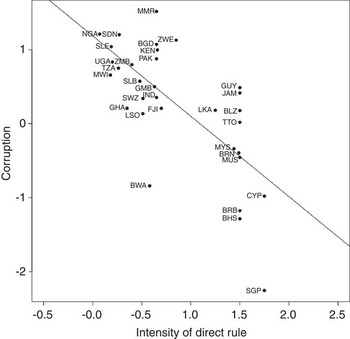
The strong positive relationship between the extent of indirect rule at the time of independence and the perception of corruption in the 1990s and 2000s is illustrated in Figure 1 (r=0.71, p<0.01). Of course, it may be that the high levels of corruption in some states are caused by underdevelopment more broadly and follow a different logic to that outlined above. This cannot be fully ruled out from the data available. However, by controlling for a number of other factors in a multivariate regression, we can see that the relationship between the extent of indirect rule at independence and contemporary corruption still holds.Footnote 121 It is almost certainly true that economic development and the curtailment of corruption over time went hand in hand.Footnote 122 But we would like to know if there is a relationship between the level of development at the time of decolonization (or rather, just before it) and subsequent development. Unfortunately, there is a limited availability of accurate data on gross domestic product (GDP) for many of the smaller colonies. By itself, the log of GDP per capita in 1950 for the twenty-two cases available is negatively associated with corruption decades later (see Table 1, column 2). However, when we include the intensity of direct rule, GDP per capita loses statistical significance and its sign changes, such that those colonies with higher GDP per capita in 1950 have higher levels of corruption in the 1990s and 2000s (column 3).Footnote 123
Direct rule and corruption in the former British Empire Key: BGD Bangladesh; BHS Bahamas; BLZ Belize; BRB Barbados; BRN Brunei; BWA Botswana; CYP Cyprus; FJI Fiji; GMB Gambia; GHA Ghana; GUY Guyana; IND India; JAM Jamaica; KEN Kenya; LKA Sri Lanka; LSO Lesotho; MMR Myanmar; MUS Mauritius; MWI Malawi; MYS Malaysia; NGA Nigeria; PAK Pakistan; SDN Sudan; SGP Singapore; SLB Solomon Islands; SLE Sierra Leone; SWZ Swaziland; TTO Trinidad; TZA Tanzania; UGA Uganda; ZMB Zambia; ZWE Zimbabwe

Multivariate Regression Results

Note: The dependent variable is Corruption. Standard errors are reported in parentheses. ***, **, and * denote significance at the 1, 5, and 10 percent levels respectively.
We would also like to know whether some prior factor is causing states to have both higher levels of indirect rule and higher levels of subsequent corruption. Drawing on recent work by Gerring et al., we can include factors that are believed to have caused colonial regimes to have instituted direct or indirect rule.Footnote 124 It is likely that indirect rule is partly a function of the size of a given colony. That is, we would naturally expect larger states to have institutionalized indirect rule. This is indeed the case, but indirect rule remains a statistically significant correlate of corruption even when colony size is controlled for (column 8). There is no correlation between indirect rule and factors like ethnic, religious, or linguistic heterogeneity (not shown) or with features of colonization such as pre-colonial population density (column 5) or the size of the settler population (column 6). The most consistent result from Gerring et al.'s study is that more developed pre-colonial states were more likely to have higher levels of indirect rule. A similar conclusion can be implied from Hariri's analysis of pre-colonial state building and postcolonial authoritarianism.Footnote 125 I include Gerring et al.'s measure of pre-colonial (or rather, early colonial) stateness. By itself, stateness is positively correlated with corruption in the 1990s and 2000s but its effect loses significance when the more proximate measure of indirect rule is controlled for (column 7). Similarly, there is also a correlation between pre-colonial development (as estimated by Mahoney, Lange, and Von Hau) and subsequent corruption (column 4), but not once indirect rule is controlled for.Footnote 126 Essentially, we can infer that more developed pre-colonial states were more likely to have indirect rule, and subsequently became more corrupt (and less developed)as independent states.Footnote 127 Thus, we can rule out with some confidence the possible counterargument that more developed colonies simply became more developed, and hence less corrupt, independent states. Finally, we can disaggregate the data into democratic and non-democratic polities. Here I use a level-measure of democracy just prior to the period in which the dependent variable is measured (1995 in this case).Footnote 128 The results for democracies and non-democracies are illustrated in columns 9 and 10 respectively. Interestingly, the results are almost indistinguishable across the two regime types. Alternatively, the results also remain robust for the inclusion of a stock variable of democracy, whether binary or continuous, from independence to 1995 (not shown). In short, democratic experience seems to have little impact on the extent of patronage or corruption when we control for the centrifugal legacies of colonial rule.
Although variation in directness of rule is not exogenous to pre-colonial state building, we can have some confidence that the association does not run directly from the characteristics of the pre-colonial states to postcolonial patronage or corruption. It is true that better-institutionalized precolonial states were more likely to experience indirect rule, that such postcolonial states persisted with more decentralized forms of government, and that such states went on to have more contemporary corruption. A reasonable interpretation might be that because empires simply incorporated ‘traditional’ patrimonial state structures through indirect rule, higher postcolonial levels of patronage simply reflect the continuity of traditional political practices in such cases. Where colonial states faced a ‘blank slate’ they could introduce more rational forms of government.Footnote 129 There are possible examples such as Mauritius, which was established and populated de novo as a British colony and has since experienced relatively competent government following independence.Footnote 130 More systematic historical evidence does not support such a view, however. Within India, for example, there is no evidence of a statistically significant relationship between the geographic extent of direct of rule at the state level and subsequent corruption. India was itself comprised of both directly and indirectly ruled territories.Footnote 131 In her study of the long-term effects of colonial rule, Iyer finds that at the substate (i.e. district) level in India, direct rule is associated with lower levels of development and public goods provision.Footnote 132 This supports the argument that the positive association between direct rule and the quality of governance operates at the national rather than subnational level. That is, indirect rule is correlated with a lower quality of postcolonial governance not because such territories were already ruled by corrupt, patrimonial leaders, but because of the way in which this pattern of indirect governance allowed for the subnational capture of the state during the critical juncture of decolonization. As the section on India above illustrated, it was the leaders of India's directly ruled provinces who pushed the hardest bargain during the institutional and constitutional design of independent India.
These findings are not conclusive; none can directly confirm or disconfirm the theory proposed above. However, the fact that the structural conditions of the late colonial period are systematically correlated with the institutionalization of corruption decades after independence is suggestive. Further empirical tests of the relationship would ideally exploit some exogenous source of variation in centrifugal pressures at the time of state formation, but it is difficult to see how the strict conditions of exogeneity would be met in practice. Nevertheless, when considered in light of the results of other observational and pseudo-experimental research on the relationship between centripetalism and governance, the findings do ring true and have important policy implications.
Conclusion
What does all this mean in terms of our theoretical understanding of the origins of patronage, how we might prevent its emergence, and how we might reform it? First, patronage seems both less intense and more amenable to reform in more centralized polities. However, centripetalism is highly path dependent. While states do sometimes become more centralized over time, England and France being prominent examples, this is often a slow process. Thus, institutional and constitutional changes to the structure of the state at critical moments are of major significance at least into the medium term of several decades. Civil wars, social revolutions, and other contentious events open up the space in which actors at multiple levels can attempt to leverage their power to gain control over the institutions of the state with the effects lasting decades or more. As in India in the twentieth century and America in the nineteenth, the institutionalization of local control over municipal and state-level patronage resources has had a persistent effect on efforts at administrative reform. Central leaders depended on local politicians to deliver votes and so were compelled to turn a blind eye to corruption at lower levels.Footnote 133 One could say the same of the cacique democracies in Latin America.Footnote 134 In these cases, as elsewhere in the former colonial world, patronage was a tool of state building as well as party building.Footnote 135
Second, establishing the direction of the relationship between centralization and patronage has important theoretical and policy implications. While it is argued in some quarters that decentralization is a remedy for corruption and patronage because it should foster greater accountability and oversight, in practice this does not seem to occur. There is good evidence to suggest that patronage is driven by the periphery rather than the center as is sometimes implied.Footnote 136 Indeed, the Indian case suggests that patronage machines may be driven by intra-party conflict between provincial and central political leaders.Footnote 137 While decentralization has its benefits, without other reforms and institutional safeguards, it may exacerbate rather than mitigate the prevalence of patronage and corruption.Footnote 138 Rather, what is needed is greater de facto separation between the legislative, executive, and judicial arms of the state, so that politics is focused at the level of policy design rather than implementation. All of this suggests that while ceding patronage resources to provincial elite brokers may be a way of retaining national unity through democratic rather than authoritarian means, there are significant trade-offs in terms of the quality of governance. The recent transitions to democracy in Iraq and Afghanistan illustrate this dilemma well. State building amid centrifugal pressures is necessarily a long and sometimes painful process.
Third, it should also be borne in mind that centralization is no guarantee of good governance either. Overly centralized government with an absence of institutional checks and balances can result in rent-seeking and corruption, not to mention outright abuses against their populations.Footnote 139 Dictators across Africa, even in relatively strong and centralized states like Rwanda, have been prolific users of patronage, and have used control of the state to amass enormous personal fortunes. Governments need local knowledge and citizen engagement to function. Yet, it has to be borne in mind that the state is no less present or pervasive in decentralized states. That is, decentralization does not necessarily correlate with increased space for civil society to engage with and control the design or implementation of policy. Moreover, decentralized states are equally prone to favoritism and corruption. Local politicians can be every bit as exploitative and incompetent as national ones. Ultimately, good governance rests on finding a balance between administrative autonomy and democratic responsiveness.