Introduction
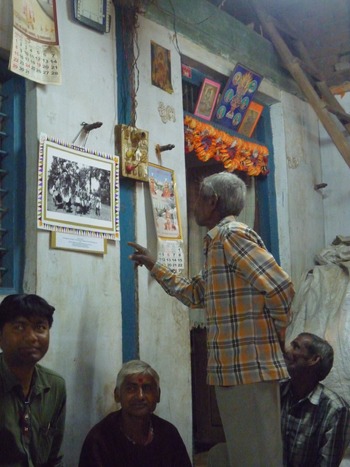
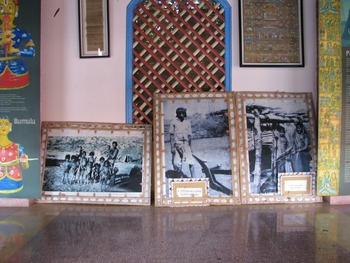
Two neon tubes light the house, and some daylight falls through the open door. Two people are spreading a large plastic cover and a blanket on the mud floor and everybody is asked to sit down, as the two finely carved wooden benches and the brown plastic chairs do not offer enough seating for everyone. Seven Rathwa men are sitting down, among them Narayan, Vikesh, and Bhavani Singh Rathwa. About the same number of white, European researchers, both men and women, are seated, as are two male Indian researchers, who will also function as translators. In a second row, a number of schoolchildren and several Rathwa women are sitting down. The second row will change in the next two hours or so, consisting of five to 12 people who are mostly listening; people will leave the room from time to time, only for other locals to take their places. What is going on here is interesting for them, but not very exciting: the Rathwa men, the two Indian non-locals, and the foreigners are engaging in a conversation about photographs hanging on the plastered walls. Between calendar images, prints of Shiva and Krishna, photos of people now deceased, garlands, clocks, and the light switchboard are six reprinted black-and-white photos from the 1920s to the 1960s. These photos were taken in India and subsequently became part of photo archives in the United Kingdom and Germany. They have now made their way back to India, into the house of Bhavani Singh Rathwa. Reprinted and nicely framed with colourful borders, they decorate the walls and remind him and the others of days long gone. Two of the images depict communal dances. Bhavani Singh Rathwa points out one of them and explains that he likes this one in particular because it reminds him of his own past (see Figure 1). He feels attracted to it because ‘there is a story in the photograph: that people came together, wore special clothes, wore traditional horns, had music instruments, drummed them. So there is a sort of festivity with action, movement. A collective thing. […] The sense of collectiveness and celebration.’ One of the Indian researchers, Mr Aggarwal, after listening to Bhavani Singh, adds, ‘These people [in the photograph] are from some other place. They have different headgear. But ancestors of this place, [Bhavani Singh Rathwa's] own father, grandfather, they also had a similar headgear, not with horns [as the Bison Horn Maria in the photograph], but with peacock feathers. […] So he likes it, because maybe it's a different thing, but he can see that these are still his own ancestors, celebrating.’
Bhavani Singh Rathwa and friends in his house. Source: Photographer: M. Elliott.

There are multiple Adivasi voices in this more contemporary appropriation of photographs dating back to the late 1920s and 1930s. The local Rathwa expressed their contemporary views, framed by their own visual and belief systems. They also resonate with the depicted Adivasi when reflecting on actions, gestures, or emotions expressed in the photographs. This Adivasi voice from the past could not always resonate so powerfully, but was—as this article will argue—restricted and determined at the moment of the photographs’ creation by technical conditions, political circumstances, and the photographer's preconceptions. Nevertheless, restriction is not erasure. Photography is a medium of expression for the photographer as well as the photographed person. It would be inappropriate to deny the photographed Adivasi a voice, even though in this photographic archive it often seems subdued.
The archiving of the photographs, together with their age, led to their subsequent recognition as historical documents or cultural heritage. As such, they are references to the past, viewed today. In these contemporary viewings lies not only the potential to construct history, but also of a renewed suppression or expression of the Adivasi voice. As the last section of this article will demonstrate, contemporary appropriations of historic Adivasi photographs have the potential to portray an Adivasi understanding of the past and the present or—yet again—to take little notice of emic perspectives.
Encoding the medium
When tracing Adivasi voices in photography, we need to turn to their moment of creation. The photographs displayed in Bhavani Singh Rathwa's house were created in the early to mid-twentieth century, at a time when professional photography was comparatively well established in India. The first cameras had been shipped to the country in the 1840s (just 15 years after Nicephore Niepce produced the world's first photograph in 1826) and the 1860s saw the emergence of the first photo studios in the country. Early Indian photography was, on the one hand, a medium for people from the upper classes, who had the economic and cultural capital to visit a photo studio and have their photo taken, mostly as a way to represent an ideal version of themselves through posture and symbols. On the other hand, photography became a tool for visually tracing and documenting the subcontinent. Researchers and colonial administrators tried to capture India and its people on glass plate and celluloid, thereby aiming at comprehensive inventories (Pinney Reference Pinney1997). Probably the best-known endeavour in this regard is ‘The people of India’, an eight-volume compendium commissioned by Lady and Lord Canning in the aftermath of the Rebellion of 1857, but numerous other photo collections of professional photographers and researchers creating inventories followed suit (see Chaudhary Reference Chaudhary2012, Karlekar Reference Karlekar2005, Falconer Reference Falconer1995, Blaney and Shah Reference Blaney and Shah2018, Gordon Reference Gordon2004).
One of the most extensive photographic inventories focusing on the subcontinent's Adivasi population is the Eickstedt archive, consisting of almost 12,000 images from the 1920s. To understand these photographs beyond their aesthetic value or an immediate Punctum (Barthes Reference Barthes1982), they need to be conceptualized as part of a photographic culture and as an interpretive process. Similar to the process around writing culture (Clifford and Marcus Reference Clifford and Marcus2010), photographs, especially anthropological ones, are a descriptive medium aimed at making statements about culture(s). As documents, they largely depend on the photographers and their preconceptions and ideas. Photographers select and frame a moment and assess it on a subjective basis, yet always in conjunction with the camera. The use of technical equipment adds a sense of ‘objectivity’ when capturing a given place and time, but the photograph remains an interpretive process at the time of its creation. Consequently, some (anthropological) photographs tell more about the person who took the photograph than about those being photographed. Preconceptions are furthermore enhanced when photographs are systematized in larger collections or as archives. Hence, to understand a photograph beyond its aesthetics, it is necessary to situate it in its historic context, to consider both the images’ content and the framing context that the photographer and the archive provide. To decode an image as a medium, we need to comprehend the encoding processes related to it (Hall Reference Hall, Durham and Kellner2006).
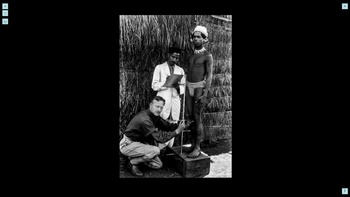
The encoding of the photographs shown at Bhavani Singh Rathwa's houseFootnote 1 was done between 1926 and 1929, when Egon von Eickstedt, a German anthropologist, went to India on a two-year expedition. The Leipzig ethnographic institute and museum commissioned Eickstedt to ‘undertake an ethnographic-anthropological research expedition to anthropologically and ethnographically investigate the tribes of India’.Footnote 2 As a physical anthropologist, Eickstedt had previously studied prisoners-of-war in the camps in Wünsdorf, Germany, and Romania. He had published his dissertation on the imprisoned Sikhs and their ‘race’ in 1921. He had held several short-term assistant positions all over the country and was well acquainted with Otto Reche, Felix von Luschan, and the then head of the Leipzig ethnographic institute and museum, Karl Weule. Eickstedt was familiar with the works of Herbert Risley, Frederick Fawcett, and Charles and Brenda Seligman, for example, and asked some of them for letters of support.Footnote 3 With an expertise and continuing interest in the racial anthropology of Indians, Eickstedt successfully negotiated and organized an expedition to the Indian subcontinent, financed by the Leipzig ethnographic institute and museum as well as the German Research Council. He departed on a steam ship in late 1926 for what was planned as a one-year journey, but ultimately lasted more than 26 months, in which Eickstedt—until March 1928 together with his wife—covered more than 30,000 km, visited around 50 different Indian communities, measured approximately 3,700 individuals, created a photographic archive of more than 12,000 photographs, and collected 2,000 artefacts (see Figure 2).
Baiga man with Eickstedt and assistant, E 3441. Source: © Staatliche Kunstsammlungen Dresden.

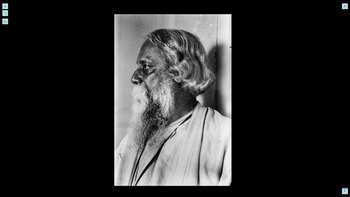
Eickstedt and his wife travelled via London and the Netherlands to Colombo. On board they met members of the Tagore family. Landing in Colombo in December 1926, the Eickstedts took four months to photograph and measure inmates of Colombo prison and the Veddah further inland and to the east of Ceylon. Eickstedt commented on positive and negative encounters with the indigenous population, for example, naming the Veddah of Bingoda ‘actors’ who moved from their dwellings into caves in order to create an impression of primitivism. The wet climate prevented him from creating moving pictures and a lot of his equipment was damaged. Subsequently, the Eickstedts moved on to Madras and then Gumla, where they collected and photographed the Sora. His remarks on the population here were rather derogatory. Since people were not willing to be photographed or measured, but rather ran away screaming, it was only through the ‘resolute intervention of the Paikos, i.e. the servants of the district superintendent, to get the distrustful and stubborn Sora to be measured and photographed and to give away some ethnographic artefacts’.Footnote 4 As he did in Ceylon, Eickstedt worked together with the colonial government who supported him in most of his research. Only in Andaman—after a visit to the Shan in Burma (the fourth sub-expedition)—was the government reluctant to help. He had to organize the transport to the Onge, Jarawa, and the Great Andamanese himself. He complained about a loss of material, transportation difficulties, and health problems. Nevertheless, he still managed to collect 147 artefacts, talked about positive encounters, and took 750 pictures. From January until March 1928 Eickstedt and his wife recovered in Kolkata and Shantiniketan, visiting the Santal and the Tagore family (see Figure 3). Contrary to their original plan and due to climatic conditions, they moved on to South India to visit the Kurumba, Paniya, Toda, and Kadar. In Malabar, Eickstedt met with Ananthakrishna Iyer and documented Brahman as well as Jewish inhabitants. After his wife fell ill and returned to Europe, and during the sixth and seventh sub-expeditions, Eickstedt travelled to Chhota Nagpur and related areas, visiting the Gond, Khond, and other communities, as well as the Bhil, Korku, and Rajputs in western India. At the beginning of 1929 Eickstedt returned to Europe, taking up a post as head of the anthropological institute in Breslau.Footnote 5
Rabindranath Tagore, T 0002. Source: © Staatliche Kunstsammlungen Dresden.

Eickstedt's motivation for the expedition was to try to prove an anthropological theory of the Indian subcontinent's settlement, and of humankind in general, which he meant to validate and construct through measuring and photographing India's indigenous population. He later published his opus Rassenkunde und Rassengeschichte der Menschheit, in which he listed and described different ‘races’ and types, classified the human population, and explained their distribution worldwide. His theory rested in part on the data collected during the India expedition. Eickstedt also published a few photographs from the archive therein.
He taught as a professor at Mainz University after 1945 and his colleagues and assistants perceived his work positively. The research community of his time came to a similar conclusion, making Eickstedt the head of the German anthropological society from 1948 until 1952. Since then, however, Eickstedt and his works have been analysed more critically. Lüddecke and AG gegen Rassenkunde argue that his work was motivated by racism (AG gegen Rassenkunde 1998; Lüddecke Reference Lüddecke2000). Preuß understands Eickstedt's work as that of an opportunist working in accordance with the understanding of the time (Preuß Reference Preuß2009).
Eickstedt's published works create an ambiguous picture. A number of his books before and after 1945 show clear racist tendencies, visible especially in his 1934 book Die rassischen Grundlagen des deutschen Volkes (‘The racial foundations of German people’), but also in his aforementioned main work Rassenkunde und Rassengeschichte der Menschheit. He refrained from the standard terminology of racial anthropology of the Nazi era and was not a leading figure in the eugenics discourse. However, he did state that ‘race’ was inevitably associated with psychological conditions and character, making his theories scientifically untenable from a contemporary point of view. He was also decidedly racist, proclaiming that, ‘Whoever is healthy and belongs to a healthy bloodline is obliged to the people to raise full-value descendants’Footnote 6 (see also Müller Reference Müller2015).
Focusing in on the expedition, Eickstedt expressed his views and sentiments in the diaries he wrote during that time. As these writings were not meant to be published, they have a harsher tone than his books and articles. Here Eickstedt articulated his caustic perceptions of the Indian population. His accounts reflect his focus on anthropometrics; in many of his writings he describes physiognomic characteristics. They also include his thoughts on and descriptions of the encounters, his impressions, general description of his journeys, and observations. When meeting the Sora in Gumla during the second sub-expedition, for example, Eickstedt painted a very negative picture of them. He described a Sora chief as ‘young and very stupid’,Footnote 7 and his accounts of the Sora in general are abusive and insulting. Eickstedt did not seem to feel for their subjugation at all. He was mostly interested in trying to study and collect as much data as he could. He did not shy away from having the Paikos drag fleeing and resistant Sora back for him to photograph them. A few months later, while working in South India, Eickstedt summarized his attitude towards the Indian population by writing in his diary that, ‘The Indians, in their entity, are human beings of a second grade, without sense or ability for the greater in Europe.’Footnote 8 He repeats arrogant and racist judgements like this a number of times in his diaries (but not in his published accounts). They therefore seem to reflect his basic attitude, rather than being a one-off. Alongside his abuse of the Indians, he praised the British for trying to squeeze as much out of India as they could. In general, British administrators were Eickstedt's first point of contact in a new area. They influenced his travels through permissions, recommendations, and resources. However, Eickstedt saw himself as an ambitious scholar and did not participate too much in receptions and social commitments in British India.
It has to be acknowledged that Eickstedt also formed friendly relationships with individuals from the Indian elite, such as Sarat Chandra Roy, or the aforementioned Tagore family, and Ananthakrishna Iyer. He commented positively on a number of scholars or helpful administrators that he met throughout his journey.Footnote 9 Moreover, despite his generally negative attitude towards the ‘Indian psyche’, Eickstedt reported on his friendly encounters, as he, staying for a few days or weeks, became friends with some of the Veddah, the Ongi, or the Toda.Footnote 10 He complained mainly about mainstream Indian culture, with which he contended in the indigenous population's ‘proletarianization’. He despised ‘primitives’ dressed in rags or adopting Western clothing.Footnote 11 He further criticized the acceptance of Hindu rituals and clothes, along with intermarriage and ‘mixture of races’, mainly because it would spoil the ‘purity’ of his ‘objects’ and potential research findings. He developed a romanticized picture of an unspoilt, savage people living in the jungle.
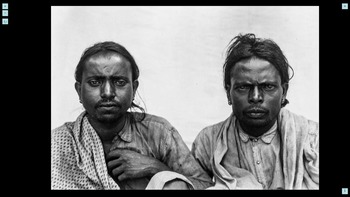
Eickstedt's photographs reflect these views. The ‘type’ photographs (similar to anthropometric photography), which account for roughly two-thirds of the images, especially reflect his racial anthropological agenda. As with many of the early anthropological photographs from India and other countries, they served as an index of veritable ‘reality’,Footnote 12 as an ‘objective’—because mechanically produced—image of something real. Yet, the portraits not only depict what was there at a particular time and place, but also reflect the relationship between photographer and those photographed. They document the hierarchical structure underlying the act of photography. Even though the photographer is not depicted, his behaviour and attitude can be traced, since colonial anthropometric photographs can be read as signs of subjugation and unequal power relations.Footnote 13 His research modus operandi, which included the aforementioned measuring and photographing in prisons or his use of physical force, supports this reading. A number of photographs show the resentment of the photographed Indians in the form of cautious, dismissive, or preoccupied facial expressions, indicating an unwillingness to be photographed, discomfort, or even forced posing. Take, for example, the image of two men from southwest India (T 3895 b).Footnote 14 Neither man seems comfortable. The man on the right is furrowing his brows, while the man on the left seems in a state of total apathy (see Figure 4). It is very likely that Eickstedt positioned them in front of the white cloth, asked them to sit still next to each other, and have their faces (and subsequently also their profiles) photographed. The two men eventually had their photos taken—after a struggle or without objection?—but their expressions indicate that it was not an enjoyable moment for either of them.
Two Pulaya men, T 3895 b. Source: © Staatliche Kunstsammlungen Dresden.

At times, it was possible for the people to refuse to be photographed. Just as the Sora would run away, in the Nilgiris, too, people fled or left their houses when hearing about the approaching foreigner with his equipment. Eickstedt also noted that people fled because of rumours that he intended to resettle local people from the subcontinent to the Andaman Islands. For those who could not escape, their expressions, posture, and movement were the only remaining ways to transmit refusal or their dislike of being photographed. Still, it is admittedly very hard to determine just from looking at an image what exactly this single moment fixed on celluloid entails. Is the grim look a conscious protest against being photographed? If this is the case, does the rejection of being photographed result from the camera per se, from notions of photography as soul-robbery,Footnote 15 from different ways of understanding visual representations,Footnote 16 or from Eickstedt's attitudeFootnote 17? Whatever the case, the faces in quite a number of photographs from the expedition display the dislike or discomfort of those photographed. In the context of photography in British India, Eickstedt's research approach, characterized by hierarchical relationships and his individual experiences in India, most likely contributed to their dislike and discomfort.
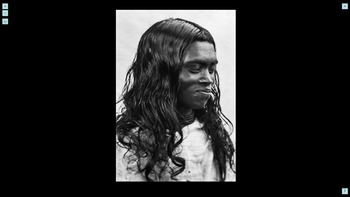
Nonetheless, the variety of photographs included in the 12,000-strong image archive forbids us to speak of a general de-subjectivation of the probands. The portraits reflect a diversity of friendly as well as distressed subjects, some showing discomfort and being forced to sit still, while others portray self-esteem and dignity. Take the Pulaya man portrayed in T 3886 as another example (see Figure 5).Footnote 18 Even within the limits of type photography—which captured his front, three-quarter-profile, and profile in front of a white cloth—the photograph still portrays a smiling young man, whose appearance conveys to me distinctive grace and sympathy.
Pulaya man, T 3886. Source: © Staatliche Kunstsammlungen Dresden.

The medium
The archive consists of approximately 12,000 photographic positive prints and about the same number of corresponding negatives. Mounted on index cards and sorted into categories, the Dresden ethnographic museum keeps the photographs in a drawer. The index cards bear short handwritten numeration and captions, indicating the place and/or ethnicity of the person portrayed.Footnote 19 Making the photographs part of a museum collection is a way of recognizing the photo archive's material qualities, as most museums continue to rely on artefact collections as material traces of the past (Macdonald Reference Macdonald1998; International Council of Museums 2009). Hence, preserving and displaying photographs in museums is a process of heritagization as well as of the value of photographs as objects (see Müller and Wille Reference Müller, Wille, Schnepen and Sen2019).
It evokes something of photography's in-between status, a medium that oscillates between visual representation and art, part material artefact and part technical reproduction. A photograph always has a close relation to reality, since it can only depict what was there at a particular time and place. It is literally a form of writing on a carrier material, such as celluloid or glass plates. The supposedly ‘neutral’ or ‘objective’ character of photographs stems from their comparison to paintings as photography's predecessor and the technical basis of photography. At the same time, a photograph is a very subjective thing. It is a selection of time and place; it is an individual framing of a moment and a value judgement that a particular moment is worth capturing and preserving. A photograph oscillates between the photographer as artist and the technical reproduction of a given scene; it is a medium characterized by its place between authenticity and construction. Consequently, it took some time for photography to be accepted as a form of art or as cultural heritage. It was only from the 1950s onwards that photographs were acknowledged more widely and even entered art collections—despite the fact that photographers had artistic takes on photography from early on (with Samuel Bourne being but one of the more famous photographers to do so: see Pohlmann et al. Reference Pohlmann, Siegert and Ruelfs2001).
The fact that Eickstedt was not a professional photographer enhanced the ‘objective’ character of the photographs. Eickstedt was a physical anthropologist who gained experience in photography through practice. Consequently, his shot selection resulted in some of his photographs showing bodies with cut off arms or feet, are sometimes under- and overexposed, or not in focus. This makes the photographs seem more genuine, as they differ from studio and posed photography. It shows that the mechanical process influences the outcome and that Eickstedt did capture ‘real’ scenes in a candid style, especially regarding the third of the archive that covers ethnographic content (unlike the anthropometric-type photography). Nonetheless, the photographs also bear traces of Eickstedt as the constructor, because he chose, cut, and fixed a scene. He decided what should be documented and what should not be. The Leipzig ethnographic institute and museum, as the sponsor of his expedition; the anticipated reception of the photographs in both academia and by the German public; and the written theories that the photographs might support co-determined what he photographed. The images stand in close relation to his writings and to the artefacts he collected.
What can also be traced in the photographs-as-medium is Eickstedt's concept of an ‘unspoiled’ India, which he wanted to document before it vanished. It materializes in both the artefacts he collected and the photographs he took. The 2,000 objects in the collection are almost entirely made of natural material such as wood, palm leaf, or clay. The photographs also aimed at capturing this ‘primitive’ India in harmony with nature. Yet, not least due to the sheer number of images, cultural change, development, and diffusion in material realms found their way into the photographs. Eickstedt was not completely able to avoid capturing Indian men in jackets with English umbrellas, cars, churches, aluminium pots, or porcelain. While he was able to keep the illusion of an unchanging, pristine India alive through his artefact collection, the reality of cultural change materializing in everyday artefacts appears in the photographic accounts.
After Mainz University, where Eickstedt taught as a professor after 1945, had archived Eickstedt's Adivasi photographs, the Dresden ethnographic museum also included them in its archive. The archiving and heritagization of the photographs in a university and museum archive slightly altered their perception. Staff at the university sorted, numbered, labelled, and inserted the photographs into a drawer in an order based on date, place, and community. Labels on the index cards read, for example, ‘E 1496 Landschaft mit heiligem Baum, Tellicherry’ (‘E 1496 Scenery with holy tree, Tellicherry [Thallassery]’) or ‘T 1485 Sora ♂+♀: (negr.) Barangsing’. As Cohn and Dirks have shown with reference to the example of Indian, or Foucault or Derrida in a decidedly more Europe-centred analysis of archival practice, archiving always implies a certain amount of power (Cohn Reference Cohn1996; Dirks Reference Dirks2001; Foucault Reference Foucault2015; Derrida and Prenowitz Reference Derrida and Prenowitz1995; see also Ebeling and Günzel Reference Ebeling and Günzel2009; Müller Reference Müller2021). Archival power is inherent in its being an ordering space. The archival institution exercises power through specifying an order, and including and excluding information. Archivists are in power when they act as gatekeepers, as are custodians, politicians, researchers, or historians accessing and using archival information.
Viewing the Adivasi within the larger context of museumization and archival practice, as instances of ordering and constructing knowledge, reduces their voices to a minimum. A small intellectual elite from the Global North predominantly conceptualized, installed, dominates, and keeps alive a system for integrating their visual representations. It is—or at least has been in archival and museum set-ups for a long time during the twentieth century—a domain of regulated access and control to resource material that could be used for providing information on and about individuals and communities. Anthropological and archival knowledge, once codified, could be, and was, used for political means (see Stoler Reference Stoler2009; Edwards Reference Edwards2001; Pinney Reference Pinney1997).
Political use (and misuse) of archival material was not particularly relevant to the Eickstedt archive, not least since Eickstedt went as a German researcher to British India in-between the two world wars, and hence at a time when relations between Germany and the United Kingdom were not particularly good.Footnote 20 Direct political instrumentalization of the photographs thus did not occur, but Eickstedt used some of the images in publications to further his own career and to establish and disseminate his own scientific concepts. He proceeded to publish some of the images from the expedition to order and characterize people all over the world in an evolutionary system of ‘races’. This way of using Adivasi images in ordering systems was in line with a general development in German anthropology—and eventually society at large—towards a racism that was to culminate in eugenics and the Holocaust (see Penny Reference Penny2002). Yet, there was no immediate political gain in the archive's ordering with regard to the Indian subcontinent or the Adivasi people. It was only after the relocation of the archive to the Dresden ethnographic museum that it drew attention anew.
Decoding the medium
Muttappan teyyam
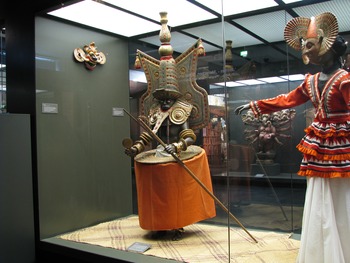
The ordering and storing process saw no expression of Adivasi voices. The museumization of the collection instead meant the inclusion of a comparatively well-defined Western value system of cultural heritage, archival documents, and museum objects. Despite severe scrutiny and criticism of (not only ethnographic) museums, in practice archival heritage in museums and archives meant predominantly the preservation of collected tangible heritage.Footnote 21 The use of the photographs by the Leipzig ethnographic museum's staff in the early 2000s also bears no traces of acknowledging or actively involving an Adivasi voice. They used single images from the photo archive to understand better the items in the South Asia collection, which they installed in their new permanent exhibition. The curators referred to six photographs (E 1547 to E 1552) when commissioning a life-size figurine to support the Muttappan teyyam costume, collected by Eickstedt in northern Malabar in 1928, which was to be set up in the new South Asia gallery.Footnote 22 They saw the photographs as an index of the Keralese religious ritual of Muttappan teyyam and used them to don the costume and dress the figure in the showcase (see Figure 6).
Leipzig ethnographic museum, exhibition detail. Source: Photographer: K. Müller.

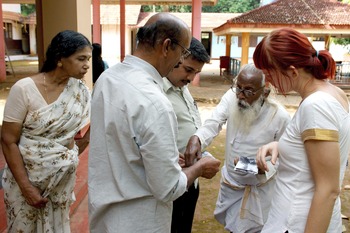
It was only subsequently that academics researched the photographs. Those from South India, which included the Muttappan teyyam photos, particularly formed part of my research, which included a visual return (see Figure 7).Footnote 23
Discussing the photographs in Kuthuparamba. Source: Photographer: T. Kauroff.

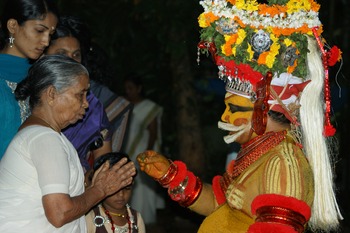
Contemporary performers of Muttappan teyyam, being South Indian Adivasi, saw the photographs and the museum installation and clearly voiced their disagreement. Balakrishnan, one of the performers, disclosed that Eickstedt's photograph was a misrepresentation of Muttappan teyyam, as the complete make-up on the upper body and face is missing in the photographs and consequently in today's exhibition. Balakrishnan said that such a depiction of Muttappan is useless in a religious context, in which the ritual is embedded (Müller Reference Müller2017a, Reference Müller2015). The photograph as a medium could not express the voice of the Adivasi, because it was obscured by Eickstedt's intervention as a photographer constructing a scene. But it could be heard when contemporary Adivasi saw the photographs, as Balakrishnan and other performers from northern Kerala clearly voiced their disagreement with both the photograph and the museum's representation of it (Müller Reference Müller2017a) (see Figure 8). The museum subsequently acknowledged this by altering the label in the exhibition, which now points out the missing make-up.
Asking Muttappan (in Balakrishnan's body) for advice. Source: Photographer: T. Kauroff.

Purvajo-ni Aankh
The Adivasi voice relating to the photographs could be heard more clearly when parts of the Eickstedt archive returned to the Indian subcontinent in another context in early 2012. As one outcome of an international workshop on the future of anthropology's archival knowledge (see Rycroft and Müller Reference Rycroft, Müller and Blesse2013), approximately a hundred photographs were digitized, burned on CDs, and brought or sent to the Adivasi Academy's Museum of Voice in Tejgadh, Gujarat.Footnote 24 The Adivasi Academy describes itself as ‘a combination of a university, a research centre, an activist-centre, a laboratory for experiments in development and a cultural expression forum, addressing all aspects of adivasi culture, history, society, rights and development’.Footnote 25 Its Museum of Voice is not so much an institution for storage, but ‘a “laboratory” for contemporary ethnic, anthropological and artistic studies carried out from the perspective of Adivasis themselves’.Footnote 26 The curators Narayan and Vikesh Rathwa, together with colleagues from the Museum of Voice and in close collaboration with the local Rathwa community, created an event that they called ‘Purvajo-ni Aankh’ or ‘Through the Eyes of the Ancestors’ (see Figure 9). This multi-sensory event combined the exhibition of the photographs at Koraj Hill as an open space with dances, singing, and celebration in the houses of four Rathwa in nearby villages, as well as the consecration of 36 of the images (Müller Reference Müller2017b). The day-long celebration of the photographs as returned ancestral images drew the largest crowd of several hundred local, national, and international visitors. The images were reproduced as enlarged printouts, several of them blown up to nearly a metre in height, some in A4 size. They were mounted on cardboard decorated with colourful borders, framed in large bamboo frames, or pinned on a background resembling bullock-cart side panels. The opening of the exhibition at Koraj Hill was shaped by local Rathwa people, with women, men, and children singing and dancing on their way to the sacred site. By the time the procession reached Koraj Hill, the curators from the Museum of Voice had installed most of the images. Only 36 images in four large baskets were still on their way. Among the singers and dancers, four men had the baskets mounted on their heads as they made their way to the sacred site. Ganesh Devy, co-founder of the Adivasi Academy, said a few introductory words, after which the exhibition was opened for all to visit and see. People came from near and far to look at the images, take mobile phone shots, discuss, and comment on them. The 36 images from the baskets were taken out and the local priest consecrated these as images of ancestors returning to Tejgadh and to the local Rathwa community living around Koraj Hill.
Museum of Voice, exhibition detail. Source: Photographer: K. Müller

The 36 consecrated images subsequently made their way to four houses in nearby villages. Once again stored in the baskets and mounted on their heads, the four men transported them with less celebration but no less importance to the houses of Jenti Rathwa, Bhavani Singh Rathwa, Muja Rathwa, and Narayan Rathwa. Discussions between the residents, the curators, and visiting researchers took place in the subsequent days in each of these houses. These discussions provided further opportunities for the local Adivasi to express their views on the photographs. As Bhavani Singh Rathwa explained, the photographs depicting Adivasi dancing and celebrating for him evoked a sense of community and togetherness. Bhavani Singh Rathwa, as with other Rathwa, saw the images as traces of the past and visual representations of ancestors. Comparing today's attire and way of life to those depicted aroused critical and admiring comments, ascertaining changes for the better and the worse, and references to religion and beliefs (see Müller Reference Müller2017b). A dominant and almost universal comment was the recognition of the images as ancestors, not only in verbal expression in the discussions, but also in the way the images were placed in the four houses. Situating them in close proximity to Pithora (see Tilche Reference Tilche2015), images of Shiva and Krishna or photos of deceased relatives underline the photographs’ value as ancestral images.
The photographs remained in the houses for a few weeks or months. Subsequently, the curators integrated them into the Museum of Voice's collection. Today, some of them are on display in the permanent exhibition, provoking questions, discussions, and comments when visitors come to see the exhibition. Some are stored and taken out on occasions such as a recent meeting of several Adivasi groups discussing photographs and ancestral relationships.
Overall, Purvajo-ni Aankh was an occasion where the voices of the Adivasi were dominant. It was not so much the voice of the Adivasi depicted in the photographs per se, but their appropriation and expression by contemporary Adivasi people. The decision on how (or if) to use the images lay with the curators of the Museum of Voice, who decided for the images’ reproduction and installation in the exhibition-cum-ancestral-worship, foregrounding local visual economies and belief systems in relation to these photographs. Doing so was not using photography as an evidential strategy, an index, or a powerful means of representation (Edwards Reference Edwards, Banks and Ruby2011). Purvajo-ni Aankh was also not eliciting ‘what pictures really want’, was not seeing them in their own right, or seeing their visuality adequate to their ontology (Mitchell Reference Mitchell1996). Narayan and Vikesh Rathwa, together with their colleagues and the local Rathwa involved, saw the photographs as a medium to be interpreted and worshipped, but not to be deconstructed and contextualized with regard to the (European) photographer. (On the contrary, the Rathwa present in one of the discussion sessions voiced no interest when one of the European researchers offered a more detailed account of the photographers' background.) The photographs became, through Purvajo-ni Aankh, a medium that allowed for the expression of ideas about the past and present, and for manifestation of an Adivasi identity supported by the presence of ancestors. In other words, the voice of the Adivasi was expressed through or with the help of the eyes of the ancestors.
Conclusion
Photographs of Adivasi people, seen over time and from different angles, show that their voice has been almost absent in this form of visual media from its inception. In the course of encoding photography as a medium, in the main the European photographer set, chose, and arranged photographs, using the Adivasi as objects for what they imagined to be a rational representation of the truth. In the abovementioned example it was the German anthropologist Eickstedt, whose combination of racist theories and idealizations of an unspoilt Adivasi influenced the photographs, leaving their compilation and arrangement to tell more about the photographer and his time than about the Adivasi people depicted.
Yet, it would be incorrect to speak of a complete subjection of the Adivasi voice in (these) historical photographs. There were ways for the (non-)depicted Adivasi to voice their protest, refusal, or resistance, as their facial expressions, swift movements, or attempts to escape show. A limited number of photographs in the Eickstedt archive also depict acceptance of the photographic process or aesthetic preferences while being depicted. However, the photographer remains the relevant, if not dominant, factor in the creation of photographs of the Adivasi in the 1920s.
Another factor to be taken into account is the technical process of photography as a medium and the ordering of the archive. As shown, the medium was not so much to be used in the Foucauldian sense of the archive as an instrument of power, since the photographs in this large archive had no direct connection to the British rule of colonial India nor found a direct appropriation in this regard. Rather, the photographs were included in the heritage realm, as they found their way into an archive and a museum. They thus became, only in a subtler way, a means of representing (interpretive) hierarchies. In this regard, Adivasi voices were practically silenced.
The Leipzig ethnographic museum's use of (parts of) the photographic collection in the 2000s was not a way to break this silence, as it concentrated on the photographs as an indexical medium instead of one of subdued voices. In the process of redesigning the permanent exhibition, which was to include Adivasi artefacts, the German curators used photographs of the Eickstedt archive with the photographer's voice being central. They took his photographic (putative) documentation of Muttappan teyyam as veritable truth, resulting in a museum installation of a Muttappan teyyam costume that found little approval in contemporary South India. It was only subsequently that the Adivasi voice, as expressed by today's teyyam performers, found an entrance into this appropriation, albeit only in the form of an additional sentence on the display's label.
A decoding of the photographic medium with a decidedly stronger and louder Adivasi voice was the Purvajo-ni Aankh exhibition-cum-worship event in 2012. While a conference held in Germany and the European museum staff's selection of images preceded the event and thus determined the inventory of photographs for the Indian curators to appropriate, Purvajo-ni Aankh was nonetheless a loud Adivasi voicing in the truest sense of the word. Singing and dancing accompanied this use of the historic photographs in Gujarat, marking an understanding and use of the photographs clearly defined by the belief systems and aesthetic preferences of the Rathwa involved. The exhibition and consecration of the reproduced photographs indicated not only a close proximity to prevailing conceptions of visual media, but situated the photographs of Gujarati and other Adivasi people in a more pan-Adivasi context of ancestral worship.
In summary, the photographs’ existence as historical documents referencing the past contain fine traces of Adivasi voices. These traces can be either highlighted or dimmed, something that Adivasi and other stakeholders have recently been doing, with almost opposite results. It reproduced established visual economies and broke them up slightly. As circumstances of taking photographs can be diverse and complex, so are the moments of seeing and interpreting them. To deny the Adivasi in previous or in contemporary times a say in creating or recreating these photographs, is as wrong as overestimating their influence. It is rather the historicity of the photographs, containing references to the past viewed from today's perspective, which makes us aware—yet again—of the intertwinement of Adivasi lives with historic ideas and documents. Acting outside of this history is as impossible as an unadulterated voice or an unframed image.
Competing interests
None.