Introduction
Major depression and anxiety disorders (ADs) are debilitating and extremely prevalent diagnoses (Kessler et al. Reference Kessler, Berglund, Demler, Jin, Merikangas and Walters2005) with wide-reaching negative psychological and economic impacts for both the individual and society (Greenberg et al. Reference Greenberg, Kessler, Birnbaum, Leong, Lowe, Berglund and Corey-Lisle2003; Beddington et al. Reference Beddington, Cooper, Field, Goswami, Huppert, Jenkins, Jones, Kirkwood, Sahakian and Thomas2008). The two sets of disorders are different; they can show distinct ages of onset (Kessler et al. Reference Kessler, Berglund, Demler, Jin, Merikangas and Walters2005), distinct heritability and genetic patterns (Jardine et al. Reference Jardine, Martin, Henderson and Rao1984; Kendler et al. Reference Kendler, Walters, Neale, Kessler, Heath and Eaves1995; Eley, Reference Eley1999), differential impact upon cognitive performance (Mogg et al. Reference Mogg, Bradley, Williams and Mathews1993; Bierman et al. Reference Bierman, Comijs, Jonker and Beekman2005), opposite effects on arousal (Clark & Watson, Reference Clark and Watson1991) and distinct pharmacological profiles (Deakin, Reference Deakin1998). Furthermore, the predominant subjective emotion in each disorder is different: ADs are characterized by a state of ‘worry’ (and normal positive affect) whereas depression is characterized by ‘sadness’ (and reduced positive affect) (Clark & Watson, Reference Clark and Watson1991; Brady & Kendall, Reference Brady and Kendall1992). Nevertheless, depression and ADs are also highly co-morbid with around 50–60% of depressed individuals reporting a lifetime history of AD (Kaufman & Charney, Reference Kaufman and Charney2000; Kessler et al. Reference Kessler, Berglund, Demler, Jin, Merikangas and Walters2005). This co-morbid pathology tends to be more persistent than either disorder alone (Merikangas et al. Reference Merikangas, Zhang, Avenevoli, Acharyya, Neuenschwander and Angst2003), with increased overall life impairment (Kessler et al. Reference Kessler, Stang, Wittchen, Ustun, Roy-Burne and Walters1998), worse treatment outcomes (Brown et al. Reference Brown, Schulberg, Madonia, Shear and Houck1996) and increased likelihood of suicide (Angst et al. Reference Angst, Angst and Stassen1999). The underlying causes of this co-morbidity remain, however, unresolved.
One possibility is that there is a relationship between the two sets of disorders that promotes co-morbidity. Negative affective states (such as depressed and anxious emotional states) increase negative emotional reactivity (Rosenberg, Reference Rosenberg1998) by potentiating the response to negatively valenced stimuli (Dichter & Tomarken, Reference Dichter and Tomarken2008). Depression and ADs may therefore predispose one another through the promotion of such negative emotional reactivity. Support for this idea comes from Beck's schema model, which argues that cognitive biases distort the processing of emotional stimuli (Beck, Reference Beck1967) and that depressed and sad mood can promote these biases, potentiating reactivity to negative stimuli. Accordingly, sad and depressed mood may sensitize the amygdala/bed nucleus of the stria terminalis fear/anxiety response network, facilitating the development of ADs.
Consistent with this, there is clear neurocognitive evidence for hyperactive aversive responding in depression (Clark et al. Reference Clark, Chamberlain and Sahakian2009; Eshel & Roiser, Reference Eshel and Roiser2010; Elliott et al. Reference Elliott, Zahn, Deakin and Anderson2011). However, several psychophysiological studies point to a pervasive hyporeactivity to both positively valenced stimuli and negatively valenced stimuli in depression (Rosenberg, Reference Rosenberg1998; Allen et al. Reference Allen, Trinder and Brennan1999; Dichter et al. Reference Dichter, Tomarken, Shelton and Sutton2004; Kaviani et al. Reference Kaviani, Gray, Checkley, Raven, Wilson and Kumari2004; Forbes et al. Reference Forbes, Miller, Cohn, Fox and Kovacs2005; Dichter & Tomarken, Reference Dichter and Tomarken2008; McTeague et al. Reference McTeague, Lang, Laplante, Cuthbert, Strauss and Bradley2009). These apparent discrepancies may be due, at least in part, to differences in depression severity across studies and, in psychophysiological studies, to procedural differences such as the nature and duration of the stimuli used to evoke responses. This latter distinction is important for two reasons. First, short- and long-duration aversive responses have been conceptualized as fear and anxiety responses respectively. Fear is similar to phobic fear, whereas anxiety is viewed as a sustained aversive state cutting across several ADs including generalized anxiety disorder, panic disorder and post-traumatic stress disorder (PTSD) (Davis et al. Reference Davis, Walker, Miles and Grillon2010). A wealth of animal and human studies has demonstrated separate neural and pharmacological systems mediating these two types of aversive responses (Grillon, Reference Grillon2008b; Davis et al. Reference Davis, Walker, Miles and Grillon2010; Miles et al. Reference Miles, Davis and Walker2011), raising the possibility that depression might have distinct effects on each response. In fact, depression is not associated with the high emotional and physiological arousal that characterizes fear-related disorders (e.g. phobias) (Dichter & Tomarken, Reference Dichter and Tomarken2008). Second, depression is a state of rumination and impaired regulation of response to sustained stressors (Nolen-Hoeksema, Reference Nolen-Hoeksema2000; Tomarken et al. Reference Tomarken, Shelton, Hollon, Rottenberg and Johnson2007; Cooney et al. Reference Cooney, Joormann, Eugène, Dennis and Gotlib2010). As such, hyperactivity may be seen for long-duration anxiety responses rather than for phasic fear.
One way to begin testing basic hypotheses about psychiatric disorders is to adopt models of psychiatric disorders in healthy individuals (Mayberg et al. Reference Mayberg, Liotti, Brannan, McGinnis, Mahurin, Jerabek, Silva, Tekell, Martin, Lancaster and Fox1999; Grillon, Reference Grillon2008b; Robinson & Sahakian, Reference Robinson and Sahakian2009a). This technique has proven fruitful in the past. For instance, evidence was found for a neurocognitive model of recurrence in depression (Robinson & Sahakian, Reference Robinson and Sahakian2008) by pairing a serotonin reduction technique with sad mood induction. In the present study we paired the same mood induction technique (Robinson & Sahakian, Reference Robinson and Sahakian2009b) with a threat of shock paradigm (Grillon & Baas, Reference Grillon and Baas2003) to examine putative interactions between fear/anxiety and depression. The threat of shock paradigm evokes robust fear and anxiety, and their behavioral, cognitive and neural concomitants in healthy individuals (Grillon, Reference Grillon2008b; Alvarez et al. Reference Alvarez, Chen, Bodurka, Kaplan and Grillon2011; Robinson et al. Reference Robinson, Letkiewicz, Overstreet, Ernst and Grillon2011). Similarly, the mood induction technique induces subjective physiological, neural and cognitive symptoms of depression in healthy individuals (Mayberg et al. Reference Mayberg, Liotti, Brannan, McGinnis, Mahurin, Jerabek, Silva, Tekell, Martin, Lancaster and Fox1999; Mitchell & Phillips, Reference Mitchell and Phillips2007; Robinson & Sahakian, Reference Robinson and Sahakian2009b; Berna et al. Reference Berna, Leknes, Holmes, Edwards, Goodwin and Tracey2010). The correspondence between these models and pathological states may be a result of the induced states recruiting the same adaptive mechanisms that, when experienced to excess, underlie the pathological states (Sanislow et al. Reference Sanislow, Pine, Quinn, Kozak, Garvey, Heinssen, Wang and Cuthbert2010). In the threat of shock paradigm, short-duration (fear) and long-duration (anxiety) aversive responses were assessed by having subjects anticipate predictable or unpredictable shocks respectively (Grillon, Reference Grillon2008b). Aversive states were then measured using the startle reflex. We hypothesized, based upon (a) the assumption that sad mood would promote negative emotional reactivity and aversive responses and (b) evidence that depression does not increase fear-potentiated startle, that sad mood would increase the potentiation of startle by unpredictable shocks but not by predictable shocks.
As such, we took two validated techniques for inducing symptoms of sadness and anxiety in healthy individuals, and examined their combined impact on a sensitive psychophysiological measure of aversive states. Using such tests in healthy individuals allows us to test hypotheses about psychiatric disorders in the absence of the many confounds present in patient populations.
Method
Participants
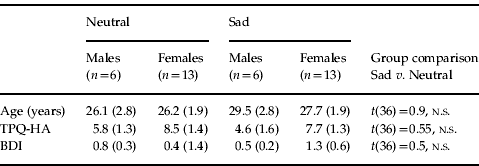
Thirty-eight paid healthy volunteers participated in the study (Table 1). Inclusion criteria were: (1) no past or current psychiatric disorders according to SCID-I/P (First et al. Reference First, Spitzer, Gibbon and Williams2002), (2) no history of a psychiatric disorder in any first-degree relatives; (3) no medical condition that interfered with the objectives of the study as established by a physician, and (4) no use of illicit drugs or psychoactive medications according to history and confirmed by a negative urine screen. All participants gave written informed consent approved by the National Institute of Mental Health (NIMH) Human Investigation Review Board.
Subjects' age and HA and BDI scores

TPQ-HA, Tridimensional Personality Questionnaire – harm avoidance; BDI, Beck Depression Inventory; n.s., not significant.
Values given as mean (standard error of the mean).
Procedure
The procedure used a between-subject design (to avoid order effects associated with repeating the manipulations) with two groups of 18 subjects. One group underwent a sad mood induction procedure (MIP) and the other a neutral MIP. The threat experiment was similar to that of our previous studies examining responses to predictable and unpredictable shocks (Grillon et al. Reference Grillon, Baas, Lissek, Smith and Milstein2004; Grillon, Reference Grillon2008a,Reference Grillonb). Following attachment of the electrodes, nine startle stimuli (habituation) were delivered every 18–25 s. This was followed by a shock work-up procedure to set up the shock intensity at a level highly annoying and mildly painful. Next, the MIP was initiated, followed by the threat experiment.
MIP
Details of the MIP procedure can be found in Robinson & Sahakian (Reference Robinson and Sahakian2009b). Subjects were presented with 60 (sad or neutral) sentences while music was played through headphones. Each sentence was presented in the center of the screen for 12 s until a ‘next’ button appeared and subjects were able to move on to the next sentence by pressing the space bar. Subjects were instructed to ‘relate the situation described by the sentence to situations in their own lives’, to get ‘as deeply as possible into any mood evoked’ and to ‘feel free to outwardly express any mood evoked’. The sad MIP contained light grey text on a dark blue background. The music played was either Adagio for Strings, Op. 11 by Samuel Barber or Adagio in G Minor by Tomaso Albinoni. Music was selected by asking the subjects which piece was the ‘saddest’ prior to testing. The neutral, sham MIP featured black text on a white background and The Planets, Op. 32: VII. Neptune, the Mystic by Gustav Holst was played.
Threat procedure
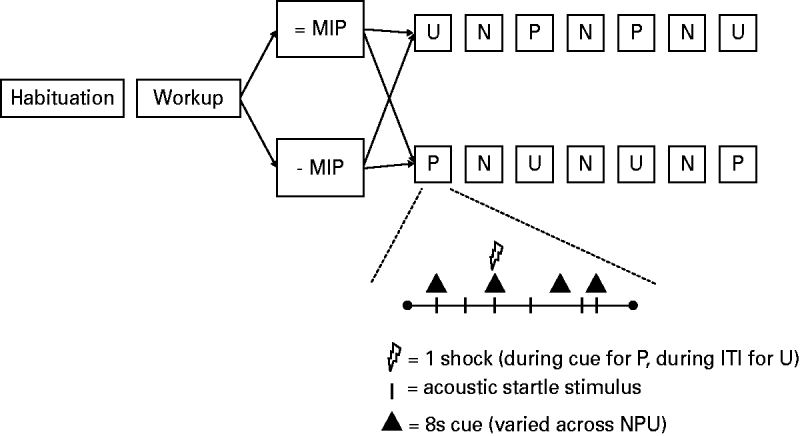
The procedure (Fig. 1) consisted of three 150-s conditions, a no-shock condition (N), and two conditions during which shocks were administered either predictably (P), that is only in the presence of a threat cue, or unpredictably (U). In each condition, an 8-s cue was presented four times. The cues consisted of different geometric colored shapes for the different conditions: blue square for N, red circle for P, green triangle for U. The cues signaled a shock only in the P condition; they had no signal value in the N and U conditions.
Task schematic. Following a startle habituation procedure, subjects underwent a shock work-up procedure followed by a neutral or negative mood induction procedure (=MIP and −MIP respectively), after which the threat of shock experiment started. The threat of shock consisted of three conditions: no shock (N), predictable shock only during cue (P), and unpredictable shock (U).

Participants were told that they (1) would not receive a shock in the no-shock condition, (2) would be at risk of receiving a shock only when the cue was on during the predictable condition but not when the cue was absent, and (3) could receive a shock at any time in the unpredictable condition. Instructions were also displayed on a computer monitor throughout the experiment, giving the following information: ‘no shock’ (N), ‘shock only during shape’ (P), or ‘shock at any time’ (U). In each N, P and U condition, six acoustic startle stimuli were delivered. Three stimuli were presented during inter-trial intervals (ITIs; that is in the absence of cues) and one stimulus was presented during three of the four cues, 5–7 s following cue onset. Two orders of presentation were created. Each started with the delivery of four startle stimuli (pre-threat startle) and consisted of three N, two P and two U. The two orders were P N U N U N P or U N P N P N U. Each participant received a single order, with half the participants in each group starting with P and the other half starting with U. One shock was administered in each individual P and U condition for a total of four shocks in P and four shocks in U. In each P, the shock was randomly associated with one of the four threat cues, and administered 7.5 s following the onset of that cue. The shock was given either 7 or 10 s following the termination of a cue in the unpredictable condition. No startle stimuli followed a shock by less than 10 s.
Questionnaires
Subjects were given self-administered questionnaires during screening, which included a measure of trait depression, the Beck Depression Inventory (BDI; Beck et al. Reference Beck, Ward, Mendelson, Mock and Erbaugh1961) and the Tridimensional Personality Questionnaire (TPQ; Cloninger, Reference Cloninger1986), a 100-item questionnaire that measures three distinct personality dimensions including a measure of trait anxiety, harm avoidance (HA) (Table 1). The State portion of the State and Trait Anxiety Inventory (STAI-State; Spielberger, Reference Spielberger1983) was administered twice, prior to the MIP and just prior to the threat experiment. A set of visual analog scales (VAS) was administered to determine self-reported mood; subjects rated how happy, sad and depressed they felt in a scale from 0 (not at all) to 10 (extremely). This mood rating scale was administered prior to and after the MIP. Another set of VAS was used to evaluate retrospective anxiety in the presence and absence of the cue in each condition (N, P, U) on a scale ranging from 0 (not at all anxious) to 10 (extremely anxious). Subjects were also asked to retrospectively rate the level of shock pain experienced during the threat experiment on an analog scale ranging from 0 (not at all painful) to 10 (extremely painful).
Stimulation and physiological responses
Stimulation and recording were controlled by a commercial system (Contact Precision Instruments, UK). The acoustic startle stimulus was a 40-ms duration, 103-dB (A) burst of white noise presented through headphones. The eyeblink reflex was recorded with electrodes placed under the left eye. The electromyographic (EMG) signal was amplifier with bandwidth set to 30–500 Hz and digitized at a rate of 1000 Hz. The shock was administered on the left wrist.
Data analysis
The raw eyeblink signal was rectified in a 150-ms window starting 50 ms before the startle stimulus and then integrated using a custom-written scoring program that simulates an integrator circuit with a 10-ms time constant. Peak magnitude of the startle/blink reflex was determined in the 20–100-ms time-frame following stimulus onset relative to a 50-ms pre-stimulus baseline and averaged within each condition. The raw scores were transformed into t scores based across conditions within subjects. The data were then averaged within each condition and stimulus types (ITI, cues). Fear-potentiated startle was defined as the increase in startle magnitude from ITI to the threat cue in the P condition. Anxiety-potentiated startle was defined as the increase in ITI startle reactivity from N to U. Data were entered into ANOVAs with repeated measures. Note that sex was used as a factor in the ANOVA because we previously reported increased contextual anxiety in females compared to males (Grillon, Reference Grillon2008a). For all statistical tests, α was set at 0.05. Greenhouse–Geisser corrections (GG-ε) were used for main effects and interactions involving factors with more than two levels.
Results
MIP
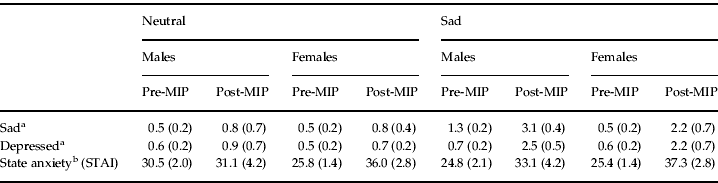
The mood scores, shown in Table 2, for sad and depressed mood were analyzed in separate MIP (neutral, sad)×time (pre-MIP, post-MIP)×sex (males, females) ANOVAs. Sad and depressed mood both showed a significant MIP×time interaction (F 1,34=6.1, p=0.02 and F 1,34=5.4, p=0.02 respectively), which reflected no change (or only trend for change) following neutral sham MIP (sad F 1,18=3.2, p=0.08; depressed F 1,18=2.5, n.s.) but a significant increase in sad and depressed ratings following sad MIP (F 1,18=12.5, p<0.003 and F 1,18=10.9, p<0.004, respectively). There was no group difference in ‘happy’ ratings following the MIP.
Mood and state anxiety ratings

STAI, State and Trait Anxiety Inventory; MIP, mood induction procedure.
Values given as mean (standard error of the mean).
a For mood, the post-MIP rating was taken just after the MIP.
b For state anxiety, the post-MIP rating was taken just prior to the threat experiment.
Baseline startle magnitude
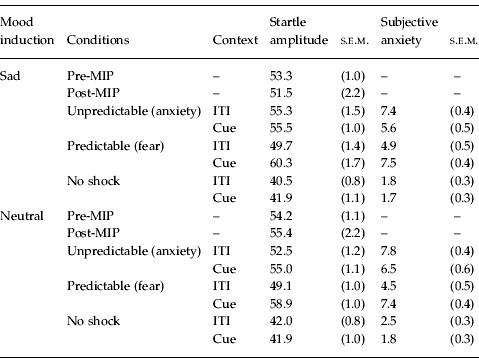
The startle scores are shown in Table 3. The effect of MIP on baseline startle was investigated by comparing the startle responses before (average of the nine startle responses during habituation) and after (average of the four startle responses prior to the threat procedure) MIP in a MIP (neutral, sad)×time (pre-MIP, post-MIP)×sex (males, females) ANOVA. Baseline startle was not affected by the sad MIP, as suggested by the lack of a MIP×time interaction (F 1,34=1.5, n.s.).
Startle magnitude (t scores) and subjective anxiety for all trial types

MIP, Mood induction procedure; ITI, inter-trial interval; s.e.m., standard error of the mean.
Cued fear- and anxiety-potentiated startle
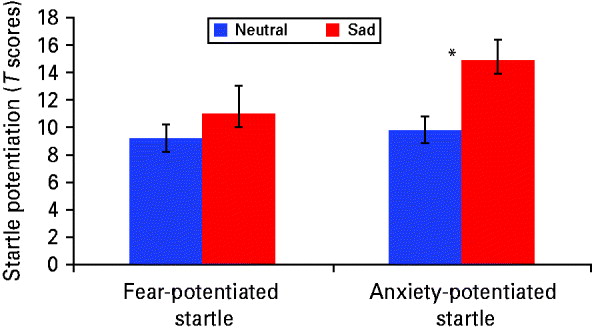
Fear-potentiated startle was defined as the increase in startle magnitude from the ITI to the threat cue in the predictable condition. Anxiety-potentiated startle was defined as the increase in ITI startle magnitude from the no-shock to the unpredictable condition. As shown in Fig. 2, anxiety-potentiated startle but not fear-potentiated startle was increased by the sad MIP.
Anxiety, not fear, was facilitated by sadness. Anxiety is operationally defined as the difference in inter-trial interval (ITI) startle magnitude between the unpredictable shock and the no-shock condition. Fear is operationally defined as the difference in startle magnitude between the ITI and cue of the predictable shock condition. Neutral and Sad represent neutral and sad mood induction procedures (MIPs). * p=0.03.

Fear-potentiated startle (in the predictable condition) was examined using a MIP (neutral, sad)×stimulus type (cue, ITI)×sex (males, females) ANOVA. As expected, there was a highly significant stimulus type main effect (F 1,34=54.6, p<0.0009), reflecting larger startle during the cue relative to ITI. Fear-potentiated startle was not significantly affected by the sad MIP, stimulus type×MIP interaction (F 1,34=0.4, n.s.; Fig. 1).
Anxiety-potentiated startle was examined with ITI startle magnitude using a MIP (neutral, sad)×condition (N, U)×sex (males, females) ANOVA. As expected (Grillon et al. Reference Grillon, Levenson and Pine2006), startle magnitude during ITI was larger in the U compared to the N condition (Table 3), resulting in a condition main effect (F 1,34=111.5, p<0.0009). As seen in Fig. 1, anxiety-potentiated startle was increased following sad MIP as reflected by a significant MIP×condition interaction (F 1,34=5.0, p<0.03). There was no significant difference in baseline startle across groups and this effect did not interact with sex.
Subjective anxiety and pain
The anxiety ratings (Table 3) were analyzed similarly to the startle data using repeated-measures ANOVAs. Subjects showed increased fear of the threat cue compared to ITI in the predictable condition (F 1,36=45.9, p<0.0009), but this effect was not modulated by the MIP (no stimulus type×MIP interaction; F 1,36=0.23, n.s.). Similarly, rating of anxiety during ITI increased from the no-shock to the unpredictable condition (F 1,36=276.8, p<0.0009) and this effect was not modulated by MIP (F 1,36=0.10, n.s.). STAI-State anxiety scores (Table 2) were analyzed in a MIP (neutral, sad)×time (pre-MIP, pre-threat)×sex (males, females) ANOVA. State anxiety increased with time (from pre-MIP to just prior to the threat experiment) (F 1,34=28.6, p<0.0009) but this effect was more pronounced in females than males, as reflected by a significant time×sex interaction (F 1,34=5.1, p<0.03). The pain scores were analyzed using a MIP (neutral, sad)×sex (males, females) ANOVA. There were no difference between the sad and the neutral MIP groups (F 1,33=0.7, n.s.) but there was a trend for females to rate the shock as more painful (F 1,33=3.7, p=0.06).
Correlations
We examined personality characteristics associated with the propensity to respond to sad MIP. A composite sad mood score was created consisting of the mean post-MIP sad and depressed mood scores. In the entire group, sad mood correlated significantly with HA (r=0.39, p<0.02) and BDI (r=0.36, p<0.03). However, this effect was essentially attributable to the sad MIP group.
Discussion
Consistent with our hypothesis, healthy individuals demonstrated increased anxiety-potentiated startle following sad mood induction. As such, potentiated startle, which is a reliable indicator of aversive responding, and an indicator of activity within a subcortical neural circuit involving the amygdala and bed nucleus of the stria terminalis (Davis et al. Reference Davis, Walker, Miles and Grillon2010), is facilitated by induced sadness. That is to say, induced sadness serves to exacerbate the impact of subsequently induced anxiety on aversive responding. Moreover, this effect was restricted to the unpredictable condition, which is thought to model anxiety, and was not seen in the predictable condition, which is thought to model fear (Grillon, Reference Grillon2008b; Davis et al. Reference Davis, Walker, Miles and Grillon2010).
The present findings thus indicate that sad mood sensitizes the anxiety network (Davis et al. Reference Davis, Walker, Miles and Grillon2010). This is consistent with the observation that induced sad mood increases amygdala activity (Schneider et al. Reference Schneider, Grodd, Weiss, Klose, Mayer, Nägele and Gur1997; Berna et al. Reference Berna, Leknes, Holmes, Edwards, Goodwin and Tracey2010) and with the observation that induced anxiety (Mechias et al. Reference Mechias, Etkin and Kalisch2010), induced sad mood (Mayberg et al. Reference Mayberg, Liotti, Brannan, McGinnis, Mahurin, Jerabek, Silva, Tekell, Martin, Lancaster and Fox1999) and induced rumination (Cooney et al. Reference Cooney, Joormann, Eugène, Dennis and Gotlib2010) recruit higher prefrontal cortical regions, which may be involved in top-down control of amygdala responses (Ochsner & Gross, Reference Ochsner and Gross2005; Etkin et al. Reference Etkin, Egner and Kalisch2011). Hence, sadness may promote hyperactivity within the anxiety network though a top-down neural mechanism.
It is important to note that although startle responses were sensitive to mood, the self-report anxiety measures were not. This dissociation between objective measures and subjective reports is common; non-perceived aversive stimuli can, for instance, elicit amygdala activity in the absence of subjective feeling (Harmer et al. Reference Harmer, Rogers, Tunbridge, Cowen and Goodwin2003; Kemp et al. Reference Kemp, Gray, Silberstein, Armstrong and Nathan2004). One explanation for the present discrepancy is that startle was measured online during the study whereas the VAS ratings were retrospective. Moreover, unlike subjective report, which is probably cortically mediated and subject to demand characteristics (Orne, Reference Orne, Rosenthal and Rosnow1969), startle is probably subcortically mediated.
Putative relationship with psychiatric conditions
Threat of shock (Grillon, Reference Grillon2008b; Davis et al. Reference Davis, Walker, Miles and Grillon2010) has a strong background in translational research and recruits mechanisms implicated in AD. Similarly, sad mood induction involves neural and pharmacological mechanisms implicated in affective disorders (Mitchell & Phillips, Reference Mitchell and Phillips2007; Robinson & Sahakian, Reference Robinson and Sahakian2009a,b). Testing for interactions between these emotion induction procedures in healthy individuals is one way to assess how these defined mechanisms interact without the many confounds present in patient populations. Of course, such models are not a substitute for research in patient populations, but they can provide a more controlled environment in which to develop hypotheses than can be subsequently tested in patient populations. Thus, the present experimental findings are consistent with robust neurocognitive evidence for hyperactive aversive responses in depression (Clark et al. Reference Clark, Chamberlain and Sahakian2009; Eshel & Roiser, Reference Eshel and Roiser2010; Elliott et al. Reference Elliott, Zahn, Deakin and Anderson2011) and partially consistent with studies assessing (short-duration fear) startle responses following negative pictures in depressed individuals. Specifically, just as we fail to see potentiation of short-duration fear responses under sad mood, several studies have shown that depression fails to increase startle responses to short-duration positive and negative pictures (e.g. Allen et al. Reference Allen, Trinder and Brennan1999; Dichter et al. Reference Dichter, Tomarken, Shelton and Sutton2004; Kaviani et al. Reference Kaviani, Gray, Checkley, Raven, Wilson and Kumari2004; Forbes et al. Reference Forbes, Miller, Cohn, Fox and Kovacs2005; Dichter & Tomarken, Reference Dichter and Tomarken2008; McTeague et al. Reference McTeague, Lang, Laplante, Cuthbert, Strauss and Bradley2009). These studies in fact show reduced startle response, which is probably due to the nature of the stimuli used. Mildly aversive stimuli such as unpleasant pictures elicit considerably less short-duration fear responding (and associated startle) relative to the physical threat used here (Lissek et al. Reference Lissek, Orme, McDowell, Johnson, Luckenbaugh, Baas, Cornwell and Grillon2007). Of course this difference may also be because the sad mood was not strong enough to mimic depression. However, this is unlikely to account for the difference between the present study and the picture studies for three reasons. First, the MIP did affect anxiety-potentiated startle. Second, the MIP used here has been used successfully in several other studies (Robinson & Sahakian, Reference Robinson and Sahakian2009a,b; Berna et al. Reference Berna, Leknes, Holmes, Edwards, Goodwin and Tracey2010; Robinson et al. Reference Robinson, Cools, Crockett and Sahakian2010). Third, like major depression, sad mood in non-depressed subjects is also associated with blunted fear-potentiated startle response to unpleasant pictures (Grüsser et al. Reference Grüsser, Wölfling, Mörsen, Kathmann and Flor2007).
It should be noted, however, that depression is heterogeneous and the severity and chronicity of the disorder are likely to affect emotional reactivity. Several studies have shown reduced affective modulation of startle by unpleasant pictures only in severely depressed individuals (Allen et al. Reference Allen, Trinder and Brennan1999; Kaviani et al. Reference Kaviani, Gray, Checkley, Raven, Wilson and Kumari2004; Forbes et al. Reference Forbes, Miller, Cohn, Fox and Kovacs2005; Melzig et al. Reference Melzig, Weike, Zimmermann and Hamm2007). Moreover, van Eijndhoven et al. (Reference van Eijndhoven, van Wingen, van Oijen, Rijpkema, Goraj, Verkes, Oude Voshaar, Fernández, Buitelaar and Tendolkar2009) found enlargement of the amygdala in first-onset but not in recurrent depression. Taken together, these results suggest that responsivity to threat, and potentially concomitant risk for an AD, changes as the depression becomes chronic. More specifically, the pattern may be hypersensitivity to threat only early on and normal or hyporesponsivity to threat later on. However, further research is necessary to clarify the impact of depression on anxiety- and fear-potentiated startle.
It should also be noted that the sadness that is associated with depression is strongly linked with long-term and persistent ‘rumination’ tendencies (Nolen-Hoeksema et al. Reference Nolen-Hoeksema, Morrow and Fredrickson1993). That is to say, once a depressed individual has a sad or aversive emotional response, they tend to dwell and amplify that response or a prolonged period of time (Nolen-Hoeksema, Reference Nolen-Hoeksema1991). Ruminatory tendencies are ‘especially characteristic’ of individuals with mixed anxiety and depression symptoms (Nolen-Hoeksema, Reference Nolen-Hoeksema2000). As such, the increased adverse impact of both sadness and induced anxiety may thus be a reflection of a situation whereby sad mood drives ruminations, which then increases anxiety about uncertain future threats and ultimately has a greater negative impact upon startle responses.
Putative relationship with co-morbidity
One potential explanation for high co-morbidity between AD and depression is that anxiety and depression are frequently co-morbid because they predispose one another. They can exist alone, but they are perhaps mutually reinforcing. That is, being anxious might increase the likelihood of becoming depressed, and being depressed may increase the likelihood of becoming anxious, and that feedback between the states means that the ultimate co-morbid presentation is associated with greater pathology than either disorder alone.
In support of this hypothesis, there is substantial evidence that ADs increase the risk for some types of depression (Weissman et al. Reference Weissman, Leckman, Merikangas, Gammon and Prusoff1984; Brady & Kendall, Reference Brady and Kendall1992; Kaufman & Charney, Reference Kaufman and Charney2000) and that ADs frequently precede depression (Bittner et al. Reference Bittner, Goodwin, Wittchen, Beesdo, Hofler and Lieb2004). This sequence is in fact the most common. However, depression has been shown to precede or coincide with AD (Mineka et al. Reference Mineka, Watson and Clark1998; Kessler et al. Reference Kessler, Gruber, Hettema, Hwang, Sampson and Yonkers2008); across all co-morbid ADs, depression comes first in approximately 40–45% of individuals, and the relationship between adolescent depression and adult generalized anxiety disorder is said to be ‘particularly strong’ (Pine et al. Reference Pine, Cohen, Gurley, Brook and Ma1998; Copeland et al. Reference Copeland, Shanahan, Costello and Angold2009). Our experimental design, in which we first induced sad mood and then induced anxiety responses, could therefore be conceptualized as modeling the latter situation: an individual who suffers from depression and then goes on to experience AD. Together with the prior evidence that ADs can predispose depression (Weissman et al. Reference Weissman, Leckman, Merikangas, Gammon and Prusoff1984; Brady & Kendall, Reference Brady and Kendall1992; Mineka et al. Reference Mineka, Watson and Clark1998; Kaufman & Charney, Reference Kaufman and Charney2000), these findings therefore provide initial support for the proposition that depression and ADs may be frequently co-morbid because they are mutually reinforcing. It should be noted, however, that ADs encompass a wide range of disorders and it may be that the present findings are more relevant for PTSD and panic disorder, which have been shown to be associated with overanxious reactivity to unpredictable aversive events, than phobias (Grillon et al. Reference Grillon, Lissek, Rabin, McDowell, Dvir and Pine2008, Reference Grillon, Pine, Lissek, Rabin, Bonne and Vythilingam2009).
There does not, however, seem to be a common neural mechanism for the mutual reinforcement of these two sets of disorders. Anxiety-driven hyperactivity within the hypothalamic–pituitary–adrenal (HPA) axis and the accumulation of stressful life experiences plausibly underlies the development of depression following anxiety (Brown et al. Reference Brown, Bifulco and Harris1987; Bifulco et al. Reference Bifulco, Brown, Moran, Ball and Campbell1998; Millan, Reference Millan2008). But how can depression lead to AD? Hypersensitivity of the fear/anxiety network (as indexed by the startle response) is indeed a key risk factor for ADs (Gorman et al. Reference Gorman, Kent, Sullivan and Coplan2000) and the present findings indicate that such hypersensitivity can be induced by sad mood. The findings are also consistent with the increased amygdala volume in first-onset depression relative to recurrent depression (and healthy controls), which is thought to reflect, at least in part, increased volume flow as a state marker of depression as opposed to predisposing structural abnormalities (van Eijndhoven et al. Reference van Eijndhoven, van Wingen, van Oijen, Rijpkema, Goraj, Verkes, Oude Voshaar, Fernández, Buitelaar and Tendolkar2009). This initial amygdala enlargement may thus be driven by the above highlighted amygdala hyperactivity with the initial onset of depressed mood.
Conclusions
This study demonstrates that induced sadness can increase anxious responding. We emphasize the importance of using experimental models in healthy individuals to provide clues as to the potential underlying mechanism of pathologies in the absence of confounds inherent in heterogeneous psychiatric populations. As such, the present study provides initial experimental support for the proposition that depression may serve to promote ADs, which, taken together with evidence that anxiety can precipitate depression, provides initial support for the proposition that ADs and depression are frequently co-morbid because they are mutually reinforcing. In addition, depression and ADs, and especially co-morbid depression and ADs, are extremely common and debilitating disorders (Mineka et al. Reference Mineka, Watson and Clark1998). Clarifying the causes of co-morbidity is a crucial step towards an improved ability to treat the underlying abnormalities (Beddington et al. Reference Beddington, Cooper, Field, Goswami, Huppert, Jenkins, Jones, Kirkwood, Sahakian and Thomas2008; Insel et al. Reference Insel, Cuthbert, Garvey, Heinssen, Pine, Quinn, Sanislow and Wang2010).
Declaration of Interest
None.
Acknowledgments
This research was supported by the Intramural Research Program of the National Institutes of Mental Health (MH002798).