Introduction
As life expectancy increases globally, dementia has become one of the most serious disabling problems all over the world. Of all people with dementia, 60.1% live in developing countries, a proportion that will rise to 71.2% in 2040, with the highest growth projections being in China and its South Asian neighbors (Ferri et al., Reference Ferri2005).
Estimates of the survival duration in persons with dementia are important for the precise estimates of disease burden, to help plan health care for policy-makers and family, and in predicting dementia prevalence. Evidence from developed countries has consistently confirmed that people with dementia have shortened life duration compared with those without dementia (Wolfson et al., Reference Wolfson2001; Brookmeyer et al., Reference Brookmeyer, Corrada, Curriero and Kawas2002; Fitzpatrick et al., Reference Fitzpatrick, Kuller, Lopez, Kawas and Jagust2005). However, survival studies on dementia are scarce in developing countries. In these few studies (Li et al., Reference Li, Shen, Chen, Zhao, Li and Lu1991; Perkins et al., Reference Perkins2002; Nitrini et al., Reference Nitrini2005; Tsai et al., Reference Tsai2007), diagnoses of dementia were according to the criteria that were initiated by developed countries, such as the Diagnostic and Statistical Manual of Mental Disorders, revised 3rd edition or 4th edition (DSM-IIIR or DSM-IV). No doubt different cultural and educational backgrounds between the two settings may result in discrepancies when using the same diagnostic instrument (Prince, Reference Prince2001). In order to deal with this issue, the 10/66 Dementia Research Group developed a culturally and educationally sensitive dementia diagnosis algorithm for developing countries (Prince et al., Reference Prince, Acosta, Chiu, Scazufca and Varghese2003). The validation study showed that 10/66 dementia criteria were more sensitive to mild dementia cases and agreed better with clinical diagnosis than DSM-IV criteria in developing countries (Prince et al., Reference Prince2008; Rodriguez et al., Reference Rodriguez2008). Previous studies demonstrated that the severity of dementia was an independent predictor of survival time (Ueki et al., Reference Ueki, Shinjo, Shimode, Nakajima and Morita2001; Knopman et al., Reference Knopman, Rocca, Cha, Edland and Kokmen2003). Thus, the underdiagnosis of less severe dementia cases by DSM-IV criteria may influence the estimate of survival time in developing countries.
A prognostic index (PI) which can stratify mortality risk and predict life expectancy is important in guiding end-of-life decision-making. For dementia patients, however, only a few attempts (Newcomer et al., Reference Newcomer, Covinsky, Clay and Yaffe2003; Pilotto et al., Reference Pilotto2009) have been made to create prediction models and none was performed in developing countries. Furthermore, these models were focused on hospitals or care facility settings and need specialized clinical experience. To be useful for providing prognostic information, a PI be must based on the general population, be as simple as possible and require fewer clinical assessments (Barer and Mitchell, Reference Barer and Mitchell1998).
Therefore, this study aimed to investigate survival duration, identify related prognostic factors and establish a prognostic prediction model for community-based dementia patients (≥65 years old) defined by 10/66 dementia criteria in Beijing, China.
Methods
Study design
This study is part of the 10/66 Dementia Research Group's population-based study in China (Prince et al., Reference Prince2007). Briefly, a cross-sectional comprehensive one-phase survey was conducted by trained psychiatrists for all residents aged 65 years and over residing in two catchment areas of Beijing from January 2004 to April 2005. The detailed characteristics of the two areas which are representative of Beijing community have been published elsewhere (Liu et al., Reference Liu2009). The baseline assessments were completed by 2162 participants (response rate 82.9%) and 137 participants were defined as having dementia according to 10/66 dementia criteria. In order to calculate a comparable median survival time, we randomly matched each case by age (±1 years) and gender to a participant without dementia from the same cohort. The follow-up examinations were conducted in 2009 which included tracing participants or their proxies and performing interviews to ascertain disease status and vital information. In the incidence survey phase of the 10/66 dementia research, verbal autopsy was conducted to establish the cause and the exact date of death among those participants who died between baseline and follow-up phases. The information about the date of death was secured from family members, medical records and death certification.
Informed consent was obtained from the participants or informants. The study was approved by the Institutional Review Board (IRB) of the Institute of Mental Health, Peking University as well as by the IRB of the Institute of Psychiatry, King's College London.
Measurements
Evaluation of dementia
The assessment of dementia was based on a standardized one-phase dementia diagnostic procedure developed by the 10/66 Dementia Research Group for use in developing countries. This procedure was devised to avoid educational and cultural bias in the diagnosis of dementia in developing countries. The detailed descriptions of the procedure have been published elsewhere (Prince et al., Reference Prince, Acosta, Chiu, Scazufca and Varghese2003). 10/66 dementia criteria were calibrated and validated cross-culturally in the 10/66 pilot study undertaken in 25 centers. The results showed that 10/66 dementia criteria obtained a sensitivity of 94% and specificity of 97% in controls with a high level of education and 94% in those with a low level of education.
Other associated assessments
Potential prognostic factors in this study were selected from previous studies, including sociodemographic factors, psychosocial factors, health status, disability and illness severity. All of these assessments were part of the 10/66 protocol.
(i) Sociodemographic factors: age, gender, marital status (married/cohabiting, widowed/separated, and single), education (none/did not complete primary/completed primary/secondary/tertiary).
(ii) Psychosocial factors: assessed using Wenger's social network typology (Wenger et al., Reference Wenger, Dykstra and Melkas2007) – the local family dependent support network (I), the locally integrated support network (II), the local self-contained support network (III), the wider community-focused support network (IV) and the private restricted support network (V).
(iii) Health status
(a) Self-reported global health: measured on a four-point scale based on the question: “How would you say your health is these days: Would you say your health is excellent, good, fair, or poor?”
(b) Comorbidity: participants or their relatives reported a history of at least one of the following health conditions: diabetes mellitus, stroke, myocardial infarction, angina and hypertension.
(iv) Disability: measured using the 12-item World Health Organization Disability Assessment Schedule (WHO-DAS-II) (Rehm et al., Reference Rehm2000). According to available normative data, a WHO-DAS-II score of 45 or above was classed as substantial disability.
(v) Severity of dementia: assessed by clinical dementia rating (CDR) scale (Morris, Reference Morris1993).
Statistical analysis
Survival time was defined from the time of enrollment to the time of death or last follow-up for the censored cases. The Kaplan-Meier method was used to calculate median survival times and the log rank test was adopted to compare the survival distributions of different groups. The factors associated with death were analyzed by Cox's proportional hazards regression model. Proportionality assumptions were examined by including an interaction term for each covariate with time, and all predictive variables met the assumption of proportionality.
To develop the prognostic system, the “scores” were assigned to those statistically significant prognostic factors in the final model (Lladó et al., Reference Lladó2000; Park et al., Reference Park2009; Ikeda et al., 2009). The scores were derived by rounding the respective β coefficients from the Cox proportional hazards model to the nearest integer. The PI for each individual was obtained by summing the scores for the appropriate level of each of the prognostic factors (X), and the formula was: PI = β1X1 + β2X2 + ⋯ + βiXi. For example, an 85-year-old man (1 point) with diabetes (2 points), severe dementia (2 points) and WHO-DAS II score of 85 (2 points) would have a PI of 7 points. This PI was on a 0–8 scoring range. The samples were divided into three risk groups according to the PI range and compared to the 5-year survival curves for different risk groups. Difference at p < 0.05 was considered to be significant. The data were analyzed using the Statistical Software Package for the Social Sciences (SPSS Inc, Chicago, IL).
Results
Descriptive characteristics
During the follow-up interval, five participants moved away, but we obtained their survival status from reliable informants or by telephone review. Thus, the survival status of all participants was obtained in our study.
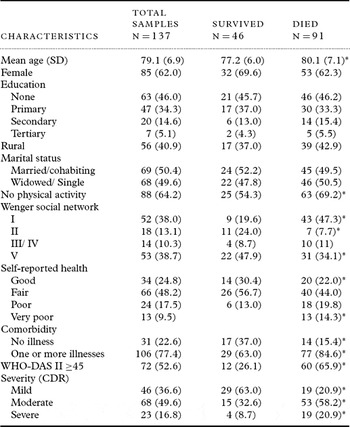
The average follow-up times were 5.15 years (SD = 0.40) for the dementia group and 4.92 years (SD = 0.32) for the referent group. Among the 137 patients with dementia, 85 (62.0%) were women and 52 (38.0%) were men, and the mean age was 79.1 years (SD = 6.9). The selected baseline characteristics of patients with dementia according to survival status during follow-up are presented in Table 1. In comparison with the survivors, the dementia patients who had died during follow-up were older at study entry (80.1 ± 7.1 vs 77.2 ± 6.0, p < 0.05), had a poorer social network (smaller percentage of wider community support, 34.1% vs 47.9%, p < 0.05), very poor self-reported health (14.3% vs 0, p < 0.05), a higher degree of disability (WHO-DAS II ≥45, 65.9% vs 26.1%, p < 0.05) and more advanced severity of dementia (moderate, 58.2% vs 32.6%, p < 0.05; severe, 20.9% vs 8.7%, p < 0.05).
Baseline characteristics of patients with dementia stratified by survival status

p < 0.05 in t tests and χ2 tests.
Figures are numbers (percentages) unless stated otherwise.
Survival times of dementia patients
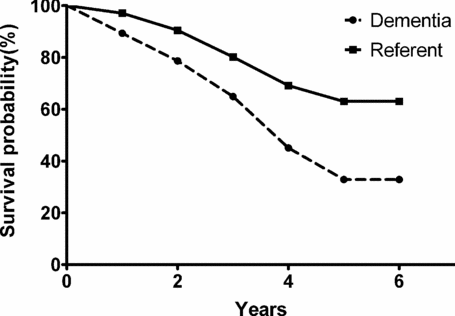
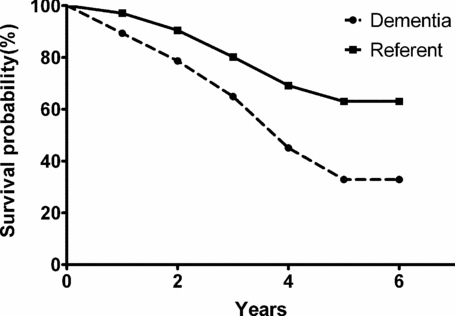
During the five-year follow-up, there were 91 (66.4%) deaths among dementia patients and 51 (37.2%) among referent subjects (p < 0.01). The median survival time was 4.2 years for dementia patients. As shown by the Kaplan-Meier curves (Figure 1), the dementia group had a significantly shorter survival time than the referent group (log-rank test, p < 0.001). Five-year survival rates were 16.1% for the dementia group and 28.5% for the referent group (p < 0.001).
Kaplan-Meier survival curves of patients with dementia and the referent subjects.
Log rank test showed marked survival differences (p < 0.001).
Mortality predictors for dementia patients
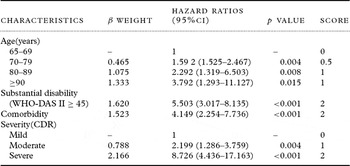
In the univariate Cox proportional hazard analyses, older age (HR:1.052, 95%CI: 1.022–1.083), male (HR:1.569, 95%CI: 1.030–2.039), poorer self-reported health (HR:3.052, 95%CI: 2.401–8.497), substantial disability (HR:3.336, 95%CI: 2.120–5.252), comorbidity diseases (HR:3.728, 95%CI: 2.102–6.610) and severity of dementia (HR:1.376, 95%CI: 1.064–1.779) were associated with an increased risk of death for patients with dementia. Educational level, social network type and marital status were not significantly associated with the survival time. The six predictors were then entered into the multivariate Cox proportional hazards model to assess the adjusted effects of these predictors. As shown in Table 2, severity of dementia (severe/mild, HR: 8.765, 95%CI: 4.436–17.163) and substantial disability (HR: 5.503, 95%CI: 3.017–8.135) were the most significant predictors of shortened survival time. Afterwards, the presence of comorbidity (HR: 4.149, 95%CI: 2.254–7.736) and age (HR: 1.079, 95%CI: 1.048–1.110) were also approaching significance, while gender and self-reported health were no longer related to survival time.
Multivariate Cox proportional hazard model and allocation of scores for the prognostic scoring system

Prognostic index
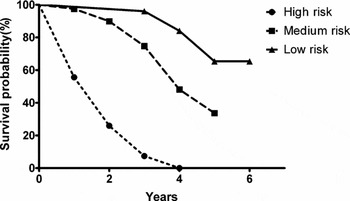
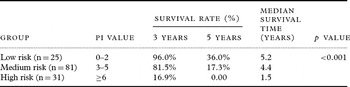
From the final Cox proportional hazard model, the risk scores were assigned for each predictor according to the respective β coefficient. To make the scores approach an integer and be intuitive for the user, all β coefficients were standardized so that the lowest PI had a value of 1 (Table 2). The patients with dementia were divided into different risk groups based on their PI: low-risk group (PI 0–2), medium-risk group (PI 3–5) and high-risk group (PI ≥6). Kaplan–Meier survival curves (Figure 2) showed that the three risk groups had significantly different survival trajectories and the differences in survival rates between the three risk groups were persistent over the 5-year follow-up. As shown in Table 3, the 5-year survival rates for the low, medium and high-risk groups were 36.0%, 17.3% and 0, respectively. The median survival times for each group were 5.2 years (95%CI: 4.9–5.4), 4.4 years (95%CI: 4.0–4.7) and 1.5 years (95%CI: 0.5–2.5), respectively. The log-rank test showed that the differences among the three risk groups were highly significant (p < 0.001).
Kaplan-Meier survival curves according to prognostic groups.
Log rank test showed marked survival differences (p < 0.001).

Median survival times and survival rates based on different risk groups

Discussion
In this longitudinal community-based study, the survival time of dementia patients was significantly shorter than that of referent subjects; the median survival time of dementia patients identified by 10/66 dementia criteria was 4.2 years. Four independent prognostic factors were identified for survival from dementia: severity of dementia, disability, comorbidity and age. The simple PI derived from the four predictors can divide the dementia patients into different mortality risk groups and predict life expectancy for community-based dementia patients.
Valid case identification, which is influenced by study design and diagnostic criteria, is important for the estimate of survival duration (Xie et al., Reference Xie, Brayne and Matthews2008). Dementia diagnoses in population-based studies in developing countries were mostly undertaken using the standard two-stage procedures (Prince, Reference Prince2001). The participants defined as positive by the cognitive screen instruments in the first stage will go to the second stage for dementia diagnosis through comprehensive examination. In developing countries, however, low educational level and illiteracy among aged people is more common than in developed countries. Thus, items that test calculation, reading and writing ability in cognitive instruments may influence the validity of the dementia diagnosis in developing countries. In addition, the two-stage procedure may result in refusal or dropout in the second stage which is a serious problem for population-based studies. The instruments used in population-based study of the 10/66 Dementia Research Group are educationally and culturally sensitive to dementia patients in developing countries (Prince et al., Reference Prince, Acosta, Chiu, Scazufca and Varghese2003). The validation study showed that the 10/66 procedure obtained high specificity and sensitivity in dementia diagnosis (Prince et al., Reference Prince2008; Rodriguez et al., Reference Rodriguez2008). Therefore, survival duration estimates using 10/66 dementia criteria may be better than DSM-IV dementia criteria in developing countries. In addition, all the interviews were conducted by trained clinicians using structured questionnaires in this study. In the two-stage procedure, however, screening instruments were administered by trained lay persons with experienced clinicians confirming the final diagnosis. The use of the structured questionnaire and trained clinicians can therefore guarantee quality control in the data collection.
The estimates for survival produced here were within the range of the studies reported by some developed countries (Brookmeyer et al., Reference Brookmeyer, Corrada, Curriero and Kawas2002; Knopman et al., Reference Knopman, Rocca, Cha, Edland and Kokmen2003; Ganguli et al., Reference Ganguli, Dodge, Shen, Pandav and DeKosky2005; Regla et al., Reference Regla, Pousa, Franch, Olmo and Roman2008). Our estimates were closest to those of a French study (Helmer et al., Reference Helmer, Joly, Letenneur, Commenges and Dartigues2001). A further community-based prospective study in the U.S.A. (Ganguli et al., Reference Ganguli, Dodge, Shen, Pandav and DeKosky2005) showed longer survival times than ours, possibly due to the longer follow-up time (15 years) and to the fact that survival was estimated from the onset of symptoms rather than the enrollment date.
Among the dementia survival studies conducted in developing countries, the mean survival times in the Taiwan study (Tsai et al., Reference Tsai2007) and Beijing study (Li et al., Reference Li, Shen, Chen, Zhao, Li and Lu1991) were longer than those reported here, at 4.48 and 8.00 years, respectively. One explanation is that the mean ages of the patients in these two studies were lower than the ages of our subjects. Second, the participants in the Taiwan study were active help-seekers from the memory clinics and thus volunteer bias is likely; similarly, the subjects in the Beijing study were selected solely from urban communities, which making selection bias likely. Generally speaking, a survival study of dementia needs to be conducted in the community because dementia patients diagnosed in a hospital or nursing home are not representative of patients in the general population.
Potential predicators of mortality in this study included illness severity, disability, comorbid diseases, demographic factors and social networks. The prediction model for dementia mortality risk in this study was based on the prevailing biopsychosocial perspective of health and illness (Engel et al., Reference Engel1997). This theory indicates that the cause of death is multifactorial for old people. The factors significantly associated with survival duration of dementia patients in this study included: severity of dementia, disability, comorbidity and age.
Consistent with previous studies (Ueki et al., Reference Ueki, Shinjo, Shimode, Nakajima and Morita2001; Xie et al., Reference Xie, Brayne and Matthews2008), the severity of dementia was the most significant predictor in this study after adjusting for other factors. The second most significantly factor associated with shortened survival time was substantial global disability which was measured by WHO-DAS-II. It is widely accepted that disability is a very reliable predictor of shortened life expectancy for patients with dementia, with a three-year absolute reduction in survival between the most and least disabled (Noale et al., Reference Noale2003; Xie et al., Reference Xie, Brayne and Matthews2008). However, disability may not relate exclusively to the survival of dementia patients but may reflect the severity of many different illnesses and most probably represents the last step from several chronic diseases to death (Noale et al., Reference Noale2003). Further prospective studies need to be conducted to quantify the effect of disability on dementia patients when adjusted for other disease. In addition, our study also found that comorbidity and older age were independently related to the poor prognosis of dementia, and these findings are supported by other studies (Xie et al., Reference Xie, Brayne and Matthews2008; Alonso et al., Reference Alonso2009). However, factors such as educational level and gender, which were reported to be associated with dementia survival in some studies (Qiu et al., Reference Qiu, Backman, Winblad, Agüero-Torres and Fratiglioni2001; Noale et al., Reference Noale2003), were not significantly related to dementia survival when adjusted by other factors in this study. These discrepancies are probably caused by variations in the nature of the variables adjusted in multivariable analysis.
Based on the four predictors of survival described above, a simple PI was calculated according to the regression coefficient which could stratify patients with dementia into different death risk groups. To the best of our knowledge, this is the first report that uses PI to stratify community-based dementia patients into different risk groups in China and other developing countries. The few prognostic studies on dementia patients in other countries (Newcomer et al., Reference Newcomer, Covinsky, Clay and Yaffe2003; Pilotto et al., Reference Pilotto2009) were either institution or hospital-based, and require complex calculation or measurements that are easily available to general practitioners. Dementia patients in developing countries are mainly cared for by family members at home, so it is important to identify prognostic information in community settings and that the PI should be feasible and simple to use. To maximize the usability of our PI, we limited the predictors to information that can be readily obtained and minimized the demands on physicians or on the patient's memory. Age and comorbidity can be obtained through patient or informant report. CDR and WHO-DAS-II scales, which are used to assess the severity and disability of patients, have been well validated already and are easy to administer. As there were no laboratory tests or genetics factors, the PI developed in our study can be easily calculated by the general practitioners in their community setting.
There are several limitations in our study that warrant mentioning. First, we focused on prevalent cases and did not include incident cases of dementia after baseline. This length bias tends to exclude those with rapidly progressive disease and short survival, and the median survival time of prevalent cases may be longer than that of incident cases (Wolfson et al., Reference Wolfson2001, Guhne et al., Reference Guhne, Matschinger, Angermeyer and Riedel-Heller2006). Second, comorbidities in this study included only certain cardiovascular diseases due to the small samples. Other conditions such as chronic pulmonary conditions or neoplastic diseases would presumably co-exist with dementia but were not included in this model. Fitzpatrick et al. (Reference Fitzpatrick, Kuller, Lopez, Kawas and Jagust2005) and Knopman et al. (Reference Knopman, Rocca, Cha, Edland and Kokmen2003) reported the relation between dementia subtypes and survival, but our sample was too small to analyze the subtype and neuropathology, and so the relationship between them remains unknown.
One limitation of the construct of the PI model is that we did not include biological and genetic predictors, especially the APOE ɛ4. Based on the prevailing biopsychosocial perspective on health and illness (Engel et al., Reference Engel1997), it is important to consider the multiple domains of illness severity and prognosis, such as biological, social and environmental issues. The association between APOE genotype and mortality has been studied extensively. Some studies report that any ɛ4 allele (Tilvis et al., Reference Tilvis, Strandberg and Juva1998; Hayden et al., Reference Hayden2005; Little et al., Reference Little2009) or only the 4/4 genotype (Juva et al., Reference Juva2000) is associated with higher mortality of overall dementia at a younger age. We will further improve our model in the phase of incidence survey using incident dementia cases and add biological and genetic predictors into the model.
Conclusions
Survival times of community-based dementia patients in Beijing, China were markedly shortened compared to referents. The median survival time of dementia patients (≥65 years) identified by 10/66 dementia criteria was 4.2 years. The severity of dementia, disability, comorbidity and age were independent predictors of dementia survival. A PI based on these four relatively simple and easily obtained variables contributes to the mortality risk stratification and may predict life expectancy for dementia patients in a community setting. To our knowledge, this is the first 10/66 dementia research study which investigates dementia survival in developing countries. These findings about dementia survival are useful to those who counsel dementia patients and their families about advance planning and palliative care options, and to those responsible for planning the provision of health care.
Conflict of interest
None.
Description of authors' roles
Y. Huang, the corresponding author, is the Chinese principal investigator of the 10/66 Dementia Research Group. Y. Wang coordinated the field work and drafted the paper. Z. Liu is the international coordinator in China and helped to write the paper. S. Li is the former Chinese principal investigator who led the baseline survey. C. Zhuo is the research assistant for the field work and quality control. M. Prince is the principal investigator of the 10/66 Dementia Research Group. All authors reviewed the paper and provided further suggestions, and approved the paper for publication.
Acknowledgments
This 10/66 Dementia Research Group study in China has been funded by the Wellcome Trust (GR08002). The authors thank the staff from Ping An Hospital in Xicheng District and from the Institute of Mental Health Care in Daxing District for their collaboration in the fieldwork in Beijing.