Two of the central questions raised in this special issue are how race affects presidential rhetoric and what value frames presidents and other candidates for political office invoke to talk about race—if they talk about it at all (see, e.g., Flaherty, 2021 and Tokeshi, Reference Tokeshi2021, this volume). These questions are important because what presidents say, and don't say, is important. Presidential rhetoric is a unique tool of “discursive governance” (Korkut et al., 2015; Gillion, 2017) in the American political system that sets the agenda, frames policy debates, delineates social goals for other elite actors and the mass public (Tulis, 1987; Cohen Reference Cohen1995; Kernell, 1997; Hill, 1998; Eshbaugh-Soha and Peake, 2004; Fucilla and Engbers, 2015).
In this paper, we address the issue of race and value framing in presidential rhetoric by asking a more general question: which values do presidents emphasize in their State of the Union addresses and why? Our emphasis is on the two dominant values of the liberal tradition—individual liberty and equality (Hartz, Reference Hartz1955; McClosky and Zaller, Reference McClosky and Zaller1984; Smith, Reference Smith1993; Tocqueville, 2000). In choosing State of the Union addresses (SOTUs) as our case, we focus on the words presidents use when the most people are listening.Footnote 1 Because freedom and equality are commonly seen as co-equal values in American political culture, one might intuitively expect them both to feature prominently, and to similar degrees, in the nation's highest-profile political rhetoric. We theorize instead that presidents have strong incentives to give full-throated emphasis to freedom while treading cautiously when it comes to equality. Race is not the only reason for this, but we argue that it is one of the most powerful.
The assumption driving our theory is that presidents will eschew polarizing value frames in their governing rhetoric. But why would a “consensual” value such as equality be regarded as potentially divisive? One reason is that equality is an inherently relational value. To press for more equality is to point out that some have more than others and to label this unjust. A second is that equality is ambiguous in scope (see Schlozman et al., 2012, Chapter 2). Appeals to egalitarian values by their nature raise questions about who is, who isn't, and who ought to be, equal to whom and in what ways. Behind the bland endorsement of “equal opportunity” and non-discrimination lies broad public resistance to any notion of equalizing outcomes. Hostility to efforts to equalize outcomes not only touches an ideological nerve in American political culture but calls forth divisions over the moral reconcilability of the belief in equal opportunities and rights with the persistence of stark social, political, and economic disparities between groups. This is especially true when race is at issue—which, sooner or later, it very often is.
By contrast, economic individualism can serve as a unifying frame because it taps into a broad cultural consensus about the desirability of opportunity, advancement, self-betterment, and responsibility. The call to expand opportunities for some need not imply that others have too many. To be sure, people disagree sharply about how to enhance these things, but there is hardly any disagreement that more opportunity and responsibility are better.
The resulting expectation is that SOTUs will highlight the value of economic individualism considerably more than the value of equality. Moreover, presidential equality talk will be highly circumscribed. Where it cannot be avoided, it will be largely confined their remarks to abstract support for the principles of equal opportunity and non-discrimination. Equality discourse in SOTUs will for the most part avoid calling attention to inequality as a social problem because doing so raises the specter of equalizing outcomes rather than opportunities and unavoidably puts group-based inequalities front and center.
To test these expectations, we use a multi-pronged design that combines automated analysis, hand-coding, and close reading of all SOTUs between 1960 and 2018. Each of these approaches allows us to assess and interpret the relative prevalence, positioning, and portrayal of egalitarian and individualistic rhetoric overall and across parties and periods in presidential SOTUs. The findings from all three types of analysis support the same conclusion: despite the ostensibly importance of equality as a core American value, despite the rapid rise of economic inequality, and despite the stubborn and highly visible persistence of racial divides and disparities, there are relatively few direct and even indirect references to equality as an American aspiration, far fewer to inequality as a social problem, and far fewer even still to inequality between racial groups. Even in the instances where egalitarian concerns would be anticipated to resound the most, such as general enumerations of abstract value priorities and discussions of poverty, equality is often conspicuous by its absence.
These findings at least qualify the view that equality and freedom are values of equal status in the American political tradition. Language is “the medium for [and of] politics” (Grimmer and Stewart, Reference Grimmer and Stewart2013). Values that are scarce, relegated to platitude, or missing altogether in the nation's most prominent political rhetoric are also less likely to influence the political agenda and shape policy preferences. As a result, identifying and explaining the unequal emphasis on equality and individualism in elite rhetoric lays the groundwork for examining the normative foundations of political behavior and choice in an era of “great divergence” that overlays stubborn racial and other group divides (e.g. Hero 1998; McCarty et al., Reference McCarty, Poole and Rosenthal2006; Bartels 2008; Hero and Levy, Reference Hero and Levy2016; Buyuker et al., Reference Buyuker, D'Urso, Filindra and Kaplan2021, this volume; Nelson, Reference Nelson2021, this volume).
Equality and individualism in elite rhetoric
Why Equality Talk is Harder than Individualism Talk egalitarian appeals are inherently polarizing. This stems from the implication that some “undeserving” people or groups have “too much” relative to others. Compounding the division is uncertainty and potential fluidity of the meaning of equality—who has too much, for what reason. This is to say that egalitarian ideals are inherently relational and ambiguous, often ostensibly zero-sum or redistributive, seldom clearly delineated in scope.
The potential leveling implications of egalitarianism have long been regarded as possible sources of resentment and division that can undermine unity, freedom, peace and prosperity if it is not held at bay. Madison (Federalist No. 10), for example, famously claimed that the “most common and durable sources of factions” had been differences in economic standing—those “with and without property, creditors vs debtors, a manufacturing interest, a mercantile interest… divide [nations] into different classes.” Tocqueville (2000) touted the exceptionally equal social, economic, and even intellectual conditions in America. On the other hand, he noted that a “passion for equality” could menace liberty and good morals (I.I.3). More recently, there have been concerns about the destabilizing influence of “radical egalitarianism”—the relentless effort to make all people equal in all ways, including in outcomes and not only opportunities (e.g. Wildavsky, 1991).
As these examples illustrate, worries about the divisive potential of egalitarian rhetoric are exacerbated by worries about its excesses, and these worries, in turn, owe in large part to ambivalence and uncertainty about its meaning (see, e.g., Hochschild, Reference Hochschild1995). Appeals to the value of equality can mean vastly different things in different contexts. They have been marshaled in the service of contradictory political goals by diametrically opposed personalities and groups. This is the case because egalitarianism is fundamentally a “protean doctrine” (Arneson, Reference Arneson and Zalta2013) whose meaning and scope is contested and often highly ambiguous. As Frankel (Reference Frankel1971) points out, virtually all egalitarian philosophies accept some types of inequality between individuals or groups while rejecting others. But they differ sharply on which rationales for inequality are valid and where the burden of proof lies. Accordingly, egalitarian principles can be, and have been, invoked to support everything from the most in egalitarian system of social relations conceivable, even including chattel slavery (Ericson, Reference Ericson2000).
Appeals to the value of individualism are arguably less saddled with this political baggage. They put the onus on individuals to improve their own lot and demand only that the state afford them a fighting chance. The pervasive understanding of liberty in American political culture is that freedom comes with obligations of self-reliance and personal responsibility. Appeals to freedom entail expanding the rights and liberties of some without implying that others have too many.
Worries about excesses of freedom and individualism have arguably been more restricted in scope and more easily defused. Free markets promote stark inequalities and offer insufficient protections to workers or degrade the condition of ordinary people. However, throughout much of American history, opportunity and responsibility, key points of emphasis in individualistic rhetoric, have been seen as engines of greater equality while it is crony capitalism—the amassing of wealth through elite collusion rather than economic competition—that has been blamed for its excesses (Ellis, Reference Ellis1992). Moreover, by pairing freedom with responsibility and assigning cultural ordering to family and community rather than government, a “merit” rationale is concocted to explain the persistence of inequality, one that implicitly limits the putative excesses of “lifestyle” individualism and subordinates it to moral structures imposed by families, communities, civic responsibilities, and religion.
The resulting expectation is that presidents will prefer to frame their rhetoric in terms of individualism than equality. This rests on the idea that equality is fundamentally harder to talk about to a broad public audience.
Which Kinds of Equality? When presidents do talk about equality, they are likely to focus on some types and avoid others. At the heart of these choices, we argue, will be the incentive to articulate support for the abstract ideal of equal opportunities for individuals while keeping a safe distance from notions of equalizing outcomes and narrowing group-based divides, especially racial inequality.
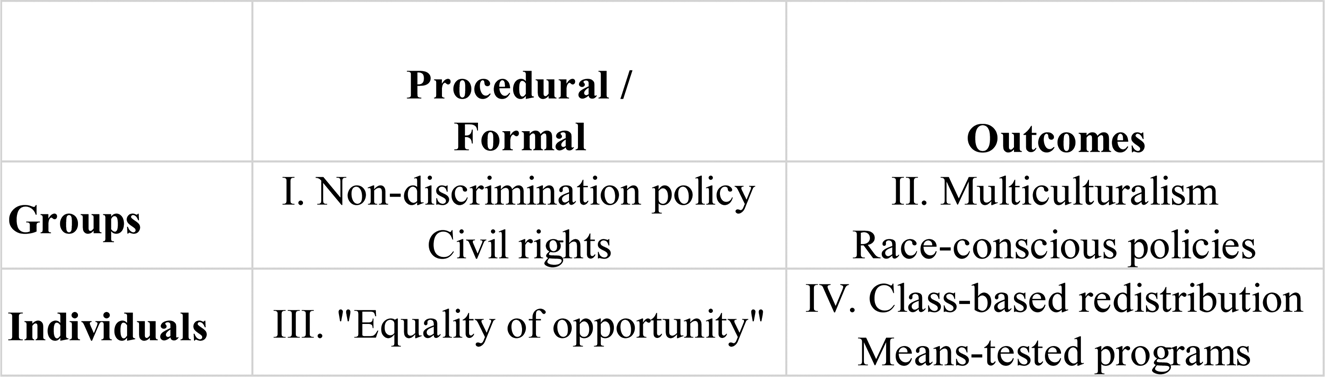
To illustrate these points, Figure 1 advances a typology that brings together elements of T.H. Marshall's conceptualization of citizenship with Frankel's elaboration of egalitarian ideals that are arguably more applicable to systems of economic exchange (also, see Canon Reference Canon1999, Chapter 6). Both the distinctions shown in the typology as well as the blurriness of the categories with respect to specific equality demands—their potential to morph into another—contribute to the challenge of equality talk.
Typology of egalitarian principles.

Two scope restrictions on our conceptualization of equality deserve special note. First, we emphasize that this typology is meant to reflect the explicit and predominant classification of egalitarian values in post-Civil Rights America. Typologies of egalitarian values in earlier periods of U.S. history would have been much broader and had to incorporate now outdated views that many forms of ascriptive hierarchy are in fact consistent with human equality (Ericson, Reference Ericson2000). These views no doubt persist but are no longer an explicit component of even most conservative rhetoric, which insists not that people should be relegated to an underclass due to circumstances of their birth but that all could advance if only they tried hard enough (Sears et al., Reference Sears, Sidanius and Bobo2000). Second, we do not automatically classify populist appeals as egalitarian (e.g. Bimes and Mulroy, Reference Bimes and Mulroy2004; Bimes, Reference Bimes2015). Though there is some overlap in relational references to class status and standing, populism includes a variety of rhetorical targets, such as big government, “the interests,” and elites that only sometimes pertain to egalitarian themes and often are invoked in support of decidedly in egalitarian motives. By the same token, much equality talk is framed in non-populist terms.
In our typology, one dimension varies by whether egalitarian principles center on formal process or on material or social outcomes. The second by the unit of comparison: whether equality is assigned to individuals or to groups. Non-discrimination policy, for example, is predicated on a belief in procedural equality between individuals, but its emphasis and basis is a presumption that inequality has existed on the basis of group identity. Proponents of multiculturalism (e.g. Taylor, Reference Taylor1994; Kymlicka, Reference Kymlicka2015) tend to argue that efforts to equalize the representation of groups in various economic, social, and political roles is an indispensable precursor to equalizing outcomes between individuals. But the focus is on group marginality, historic and ongoing disadvantage, and the importance of group recognition. In general (cf. Canon Reference Canon1999), there is more political controversy when issues are considered in group (rather than individual) terms, and regarding outcomes (rather than processes).
Both dimensions of egalitarianism encompass political and economic spheres. In particular, equality of economic opportunity—the ability to participate on equal footing and under equal rules and procedures in the free market—is itself one type of political equality. Specifically, it might be considered a component of “civil equality,” or equality before the law since it is the law that regulates the marketplace and sets the rules of exchange. Although Marshall (Reference Marshall1950) distinguished civil citizenship from political citizenship, an equal power to choose lawmakers who establish procedures that are then applied equally, and indeed the second lagged the first historically, he felt that civil equality also implied political equality, from a moral standpoint. Since these ideas tend to go together in modern societies, we consider political equality part and parcel of formal equality between individuals. Civil equality more closely resembles Frankel's (Reference Frankel1971) notion of “fundamental equality” than what he terms “formal equality.” What Frankel terms “formal equality” disavows arbitrary distinctions—say, a nobleman's decision on a whim to favor one subordinate over another when both are of the same class—between individuals and demands that “like be treated alike” but countenances, in principle at least, a number of social stratification systems or rules that legitimate stark inequality (193). “Fundamental equality” puts the burden of proof on the defender of a given inequality to explain why it conforms to a morally defensible rule (more like “equity”) and goes beyond “formal equality” (more akin to “sameness”).
The post-Civil Rights egalitarian consensus in America revolves around nearly universal support for a guarantee of equality of opportunity but not outcome (e.g., Frankel, Reference Frankel1971). This obtains in both the political and economic realms: all citizens are in principle afforded the same opportunity to participate in and try to influence politics but with no guarantee of equal influence in fact (Pevnick, 2016); all are afforded the same opportunity to participate in markets but with no assurance of equal income or wealth. Americans strongly believe in and forcefully endorse this principle of equality, in the abstract, at least (e.g. Hofstadter, Reference Hofstadter1948; Hartz, Reference Hartz1955).
Group-based inequality poses a special difficulty for egalitarian rhetoric. The fusion of equality issues with controversies over race makes egalitarian rhetoric even more, and especially, charged. The injection of racial attitudes and identities into debates about the size and role of government in the U.S. comes with a set of assumptions and myths that have been propounded to justify formal inequality and have been modified and stripped of their “biological” claims to reconcile stark inequality of outcome between racial groups with belief that equality of opportunity has been realized. These assumptions also bolster opposition to non-discrimination policies that ostensibly go “too far” (Kinder and Sears, Reference Kinder and Sears1981; Kinder and Sanders, Reference Kinder and Sanders1996; Tesler, Reference Tesler2016).
Poverty and inequality are deeply racialized social problems in the United States, and inequality legitimizing myths are inextricably tied to long circulating stereotypes about American blacks as lazy and immoral (Gilens, Reference Gilens1999; Sidanius and Pratto, Reference Sidanius and Pratto1999; Soss et al., Reference Soss, Fording and Schram2011). These legitimizing myths and stereotypes are bound up with core American values and aspirations, often linked to “deservingness” and associated with ideas such as upward mobility through “hard work” and “responsibility” (Sears et al., Reference Sears, Sidanius and Bobo2000). Thus, beyond threatening to destabilize traditional systems of racial stratification and undermining ascriptive ideologies that are a recurring theme in the country's history (Smith, Reference Smith1993; Smith and King, Reference Smith and King2005), egalitarian rhetoric about race can seem to many to strike at the heart of the liberal tradition of individualism and consensual aspects of American national identity.
Accordingly, studies of presidential rhetoric, including during Barack Obama's tenure, have identified relatively few references to racial struggle or inequality (Gillion, Reference Gillion2016; Haines et al., Reference Haines, Mendelberg and Butler2019) in their rhetoric. The emphasis instead has been on unifying rhetoric that de-emphasizes the significance of race and can undermine efforts to promote racial equality (Harris, Reference Harris2012), although with significant variation, nuance, and evolution over time (Price, Reference Price2016). In contrast to these studies, our research sees the patterns with respect to race as an important case of a broader phenomenon—the relative neglect of equality talk—that spans at least two lengthy eras of presidential rhetoric.
Racial inequality, and race-conscious efforts to alleviate it, have also played a large role in the ideational decoupling of “process-oriented” from “results-oriented” equality. As Ellis (Reference Ellis1992) has shown, for much of American history leaders and thinkers often assumed that equality of opportunity in a free market would lead over time to more equal economic outcomes. Elites by and large understood government favoritism and unequal treatment to be the primary source of inequality of results. As such, one could easily support capitalism in process and see no conflict with the goal of more equal outcomes. However, Ellis points out that the evolving understanding of what constitutes evidence of group-based discrimination from an emphasis on intent to effect reverses this assumption. On the contemporary political left, the presence of inequalities of outcome by class, and especially by race, is therefore now widely assumed to firmly demonstrate that opportunities are unequal. On the political right, inequalities of outcome between individuals and groups are defended as “natural” and acceptable outgrowths of free market capitalism.
On the whole, we would anticipate most presidential rhetoric to fall into quadrant I, least into quadrant II, and intermediate levels into III and IV. Put differently, where we do find equality talk, it will mostly skirt the most salient and consequential disparities in contemporary American society.
While this typology serves primarily to distinguish the types of egalitarian appeals presidents will and won't often make, it also highlights how the ambiguity of equality talk limits its likely use overall. The categories in our typology are in practice hard to pin down, not least because all presidential rhetoric is subject to willful misunderstanding by political opponents and other opinion leaders. Even with pure intentions, it is not easy to draw a bright line between distinct types of equality appeals. For example, consider a reference to growing inequality as a social problem. Where poverty is often thought of in racial terms (Gilens, Reference Gilens1999), this reference might automatically conjure group inequalities. In so doing, it will raise the question of why such group disparities are justifiable—a difficult question to answer without contending with the racially conservative proposition that some groups are superior to others “culturally” or the racially liberal contention that American society is “structurally racist” and treats different groups unequally. Moreover, unequal outcomes can spawn unequal opportunities. Even without an obvious structural element, inequality presents hurdles to individuals' ability to participate and influence politics (see, e.g., Verba et al., Reference Verba, Schlozman and Brady1995). This means that political actors will often cast the equalization of resources—a deeply controversial proposition—as a necessary predicate to the equalization of political rights and opportunities, an ideal that is almost universally endorsed in the abstract.
More broadly, the apparent social and elite consensus about equality of opportunity is only as stable as agreement about where guarantees of equal opportunity end and efforts to equalize outcomes begin. Once again, this is true in both the economic and political realms, which also influence one another. It is one thing to adopt the principle of “one person, one vote,” but what does this imply about socio-economic or other constraints that many individuals may face, much less in the way legislative districts should be drawn and their relation to the presence of minority and majority group voters? It is one thing to say that everyone should have an equal opportunity in the free marketplace, but where does one draw the line—especially when it comes to such formative public goods as education (Frankel, Reference Frankel1971) that structure differential opportunities throughout the lifecycle?
In short, the typology not only identifies which types of equality presidents are likelier to emphasize but also underlines their expected reticence to use egalitarian rhetoric at all. Even when it is purportedly tied to only formal and procedural aspects of equality, which enjoy an outward consensus in contemporary American society, it can venture into areas that have clear perils. These dimensions encroach on and overlap with one another in practice in ways that a superficially clean typology resembling Figure 1 belies. The line between equality of procedure and equality of outcome is very blurry. Where the burden lies in explaining social and economic inequality is inherently unclear. This makes equality talk of any but the blandest kinds a rhetorical gamble—costly to engage in and easily misunderstood. Or, as Ronald Reagan put it, “if you're explaining, you're losing.”
Theoretical expectations
This reasoning leads to three expectations about egalitarian rhetoric relative to individualism in State of the Union Addresses. We avoid the language and strict modality of hypothesis testing as we focus on examining and illuminating general patterns consistent or inconsistent with these expectations, since our research is exploratory rather than confirmatory.
Prevalence: First, given the divisive potential of egalitarian rhetoric generally, the unclear boundary between widely supported formal equality and equality of outcome, and the ripe potential for slippage between discussions about equality between individuals and the challenge they pose to widely believed legitimating myths about lingering inequalities between racial groups, we anticipate that overall references to egalitarianism will not occur frequently. We mean this in a relative sense: equality will be spoken about less often than other core values such as individualism or freedom.
Portrayal: Second, we anticipate that where we do encounter egalitarian frames and appeals, they will focus heavily and explicitly on equality of opportunity rather than outcome, and on procedural formulations or principles of civil rights rather than inequality of outcome. This means that we expect few references to inequality as a social problem, whether it be between individuals or between groups and few allusions to the concrete economic and political manifestations of unequal structures of opportunity. There may be some acknowledgements of “difference(s),” but not necessarily of inequality.
Positioning: Third, we expect that egalitarian appeals will generally be kept “at a safe distance” from discussions of race, except when they pertain to formal equality and procedurally oriented civil rights principles, in which case the two are obviously inseparable. References to inequality, per se, as a social problem, however, will likely be less prevalent whenever the issue of race lurks.
We have so far theorized about the use of equality and individualism frames overall. However, there are also reasons to suppose that the incentives to deploy or avoid equality talk differ across party and period:
Party: We also have two additional expectations about differences in the relative prevalence of equality talk of all kinds across party lines and political eras. Since the Democratic Party has been aligned with Civil Rights causes since the 1960s and therefore throughout the great majority of the period we study, we expect that the frequency (and framing) of equality and individualism will be more similar or balanced in the SOTUs of Democratic than Republican presidents. However, this is far from a clear-cut expectation. Precisely because Democratic presidents may believe themselves vulnerable to charges of playing “class politics” (or even “class warfare”) or making racially explicit references that may be interpreted as divisive by some, they might compensate by assiduously muffling or moderating references to equality and/or linking it to or emphasizing individualism. They might also be especially wary of evoking race in discussing equality. SOTUs are speeches to the public as a whole, so partisan themes may be dampened in the hope of avoiding ideas that may be seen as sowing discord. This makes our expectations somewhat unclear ex ante.
Period: Our study spans two distinct periods of presidential history (Skowronek, Reference Skowronek2011), seeking to be expansive in time, and varied in the ostensible nature of the equality “regimes.” The first period encompasses the Kennedy, Johnson, Nixon, Ford, and Carter presidencies, an era in which the New Deal and Keynesian Consensuses largely persisted in national politics and one rocked by the Civil Rights movement, which was explicitly focused on securing political equality and in its later years turned the focus more toward persistent racial economic inequality, a source of continued division. The second period, beginning with Ronald Reagan's presidency, is defined by the ascendancy of “neoliberalism.” Even Democratic presidents during this period—Clinton and Obama—adopted much of the neoliberal discourse of free markets, incentives, small government, and personal responsibility associated with the market-conservative reaction to New Deal liberalism. Extending the analysis over these two political eras enhances the generalizability of our results and allows us to compare the prevalence of equality and race-related themes during the heart of the Civil Rights movement and its aftermath to a period often characterized as a reaction to government efforts to legislated equality.
Analytical approaches: Close reading, automated text analysis, and hand coding
The presidential SOTUs from 1960 onward were collected and read and subjected to content analysis, undertaken in three principal ways. First, the authors of the paper, along with two research assistants, engaged in close readings and assessment of major themes to develop a sense of references to and phrasing of words pertaining to (in)equality, race, discrimination and civil rights and words pertaining to economic class as well as other core values in the American political tradition. Second, building on this more subjective approach, our close reading and hand coding guided us in developing a dictionary to be applied in supervised machine learning content analysis for both explicit and implicit references to these concepts. Using this last approach, we obtained word counts pertaining to each major concept of interest. The unit of analysis in this case was the speech (or year). Third, the close reading also laid the groundwork for hand-coding of speeches at the paragraph level, using the text splicing displayed in transcripts obtained from the UC Santa Barbara American Presidency Project (https://www.presidency.ucsb.edu/). This hand-coding, carried out by two graduate student research assistants under our supervision, permitted us to incorporate more oblique or “implicit” references to the concepts at play in our analysis. The pairing of automated word counts and hand coding has been put to effective use in earlier research analyzing presidential rhetoric (e.g. Bimes and Mulroy Reference Bimes and Mulroy2004). Following the text analysis and hand coding, the authors repeated a close reading of the addresses to add interpretive richness to the patterns that were observed.
When it comes to race, explicit references include mentions of the terms race or ethnicity or the names of racial and ethnic groups in the U.S. They also include overt references to civil rights and voting rights, racial discrimination, and a variety of other references to race and ethnicity that do not have obvious equality-related content. For example, claiming to have improved the economic condition of members of multiple racial groups, while clearly a race reference for our purposes, is not necessarily an equality reference unless the achievement is framed as progress toward closing a gap or reducing inequality. Implicit references to race include language that is racially coded, such as references to the struggles of “inner cities” or references to salient racially charged events such as “Selma” or “Ferguson.” However, our conception of implicit references to race is decidedly narrower than some employed in the literature on racial priming and public opinion (e.g. White Reference White2007). It excludes unadorned references to poverty and other forms of economic distress unless they are accompanied by some additional context that ties them directly to race.
Online Appendix, Table A1 presents an inventory of the words and phrases associated with the main concepts and themes of interest in the SOTUs. We acknowledge that in many cases it is difficult to define precise sets of words and phrases that identify these themes. Moreover, it is clear that the way that certain social problems, values, and aims are talked about evolves over time. However, the terms included encompass, in our view, a broad interpretation of these themes and reflect the rhetorical tropes through which they are almost always expressed. As corroboration of this, our hand-coding analysis closely resembles the patterns we find in the machine learning analysis, lending credence to the dictionary's exhaustiveness.
Before proceeding, it is important to articulate three important features of the conceptual delineation and application of equality and inequality that we employ. For one, we do not automatically classify efforts to address “poverty” as egalitarian in character. Although some anti-poverty efforts are couched in egalitarian terms, in the U.S. the majority are not. Rather efforts to alleviate poverty have generally been framed as a way to put a “floor” on citizens' wellbeing, akin to the idea of T.H. Marshall's “social citizenship” (Marshall, Reference Marshall1950). The social safety net is not structured to bring people to the same level but rather to address suffering. Indeed, this emphasis on humanitarian, rather than egalitarian, framing of anti-poverty efforts appears to dovetail with the way ordinary citizens tend to think about welfare issues: the most widely supported programs offer limited humanitarian assistance while more expansively egalitarian efforts to extend the role of government receive more limited support (Feldman and Steenbergen, Reference Feldman and Steenbergen2001). As Frankel (Reference Frankel1971) points out, the idea that policy should aim at the “satisfaction” of “basic needs” leaves much to the imagination about how much satisfaction is enough and which needs are truly basic. As a result, it is at most a “highly attenuated” notion of equality that often goes no further than the alleviation of human suffering (198–199).
For another, we distinguish between references to the expansion or increase of opportunity and equality of opportunity. As we will see, this is a significant distinction in presidential rhetoric because references to opportunity abound but are often noticeably divorced from any explicitly egalitarian connotations. More opportunity does not necessarily make people more equal. The expansion of opportunity for some, say, though a job training program or, conservatives might argue, even the elimination of the minimum wage, can often support economic policies that are widely acknowledged to increase inequality, at least in the short run. Expanding opportunities by investing in education may benefit tomorrow's capitalists even more than tomorrow's laborers, thus widening income gaps rather than narrowing them. “Opportunity for all” does not entail equal opportunity for all, let alone more equal outcomes.
Analysis of state of the union messages
Our empirical strategy brings together three complementary modes of analysis. Automated text analysis, specifically supervised machine learning, provides what might be considered the most objective appraisal of thematic emphasis in these speeches. Supplementing this with hand-coded analysis at the level of speech paragraphs allows us to capture themes that are more implicit and therefore not fully spelled out in the text in ways that any dictionary constructed ex ante would plausibly capture. Finally, we add to these analyses our own close reading of the text. While the most interpretive and subjective component of this analysis, we show that close reading can bring attention to connections and themes that neither of the other approaches can. Perhaps most important, close reading can identify patterns of omission in rhetoric that more systematized analysis would likely miss. Along with illuminating the significance of imbalance between the core values of the liberal tradition in the nation's most prominent political rhetoric, this approach lays the groundwork for investigation of other domains of elite discourse, past and present.
Automated analysis of state of the union addresses
We present the principal evidence from the machine learning analysis based on these terms, encompassing basic information and descriptive data on all the SOTUs, in a series of figures. Our measures of emphasis are counts of the frequency of related words used throughout the speeches. The unit of analysis for the machine learning portion of our study is the individual speech. But we will aggregate the results by partisanship and the mean frequency per speech for each thematic concept by president as well. Given the strikingly equal number of years in which each party has held the presidency, the raw frequencies across party are comparable without further adjustment. For clarity, however, we present box and whiskers plots representing the distribution of themes across parties as well as presidents. In the interest of brevity, we present aggregations across all the terms in each theme cluster in our dictionary and comment on the subcategories and particular terms in our subsequent discussion.
Each of our analytic approaches has both strengths and limitations. The automated analysis is carried out at the level of the speech, rather than the paragraph (as in the hand-coding below). We therefore use it to gauge frequencies as they relate to our theoretical expectations concerning the prevalence, portrayal, partisan divisions, and periodicity of references to equality and inequality. We reserve discussions of proximity to the subsequent section on hand-coding.
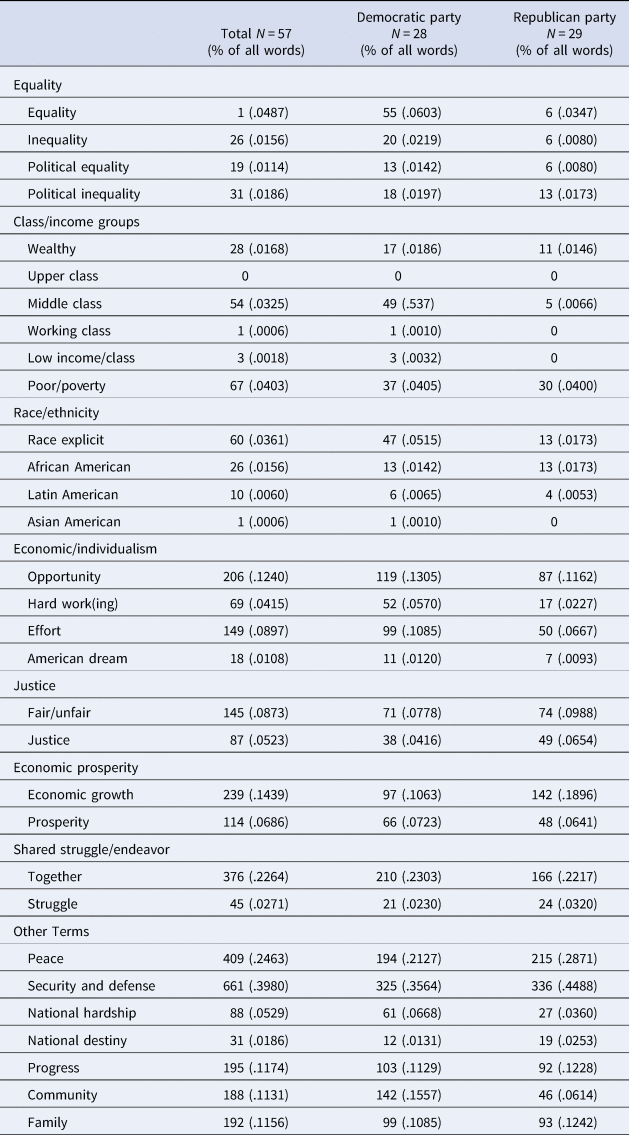
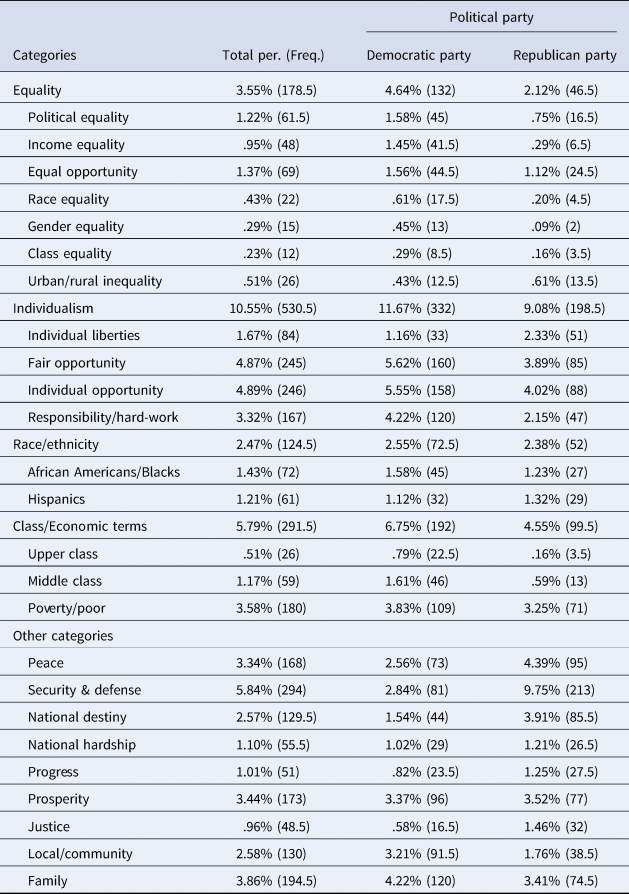
Prevalence: Table 1 displays the frequencies associated with our key themes as well as the percentage of all words used in the State of the Union Addresses that each particular dictionary entry accounts for. The specific terms associated in our algorithm with each line item in the table are shown in the Online Appendix. While we provide breakdowns here by party for reference, we focus first on aggregate patterns, leaving discussion of party differences to a section below.
Core themes and values in state of the union addresses, 1960–2017, machine learning

Note : There was no official SOTU speech in 1973. Percentages in parentheses estimated from 91,183 words related to the Democratic party's speeches, 74,864 of the Republican party, and 166,047 words of all SOTUs.
On the whole, what stands out in these results is the relative paucity of overt references to egalitarian values. Even when including both political, economic, and general references to equality or inequality, there is only one such reference for approximately every three to words associated with individualism—effort, opportunity (but not explicitly equal opportunity), and other words associated with upward mobility and the American Dream. Egalitarian references are also vastly outnumbered by discussion of “valence” issues such as peace, prosperity, and security and terms associated with republican notions of civic community and shared membership. We had no a priori expectation about the relative prevalence of liberal and republican values in these speeches, but the raw tabulations suggest the latter carry at least as much emphasis, again underscoring the multiple ideological traditions in American political culture (Smith, Reference Smith1993). There is also a substantial number of references to values such as fairness and justice but, as we discuss below, in contrast to the increasingly common framing of equality as a “justice” issue, most without sufficient context to relate them to egalitarian ideals. Finally, even topics such as race and class that denote divides commonly invoked in discussions of equality and inequality are relatively rare, and most class references are to the mushy notion of the “middle class” or to the poor, a group that we will see is discussed more often with reference to humanitarian and individualistic values than egalitarian appeals.
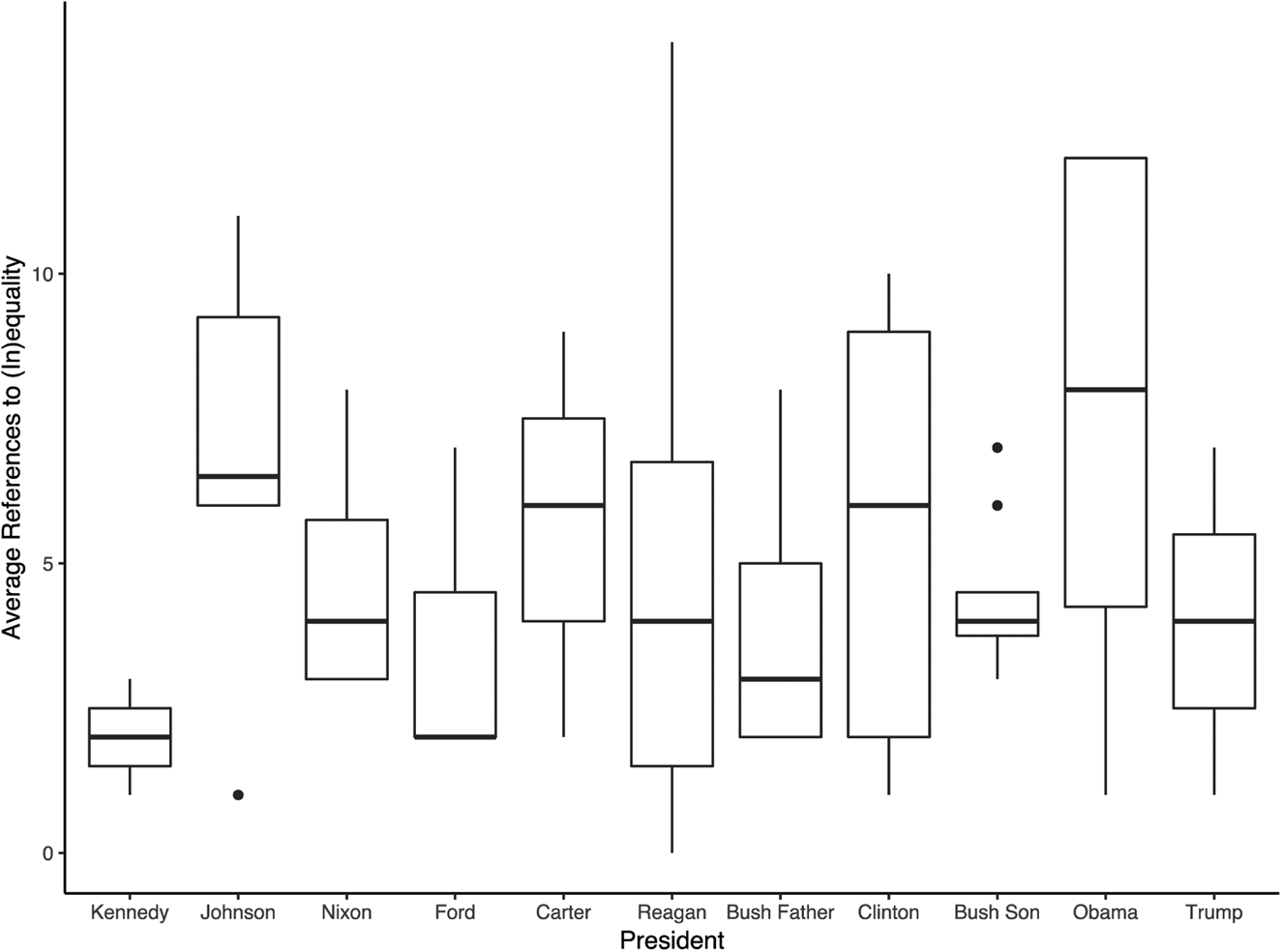
Figure 2 displays the frequency of equality-related terms in the SOTUs by presidency. We are again struck by the apparent paucity of equality references across most presidential administrations, given that it is generally thought of as one of the central values in the liberal tradition and the face that struggles for equality have been at the forefront of politics and civil rights.
Use of (in)equality in the state of the union addresses by president.

What's more, as Figure 2 demonstrates, the total references to equality is greatly boosted by two of the 11 presidents during our period of study—Johnson and Obama. No other president has averaged above six—even Clinton, despite his notoriously long addresses. Most presidents have averaged under five references to the value of equality or the problem of inequality per address.
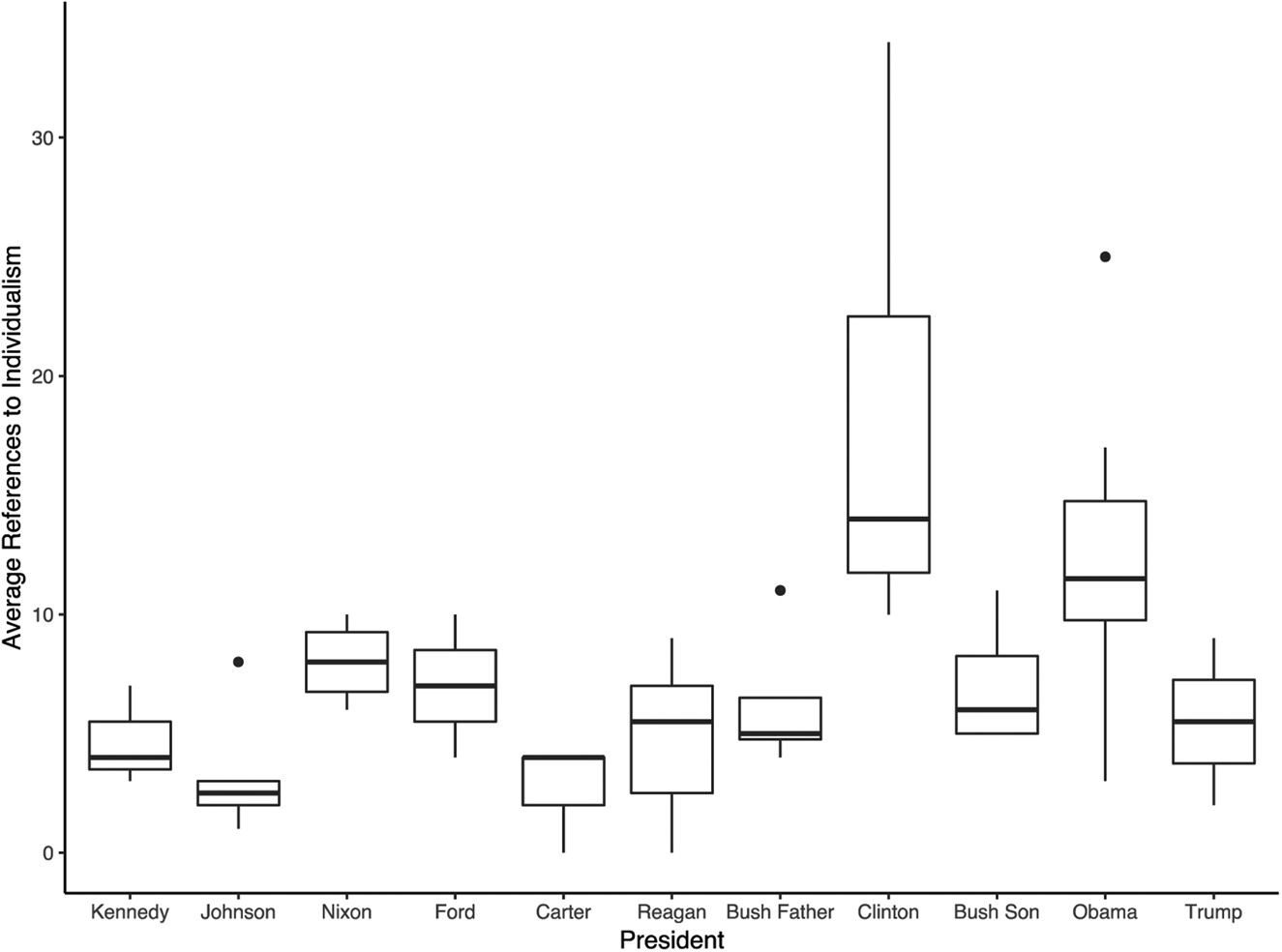
It is worth recalling here that our equality category is quite broad and includes a wide range of references to terms as vague as “fairness” to “civil rights” and political equality to any reference of equality of opportunity. Moreover, the relative infrequency of references to equality comes into greater relief when we compare it to the presence of words related to individualism—hard work, opportunity, liberty, market freedom, and personal responsibility. As shown in Figure 3, references to this value have been almost twice as common as references to equality across all our SOTUs.
Individualism in the state of the union addresses by president.

Figure 3 shows that Clinton and Obama lead all other presidents in references to individualism. This is somewhat surprising given the ostensible centrality of market freedom and individual initiative in Reagan's presidency.
We also suggested that equality-related themes might be at their most charged and divisive when related to issues of race. While we save a fine-grained analysis of positioning for the next section, we find some suggestive support here that race is a topic most presidents would rather avoid. Earlier research (Gillion, Reference Gillion2016) has found that race receives sparse attention in presidential rhetoric, and our analysis corroborates this finding. There has been an average of only about one reference to any term related to race or ethnicity in these speeches. As we will see, this includes a variety of references to race that are essentially aimed at minimizing the significance of inequalities between racial and ethnic groups and downplaying or inveighing against racial division. Given the narrow range of references to race and ethnicity, we omit frequencies by president.
Beyond our main concepts of interest, among the most prevalent themes in these speeches, when it comes to domestic issues, have to do with shared prosperity and a common or collective endeavor to achieve it, as well as other themes of commonality and shared communal responsibility. Not surprisingly, presidents place a premium on arguing that their agendas will increase the size of the pie. There are also a plethora of other parochial variants of shared responsibility and collective endeavor, community ties and family. This underlines that the emphases in these speeches are unifying, collective endeavors and aims and individual freedoms. These endeavors parallel themes described in Tocqueville and re-cast by scholars such as Robert Bellah—a strong individualistic ethos tempered by a “joiner” mentality and strong families. Alongside these themes, a reader of these addresses alone would not the alleged strength of the egalitarian tradition and impulse in American political culture or the centrality of race in its politics and society.
Portrayal: We are also interested in the particular kinds of equality that presidents have talked about, when they have talked about it at all. As we expected, references to equality vary strongly by type. As seen in the top panel of Table 1, discussion of economic inequality as a social or political problem are remarkably uncommon, which is consistent with avoidance of the potentially divisive issue of unequal outcomes. In fact, prior to Obama's second term, it was literally absent. Obama's five uses of the word “inequality” during his second term are the only ones over the entire period of our analysis—nearly 60 years! Those references were evidently enough to elicit accusations of “playing class politics” from Obama's critics. In short, the word equality in these speeches has always referred to political equality, equality of status, and the principle of non-discrimination on the basis of ascriptive characteristics. It has not referred to the value of equality of outcome and even then, often used to emphasize unity rather than to call attention to an uneven playing field.
What limited references presidents do make to the value of equality are instead focused on gestures toward the principle of non-discrimination and equal treatment or equal justice. As we discuss below, close reading reveals that many of these are passing references devoid of detailed discussion. Some are in fact statements in opposition to “reverse” discrimination often alleged to be a consequence of affirmative action. Equal opportunity, as we expected, is the main theme in the sphere of equality talk. Much of it is focused on education-based opportunity “gaps,” with the equalization of opportunities for children apparently viewed as a safer discursive focus than the inequality faced by the adults they become.
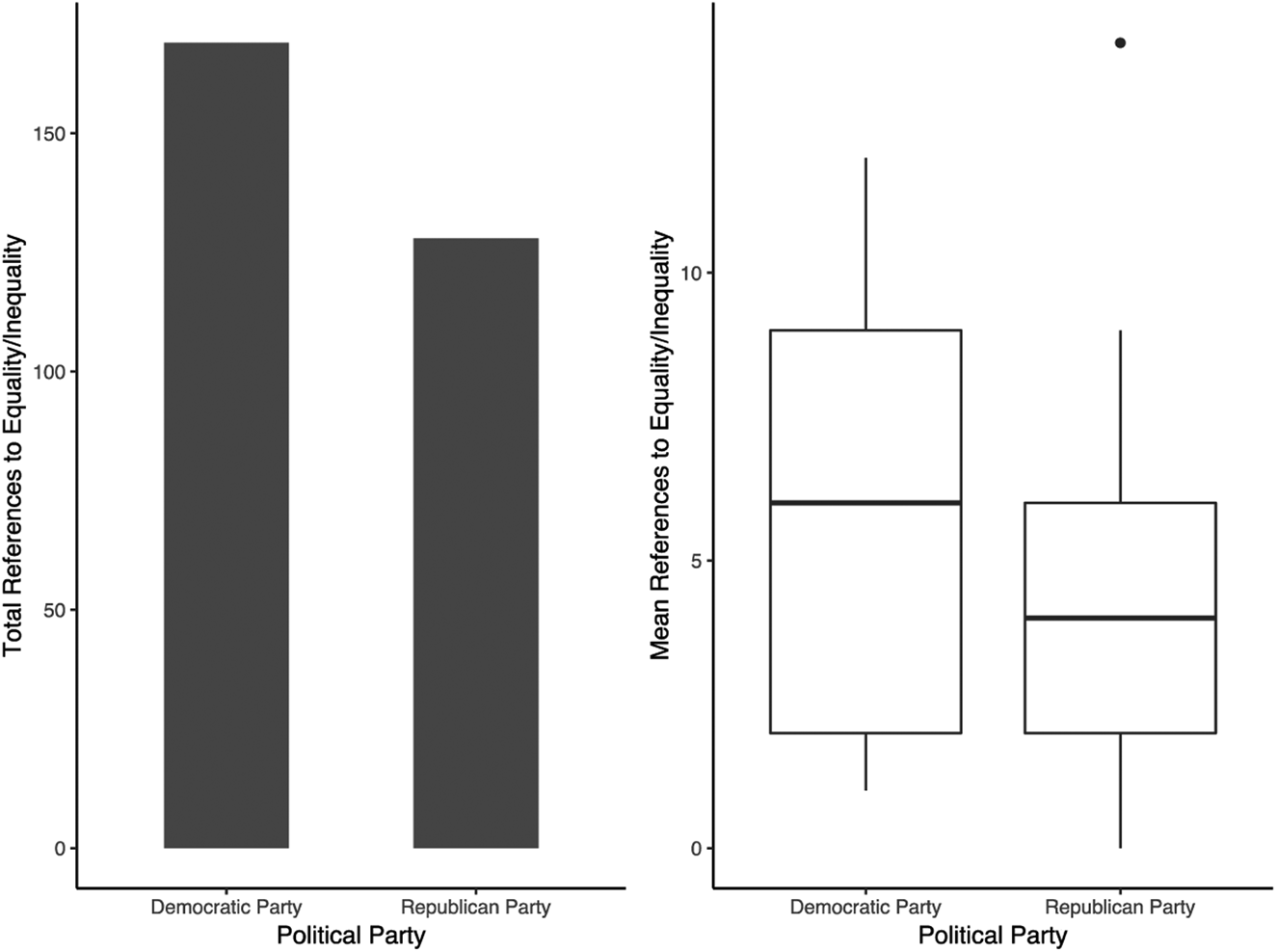
Partisanship: Consistent with the conventional wisdom, Democrats do talk about equality more often than Republicans. Figure 4 shows, however, that the differences are surprisingly narrow. Despite being the “party of civil rights,” even Democrats talk infrequently about equality.
(In)equality in the state of the union addresses by political party.

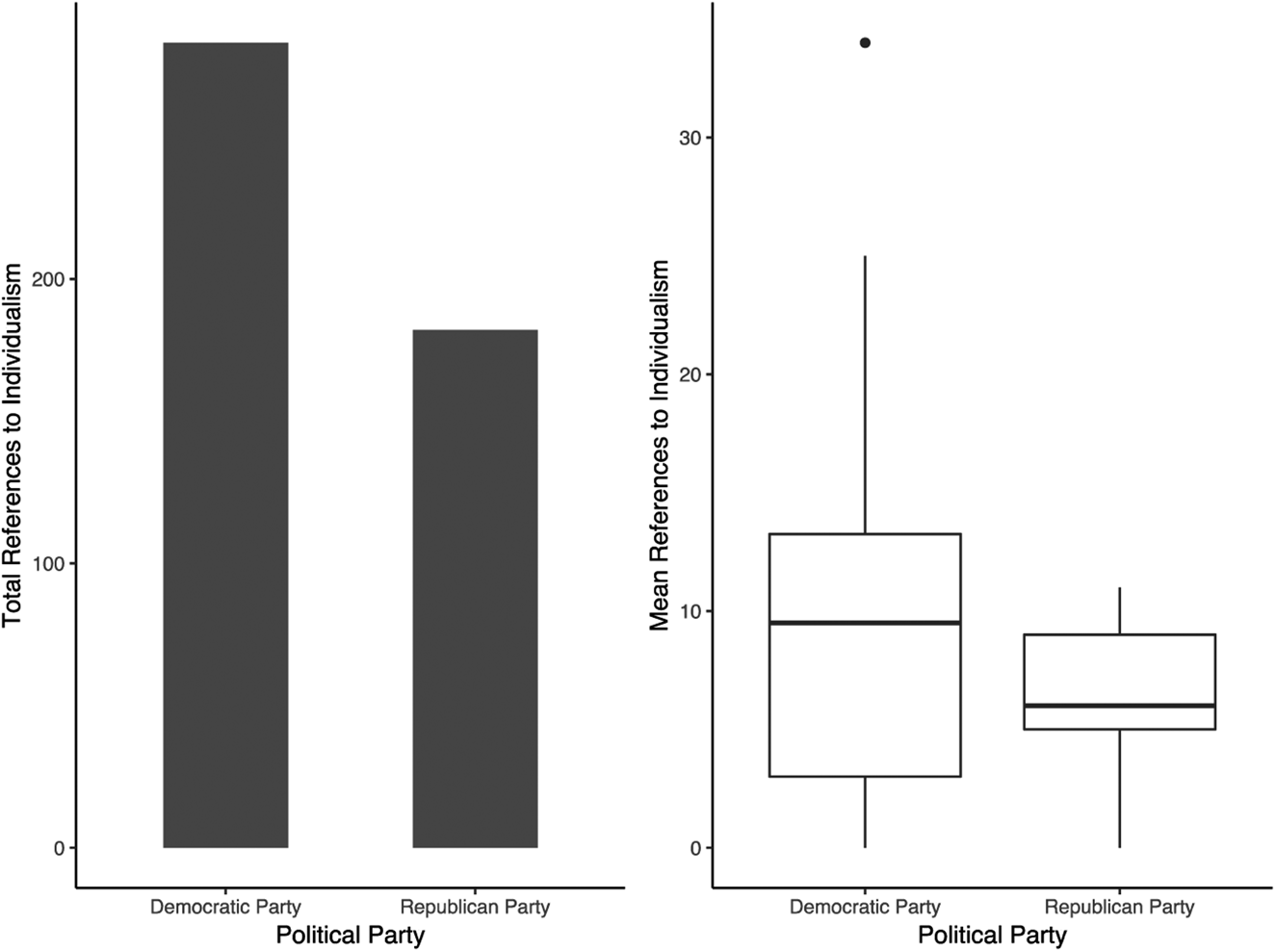
Strikingly, as shown in Figure 5, Democrats do not appear to give greater weight to equality relative to individualism than Republicans do. Democrats are also considerably more likely than Republicans to refer to individualism. In other words, Democrats are likelier to address both of the dominant core values in the liberal tradition, and both Democrats and Republicans have talked the talk of individualism far more than they have invoked equality as an aspiration or policy goal.
Use of individualism in the state of the union addresses by political party (1961–2018).

One interpretation of these partisan patterns is that Democrats have had to work harder to convince voters that they were in line with the value of economic individualism whereas Republicans could take this perception for granted. If Democrats in the neo-liberal era of the American presidency felt that voters suspect their party of playing “class politics,” an accusation often leveled against Barack Obama during his second term, they might have taken pains to join discussion about equality with even more discussion of individualism. We will see shortly that a close reading of these addresses lends some support to this idea.
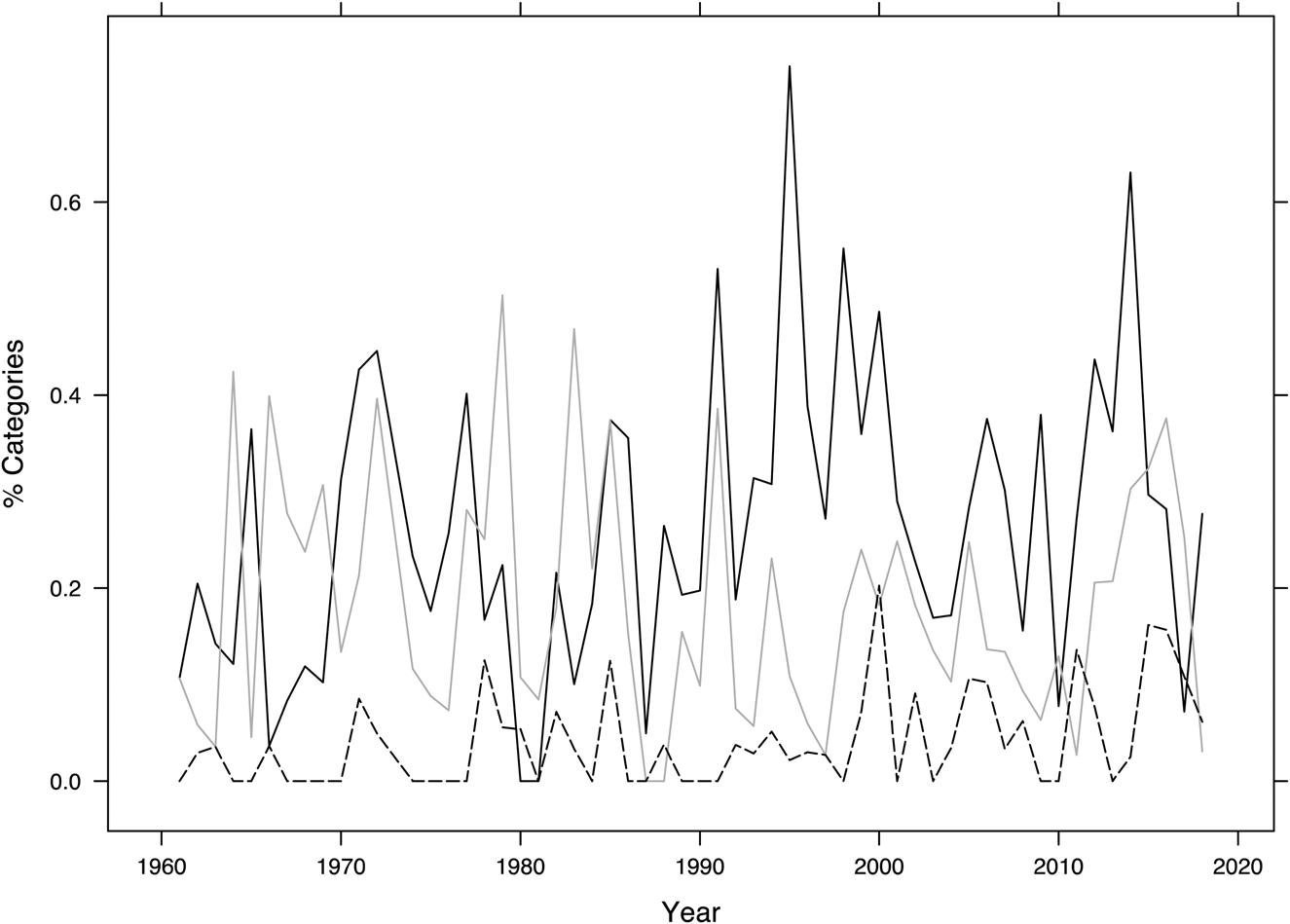
Period: Figure 6 presents trends over time in the frequency of terms related to each of our three main thematic areas of interest. We see intriguing variation by period that conforms to our supposition that the later Keynesian era that spanned the onset of civil rights differs from the Reagan era of hegemonic neoliberalism in important respects. On the whole, individualism has generally predominated over equality. However, the frequency of references to individualism have increased since the 1980s while references to equality have not. This is in keeping with the greater free market orthodoxy and reaction to civil rights characteristic of Republicans' “Southern Strategy” and Democrats' reactive approach of “triangulation.” Nonetheless, references to individualism and equality appear to covary positively across speeches: more of one is associated with more of the other, a pattern we have speculated reflects the need to temper equality talk with emphasis on individual opportunity and responsibility. Finally, it is noteworthy that references to race and ethnicity have been extremely infrequent over the entire period of study, despite the centrality of race and racial inequality in American politics.
Use of the categories of analysis in the state of the union addresses over time.
Notes: The solid black line represents individualism, the solid gray line is used for (in)equality, and the dashed black line is used for race.

Hand coding
Our hand-coding provides a more granular complement to the automated text analysis. The unit of analysis was the paragraph within each speech. These were coded 1 if the theme was judged to appear explicitly or implicitly and 0 otherwise. Binary coding cannot gauge the intensity or nature of the value or theme invocation, but it does give a broad sense of frequency within speeches and also “what goes with what.” Encouragingly, our two coders showed a respectable level of agreement on which themes were present in which paragraphs. The correlation between equality codes was .81, on individualism .66, and on race/ethnicity .76. We averaged the two coders' ratings of each broad category for the purposes of this analysis.
Prevalence In general, the hand-coding corroborates the automated analysis in terms of the relative frequencies of each theme. Equality was identified in a total of 3.6% of the paragraphs. Individualism was found to be far more prevalent, with both coders seeing it in 10.6% of paragraphs. Race was the least common key theme, appearing in only 2.5% of paragraphs. Once again themes associated with valence issues, taken together, are relatively prevalent though this is less pronounced than in the machine learning, perhaps because such references tend to be clustered together within paragraphs.
Portrayal: Our hand-coding provides a granular look at how equality and other values are spoken about when they are. In keeping with our expectations, there is a good deal more attention to political equality as a formal matter, usually involving non-discrimination, than to economic inequality. Rather, there is more attention to equal opportunity than to inequality as a social problem. As expected as well, there is very little discussion of inequality between groups, including race, despite the centrality and endurance of racial inequality in the fabric of the American economy (Table 2).
Core themes and values in state of the union addresses, 1960–2017, hand-coding

Note: Disagreement between coders is coded as .5. The percentage of appearance of each category was estimated in relation to 2,843 paragraphs of SOTUs of the Democratic party and 2,184 paragraphs of the Republican party.
Position: The hand-coding permits in depth analysis of how these concepts are positioned relative to one another. This analysis broadly supports most of our expectations but not all. At the paragraph level, as at the level of the speech in the automated analysis, we observe a substantial correlation between references to equality and individualism. Presidents of both parties are likelier to pair the two or speak of them in close proximity. The presence of discussion of equality in a given paragraph is correlated with a discussion of individualism in the same, the prior, or the subsequent paragraph at .22. In many respects, proximity is found to vary by period and party.
Partisanship: Corroborating the automated analysis, Democrats were more likely than Republicans to refer to all three thematic categories. The analysis of hand-coded data permits a more nuanced look, however, at partisan variation in how these concepts go together. The results are revealing. The equality-individualism linkage is significantly higher (p < .05) among Democrats (.25) than among Republicans (.15). This suggests again that Democrats feel particular pressure to combine discussion of equality with proximate discussion of the potentially less divisive value of individualism.
Period: We again see evidence that political eras matter, both in the frequency of each theme and their covariation. Each year of our period of analysis is associated with a .0006 increase in the proportion of paragraphs mentioning equality but threefold greater (.002) increase in mention of individualism. Both increases are only statistically significant and heavily driven by rises among Democratic presidents. Moreover, the association between references to equality and proximate references to individualism has also increased since the Reagan era, from .17 pre-Reagan to .26 since, with similar increases in both parties.
The proportion of paragraphs devoted to race has also increased but at a slower rate, .0004 per paragraph per year. Moreover, the increase is only significant among Republicans (.0013) and not among Democrats (.00005). We conjectured that race and equality would often be decoupled in these addresses. In fact, however, over the course of the full period of analysis, references to race are correlated at .33 with proximate (previous, same, or subsequent paragraph) references to equality, considerably higher than they are with proximate references to individualism (.11). However, the link between race and equality was much greater prior to 1980 (.55) and has declined sharply since (.23), while the link between race and individualism has remained about the same (.11 and .10 respectively). In fact, the equality-race connection is driven heavily by several of Johnson's addresses at the height of the Civil Rights movement. Excluding Johnson from the analysis leave this link at .33. About half of the paragraphs that both coders saw as relating to race/ethnicity mentioned equality. Just over a third mentioned individualism. Thus despite the centrality of the value of equality to race issues in the U.S., individualism is even here also a quite prominent frame.
To summarize, we once again see evidence that talk about individualism predominates over discussion of equality and, even more so, race and ethnicity. Moreover, corroborating the idea that references to equality are “safer” when paired with individualism, we see the two mentioned in tandem far more than chance would suggest. Since the Civil Rights era, individualism talk has increased far more substantially than attention to equality or race.
Close reading
Our close reading of the SOTUs aids in the interpretation of these patterns, especially when it comes to the thorny issue of racial equality. A substantial portion of the references to equality refer to race (or gender). Nixon's speeches referred to civil rights. Reagan did several times as well. And Clinton's speeches made occasional reference to the Equal Opportunity Employment Commission or initiatives to combat discrimination, while Obama's went further, occasionally mentioning the particular hardships of minority youth trapped in poverty. For example, in 2015:
We may have different takes on the events of Ferguson and New York. But surely we can understand a father who fears his son can't walk home without being harassed. And surely we can understand the wife who won't rest until the police officer she married walks through the front door at the end of his shift. And surely we can agree that it's a good thing that for the first time in 40 years, the crime rate and the incarceration rate have come down together, and use that as a starting point for Democrats and Republicans, community leaders and law enforcement, to reform America's criminal justice system so that it protects and serves all of us.
Yet what stands out is that, in many other places, implicit references to economic status are stated in ways that curiously decouple race and class or race and labor. Reagan's 1982 speech contains such an example:
Seldom have the stakes been higher for America. What we do and say here will make all the difference to autoworkers in Detroit, lumberjacks in the Northwest, steelworkers in Steubenville who are in the unemployment lines; to black teenagers in Newark and Chicago (our emphasis); to hard-pressed farmers and small businessmen; and to millions of everyday Americans who harbor the simple wish of a safe and financially secure future for their children.
Particularly notable is that in referring to various workers (autoworkers, lumberjacks, steelworkers) in various places and others who will allegedly be (especially) helped by the (new) economic policies, only one—black teenagers in Newark and Chicago—refers to a racial group.
Notably, references to poverty as a social problem or welfare are quite seldom framed as an equality issue. Consider Nixon, in 1974. Speaking of “replacing a discredited welfare system with one that is fair to those who need help or cannot help themselves, fair to the community, and fair to the taxpayer,” he emphasizes fairness but is clearly not identifying inequality in a relational sense as a problem. Carter, in 1978, curiously decouples fairness from economic privation: “The fruits of growth must be widely shared. More jobs must be made available to those who have been bypassed until now. And the tax system must be made fairer and simpler.” Thus poverty alleviation and fairness reference two different issues. We will see below that the separation of equality and anti-poverty programs is a recurring tactic in these addresses. Reagan in 1983 speaks of fairness in the sense of fair housing and equal opportunity but never again in this sense, instead referring in 1984 vaguely to “fair play” (as in abiding by laws) and in 1985 to “fairness to families” in the tax code. Perhaps no use of “fairness” or equality on the topic of race is more clearly stripped of its conventional egalitarian connotation—even inverted—than in George H.W. Bush's 1991 address:
Civil rights are also crucial to protecting equal opportunity. Every one of us has a responsibility to speak out against racism, bigotry, and hate. We will continue our vigorous enforcement of existing statutes, and I will once again press the Congress to strengthen the laws against employment discrimination without resorting to the use of unfair preferences.
and later
We're determined to protect another fundamental civil right: freedom from crime and the fear that stalks our cities.
On the whole, references to equality in these speeches could be described as “safe, legal, and rare.” They are safe in that they refer in bland ways to uncontroversial generalities about equal treatment and political equality and decouple the issue of racial distress from the issue of economic class. They are legal, or legalistic, in that they refer primarily to the enforcement of civil rights law and statutory non-discrimination. And more than anything, they are simply rare, garnering far less attention in the half century following Civil Rights than one might have expected and far less than other values associated with the American Creed.
At one level, it is not surprising that issues of non-discrimination and equal political status and rights would receive more attention than inequalities of economic or social condition. In the abstract, equality of opportunity is a point of near consensus in American politics, whereas the causes and appropriate responses to inequality of outcome are highly controversial. But it is still striking that for more than forty years of rapidly raising income inequality, presidential State of the Union Addresses did not once identify inequality as a social, political, or economic problem. Obama used the word inequality five times in those second term addresses, enough evidently to be accused of playing “class politics.” Ironically, while these allegations certainly exaggerate the degree to which inequality was a focus in his speeches, they are accurate in the sense that Obama talked about the issue far more than any of his predecessors, who did not use the word at all. It is worth keeping in mind that this involves eight (notoriously lengthy) speeches by Democrat Bill Clinton during a period of already rapidly rising income inequality and, early on, through a period of recession. The rise of attention to inequality in Obama's second-term speeches may signal (and have promoted) heightened attention to inequality among Democrats. The few other prior references to inequality of outcome were largely confined to issues of inequality in education, which is not hard to see as inequality of opportunity. For example, George W. Bush alluded to a closing racial “achievement gap” in 2007. But even these references are rare despite widespread acknowledgment that a deeply uneven educational system in America is an engine of economic and social inequality later in life.
Even more oblique references to economic status, which might evoke concerns about inequality, are relatively rare. When “class” is mentioned, it is almost exclusively used to refer to “middle class,” an amorphous group that can in principle include the vast majority of Americans. One exception is in Obama's second-term addresses, where his appeals to middle-class economics were pitched with sparse explicit reference to the terms equality and inequality but with considerable attention to “fairness” framed clearly in the sense of equal opportunity for self-betterment:
Will we accept an economy where only a few of us do spectacularly well? Or will we commit ourselves to an economy that generates rising incomes and chances for everyone who makes the effort?
Middle class economics works. Expanding opportunity works.
…at every moment of economic change throughout our history, this country has taken bold action to adapt to new circumstances and to make sure everyone gets a fair shot. We set up worker protections, Social Security, Medicare, Medicaid to protect ourselves from the harshest adversity. We gave our citizens schools and colleges, infrastructure and the Internet, tools they needed to go as far as their efforts and their dreams will take them.
That's what middle class economics is: the idea that this country does best when everyone gets their fair shot, everyone does their fair share, everyone plays by the same set of rules. We don't just want everyone to share in America's success, we want everyone to contribute to our success.
So what does middle class economics require in our time? First, middle class economics means helping working families feel more secure in a world of constant change. That means helping folks afford childcare, college, health care, a home, retirement..
Even in this passage, however, we see considerably more reference to the values of prosperity, “expanded opportunity” (rather than equal opportunity), and the value of hard work as a means of advancement.
More importantly, Obama's second-term addresses are once again unique in juxtaposing the issue of class at all with questions about equal opportunity (“fair shot,” a phrase used only one other time in these addresses, by Bill Clinton in 1994). No other references to class in these speeches do so. No other president calls attention to inequality or differences between the well-being or trajectory of the middle class versus more prosperous or the wealthy. Seldom is there direct mention of “upper class,” or “lower class,” at all, and the “working class,” a group that a large number of Americans identifies as when offered the choice, is almost never mentioned (only by Nixon). The less well-off may be referred to as “lower income,” as “needy” or disadvantaged. It is not uncommon for “rich and poor” to be mentioned along with various other binary categories or listing of such ideas as creed, race, color, etc. But aggregating all of these terms together still points to a rather unexpectedly low number of references to income status, class status, or the condition of economic privation—relative to the other concepts we measure in the table. Indeed, when opposites such as “rich and poor” are paired, it is more often to express a sense of unity and togetherness (e.g. such and such a proposal or condition affects all of us, rich and poor, etc.) than to call attention to difference and disparity. This is true even in Obama's own 2014 State of the Union Address:
And what I believe unites the people of this Nation—regardless of race or region or party, young or old, rich or poor—is the simple, profound belief in opportunity for all: the notion that if you work hard and take responsibility, you can get ahead in America.
Nonetheless, the emphasis on the language of individualism did not preclude substantial differences in Obama's perceived economic liberalism between whites and non-whites and also racially resentful and unprejudiced whites (Jacobsmeier, Reference Jacobsmeier2021, this volume).
Perhaps more revealing is the fact that in cases where one might anticipate a reference to equality, it very often does not appear. As an example, while the word “opportunity” pertaining to the potential for individuals' well-being—e.g., America as “an opportunity society”—appear with some frequency, strikingly seldom is there reference to “equality of opportunity.” Consider this passage from Bill Clinton's 1996 SOTU:
In the best traditions of our nation, Americans determined to set things right. We restored the vital center, replacing outmoded ideologies with a new vision anchored in basic, enduring values: opportunity for all (emphasis ours), responsibility from all, a community of all Americans.
And later in the speech:
Now, we must shape a 21st century American revolution of opportunity, responsibility, and community.
The theme of Clinton's “New Covenant” is “opportunity for all,” along with “responsibility” and “community” or elsewhere “citizenship” (1995). But with 12 relevant references in the 1996 speech to the concept of opportunity, not one is modified with a word or phrase suggesting that these opportunities ought to be “equal,” just widely available. This pattern holds throughout Clinton's addresses. Values are commonly enumerated, ranging from opportunity and responsibility to remedying basic social problems such as crime and teenage pregnancy. But only rarely does equality make the list.
Equality is also seldom referenced in relation to social problems such as economic distress and the problem of poverty. For example, references to welfare most often speak to alleviating the worst kind of suffering and indignity rather than addressing inequality. Consider Nixon's proposal to enact a basic minimum income:
Let us place a floor under the income of every family with children in America-and without those demeaning, soul-stifling affronts to human dignity that so blight the lives of welfare children today. But let us also establish an effective work incentive and an effective work requirement.
This typifies the way that welfare has been spoken about by all presidents of both parties who have devoted it significant attention. There is almost always an emphasis on cultivating responsibility and requiring personal responsibility and incentivizing work, including separating those who ostensibly exploit the welfare system from the “truly needy,” a phrase often attributed to Reagan (1982 and 1983; see, e.g., Prager Reference Prager1987) but first used by Ford (1976). There is also an offsetting emphasis on the humanitarian goal of alleviating the worst sort of suffering. But there are seldom references to using the program or other welfare state institutions as a way of equalizing income or even opportunity.
Above all, we emphasize the paucity of references to inequality and equality, as political or economic ends or as social problems. This low frequency contrasts markedly with the prevalence of words associated with other core values in the American political tradition. Words associated with economic individualism and the by-the-bootstraps mentality are much more common. In addition to “opportunity,” the words “effort,” hard work, and allusions to the American Dream appear frequently in the speeches of all presidents. Whereas the concept of capitalism and freedom for private enterprise may be controversial when they run up against other priorities (e.g. McClosky and Zaller Reference McClosky and Zaller1984), it appears that getting ahead on your own is viewed by presidents as a pervasively supported ideal and perhaps one with less peril of division than speaking of equality.
In sum, a close reading of these State of the Union addresses makes it difficult to escape the conclusion that presidents from both parties are going out of their way to avoid referencing equality. Increased “opportunity for all” is a pervasive theme in these speeches. But “equal opportunity” is only occasionally referenced. There is considerable attention to the problem of poverty and discussion of social welfare. But these discussions tend to focus on the humanitarian goal of alleviating suffering and helping the poor advance rather than framing poverty and inequality as a byproduct or manifestation of inequality. Presidents from both parties agree that the poor should be given tools to become better off, though they disagree about what, exactly, those tools should be. Better off, however, does not necessarily mean as better off as the middle class or the wealthy, either in outcome or even potential. Appeals to “justice” and “fairness” are more common in these addresses, but they only sometimes reference equality of outcome or even opportunity and are generally very brief. Perhaps most strikingly, partisan differences in attention to equality and inequality have been modest. And despite rising public attention to issues of income and wealth inequality since the Great Recession (2008), there is only a hint of greater attention to these themes in recent SOTUs.
Discussion and conclusion
Several conclusions are apparent from and consistent across the three components of our study. First and foremost, there are many values and aims that receive a great deal of attention in SOTUs, but the value of equality seems to lag far behind what we would expect based on its status in American political culture. Second, mentions of equality tend to be accompanied by mentions of individualism, but there are far more instances in which individualism is mentioned without reference to equality than in which equality is mentioned without reference to individualism. The values of the “liberal creed” go together, but one value predominates over the other. Third, discussion of equality is often kept apart from race and class, though of course in other cases especially having to do with usually bland references to non-discrimination and civil rights, they do often go together. Race is often discussed in the same speeches in which individualism is a prevalent theme. Even references to economic class are kept apart from both individualism and equality, a sign that the idea of America as a “classless” society remains a core feature of elite rhetoric: there may be classes, but their existence is evidently separate from talk of the key ideals in the nation's political culture.
To the extent that economic inequality or class is invoked as a social problem or equality as an ideal, it is seldom coupled with the topic of race. The dearth of attention to race in contemporary American political rhetoric is well documented and known to be a conscious strategy (Prager, Reference Prager1987; Gillion, Reference Gillion2016). But what we find is that class and race, when they are discussed at all, very often seem to constitute separate threads in State of the Union rhetoric. The two are sometimes spoken about jointly when it comes to affirming the consensual principle of non-discrimination but separated when it comes to dealing with issues of economic status or outcome.
This analysis provides an initial benchmark against which to assess and understand seemingly momentous changes in mainstream political rhetoric about inequality, race, and the intersection between the two. As income inequality rises sharply and policy either fails to address or exacerbates it (McCarty et al., Reference McCarty, Poole and Rosenthal2006; Bartels, 2008), concerns about equality are gaining strength. Moreover, attention to the legacy of systemic racial oppression and ascriptive hierarchy that long subverted egalitarian ideals across racial and gender lines (e.g. Smith, Reference Smith1993; Smith and King, Reference Smith and King2005; Hero and Levy, Reference Hero and Levy2016) has continued to shape elite debates and mass opinion about redistribution and affirmative action (Sears et al., Reference Sears, Sidanius and Bobo2000). Persistent and even growing inequities between individuals and groups have prompted critical scrutiny of the American Dream—the belief that anyone can get ahead through hard work (Hochschild, Reference Hochschild1995). Simultaneously, fallout from the financial crisis of 2008 and the TARP bailout generated increased attention to income inequality and gave rise to the Occupy Wall St. movement.
The meaning of equality may also be broadening for many Americans in the last decade, as ideas about the prevalence of “structural inequality,” implicit bias, and “institutional racism” have made their way into public consciousness, vast wealth continues to concentrate at the top, and the promise of inter-generational upward mobility strikes many Americans as increasingly in doubt. These trends have foisted equality to the center of political controversy and may be tilting the balance between the values of freedom and equality (e.g. Chong and Levy Reference Chong and Levy2018).
Time will tell whether President Obama's unprecedented rhetoric about economic inequality during his second term State of the Union addresses is an aberration or marks the rise of presidential attention to this issue, at least among Democrats. Significant portions of the Democratic Party have explicitly adopted the mantle of “Democratic socialism” and a correspondingly more radical egalitarian view that structural inequality, rather than differences in effort and talent to be regarded as “natural” and acceptable, lurks behind persistent inequalities of outcome. Hillary Clinton made waves during the 2016 campaign, for example, by referring to implicit racial bias as a significant social problem, an indication that such ideas had penetrated the center of the party. More recently, support for reparations has gained unprecedented support among Democratic contenders in the 2020 election. Thus our analysis may capture a major turning point in the extent and manner of presidential discourse about inequality.
Regardless, however, the elusiveness of equality and inequality and especially race as themes in presidential rhetoric during the fifty years following Civil Rights and during decades of rapidly rising economic disparities calls for further exploration and explanation. Given the ostensible centrality of equality as a core value in American politics, its absence in the most prominent communication of the nation's leader with its citizens is telling. It would be useful to explore the kinds of public reactions that various excerpts from these speeches garner, both with and without reference to the president or party responsible for them. It may be that references to inequality or even equal opportunity prove more divisive than arguably more straightforward aims such as prosperity and peace but also than references to the nearly consensual value of hard work and “opportunity.”
Our study also suggests several important avenues for further research. Most crucially, SOTUs are one very important case of elite political rhetoric but hardly the only one and in some important respects potentially distinctive. SOTUs are extremely vetted even relative to much other presidential rhetoric. Their audience is broader and more diverse. This is advantageous in the sense that vetting leaves little room for “accident” in the patterns we observe here and broad audiences should elicit discussion of values that reflects broad tendencies or even consensus rather than the opinions of a given party or faction. However, we can learn more about the scope of the patterns we have identified by broadening the exploration to several other types of presidential or presidential candidate rhetoric. In particular, it is important to compare these results to addresses with audiences that are somewhat less wide than SOTUs (or inaugural addresses, which are likely to evince a similarly unifying thrust), perhaps freeing presidents up to address more potentially divisive themes. Research should also examine campaign rhetoric, alongside governing rhetoric, as expressed in presidential debates and other major candidate addresses. Beyond presidential rhetoric, we can examine the prevalence of equality as a theme in Congressional discourse and judicial opinions. Outside government, op-eds and other persuasive appeals written primarily by other opinion leaders will also help characterize the scope of these findings.
Whatever this additional research may suggest about the prevalence and character of equality talk in other channels of elite political rhetoric in the U.S., its limited presence in the most prominent and widely heard address in the nation is an important finding that merits additional study and calls for a more developed theoretical explanation. Equality is surely a core value in American political culture. But all core values are evidently not created equal.
Supplementary material
The supplementary material for this article can be found at https://doi.org/10.1017/rep.2021.21