Neonates undergoing congenital heart surgery remain at high risk for postoperative growth failure, often requiring increased caloric intake compared with healthy neonates due to high energy expenditure during critical illness and inefficient haemodynamics.Reference Owens and Musa1–Reference Kelleher, Laussen, Teixeira-Pinto and Duggan3 In addition, genetic disorders, gastrointestinal abnormalities, swallowing and vocal cord dysfunction, and fluid restriction contribute to impaired nutritional support in these patients.Reference Owens and Musa1, Reference Medoff-Cooper, Irving and Bird2, Reference Skinner, Halstead, Rubinstein, Atz, Andrews and Bradley4 Previous literature links malnutrition to increased hospital length of stay, mortality, and worse neurodevelopmental outcomes in infants after cardiac surgery.Reference Kelleher, Laussen, Teixeira-Pinto and Duggan3, Reference Ravishankar, Zak and Williams5, Reference Eskedal, Hagemo and Seem6 Close attention to adequate nutrition and efforts to promote weight gain will likely improve outcomes after neonatal cardiac surgery.
Despite recognition of the importance of perioperative nutrition, no consensus exists regarding optimal feeding strategies for neonates with CHD, and highly variable feeding management practices exist across cardiac centres.Reference Pasquali, Ohye and Lu7, Reference Lambert, Pike and Medoff-Cooper8 Postoperative feeding algorithms and home monitoring programmes are the only interventions shown to consistently improve weight gain and improve morbidity after the first-stage palliation for hypoplastic left heart syndrome,Reference Petit, Fraser, Mattamal, Slesnick, Cephus and Ocampo9–Reference Ghanayem, Hoffman and Mussatto12 but data on other neonatal cardiac surgery cohorts remain scarce. Owing to the increased risk of necrotising enterocolitis in neonates with CHD, many centres hesitate to feed preoperatively, especially in patients with ductal-dependent systemic circulation. A few single-centre studies, however, have reported the safety and benefit of preoperative feeding in this population.Reference del Castillo, McCulley and Khemani11, Reference Toms, Kirklin, Dabal, Reebals and Alten13–Reference Becker, Hornik and Cotton16 In addition, some centres do not advance enteral nutrition in neonates while an umbilical arterial catheter is in place due to concerns of splanchnic ischaemia. Finally, little is known about feeding practices during the early postoperative period at the peak of critical illness in patients receiving mechanical ventilation and continuous vasoactive infusions.
In this context, we chose to perform a multi-centre review examining perioperative feeding management in neonates with CHD. Utilising data from the Pediatric Cardiac Critical Care Consortium (PC4) database, we sought to describe perioperative feeding practices in neonates across multiple centres to identify areas of high variability as opportunities for future research and quality improvement.
Materials and methods
PC4
The PC4 includes 21 hospitals in North America who voluntarily submit cases to a clinical registry developed for the purpose of promoting collaborative quality improvement. At the time of this study, eight centres were actively submitting data to the registry. The database includes all patients with cardiovascular disease admitted to the cardiovascular ICU at each institution under the care of an ICU physician. Variables collected include patient demographics, surgical procedure, intraoperative data, ICU clinical course, practices/therapies, and outcomes. The PC4 shares common data definitions and terminology with multiple congenital cardiac registries, and the data entry process is integrated with each site’s local data collection for the Society of Thoracic Surgery Congenital Heart Surgery Database.
All data in the PC4 registry are defined according to standardised definitions; all queries concerning definitions are resolved at weekly PC4 data collection team teleconferences and periodic in-person meetings. Data are entered by trained data managers who are required to pass a certification exam before entering data, and thereafter at the time of each database upgrade. A patient’s data cannot be submitted unless all mandatory fields are completed; 90% of the fields are mandatory. All the variables collected for this feeding study are mandatory. The PC4 data collection process is closely monitored and audited by the PC4 data coordinating centre, which includes blind chart abstraction and data source verification. All centres included in this study have been audited with a major discrepancy rate <1%.Reference Gaies, Donohue and Willis17
This study was reviewed by the Institutional Review Board at the University of Michigan. Informed consent was waived.
Subjects
Inclusion criteria included all neonates admitted to the ICU from 1 October, 2013, to 2 July, 2014, who were less than 28 days of age at the time of surgery and were in the ICU for at least 24 hours before surgery.
Data collection and definitions
Demographic data included age at operation, sex, gestational age, presence or absence of a genetic syndrome, anatomical diagnosis, surgical procedure, weight at admission and discharge, cardiopulmonary bypass time, and the Society of Thoracic Surgeons-European Association for Cardiothoracic Surgery mortality category.Reference O’Brien, Clarke and Jacobs18 All surgical and postoperative data pertain to the patient’s index operation as defined in the Society of Thoracic Surgeons database. All data are from the ICU encounter associated with the index operation.
Feeding data collected included enteral nutrition initiation and timing in relation to the index operation, mechanical ventilation, and presence of an umbilical arterial catheter. If mechanical ventilation or umbilical arterial catheter was discontinued on the same day feeding was initiated, feeding was deemed to have started after discontinuation. Volume of feeds at ICU discharge was collected. The PC4 does not collect volume data if the patient is >30 days old at ICU discharge; for these patients, full volume feeds were assumed (100 ml/kg/day). Caloric density of feeds was not collected during the time frame of this study.
Data regarding diagnosis of necrotising enterocolitis and timing in relationship to operation were collected. Necrotising enterocolitis was recorded in the PC4 database only if it was treated at any point during ICU stay; episodes of necrotising enterocolitis treated in other inpatient wards were not included. The registry defines necrotising enterocolitis in accordance with the International Pediatric and Congenital Cardiac Code nomenclature.Reference Franklin, Jacobs and Krogmann19 Other variables included hospital length of stay, duration of vasoactive medications, presence of surgical and non-surgical feeding tubes at discharge, and diagnosis of vocal cord dysfunction. Vocal cord dysfunction was recorded only if diagnosed in the ICU. The database did not distinguish between types of central arterial lines – umbilical, femoral, or axillary. The methodology for inferring the presence of an umbilical arterial catheter can be found in the Appendix.
Cardiac diagnoses were grouped into the following seven categories: interrupted aortic arch, coarctation of the aorta and/or arch hypoplasia, hypoplastic left heart syndrome, pulmonary atresia, transposition of the great arteries, truncus arteriosus, and others. Surgical procedures were grouped into the following five categories: stage 1 palliation for hypoplastic left heart syndrome and variants, hybrid or Norwood procedure, biventricular repair without arch obstruction, biventricular repair with arch obstruction, aortopulmonary shunt, and others.
Statistical analysis
Patient characteristics and perioperative feeding practices and outcome were described overall and by subgroups of interest as well as across centres, using frequency with percentage for categorical variables and mean±standard deviation or median with IQR for continuous variables. Only the six centres that contributed data on more than 20 subjects were included in centre variation comparisons; otherwise, all the subjects from all eight centres were included in the descriptive analyses of the overall cohort.
Results
Patient characteristics
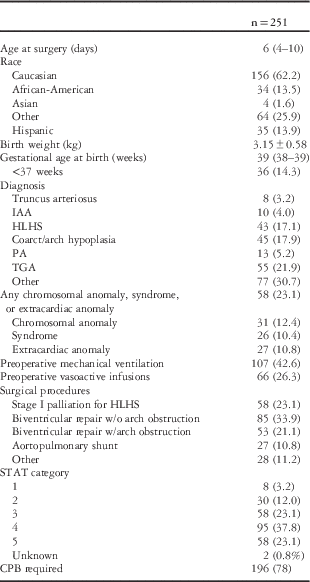
In total, 302 neonates had an index operation, registered in the PC4 database, during the study period; 251 neonates were in the ICU for at least 24 hours before the operation and represent our study population. Patient characteristics and surgical details are included in Table 1. The median ICU length of stay was 14 days (IQR 9–22) with 15% discharged home and 77% transferred location in the same hospital outside of the cardiac ICU; hospital mortality was 8%. Median total hospital length of stay was 21 days (IQR 14–35).
Patient and clinical characteristics.

Coarct=coarctation; CPB=cardiopulmonary bypass; HLHS=hypoplastic left heart syndrome; IAA=interrupted aortic arch; PA=pulmonary atresia; TGA=transposition of the great arteries; w/=with; w/o=without
Data are presented as n (%) for categorical variables and mean±standard deviation or median (25th –75th percentile), as appropriate, for continuous variables
Vasoactive infusions includes norepinephrine, epinephrine, vasopressin, dobutamine, dopamine, and milrinone
Preoperative feeding
Overall, 133 (53%) patients received preoperative feeds. Figure 1 demonstrates the proportion of patients who received preoperative feeds within the specified diagnostic cohorts and other subgroups of interest. Patients with hypoplastic left heart syndrome and/or prematurity had the lowest frequency of feeding preoperatively (42%). Figure 2a demonstrates that the rate of preoperative feeding of neonates at the six centres varied widely between centres from 29 to 79%. When considering the three most common cardiac diagnostic groups – that is, d-transposition of the great arteries, interrupted aortic arch/coarctation/aortic arch hypoplasia, and hypoplastic left heart syndrome – preoperative feeding rate in d-transposition of great arteries was 64% versus 46% for those with ductal-dependent systemic circulation.
Preoperative feeds by diagnostic cohort and risk factor. Coarct=coarctation; HLHS=hypoplastic left heart syndrome; IAA=interrupted aortic arch; TGA=transpotition of the great arteries; UAC=umbilical arterial catheter.
Feeding characteristics by centre. Two sites were dropped due to <20 subjects a each site, remaining n=224.
Umbilical artery catheters
An umbilical arterial catheter was present in 99 (39%) patients at some point during their ICU stay; umbilical arterial catheter placement varied across centres (range 11–63%); 76 of 99 (77%) patients with an umbilical arterial catheter were fed with the catheter in place, and 45 were fed preoperatively. Within the subgroups, neonates with biventricular repair including aortic arch obstruction (10/16, 63%) and prematurity (11/18, 61%) had low incidence of feeding with the umbilical arterial catheter in place; 16/20 (80%) patients with hypoplastic left heart syndrome were fed concurrently with the umbilical arterial catheter.
Postoperative feeding
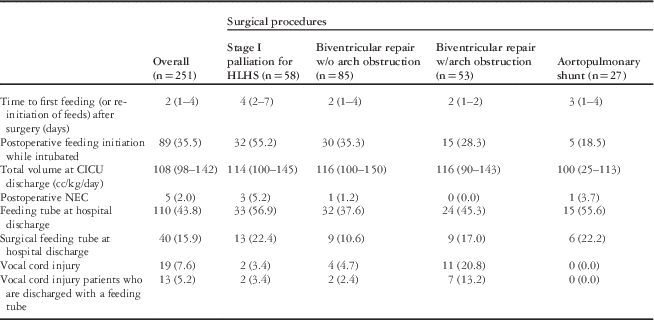
The variability in postoperative feeding practices and outcomes by diagnostic cohort and centre are shown in Tables 2 and 3. Median time to initiation of postoperative feeding for the entire cohort was postoperative day 2 (IQR 1–4; range 0–29 days), varying from postoperative day 1–4 across centres. Patients with hypoplastic left heart syndrome had feeds initiated on median postoperative day 4, IQR 2–7. Postoperative feeds were initiated in 35% (range 21–61% across centres) of patients concurrently receiving mechanical ventilation. Patients who underwent aortopulmonary shunt placement were fed 19% of the time, and 55% of patients with hypoplastic left heart syndrome were fed while mechanically ventilated, both likely related to the anticipated/expected duration of mechanical ventilation.
Postoperative cardiovascular ICU feeding practice and outcomes by surgery cohorts.
CICU=cardiovascular intensive care unit; HLHS=hypoplastic left heart syndrome; NEC=necrotising enterocolitis; w/=with; w/o=without
Data are presented as n (%) for categorical variables and median (25th–75th percentile), as appropriate, for continuous variables
Feeding practice and outcomes by centre.
CICU=cardiovascular intensive unit; UAC=umbilical artery catheter
Data are presented as n (%) for categorical variables and median (25th–75th percentile), as appropriate, for continuous variables
The median ICU discharge feeding volume was 108 cc/kg/day (IQR 98–142), but this varied from 100 to 128 cc/kg/day across centres (Table 3). The mean weight at hospital discharge was 3.4±0.8 kg; the overall mean discharge weight was 280 g above birth weight, ranging from 100 to 430 g mean weight gain across centres.
Complications
In the entire cohort, eight patients (3.2%) developed necrotising enterocolitis: three occurring preoperatively – two with interrupted aortic arch, one with truncus arteriosus, and one patient had prematurity – and five occurring postoperatively (Table 2); three patients who underwent stage I palliation – Norwood or Hybrid – for hypoplastic left heart syndrome had postoperative necrotising enterocolitis – that is, 7% of hypoplastic left heart syndrome patients in the study cohort. Moreover, two patients with necrotising enterocolitis were diagnosed concurrently with an umbilical arterial catheter in place. Out of the eight necrotising enterocolitis cases, six occurred at one centre, with an institutional prevalence of 8.3%.
Vocal cord injury was diagnosed in 19 (7.6%) patients. For centres contributing data on >20 subjects, vocal cord injury prevalence varied from 2 to 17%. The majority of cases (n=11) occurred in biventricular repairs with aortic arch obstruction (prevalence 21% in this cohort). Vocal cord injury was diagnosed only in two patients (3.4% within subgroup) after stage I palliation for hypoplastic left heart syndrome.
Feeding tubes at discharge
In the overall cohort, 110 (44%) patients were discharged from the hospital with feeding tubes, with proportions varying from 6 to 80% across centres (Fig 2b). In 40/110 (36%) patients with feeding tubes, surgical feeding tubes (gastrostomy/enterostomy) were placed; three centres placed no surgical tubes, whereas at three other centres >75% of the patients were discharged with a surgically placed feeding tube. In all, 57% of hypoplastic left heart syndrome patients and 56% of aortopulmonary shunt patients were discharged with a feeding tube. Patients with vocal injury were discharged with a feeding tube in 68% of cases (13/19), with seven of these patients having undergone biventricular repair with arch obstruction. Overall, 12% of the patients discharged with feeding tubes had concomitant vocal cord dysfunction.
Discussion
This study from the PC4 clinical registry represents the first multi-institutional description of perioperative feeding practices in a heterogeneous population of neonates undergoing cardiac surgery. The findings demonstrate that feeding practices vary considerably across centres and diagnostic cohorts, with no apparent consensus about the timing of feeding, modality, or goal volume. Only half of the patients receive preoperative enteral feeds and almost half are discharged with feeding tubes. Despite the variation in feeding management, there was median weight gain above birth weight at all centres, although, importantly, it varied fourfold across centres. The incidence of necrotising enterocolitis was low, similar to that previously reported.Reference Iannucci, Oster and Mahle14, Reference McElhinney, Hedrick and Bush20 This investigation of variation in feeding practices represents a necessary initial step towards identifying specific nutritional strategies that may improve outcomes.
Malnutrition affects up to 70% of neonates with CHD and has been associated with infection, hospital length of stay, duration of mechanical ventilation, developmental delay, and mortality.Reference Kelleher, Laussen, Teixeira-Pinto and Duggan3, Reference Ravishankar, Zak and Williams5, Reference Eskedal, Hagemo and Seem6, Reference Cameron, Rosenthal and Olson21–Reference Anderson, Beekman and Border24 Optimising nutrition may decrease the morbidity and mortality associated with growth failure in early infancy; however, the ideal perioperative feeding practice(s) to achieve maximal nutrition in neonatal cardiac surgical patients remains unknown. Our study does not contain the statistical power to associate specific institutional practices with clinical outcomes, including growth and complications. We hope that with accrual of many more centres, the PC4 will be positioned to analyse these relationships in the near future.
Our study found tremendous variation in the prevalence of preoperative feeding. This is not surprising as very little evidence-based data are available to support the safety and/or benefit of preoperative enteral nutrition in neonatal cardiac surgical patients. Only half of the patients in this cohort received feeds preoperatively. There was low frequency of feeding in patients with prematurity or ductal-dependent systemic circulation, likely secondary to concern for potential gastrointestinal ischaemia in these cohorts. Alternatively, recent publications suggest that preoperative feeds may be safe and may improve postoperative feeding tolerance and other clinical outcomes in these cohorts.Reference Toms, Kirklin, Dabal, Reebals and Alten13, Reference Willis, Thureen, Kaufman, Wymore, Skillman and da Cruz15, Reference Natarajan, Reddy and Aggarwal25 Owing to the retrospective nature of this review, it is not possible to determine whether clinical reason(s) including severity of illness or other perceived risk factors and/or local feeding practice guidelines explain why individual patients were not fed. Clearly, further research is necessary to determine the comparative risks and benefits of preoperative feeding in specific patient subgroups.
Previous studies have described an association between umbilical arterial catheter placement and incidence of mesenteric arterial thrombosis and necrotising enterocolitis, likely through a mechanism by which the umbilical arterial catheter decreases splanchnic blood flow.Reference Lehmiller and Kanot26 Some centres will not feed a patient with an umbilical arterial catheter in place.Reference Howely, Kaufman and Wymore27 Prevalence of concurrent feeding and umbilical arterial catheter use was fairly high overall (77%) in our study; however, the percentage of patients who received umbilical arterial catheter placement was much lower in some centres, suggesting an unmeasured method to avoid feeding with an umbilical arterial catheter in place. This study was underpowered to analyse any association between umbilical arterial catheter utilisation, concurrent feeding, and necrotising enterocolitis.
Similarly, we could not assess risk factors for developing necrotising enterocolitis. The overall necrotising enterocolitis rate in our study was 3.2%, which is similar to previous studies,Reference Iannucci, Oster and Mahle14, Reference McElhinney, Hedrick and Bush20 but overall incidence after stage I palliation was lower than that previously reported.Reference Kelleher, Laussen, Teixeira-Pinto and Duggan3, Reference del Castillo, McCulley and Khemani11, Reference McElhinney, Hedrick and Bush20, Reference Davies, Carver and Schmidt28, Reference Jeffries, Wells, Starnes, Wetzel and Moromisato29 Interestingly, six out of eight cases of necrotising enterocolitis occurred at one institution; however, the centre data did not account for any potential differences in patient volume or case mix. Nonetheless, this cluster of necrotising enterocolitis cases demonstrates the potential value of data from multi-institutional collaboratives such as PC4, which enable identification of centre-specific management that may contribute to outcomes. Further evaluation of centre differences can lead to opportunities for quality improvement, if there is evidence that these differences are real when accounting for other important confounders and are not due to surveillance bias.
Early initiation of feeding and postoperative feeding protocols has been associated with improved outcomes, including decreased hospital length of stay after neonatal cardiac surgery.Reference Braudis, Curley and Beaupre10, Reference del Castillo, McCulley and Khemani11 Timing of postoperative initiation of enteral nutrition also varied significantly across type of surgery and centres in this study. Not surprisingly, initiation of postoperative feeds was delayed in patients after stage I palliation for hypoplastic left heart syndrome, who are often haemodynamically unstable, requiring longer duration of vasoactive medications and mechanical ventilation. Initiation of feeds during mechanical ventilation and initiation during inotrope therapy are two variable practices that could be modified and lead to earlier initiation of feeds. There is growing evidence that early enteral nutrition during vasoactive medication therapy is safe and may improve outcomes in critically ill patients.Reference Yang, Wu, Yu and Li30
Increasing caloric intake and feeding protocols after cardiac surgery are associated with improved growth.Reference Braudis, Curley and Beaupre10 In our study, discharge feeding volume was similar across diagnostic cohorts and centres; patients with univentricular and biventricular hearts were fed the same median volume. Encouragingly, unadjusted aggregate data demonstrated positive mean weight gain compared with birth weight at all centres, although weight gain was much higher in some centres, suggesting another potential target for quality initiatives. In the future, collecting formula and caloric intake data will be crucial to comprehensively identify centre-specific and diagnostic cohort-specific feeding practices that are associated with improved growth and better outcomes.
Feeding modality – via surgical feeding tube, nasal feeding tube, or oral feeding – also varied by lesion and across centres in this analysis. This likely stems from different guidelines for placement of a feeding tube, either surgical or nasogastric, thresholds for discharge with feeding tubes versus continued hospitalisation to work on oral feeds, and/or protocols for assessment of vocal cord dysfunction, gastrointestinal reflux, or swallowing difficulties. In our study, almost half of the children were discharged home with a feeding tube, which is similar to other studies.Reference Pasquali, Ohye and Lu7, Reference Lambert, Pike and Medoff-Cooper8 On the other hand, the type of feeding tube was dramatically different between centres, which is a reflection of the scant, conflicting data regarding whether a surgical or a temporary tube is safer or more efficacious for post-discharge weight gain and improved outcomes. A propensity score-matched analysis may help determine which type of feeding tube, if any, is superior with regard to safety and/or efficacy after neonatal cardiac surgery.
Although we have demonstrated wide variability in feeding management practices and outcomes across centres, we are limited by the inherent weaknesses of a clinical registry study. Neonates managed in the neonatal ICU immediately before surgery were not captured. We did not record data on practices that might impact outcomes such as intermittent feeding, rate of feeding advancement, caloric density of feeds, percent oral versus tube feeds, and specific placement of the umbilical arterial catheter – that is, high or low. Our study was not powered to associate feeding variables with outcomes; however, we did identify wide centre variation, suggesting that important knowledge gaps remain. Accumulation of larger samples, collection of additional practice variables, and risk adjustment using medical and surgical models will be necessary to conclusively identify centres with feeding practices that are associated with better outcomes.
In conclusion, perioperative feeding practices in neonates undergoing cardiac surgery vary significantly across centres, diagnostic cohorts, and surgical procedures. These data begin to elucidate the feeding practices that may impact clinical outcomes. Determining and then sharing best practices through collaborative quality improvement or other research initiatives will likely lead to improvements in weight gain, feeding tolerance, and hospital length of stay, potentially decreasing the morbidity and mortality associated with growth failure in neonatal patients undergoing cardiac surgery.
Acknowledgement
We acknowledge the data collection teams at University of Alabama at Birmingham, Birmingham, Benioff Children’s Hospital and University of California San Francisco School of Medicine, the Heart Institute Cincinnati Children’s Hospital Medical Center, Cincinnati, Medical University of South Carolina, Children’s Hospital of Wisconsin, Medical College of Wisconsin, Northwestern University Feinberg School of Medicine, Ann and Robert H. Lurie Children’s Hospital of Chicago, University of Tennessee Health Science Center, Memphis, Emory University School of Medicine/Children’s Healthcare of Atlanta, Johns Hopkins All Children’s Heart Institute, All Children’s Hospital and Florida Hospital for Children, Johns Hopkins University School of Medicine, C.S. Mott Children’s Hospital and University of Michigan Medical School for their efforts to provide data for this investigation.
Financial Support
Support for this study was provided through departmental funds.
Conflicts of Interest
None.
Ethical Standards
The authors assert that all the procedures contributing to this work comply with the ethical standards of the relevant national guidelines on human experimentation and with the Helsinki Declaration of 1975, as revised in 2008, and has been approved by the institutional committees of the University of Michigan.
Appendix
A patient was determined to have an umbilical arterial catheter using the following logic: Central arterial lines placed in the operating room were never coded as umbilical arterial catheter; if the patient had an umbilical venous catheter placed within 1 hour of a central arterial line placement, the central arterial line was considered a umbilical arterial catheter; if the central arterial line was placed at an outside hospital and the patient had no central venous line other than an umbilical venous catheter, the central arterial line was considered an umbilical arterial catheter; if the central arterial line was placed on day of life zero, it was considered an umbilical arterial catheter. The logic was tested on a sample of cases from the registry and results were confirmed against the medical record; the logic assigned umbilical arterial catheter status correctly in >95% of cases.