Introduction
Throughout the aging process, preservation of cognitive abilities is suitable for the maintenance of good quality of life. In recent years, increasing interest toward the links between dysregulation of the hypothalamic–pituitary–adrenal (HPA) axis and cognitive functioning in the older population has emerged. This rise of attention was mainly triggered by results from animal research indicating that sustained exposure to glucocorticoids, the end product of the HPA axis, induces neuronal vulnerability to various insults including tumor (Sapolsky and Donnelly, Reference Sapolsky and Donnelly1985), ischemia (Sapolsky and Pulsinelli, Reference Sapolsky and Pulsinelli1985), or neurotoxic substance such as ibotenic or kainic acid (Sapolsky, Reference Sapolsky1985; Conrad et al., Reference Conrad, Jackson and Wise2004). This vulnerability was observed mainly in areas of the hippocampal formation (e.g. subiculum, dentate gyrus, and Ammon's horn), which are essential for memory in animals and humans (Squire, Reference Squire1992; Hunsaker et al., Reference Hunsaker, Mooy, Swift and Kesner2007; Potvin et al., Reference Potvin, Dore and Goulet2007; Reference Potvin, Dore and Goulet2009) and, therefore, memory impairments were expected following chronic exposure to glucocorticoids. However, the deleterious effect of glucocorticoids might not be restricted to hippocampal areas and to memory since vulnerability induced by glucocorticoids was also reported in the striatum and the neocortex (Sapolsky and Pulsinelli, Reference Sapolsky and Pulsinelli1985). Together, these results from animal studies suggested the hypothesis that high glucocorticoids level could be one mechanism for cognitive decline in older adults.
In healthy humans, cross-sectional studies in older adults revealed that high cortisol levels from saliva, blood, or urine samples were associated with poor performance in various cognitive domains (Lupien et al., Reference Lupien, Lecours, Lussier, Schwartz, Nair and Meaney1994; Seeman et al., Reference Seeman, McEwen, Singer, Albert and Rowe1997; Carlson and Sherwin, Reference Carlson and Sherwin1999; Li et al., Reference Li2006; Lee et al., Reference Lee2007; Beluche et al., Reference Beluche, Carriere, Ritchie and Ancelin2010; Comijs et al., Reference Comijs, Gerritsen, Penninx, Bremmer, Deeg and Geerlings2010). In longitudinal studies, high salivary or urinary cortisol level (Karlamangla et al., Reference Karlamangla, Singer, Chodosh, McEwen and Seeman2005; Li et al., Reference Li2006; Beluche et al., Reference Beluche, Carriere, Ritchie and Ancelin2010) and flat slope of salivary cortisol diurnal rhythm (Beluche et al., Reference Beluche, Carriere, Ritchie and Ancelin2010) were predictive of future cognitive decline one to seven years later. One study also observed that high serum cortisol level predicted poorer cognitive functioning two years later (Greendale et al., Reference Greendale, Kritz-Silverstein, Seeman and Barrett-Connor2000), but other results showed no link between serum or plasma cortisol and future cognitive performance (Carlson and Sherwin, Reference Carlson and Sherwin1999; Comijs et al., Reference Comijs, Gerritsen, Penninx, Bremmer, Deeg and Geerlings2010). It was also reported that morning plasma cortisol was associated with faster cognitive decline in elders with Alzheimer's disease (Csernansky et al., Reference Csernansky2006).
Moreover, in healthy elders, fluctuation of urinary cortisol value between 24 and 32 months interval was found to follow the variation of cognitive functioning; increased and decreased cortisol levels were linked to poorer and better memory performance, respectively (Seeman et al., Reference Seeman, McEwen, Singer, Albert and Rowe1997). Acute modulations of cortisol level in elders also revealed that increased and decreased cortisol levels can alter cognitive functioning (Lupien et al., Reference Lupien, Wilkinson, Briere, Ng Ying Kin, Meaney and Nair2002) and some authors proposed a non-linear relationship between acute cortisol level and cognition (Lupien and McEwen, Reference Lupien and McEwen1997; Lupien et al., Reference Lupien, Gillin and Hauger1999; Lupien et al., Reference Lupien, Buss, Schramek, Maheu and Pruessner2005). Very few studies have tested non-linear relationships between cortisol level and cognitive functioning. Results from two population-based studies did not support the hypothesis of a U-shaped relationship between serum cortisol level and cognitive functioning or decline (Greendale et al., Reference Greendale, Kritz-Silverstein, Seeman and Barrett-Connor2000; Comijs et al., Reference Comijs, Gerritsen, Penninx, Bremmer, Deeg and Geerlings2010). It is also important to note that most of the aforementioned studies examined cognitive functioning in terms of continuous performance fluctuations rather than in terms of clinically significant cognitive change.
Data from previous studies suggest that the prediction of cognitive functioning from cortisol level is modified by other factors. First, some studies in elders reported that cortisol level predicted poor cognitive functioning or decline in different domains for men and women (Comijs et al., Reference Comijs, Dik, Aartsen, Deeg and Jonker2005; Beluche et al., Reference Beluche, Carriere, Ritchie and Ancelin2010) and other studies observed that cortisol level was linked to cognitive functioning or decline in women, but not in men (Seeman et al., Reference Seeman, McEwen, Singer, Albert and Rowe1997; Peavy et al., Reference Peavy2009). Acute increase of cortisol was also found to be negatively correlated to memory performance in elder men, but not in elder women (Wolf et al., Reference Wolf, Schommer, Hellhammer, McEwen and Kirschbaum2001).Other results revealed that sex did not modify the links between cortisol level and incident cognitive impairment (Karlamangla et al., Reference Karlamangla, Singer, Chodosh, McEwen and Seeman2005). Second, a recent study found that salivary cortisol level was related to cognitive decline only in apolipoprotein ɛ4 (APOE4) carriers (Gerritsen et al., Reference Gerritsen, Comijs, Deeg, Penninx and Geerlings2011), a genotype increasing the risk of Alzheimer's disease (Poirier et al., Reference Poirier, Davignon, Bouthillier, Kogan, Bertrand and Gauthier1993) and other dementias (Frisoni et al., Reference Frisoni, Bianchetti, Govoni, Trabucchi, Calabresi and Franceschini1994). A similar effect was observed in cross-sectional studies (Peavy et al., Reference Peavy2007; Lee et al., Reference Lee2008). These findings suggest that abnormal cortisol value may be deleterious only in elders with brain vulnerability or at high risk of cognitive decline (e.g. elders with high age, low education (Qiu et al., Reference Qiu, Backman, Winblad, Aguero-Torres and Fratiglioni2001), mild cognitive impairment (Petersen et al., Reference Petersen, Smith, Waring, Ivnik, Tangalos and Kokmen1999), poor physical health (Barnes et al., Reference Barnes, Alexopoulos, Lopez, Williamson and Yaffe2006; Hayden et al., Reference Hayden2006), or with anxio-depressive symptoms (Gallacher et al., Reference Gallacher2009; Li et al., Reference Li2011; Potvin et al., Reference Potvin, Forget, Grenier, Preville and Hudon2011). However, another study did not support this hypothesis and showed that high cortisol level was associated with a slower cognitive decline in elders with mild cognitive impairment (Peavy et al., Reference Peavy2009). Cross-sectional results also showed that high salivary cortisol level was linked with better memory performance in healthy elders and poorer performance in elders with mild cognitive impairment (Souza-Talarico et al., Reference Souza-Talarico, Chaves, Lupien, Nitrini and Caramelli2010). Thus, the relationship between cortisol level and cognitive functioning or decline appeared to be modified by the level of cognitive functioning.
At the moment, the relationship between cortisol level and cognitive decline in the healthy older adult population appears to be modified by other factors, such as sex, physical health, and level of cognitive functioning, and not much is known about these effect modifiers. These factors could explain at least some of the inconsistencies in previous results. The primary objective of the present study was to examine, in a population-based study, the modifying factors of the relationship between salivary cortisol level and prevalent and incident cognitive impairment. It was hypothesized that high cortisol levels at baseline would be linked to incident cognitive impairment in elders with high risk of cognitive decline, that is, elders with higher age, lower education level, poor physical health (Xu et al., Reference Xu, Qiu, Wahlin, Winblad and Fratiglioni2004; Barnes et al., Reference Barnes, Alexopoulos, Lopez, Williamson and Yaffe2006; Hayden et al., Reference Hayden2006), depressive symptoms (Ritchie et al., Reference Ritchie, Carriere, Ritchie, Berr, Artero and Ancelin2010; Li et al., Reference Li2011; Potvin et al., Reference Potvin, Forget, Grenier, Preville and Hudon2011), and anxiety (Gallacher et al., Reference Gallacher2009; Potvin et al., Reference Potvin, Forget, Grenier, Preville and Hudon2011). A secondary objective was to evaluate the hypothesis that the relationship between cortisol level and cognitive impairment is non-linear as previously proposed (Lupien et al., Reference Lupien, Buss, Schramek, Maheu and Pruessner2005).
Methods
ESA study
Data come from a population-based survey on the psychological distress of elders living in the province of Québec (Canada), the ESA study (Enquête sur la santé des aînés; in English, Study on elders’ health; Préville et al., Reference Préville2008). In 2005–2006, a random sample (n = 2,811) of community-dwelling French-speaking adults (95% of the Québec population speaks French; Statistics Canada, 2006) aged 65 years or older and living in the province of Québec, Canada, was recruited. The sampling frame of the study used a random dialing method with a stratification of proportional sample of households according to geographical areas (metropolitan, urban, and rural) and the 16 administrative regions of the Québec's province. A random sampling method was also used to select only one elder within the household. The response rate was 76.5% at baseline.
Data were collected through in-home structured interviews conducted by trained research nurses who received two days of training by the principal investigator of the ESA study (M.P.) in the administration of a computer-assisted questionnaire that comprises many questionnaires including the French version of the Mini-Mental State Examination (MMSE; Hébert et al., Reference Hébert, Bravo and Girouard1992) and an adapted version of the Diagnostic and Statistical Manual of Mental Disorders, Fourth Edition (DSM-IV) mood and anxiety disorders sections of the Diagnostic Interview Schedule and Composite International Diagnostic Interview (Robins et al., Reference Robins, Helzer, Croughan and Ratcliff1981; Erdman et al., Reference Erdman1992). At the beginning of the interview, a written consent to participate in the study was signed by the volunteers.
To ensure the validity of the data in the ESA study, the complete interview was done only with participants who scored 22 or higher on the MMSE (26 participants had an MMSE score of <22 at baseline). The follow-up interview occurred approximately 12 months after the baseline assessment (mean = 12.5 SD = 1.4). Data from the ESA study were linked with medical records from the Régie de l'assurance maladie du Québec (RAMQ; Québec's public health insurance plan). All Québec residents are registered to the RAMQ coverage. The respondents were offered a $15 compensation for their participation at each interview. The research procedures were previously reviewed and authorized by the ethics committee of the Institut universitaire de gériatrie de Sherbrooke.
Study sample
Among the 2,785 participants who received the interview at baseline, medical records from the RAMQ were available for 2,494 individuals and only these participants were included in the present study. The missing data from the RAMQ records were due to refusal of consent to provide medical records, moving outside Québec, or having additional drug insurance. According to the medical records covering one year before and one year after the baseline interview, participants with brain diseases including dementia, cerebrovascular disease, brain trauma/tumor/infections, multiple sclerosis, Parkinson's disease, epilepsy, and schizophrenia or other forms of psychosis were excluded from the sample (n = 133). Participants with a prescription of corticosteroids in the three months prior to the interview were excluded (n = 166). Six participants were excluded because education level was unknown and 15 had an incomplete baseline interview. Cortisol samples at baseline were available for 1,226 participants; data from these participants were used for analyses on prevalent cognitive impairment (cross-sectional). Participants with missing cortisol value did not differ significantly from participants with available cortisol value in terms of age, sex, education, and MMSE scores (results not shown). For analyses on incident cognitive impairment (longitudinal), 19 follow-up interviews were missing or incomplete and 103 participants with prevalent cognitive impairment at baseline were excluded, leaving 1,104 participants available.
Salivary cortisol analyses
At the beginning of the baseline interview, before the cognitive evaluation and the administration of questionnaires, participants were invited to rinse their mouth with water, to chew a sugar-free gum to stimulate saliva production, and a saliva sample of 6–7 mL was collected in a Salivette tube (Sarstedt). Samples were then stored at −20°C until the cortisol analyses. To accommodate the large sample size, visits were scheduled at all times of the day. More specifically, saliva samples were collected between 7:30 AM and 21:00 PM, depending on the moment of the interview. Cortisol analyses were performed at the Fernand-Seguin Research Center, Montreal, Canada. Cortisol concentration in nanomoles/liter (nmol/L) was determined in duplicate by radioimmunoassay (Salimetrics, State College, PA). The limit of detection of this assay was 0.33 nmol/L for a range of 0.33–83 nmol/L. The inter-assay coefficient of variation was calculated from the mean values of the high and low controls on each plate over 12 plates (5.1%) and the intra-assay coefficient of variation was an average value calculated from 32 samples (3.5%).
Cognitive impairment
Prevalent cognitive impairment was defined as an MMSE score below the 15th percentile according to normative data for age, sex, and education level (Hudon et al., Reference Hudon2009). Similar criteria are commonly used (Palmer et al., Reference Palmer, Wang, Backman, Winblad and Fratiglioni2002; Potvin et al., Reference Potvin, Hudon, Grenier and Préville2010). In participants without prevalent cognitive impairment, incident cognitive impairment was defined as a follow-up MMSE score below the 15th percentile according to normative data, in addition to a loss of at least two MMSE points between baseline and follow-up. It was previously established that a reliable change in MMSE score for short intervals corresponds to a loss of at least two points (Hensel et al., Reference Hensel, Angermeyer and Riedel-Heller2007). These criteria for incident cognitive impairment have been previously used (Potvin et al., Reference Potvin, Forget, Grenier, Preville and Hudon2011; Reference Potvin2012).
Covariates
Potential confounders included time of saliva collection, age, education, sex, depressive episode, anxiety, psychotropic drug use, vascular conditions, and chronic diseases. Education level was categorized into high (post-secondary degree) and low (secondary degree or less). Depressive episode and anxiety were identified for the 12-month period preceding the interview according to an adapted version of the DSM-IV-TR mood and anxiety disorders (American Psychiatric Association, 2000) sections of the Diagnostic Interview Schedule and Composite International Diagnostic Interview (Robins et al., Reference Robins, Helzer, Croughan and Ratcliff1981; Wittchen et al., Reference Wittchen, Robins, Cottler, Sartorius, Burke and Regier1991; Erdman et al., Reference Erdman1992). Depressive episode included major depressive episode and depressive disorder not otherwise specified (minor depression). Anxiety disorders considered in this study were specific phobia, social phobia, agoraphobia, panic disorder, and generalized anxiety disorder. Because anxiety symptoms not meeting all DSM-IV criteria were previously linked with incident cognitive impairment (Potvin et al., Reference Potvin, Forget, Grenier, Preville and Hudon2011), the anxiety variable included both anxiety disorders and anxiety symptoms. Participants having at least one essential symptom of DSM-IV anxiety disorders without meeting full criteria were considered as having symptoms.
Psychotropic drug use was assessed by the RAMQ medical records and drugs were coded according to the American Hospital Formulary Service (American Society of Health System Pharmacist, 2001). Two categories of drugs were used in the present study: antidepressants and anxiolytics/sedatives/hypnotics. Data on drug use were assessed on the period covering one year prior to the baseline interview and one year after the baseline interview. The number of chronic diseases was measured by asking participants at baseline if they had any of the following chronic health problems comprised in the International Classification of Diseases (ICD-10): arthritis or rheumatism, eye diseases, backache or spinal problems, digestive problems, thyroid disorders, other metabolic disorders, anemia, hypercholesterolemia, asthma or emphysema or chronic bronchial diseases, liver diseases, kidney or urinary problems, skin diseases, and migraine or frequent headaches. A cardiovascular condition score was computed using the RAMQ medical records covering the period of one year before and one year after the baseline interview and by asking participants at baseline if they had high blood pressure, diabetes, or heart diseases. The score was the total of these three health problems.
Statistical analysis
Data were weighted to ensure that the actual proportion of older adults in each region and in each geographical area was reflected in the analysis. Weights were determined based on (1) the probability of selection of the administrative region in the geographic area [π (a)], (2) the conditional probability of selection of the household in the administrative region [π (b/a)], and (3) the conditional probability of selection of the subject in the household [π (c/ab)]. The weight attributed to each subject represented the inverse of its probability of selection (1/[π (abc)]). All results refer to weighted data and frequencies are rounded to the nearest whole number.
Participants were split into two categories according to the time of saliva collection (AM: 7 h 30 min–11 h 30 min; PM: 13 h–21 h). The association between baseline cortisol level and cognitive impairment (prevalent and incident) was first assessed by crude odds ratio (OR) with 95% confidence intervals (CIs). Then, an adjusted OR was computed by a logistic regression with cognitive impairment as the predicted variable, cortisol level as predictor, and was adjusted for time of saliva collection, age, education, sex, antidepressants use, anxiolytics/sedatives/hypnotics use, cardiovascular conditions score, chronic diseases, and MMSE score at baseline (for incident cognitive impairment analyses only). For psychotropics use, anxiety symptoms, and depressive episode, the period of one year prior to the baseline interview was used for analyses on prevalent cognitive impairment while the period of one year prior to the baseline and one year between the baseline and follow-up interviews was used for analyses on incident cognitive impairment. To verify the first hypothesis, interactions between cortisol level and other factors including age, education, sex, cardiovascular conditions score, chronic diseases, and MMSE score at baseline were tested in adjusted models. For significant interactions, ORs were stratified according to current categories or using a median split. To verify the second hypothesis, non-linear relationship (U-shape) between cortisol value and cognitive impairment was assessed by adding a squared-cortisol term in adjusted models. Cortisol level was used as a continuous variable (Z score) in order that ORs represent a one standard deviation increase. To avoid outliers, cortisol values over three standard deviations were replaced by the three standard deviation value. All other variables were categorized as shown in Table 1. Statistical assumptions were verified and analyses were performed using IBM SPSS Statistics software (version 19.0) with the α level set at a two-tailed 5%.
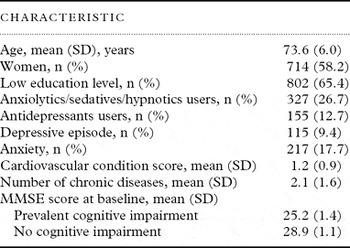
Characteristics of participants at baseline (N = 1,226)

Results
Table 1 shows the characteristics of the participants at the baseline interview. The mean age was 74 years and most participants were women and had a low education level. In the year preceding the baseline interview, approximately 27% of participants used anxiolytics/sedatives/hypnotics, 13% used antidepressants, 9% had a depressive episode, and 18% displayed anxiety symptoms. The mean cardiovascular condition score and number of chronic diseases were 1.2 and 2.1, respectively. The number of participants in AM (baseline: n = 635, 52%; follow-up: n = 581, 53%) and PM (baseline: n = 591, 48%; follow-up: n = 523, 47%) categories of saliva collection were relatively similar.
Prevalent cognitive impairment
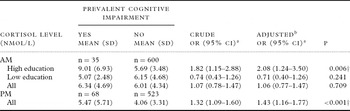
One hundred and three participants (8%) met the criteria for prevalent cognitive impairment at baseline. Table 2 presents the results of the association between baseline cortisol level and prevalent cognitive impairment. When all participants were analyzed, PM cortisol level was significantly associated with prevalent cognitive impairment, but not AM cortisol level. For AM cortisol level, an interaction was observed with education level (p = 0.016). Higher AM cortisol level was significantly associated with prevalent cognitive impairment in participants with a high education level, but not in participants with low education level. The addition of a squared-cortisol term revealed no significant non-linear relationship between cortisol level and prevalent cognitive impairment.
Prevalent cognitive impairment and cortisol level in elders

aOR is for a 1 SD increase of cortisol level.
bAdjusted for time of saliva collection, age, education level, sex, depressive episode, anxiety, antidepressants use, anxiolytics/sedatives/hypnotics use, cardiovascular conditions, and chronic diseases. P values were obtained by Wald F statistics with df = 1.
†p < 0.05.
ASH = anxiolytics/sedatives/hypnotics; CI = confidence interval; OR = odds ratio; SD = standard deviation.
Incident cognitive impairment
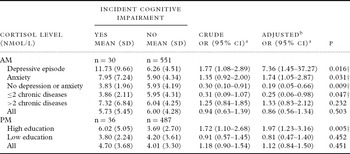
Sixty-six participants had an incident general cognitive impairment (6%). Table 3 shows the results of the associations between baseline cortisol level and incident cognitive impairment. When all participants were analyzed, AM and PM cortisol levels did not significantly predict incident cognitive impairment. For AM cortisol level, interactions were observed with anxiety (p = 0.008), depressive episode (p = 0.002), and the number of chronic diseases (p = 0.030). Higher AM cortisol level significantly increased the risk of incident cognitive impairment in participants with anxiety or depressive episode. In participants without anxiety or depressive episode, higher AM cortisol level significantly decreased the risk of incident cognitive impairment, as a result that the risk incident cognitive impairment was increased by lower cortisol level (OR: 5.40, 95% CI: 1.52–19.15). The interaction with chronic diseases revealed that higher cortisol values resulted in a significant decrease of the risk of incident cognitive impairment for participants with two or fewer chronic diseases. When reversed, this result indicated that in participants with two or fewer chronic diseases, the risk of incident cognitive impairment was increased by lower cortisol level (OR: 4.04, 95% CI: 1.02–16.01). For PM cortisol level, an interaction was found with education level (p = 0.024), which revealed that higher PM cortisol level significantly increased the risk of incident cognitive impairment in participants with high education, but not in participants with low education.
Incident cognitive impairment and cortisol level in elders

aOR is for a 1 SD increase of cortisol level.
bAdjusted for time of saliva collection, age, education level, sex, depressive episode, anxiety, antidepressants use, anxiolytics/sedatives/hypnotics use, cardiovascular conditions, MMSE score at baseline, and chronic diseases. P values were obtained by Wald F statistics with df = 1.
†p < 0.05.
CI = confidence interval; OR = odds ratio; SD = standard deviation.
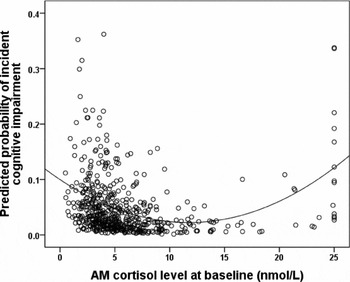
The addition of a squared-cortisol term revealed a significant non-linear relationship between AM baseline cortisol value and incident cognitive impairment (p = 0.011). Figure 1 shows this relationship and suggests a U-shaped relationship between AM cortisol level at baseline and incident cognitive impairment. Since a higher risk of incident cognitive impairment was predicted by higher AM cortisol level in participants with anxiety or depressive episode and by lower AM cortisol level in participants without anxiety or depressive episode, we verified whether this interaction was responsible for the significant non-linear relationship. When the squared-cortisol term was tested in the absence of participants with anxiety or depressive episode, the non-linear relationship between AM cortisol level and incident cognitive impairment did not remain significant (p = 0.642), suggesting that the cases of anxiety and depressive episode highly contributed for this non-linear relationship.
Relationship between predicted probability of incident cognitive impairment and AM cortisol level at baseline from the adjusted logistic regression model.

Discussion
The main objective of the present study was to examine the modifying factors of the relationship between morning (AM) or afternoon (PM) cortisol level and prevalent/incident cognitive impairment in older adults. First, we observed that in the whole sample, higher levels of PM cortisol were associated with prevalent, but not incident, cognitive impairment, whereas AM cortisol level was not associated with prevalent or incident cognitive impairment. Second, we found that anxiety, depressive episode, education level, and chronic diseases modified the relationship between cortisol level and cognitive impairment. In highly educated participants, high AM cortisol level was associated with prevalent cognitive impairment. Moreover, higher AM cortisol level resulted in an increased risk of incident cognitive impairment in participants with anxiety or depressive episode and a lower risk in participants without anxiety or depressive episode. In participants with two or fewer chronic diseases, higher AM cortisol level resulted in a lower risk of incident cognitive impairment. High PM cortisol level increased the risk of incident cognitive impairment in highly educated participants. The secondary objective was to evaluate whether the relationship between cortisol level and cognitive impairment is non-linear. As hypothesized, we observed a curvilinear relationship between cortisol level (AM) and the probability of incident cognitive impairment, the probability of having an incident cognitive impairment being higher in low and high cortisol levels. However, further analyses suggested that this non-linear relationship was explained by the differential effects of high and low cortisol in participants with and without anxiety/depressive episode. Together, these results suggest that high and low cortisol levels are linked to cognitive impairment in older adults depending on mental health, physical health, and education level statuses.
Based on previous results showing that salivary cortisol level was linked to cognitive decline in APOE4 carriers (Gerritsen et al., Reference Gerritsen, Comijs, Deeg, Penninx and Geerlings2011), our hypothesis was that cortisol level at baseline would be more strongly associated with incident cognitive impairment in elders with risk factors of cognitive decline than elders without risk factors. One finding supported this hypothesis: higher AM cortisol level increased the risk of incident cognitive impairment in elders with anxiety or depressive episode. However, since we failed to find that a higher cortisol value was linked to incident cognitive impairment in elders with higher age, lower education level, and poorer physical health, our hypothesis was not confirmed. An alternative hypothesis for the increased risk of cognitive impairment in individuals with anxiety or depressive episode is that anxiety and depressive episode, which are linked to cognitive impairment, are triggering higher cortisol secretion. However, this hypothesis applies only for AM cortisol level, since high PM cortisol also increased the risk of incident cognitive impairment, but did not depend on the presence of anxiety or depressive episode. Another alternative hypothesis is that the combination of psychological distress and a high cortisol level could be two conditions required to induce significant cognitive deterioration. Indeed, a study in rats indicated that high levels of corticosterone were associated with impaired memory only when rats were placed in a stressful condition (Park et al., Reference Park, Campbell, Woodson, Smith, Fleshner and Diamond2006). However, these results need to be replicated and the relationship between cortisol and anxiety or depression appeared to be even more complex. Previous results showed that late-life depression is associated with both hyperactivity and hypoactivity of the HPA axis (Bremmer et al., Reference Bremmer, Deeg, Beekman, Penninx, Lips and Hoogendijk2007). Interestingly, these authors have suggested that the U-shaped association between cortisol and depression may represent different depression subtypes and that hypercortisolemic depression (versus hypocortisolemic depression) was probably associated with cognitive impairment. More recently, results in middle-aged adults showed that low and high anxiety and depression dimensional scores were both associated with low morning cortisol level (Wardenaar et al., Reference Wardenaar2011). The authors proposed that cortisol level increases with severity of symptoms until it reached a threshold after which the HPA axis could be downregulated or exhausted. Finally, the literature on HPA axis activity in anxiety disorders is inconclusive, illustrating elevated (Mantella et al., Reference Mantella2008) or normal (Chaudieu et al., Reference Chaudieu, Beluche, Norton, Boulenger, Ritchie and Ancelin2008) basal cortisol levels and association between anxiety disorder with higher awakening, but not evening, cortisol levels (Vreeburg et al., Reference Vreeburg2010).
A surprising result was that we found the opposite association of what was expected for education level. In highly educated participants, elevated AM cortisol level was related to prevalent cognitive impairment whereas elevated PM cortisol level was associated with incident cognitive impairment. Previous results reported that education and socioeconomic status modulate cortisol level (Kubzansky et al., Reference Kubzansky, Berkman, Glass and Seeman1998; Steptoe et al., Reference Steptoe2003; Kunz-Ebrecht et al., Reference Kunz-Ebrecht, Kirschbaum and Steptoe2004; Cohen et al., Reference Cohen, Schwartz, Epel, Kirschbaum, Sidney and Seeman2006). In older participants, urinary cortisol level increases with educational attainment (Kubzansky et al., Reference Kubzansky, Berkman, Glass and Seeman1998) while in young adults, low education level was associated with higher cortisol level in the evening and this effect was independent of income (Cohen et al., Reference Cohen, Schwartz, Epel, Kirschbaum, Sidney and Seeman2006). Although we did not test this effect, our results tend to show a similar tendency in older adults since in participants with intact cognitive functioning, higher cortisol levels were observed in those with low education level compared to those with high education level. However, this does not explain why older adults with higher education would be more cognitively vulnerable to high cortisol level than those with lower education. Cortisol plays a crucial role in the organism's efforts to adjust to the daily challenges and dysregulation in this release is associated with various disorders. The cortisol levels in the morning hours are associated with the anticipation of the upcoming day. Higher daytime cortisol levels are usually the result of a challenging situation and the hippocampus and the prefrontal cortex have been implicated in the inhibition of this hormonal response to challenges (Herman et al., Reference Herman, Ostrander, Mueller and Figueiredo2005). One possible explanation is that participants with higher education are more aware of subtle cognitive changes than those with lower education. This perception of cognitive problems could result in increasing stress or exaggerated responses to stressful situations (e.g. interview in our study) and, as previously suggested, the combination of stressful condition and high cortisol level may be required to alter cognitive functioning.
The present study provides new findings about the factors moderating the association between cortisol level and cognitive impairment. The main strength is that participants were randomly recruited, avoiding selection biases and being representative of the older population. The main limit of the study is the collection of a single saliva sample at a variable time across participants. Given the fact that cortisol exhibits a 24-h circadian profile, with a morning maximum approximately 30–60 min post-awakening and slowly declining levels during the day, it would have been preferable to have at least two cortisol measures at the exact same time after awaking. Thus, it was not possible to assess the predictive value of the diurnal cortisol slope. However, a large sample was used and this limitation was minimized by separating the sample into two categories (AM vs. PM) and by including the time of data collection as a covariate. Despite these procedures, the results should be interpreted with caution and need replication. A second limit is the exclusive use of the MMSE to assess cognitive functioning. We used conservative criteria for the identification of cognitive impairment, resulting in a higher specificity but lower sensitivity. This lower sensitivity, in addition to the stratification of AM/PM saliva collection, lowered the statistical power of the present study. Therefore, other factors that were not significant, such as sex, may also modulate the links between cortisol level and cognitive impairment (Beluche et al., Reference Beluche, Carriere, Ritchie and Ancelin2010). Moreover, some potential confounding variables such as smoking, the use of alcohol, the presence of cancer, and the moment that participants last ate or drank were not taken into account because they were not measured in the ESA study. We cannot also exclude that the interaction between education level and cortisol was not due to these factors: less educated participants could have been more exposed to smoking and to alcohol than high educated participants. Further studies are needed to verify this hypothesis. Finally, since four regressions were conducted and interactions with many factors were assessed, the risk of type 1 error is higher.
Together, these results strengthen the proposal that saliva cortisol, an accessible and non-invasive biological variable, is associated with present and future cognitive impairment. However, the present study suggests that the relationships between cortisol level and prevalent/incident cognitive impairment are complex since low and high cortisol levels can predict cognitive impairment depending on mental health, physical health, and education level. Mental health, physical health, and education level could explain to some extent the inconsistencies observed in results from studies assessing the relationships between cortisol level and cognitive impairment.
Conflict of interest
None.
Description of authors’ roles
Olivier Potvin wrote the manuscript and conducted the statistical analyses. Hélène Forget, Michel Préville, Djamal Berbiche, Yvon Chagnon, and Carol Hudon revised the manuscript and contributed to its content and to interpretation of data. Michel Préville developed the research design.
Acknowledgments
This study was supported by research grants from the Canadian Institutes of Health Research (CIHR; 200403MOP) and the Fonds de recherche en santé du Québec (9854). Olivier Potvin is supported by a postdoctoral fellowship award from the CIHR. Carol Hudon is supported by a salary award (chercheur-boursier, Junior 2; 22420) from the Fonds de recherche du Québec – Santé.