Introduction
Suicide is the 10th leading cause of death in the United States (CDC, 2017). Individuals who experience suicidal ideation (SI), or the thoughts that they would be better off dead and of killing themselves, are at increased risk of attempting suicide and dying by suicide for up to two years after reporting SI (Rossom et al., Reference Rossom, Coleman, Ahmedani, Beck, Johnson, Oliver and Simon2017). Other notable risk factors for death by suicide include the presence of a medical illness, particularly among elderly adults (Steele, Thrower, Noroian & Saleh, Reference Steele, Thrower, Noroian and Saleh2018). Thus, it is understandable that risk of death by suicide in persons with cancer is significantly higher than the general population (Kumar, Chaudhary, Soni & Jha, Reference Kumar, Chaudhary, Soni and Jha2017; Misono, Weiss, Fann, Redman & Yueh, Reference Misono, Weiss, Fann, Redman and Yueh2008). Three previous systematic reviews focusing broadly on suicide and cancer (Anguiano, Mayer, Piven & Rosenstein, Reference Anguiano, Mayer, Piven and Rosenstein2012; Robson, Scrutton, Wilkinson & MacLeod, Reference Robson, Scrutton, Wilkinson and MacLeod2010; Spoletini et al., Reference Spoletini, Gianni, Caltagirone, Madaio, Repetto and Spalletta2011) identified risk factors for death by suicide including depression (Anguiano et al., Reference Anguiano, Mayer, Piven and Rosenstein2012), male sex, White race, disease site (lung, stomach, head and neck; Misono et al., Reference Misono, Weiss, Fann, Redman and Yueh2008), as well as time since diagnosis (Robson et al., Reference Robson, Scrutton, Wilkinson and MacLeod2010). Although not all patients with cancer who die by suicide disclose SI, and not all patients who report SI attempt suicide, SI is thought to underlie intention for death by suicide (Beck, Kovacs & Weissman, Reference Beck, Kovacs and Weissman1979). Better understanding of the prevalence of and risk factors for SI in patients with cancer is critically important for clinicians and researchers alike. Addressing this gap in the literature will allow for improved risk assessment and connection to potentially life-saving interventions.
Assessment of SI in patients with cancer can be complicated by its close connection to constructs such as demoralization and wish for hastened death (Breitbart et al., Reference Breitbart, Rosenfeld, Pessin, Kaim, Funesti-Esch, Galietta, Nelson and Brescia2000; Vehling et al., Reference Vehling, Kissane, Lo, Glaesmer, Hartung, Rodin and Mehnert2017). There is additional debate about the accuracy of commonly used measures of assessing SI in patients with cancer. In a study of patients who endorsed the “suicidal thoughts” item of the PHQ-9, a commonly used measure of symptoms of depression, only a third of patients reported suicidal thoughts upon interview (Walker et al., Reference Walker, Hansen, Hodges, Thekkumpurath, O'Connor, Sharma, Kleiboer, Murray, Kroenke and Sharpe2010).
The goal of this systematic review is to expand upon previous reviews of suicide and cancer (Anguiano et al., Reference Anguiano, Mayer, Piven and Rosenstein2012; Robson et al., Reference Robson, Scrutton, Wilkinson and MacLeod2010; Spoletini et al., Reference Spoletini, Gianni, Caltagirone, Madaio, Repetto and Spalletta2011) with an emphasis on SI to provide an updated comprehensive review of the literature. Previous reviews include articles published through 2009, therefore, this decade review highlights the most recent investigations of SI. This focus on more recent research not only avoids redundancy with previous reviews but also gives specific attention to current practice in assessment and intervention with a goal for more relevant application to those engaging in clinical research and service with this population. Not only does it concentrate on identifying the prevalence and correlates of SI in patients with cancer, but it also provides focused study of the assessment of SI and current intervention studies. The results of this review will inform screening for SI and future intervention development to reduce risk of SI and ultimately death by suicide in patients with cancer.
Methods
Literature search methods
This systematic review was registered with the PROSPERO database (CRD42018115405) and guided by the PRISMA (Preferred Reporting Items for Systematic Reviews and Meta-Analyses) statement. Relevant literature was searched on September 5, 2018 in the following electronic databases: Medline (Ovid), PsycInfo (Ovid), Embase (Embase.com), CINAHL (EBSCO), the Cochrane Database of Systematic Reviews (Cochrane Library, Wiley), and Cochrane Central (Cochrane Library, Wiley). As one of the goals of our review was to focus on current assessment and intervention practice, and given the presence of past reviews, we only included studies published within the last ten years (from January 2008 to September 2018). The search strategies (Supplemental Figure 1) were based on the concepts of suicide ideation and cancer patients/survivors, using multiple free text terms and subject headings for each concept. Search terms were determined using the MeSH (Medline) and Emtree (Embase) databases, as well as by reviewing terms assigned to relevant citations. The database searches were not limited by publication type (e.g., original article, brief report, or published abstracts from professional meetings) but the bibliographic management software identified non-relevant publication types, and organized retrieval by removing duplicates. Our search also included manual review of citations of relevant articles (i.e., previous reviews).
Eligibility criteria
Eligible studies included: (1) adults previously diagnosed with cancer, and (2) SI stated as an outcome. Studies were excluded if they (1) included participants 17 years of age or younger, (2) findings were based on qualitative data methods, (3) did not include experimental analyses (i.e., case studies, systematic reviews/meta-analyses, letter to the editor, or commentary).
Selection of studies and data extraction
Article selection occurred through a multi-step review strategy managed by Covidence systematic review software (Kim & Lee, Reference Kim and Lee2010). First, two reviewers (ECM and EK) independently reviewed titles and abstracts of initially identified articles. Abstracts were then labeled as “Yes,” “No,” or “Maybe” for full text review. In the second stage of screening, full texts were categorized based on eligibility criteria. The following data was extracted using a standardized reporting form: first author, year of publication, country, setting, sample size, study design, associated characteristics/risk factors, outcomes, measurement tools. Extracted data was stored in an electronic database. Data were summarized through descriptive means (i.e., percentages, ranges).
Quality assessment
Two reviewers (EK and ECM) independently rated the quality of all extracted studies using a modified Newcastle-Ottawa Quality Assessment Scale for observational studies (Modesti et al., Reference Modesti, Reboldi, Cappuccio, Agyemang, Remuzzi, Rapi, Perruolo and Parati2016) and the Cochrane Risk of Bias Tool (Higgins et al., Reference Higgins, Altman, Gøtzsche, Jüni, Moher, Oxman, Savović, Schulz, Weeks and Sterne2011) for clinical trials. The Newcastle-Ottawa Quality Assessment Scale includes three criteria for evaluation, including participant selection, comparability of outcome groups, and assessment/ascertainment of outcome. No studies were excluded based on quality assessment ratings in order to be inclusive and represent the current state of the literature (see supplemental Tables 1 and 2).
PRISMA Flow Diagram.

Results
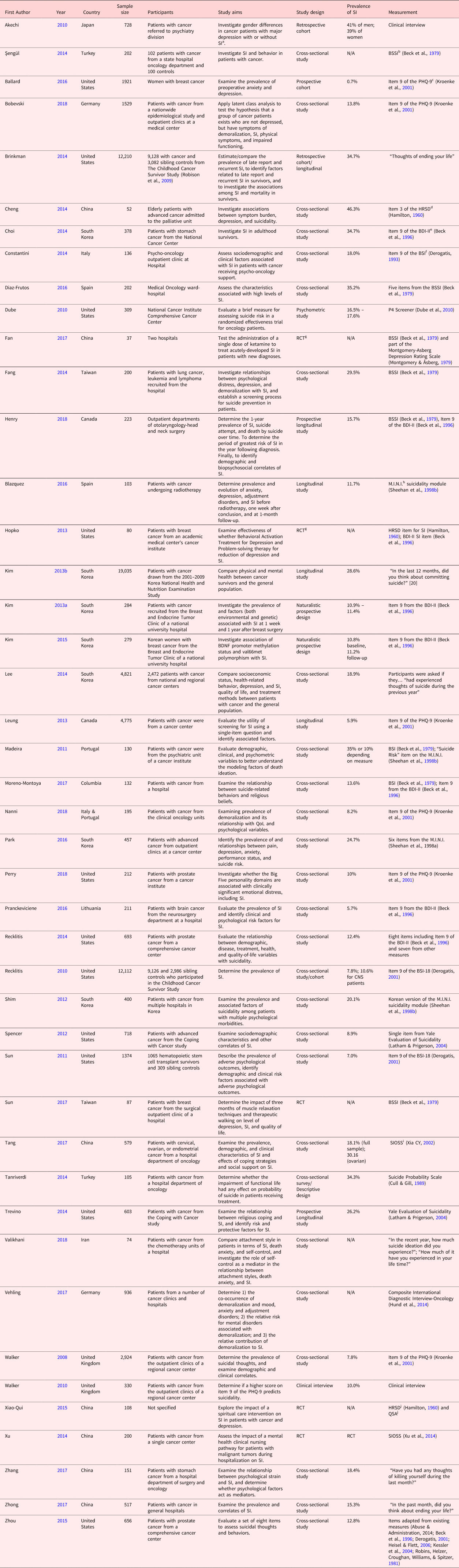
We identified 44 articles that met study inclusion criteria (Table 1). Articles were evenly distributed from Asia (n = 17, 38.6%), North America (n = 13, 29.5%), and Europe (n = 12, 27.3%) with one from South America and another from the Middle East. The majority of studies were recruited from oncology settings (n = 28, 63.6%) or general medical settings (n = 10, 22.7%). The remaining studies recruited participants from mental health (n = 1, 2.3%) or psycho-oncology settings (n = 2, 4.5%). Four studies (9.1%) involved secondary analysis of previously collected databases, population registries, or were not otherwise specified. More than a quarter of the studies recruited participants from multiple sites (n = 13, 29.5%). Most of the articles focused on participants with heterogeneous cancer diagnoses (n = 30, 68.2%). Studies of specific cancer diagnoses included a focus on breast (n = 5, 11.4%), prostate (n = 3, 6.8%), stomach (n = 2, 4.5%), head and neck (n = 1, 2.3%), and brain cancer (n = 1, 2.3%). Most of the studies included populations across the cancer trajectory. Few studies specifically focused on the newly diagnosed (n = 5, 11.4%), survivors (n = 4, 9.1%), and those with advanced disease (n = 2, 4.5%) specifically. Most studies were reported as cross-sectional in design (n = 26, 59.1%), followed by longitudinal (n = 6, 13.6%), prospective cohort (n = 5, 11.4%), and retrospective cohort (n = 2, 4.5%), with some authors indicating overlapping research designs. Five studies were randomized controlled trials (11.4%), and the remainder were psychometric analyses (n = 1, 2.3%) or interview studies (n = 2, 4.5%).
Articles included in review

Note: aSuicidal Ideation (SI), bBeck Scale for Suicidal Ideation (BSSI), cPatient Health Questionnaire (PHQ-9), dHamilton Rating Scale for Depression (HRSD), eBeck Depression Inventory – II, fBrief Symptom Inventory (BSI), gRandomized Controlled Trial (RCT), hThe Mini-International Neuropsychiatric Interview (MINI), iSuicidal Ideation Self-Rating Scale, jQuestionnaire on Suicide Attitudes.
Prevalence of suicidal ideation
Prevalence of SI varied across studies due to heterogeneity of population and method of assessment. Prevalence of SI ranged from as low as 0.7%, using a single-item assessment measure in a study of women with a history of breast cancer (Ballard et al., Reference Ballard, Chen, Kim, Hamill, Pusic, Wilkins and Roth2016), to as high as 46.3%, assessed by a different single item, in a sample of older (65 or above) patients with advanced cancer admitted to hospital for palliative care (Cheng, Chan, Sham & Li, Reference Cheng, Chan, Sham and Li2014). Complete prevalence data are presented in Table 1.
Risk factors for SI
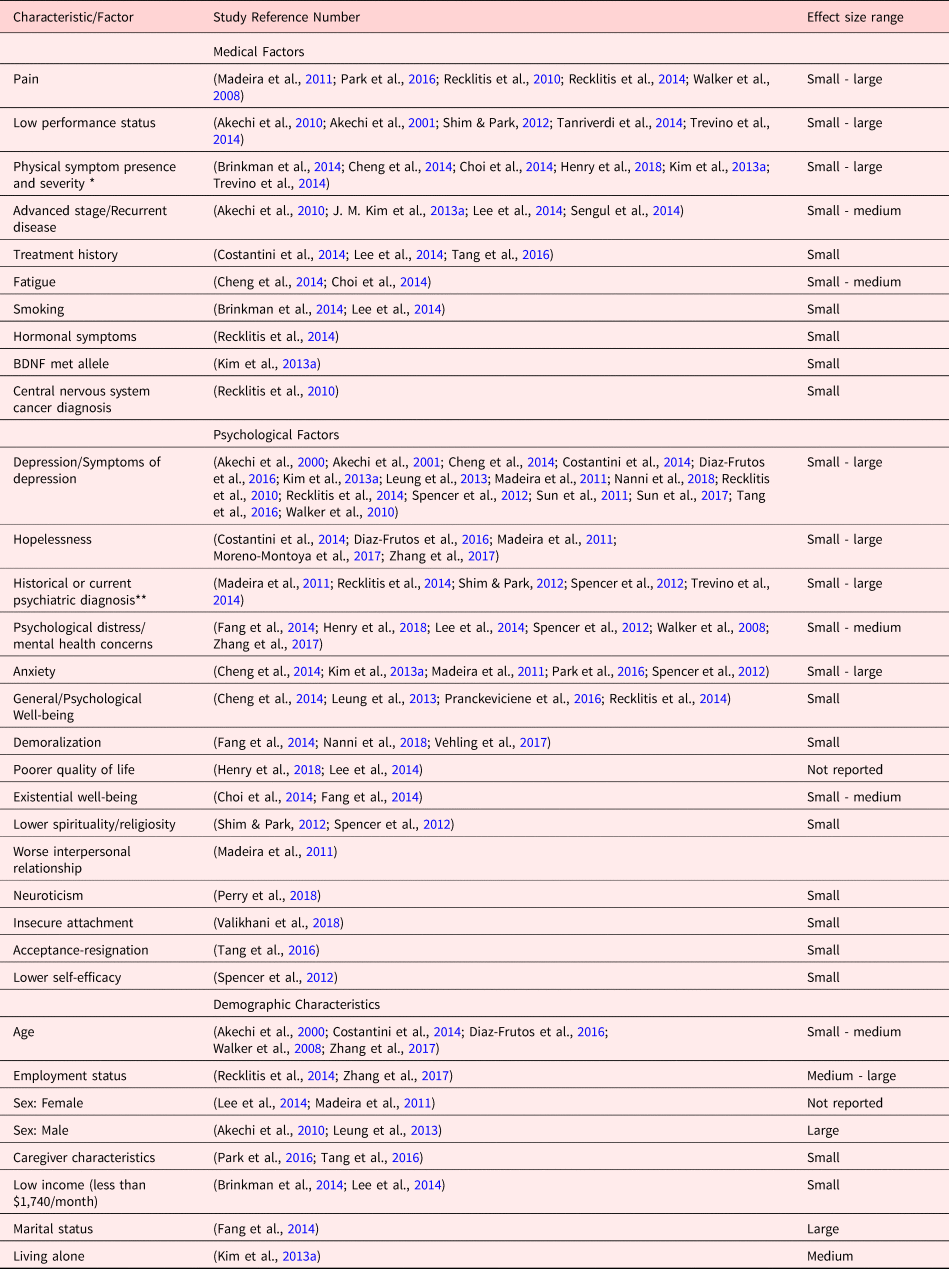
The studies included in this review identified demographic, disease/treatment-related, and psychosocial risk factors of SI in patients with cancer as well as reported effect size category (Table 2). With regard to demographic risk factors, older age was frequently identified as a significant correlate of SI, specifically that those over the age of 60 had increased odds of reporting SI, with the exception of a single study of patients with stomach cancer that demonstrated opposite findings (Akechi et al., Reference Akechi, Okamura, Kugaya, Nakano, Nakanishi, Akizuki, Yamawaki and Uchitomi2000; Costantini et al., Reference Costantini, Pompili, Innamorati, Zezza, Di Carlo, Sher and Girardi2014; Diaz-Frutos, Baca-Garcia, Mahillo-Fernandez, Garcia-Foncillas & Lopez-Castroman, Reference Diaz-Frutos, Baca-Garcia, Mahillo-Fernandez, Garcia-Foncillas and Lopez-Castroman2016; Walker et al., Reference Walker, Waters, Murray, Swanson, Hibberd, Rush, Storey, Strong, Fallon, Wall and Sharpe2008; Zhang et al., Reference Zhang, Zhang, Procter, Chen, Su, Lou and Cao2017). Both female (Lee et al., Reference Lee, Park, Park, Kim, Lee, Kim, Koh, Kim and Sohn2014; Madeira, Albuquerque, Santos, Mendes & Roque, Reference Madeira, Albuquerque, Santos, Mendes and Roque2011) and male (Akechi et al., Reference Akechi, Okamura, Nakano, Akizuki, Okamura, Shimizu, Okuyama, Furukawa and Uchitomi2010; Leung et al., Reference Leung, Li, Devins, Zimmermann, Rydall, Lo and Rodin2013) sex were identified as significant characteristics associated with SI. Factors related to social support, including marital status (Fang et al., Reference Fang, Chang, Chen, Lin, Chen, Lin, Hsieh, Chang, Chen, Wu and Lin2014), living alone (Kim et al., Reference Kim, Jang, Stewart, Kim, Kim, Kang, Shin, Park, Yoon and Yoon2013a), and caregiver characteristics (Park et al., Reference Park, Hong, Lee, Park, Park, Jeon, Ahn and Yoon2016; Tang et al., Reference Tang, Yan, Yan, Fu, Zhu, Zhou, Huang, Wang and Lei2016) were also identified as risk factors.
Associated characteristics/factors for SI in patients with cancer

Note: *Specific physical symptoms include diarrhea, hair loss, etc.; **Meeting criteria for panic disorder, current Post-Traumatic Stress Disorder, other Structured Clinical Interview for DSM-5 disorders, psychological comorbidity, history of depression, history of anxiety, history of bipolar, dysthymia. Effect-size ranges based on reported odds ratios, beta coefficients, eta squared, and correlation coefficients.
Numerous studies identified disease/treatment-related characteristics as risk factors for SI. In a study of childhood cancer survivors, patients with central nervous system cancers had the highest prevalence of SI (10.6%; Recklitis et al., Reference Recklitis, Diller, Li, Najita, Robison and Zeltzer2010)). Furthermore, a history of chemotherapy (Lee et al., Reference Lee, Park, Park, Kim, Lee, Kim, Koh, Kim and Sohn2014; Tang et al., Reference Tang, Yan, Yan, Fu, Zhu, Zhou, Huang, Wang and Lei2016) was identified as a treatment-related correlate of SI. However, in a study of patients attending an outpatient psycho-oncology clinic, participants with SI were less frequently treated with chemotherapy (Costantini et al., Reference Costantini, Pompili, Innamorati, Zezza, Di Carlo, Sher and Girardi2014). In addition to disease- and treatment-related risk factors, physical symptom presence and burden increased risk of SI. Several studies identified pain (Madeira et al., Reference Madeira, Albuquerque, Santos, Mendes and Roque2011; Park et al., Reference Park, Hong, Lee, Park, Park, Jeon, Ahn and Yoon2016; Recklitis et al., Reference Recklitis, Diller, Li, Najita, Robison and Zeltzer2010; Recklitis, Zhou, Zwemer, Hu & Kantoff, Reference Recklitis, Zhou, Zwemer, Hu and Kantoff2014; Walker et al., Reference Walker, Waters, Murray, Swanson, Hibberd, Rush, Storey, Strong, Fallon, Wall and Sharpe2008; Zhong et al., Reference Zhong, Li, Lv, Tian, Liu, Li, Zhuang, Tao, Zhang and Zhuo2017) and fatigue (Cheng et al., Reference Cheng, Chan, Sham and Li2014; Choi et al., Reference Choi, Kim, Yun, Kim, Bae, Kim, Ryu, Lee, Noh and Sohn2014) as significant physical symptoms related to SI. Treatment-related symptoms were also associated with predicted SI (Choi et al., Reference Choi, Kim, Yun, Kim, Bae, Kim, Ryu, Lee, Noh and Sohn2014).
A number of psychological risk factors consistently predicted SI in patients with cancer. Depression was identified as a significant associated variable (Akechi et al., Reference Akechi, Okamura, Kugaya, Nakano, Nakanishi, Akizuki, Yamawaki and Uchitomi2000; Akechi, Okamura, Yamawaki & Uchitomi, Reference Akechi, Okamura, Yamawaki and Uchitomi2001; Cheng et al., Reference Cheng, Chan, Sham and Li2014; Costantini et al., Reference Costantini, Pompili, Innamorati, Zezza, Di Carlo, Sher and Girardi2014; Diaz-Frutos et al., Reference Diaz-Frutos, Baca-Garcia, Mahillo-Fernandez, Garcia-Foncillas and Lopez-Castroman2016; Kim et al., Reference Kim, Jang, Stewart, Kim, Kim, Kang, Shin, Park, Yoon and Yoon2013a; Madeira et al., Reference Madeira, Albuquerque, Santos, Mendes and Roque2011; Nanni et al., Reference Nanni, Caruso, Travado, Ventura, Palma, Berardi, Meggiolaro, Ruffilli, Martins, Kissane and Grassi2018; Recklitis et al., Reference Recklitis, Diller, Li, Najita, Robison and Zeltzer2010; Recklitis et al., Reference Recklitis, Zhou, Zwemer, Hu and Kantoff2014; Spencer, Ray, Pirl, & Prigerson, Reference Spencer, Ray, Pirl and Prigerson2012; Sun et al., Reference Sun, Francisco, Baker, Weisdorf, Forman and Bhatia2011; Tang et al., Reference Tang, Yan, Yan, Fu, Zhu, Zhou, Huang, Wang and Lei2016; Walker et al., Reference Walker, Hansen, Hodges, Thekkumpurath, O'Connor, Sharma, Kleiboer, Murray, Kroenke and Sharpe2010; Zhong et al., Reference Zhong, Li, Lv, Tian, Liu, Li, Zhuang, Tao, Zhang and Zhuo2017) as was anxiety (Cheng et al., Reference Cheng, Chan, Sham and Li2014; Kim et al., Reference Kim, Jang, Stewart, Kim, Kim, Kang, Shin, Park, Yoon and Yoon2013a; Madeira et al., Reference Madeira, Albuquerque, Santos, Mendes and Roque2011; Park et al., Reference Park, Hong, Lee, Park, Park, Jeon, Ahn and Yoon2016; Spencer et al., Reference Spencer, Ray, Pirl and Prigerson2012; Zhong et al., Reference Zhong, Li, Lv, Tian, Liu, Li, Zhuang, Tao, Zhang and Zhuo2017). Patients with symptoms of depression were up to thirteen times more likely to report SI (Walker et al., Reference Walker, Hansen, Hodges, Thekkumpurath, O'Connor, Sharma, Kleiboer, Murray, Kroenke and Sharpe2010). General psychological distress (Fang et al., Reference Fang, Chang, Chen, Lin, Chen, Lin, Hsieh, Chang, Chen, Wu and Lin2014; Henry et al., Reference Henry, Rosberger, Bertrand, Klassen, Hier, Zeitouni, Kost, Mlynarek, Richardson, Black and MacDonald2018; Lee et al., Reference Lee, Park, Park, Kim, Lee, Kim, Koh, Kim and Sohn2014; Spencer et al., Reference Spencer, Ray, Pirl and Prigerson2012; Walker et al., Reference Walker, Waters, Murray, Swanson, Hibberd, Rush, Storey, Strong, Fallon, Wall and Sharpe2008; Zhang et al., Reference Zhang, Zhang, Procter, Chen, Su, Lou and Cao2017), a historical or current psychiatric diagnosis (Madeira et al., Reference Madeira, Albuquerque, Santos, Mendes and Roque2011; Recklitis et al., Reference Recklitis, Zhou, Zwemer, Hu and Kantoff2014; Shim & Park, Reference Shim and Park2012; Spencer et al., Reference Spencer, Ray, Pirl and Prigerson2012; Trevino, Balboni, Zollfrank, Balboni & Prigerson, Reference Trevino, Balboni, Zollfrank, Balboni and Prigerson2014) and poorer psychological well-being (Cheng et al., Reference Cheng, Chan, Sham and Li2014; Leung et al., Reference Leung, Li, Devins, Zimmermann, Rydall, Lo and Rodin2013; Pranckeviciene et al., Reference Pranckeviciene, Tamasauskas, Deltuva, Bunevicius, Tamasauskas and Bunevicius2016; Recklitis et al., Reference Recklitis, Zhou, Zwemer, Hu and Kantoff2014) were also identified as risk factors. Demoralization (Fang et al., Reference Fang, Chang, Chen, Lin, Chen, Lin, Hsieh, Chang, Chen, Wu and Lin2014; Nanni et al., Reference Nanni, Caruso, Travado, Ventura, Palma, Berardi, Meggiolaro, Ruffilli, Martins, Kissane and Grassi2018; Vehling et al., Reference Vehling, Kissane, Lo, Glaesmer, Hartung, Rodin and Mehnert2017), hopelessness (Costantini et al., Reference Costantini, Pompili, Innamorati, Zezza, Di Carlo, Sher and Girardi2014; Diaz-Frutos et al., Reference Diaz-Frutos, Baca-Garcia, Mahillo-Fernandez, Garcia-Foncillas and Lopez-Castroman2016; Madeira et al., Reference Madeira, Albuquerque, Santos, Mendes and Roque2011; Moreno-Montoya, Palacios-Espinosa & Gracia-Ruiz, Reference Moreno-Montoya, Palacios-Espinosa and Gracia-Ruiz2017; Xu, Chen, Li, & Dai, Reference Xu, Chen, Li and Dai2014; Zhang et al., Reference Zhang, Zhang, Procter, Chen, Su, Lou and Cao2017), and existential well-being (Choi et al., Reference Choi, Kim, Yun, Kim, Bae, Kim, Ryu, Lee, Noh and Sohn2014; Fang et al., Reference Fang, Chang, Chen, Lin, Chen, Lin, Hsieh, Chang, Chen, Wu and Lin2014) were also significant factors associated with SI in patients with cancer
Intervention studies
We identified five studies that used interventions to address SI in patients with cancer. Hopko and colleagues (Reference Hopko, Funderburk, Shorey, McIndoo, Ryba, File, Benson and Vitulano2013) found preliminary support for behavioral activation and problem-solving interventions in reducing depression, SI, and increasing hopefulness in patients with breast cancer. Sun and colleagues did not find support for the impact of muscle relaxation techniques (2017) and therapeutic walking on depression, SI, and quality of life in patients with breast cancer (Sun, Hung, Yao, Lu & Chiang, Reference Sun, Hung, Yao, Lu and Chiang2017). A third study found support for the impact of spiritual care intervention on SI in patients with cancer and depression, who were being treated with antidepressants (Xiao-Qiu, Reference Xiao-Qiu2015). Xu and colleagues (Reference Xu, Chen, Li and Dai2014) evaluated the impact of a mental health clinical nursing intervention, including frequent assessment and education for hospitalized patients with cancer. Participants in the intervention group reported significantly lower scores on three of four scales assessing SI. Finally, Fan and colleagues (Reference Fan, Yang, Sun, Zhang, Li, Zheng and Liu2017) investigated the use of a single dose of ketamine to treat SI in patients with newly diagnosed cancer. Both immediately following administration and three days after, intervention group participants reported significantly lower SI.
Measurement of suicidal ideation
Measurement of SI varied across studies. Many studies relied on a single item from a validated measure (n = 20, 45.5%), the most common including item 9 from the Beck Depression Inventory (Beck, Steer, & Brown, Reference Beck, Steer and Brown1996), item 9 from the Patient Health Questionnaire–9 (Kroenke, Spitzer & Williams, Reference Kroenke, Spitzer and Williams2001), and item 9 from the Brief Symptom Inventory–18 (Derogatis, Reference Derogatis1993). Other individual items included item 3 from the Hamilton Rating Scale for Depression (Hamilton, Reference Hamilton1960) and the “suicide risk” item from the Mini Neuropsychiatric Interview (Sheehan et al., Reference Sheehan, Lecrubier, Sheehan, Amorim, Janavs, Weiller, Hergueta, Baker and Dunbar1998b). About a quarter of studies (n = 11, 25.0%) used validated measures including the Beck Scale for Suicidal Ideation (Beck et al., Reference Beck, Kovacs and Weissman1979), Self-Rating Idea of Suicide Scale (Xu et al., Reference Xu, Chen, Li and Dai2014), and Yale Evaluation of Suicidality (Latham & Prigerson, Reference Latham and Prigerson2004). About a quarter (n = 10, 22.7%) relied on clinical interviews to assess SI. Several relied on the Mini International Neuropsychiatric Interview (Sheehan et al., Reference Sheehan, Lecrubier, Sheehan, Amorim, Janavs, Weiller, Hergueta, Baker and Dunbar1998b), another used the Composite International Diagnostic Interview-Oncology (Hund et al., Reference Hund, Reuter, Jacobi, Siegert, Wittchen, Harter and Mehnert2014), and the remainder were either unstructured or unspecified. Finally, the remaining studies (n = 20, 45.5%) used either partial scales (i.e., five items from the Beck Scale for Suicidal Ideation; Diaz-Frutos et al., Reference Diaz-Frutos, Baca-Garcia, Mahillo-Fernandez, Garcia-Foncillas and Lopez-Castroman2016; Recklitis et al., Reference Recklitis, Zhou, Zwemer, Hu and Kantoff2014), measures that have not been validated (Dube, Kurt, Bair, Theobald & Williams, Reference Dube, Kurt, Bair, Theobald and Williams2010), or were not specified (Xiao-Qiu, Reference Xiao-Qiu2015). All of the studies that used large databases or cancer registries (n = 4) used single items to assess SI. Studies drawn from medical, oncology, and mental health/psycho-oncology settings used a variety of assessment methods.
Discussion
The goal of this systematic review was to review the current state of SI research in patients with cancer, building upon past reviews that have evaluated death by suicide and suicidal behavior in this population. The review focused on articles published in the last decade (2008–2018), providing a substantial update to the literature. In addition to studying prevalence of SI and its associated risk factors in patients with cancer, this review is innovative in that it includes both a focus on assessment and intervention of SI in patients with cancer.
Similar to past reviews, prevalence of SI ranged widely from 0.7% to 45.5% in the identified articles. Robson and colleagues (Reference Robson, Scrutton, Wilkinson and MacLeod2010) found a similarly varied range and noted that this is likely the result of both differences in populations studied and fluctuations in SI over time, a weakness of cross-sectional research. We agree with these conclusions and add that method of assessment likely contributes to this variation in prevalence, as a clinical interview would assess both current and lifetime prevalence of SI whereas a single item might only assess SI over the previous two weeks.
The prevalence of SI was higher in patients with psychiatric diagnoses. Studies of SI in samples of patients with cancer recruited from mental health settings revealed prevalence rates ranging from 18.0% (Costantini et al., Reference Costantini, Pompili, Innamorati, Zezza, Di Carlo, Sher and Girardi2014) to 46.3% (Cheng et al., Reference Cheng, Chan, Sham and Li2014). This is alarmingly high and something that mental health providers working with patients with cancer must be prepared to address clinically. Better understanding the experience of patients with SI receiving psychological or psychiatric care is necessary to identify interventions to reduce SI in this at-risk group of patients with cancer. This, and previous reviews concluded that depression and hopelessness were also consistently associated with SI. Research regarding SI in the general population has also shown a lower range of estimated prevalence rates, with substantially less variance at 3‒15.6% (Nock et al., Reference Nock, Borges, Bromet, Alonso, Angermeyer, Beautrais, Bruffaerts, Chiu, De Girolamo, Gluzman and De Graaf2008). Similar to our findings in patients with cancer, participants in a cross-national study found previous diagnoses of mental health conditions to also be associated with increased risk for SI (Nock et al., Reference Nock, Borges, Bromet, Alonso, Angermeyer, Beautrais, Bruffaerts, Chiu, De Girolamo, Gluzman and De Graaf2008).
Studies dependably found a relationship between psychiatric diagnoses and psychological constructs (e.g., symptoms of anxiety and depression) and SI. Furthermore, additional constructs meaningful to coping with cancer, including existential distress, hopelessness, and demoralization demonstrated significant associations with SI. Due to this association, these constructs should be consistently included in studies of SI in patients with cancer. These findings strongly echo those of previous reviews that dependably identified psychological distress as a risk factor of SI with effect sizes that range from small to very large. Each previous systematic review including SI in patients with cancer highlighted the role of depression and hopelessness as associated risk factors. Thus, again, the presence of psychological distress should inform use of a more comprehensive assessment of SI. We recommend the clinical use of more thorough assessment measures (i.e., clinical interview or validated measure) for use in these populations who are at higher risk for experiencing SI. Although we must note that there is an inherent confound as suicidal ideation is a diagnostic criterion of depression and thus, it is unsurprising that these two constructs are so closely connected.
This review also identified demographic and disease/treatment-related characteristics associated with SI in patients with cancer. With regard to demographics, there was no consensus surrounding gender's relationship with SI, as some studies identified the female gender as having a statistically significant relationship with SI and others identified the male gender. This differs from evidence consistently supporting the female sex as an associated factor for SI in non-oncology samples (Dutta et al., Reference Dutta, Ball, Siribaddana, Sumathipala, Samaraweera, McGuffin and Hotopf2017; Nock et al., Reference Nock, Borges, Bromet, Alonso, Angermeyer, Beautrais, Bruffaerts, Chiu, De Girolamo, Gluzman and De Graaf2008). Those over the age of 60 generally showed higher rates of SI. We noted that patients with less social support, those living alone, those not partnered, and with less support from caregivers, also had higher levels of SI. Thus, interventions that enhance social support, including dyadic and caregiver support may be beneficial in future efforts to reduce SI.
The method of measurement varied widely across studies, with some relying on validated measures, while others used single items from validated measures, clinical interviews, or a collection of individual items. However, the majority of studies that examine SI, suicide intent, and suicide attempts in patients with cancer tend to rely on a single item. Zhou and colleagues (Reference Zhou, Hu, Kantoff and Recklitis2015) emphasized that the use of single items is problematic in that many of these items only assess SI over the previous one to two weeks and thus do not capture the episodic nature of SI. Perhaps this explains the wide range of prevalence of SI identified in this review. Despite the existence of validated measures to assess SI (Beck et al., Reference Beck, Kovacs and Weissman1979; Cull & Gill, Reference Cull and Gill1989; Heisel & Flett, Reference Heisel and Flett2006; Latham & Prigerson, Reference Latham and Prigerson2004; Sheehan et al., Reference Sheehan, Lecrubier, Sheehan, Amorim, Janavs, Weiller, Hergueta, Baker and Dunbar1998b; Xia, Reference Xia, W. D. and Wu2002), it is surprising that most studies rely on the use of individual items. It is possible that researchers are often hesitant to discuss SI directly with research participants, instead relying on individual items embedded in other measures. Additionally, for clinicians, single-item measures may seem more feasible for implementation in a busy clinic setting, despite reduced psychometric validity. Future study of SI in patients with cancer should include the use of validated measures and clinical interviews for assessing SI, suicidality, and longitudinal methodology.
Clinical implications
This systematic review expands beyond past reviews by examining interventions for SI. There was evidence that spiritual, behavioral, and pharmaceutical interventions could significantly reduce SI in patients with cancer. However, these studies are few. Nonetheless, findings indicate that there is a role for psychotherapy as effects were found for both problem-solving and behavioral activation interventions (Hopko et al., Reference Hopko, Funderburk, Shorey, McIndoo, Ryba, File, Benson and Vitulano2013), as well as spiritual care (Xiao-Qiu, Reference Xiao-Qiu2015) and nursing interventions (Xu et al., Reference Xu, Chen, Li and Dai2014). These findings highlight the need for available psychological interventions that address SI for patients with cancer. Fortunately, there are empirically supported interventions that target psychological distress in patients with cancer (Breitbart et al., Reference Breitbart, Pessin, Rosenfeld, Applebaum, Lichtenthal, Li, Saracino, Marziliano, Masterson, Tobias and Fenn2018), and thus researchers must explore their application in the context of SI. Appropriate assessment of SI can further inform connection to interventions.
The findings from this review highlight the role of proper symptom management in reducing SI in patients with cancer. Pain and fatigue were consistent physical symptoms associated with SI, as were other treatment-related side effects. Future studies should examine the role of symptom management, and perhaps palliative care integration, physical therapy, and behavioral interventions targeting pain on SI in patients with cancer.
Study limitations
This review attempted to include all studies over the last decade in patients with cancer that included SI as an outcome variable, and thus the included studies are of varied methodology. We used an adapted version of the Newcastle-Ottawa Scale to assess quality, allowing for flexible evaluation. Additionally, there was great range as to which variables were included as independent variables. Some studies focused more on clinical and demographic correlates of SI and others on psychological factors, making it difficult to generalize findings across studies. We attempted to address this through the inclusion of effect size categories for those studies that included such information (Table 2). Further, there was variation in how SI was operationalized, from the use of multi-item measures, to clinical interviews, to single items created by the researchers, leading to varied reports of prevalence from study to study. Yet, the presence of beliefs concerning suicide and self-harm are present in these studies and must be taken seriously.
Conclusions
This review provides a necessary update as researchers and clinicians are increasingly interested in the high prevalence of suicide in patients with cancer relative to the general population. Focusing on SI, the cognitive construct associated with risk for suicide is crucial for identifying areas for intervention. Despite a few studies detailed in this review, there is a paucity of interventions targeting SI in patients with cancer.
We conclude that although SI is dynamic and varies with method of assessment, it should always be taken seriously. Risk for death by suicide is higher in patients with cancer than in the general population and thus understanding the prevalence and risk factors of SI in patients with cancer is necessary for psycho-oncology providers. For patients at risk for SI we must rely on comprehensive assessments, rather than relying on the presence of demographic factors to inform risk for SI, as it is a phenomenon that emerges across age, cancer diagnosis, and region. Interventions that specifically target associated risk factors of SI are needed. Further, connecting patients at risk for SI with palliative care and oncology rehabilitation for symptom management holds promise for reducing SI in at-risk patients.
Supplementary material
The supplementary material for this article can be found at https://doi.org/10.1017/S1478951519000610.
Acknowledgments
ECM's effort on this project was supported by NCI K12 CA086913.