INTRODUCTION
The productive performance of a ewe is dependent on her ability to be multiple ovulating, to conceive and to rear heavy lambs at weaning. Any factor that limits any of these will reduce productivity. It is possible that the in utero environment that a female foetus experiences affects her productive performance as an adult. Under-nutrition during early gestation (Rae et al. Reference Rae, Kyle, Miller, Hammond, Brooks and Rhind2002) or during both late gestation and early postnatal life (Gunn Reference Gunn1977; Gunn et al. Reference Gunn, Sim and Hunter1995) is known to reduce the ovulation rate of the offspring. It is known that under-nutrition during early and late gestation could affect foetal ovarian development (Borwick et al. Reference Borwick, Rhind, McMillen and Racey1997; Rae et al. Reference Rae, Palassio, Kyle, Brooks, Lea, Miller and Rhind2001; Borwick et al. Reference Borwick, Rae, Brooks, McNeilly, Racey and Rhind2003), which may explain the above-mentioned reduced ovulation rates. In addition, mammary gland development of the ovine foetus has been shown to be affected by dam nutrition during pregnancy (Jenkinson Reference Jenkinson2003). These effects on the development of the ovary and mammary gland may result in a reduced number of lambs at birth and number/weight at weaning.
Dam size could also play an important role in foetal development, as it affects foetal growth through the size of the placenta, which influences the nutrient supply to the developing foetus (Mellor Reference Mellor1983). Embryo transfer and cross-breeding experiments in large and small breeds of sheep (Dickinson et al. Reference Dickinson, Hancock, Hovell, Taylor and Wiener1962; Gootwine et al. Reference Gootwine, Bor, Brawtal and Zenou1993), horses (Walton & Hammond Reference Walton and Hammond1938; Allen et al. Reference Allen, Wilsher, Turnbull, Stewart, Ousey, Rossdale and Fowden2002) and pigs (Wilson et al. Reference Wilson, Biensen, Youngs and Ford1998) have shown that foetal growth can be altered from the ‘normal’ genetic potential by differing maternal size, resulting in altered birth weight and postnatal growth. However, these studies have not determined the long-term effects of dam size in terms of productive performance of the offspring.
Therefore, the effects of dam weight and nutrition during gestation on the performance of female primiparous offspring at 2 years of age were investigated. It was hypothesized that a light dam and maintenance nutrition during pregnancy would have a negative effect on the performance of the ewe offspring, resulting in fewer ewes mated, lower pregnancy rates and lighter lambs born and weaned per ewe.
MATERIALS AND METHODS
The study was conducted at the Massey University Keeble Sheep and Beef farm, 5 km south of Palmerston North, New Zealand. The study and all animal handling procedures were approved by the Massey University Animal Ethics Committee, Palmerston North, New Zealand.
Dams
Four hundred and fifty heavy (H) (mean±s.e.m.: 60·8 kg±0·18) and 450 light (L) (42·5 kg±0·17) Romney dams were selected from the extremes in a commercial flock of 2900 ewes, on the basis of weight, as determined by live weight, and bred using artificial insemination as previously described by Kenyon et al. (Reference Kenyon, Blair, Jenkinson, Morris, MacKenzie, Peterson, Firth and Johnston2009). From day 21 until day 140 post-insemination, the dams were randomly allocated, within weight, to ad libitum (A) or maintenance (M) nutritional regimens under New Zealand pastoral grazing conditions (Table 1) (Kenyon et al. Reference Kenyon, Blair, Jenkinson, Morris, MacKenzie, Peterson, Firth and Johnston2009). Pasture herbage was the only nutritional input and the average pre- and post-grazing pasture covers during the period day 21–day 140 were 1330±140·0 and 804·0±133·4 kg of dry matter per hectare (kg DM/ha), respectively, for the M-feeding regimen and 2304·0±156·8 and 1723·3±149·7 kg DM/ha for the A-feeding regimen (Kenyon et al. Reference Kenyon, Blair, Jenkinson, Morris, MacKenzie, Peterson, Firth and Johnston2009).
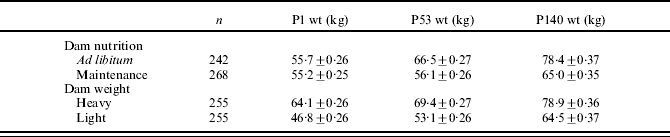
The effect of being a heavy or light dams fed ad libitum or maintenance during pregnancy on live weight (kg) at pregnancy day 1 (P1), 53 (P53) and 140 (P140). The table shows least square means (±s.e.m.)
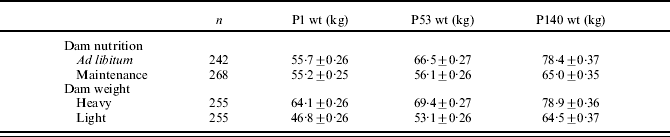
Source: Data adapted from Kenyon et al. (Reference Kenyon, Blair, Jenkinson, Morris, MacKenzie, Peterson, Firth and Johnston2009).
From day 140 of pregnancy through to weaning, all dams and their lambs were provided with ad libitum feeding. The offspring born to H-dams were heavier (P<0·05) than offspring born to L-dams at birth (5·5 kg±0·05 v. 5·4 kg±0·05; for offspring born to H- and L-dams, respectively) and at weaning (32·7 kg±0·36 v. 31·2 kg±0·33; for offspring born to H- and L-dams, respectively) (Kenyon et al. Reference Kenyon, Blair, Jenkinson, Morris, MacKenzie, Peterson, Firth and Johnston2009). The offspring born to A-dams were heavier (P<0·05) than offspring born to M-dams at birth (5·7 kg±0·05 v. 5·2 kg±0·05; for offspring born to A- and M-dams, respectively) and at weaning (32·8 kg±0·37 v. 31·0 kg±0·36; for offspring born to A- and M-dams, respectively) (Kenyon et al. Reference Kenyon, Blair, Jenkinson, Morris, MacKenzie, Peterson, Firth and Johnston2009). In addition, offspring born to A-dams had greater body dimensions than offspring born to M-dams at birth (Kenyon et al. Reference Kenyon, Blair, Jenkinson, Morris, MacKenzie, Peterson, Firth and Johnston2009). After weaning, female progeny were managed and fed to nutritional requirements as one group under commercial New Zealand farming practice (van der Linden et al. Reference Van Der Linden, Kenyon, Jenkinson, Peterson, Lopez-Villalobos and Blair2007). The study, therefore, utilized a two×two factorial design, two dam nutritional treatments (M v. A) and two dam-weight treatments (H v. L).
Ewes
The young ewes utilized in the present study were born to the dams in the above-described study (Kenyon et al. Reference Kenyon, Blair, Jenkinson, Morris, MacKenzie, Peterson, Firth and Johnston2009). Ewes born to dams fed maintenance or ad libitum during pregnancy will be referred to as M- and A-ewes, respectively. Ewes born to heavy or light dams will be referred to as H- and L-ewes, respectively.
At 18 months of age, oestrous cycles of the young ewes (n=207) were synchronized using controlled-internal-drug-release devices (CIDRs) that contained 0·3 g progesterone (Pharmacia and UpJohn, Auckland, New Zealand) and they were naturally mated with eight crayon-harnessed rams in two randomly allocated groups, 10 days apart. Ram-harness-crayon marks on the rumps of the ewes were recorded daily for 5 days, as an indicator of breeding activity. Ram-harness-crayon colours were changed 20 days after the first introduction of the ram, to allow for identification of animals mated in the second cycle and marks were recorded weekly for 3 weeks. Ewes were scanned for pregnancy by ultrasound at approximately day 70 of pregnancy (P70) and diagnosed as being either singleton-, twin- or triplet-bearing. Ewes were weighed and scored for body condition (Jefferies Reference Jefferies1961) at P0 (breeding), P70 (pregnancy scanning) and P135 of pregnancy and at weaning of their lambs.
Lambs
Lambs were ear-tagged and identified to the young ewes, weighed and the thoracic girth, crown–rump length and length of the right front leg (from elbow (cubital) joint to toe of the hoof) and right hind leg (from hip (coxofemoral) joint to toe of the hoof) were measured within 24 h of birth. Lambs were weighed at day 24±2·2 (s.d.) of age (L24) and at weaning (L77±12·6 (s.d.) of age). Lamb growth rates were calculated for the periods from birth until L24 (LWGbirth−L24), from L24 until weaning (LWGL24−wean) and from birth until weaning (LWGbirth−wean).
Statistical analysis
Ewe live weight, ewe body condition score, lamb body dimensions at birth, lamb live weight, lamb growth rates and total weight of lambs weaned per ewe mated were analysed using the MIXED procedure (SAS 2006) with a mixed linear model. The model included the fixed effects of dam nutrition, dam weight, sex of the lamb, the interaction dam nutrition by dam size, birth rank or rearing rank, and birth rank of the ewe, the two- and three-way interactions between these effects and the random effect of mating group. Non-significant two-way interactions were removed from final analyses. All three-way interactions were non-significant and were removed from final analyses. The fixed effect of birth rank of the lamb was used in the analyses of lamb birth weight, lamb dimensions at birth, ewe live weight and body condition score at P0, P70 and P135. The fixed effect of rearing rank of the lamb was used in the analysis of lamb weight at L24, at weaning (L77) and growth rates, ewe live weight and body condition score at weaning (L77) and total weight of lambs weaned per ewe mated. Birth rank of the ewe was found to be non-significant (P>0·10) for all the analyses and data are not shown.
Number of lambs at pregnancy scanning, birth and weaning was analysed using the MIXED procedure (SAS 2006) with a linear model that included the fixed effects of dam nutrition, dam weight, the interaction dam nutrition by dam weight and the random effect of mating group.
Ewe efficiency was calculated as the regression (β1) of total lamb weaning weight on ewe metabolic live weight (LW0·75) at P0 for each of the dam treatments (dam nutrition or weight) with the following model:

where y klm is the total lamb weaning weight measured on ewe l from dam treatment k, β0k and β1k are regression coefficients describing the regression line in dam treatment k, Rkl is the effect of rearing rank m of ewe l from dam treatment k and eklm is the residual error corresponding to the observation yklm.
Statistical analyses of ewe efficiency and total weight of lambs weaned per ewe mated was conducted on all ewes presented for breeding. Least square means and standard errors (s.e.m.) were obtained and used for multiple comparisons.
Ewe breeding performance was analysed as a binomial trait after logit transformation using the GENMOD procedure (SAS 2006) with a linear model that included the fixed effects of dam nutrition, dam weight and the interaction dam nutrition by dam weight. Similarly, lamb survival (lambs present at weaning (L77) were coded 1, whereas lambs not present were coded 0) was analysed as a binomial trait after logit transformation using the GENMOD procedure (SAS 2006) with a linear model that included the fixed effects of dam nutrition, dam weight and the interaction dam nutrition by dam weight. The data were back-transformed and presented as least square means with 0·95 confidence interval (CI).
At the start of the experiment, 207 (HA: n=60; HM: n=59; LA: n=44; LM: n=44) young ewes were presented for breeding. Non-pregnant ewes (HA: n=8; HM: n=8; LA: n=5; LM: n=9) or ewes carrying triplets (HA: n=0; HM: n=1; LA: n=2; LM: n=2) at pregnancy scanning were excluded from any analyses from P70 onwards. Thirty-two singleton- or twin-bearing ewes (HA: n=10; HM: n=8; LA: n=7; LM: n=7) lost one or more of their lamb(s) prior to weaning and were excluded for analyses of weights at L24 and weaning (L77).
No interactions between dam nutrition and dam weight were detected (P>0·10); therefore only the main effects are reported.
RESULTS
Ewe live weights and body condition scores
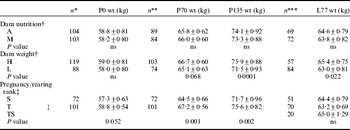
Dam nutrition had no effect (P>0·10) on ewe live weight at P0, P70 or P135 (Table 2). At weaning, there was an interaction between dam nutrition and ewe pregnancy/rearing rank (P=0·017), such that singleton-bearing and -rearing (S-rearing) M-ewes tended to be heavier (P=0·067) compared to S-rearing A-ewes (66 kg±1·1 v. 63 kg±1·2; for S-rearing M- and A-ewes, respectively). Twin-bearing but singleton-rearing (TS-rearing) M-ewes were lighter (P=0·025) than TS-rearing A-ewes (62 kg±1·8 v. 68 kg±1·8; for TS-rearing M- and A-ewes, respectively). However, in the twin-bearing and -rearing (T-rearing) ewes no effect of dam nutrition was found (63 kg±1·0 v. 63 kg±0·9; P>0·10; for T-rearing M- and A-ewes, respectively).
The effects of heavy (H) or light (L) dams fed ad libitum (A) or maintenance (M) during pregnancy on the live weights (kg) of the ewe offspring at pregnancy day 0 (P0), 70 (P70) and 135 (P135) and at weaning (L77) of their lambs. Ewes were either bearing and rearing singleton (S) or twin (T) lambs or bearing twins but rearing singleton lambs (TS) to weaning (L77). The table shows least square means (±s.e.m.)

* Ewes presented for breeding.
** Non-pregnant (n=30) or ewes carrying triplets (n=5) were excluded from further analysis.
*** Singleton- or twin-bearing ewes that were not able to raise at least one lamb through to weaning (n=32) were excluded from further analysis.
† No interactions between dam nutrition and dam weight were detected (P>0·10); therefore, only the main effects are reported.
‡ Pregnancy rank is used for live weight at P0, P70 and P135; rearing rank is used for live weight at weaning, based on whether the ewes were either bearing and rearing singleton (S) or twin (T) lambs or bearing twins but rearing singleton lambs (TS) to weaning (L77).
ns=P>0·10.
Dam weight had no effect (P>0·10) on ewe live weight at P0. H-ewes tended to be heavier at P70 (P=0·068) and were heavier at P135 (P=0·001) and at weaning (P=0·022) than L-ewes. Twin-bearing ewes were heavier at P0 (P=0·052), P70 (P=0·001) and P135 (P=0·002) than singleton-bearing ewes.
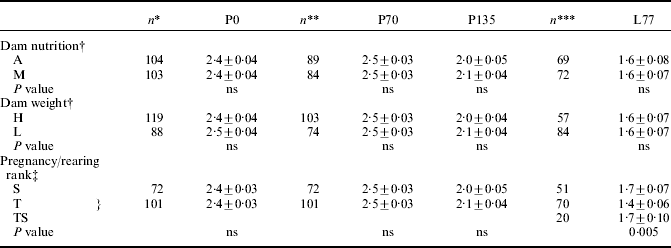
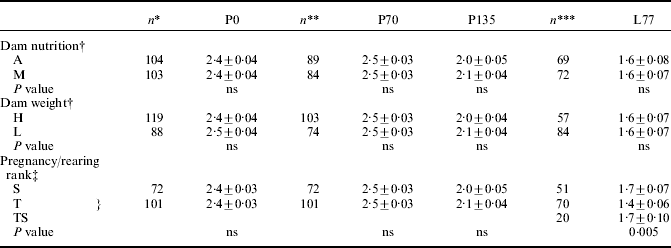
None among dam nutrition, dam weight and ewe pregnancy rank affected body condition score at P0, P70 or P135 (Table 3). At weaning, there was an interaction (P=0·007) between dam nutrition and pregnancy/rearing rank, such that S-rearing M-ewes had greater (P<0·001) body condition scores than S-rearing A-ewes (1·9±0·08 v. 1·5±0·09; for S-rearing M- and A-ewes, respectively). No effects (P>0·10) of dam nutrition on body condition score were found in the T-rearing ewes (1·4±0·08 v. 1·4±0·08; for T-rearing M- and A-ewes, respectively) or the TS-rearing ewes (1·6±0·13 v. 1·8±0·14; for TS-rearing M- and H-ewes, respectively).
The effects of heavy (H) or light (L) dams fed ad libitum (A) or maintenance (M) during pregnancy on the body condition score (scale 1–5) of the ewe offspring at pregnancy day 0 (P0), 70 (P70) and 135 (P135) and at weaning (L77) of their lambs. Ewes were either bearing and rearing singleton (S) or twin (T) lambs or bearing twins but rearing singleton lambs (TS) to weaning (L77). The table shows least square means (±s.e.m.)
* Ewes presented for breeding.
** Non-pregnant (n=30) or ewes carrying triplets (n=5) were excluded from further analysis.
*** Singleton- or twin-bearing ewes that were not able to raise at least one lamb through to weaning (n=32) were excluded from further analysis.
† No interactions between dam nutrition and dam weight were detected (P>0·10); therefore, only the main effects are reported.
‡ Pregnancy rank is used for body condition score P0, P70 and P135; rearing rank is used for body condition score at weaning, based on whether the ewes were either bearing and rearing singleton (S) or twin (T) lambs or bearing twins but rearing singleton lambs (TS) to weaning (L77).
ns=P>0·10.
Reproductive performance
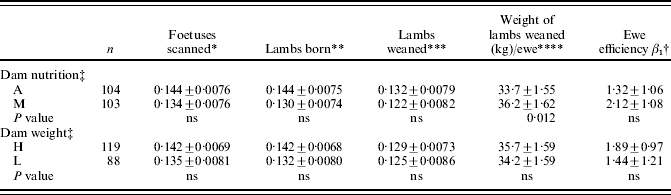
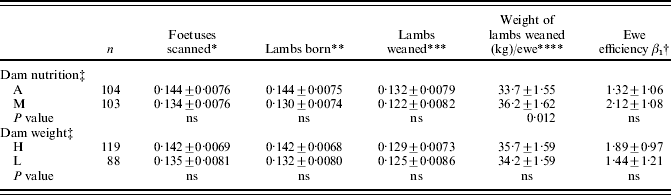
Neither dam nutrition nor dam weight affected (P>0·10) ewe breeding performance (100% (100–100) v. 100% (100–100) and 97·6% (92·4–99·3) v. 100% (100–100); breeding percentage during the first 34 days of oestrus for A- and M-ewes and H- and L-ewes, respectively). In addition, neither dam nutrition nor dam weight affected (P>0·10) the number of foetuses scanned per ewe mated; nor did they affect the number of lambs born or weaned per ewe mated (Table 4). No effects of dam nutrition or dam weight were found on lamb survival until weaning (81·6% (73·6–87·3) v. 81·4% (73·6–87·3) and 80·1% (73·2–85·5) v. 82·8% (74·6–88·8); lamb survival percentage from birth until weaning for lambs born to A- and M-ewes and H- and L-ewes, respectively). M-ewes weaned significantly (P=0·012) greater total weight of lambs per ewe mated than did A-ewes. No effect of dam weight was found on the total weight of lambs weaned per ewe mated. Although the relationship of ewe metabolic live weight to lamb weaning weight was significantly different from zero for M-ewes (P=0·049) and H-ewes (P=0·052), the regression slopes (β1) of the dam-nutrition and dam-weight groups were found to be not different from each other (P>0·10).
The effects of heavy (H) or light (L) dams fed ad libitum (A) or maintenance (M) during pregnancy on pregnancy scanning, lambing and weaning performance of the ewe offspring and total weight (kg) of lambs weaned per ewe mated and ewe efficiency (kg). The table shows least square means (±s.e.m.)
* Defined as the number of foetuses identified at pregnancy diagnosis per ewe presented for breeding.
** Defined as the number of lambs born alive per ewe presented for breeding.
*** Defined as the number of lambs weaned alive per ewe presented for breeding.
**** Defined as the total weight of lambs at weaning per ewe presented for breeding.
† Total lamb weaning weight regressed on ewe metabolic live weight at mating of ewes presented for breeding.
‡ No interactions between dam nutrition and dam weight were detected (P>0·10); therefore, only the main effects are reported.
ns=P>0·10.
Lamb live weights
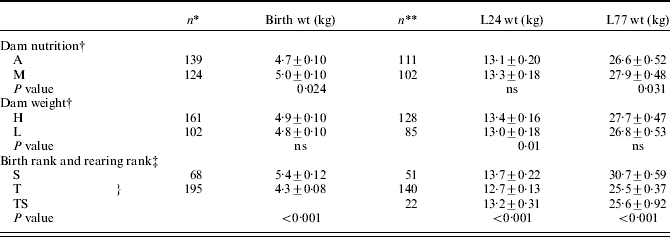
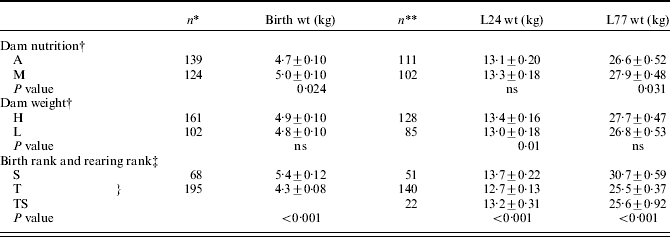
Lambs whose grand-dams were fed maintenance were heavier at birth (P=0·024) and weaning (P=0·031) than lambs whose grand-dams were fed ad libitum (Table 5). There was a significant interaction (P=0·004) between grand-dam nutrition and birth/rearing rank for lamb live weight at L24, such that twin-born and reared (T-reared) lambs whose grand-dams were fed maintenance were heavier (P=0·001) than T-reared lambs whose grand-dams were fed ad libitum (13·0 kg±0·18 v. 12·4 kg±0·18; for T-reared lambs of M- and A-grand-dams, respectively). No such effect (P>0·10) for live weight at L24 was found in singleton-born and reared (S-reared) lambs (13·5 kg±0·28 v. 13·9 kg±0·32; for S-reared lambs of M- and A-grand-dams, respectively) or twin-born and singleton-reared (TS-reared) lambs (13·3 kg±0·41 v. 13·1 kg±0·46; for TS-reared lambs of M- and A-grand-dams, respectively).
The effects of heavy (H) or light (L) grand-dams fed ad libitum (A) or maintenance (M) during pregnancy on weight (kg) at birth, L24 and weaning (L77) of grand-offspring. Lambs were born and reared either as a singleton (S) or twin (T) or born as a twin but reared as a singleton (TS) to weaning (L77). The table shows least square means (±s.e.m.)
* Number of lambs born.
** Number of lambs born and raised as a singleton (S), born and raised as a twin (T) and born as twin but raised as a singleton (TS) to weaning (L77).
† No interactions between dam nutrition and dam weight were detected (P>0·10); therefore, only the main effects are reported.
‡ Birth rank was used in the birth weight analysis and rearing rank was used in the analysis for weight at L24 and at weaning (L77).
ns=P>0·10.
After adjusting for birth weight, the effects of grand-dam-nutrition on lamb weaning weight remained significant (P<0·05); however, the interaction between grand-dam nutrition and rearing rank for lamb live weight at L24 was no longer significant (P>0·10).
There tended to be an interaction (P=0·086) between grand-dam weight and lamb birth rank for birth weight, such that twin-born (T-born) lambs of H-grand-dams were heavier (P=0·014) than T-born lambs of L-grand-dams (4·5 kg±0·10 v. 4·2 kg±0·12; for T-born lambs of H- and L-grand-dams, respectively). No such relationship (P>0·10) was found for birth weight in singleton-born (S-born) lambs (5·3 kg±0·16 v. 5·4 kg±0·16; for S-born lambs of H- and L-grand-dams, respectively). Lambs of H-grand-dam were heavier (P=0·012) at L24 than lambs from an L-grand-dam. Dam weight had no effect (P>0·10) on lamb weaning weight.
After adjusting for birth weight, lambs of H-grand-dams tended (P=0·095) to be heavier than lambs of L-grand-dams at L24.
S-reared lambs were heavier at weaning (P<0·001) than T-reared lambs and TS-reared lambs (P<0·001).
After adjusting for birth weight, the birth/rearing-rank difference between S- and T-reared lambs at weaning remained significant; however, the birth/rearing-rank difference between S-reared lambs and TS-reared lambs at L24 became non-significant (P>0·10).
Lamb body dimensions at birth
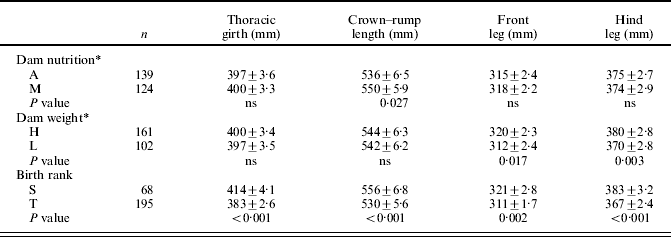
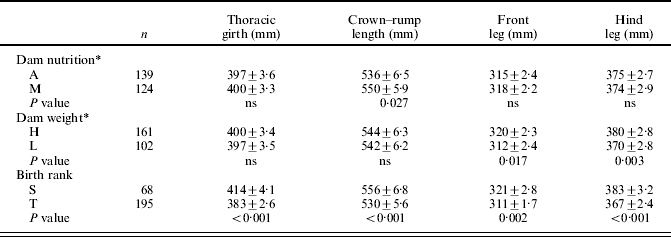
Grand-dam nutrition had no effect (P>0·10) on length of the front or hind legs of lambs (Table 6). Lambs whose grand-dams were fed maintenance had greater (P=0·27) crown–rump lengths than lambs whose grand-dams were fed ad libitum. There was a significant interaction (P=0·028) between grand-dam nutrition and birth rank for thoracic girth, such that T-born lambs of M-grand-dams had greater (P=0·013) thoracic girths than T-born lambs of A-grand-dams (389 mm±3·7 v. 377 mm±3·5; for T-born lambs of M- and A-grand-dams, respectively). No such relationship (P>0·10) for thoracic girth was found for S-born lambs (410 mm±5·5 v. 418 mm±6·0; for S-born lambs of M- and A-grand-dams, respectively).
The effect of heavy (H) or light (L) grand-dams fed ad libitum (A) or maintenance (M) during pregnancy on the thoracic girth (cm), crown–rump length (cm) and length of right front and hind legs (cm) of grand-offspring. Lambs were born either as a singleton (S) or twin (T). The table shows least square means (±s.e.m.)
* No interactions between dam nutrition and dam weight were detected (P>0·10); therefore, only the main effects are reported.
ns=P>0·10.
No grand-dam weight effect (P>0·10) was found on crown–rump length of the lambs. The hind legs of lambs of H-grand-dams were longer (P=0·003) than those of lambs of L-grand-dams. There tended to be an interaction (P=0·085) between grand-dam weight and birth rank for thoracic girth, such that T-born lambs of L-grand-dams had smaller (P=0·029) thoracic girths than lambs of H-grand-dams (378 mm±4·0 v. 389 mm±3·2; for T-born lambs of L- and H-grand-dams, respectively). No such relationship (P>0·10) for thoracic girths was found for S-born lambs (378 mm±4·0 v. 389 mm±3·2; for S-born lambs of L- and H-grand-dams, respectively). There was a significant interaction (P=0·024) between grand-dam weight and birth rank for the length of the front leg, such that twin-born lambs of H-grand-dams had longer (P<0·001) front legs than T-born lambs of L-grand-dams (319 mm±2·1 v. 304 mm±2·7; for T-born lambs of H- and L-grand-dams, respectively). No such relationship (P>0·10) for the length of the front leg was found for S-born lambs (321 cm±3·9 v. 321 cm±3·9; for S-born lambs of H- and L-grand-dams, respectively).
S-born lambs had greater crown–rump lengths (P<0·001) and longer hind legs (P=0·001) compared to T-born lambs.
Lamb growth rates
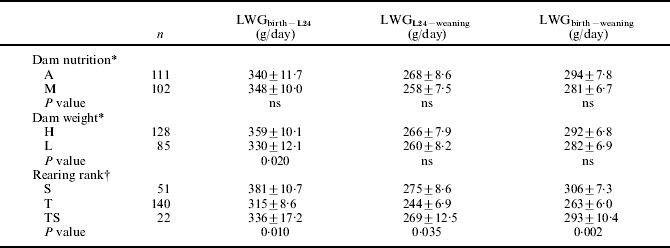
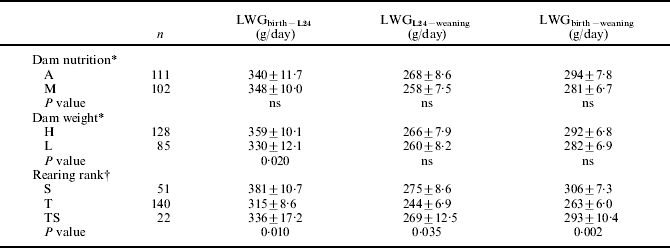
Grand-dam nutrition had no effect (P>0·10) on LWGL24−weaning (Table 7).
The effects of heavy (H) or light (L) grand-dams fed ad libitum (A) or maintenance (M) during pregnancy on growth rates (g/day) from birth to L24, from L24 to weaning (L77) and from birth to weaning (L77) of grand-lambs, which were either born and reared as singleton or twin or born as a twin but reared as a singleton (TS) to weaning (L77). The table shows least square means (±s.e.m.)
* No interactions between dam nutrition and dam weight were detected (P>0·10); therefore, only the main effects are reported.
† Number of lambs born and raised as a singleton (S), born and raised as a twin (T) and born as twin but raised as a singleton (TS) to weaning (L77).
ns=P>0·10.
There was a significant interaction (P=0·005) between grand-dam nutrition and birth/rearing rank for LWGbirth−L24 such that S-reared lambs of A-grand-dams had greater (P=0·046) growth rates than S-reared lambs of M-grand-dams (398 g/day±14·4 v. 364 g/day±12·8; for S-reared lambs of A- and M-grand-dams, respectively). In addition, T-reared lambs whose grand-dams were fed maintenance had greater (P<0·001) growth rates than T-reared lambs of A-grand-dams for LWGbirth−L24 (330 g/day±9·8 v. 300 g/day±10·5; for T-reared lambs of M- and A-grand-dams, respectively). No such relationship (P>0·10) for LWGbirth−L24 was found for TS-reared lambs (350 g/day±20·1 v. 322 g/day±23·1; for TS-reared lambs of M- and A-grand-dams, respectively).
There was a significant interaction (P=0·032) between grand-dam nutrition and birth/rearing rank for LWGbirth−weaning, such that S-reared lambs of A-grand-dams tended to have greater (P=0·062) growth rates than S-reared lambs of M-grand-dams (316 g/day±9·7 v. 295 g/day±8·6; for S-reared lambs of A- and M-grand-dams, respectively). No such relationship (P>0·10) for LWGbirth−weaning was found for T-reared lambs (259 g/day±7·2 v. 267 g/day±6·7; for T-reared lambs of A- and M-grand-dams, respectively) and TS-reared lambs (306 g/day±14·4 v. 279 g/day±12·7; for TS-reared lambs of A- and M-grand-dams, respectively).
After adjusting for birth weight, the grand-dam nutrition effects found on lamb growth rates remained significant (P<0·05); however, the interaction between grand-dam nutrition and rearing rank for LWGbirth−weaning became non-significant (P>0·10).
Grand-dam weight had no effect (P>0·10) on LWGL24–weaning. Lambs of H-grand-dams tended (P=0·078) to have greater growth rates than lambs of L-grand-dams for LWGbirth–weaning. There tended to be an interaction (P=0·078) between grand-dam weight and birth/rearing rank for LWGbirth–L24, such that S-reared lambs of H-grand-dams had greater (P=0·014) growth rates than S-reared lambs of L-grand-dams (402 g/day±13·8 v. 361 g/day±13·4; for S-reared lambs of H- and L-grand-dams, respectively). No such relationship (P>0·10) for LWGbirth–L24 was found for T-reared lambs (315 g/day±10·4 v. 315 g/day±9·8; for T-reared lambs of H- and L-grand-dams, respectively) and TS-reared lambs (358 g/day±17·1 v. 315 g/day±27·8; for TS-reared lambs of H- and L-grand-dams, respectively). S-born lambs had greater growth rates than T-born lambs for LWGL24–weaning (P<0·001). TS-reared lambs had greater growth rates for LWGL24−weaning (P=0·035) than T-reared lambs.
After adjusting for lamb birth weight, the significant grand-dam weight effects found on lamb growth rates remained significant (P<0·05).
DISCUSSION
Dam and grand-dam nutrition
The number of foetuses per ewe presented for breeding was not affected by dam nutrition. Previous studies have found a reduced ovulation rate in ewes at 20 months of age born to dams fed 0·50 of the metabolizable energy (ME) for pregnancy from mating to day 95 of pregnancy (Rae et al. Reference Rae, Kyle, Miller, Hammond, Brooks and Rhind2002). In contrast to the study by Rae et al. (Reference Rae, Kyle, Miller, Hammond, Brooks and Rhind2002) the oestrus of the ewes was synchronized for practical reasons in the present study. This treatment could have overridden any potential endocrine differences, masking potential differences in reproductive performance. Although ovulation rate was not measured in the present study, it is possible that the maintenance feeding regimen during gestation of the dams was not severe enough to alter reproductive function in the female offspring. In addition, no effect of dam nutrition during pregnancy was found at the onset of puberty in the female offspring (van der Linden et al. Reference Van Der Linden, Kenyon, Jenkinson, Peterson, Lopez-Villalobos and Blair2007).
Interestingly, M-ewes gave birth to heavier lambs somewhat explained by the greater crown–rump lengths of these lambs, and weaned heavier lambs, which contributed to greater total weight of lambs weaned per ewe mated compared to A-ewes. In addition, within the twin-born lambs, lambs whose grand-dams were M-fed were heavier at L24 and grew faster from birth to L24 than lambs of A-grand-dams. The current study is the first to show that maintenance nutrition of the grand-dam during pregnancy positively affects the weight of the second generation offspring. This has implications for the design of the optimal feeding regimen for ewes during pregnancy, in terms of the performance of future generations.
During the first 3–4 weeks of life, milk is the sole source of nutrients for the newborn lamb (Degen & Benjamin Reference Degen and Benjamin2005); thus, its survival and potential to reach maturity are directly dependent upon the success of its dam's lactation. Therefore, the greater lamb live weights at weaning and the greater early growth rates in lambs within the twin-born group whose grand-dams were M-fed could partly be driven by the greater milk production (Snowder & Glimp Reference Snowder and Glimp1991). A sub-set of ewes in the present study were milked (van der Linden et al. Reference Van Der Linden, Kenyon, Blair, Lopez-Villalobos, Jenkinson, Peterson and MacKenzie2009) and it was observed that twin-bearing and -rearing M-ewes had greater milk yield (132 kg±2·8 v. 126 kg±2·6; for M- and A-ewes, respectively), greater lactose (7·0 kg±0·14 v. 6·6 kg±0·13; for M- and A-ewes, respectively) and crude protein yields (6·3 kg±0·15 v. and 5·9 kg±0·14; for M- and A-ewes, respectively) compared to A-ewes. This indicates that at least some of the response in lamb live weight was driven by the milk production of the ewe. Thus, a maintenance diet of a dam during pregnancy positively affects its offspring's milk production. Thus, based on these finding, it would be beneficial to farmers to feed their pregnant ewes a maintenance diet to increase the productivity of the next generation. However, the present results are potentially in contrast with studies conducted in rodents where poorer growth of the grand-offspring is associated with poor nutritional regimen of the grand-dam (Zambrano et al. Reference Zambrano, Martinez-Samayoa, Bautista, Deas, Guillen, Rodriguez-Gonzalez, Guzman, Larrea and Nathanielsz2005; Pinheiro et al. Reference Pinheiro, Salvucci, Aguila and Mandarim-De-Lacerda2008; Corson et al. Reference Corson, Laws, Litten, Lean and Clarke2009), but the maintenance regimen in the present study is not as severe as the protein-restriction regimen used in the rodent studies.
No differences in ewe efficiency, defined as the relationship of ewe metabolic live weight at breeding to total lamb weaning weight, were found between nutrition groups. However, the regression slope of M-ewes was significantly different from zero, indicating that an increase in metabolic live weight of the M-ewes at breeding resulted in an increase in the weight of their lambs at weaning. This relationship was not observed in A-ewes, indicating that metabolic live weight of A-ewes had no effect on lamb weaning weight. Thus, from a practical point of view, it would be of benefit to farmers if the offspring born to maintenance fed dams were themselves heavier at their breeding, in terms of weaning weight of the lambs of the second generation, but there is no benefit if offspring born to ad libitum fed dams were themselves heavier at their breeding.
Wilson et al. (Reference Wilson, MacRae and Buttery1983) found that lamb birth weight was positively correlated with dam glucose production and also suggested that dam glucose production could be one of the factors influencing milk production and, consequently, has some control over lamb growth rates. Our previous work (van der Linden, unpublished data) has shown that M-ewes had greater glucose production in response to an epinephrine challenge compared to A-ewes at 16 months of age, suggesting that M-ewes may have an advantage over A-ewes in their ability to positively affect foetal growth and their lactational performance, which may explain heavier lambs at birth and faster growing lambs born to M-ewes compared to lambs born to A-ewes.
No differences in lamb survival were observed between treatment groups. However, care must be taken when interpreting these data due to relatively low number of animals within each treatment group.
Dam and grand-dam weight
Dam weight had no effect on reproductive performance of the offspring, or lamb weaning weight of the grand-offspring, although twin-bearing H-ewes gave birth to heavier lambs compared to twin-bearing L-ewes. This could be explained by the observation that H-ewes were heavier at P70, at P135 and at weaning than L-ewes. In addition, no grand-dam weight effect was found for lamb birth weight in singleton-bearing ewes. The heritability of adult weight of an animal is 0·41 (Safari et al. Reference Safari, Fogarty and Gilmour2005); therefore ewes born to H-dams are more likely to be heavier as an adult than ewes born to L-dams. Thus, H-ewes probably had more space for the foetuses in utero (uteroplacental complex) (Gootwine et al. Reference Gootwine, Spencer and Bazer2007) and possibly a bigger digestive tract to be able to supply more nutrients to the foetuses. In addition, lambs born to H-ewes had longer front and hind legs at birth compared to those born to L-ewes. This is in agreement with the longer legs found in H-ewes at birth compared to L-ewes (Kenyon et al. Reference Kenyon, Blair, Jenkinson, Morris, MacKenzie, Peterson, Firth and Johnston2009) and this is therefore presumably due to genetic effects. However, grand-dam weight was found to have no effect on lamb weaning weight, lambing or weaning percentage, or the total weight of lambs weaned per ewe, indicating that heavier or larger animals might not be as efficient compared to their smaller counterparts, which is in agreement with previous work.
CONCLUSION
Dam weight had no effect on reproductive performance of the female offspring, with only a minor effect on the weight of grand-offspring. Thus, being born to a heavy (larger) dam has no advantages over being born to a light (smaller) dam, in terms of reproductive performance, number of lambs born and the weight of lambs at birth and weaning. Maintenance nutrition of the grand-dam had no effect on reproductive performance; however, it increased lamb birth and weaning weight and lamb growth rates of the grand-offspring. Therefore, this indicates that ewes born to dams fed maintenance during pregnancy have an advantage over A-ewes in physiological stressful situations (e.g. pregnancy or lactation) and is likely to be driven by the ability of M-ewes to produce a greater amount of glucose in physiologically demanding situations. Therefore, it would be of considerable interest to investigate whether the increase in lamb birth and weaning weight persists in the second parity and to determine what mechanisms are driving this nutritional effect.
The authors are grateful to Meat and Wool New Zealand, Massey University, Palmerston North and the National Research Centre for Growth and Development for providing funding assistance for this project. The senior author is supported by an AGMARDT doctoral scholarship. The authors also thank M. Plumhoff-Tygesen, A. Meyer, L. Meeuwissen and I. van Kerkhof who assisted with data collection.