Implications
During the past decades, reproductive performance of dairy cows has been declining, whereas milk production genetic level was increasing. Our study aimed at improving our understanding of the effect of breed, genetic merit for production traits and feeding system (FS) on their ability to be inseminated. Our results suggest that cows selected for production through higher fat and protein contents would resume ovarian cyclicity on time, express the same oestrus behaviour and achieve the same submission rate than cows selected for milk production. If their fertility is preserved, these cows would be more robust to more durable systems.
Introduction
The ability of cows to resume normal ovarian cyclicity on time impacts the subsequent steps of the reproductive process (Gautam et al., Reference Gautam, Nakao, Yamada and Yoshida2010). Abnormal ovarian activity is common in the current dairy cows’ population (40% of the Holstein cows), with delayed commencement of luteal activity (CLA) and prolonged luteal phases (PLP) commonly reported (Petersson et al., Reference Petersson, Gustafsson, Strandberg and Berglund2006; Windig et al., Reference Windig, Beerda and Veerkamp2008). In total, 13% to 30% of the observed variance in the CLA is due to genetic factors and CLA is unfavourably genetically correlated to milk yield. Also, the occurrence of PLP may be related to high milk yield (Royal et al., Reference Royal, Pryce, Woolliams and Flint2002; Petersson et al., Reference Petersson, Berglund, Strandberg, Gustafsson, Flint, Woolliams and Royal2007; Kafi et al., Reference Kafi, Mirzaei, Tamadon and Saeb2012). However, the deleterious effect of high genetic merit for milk yield on cyclicity is not always clear (Royal et al., Reference Royal, Pryce, Woolliams and Flint2002; Windig et al., Reference Windig, Beerda and Veerkamp2008). Low body reserves at calving or large mobilisation at the beginning of lactation are risk factors for CLA. Also, cows that are too fat at calving experience more abnormal cyclicity patterns (Cutullic et al., Reference Cutullic, Delaby, Gallard and Disenhaus2012).
Once cyclicity is established, the ability of dairy cows to express oestrus is crucial to enable insemination and pregnancy. However, there is a large variability in both duration and intensity of oestrus (Kerbrat and Disenhaus, Reference Kerbrat and Disenhaus2004; Sveberg et al., Reference Sveberg, Rogers, Cooper, Refsdal, Erhard, Kommisrud, Buckley, Waldmann and Ropstad2015). Very few studies exist on oestrus expression in dairy cows due to the difficulty to accurately measure this trait. Oestrus expression is unfavourably associated with milk yield, low body condition score (BCS) in early lactation or large body condition (BC) loss (Cutullic et al., Reference Cutullic, Delaby, Gallard and Disenhaus2012; Madureira et al., Reference Madureira, Silper, Burnett, Polsky, Cruppe, Veira, Vasconcelos and Cerri2015). Studies on oestrus expression between breeds are not in concordance. Some studies show that Holstein cows express less specific oestrus behaviour than dual-purpose cows (Cutullic et al., Reference Cutullic, Delaby, Causeur, Michel and Disenhaus2009; Sveberg et al., Reference Sveberg, Rogers, Cooper, Refsdal, Erhard, Kommisrud, Buckley, Waldmann and Ropstad2015), whereas in other studies the opposite was observed (Løvendahl and Chagunda, Reference Løvendahl and Chagunda2010). FS are known to affect oestrus intensity and duration, because of their effect on milk yield rather than on energy balance (Cutullic et al., Reference Cutullic, Delaby, Gallard and Disenhaus2011; Gilmore et al., Reference Gilmore, Young, Patterson, Wylie, Law, Kilpatrick, Elliott and Mayne2011).
In compact calving systems, the ability to be inseminated can be studied as days from the start of the breeding season to first service or submission rate (proportion of inseminated cows) at a given time after the start of the breeding season. Genetic characteristics are known to impact submission rate: it is lower for Holstein cows than for dual-purpose breeds (Dillon et al., Reference Dillon, Snijders, Buckley, Harris, O’Connor and Mee2003; Walsh et al., Reference Walsh, Buckley, Pierce, Byrne, Patton and Dillon2008). High genetic merit for production traits is associated with low submission rate (Fulkerson et al., Reference Fulkerson, Wilkins, Dobos, Hough, Goddard and Davison2001). Submission rate is also affected by low BCS and severe BCS loss (Buckley et al., Reference Buckley, O’Sullivan, Mee, Evans and Dillon2003; Roche et al., Reference Roche, Macdonald, Burke, Lee and Berry2007).
The present study aimed to assess and measure the effects of breed, genetic merit for production traits, and FS on the ability of dairy cows to be inseminated through its components (cyclicity, oestrus, submission to first service). Our hypotheses were that (i) high estimated breeding values (EBV) for production traits is unfavourably associated with this ability; (ii) FS, through their impacts on milk yield and BC, affect this ability. The results of this study should enhance our understanding on how to improve reproductive performance of dairy cows by identifying genetic and environmental strategies that could cope with their potential decline.
Material and methods
Experimental design
From 2006 to 2014, an experiment was conducted at the dairy research farm of Le Pin-au-Haras (48.448N, 0.098E, Normandy, France). Dairy cows were equally distributed among genetic characteristics (two breeds, two genetic groups) and two FS. A total of 296 Normande (dual-purpose cows) and 240 Holstein (dairy cows) were involved in the trial. Within breeds cows were classified into two groups according to their EBV for milk yield, fat and protein contents as two groups globally producing the same milk solids quantity with different genetic characteristics: cows with high EBV for milk yield were included in a ‘Milk-Group’ and those with high EBV for fat and protein contents were included in a ‘Content-Group’ (more details in Supplementary Material S1). There were 116 Holstein and 147 Normande managed under a ‘High’ FS that enabled high milk yield while limiting BC loss; and 124 Holstein and 149 Normande managed under a ‘Low’ FS that limited milk yield while inducing a large BC loss (further information on diets can be found in Supplementary Table S1). Cows were randomly assigned to their FS and remained in it until they were culled due to lack of pregnancy, severe health problem or accidental death. Among the 536 cows involved in this study, 15 could not be milked and 21 had severe health problems. As they were not related to any experimental factor, they were removed from the study. Finally, 500 cows including 207 primiparous cows were included in the analyses of the present study.
Sampling and measurements
Cows were milked twice daily at 0630 and 1600 h. Individual milk yields were recorded by flow meters (Metatron, Westfalia, Germany). Fat and protein contents were determined three times a week by IR analyser (MilkoScanTM; Foss Electric, Hillerød, Denmark) from individually preserved milk samples from the two time points. Milk solids were calculated by multiplying milk yield to fat content plus protein content. Milk progesterone (P4) concentration was determined using commercial ELISA kits (Ridgeway Science Ltd., Gloucestershire, England). Morning milk samples were taken from calving to either 2 weeks after service inducing pregnancy or to the end of July, on Monday, Wednesday and Friday and stored at −20°C. The coefficients of variation between assays on 5 ng/ml control samples ranged between 8% and 14% among experimental years. BCS (0 to 5 scale with 0.25 increments) was evaluated monthly by the same three trained assessors as described by Bazin et al. (Reference Bazin, Augeard, Carteau, Champion, Chilliard, Cuylle, Disenhaus, Durand, Espinasse, Gascoin, Godineau, Jouanne, Ollivier and Remond1984).
Cyclicity parameters
Milk P4 concentration was used to compute ovarian physiological intervals: concentration CLA, cycle length, luteal phase length (LUT) and inter-luteal interval (ILI; for details, see Cutullic et al., Reference Cutullic, Delaby, Gallard and Disenhaus2011).
PLP was diagnosed if LUT lasted longer than 25 days. Ovulation was considered to be delayed if ILI lasted longer than 12 days. Based on these definitions, P4 profiles were classified as normal, PLP (if at least one PLP was observed), delayed (if CLA >50 days), interrupted (if at least one ovulation of rank >2 was delayed) or disordered (if luteal activity appeared irregular, but could not be included in any other previous abnormality class).
Oestrus parameters
Oestrus signs were recorded from April to June, by experienced staff observing the cows five times a day during quiet periods (0620, 1000, 1330, 1550 and 2100 h). A standardised recording procedure was used: it classified oestrus behaviours in standing behaviour (standing to be mounted and mounting head-side on), mounting behaviour and discrete behaviour (sniffing/licking the vulva of another cow, chin resting and caressing, restless, mooing and milk yield drop). Tail paint was used as an aid to oestrus detection. Using the P4 profiles, it was possible to separate observed oestrus into true (observed during ovulatory phases) or false oestrus (observed during luteal phases) and to identify undetected ovulation in order to estimate ovulation detection rate. The presence of another cow in oestrus is a well-known risk factor of oestrus expression. To take it into account, we considered there was another cow (0/1) in oestrus if there was at least one cow in oestrus (detected or expected) on the same or previous day.
Reproductive management
The herd was managed under a 3 months compact calving system (January to March). After calving, uterine involution was checked by rectal palpation 25 to 30 days postpartum. When involution was achieved, artificial inseminations were performed on spontaneous oestrus, if expressed at least 40 days postpartum and during the breeding period (April to June). If cows were not expressing new oestrus in the 35 days following a service, ultrasonography was conducted to diagnose pregnancy status. If the first one was positive, a second diagnosis was performed 60 days after last service.
Health events were recorded throughout the lactation with emphasis on reproductive problems (calving difficulties, caesarean, retained placenta and/or metritis). During this experiment, 107 cows (21%) experienced reproductive problems. Due to their potential effects on subsequent reproductive performance, the occurrence of calving problems was accounted for in the analyses.
Statistical analyses
All initial models included the fixed effects of year of experiment, parity (as 1, 2 or ⩾3), FS, breed, genetic group within breed, first-order interactions between experimental factors, and the random (genetic and non-genetic) effect of the cow. Effects were included in the final models if their P-value was <0.1.
Production performance
Production performance was studied using linear mixed models. In this case, final models also included the effect of the associated EBV as a continuous variable when the dependent variables were milk yield, fat and protein content or yield. All linear mixed model analyses were performed using the lmer procedure of the R statistical package (R Core Team, 2016).
Type of P4 profile
Types of P4 profile were studied using generalised (logistic) linear mixed models. A dichotomous variable was created for each type of P4 profile (e.g. Normal profile: 0/1). All generalised mixed models were performed using the glmer procedure and the logit link function of the R statistical package (R Core Team, 2016).
Ovulation detection
Ovulation detection and oestrus expression were studied using generalised (logistic) linear mixed models. A dichotomous variable was created for each type of oestrus expression (e.g. standing behaviour: 0/1). Final models included the fixed effects of the presence of another cow in oestrus (0/1), observation during the breeding season (0/1) and the effect of milk yield production centred within FS. The estimation of variance components failed presumably because of lack of information or over-parametrisation. As an alternative, an empirical Bayesian approach was implemented and values were estimated using uninformative Wishart priors. The robustness of the other estimated effects to this choice of animal variance were checked by looking at their value when this prior was multiplied or divided by 2. All Bayesian mixed models were performed using the blmer procedure of the R statistical package (R Core Team, 2016).
Commencement of luteal activity and days from start of the breeding season to first service
Effects of experimental factors on the time from calving to CLA in days, and on the time from the start of the breeding season to first service in days (DAI1) were studied using survival analyses (Weibull hazard functions). Breeds needed to be treated as population strata for all survival analyses (more details in Bedere et al., Reference Bedere, Delaby, Ducrocq, Leurent-Colette and Disenhaus2016). When no luteal phase was observed before the end of the breeding season (day t 1 of lactation), CLA was set to t 1 and treated as censored. The final model for CLA included time independent fixed effects of significant experimental factors, year of experiment, parity, calving problems indicators, EBV for milk yield as a continuous variable, and days in milk at turnout as continuous variable; the time-dependent effect of protein content (changing weekly), and the random effect of the cow. When no artificial insemination (AI) was performed before the end of the breeding season (day t 2 from possible AI), DAI1 was set to t 2 and treated as censored. The final model for DAI1 included time independent fixed effects (year of experiment, parity, calving problems, EBV for milk yield, type of P4 profile and type of oestrus behaviour), the time-dependent effect of protein content and the random effect of the cow. For DAI1, the estimation of variance components failed, probably because of a too limited number of records. Animal variance was fixed at 0.49 assuming a loggamma distribution for this effect (a common practice in frailty models) with parameter γ equal to 0.4. The robustness of the models was tested by comparing the results with an animal variance equal to 0.22 (γ=0.2) and 1.64 (γ=0.8), and the other results were similar. All survival analyses were performed using the Survival Kit statistical package (Mészáros et al., Reference Mészáros, Sölkner and Ducrocq2013).
Results
Production performance
According to genetic characteristics
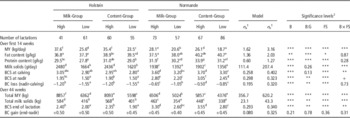
Holstein produced more milk (+2294 kg in the High FS and +1280 kg in the Low FS, P<0.001, Table 1) and milk solids throughout lactation (+120 kg in the High FS and +62 kg in the Low FS, P<0.001) than Normande cows. Over the 14 1st weeks of lactation, Holstein had lower fat (−1.0 g/kg, P<0.01) and protein content (−2.5 g/kg, P<0.001) than Normande. In both breeds, cows in the Milk-Group produced more milk than cows in the Content-Group (+764 kg for Holstein and +649 kg for Normande cows, P<0.001). Milk solids production was not different between genetic groups within breed (P=0.17 for Holstein and P=0.12 Normande cows). Cows in the Milk-Group had lower fat content (−2.1 g/kg for Holstein and −2.7 g/kg for Normande cows, P<0.001) and lower protein content (−1.3 g/kg for Holstein, P<0.01, and −1.5 g/kg for Normande, P<0.001).
Adjusted production performance over the first 14 lactation weeks or over the whole lactation (44 weeks) for Holstein and Normande cows, in the milk- or the content-group, under either the high or low feeding system

BCS=body condition score; BC=body condition; MY=milk yield.
a,b,c,d,e,fDistinguish adjusted means that are different between breeds, genetic groups, and feeding systems (P<0.05, Tukey’s pairwise comparison).
1 Standard deviation of the random terms, animal genetic and non-genetic effect (σ a; assuming uncorrelated animal effects) and error (σ e).
2 Effects of breed (B), genetic group within breed (B:G), feeding system (FS), breed×Feeding system (B×FS).
Significant levels: ***P<0.001, **P<0.01, *P<0.05; + P<0.1.
Holstein cows had a lower BCS than Normande cows at calving (−0.70 points in the High FS, P<0.001, and −0.35 in the Low FS, P<0.01), at nadir (−1.00 points in the High FS and −0.80 points in the Low FS, P<0.001) and at the end of lactation (−1.05 in the High FS and −0.75 in the Low FS, P<0.001). Normande cows in the Milk-Group had a lower BCS at nadir than cows in the Content-Group (−0.25 points, P<0.01) because of a larger loss to nadir (−0.20 points, P<0.01). They also had a lower BCS at the end of lactation (−0.20 points, P<0.05) despite a similar gain from nadir (P=0.15). For Holstein cows, BCS was not affected by genetic groups (P=0.99 at nadir, P=0.97 for loss to nadir, P=0.83 at the end of lactation).
According to feeding system
Cows in the High FS produced more milk (+2495 kg for Holstein and +1481 kg for Normande, P<0.001) and more milk solids (+168 kg for Holstein and +109 kg for Normande, P<0.001) than those in the Low FS. Holstein cows had similar BCS at calving in the two FS (P=0.53) and Normande cows in the High FS had higher BC at calving than in the Low FS (+0.40 points, P<0.001). Cows in the High FS had a higher BCS at nadir (+0.40 for Holstein and +0.60 for Normande, P<0.001) and at the end of lactation (+0.45 for Holstein and +0.70 for Normande, P<0.001). More information on BW and plasma concentration of glucose, non-esterified fatty acids and urea can be found in Supplementary Table S2.
Cyclicity
Commencement of luteal activity
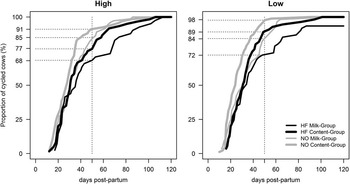
CLA ranged from 10 to 205 days, with a median of 30 days. Three cows had censored CLA. Holstein cows had later CLA than Normande cows (Figure 1). In both breeds, cows in the Content-Group were 1.7 times more likely to show CLA at a given time than those in the Milk-Group (P<0.01; Table 2). In other words, cows in the Content-Group had earlier CLA than cows in the Milk-Group. Within breed and genetic groups, higher EBV for milk yield was associated with later CLA (P<0.01). Time to CLA was not affected by FS (P=0.15). However, higher milk protein content was associated to earlier CLA (P<0.01). Second lactation cows had earlier CLA than primiparous and older cows (P<0.001). Cows that had later day to turnout had earlier CLA than others (P<0.001).
Observed reversed survival function (cumulative proportions) of Holstein cows (HF) and Normande cows (NO) that resumed luteal activity over the first 120 days postpartum by feeding system.

Estimated effect sizes
 $${\rm (}\widehat{\beta }{\rm )}$$
, associated hazard ratios
 $${\rm (HR{\equals}exp(}\widehat{\beta }{\rm ))}$$
and confidence intervals (CI) of factors influencing time to commencement of luteal activity (CLA; n=500 of which three are censored) for Holstein and Normande cows

EBV=estimated breeding values, MY=milk yield.
1 EBV has a null mean because it was centred within breed and genetic groups.
2 Tournout is the number of days in milk at turnout (start of grazing).
Significant levels: ***P<0.001, **P<0.01, *P<0.05, + P<0.1.
Type of P4 profile
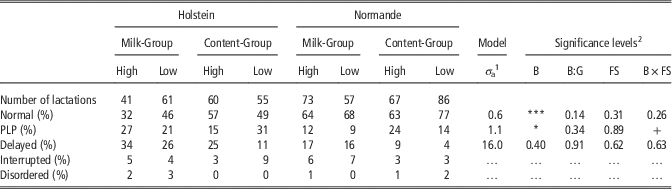
Holstein cows had a lower proportion of normal P4 profiles than Normande cows (−22 points, P<0.001; Table 3) because they had more PLP (+8 points, P<0.05). Holstein cows seemed to have more delayed profiles (+13 points, P=0.26), but this effect was due to individual deviation. The proportion of cows with normal P4 profiles was neither affected by genetic groups (P=0.14) nor by FS (0.31).
Distribution of type of progesterone profile for Holstein and Normande cows, in the milk- or the content-group, under either the high or low feeding system

PLP=prolonged luteal phases.
1 Standard deviation of the random animal genetic and non-genetic effect (σ a; assuming uncorrelated animal effects). No error term (σ e) is estimated with logistic regression.
2 Effects of breed (B), genetic group within breed (B:G), feeding system (FS), breed×feeding system (B×FS).
Significant levels: ***P<0.001, **P<0.01, *P<0.05, + P<0.1.
Oestrus expression and detection
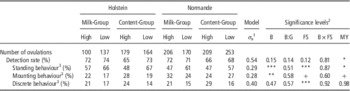
More ovulations occurred in Normande cows than in Holstein cows and for both breeds there were more ovulations in the Content-Group than in the Milk-Group (Table 4). Ovulation detection rate was about 70% and was similar between breeds (P=0.15), genetic groups (P=0.14) and FS (P=0.12). However, Holstein cows expressed more intensively oestrus than Normande cows (+7 points of standing behaviour, P<0.001, balanced by −5 points of mounting behaviour, P<0.05). Cows in the Low FS expressed more intensively oestrus than cows in the High FS (+13 points of standing behaviour, P<0.001). Interestingly, when milk yield of the ovulation week was added to the model, there was no residual FS effect (0.53; data not shown). This proved that observed differences in oestrus intensity between FS was mainly due to differences in milk yield. Consistently, we observed a continuous effect of milk yield within FS: the greater milk yield associated with week of ovulation reduced the chances to detect the proportion of standing oestrus behaviour and ovulation (P<0.05).
Proportion of ovulation detected by oestrus observations and proportion of expressed behaviours among detected ovulations for Holstein and Normande cows, in the milk- or the content-group, under either the high or low feeding system

1 Standard deviation of the random animal genetic and non-genetic effect (σ a; assuming uncorrelated animal effects). No error term (σ e) is estimated with logistic regression.
2 Effects of breed (B), genetic group within breed (B:G), feeding system (FS), breed×feeding system (B×FS), milk yield centred within feeding systems (MY).
3 The estimation of variance components failed. As an alternative, an empirical Bayesian approach was implemented. The robustness of the other estimated was checked by looking at their value when the chosen prior was multiplied or divided by 2.
Significant levels: ***P<0.001, **P<0.01, *P<0.05, + P<0.1.
Days to first service
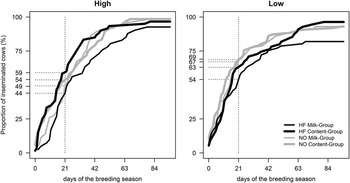
DAI1 ranged from 1 to 97 days, with a median of 20 days. In total, 31 cows had censored DAI1 with an averaged censoring time of 73 days. Holstein cows had later DAI1 than Normande cows. Submission rate at 21 days was 55% for Holstein and 59% for Normande cows (insemination on true oestrus) and 92% and 96%, respectively, at the end of the breeding season (Figure 2). DAI1 was similar in both genetic groups (P=0.79) and FS (P=0.51). However, higher EBV for milk yield was associated with later DAI1 (P<0.05; Table 5). Cows with higher milk protein content during the breeding season tended to be inseminated earlier (P<0.10). Primiparous cows were inseminated earlier in the breeding season than multiparous cows (associated hazard ratio (HR)=1.7; P<0.01). Cows without calving problems were inseminated earlier than others (associated HR=1.6; P<0.05). Cows with normal cyclicity were inseminated earlier than cows with any type of abnormal cyclicity pattern (associated HR=3.6; P<0.001). Cows expressing standing or mounting behaviour were inseminated earlier than cows expressing discrete behaviour (associated HR=1.9; P<0.001).
Observed reversed survival function (cumulative proportions) of Holstein cows (HF) and Normande cows (NO) that were inseminated over the breeding season by feeding system.

Estimated effect sizes
 $${\rm (}\widehat{\beta }{\rm )}$$
, associated hazard ratios
 ${\rm (HR{\equals}exp(}\widehat{\beta }{\rm ))}$
and confidence intervals (CI) of factors influencing days from start of the breeding season to first service (DAI1; n=500 of which 31 are censored) for Holstein and Normande cows

PLP=prolonged luteal phases; EBV=estimated breeding values, MY=milk yield.
1 EBV has a null mean because it was centred within breed.
Significant levels: ***P<0.001, **P<0.01, *P<0.05, + P<0.1.
Discussion
The ability to be inseminated is impacted by genetic characteristics
The differences in production performances between Holstein and Normande cows are consistent with our previous studies (Cutullic et al., Reference Cutullic, Delaby, Gallard and Disenhaus2011; Bedere et al., Reference Bedere, Delaby, Ducrocq, Leurent-Colette and Disenhaus2016). Our results confirmed that Holstein cows have later CLA than other dairy breeds (Petersson et al., Reference Petersson, Gustafsson, Strandberg and Berglund2006; Piccand et al., Reference Piccand, Cutullic, Meier, Schori, Kunz, Roche and Thomet2013). Holstein cows had more PLP than Normande cows, which is consistent with the idea that PLP may be a characteristic of Holstein cows (Royal et al., Reference Royal, Darwash, Flint, Webb, Woolliams and Lamming2000). However, Holstein cows expressed oestrus more intensively than Normande cows. This difference was consistent with observations between Holstein and Jersey cows observed by Løvendahl and Chagunda (Reference Løvendahl and Chagunda2010). In our experiment, Holstein cows had later DAI1 than Normande cows as well as a lower submission rate at the end of the breeding season. This result is consistent with other studies where the 21-day submission rate of Holstein cows was lower than for dual-purpose breeds (Dillon et al., Reference Dillon, Snijders, Buckley, Harris, O’Connor and Mee2003; Piccand et al., Reference Piccand, Cutullic, Meier, Schori, Kunz, Roche and Thomet2013).
As previously observed, producing milk solids through higher fat and protein contents is associated with earlier CLA (Bedere et al., Reference Bedere, Delaby, Ducrocq, Leurent-Colette and Disenhaus2016). Interestingly, genetic groups neither affected postpartum P4 profile, oestrus expression nor DAI1 in this study. To our knowledge, the relationship between the source of high milk fat plus protein production (high yield or high milk fat and protein contents) and reproductive performance has not been investigated previously. Relatively little is known about the genetic control of oestrus expression, due to the difficulty to measure and quantify oestrus intensity. Oestrus expression is often associated with production traits, suggesting the existence of an animal (and thus a genetic) component in the variability of oestrus expression. Yet, published heritability estimates for oestrus intensity are low, ranging from 0.01 to 0.04 (Roxström et al., Reference Roxström, Strandberg, Berglund, Emanuelson and Philipsson2001; Carthy et al., Reference Carthy, Ryan, Fitzgerald, Evans and Berry2016).
As reported before, EBV for milk yield was negatively associated with CLA (Royal et al., Reference Royal, Pryce, Woolliams and Flint2002; Windig et al., Reference Windig, Beerda and Veerkamp2008). We also found that higher genetic merit for milk yield was associated with later DAI1. Fulkerson et al. (Reference Fulkerson, Wilkins, Dobos, Hough, Goddard and Davison2001) found that cows with high genetic merit for production traits had lower submission rate than cows with low genetic merit, which is consistent with our results. A recent review by Washburn and Mullen (Reference Washburn and Mullen2014) indicates that 21-day submission rate is also genetically correlated with BCS (about 0.50).
Restrictive feeding system enhances oestrus expression but had no effect on cyclicity and time to first service
In this experiment, cows were fed ad libitum even though the 2 FS differed in nutrient intake. The Low FS was very restrictive, causing an insufficient energy intake associated with a large BCS loss. Cows adjusted their performances by limiting their milk production according to this nutritive constraint in order to reduce the severity of negative energy balance. Cows in the Low FS expressed oestrus more intensively than cows in the High FS, as in our previous studies (Cutullic et al., Reference Cutullic, Delaby, Causeur, Michel and Disenhaus2009 and Reference Cutullic, Delaby, Gallard and Disenhaus2011). The effect of FS is largely explained by differences in milk yield. As expected, higher milk yield was associated with lower oestrus intensity (Friggens et al., Reference Friggens, Disenhaus and Petit2010). A possible reason suggested in the literature is that high yielding dairy cows have a higher blood flow and consequently a higher hepatic catabolism of steroids that leads to decreased plasma oestradiol concentration (Wiltbank et al., Reference Wiltbank, Lopez, Sartori, Sangsritavong and Gümen2006). Some studies suggested that low BCS in early lactation was associated with reduced oestrus expression (Løvendahl and Chagunda, Reference Løvendahl and Chagunda2010; Madureira et al., Reference Madureira, Silper, Burnett, Polsky, Cruppe, Veira, Vasconcelos and Cerri2015). But in these studies, effects of level and dynamics of milk yield and BC may be confounded. Our previous work showed that oestrus expression was more associated with milk yield than BCS, even though a threshold of low BCS might exist beneath which both BCS and milk yield impact oestrus expression (Cutullic et al., Reference Cutullic, Delaby, Gallard and Disenhaus2012).
As expected, feeding strategies that partly disentangle milk production and body reserves mobilisation do not impact cyclicity (Walsh et al., Reference Walsh, Buckley, Pierce, Byrne, Patton and Dillon2008; Vance et al., Reference Vance, Ferris, Elliott, Hartley and Kilpatrick2013). However, higher protein content was associated with earlier CLA suggesting a residual effect of energy status after considering genetic effects. Protein content is known to be lower for cows in severe and prolonged negative energy balance (Fulkerson et al., Reference Fulkerson, Wilkins, Dobos, Hough, Goddard and Davison2001). This result is consistent with previous studies where earlier CLA was associated with better energy balance (Royal et al., Reference Royal, Pryce, Woolliams and Flint2002; Chagas et al., Reference Chagas, Gore, Graham, Macdonald and Blache2008).
DAI1 was not affected by FS. Kennedy et al. (Reference Kennedy, Dillon, O’Sullivan, Buckley and Rath2003) reported that the level of concentrates supplementation on pasture-based FS did not impact submission rate in the first 3 weeks of the breeding season. Cows with higher protein content had earlier DAI1 in our study. Considering that cows with higher protein content had a better energy balance, this finding is consistent with other studies where cows that had too low BCS (Buckley et al., Reference Buckley, O’Sullivan, Mee, Evans and Dillon2003) or too severe BCS loss (Roche et al., Reference Roche, Macdonald, Burke, Lee and Berry2007) had lower 21 days submission rate.
Conclusion
This study clearly showed that high yielding dairy cows (Holstein in the Milk-Group) had the poorer ability to be inseminated on time and this effect was also exacerbated by restricted diet. This effect was mostly due to a poor cyclicity. Our results suggest that selecting cows on production traits differently (high milk fat and protein contents) would not change milk solids production, would improve cyclicity, with no impact on oestrus expression or submission rate. Given the impact of CLA on re-calving rate and cow survival in compact calving systems, such selection strategy would lead to more robust cows, if their fertility is preserved. Investigations are still required on the ability to ensure pregnancy of such dairy cows.
Acknowledgements
The research leading to these results has received funding from the European Union Seventh Framework Programmes (FP7:2007–2013) under the grant agreement no. 311776 (PROLIFIC: Pluridisciplinary study for a RObust and sustainabLe Improvement of Fertility In Cows). The study was also funded by the Brittany Region, France. The authors would like to thank the staff of the experimental farm of Le Pin-au-Haras for their help in managing the herd and collecting the samples and data. The authors are also grateful to the laboratory staff of INRA and Agrocampus Ouest for analysing all the samples collected.
Supplementary material
To view supplementary material for this article, please visit https://doi.org/10.1017/S1751731116002111