1. Introduction
A growing body of research has recently focused on the cognitive development of bilingual children (e.g., Barac, Bialystok, Castro & Sanchez, Reference Barac, Bialystok, Castro and Sanchez2014; Hammer, Hoff, Uchikoshi, Gillanders, Castro & Sandilos, Reference Hammer, Hoff, Uchikoshi, Gillanders, Castro and Sandilos2014; Paap, Johnson & Sawi, Reference Paap, Johnson and Sawi2015). Two main trends emerge from this body of work. On the one hand, bilingual children are often reported to lag behind monolinguals in aspects of language development, such as vocabulary proficiency, when each of their languages is considered separately (e.g., Bialystok, Luk, Peets & Yang, Reference Bialystok, Luk, Peets and Yang2010). This is, however, only a normal reflection of the different quantity and quality of language input that bilinguals receive in each of their languages as compared to monolinguals (e.g., because their language input is divided in two languages). When bilinguals’ total or conceptual vocabulary (across their two languages) is taken into account, for instance, vocabulary differences with monolinguals often disappear (e.g., Hammer et al., Reference Hammer, Hoff, Uchikoshi, Gillanders, Castro and Sandilos2014). On the other hand, some evidence suggests a positive effect of bilingualism on executive functions (Bialystok, Reference Bialystok2017; Costa & Sebastián-Gallés, Reference Costa and Sebastián-Gallés2014; though see Paap et al., Reference Paap, Johnson and Sawi2015 for counter-evidence and criticism), a set of cognitive processes that include working memory, inhibition, and switching (Miyake, Friedman, Emerson, Witzki, Howerter & Wager, Reference Miyake, Friedman, Emerson, Witzki, Howerter and Wager2000).
In the past years, language and executive functions have dominated the literature on the cognitive effects of bilingualism. However, other facets of bilingual children's cognitive development, such as pragmatic-communicative skills, have received relatively little research attention. Likewise, very few studies have examined the cognitive development of bi-dialectal children – that is, children who grow up with two structurally, lexically similar, genetically related, and (to some degree) mutually intelligible linguistic varieties, known as dialects (though see, e.g., Antoniou, Grohmann, Kambanaros & Katsos, Reference Antoniou, Grohmann, Kambanaros and Katsos2016; Blom, Boerma, Bosma, Cornips & Everaert, Reference Blom, Boerma, Bosma, Cornips and Everaert2017; Garraffa, Beveridge & Sorace, Reference Garraffa, Beveridge and Sorace2015; Grohmann & Kambanaros, Reference Grohmann and Kambanaros2016; Kirk, Fiala, Scott-Brown & Kempe, Reference Kirk, Fiala, Scott-Brown and Kempe2014; Ross & Melinger, Reference Ross and Melinger2017). In this study, we examined how bilingualism and bi-dialectalism affect children's understanding and processing of pragmatic meanings.
1.1 Theoretical background
According to Grice (Reference Grice1989), speaker's meaning can be rationally reconstructed in terms of intention attribution. For a speaker to mean something, with an utterance, is for this speaker to intend with that utterance to provoke a response (e.g., to induce a belief) in an addressee, such that the reason for the addressee's response is the recognition of this very intention.
Grice (Reference Grice1989) also accounted for cases of conversation where the speaker's meaning diverges from the conventional meaning of the words she/he used. In this account, communicative exchanges are presumed to abide by the Principle of Cooperation, which is subdivided in four conversational Maxims. According to these maxims, speakers are expected to be relevant (maxim of relevance), give no less and no more information than is needed for the purpose of the talk exchange (maxim of quantity), be brief, orderly and avoid ambiguity and obscurity (maxim of manner), and provide information that is true and for which they have adequate evidence (maxim of quality).
Conversational maxims are often not fulfilled at the literal level. This invites the listener to infer an interpretation that goes beyond what the speaker explicitly said. These implied meanings are what Grice called conversational implicatures. The utterance He was a sinking ship, for instance, when taken literally, violates the maxim of quality. This invites the listener to infer an interpretation that makes the utterance truthful – i.e., that “He is feeling very sad” or a related figurative interpretation.
Grice himself did not intend for his ideas to be associated to cognitive-psycholinguistic models of language processing and development. Nevertheless, pragmatic theorists who have followed up on Grice (e.g., Levinson, Reference Levinson2000; Sperber & Wilson, Reference Sperber and Wilson2002) share a cognitive-psychological perspective, and aim to provide an explanatory account of the mechanisms that deliver different aspects of meaning and of how these mechanisms develop in children.
The cognitive factors that underpin the development and interpretation of non-literal meanings are a matter of on-going debate. One proposal suggests that the relevant factor affecting pragmatic skills is language proficiency and that level of pragmatic development is in keeping with levels of structural language (see Andrés-Roqueta & Katsos, Reference Andrés-Roqueta and Katsos2017). An alternative view is that understanding pragmatic language also depends on executive control (e.g., Huang & Snedeker, Reference Huang and Snedeker2009b; Siegal & Surian, Reference Siegal, Surian, Hoff and Shatz2007) and/or Theory of Mind (e.g., Sperber & Wilson, Reference Sperber and Wilson2002). Executive control skills, for instance, might be required for inhibiting the literal meaning of an utterance or for coordinating different pieces of information – literal meaning, encyclopedic knowledge, pragmatic maxims, speaker's knowledge and intentions – that are necessary for accessing a pragmatic interpretation. There is also some experimental evidence indicating that pragmatic understanding draws on working memory (WM). For instance, studies on adults’ understanding of scalar implicatures (specifically, on the derivation of the inference that some implicates “not all”)Footnote 1 have shown that burdening participants’ WM resources with a secondary task resulted in fewer scalar implicature interpretations (De Neys & Schaeken, Reference De Neys and Schaeken2007; Marty & Chemla, Reference Marty and Chemla2013; Marty, Chemla & Spector, Reference Marty, Chemla and Spector2013; see also Antoniou, Cummins & Katsos, Reference Antoniou, Cummins and Katsos2016; in addition, Chiappe & Chiappe, Reference Chiappe and Chiappe2007 and Mashal, Reference Mashal2013 for WM effects on metaphor interpretation).
On the other hand, theoretical accounts inspired by Grice (e.g., Sperber & Wilson, Reference Sperber and Wilson1986/1995; Reference Sperber and Wilson2002) propose that pragmatic understanding involves reasoning about and considering the speaker's beliefs, knowledge and intentions (but see Breheny, Reference Breheny2006; Kissine, Reference Kissine2013, Reference Kissine2016; Levinson, Reference Levinson2000; Recanati, Reference Recanati2002). In this respect, it has been suggested that pragmatic intrerpretation depends on a Theory of Mind (ToM), the cognitive component that is responsible for ascribing mental states (e.g., beliefs, intentions) to oneself and/or to others and for interpreting the behaviour of others based on these mental states. Again, experimental evidence has shown that ToM-related processes (e.g., taking into account speaker's reliability or knowledge) are involved during online pragmatic interpretation (see e.g., Breheny, Ferguson & Katsos, Reference Breheny, Ferguson and Katsos2013; Grodner & Sedivy, Reference Grodner, Sedivy, Pearlmutter and Gibson2011; Spotorno & Noveck, Reference Spotorno and Noveck2014) and that successful pragmatic understanding in children may depend on the development of a Theory of Mind (Filippova, Reference Filippova and Matthews2014).
1.2 Bilingualism and socio-communicative skills
Three studies conducted by Siegal and colleagues (Siegal, Iozzi & Surian, Reference Siegal, Iozzi and Surian2009; Siegal, Matsuo, Pond & Otsu, Reference Siegal, Matsuo, Pond and Otsu2007; Siegal, Surian, Matsuo, Geraci, Iozzi, Okumura & Itakura, Reference Siegal, Surian, Matsuo, Geraci, Iozzi, Okumura and Itakura2010) suggest enhanced pragmatic skills in bilingual preschool-aged children. Siegal et al. (Reference Siegal, Matsuo, Pond and Otsu2007) report that bilingual children were more likely than monolinguals to understand the scalar implicature associated with some. Similarly, in subsequent research, Siegal et al. (Reference Siegal, Iozzi and Surian2009; Reference Siegal, Surian, Matsuo, Geraci, Iozzi, Okumura and Itakura2010) found that bilingual children were better than monolinguals at indicating which of two statements was a pragmatically inappropriate reply to a question (i.e., violated a conversational maxim).Footnote 2 Siegal et al. (Reference Siegal, Iozzi and Surian2009) propose two possible explanations for the bilingual pragmatic advantage in their study. First, they suggest that bilingual children exhibited enhanced pragmatic abilities because of their superior executive control (EC) skills. The second explanation is that bilingual children develop better pragmatic skills as a compensation for the initial lag they often exhibit in aspects of language acquisition.
Bilingual advantages have been also reported for other facets of socio-communicative development. Yow and Markman (Reference Yow and Markman2015), for instance, found that bilingual toddlers were more adept at using multiple cues to understand a speaker's communicative intent. More recently, Liberman, Woodward, Keysar and Kinzler (Reference Liberman, Woodward, Keysar and Kinzler2017) reported that bilingual infants were more likely than monolinguals to interpret an experimenter's request as referring to a mutually visible object rather than to an identical object in their privileged perspective. Finally, various studies reported superior bilingual performance in ToM tasks for preschool-aged children (Barac et al., Reference Barac, Bialystok, Castro and Sanchez2014).
Other research, however, has failed to find evidence for better pragmatic-communicative skills in bilinguals. Antoniou and Katsos (Reference Antoniou and Katsos2017) tested Greek-speaking multilingual, bi-dialectal and monolingual children (aged six to nine years) in various pragmatic meanings (relevance, scalar, manner implicatures and novel metaphors). They hypothesised that multilingual children would exhibit better pragmatic understanding skills than monolinguals for two reasons. First, because the previous study by Siegal et al. (Reference Siegal, Matsuo, Pond and Otsu2007) found that bilingual children outperformed monolinguals in scalar implicature (SI) understanding; and second, because previous evidence indicated that bilingual children excel in almost all factors that have been suggested to underlie pragmatic interpretation (ToM, EC, sensitivity to Gricean maxims). However, Antoniou and Katsos (Reference Antoniou and Katsos2017) found no group differences in pragmatic comprehension. Null differences were also reported by Syrett, Austin, Sánchez, Germak, Lingwall, Perez-Cortes, Arias-Amaya and Baker (Reference Syrett, Austin, Sanchez, Germak, Lingwall, Perez-Cortes, Arias-Amaya and Baker2016) and Syrett, Lingwall, Perez-Cortes, Austin, Sánchez, Baker, Germak and Arias-Amaya (Reference Syrett, Lingwall, Perez-Cortes, Austin, Sánchez, Baker, Germak and Arias-Amaya2017), who compared Spanish-speaking bilingual and monolingual children (aged three to six years) in SI interpretation.Footnote 3
To sum, bilingual children have been found to exhibit advantages in various pragmatic-communicative and social skills, though not necessarily in pragmatic comprehension. Moreover, bilingual benefits have been most consistently reported for preschool-aged children. Thus, type of social or pragmatic skills and age seem to be two factors that can possibly explain why the bilingual benefit is found in some studies but not in others.
1.3 The present study
In this context, our study aimed to achieve four main goals. Firstly, we wanted to test the hypothesis of a bilingual advantage in pragmatic comprehension using a more sensitive experimental design than previous studies. Our study included a larger sample of participants (n = 138) and more critical items (n = 12) than past research on bilingual children's understanding of non-literal meanings (apart from Syrett et al., Reference Syrett, Lingwall, Perez-Cortes, Austin, Sánchez, Baker, Germak and Arias-Amaya2017 who tested 139 children in two experiments and Antoniou & Katsos, Reference Antoniou and Katsos2017, who used 15 critical items). In addition, we examined the comprehension of irony, which is generally thought to be the most demanding pragmatic meaning for children (Filippova, Reference Filippova and Matthews2014). Thus, the items on irony are possibly more sensitive to group differences. Finally, our study examined two different measures of pragmatic comprehension (accuracy and reaction times) while previous studies focused only on accuracy. All the above in combination suggest that the current experiment is more likely to detect a bilingual advantage in pragmatic understanding, if such an effect exists.
Second, we aimed to examine how bilingualism/bi-dialectalism affects the interpretation of pragmatic meanings that have not been previously tested in bilinguals/bi-dialectals (specifically, contrastive implicatures and irony). We expected a bilingual advantage particularly in irony comprehension for various reasons. As already noted, irony is the most difficult and late-developing pragmatic meaning for children (Filippova, Reference Filippova and Matthews2014). It is possible that a bilingual advantage in older children is found only when using very demanding tasks. This is because older children have possibly reached an advance level of cognitive development and, hence, any bilingual advantages are more difficult to detect. Moreover, a previous study by Yow and Markman (Reference Yow and Markman2011) reported that bilingual toddlers were more adept than monolinguals at using tone of voice to judge a speaker's emotion behind an utterance when semantic content and intonation conflicted. This situation resembles cases of irony where intonation indicates an interpretation different from the utterance's literal meaning.Footnote 4
Third, we wanted to examine how bilingualism/bi-dialectalism affects pragmatic processing. We hypothesised a bilingual advantage in pragmatic processing (i.e., faster pragmatic interpretations) for various reasons. First, experimental evidence suggests that proficient bilinguals can achieve native-like semantic and grammatical processing, even in their second language (e.g., Clahsen & Felser, Reference Clahsen and Felser2006b). On the other hand, there is some evidence that bilinguals are more sensitive to pragmatic cues during language processing than native speakers, especially in their second language (Roberts & Felser, Reference Roberts and Felser2011; Roberts, Gullberg & Indfrey, Reference Roberts, Gullberg and Indefrey2008; see also in Clahsen & Felser, Reference Clahsen and Felser2006a; Reference Clahsen and Felser2006b; Foucart, Garcia, Ayguasanosa, Thierry, Martin & Costa, Reference Foucart, Garcia, Ayguasanosa, Thierry, Martin and Costa2015). Moreover, other research suggests that pragmatic processing draws on cognitive resources like WM and ToM, which are thought to be domains of bilingual strength. Findings with adults, for instance, indicate that the processing of pragmatic meanings is associated with a reaction-time cost as compared to literal meanings (e.g., Bott & Noveck, Reference Bott and Noveck2004; Breheny, Katsos & Williams, Reference Breheny, Katsos and Williams2006; Deliens, Antoniou, Clin, Ostaschenko & Kissine, Reference Deliens, Antoniou, Clin, Ostashchenko and Kissine2018; Huang & Snedeker, Reference Huang and Snedeker2009a). This further suggests that pragmatic interpretation is a non-automatic process that draws on executive functions. Indeed, as already noted, studies with adults have shown that SI processing depends on WM resources (De Neys & Schaeken, Reference De Neys and Schaeken2007; Marty & Chemla, Reference Marty and Chemla2013). Finally, experimental evidence on irony has revealed that irony processing activates brain regions associated with ToM (Spotorno & Noveck, Reference Spotorno and Noveck2014).
Our final goal was to contribute to the debate regarding the cognitive factors that underpin pragmatic understanding. If bilingual and/or bi-dialectal children exhibit the expected pattern of lower language proficiency in the language of testing but better (or equal) pragmatic skills as compared to monolinguals, this will be evidence against an account which predicts that pragmatic understanding depends solely on structural language skills in the target language. We should note that, in this study, we were interested in the effect of language proficiency only in the language of testing because, based on previous research, we had reasons to believe that bilinguals and bi-dialectals will exhibit lower language performance when tested in only one of their languages. This naturally poses the question of whether having lower proficiency in a given language affects pragmatic interpretation in that language. We were also interested in possible effects of language knowledge per se (not some other aspect of general language use or cognitive skill that possibly correlates with language proficiency/knowledge). For instance, when interpreting implicatures in a given language, listeners need to recruit language knowledge from that language to process and understand (at least to some degree) the semantics of target utterances. There is no reason to suppose that language knowledge in the other language (or total language knowledge across languages) is necessary in this process.
As previously mentioned, bilingual and bi-dialectal children tend to exhibit enhanced EC skills as compared to monolinguals. If pragmatic comprehension draws on executive functions, then we would expect bilinguals and/or bi-dialectals to also excel in pragmatic understanding. Our study, however, offers the opportunity to examine this question irrespective of group differences in language proficiency or EC. By directly looking at the correlations between executive functions, language proficiency and pragmatic performance, we can provide direct evidence regarding the independent effects of these two factors (if any).
Finally, we were especially interested in whether bilingual/bi-dialectal children understand pragmatic language by relying differently (e.g., more heavily) as compared to monolinguals on their EC resources.
In this study, a bilingual, a bi-dialectal and a monolingual group of Dutch-speaking children were administered a novel task (in Dutch) on various pragmatic meanings: relevance, scalar, contrastive, manner implicatures, novel metaphors and irony. The task was designed on E-Prime (Psychology Software Tools, Pittsburgh, PA, 2012) and both accuracy and reaction times (RTs) were recorded. Children were further given two vocabulary tests only in Dutch. Various EC tasks were also administered as part of another study (Veenstra, Antoniou, Katsos & Kissine, Reference Veenstra, Antoniou, Katsos and Kissine2018).
We tested children between 10–12 years of age for three reasons. First, given that bilingual and bi-dialectal children in our study were exposed to Dutch primarily through education, we wanted to ensure that they had sufficient experience and knowledge of that language. Second, we tested older children because we wanted to examine pragmatic meanings such as irony, which previous research has shown to develop until late in childhood (Filippova, Reference Filippova and Matthews2014). Thirdly, we wanted to test children who would be old and competent enough to understand the pragmatic meanings examined and to perform unaided a computerised task recording RTs.
We also tested bi-dialectal children because we wanted to examine how bi-dialectals pattern in terms of their cognitive skills as compared to monolinguals and bilinguals. Moreover, we were interested in how the close language similarity between the varieties spoken by bi-dialectals possibly affects the cognitive outcomes of bilingualism.
2. Method
2.1 Participants
Approval for this study was obtained from the Ethical board of the Université libre de Bruxelles. All parents gave informed consent for their children's participation. Participants included 46 bi-dialectal children (in Dutch and West Flemish; 23 girls; aged 121–155 months, mean age 136.2, SD 8.9 months), 48 bilinguals (in Dutch and French; 28 girls; aged 121–144 months, mean age 132.5, SD 6.7 months), and 44 monolingual children (speakers of Dutch; 25 girls; aged 121–145 months, mean age 132.5 months, SD 6.8 months). A power calculation using G* Power (Faul, Erdfelder, Lang & Buchner, Reference Faul, Erdfelder, Lang and Buchner2007) indicated that our study had a power of .99 to detect a group effect of r = .39 (see Antoniou & Katsos, Reference Antoniou and Katsos2017).Footnote 5 This level of power is well above Cohen's (Reference Cohen1988) recommended level of .8.
Bi-dialectal children were recruited in West-Flanders (Belgium), bilinguals in Brussels (Belgium), and monolinguals in Eindhoven (the Netherlands). All children were educated in Dutch. Dutch instruction started in daycare and kindergarten, around the age of 2;6 years. Bilingual children were dominant in French and spoke exclusively French at home, while bi-dialectals used exclusively West Flemish at home.
2.2 Materials and procedure
Participants were tested in three sessions taking approximately 45 minutes each. For EC, we used the following measures (tasks are given in parentheses): interference effect (Attentional Networks Task; Rueda, Fan, McCandliss, Halparin, Gruber, Lercari & Posner, Reference Rueda, Fan, McCandliss, Halparin, Gruber, Lercari and Posner2004), switch cost (Colour-Shape task; Ellefson, Shapiro & Chater, Reference Ellefson, Shapiro and Chater2006), and number of correctly recalled trials (in the forward and backward Corsi Blocks task and Digit Recall task; Mueller & Piper, Reference Mueller and Piper2014 and Kort, Schittekatte & Compaan, Reference Kort, Schittekatte and Compaan2008, respectively). These tasks and measures are described in Veenstra et al. (Reference Veenstra, Antoniou, Katsos and Kissine2018).
Pragmatics test
Each type of pragmatic meaning was based on one of Grice's (Reference Grice1989) maxims. In the relevance sub-test, an utterance such as It's raining as a reply to the question What kind of item do you want?, when taken literally, violates the maxim of relevance. This invites the listener to infer a relevant interpretation, i.e., that (between a winter hat, an umbrella, and a pair of shorts) the speaker wants the umbrella. For SIs, the use of the term some invites the listener to infer (by Grice's maxim of quantity) that all does not hold. For contrastive implicatures, the use of a modified noun phrase such as Open window to describe a single window would be over-informative. This implicates that there is another window in context. For manner implicatures, a description such as Vehicle with two wheels (in the context of a motorcycle and an atypical vehicle with two wheels) implicates that “The speaker refers to the atypical vehicle”. This is because the speaker used a more prolix sentence instead of the simpler description Motorcycle. Finally, for novel metaphors and irony, the violation of the maxim of quality at the literal level (e.g., when a speaker utters Yes, you know how much I like red clothes!, but interlocutors know that she/he definitely hates red clothes) invites the listener to infer a truthful interpretation (e.g., “No, you know that I definitely hate red clothes!”). Each sub-test is detailed below.
All sub-tests, apart from SIs, had a picture-selection format. The participant heard a target statement, and was then presented with three pictures from which she/he had to select one. For SIs, children had to judge whether a statement was a correct or incorrect description of a visual display. Items were recorded in Dutch by a native Dutch speaker for monolinguals and by a native Belgian Dutch speaker for the other groups. All verbal stimuli, apart from ironic sentences, were pronounced with a neutral intonation without any contrastive focus accent or non-default prosody. Ironic statements were produced with a distinctive, exaggerated, ironic prosody.
For critical items of picture-selection sub-tests, one picture corresponded to the pragmatic meaning. For novel metaphors, irony, and manner implicatures, a second picture was compatible with a literal interpretation. The other pictures were incorrect matches to both the semantic and pragmatic meaning of target statements. For the SI sub-test, rejection of the critical statements as incorrect (e.g., There are stars on some of the cards as a description of a display where all cards depicted stars) indicated a SI interpretation whereas acceptance of the same items indicated a literal interpretation.Footnote 6
In sum, there were six sub-tests with two critical and four control or filler items each. We used only two critical items for each pragmatic meaning because we wanted to avoid effects of fatigue or the children losing interest in the task (the task took approximately 25 minutes). In addition, item-level power is higher when considering the analyses on overall pragmatic performance which average responses to all critical items.
For relevance, scalar, manner implicatures, novel metaphors and irony, (some) non-implicature items were control items; that is, they were comparable to the implicature items in semantic meaning and linguistic form (for SIs, irony and two items from novel metaphors and relevance implicatures), or in terms of communicated meaning (for two items from novel metaphors), or in terms of semantic meaning (for two items from manner implicatures). For contrastive implicatures, all non-implicature items were fillers.
In each sub-test, the children performed two practice trials. In all sub-tests, there were three conditions (Pragmatic, Literal-1, Literal-2). For metaphors, each condition began with different instructions and its own practice trial because initial pilot testing showed that participants found the general instructions confusing.
There were three versions of the pragmatics test. For each critical trial in one version, the second and/or third versions included the control trial(s) for that critical trial. An approximately equal number of children (within each group) was tested with each version.
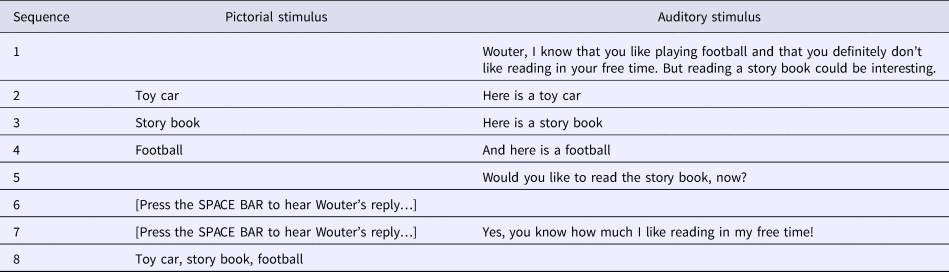
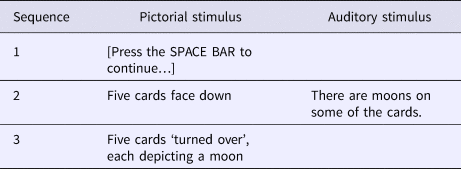
Children were instructed to respond as fast and accurate as possible. Reaction times were recorded as soon as the final response slide appeared (after the target statement). The SI sub-test was administered first, and the other sub-tests were then randomly presented. The linguistic stimuli from the pragmatics test can be found in the online supplementary material (Supplementary Material). Tables 1 and 2 provide sample trials from the (picture-selection) sub-test on irony and the SI judgment task, respectively.
Example critical trial from the irony sub-test

Note. Stimuli in brackets were presented in written form.
Example critical trial from the scalar implicatures sub-test

Note. Stimuli in brackets were presented in written form.
Relevance implicatures
Children were presented with a character, named Thomas and a female speaker, who asked Thomas to describe which of three items/pictures he wanted. They had to select one item/picture based on Thomas's reply. All trials were randomly presented.
For critical trials, the speaker initially urged Thomas to wear a blindfold. This was necessary to motivate why Thomas replied indirectly. The target question was then heard (e.g., What kind of item do you want?). Next, participants heard the target statement (e.g., It's snowing) and, immediately after that, saw the final slide depicting three items (e.g., a coat, a belt and a hat).
The same procedure was followed for Literal-1 control trials (e.g., It's raining) with the difference that the speaker did not urge Thomas to wear a blindfold; she introduced three pictures, and then asked the target question (e.g., How is the weather in the picture that you want?). For the Literal-2 filler trials (e.g., It's shining), the speaker introduced three items in separate slides and, then, asked Thomas to describe what he wanted.
Scalar implicatures
Participants heard a character, named Bram, describing various visual displays with five cards. They had to judge whether Bram's utterances were correct or incorrect descriptions of the visual displays.
In each trial, an auditory stimulus was played, There are < X > on < Q > of the cards, where X was the item (moons, squares, rings, hearts, suns, stars) and Q the quantifier (all, some, none). The cards were then immediately ‘turned over’ to reveal the items.
There were two critical items with some. True-and-informative some and false some statements (Literal-1 and Literal-2 conditions, respectively) served as controls.
Contrastive implicatures
This sub-test was based on a task previously used by Kronmüller, Morisseau and Noveck (Reference Kronmüller, Morisseau and Noveck2014). Children were instructed that a character named Martijn would describe one of two cards (visible only to himself) and they had to guess what his second card depicted. Trials were presented randomly.
Critical statements included modified or bare nouns such as Open window or Window. For each trial, the children heard Martijn describing one card. The next slide included a written question In your opinion, which one is Martijn's second picture? In the final slide, participants saw three pictures (e.g., a closed window, a dog and an open window).
In the Literal-2 condition, Martijn explicitly provided a hint about what his second card depicted. In the Literal-1 condition, he did not provide any hints about his second card and participants had to select a card at chance.
Manner implicatures
Participants were informed that for each trial they had to select the picture described by a character named Sander. Critical statements included modified noun phrases with generic nouns (e.g., Vehicle with two wheels). For each trial, the children heard a female speaker asking Sander to describe a picture. They heard the target description and, finally, viewed three pictures (e.g., a motorcycle, an atypical vehicle with two wheels, a car).
For critical trials, one picture corresponded to a pragmatic interpretation, the second was compatible with a literally true but pragmatically inappropriate interpretation (competitor), and the third depicted another incorrect referent. Trials were presented in a fixed order so that, for each critical statement, the corresponding simpler noun phrase (e.g., Motorcycle) was introduced in a previous trial. This was necessary to avoid the participants thinking that the speaker did not know the label for the competitor, which would make the critical statement ambiguous.
Novel metaphors
The sub-test was designed based on Waggoner and Palermo (Reference Waggoner and Palermo1989). In this sub-test, we used six (from a list of 12) metaphors that were judged as novel (mean novelty rating of 3.09/5) but also ranked high for aptness (lowest mean rating was 1.97/5) by 32 adult Dutch native speakers.
Children were presented with a character, named Niels, and a female speaker who asked questions. They had to select one of three pictures depicting a sad man, an angry man or a situation compatible with a literal-like interpretation of a metaphor.
In the Metaphor condition, children heard stories about Niels's father. The speaker asked the target question (e.g., Niels, how was your father feeling when he found out?) and the target statement was heard (e.g., He was a thunderous storm cloud). Children had to select the picture showing how Niels's father felt.
The same procedure was followed in Literal-1 (e.g., He was a sad man) and Literal-2 (e.g., It was a sinking ship) control trials. In the Literal-2 condition, however, the children were instructed to select the picture that indicated what happened at the end of each story.
There were three blocks, one for each condition. The blocks and the trials within each block were randomly presented.
Irony
This sub-test was based on a task previously used by Kowatch, Whalen, and Pexman (Reference Kowatch, Whalen and Pexman2013). A female speaker asked a character, named Wouter, questions about which item he wanted. Participants had to give Wouter the item he wanted. Trials were presented in a fixed order, so that each critical trial appeared only after a Literal-1 (e.g., Yes, you know how much I like vegetables for lunch!) and Literal-2 (e.g., No, you know how much I hate red clothes!) control trial.
For all trials, the speaker initially gave contextual information regarding Wouter's preferences. She then introduced three items and the target question was heard. Next, the target statement was presented and, then, three items appeared on the screen.
Socioeconomic status and language background questionnaire
This questionnaire (based on Paradis, Reference Paradis2011; Paradis, Emmerzael & Duncan, Reference Paradis, Emmerzael and Duncan2010) asked for information regarding the child's language use, among other topics. It also included three indicators of socioeconomic status (SES): the Family Affluence Scale (FAS; Boyce, Torsheim, Currie & Zambon, Reference Boyce, Torsheim, Currie and Zambon2006) and parents’ levels of education.
Language measures
Receptive vocaburaly in Dutch was tested using the Peabody Picture Vocabulary Test III-NL (PPVT; Dunn, Dunn & Schlichting, Reference Dunn, Dunn and Schlichting2005) and Dutch expressive vocabulary with the Word Definitions task from the CELF 4-NL (Semel, Wiig, Secord & Kort, Reference Semel, Wiig, Secord and Kort2008).
3. Results
Accuracy in the pragmatics test was analysed with generalized linear mixed-effects models using the logit link function from the lme4 package in RStudio (Bates, Maechler, Bolker & Walker, Reference Bates, Maechler, Bolker and Walker2015; RStudio Team, 2016). Reaction times were analysed with linear mixed-effects models, using the same package. The significance of the fixed effects was assessed with likelihood ratio tests where a model containing the fixed effect was compared to an identical model without it (Barr, Levy, Scheepers & Tily, Reference Barr, Levy, Scheepers and Tily2013). For follow-up contrasts, we used the multcomp package in R (Hothorn, Bretz, Westfall, Heiberger, Schuetzenmeister, Scheibe & Hothorn, Reference Hothorn, Bretz, Westfall, Heiberger, Schuetzenmeister, Scheibe and Hothorn2016) and the default single-step method to correct for multiple comparisons.
For the comparison models, we attempted to specify the maximal random effects structure (Barr et al., Reference Barr, Levy, Scheepers and Tily2013). Moreover, we did not include random slopes for control variables (Barr et al., Reference Barr, Levy, Scheepers and Tily2013). To deal with non-convergence, we followed the procedure described in Barr et al. (Reference Barr, Levy, Scheepers and Tily2013). Where singularity was observed, we dropped random effects associated with zero variance or a random correlation of +/-1 (Bolker, Brooks, Clark, Geange, Poulsen, Stevens & White, Reference Bolker, Brooks, Clark, Geange, Poulsen, Stevens and White2009).
All other between-group comparisons were conducted using Analyses of (Co)Variance (Bonferroni correction was applied for multiple constrasts). Finally, all between-group analyses included as control variables background measures for which significant group differences were found.
3.1 Preliminary analyses
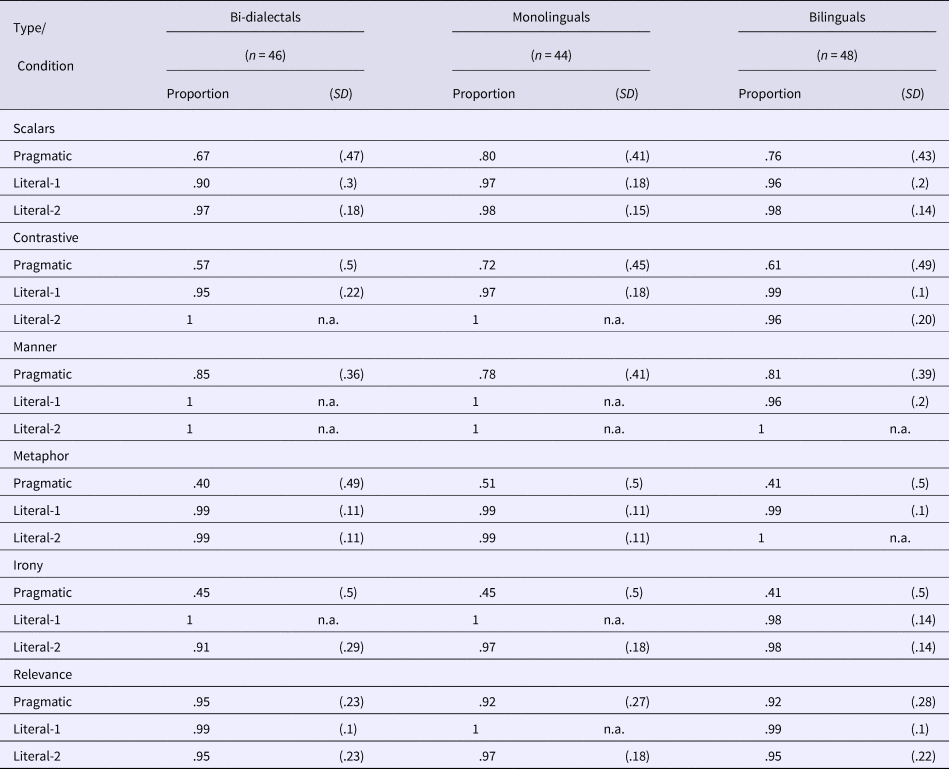
Figure 1 shows accuracy by Condition (Pragmatic, Literal-1, Literal-2) and sub-test. Accuracy data from the relevance sub-test was excluded from subsequent analyses because a ceiling effect was observed (93%).
Accuracy (in proportions) by Condition (Literal-1, Literal-2, Pragmatic) in each pragmatic sub-test (Irony, Metaphor, Contrastive, Manner, Relevance and Scalar implicatures).

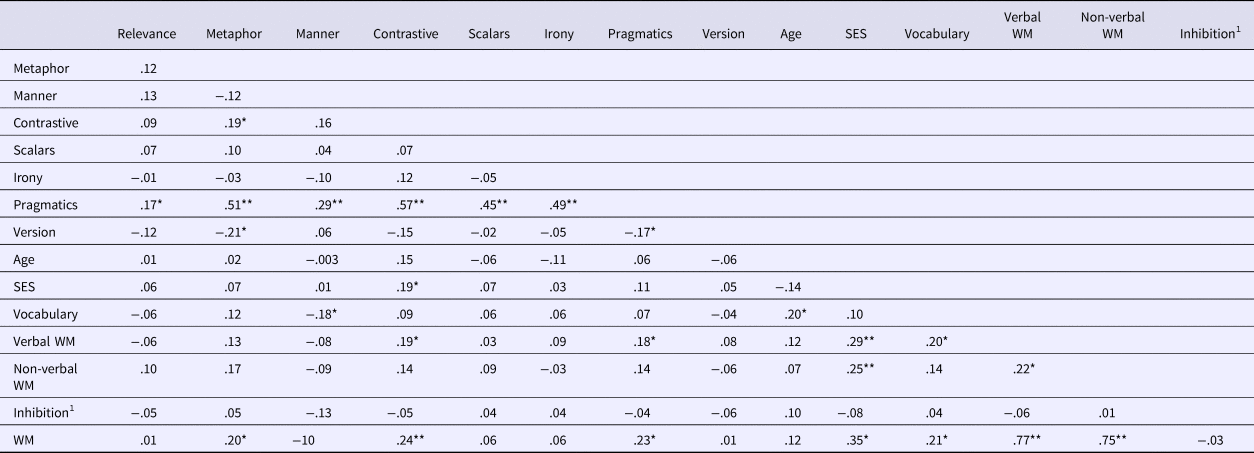
To reduce the number of variables entered into subsequent analyses and to increase reliability of measurement for these variables (Carlson, Reference Carlson2003; Rushton, Brainerd & Pressley, Reference Rushton, Brainerd and Pressley1983), we created composite scores for variables that were conceptually and statistically related. These were calculated by transforming into z scores and averaging the individual measures (e.g., Carlson & Meltzoff, Reference Carlson and Meltzoff2008). A vocabulary composite score was computed based on the PPVT and the Word Definitions test, and a SES composite measure was calculated based on maternal, paternal level of education and FAS. Moreover, Veenstra et al. (Reference Veenstra, Antoniou, Katsos and Kissine2018) created composite scores (as above) for three EC factors (based on a Principal Component Analysis): Non-verbal WM (from scores in the forward and backward Corsi Blocks task), Verbal WM (from scores in the forward and backward Digit Recall task) and Inhibition (from the switching cost and interference effect). Correlations between accuracy in the pragmatic sub-tests, Age, Vocabulary, SES, Task Version and EC are presented in Table 3.
Bivariate correlations (Spearman's rho) between pragmatic scores, task version, executive control, vocabulary, and background variables

*. Correlation is significant at the 0.05 level (two-tailed), **. Correlation is significant at the 0.01 level (two-tailed).
1 Measure was reverse scored so that a higher value indicates better performance.
Note. Relevance = accuracy for the critical items of the sub-test on relevance implicatures, Metaphor = accuracy for the critical items of the sub-test on metaphors, Manner = accuracy for the critical items of the sub-test on manner implicatures, Contrastive = accuracy for the critical items of the sub-test on contrastive implicatures, Scalars = accuracy for the critical items of the sub-test on scalar implicatures, Irony = accuracy for the critical items of the sub-test on irony, Pragmatics = overall accuracy for the critical items of the pragmatics test (calculated by averaging accuracy in all pragmatic sub-tests, besides relevance), Version = task version of the pragmatics test, Age = participants’ age in months, SES = socioeconomic status composite score, Vocabulary = vocabulary composite score, Verbal WM = verbal working memory composite score, Non-verbal WM = non-verbal working memory composite score, Inhibition = inhibition composite score.
3.2 Main analyses
Background measures
There were significant group differences in age in months (F(2, 135) = 3.625, p < .05), SES (F(2, 135) = 80.56, p < .05) and Vocabulary (F(2, 133) = 9.944, p < .05). Regarding age, there was a trend for bi-dialectals being older than both bilingual (p = .06) and monolingual children (p = .07). For SES, bilinguals had a higher SES than bi-dialectal and monolingual children, and monolinguals had a higher SES than bi-dialectals (ps < .05). Moreover, monolinguals had a higher Dutch vocabulary than bi-dialectal and bilingual children (all ps < .05). Finally, as reported in Veenstra et al. (Reference Veenstra, Antoniou, Katsos and Kissine2018), there were no significant group differences in EC.
Pragmatics test: Accuracy
Descriptive statistics for accuracy by Type of Pragmatic Meaning (Relevance, Scalar, Contrastive, Manner, Metaphors, Irony), Condition (Pragmatic, Literal-1, Literal-2) and Group (Monolinguals, Bi-dialectals, Bilinguals) are reported in Table 4.
Descriptive statistics (proportion correct and standard deviations) from the pragmatics test (raw values) by type of pragmatic meaning, condition and language group

Note. n.a.=not applicable, n = number, SD = standard deviation, Proportion = proportion correct, Relevance = sub-test on relevance implicatures, Metaphor = sub-test on metaphors, Manner = sub-test on manner implicatures, Scalars = sub-test on scalar impicatures, Contrastive = sub-test on contrastive implicatures, Pragmatic = condition with critical implicature items, Literal-1 = first condition with literal items, Literal-2 = second condition with literal items.
Effect of Type of Pragmatic Meaning and Task Version
Models with by-subject and by-item random intercepts revealed a significant effect of Type (χ 2(4) = 30.898, p < .05), but a non-significant effect of Version (χ 2(2) = 1.21, p > .05) or Type by Version interaction (χ 2(8) = 15.271, p = .054). Pairwise contrasts for Type indicated that accuracy in the scalars sub-test was significantly higher than for metaphors (estimate=−1.41, SE = 0.32, z=−4.38, p < .05) and irony (estimate=−1.41, SE = 0.32, z=−4.38, p < .05); performance for contrastive implicatures was significantly lower than for manner (estimate = 1.06, SE = 0.33, z = 3.16, p < .05), but did not significantly differ from metaphors (estimate=−0.87, SE = 0.32, z=−2.73, p = .07) and irony (estimate=−0.87, SE = 0.32, z=−2.73, p = .07); and accuracy was significantly higher in manner than in the metaphor (estimate=−1.93, SE = 0.34, z=−5.73, p < .05) and irony sub-tests (estimate=−1.92, SE = 0.34, z=−5.7, p < .05).
Effect of Group
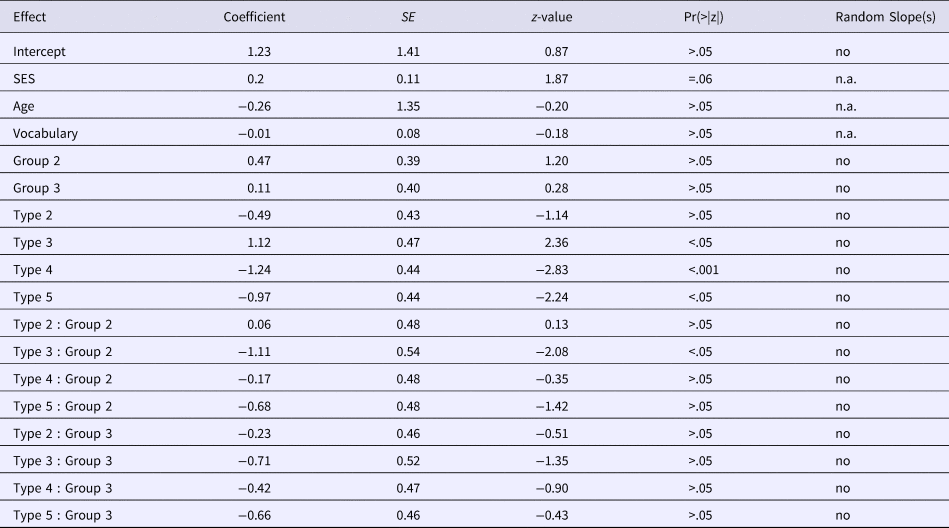
We specified a model with Group, Type, and their interaction, SES and Age as covariates, by-subject random slopes for Type and by-item random intercepts.
Results showed that neither Group (χ 2(2) = 5.04, p = .08) nor the interaction were significant (χ 2(8) = 6, p > .05). Given the group differences in vocabulary, we also included Vocabulary as an additional covariate in the models. These analyses indicated again a non-significant Group effect (χ 2(2) = 4.289, p > .05) and a non-significant interaction (χ 2(8) = 8.42, p > .05). These results are presented in Table 5.
Summary of the generalized linear mixed-effects regression model for the effect of Group on pragmatic accuracy

Note. n.a.=not applicable, SES = socioeconomic status composite score, Age = participants’ age in months, Vocabulary = vocabulary composite score, Type 1 = accuracy in the scalar implicatures sub-test, Type 2 = accuracy in the contrastive implicatures sub-test, Type 3 = accuracy in the manner implicatures sub-test, Type 4 = accuracy in the metaphors sub-test, Type 5 = accuracy in the irony sub-test, Group 1 = bi-dialectals, Group 2 = monolinguals, Group 3 = bilinguals.
The relation between pragmatic accuracy, SES, Age, Vocabulary and Executive Functions
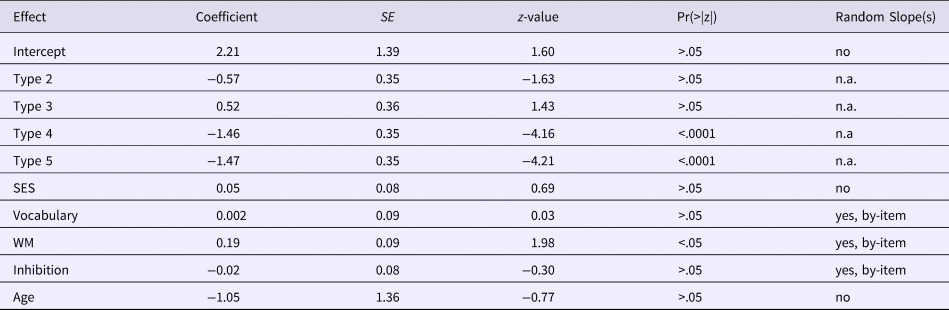
Initial analyses on pragmatic accuracy with Type, Verbal WM, Non-verbal WM, Inhibition, Vocabulary, SES and Age as predictors showed no significant effects (besides for Type). However, given that Verbal and Non-Verbal WM significantly correlated with each other (see Table 3) and to benefit from the increased reliability resulting from combining four WM indicators, we repeated the above analyses using a single WM composite score. This analysis showed that only WM positively predicted pragmatic performance (χ 2(1) = 3.77, p = .052; estimate = 0.19, SE = 0.09, z = 1.98, p = .048; see also Table 3). These results are presented in Table 6.
Summary of the generalized linear mixed-effects regression model for the effect of Type, Working Memory, Inhibition, Vocabulary, Age and Socioeconomic Status on pragmatic accuracy

Note. n.a.=not applicable, Type 2 = accuracy for critical items in the contrastive implicatures sub-test, Type 3 = accuracy for critical items in the manner implicatures sub-test, Type 4 = accuracy for the critical items in the metaphors sub-test, Type 5 = accuracy for critical items in the irony sub-test, SES = socioeconomic status composite score, Vocabulary = vocabulary composite score, WM = working memory composite score, Inhibition = Inhibition composite score, Age = participants’ age in months.
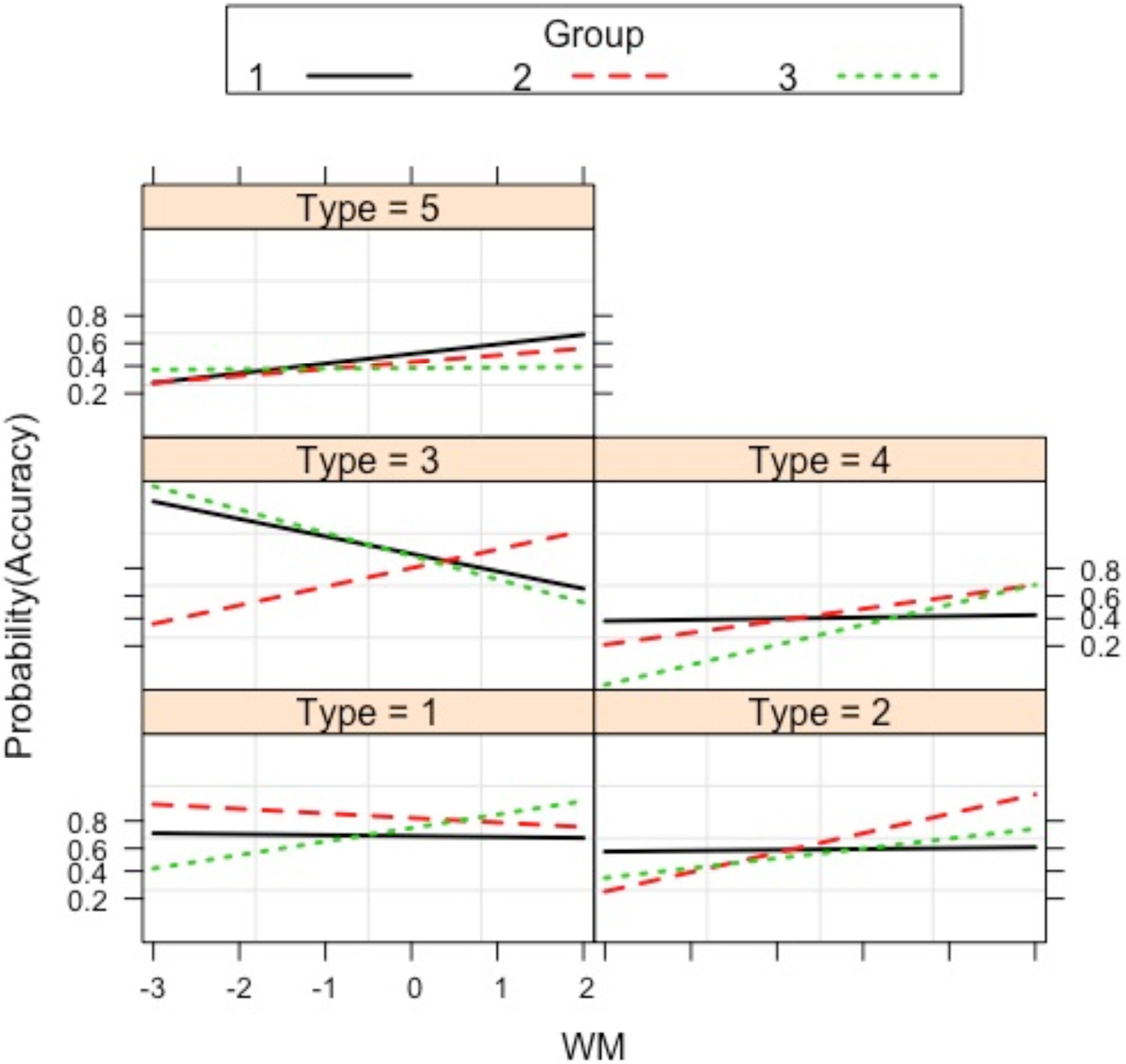
Moreover, we examined whether the WM effect was qualified by Group and/or Type. The three-way interaction between Group, Type and WM was significant (χ 2(8) = 18.88, p< .05). The interaction is illustrated in Figure 2. It indicates positive relations between WM and accuracy in most sub-tests, particularly for bilinguals and monolinguals. However, in the manner sub-test, there were negative correlations between WM and accuracy for bilinguals and bi-dialectals and a positive relation for monolinguals.
Three-way interaction between Group (1 = bi-dialectals, 2 = monolinguals, 3 = bilinguals), Type (Type 1 = scalar implicatures, Type 2 = contrastive implicatures, Type 3 = manner implicatures, Type 4 = metaphors, Type 5 = irony) and Working Memory (WM) from the generalized linear mixed-effects regression model on pragmatic accuracy.

Thus, WM positively predicted pragmatic performance, but there is no clear evidence that bilinguals/bi-dialectals achieve pragmatic interpretation by relying differently on these resources relative to monolinguals.
Pragmatics test: Reaction times
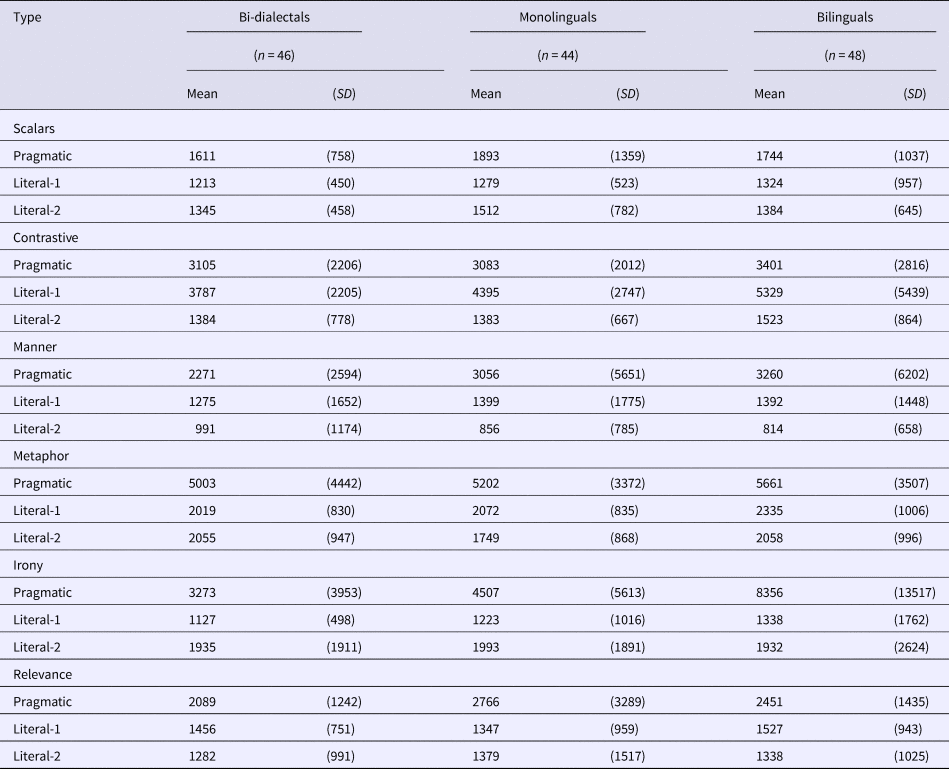
Table 7 reports descriptive statistics for RTs by Type (Relevance, Scalar, Contrastive, Manner, Metaphors, Irony), Condition (Pragmatic, Literal-1, Literal-2) and Group (Monolinguals, Bi-dialectals, Bilinguals).
Descriptive statistics (mean reaction times and standard deviations for correct responses) from the pragmatics test (raw values) by type of pragmatic meaning, condition and language group

Note. n = number, SD = standard deviation, Relevance = sub-test on relevance implicatures, Metaphor = sub-test on metaphors, Manner = sub-test on manner implicatures, Scalars = sub-test on scalar impicatures, Contrastive = sub-test on contrastive implicatures, Pragmatic = condition with critical implicature items, Literal-1 = first condition with literal items, Literal-2 = second condition with literal items.
Pragmatic versus literal interpretations
We first examined whether pragmatic interpretations were slower than literal responses. However, for the reader's convenience, we only present a summary of these results here. The full analyses are presented in the online supplementary material (Supplementary Material).
Overall, there was strong evidence that ironic and figurative interpetations take longer to process than literal interpretations. This was manifested both in the comparisons between correct pragmatic responses to critical items and correct literal responses to control items, and in the comparisons between pragmatic (correct) and literal (incorrect) responses (i.e., responses where the literal picture was selected) to critical items. Similarly, there was some evidence that relevance, manner, and SIs incur processing delays. This was evident in the comparisons between correct pragmatic responses to critical items and correct literal responses to control items. The evidence for the latter three pragmatic meanings, however, is weaker as, for relevance implicatures, our items were not designed to allow comparisons between pragmatic and literal responses to the same critical items (there was no picture that corresponded to a literal interpretation); for SIs, this comparison showed no differences in processing time; and for manner, it showed that literal responses were slower than pragmatic interpretations.
Regarding manner, we believe that these results indicate that children calculated the implicature in all cases, but, for literal responses, they cancelled it in favour of the literal interpretation (since critical statements were true, though pragmatically inappropriate descriptions of the literal picture). Nevertheless, we still report the group results on manner RTs below.
Global analyses on reaction times
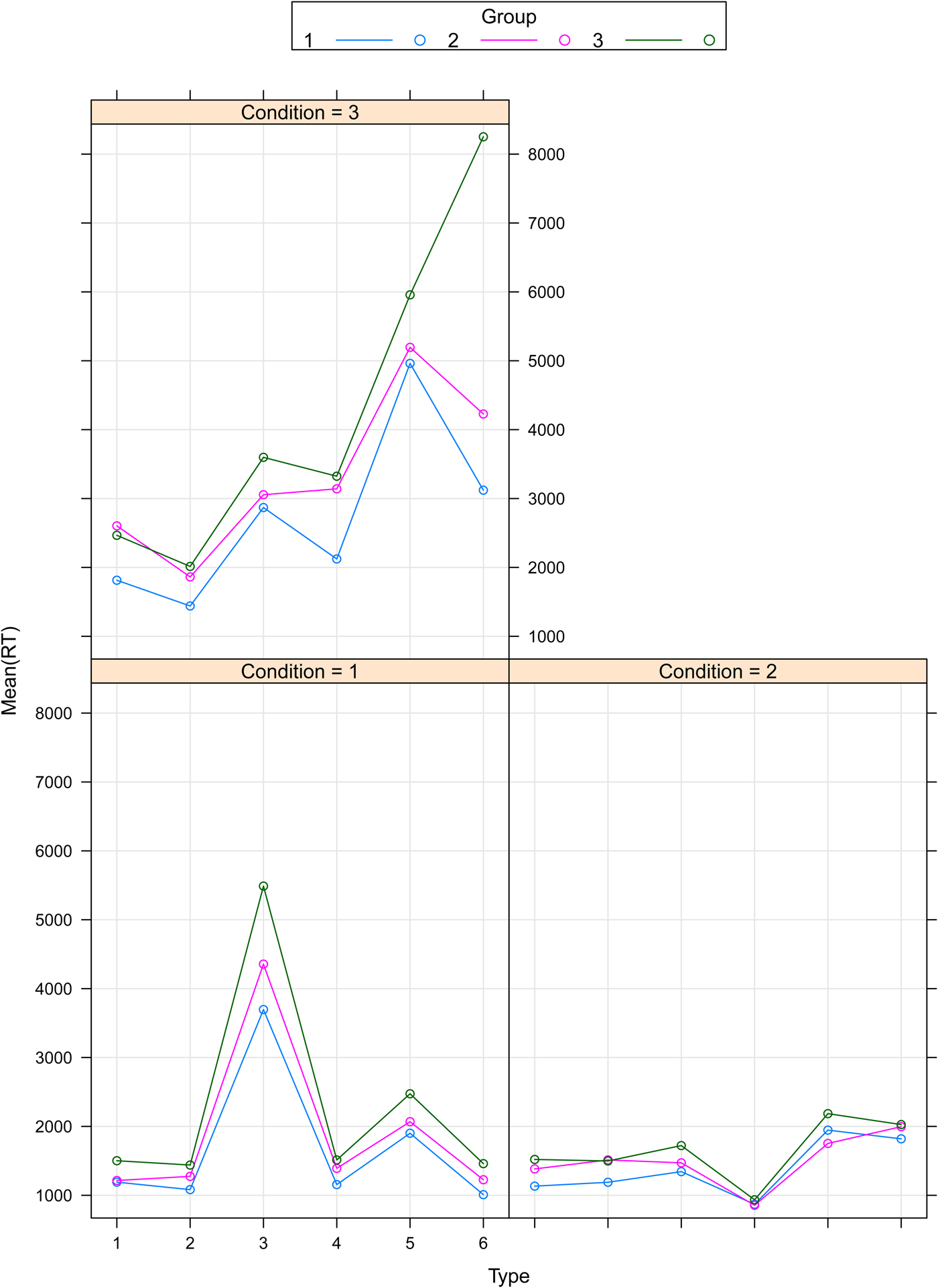
We first conducted a global analysis on RTs with Group as a between-subject factor, Type and Condition as within-subject factors, SES and Age as covariates and by-subject and by-item random intercepts. This analysis showed a significant three-way interaction between Group, Type and Condition (χ 2(20) = 71.01, p < .05). As Figure 3 shows, the interaction was due to bilinguals performing slower than the other two groups in the critical condition of the irony sub-test. This difference is more prominent between bilinguals and bi-dialectals.
Three-way interaction between Group (1 = bi-dialectals, 2 = monolinguals, 3 = bilinguals), Type (Type 1 = relevance implicatures, Type 2 = scalar implicatures, Type 3 = contrastive implicatures, Type 4 = manner implicatures, Type 5 = metaphors, Type 6 = irony) and Condition (Condition 1 = Literal-1, Condition 2 = Literal-2, Condition 3 = Pragmatic) from the linear mixed-effects regression model on reaction times.

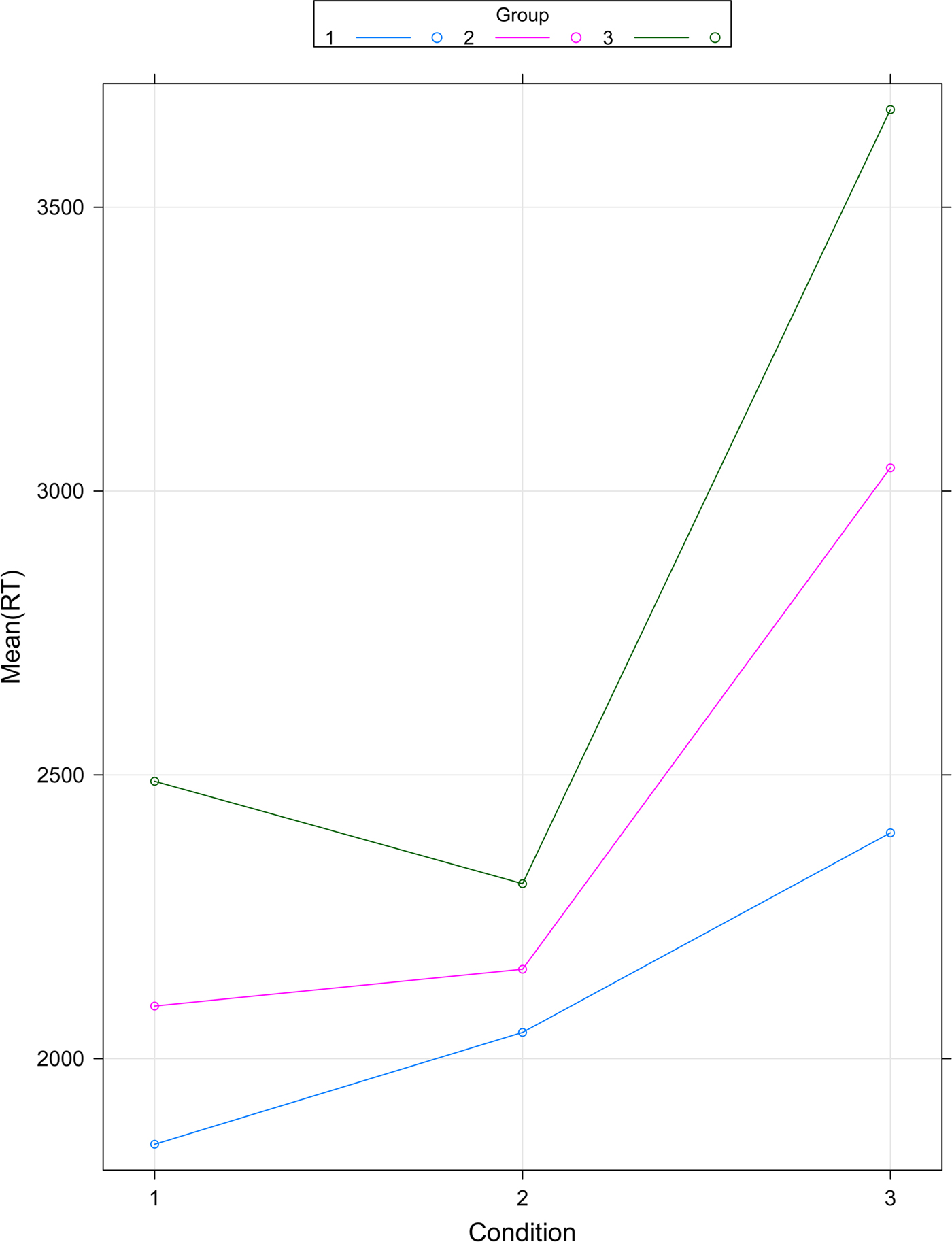
We also conducted an analysis on RTs with the same variables as above but collapsing across Type to benefit from the increased item-level power resulting from averaging RTs from 12 items. This analysis showed a significant Group by Condition interaction (χ 2(4) = 20.27, p < .05). As Figure 4 shows, the interaction is driven by differences between bi-dialectals and the other two groups (in that bi-dialectals were faster) in the Literal-1 and Pragmatic conditions. Again, these differences were more prominent between bi-dialectal and bilingual children. Subsequent between-group analyses for each condition showed a significant Group effect only for the Literal-1 condition (χ 2(2) = 6.74, p < .05) in that bi-dialectals were faster than bilinguals (estimate = 626, SE = 254, z = 2.46, p < .05). The above analyses were repeated with vocabulary as an additional covariate and revealed largely the same results.
Two-way interaction between Group (1 = bi-dialectals, 2 = monolinguals, 3 = bilinguals), and Condition (Condition 1 = Literal-1, Condition 2 = Literal-2, Condition 3 = Pragmatic) from the linear mixed-effects regression model on reaction times (with the factor Type excluded).

Finally, to further explore the significant three-way interaction between Group, Type and Condition reported above, we performed analyses on RTs in each pragmatic sub-test separately. These analyses showed the following significant results. For relevance, there was a significant Group effect in the analysis with Vocabulary covaried (χ 2(2) = 7.60, p < .05) in that bi-dialectals were overall faster (i.e., across conditions, not only in the pragmatic one) than monolinguals (estimate = 524.7, SE = 195, z = 2.68, p < .05). Similarly, for SIs, there was a significant Group effect (χ 2(2) = 6.77, p < .05, for the analysis without vocabulary covaried) due to bi-dialectals responding overall faster (i.e., across conditions, not only in the pragmatic one) than monolinguals (estimate = 296.5, SE = 116, z = 2.547, p < .05). Finally, the analysis on irony revealed a significant interaction beween Group and Condition (χ 2(4) = 27.46, p< .05, without vocabulary covaried). Subsequent analyses indicated that there was a significant Group effect only in the ironic condition (χ 2(2) = 6.11, p< .05) in that bi-dialectals responded faster than bilinguals (estimate = 7818, SE = 3291, z = 2.376, p < .05). For scalars and irony, the results above were the same when vocabulary was covaried in the analyses.
Correlations between pragmatic performance and aspects of bilinguals’/bi-dialectals’ language experience
We initially looked at the bivariate correlations between bilinguals’/bi-dialectals’ pragmatic performance and amount of exposure to Dutch (language of testing), second language or dialect and degree of balanced bilingualism or bi-dialectalism (see Supplementary Material, for how these were quantified). There was only a significant negative correlation between RTs for scalar implicature responses and exposure to second dialect (Spearman's rho(36)=−.33, p(two-tailed) < .05), suggesting faster performance for bi-dialectals with more exposure to a second dialect.
Moreover, we further explored whether those bilingual/bi-dialectal children who had more exposure to Dutch (language of testing) might exhibit better pragmatic performance. To do this, we divided the bilingual and bi-dialectal groups into sub-groups based on their exposure to Dutch (West Flemish-dominant bi-dialectals, Dutch-dominant bi-dialectals, unbalanced bilinguals, balanced bilinguals; see Appendix SB in the online Supplementary Material for how this was achieved).
Preliminary analyses showed that the five groups did not differ in age (F(4, 131) = 2.36, p = .057). However, there were significant group differences in SES (F(4, 131) = 43.62, p < .05) in that West-Flemish dominant and Dutch-dominant bi-dialectals had a lower SES than the other groups (ps < .05) and did not differ from each other (p > .05); and that unbalanced bilinguals had a higher SES than monolinguals (p < .05). Moreover, there was a significant Group effect on vocabulary (F(4, 129) = 5.18, p < .05) in that only the bilingual groups with the least exposure to Dutch (West Flemish-dominant bi-dialectals and unbalanced bilinguals) had lower vocabularies than monolinguals (ps < .05). The results on vocabulary are in line with accounts which suggest that bilinguals’ vocabulary gap in a given language might close with sufficient exposure to that language (Thordardottir, Reference Thordardottir2011).
The following significant results were observed in the analyses on pragmatic performance (see online Supplementary Material, Table S1, for descriptive statistics). For accuracy, there was a significant Group by Type interaction (χ 2(16) = 27.4, p < .05, with vocabulary included as a covariate or not). Subsequent analyses on each type of pragmatic meaning showed a significant Group effect only for metaphors (with vocabulary included: χ 2(4) = 9.93, p < .05; without vocabulary included: χ 2(4) = 10.18, p < .05). Pairwise contrasts, however, revealed no significant differences between the five groups (all ps > .05).
For RTs, the Group by Type by Condition interaction in the global analysis on RTs was significant (without vocabulary covaried or not: χ 2(40) = 85.33, p < .05). To further explore the interaction, we conducted analyses for each sub-test separately. There was a significant Group by Condition interaction in the analysis for irony (with vocabulary included (χ 2(8) = 33.62, p < .05) or not (χ 2(8) = 33.54, p < .05)). Subsequent analyses, however, for each condition separately (Pragmatic, Literal-1, Literal-2) indicated no significant group effects (all ps > .05). Moreover, there was a significant Group effect in the analysis for SIs (whether vocabulary was covaried (χ 2(4) = 9.86, p < .05) or not (χ 2(4) = 13.6, p < .05)), even though, again, post-hoc contrasts showed no significant group differences (all ps > .05).
Finally, the Group by Condition interaction in the global analysis on RTs without the Type factor, was also significant (χ 2(8) = 30.22, p < .05 whether vocabulary was covaried or not). Subsequent group comparisons, however, for each condition separately showed no significant results (with vocabulary covaried or not).
4. Discussion
In this study, we tested the hypothesis of a bilingual and/or bi-dialectal advantage in children's understanding and processing of pragmatic meanings.
4.1 Bilingualism, bi-dialectalism, pragmatic interpretation and processing
Children were tested on a wide range of pragmatic meanings and exhibited variability in pragmatic performance at various levels. Pragmatic responses to critical items in all sub-tests (besides contrastive implicatures) were significantly slower than literal responses to control items. In addition, overall pragmatic performance positively correlated with working memory. Crucially, these two findings are also consistent with past research on pragmatic interpretation in adults suggesting that our task was successful in tapping into pragmatic processing.Footnote 7 Moreover, there was significant variability in the difficulty level of the pragmatic meanings tested. With regards to accuracy, children exhibited ceiling performance with relevance implicatures, very high performance for manner, moderate performance with scalar and constrastive implicatures, and were least accurate with novel metaphors and irony (see Figure 1). Novel metaphors and irony were also the most demanding at the processing level, in that, for these pragmatic meanings, pragmatic responses to critical items were significantly slower than both correct literal responses to control trials and incorrect literal responses to critical trials.
However, despite this variation in pragmatic performance, there was no evidence for a bilingual or bi-dialectal pragmatic advantage over monolinguals. Thus, we consider these results as strong evidence indicating that bilingual and bi-dialectal children do not differ from monolinguals in pragmatic understanding. This holds for various types of pragmatic meanings (including late-developing types, like irony) and is true at both the interpretation and processing level. It is also true despite bilinguals’ and bi-dialectals’ lower vocabulary as measured by formal language tests. Moreover, this holds irrespective of factors such as typological proximity between the language pairs spoken by bilinguals (bilingual and bi-dialectal children performed largely comparably to monolinguals) and language dominance or balance (Dutch-dominant bi-dialectals, Flemish-dominant bi-dialectals, balanced and unbalanced bilinguals also performed largely comparably to monolinguals).
At face value, our results contradict past research that did report superior social-pragmatic skills in bilinguals. How is it possible to explain these contradictory findings? A close examination of the studies that reported superior social-pragmatic skills in bilinguals suggests that the strict majority of them have been conducted with preschool-aged children. As Antoniou and Katsos (Reference Antoniou and Katsos2017) suggest, it is possible that a bilingual pragmatic advantage is found only in the first years of life, a period during which there is possibly more room for plasticity or acceleration of pragmatic development because of bilingualism. Nevertheless, even though bilingual advantages in the preschool years have been found for certain socio-pragmatic skills, such specific benefits are not very likely to extend to pragmatic comprehension. This is because the studies by Syrett et al. (Reference Syrett, Austin, Sanchez, Germak, Lingwall, Perez-Cortes, Arias-Amaya and Baker2016; Reference Syrett, Lingwall, Perez-Cortes, Austin, Sánchez, Baker, Germak and Arias-Amaya2017) investigated SI comprehension in preschool-aged children and did not find differences between bilinguals and monolinguals (but see Siegal et al., Reference Siegal, Matsuo, Pond and Otsu2007).
A second explanation might be the degree to which the pragmatic skill examined depends on language. Pragmatic competence involves a wide range of skills, some of which are non-verbal (e.g., following a pointing gesture) and some of which are verbal to a lesser or greater extent (e.g., implicatures). Given that bilingual children often exhibit lower linguistic performance in each of their languages separately, it is possible that the degree to which a pragmatic skill involves language modulates the emergence of the bilingual pragmatic advantage.
All in all, then, our results, in conjunction with the findings of past research, support the following conclusion. Bilingual preschool-aged children seem to enjoy benefits in various social and pragmatic skills. These advantages, however, do not extend to children's comprehension of verbal-pragmatic inferences and this seems to hold irrespective of age.
As a final note, we should clarify that we do not believe that testing pragmatic comprehension in older children was a wrong methodological decision for our study. Different experiences with two languages, at different developmental stages, and in diverging environmental situations (e.g., sociolinguistic contexts, SES layers) lead to unique bilingual experiences that possibly affect cognitive functioning in different ways. We maintain that it is important to examine the possibility of a cognitive advantage across the range of bilingual experiences and to uncover the conditions under which or the specific skills for which the bilingual benefit might or might not be evident.
4.2 The cognitive foundations of pragmatic development
In this study, we also investigated the effects of language proficiency and executive functions on pragmatic performance. The group results provided evidence against a view of pragmatic comprehension as depending only on structural language skills in the target language: bilingual and bi-dialectal children exhibited lower vocabularies than monolinguals but comparable pragmatic performance. The factorial analyses, however, could not directly answer the question of whether pragmatic understanding depends on executive functions, given that, in this study, we did not find better executive control skills in bilingual and/or bi-dialectal children. The lack of EC differences in our sample suggests either a complete absence of a bilingual EC advantage (e.g., Paap et al., Reference Paap, Johnson and Sawi2015) or that the cognitive benefit in bilinguals is found only under certain conditions. Factors that have been suggested to modulate the emergence of the bilingual cognitive advantage, for instance, include age, patterns of everyday language use, the sociolinguistic context of language use, language proficiency, and type of tasks used (see Dong & Li, Reference Dong and Li2015; Green & Abutalebi, Reference Green and Abutalebi2013).
The findings of the correlational analysis, however, revealed a positive effect of WM. The positive WM effect possibly indicates that pragmatic comprehension involves a process whereby listeners combine different pieces of information (e.g., the speaker's knowledge, literal features, encyclopedic knowledge, pragmatic maxims) in working memory. A related possibility is that the WM effect is linked to Theory of Mind. As already noted, some theoretical accounts suggest that pragmatic comprehension is a mind-reading process that involves understanding the intentions of a speaker behind an utterance, and, hence, requires the use of a ToM (e.g., Sperber & Wilson, Reference Sperber and Wilson1986). In addition, there is some experimental evidence that shows that using ToM to understand language is a slow and costly process that draws on executive functions (including WM; e.g., Apperly, Riggs, Simpson, Chiavarino & Samson, Reference Apperly, Riggs, Simpson, Chiavarino and Samson2006; Lin, Keysar & Epley, Reference Lin, Keysar and Epley2010; Schneider, Lam, Bayliss & Dux, Reference Schneider, Lam, Bayliss and Dux2012). Of course, it is also possible that both WM and ToM have independent effects on pragmatic comprehension. Future studies should more closely examine which exact aspect of pragmatic comprehension makes it dependent on WM and whether pragmatic understanding is independently affected by ToM.
Moreover, we did not find any strong indication that the relation between pragmatics and WM differed in the three groups. Thus, our findings largely suggest that pragmatic interpretation in bilinguals does not draw on executive functions in a different way relative to monolinguals.
Finally, our results showed no significant effect of inhibition on pragmatic performance. Inhibition would be expected to play a role, for instance, within theoretical models that suggest that listeners (always or sometimes) consider a literal (or at least some features associated with a literal) representation of a word or utterance before or in parallel to accessing a pragmatic interpretation (e.g., Giora, Givoni & Fein, Reference Giora, Givoni and Fein2015; Grice, Reference Grice1989; Rubio-Fernandez, Reference Rubio-Fernandez2007). Inhibition skills would then be required to suppress these irrelevant literal features. The finding that inhibition does not affect pragmatic interpretation suggests that these literal features are either not considered at all or at least that they are not actively inhibited during pragmatic comprehension.
4.3 A model of bilingual pragmatic development, representation and processing
What do the above findings, then, mean regarding the development, processing and representation of pragmatics in bilinguals? First, our results indicate that there is a point in pragmatic development during which language proficiency in the target language no longer affects pragmatic interpretation in the same language (even though there is still variability in children's pragmatic performance). This finding provides some (perhaps partial support) to the view that pragmatic competence (at least the pragmatic knowledge that is needed for the comprehension of pragmatic meanings) is to some extent independent of structural language skills (see also Katsos, Roqueta, Estevan & Cummins, Reference Katsos, Roqueta, Estevan and Cummins2011; Levinson, Reference Levinson2016).
Second, pragmatic principles such as Gricean maxims possibly reflect universal properties of communication, whether verbal or not (Grice, Reference Grice1989; Prince, Reference Prince1982; Sperber & Wilson, Reference Sperber and Wilson1986; Stivers, Enfield, Brown, Englert, Hayashi, Heinemann, Hoymann, Rossano, de Ruiter, Yoon & Levinson, Reference Stivers, Enfield, Brown, Englert, Hayashi, Heinemann, Hoymann, Rossano, de Ruiter, Yoon and Levinson2009; see also Antoniou, Reference Antoniou and Taguchiin press; Katsos, Cummins, Ezeizabarrena, Gavarró, Kraljević, Hrzica, Grohmann, Skordi, de López, Sundahl, van Hout, Hollebrandse, Overweg, Faber, van Koert, Smith, Vija, Zupping, Kunnari, Morisseau, Rusieshvili, Yatsushiro, Fengler, Varlokosta, Konstantzou, Farby, Guasti, Vernice, Okabe, Isobe, Crosthwaite, Hong, Balčiūnienė, Nizar, Grech, Gatt, Cheong, Asbjørnsen, von Koss Torkildsen, Haman, Miękisz, Gagarina, Puzanova, Anđelković, Savić, Jošić, Slanćová, Kapalková, Barberán & Özge, Reference Katsos, Cummins, Ezeizabarrena, Gavarró, Kraljević, Hrzica, Grohmann, Skordi, de López, Sundahl, van Hout, Hollebrandse, Overweg, Faber, van Koert, Smith, Vija, Zupping, Kunnari, Morisseau, Rusieshvili, Yatsushiro, Fengler, Varlokosta, Konstantzou, Farby, Guasti, Vernice, Okabe, Isobe, Crosthwaite, Hong, Balčiūnienė, Nizar, Grech, Gatt, Cheong, Asbjørnsen, von Koss Torkildsen, Haman, Miękisz, Gagarina, Puzanova, Anđelković, Savić, Jošić, Slanćová, Kapalková, Barberán and Özge2016; Slabakova, Reference Slabakova2010). This further suggests that bilingual children possibly have equivalent to monolinguals exposure to pragmatic principles across their languages and (verbal or non-verbal) communicative experiences in general.
The independence of pragmatics from language is further supported by additional considerations. Given the claim that pragmatic maxims are universal, it follows that pragmatic principles are possibly represented independently of the bilinguals’ languages, since it would make little sense (at least from a perspective of cognitive efficiency) to represent the same knowledge twice. Moreover, independence of pragmatics from language is predicted by some pragmatic and language acquisition theories. Sperber and Wilson (Reference Sperber and Wilson2002), for instance, propose a pragmatic module (an autonomous system) that is responsible for interpreting communicative stimuli based on the pragmatic principle of relevance. Some theoretical accounts of language acquisition, on the other hand, suggest that language is acquired by using preexisting pragmatic knowledge (e.g., Grice's cooperative principle) to make inferences about the speaker's intentions (e.g., Tomasello, Reference Tomasello2008). Finally, the claim that pragmatics can be separated from language(s) is further supported by the fact that pragmatic knowledge is also employed during non-verbal communication (Sperber & Wilson, Reference Sperber and Wilson1986).
Third, our findings also revealed that pragmatic interpretation draws on working memory but that pragmatic understanding in bilinguals does not seem to depend differently on these non-verbal cognitive resources relative to monolinguals.
It is therefore possible that bilingual children have a single, language-independent pragmatic system that develops and functions in a similar way to monolinguals (see also Antoniou, Reference Antoniou and Taguchiin press; Kecskes, Reference Kecskes2015; Slabakova, Reference Slabakova2010). To the extent that bilinguals have sufficient proficiency in the relevant language to understand and process the explicit meaning of non-literal utterances, this account would predict bilingual skill in pragmatic interpretation that is comparable to monolinguals.
4.4. The role of confounding factors
In our study, there were significant group differences in age, SES and vocabulary. Is it possible that these background differences confounded our results? We find this highly unlikely. First, the three variables were included as covariates in all between-group analyses. Second, none of these variables significantly affected pragmatic performance. Finally, balanced bilinguals in our study did not differ from monolinguals in any of the background variables, had extensive exposure to Dutch (language of testing) and were balanced in their two languages to a higher degree (see online Supplementary Material, Appendix SB). Yet, again, no significant differences were observed between this group and monolinguals.
5. Conclusion
Using a comprehensive test of different types of pragmatic meanings, our study revealed no bilingual or bi-dialectal advantage over monolinguals in pragmatic comprehension or processing. Null differences between bilinguals, bi-dialectals and monolinguals are important findings; especially, when these are reported for pragmatic-communicative skills that draw on language and are evident in the presence of lower language proficiency (as measured by formal tests) for bilinguals and bi-dialectals. These findings suggest that bilingual and bi-dialectal children maintain equivalent to monolinguals’ verbal pragmatic-communicative functioning, despite their often-reported weaker language knowledge in the target language.
Supplementary Material
Supplementary material can be found online at http://doi.org/10.1017/S1366728918001189
Acknowledgements
Research presented in this paper has been made possible by a Fondation Wiener-Anspach (Brussels, Belgium) and Issac Newton Trust (Cambridge, UK) grant “The impact of bilingualism and bi-dialectalism on linguistic and cognitive development” to N. Katsos and M. Kissine. The writing of this article has been also supported by a Marie Skłodowska-Curie fellowship (grant agreement No. 800305) to K. Antoniou. We also thank all our participants and their parents, and the teachers and principals of the following primary schools: Floralaan Eindhoven, ‘t Wilgenhof Vlamertinge, Capucienen Ieper, Groenheuvel Bellegem, De Baai Kortrijk, Sint-Amandscollege Noord Kortrijk, Mater Dei Brussel, and Mooi-Bos Brussel. Special thanks also go to Marlein Rusch and Dalila De Waele, for helping with the data collection.