
Introduction
Some archaeological objects are extraordinary. They are distinguished from other objects by their uniqueness—in their materials, forms or both—and the capacity to convey their distinction to the subjects and other objects with which they are associated. Archaeological research often labels these objects as ‘prestige goods’. This designation, however, tells us more about the ideology of those employing the term than it does about these objects. ‘Prestige’ suggests that the individuals associated with these objects were viewed positively, assuming rather than demonstrating social conformity. Instead, referring to these objects as ‘emblematic’ (Lull Reference Lull2007: 231–32) emphasises their distinctive character, as well as their ability to distinguish diverse political actions, while avoiding positive assumptions about the individuals associated with them. We may recognise an emblematic object as a symbol that materially represents ideas or social values, demanding some form of respect or action, from submission to veneration. These objects do not prejudge the nature of the actions, feelings or beliefs directed towards the emblems or their bearers. Rather, these objects are limited to a communicative function within the political framework of society.
The Early Bronze Age El Argar society flourished between c. 2200 and 1550 cal BC in the south-east of Iberia (Siret & Siret Reference Siret and Siret1887; Lull Reference Lull1983; Lull et al. Reference Lull, Micó, Herrada, Risch, Hansen and Müller2011). This society is characterised by a complex settlement system, featuring urban centres with monumental structures, a developed division of labour, intramural burials with marked asymmetries in funerary expenditure between individuals, political boundaries and institutionalised violence—all in the context of a class-based state society (Lull & Estévez Reference Lull and Estévez1986; Lull & Risch Reference Lull and Risch1995; Lull Reference Lull2000; Risch Reference Risch2002; Chapman Reference Chapman2003; Lull et al. Reference Lull, Micó, Herrada and Risch2005, Reference Lull, Micó, Herrada, Risch, Hansen and Müller2011, Reference Lull, Micó, Herrada and Risch2014a; Contreras Reference Contreras2009/2010; Cámara & Molina Reference Cámara and Molina2011), although this last point is subject to ongoing debate (e.g. Gilman Reference Gilman, Berrocal, Sanjuán and Gilman2013; Ramos Reference Ramos, Berrocal, Sanjuán and Gilman2013; Aranda et al. Reference Aranda, Montón-Subías and Romero2015). A particular question about El Argar society, raised by the exclusive presence of certain objects of social value in female graves, concerns the potentially prominent political role and status of women. This possibility is further supported by the recognition, in the funerary ritual, of adulthood at a younger age for girls compared with boys, and by the interment of some elite warriors of the middle Argar phase (c. 2000–1800 cal BC) in graves where a woman had been previously buried (Lull et al. Reference Lull, Micó, Herrada and Risch2016, Reference Lull, Micó, Rihuete Herrada, Risch, Escanilla, Barceló, Bogdanovic and Morell2017). Recent excavations at Almoloya, municipality of Pliego, Murcia, approximately 90km north of the eponymous site of El Argar, have provided new evidence concerning the organisation of this society (Lull et al. Reference Lull, Micó, Herrada, Risch, Celdrán, Fregeiro, Oliart and Velasco2015). Here, we outline an archaeology of politics through a discussion of one of the most distinctive emblematic objects of the late El Argar phase, its funerary context and its presence in a unique building.
Argaric diadems as embodied emblems
Diadems and crowns made of precious metals are some of the most easily recognised emblematic objects. Unlike flags or heraldry, diadems are designed to be worn by individual people. The object's connection with the human head and face—the most visible and distinctive physical features of any individual—produces a hybrid object-subject entity, comprising a general abstract symbol and a specific physical appearance. That hybrid entity, in turn, becomes a new emblem: an ‘emblematic subject’.
Metal diadems appear in the archaeological record of the Iberian Peninsula during the Late Chalcolithic and the Early Bronze Age (from the mid to late third millennium cal BC). Such objects, however, are very rare and contextual data are poor. The oldest examples were made of long, plain (undecorated) golden sheets with distal perforations for their attachment to the head (Perea Reference Perea1991). These objects are often interpreted as symbols of rank, worn by ‘leaders’ or ‘chiefs’ with military power (Garrido Reference Garrido and Almagro2014). This interpretation stems from their presence in individual—or presumably individual—tombs (e.g. at Fuente Olmedo, Montilla, Quinta da Agua Branca), along with weapons and other distinctive objects linked with the Bell Beaker complex.
When compared with other earlier and contemporaneous examples from Iberia, diadems display distinctive forms and meanings in Argaric society. First, they are made from native silver, with just a single known gold example. There are two varieties: simple headbands and semi-circular rods with a disc-shaped appendix.
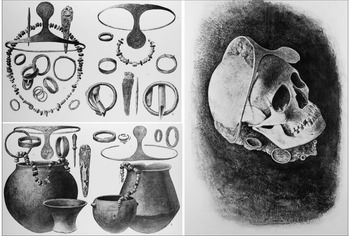
The latter is unique to the Argaric material repertoire. To date, only six such diadems have been reported. Four were found in 1883 and 1884 by the brothers Henri and Louis Siret and their foreman Pedro Flores at the eponymous site of El Argar (Almería) (Figure 1). The diadems were found either in single (El Argar graves 51, 396 & 454) or double (grave 62) burials (pithoi). Where osteological information about the burials is available, diadems were found to be associated with females. This was also the case with the headbands, which were discovered at the sites of Gatas (grave 2), El Oficio (grave 6) and Fuente Álamo (grave 9) (Siret & Siret Reference Siret and Siret1887). Furthermore, diadems were always found in association with a larger variety of grave goods, including necklaces, silver and copper ornaments, knives, awls and pottery. As a result, the Sirets claimed that the women buried with diadems were “souveraines ou femmes de chefs” (“sovereigns or wives of chiefs”; Siret & Siret Reference Siret and Siret1887: 163). The authors sometimes referred to the headbands as ‘couronnes’ (‘crowns’), in reference to a typical emblem of kingship. Almost a century later, statistical analysis carried out by Lull and Estévez (Reference Lull and Estévez1986) provided support for this interpretation by including diadems in the ‘category 1’ of Argaric grave goods—those associated with the ruling class. A fifth diadem came to light around 1923, probably originating from a tomb in Cerro de la Plaza de Armas, in Murcia (Melgares Reference Melgares1983). This diadem differs from the others in that it is made of gold and features a linear embossed pattern of small dots along its entire perimeter, extending onto the disc-shaped appendix.
Silver diadems with disc-shaped appendix and associated grave goods from El Argar (Siret & Siret Reference Siret and Siret1887: pls 43 & 44–45).

Although burial context data are available for the four El Argar site graves, nothing is known about the buildings under which the tombs were located. Analysis of the overall site plan of El Argar and the distances between the tombs provided by Flores (see http://www.man.es/man/coleccion/catalogos-tematicos/siret.html) suggests that all four graves were placed in the central-east sector of the site, probably in two discrete locations separated by at least 15m, with two graves in each area. While these observations are compatible with the existence of an elite quarter, they preclude the possibility of the four graves having been placed beneath a single building.
La Almoloya grave 38
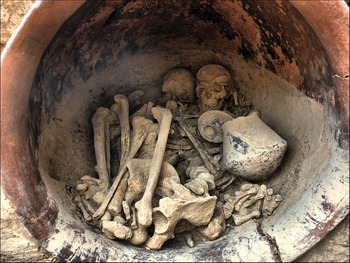
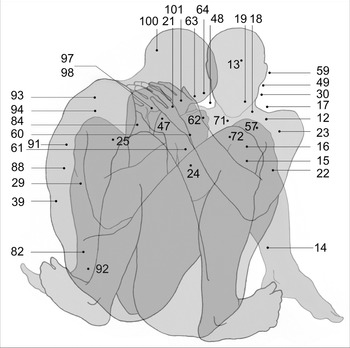
The only fully documented discovery of an Argaric diadem was made by our research team in 2014 within grave 38 at La Almoloya (Figure 2). The tomb comprises a large, ovoid jar buried beneath the floor of a room. The jar contained the remains of a woman and a man, whose estimated ages at death were 25–30 and 35–40 years, respectively, according to pelvic, cranial and other widely used skeletal morphological indicators (Buikstra & Ubelaker Reference Buikstra and Ubelaker1994) (Figure 3). The male was interred first, lying tightly flexed on his left side. The female was positioned on her back, partly overlying the male, but with the lower limbs flexed to the right. Despite some minor bone displacement typical of decomposition in an empty space (affecting, for example, the hand and foot elements), the male skeleton was in full articulation, including the labile regions of the scapular girdle and the ribcage. This suggests that little time had elapsed between the two burials. Indeed, the radiocarbon dates for the two individuals are statistically indistinguishable (Table 1), suggesting that both probably died in the mid seventeenth century BC, at the peak of Argaric development.
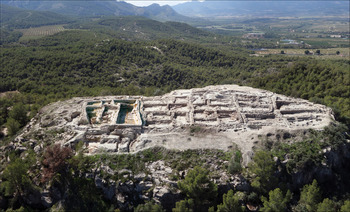
Aerial view of La Almoloya in 2015 (figure courtesy of the Arqueoecologia Social Mediterrània Research Group, Universitat Autònoma de Barcelona).

View of the interior of La Almoloya grave 38 (figure courtesy of the Arqueoecologia Social Mediterrània Research Group, Universitat Autònoma de Barcelona).

Radiocarbon dating of La Almoloya Grave 38 (calibration performed with Calib 8.2 program and the IntCal20 calibration curve; Reimer et al. Reference Reimer2020; Stuiver et al. Reference Stuiver, Reimer and Reimer2021).

Ancient DNA analysis of genome-wide data, in the form of 1.24 million ancestry-informative single nucleotide polymorphisms, reveals that the individuals were biologically unrelated, but had shared offspring. Their kin connection is confirmed by a mutual, first-degree relationship with a female infant buried under a nearby building. The latter discovery confirms that the male and female adults were contemporaneous—a fact that is far from being attested among all Argaric double graves, in which the two buried individuals appear to have lived and died at different times, according to radiocarbon analysis (Lull et al. Reference Lull, Micó, Herrada and Risch2013).
Osteological analysis by the authors reveals a series of congenital anomalies affecting the female individual, including the absence of the twelfth rib, only six cervical vertebrae, a lumbosacral transitional vertebra, a fusion defect of the fourth and fifth sacral vertebrae, partial ossification of the interosseous radioulnar membrane, shortening and marked bending of the left ulna, and abnormal shortening of the left thumb (brachydactyly). There is extensive evidence for active and proliferating periostitis on the dorsal side of the sternal section of the ribs (third to eighth right ribs and second to eleventh left ribs), suggesting that a pleural inflammation, probably associated with a pulmonary infectious process (Matos & Santos Reference Matos and Santos2006), was active at the time of death.
The male exhibits a traumatic injury to the left squamous portion of the frontal bone, which had fully healed long before death. The individual also exhibits activity-related skeletal markers, defined by roughed surfaces of muscle attachment sites, upper limb asymmetry and robusticity, and extensive lower limb remodelling associated with bilateral flexion of the hip and knee joints, abduction of the legs and the need to stabilise the pelvis. All of these indicators point to intensive, long-term physical activity, and are possibly consistent with horse riding (Molleson & Blondiaux Reference Molleson and Blondiaux1994; Capasso et al. Reference Capasso, Kennedy and Wilczak1999).
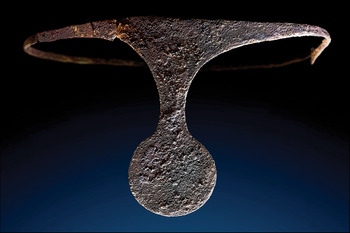
A silver diadem with a disc-shaped appendix pointing downward was found placed on the female's skull (Figure 4). Its position matched that of the diadems found in El Argar graves 62 and 398, and probably also grave 51; only in grave 454 was the disc-shaped appendix arranged pointing upward. Thus, in most cases, the disc-shaped appendix would lie on the forehead or just over the bridge or tip of the nose.
Silver diadem from La Almoloya grave 38 (figure by J.A. Soldevilla, courtesy of the Arqueoecologia Social Mediterrània Research Group, Universitat Autònoma de Barcelona).

The morphological similarities between the five silver disc diadems from El Argar and La Almoloya are astonishing. Despite deformation or loss of material, the dimensions of the disc, the width of the stem between the disc and the belt, and the maximum height of the object are remarkably uniform (Table 2). The coefficients of variation between the width and height of the disc (4.5 per cent) and between the disc width and the maximum height of the object (6.5 per cent) are both very low. This homogeneity is consistent with manufacture in a specialist silversmith workshop, such as the one identified in the central building of the slightly earlier, fortified site of Tira del Lienzo (Delgado-Raack et al. Reference Delgado-Raack, Lull, Martin, Micó, Rihuete and Risch2016).
Dimensions (mm) of El Argar (AR) and La Almoloya (AY) silver diadems with disc-shaped appendix; absolute measurements of El Argar diadems are based on the drawings by Siret and Siret (Reference Siret and Siret1887).

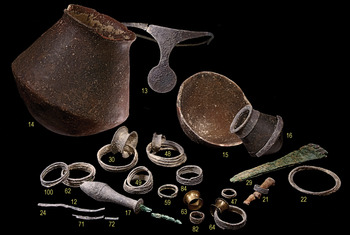
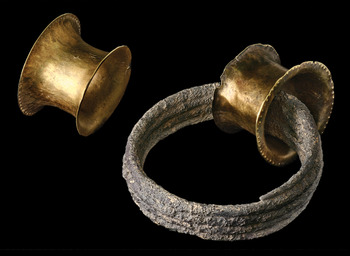
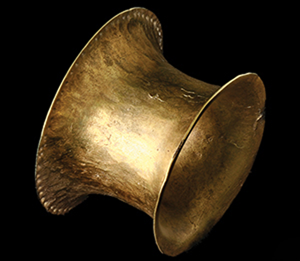
The silver diadem stands out among the numerous grave goods found in grave 38 (see Table S1 in the online supplementary material (OSM); Figures 5–6), many of which are also made from precious metals, such as the four earlobe tunnel-plugs. Two of these plugs were made of silver and were placed on each side of the woman's skull. The plug found on the left side is unusually large, and features a large silver spiral passing through it (Figure 5.30; Table S1: 30). The right earplug is slightly smaller, and also features a silver spiral (Table S1: 48). The other two earplugs are even smaller, and are made of gold (Table S1: 63–64; Figure 7). Both are decorated with embossed small dots around their flaring ends, and a silver spiral was strung through one of the two earplugs (Table S1: 62).
A selection of grave goods from La Almoloya grave 38 (figure by J.A. Soldevilla, courtesy of the Arqueoecologia Social Mediterrània Research Group, Universitat Autònoma de Barcelona).

Schematic drawing showing the location of grave goods in relation to the bodies in La Almoloya 38: 13) diadem; 19, 57, 18, 12, 23, 24, 71, 72) layered necklace beads and spacers; 14) carinated vessel; 15) bowl; 16) carinated vessel with silver coating; 17) awl; 21 and 82) rings; 22 and 60) bracelets; 25, 39, 88, 91, 92) meat-offering bones; 29) dagger; 30, 48, 64) ear plug and spiral sets; 47, 49, 59, 62, 84, 100) spirals; 61) textile; 63) isolated ear plug; 93, 94, 97, 98, 101) simple necklace beads (figure by A. Celdrán Beltrán).

Golden earlobe tunnel-plugs from La Almoloya grave 38 (left: 63; right: 64) (figure by J.A. Soldevilla, courtesy of the Arqueoecologia Social Mediterrània Research Group, Universitat Autònoma de Barcelona).

Earplugs, whether made of gold or silver, are rare in Argaric assemblages. A few examples come from rich tombs, such as El Argar grave 454, which also yielded a diadem. These tombs were almost certainly related to the ruling class. As with diadems, the transformation of an individual's physical appearance afforded by earplugs must have been truly striking. A few similar earplugs have also been recorded outside the Argaric territory (Pingel Reference Pingel1992; Cabezas Reference Cabezas2015; Daura et al. Reference Daura2017). A further set of six, silver, spiral objects was also found in grave 38. Their size and location suggest that they were used as hair ties or as parts of a headdress. Three may have fastened the male's braids (Table S1: 47, 84 & 100), echoing the hairstyle recorded in Castellón Alto grave 121 (Molina et al. Reference Molina, Rodríguez-Ariza, Jiménez and Botella2003). The other three (Table S1: 49.1, 49.2 & 59) are more clearly related to the woman's headdress, as they were found between the left side of her skull and the wall of the urn.
Also found in grave 38 were three bracelets, two of them—both made of silver (Table S1: 22.1 & 22.2)—in situ around the female's left distal humerus, while the third, a copper-based bracelet (Table S1: 60), was found on the male's right wrist. In the latter case, corrosion preserved a small linen braid and a cloth fragment that might have formed part of another arm ornament and a sleeve, respectively (Table S1: 61). Two silver rings of almost identical size were also found, one still in place around the fourth finger of the female's left hand (Table S1: 21), the other next to the male's second lumbar vertebra (Table S1: 82).
Forty-six beads from two different necklaces were recovered from the burial. The necklace associated with the male comprised seven large beads of different colours. The necklace associated with the female had a minimum of 39 beads, and was probably layered, as the four silver, perforated plate fragments found close by may have acted as spacer clasps (Table S1: 12, 24 & 71–72). Although these elements are rare in the Argaric archaeological record, two comparable examples—made of bone or ivory—were found in La Bastida grave 37, a tomb typical of the Argaric elite and one of the few to have also yielded a silver ear plug (Posac et al. Reference Posac, Sopranis, del Val, Santa-Olalla, Sáez, Posac, Sopranis and del Val1947: 89; Carrasco et al. Reference Carrasco, Pachón and Gámiz2009: 15).
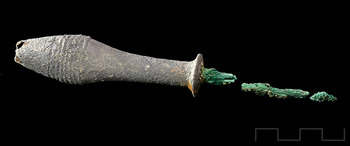
Metal daggers and awls are typical grave goods of the intermediate and top classes of El Argar society (Lull & Estévez Reference Lull and Estévez1986). In La Almoloya grave 38, however, they are far from common objects (Figure 8). The awl from grave 38 was fitted in an 87mm-long oak-wood haft that was completely covered with three silver plates joined together into a single piece. The handle has an ergonomic shape that is similar to other well-preserved examples made of wood, such as that from El Argar grave 398 (also associated with a diadem). The awl of La Almoloya, however, stands out as a remarkable example of silversmithing. Comparable examples have been found in Argaric territory or its periphery (Los Villares de Andújar: Carrasco et al. Reference Carrasco, Pachón and Unguetti1979; Alquife: Arribas Reference Arribas1966; plus two items of unknown provenance curated by the Fundació Privada Catalana per a l'Arqueologia Ibèrica). The funerary goods associated with the female buried at Gatas 2 also include an awl with a silver-coated haft (Lull et al. Reference Lull, Micó, Rihuete Herrada, Risch, Meller, Risch and Pernicka2014b: 567). As the silver coating provides no functional advantages, these awls probably communicated social distinction beyond their association with textile production.
Copper awl with a handle coated in silver (17) from La Almoloya grave 38; scale in centimetres (figure by J.A. Soldevilla, courtesy of the Arqueoecologia Social Mediterrània Research Group, Universitat Autònoma de Barcelona).

The same combination of mechanical and communicative functions can be identified in the copper dagger with four silver rivets from La Almoloya grave 38 (Table S1: 29). The use of silver rivets for hafting daggers, halberds and swords is a distinctive feature of Argaric metallurgy. Some 24 weapons with silver rivets have been recorded across Argaric territory and another four in its periphery; in contrast, only eight examples are known from the rest of Iberia and south-western France (Brandherm Reference Brandherm2003; Valério et al. Reference Valério, Monge Soares, Araújo, Silva, Porfírio and Serra2014; Moreno & Contreras Reference Moreno and Contreras2015). Farther afield, contemporaneous weapons with rivets of precious metal are found only in the Balkans, Eastern Mediterranean, Mesopotamia and Egypt (e.g. Kilian-Dirlmeier Reference Kilian-Dirlmeier1997; Petschel Reference Petschel2011; Alexandrov & Hristov Reference Alexandrov and Hristov2018).
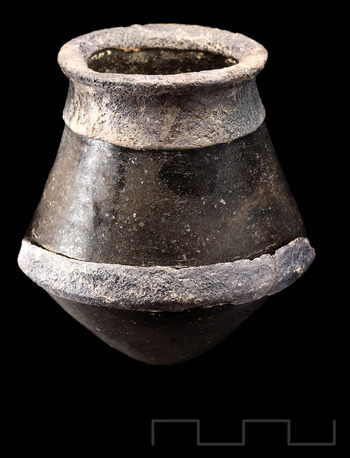
Following the above trend of visually emphasising certain objects using precious metal, silver sheets were applied to the full circumference of the rim and along the entire carinated body of the smallest of the three pots found in grave 38 (Table S1: 16; Figure 9). As with the awl, the silversmithing evident here demonstrates great skill, with few contemporaneous parallels; the closest comparable example was found in the previously mentioned cist grave at Los Villares in Andújar (Carrasco et al. Reference Carrasco, Pachón and Unguetti1979). While vessels made entirely of precious metals are known from other parts of Bronze Age Europe (Needham et al. Reference Needham, Parfitt and Varndell2006), the enhancement of fine pottery with silver sheet is unique to El Argar elite graves. Two portions of the left forelimb of a bovine older than four years at death, also place grave 38 among the most distinguished burials of El Argar (Aranda & Montón Reference Aranda, Montón, Aranda, Montón and Romero2011; Lull et al. Reference Lull, Micó, Rihuete Herrada, Risch, Escanilla, Barceló, Bogdanovic and Morell2017). Portions of limbs from domestic herbivores are common funerary offerings, but those from cattle were usually reserved for elite individuals (Liesau & Schubart Reference Liesau, Schubart, Pozo, Kunter, Medina, Liesau, Casas, Schubart, Pingel, Tresserras and Hägg2004; Aranda & Montón Reference Aranda, Montón, Aranda, Montón and Romero2011).
Small, carinated vessel with silver coatings (16/37, 38) from La Almoloya grave 38; scale in centimetres (figure by J.A. Soldevilla, courtesy of the Arqueoecologia Social Mediterrània Research Group, Universitat Autònoma de Barcelona).

Finally, X-ray fluorescence spectroscopy (XRF) and scanning electron microscopy with energy dispersive spectroscopy (SEM-EDS) analyses have identified traces of cinnabar on several areas of the male's skull and on one of the female's teeth. Cinnabar found on Argaric skeletal remains has been attributed to its use in either dyed garments or corpse wrappings, such as headbands or cloaks, or as a direct skin treatment, such as make-up or body paint (López Padilla et al. Reference López Padilla, de Miguel, Arnay, Galindo, Roldán and Murcia2012). Notably, the cinnabar detected in La Almoloya grave 38 was invisible to the naked eye. This raises the possibility that cinnabar was used more frequently in Argaric society than has been reported in the literature.
In summary, most of the 29 items from grave 38—and most significantly, all those made of silver—were associated with the female individual. The copper-based bracelet, the large stone and amber beads, and in all likelihood, the two golden earlobe plugs with silver spirals and the three hair ties, were associated with the male. The metallic items from grave 38 stand out in both qualitative and quantitative terms. The total weight of silver is approximately 230g. By the time of the Babylonian ruler of Hammurabi in the first half of the eighteenth century BC (contemporaneous with El Argar), one silver shekel (8.33g) was worth 150–180 litres of barley, while daily wages for a labourer were equivalent to 0.23–0.26g of silver (Powell Reference Powell1990). Hence, for comparative purposes, the silver deposited in grave 38 would amount to approximately 27.5 shekels, with which it would have been possible to pay around 938 daily wages or buy 4500 litres of barley (approximately 3350kg). Notably, the mean weight of the three medium-sized silver spirals worn by both individuals (49.1, 49.2 & 100) is 8.44±0.87g. This matches the weight of the Mesopotamian shekel, which was also used or adapted by other Near Eastern and Aegean economies (Rahmstorf & Stratford Reference Rahmstorf and Stratford2019). Furthermore, the weights of other silver spirals found in grave 38 are approximately ⅙, ½, 1½, 2 and 3 times that figure. Further research is required, however, to ascertain whether this is a random distribution or, rather, the hint of a standardised system of weights and measures mirroring contemporaneous Eastern examples (see also Lull et al. Reference Lull, Micó, Rihuete Herrada, Risch, Meller, Risch and Pernicka2014b).
Spaces of power
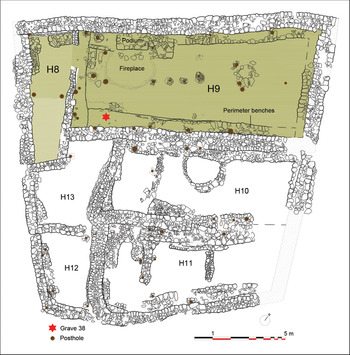
La Almoloya grave 38 is one of the most lavish burials of the European Early Bronze Age. Nevertheless, the uniqueness and, at the same time, distinctiveness of this tomb lies not only in its contents, but also in the building within which it was placed. The tomb was found in the south-western corner of a large and partially subterranean room. The room had a slightly trapezoidal plan extending over 130m2 and with two functional spaces of 70m2 (H9) and approximately 13m2 (H8), respectively, with their floors set at different levels (Figure 10). The room of which H8 and H9 formed part was located within ‘housing complex 1’ (Figure 10). This 266m2 compound is located in the southern sector of La Almoloya and seems, at least in part, to have supported a second storey. Although the findings are still under study, evidence for large-scale grain storage and grinding, as well as other production and consumption activities, has been documented. The upstairs space above H8–9 and H10 housed a minimum of 24 grinding tools, a large quantity of ceramic vessels of different types, as well as hammer stones, abraders and unworked volcanic blocks for the production of further grinding tools. H10 and H11 also featured a range of forging and sharpening metal tools, stone axeheads, tools for textile production, and stone artefacts used in the processing of beeswax and honey (Ache et al. Reference Ache, Delgado-Raack, Molina, Risch and Rossell-Melé2017). The number and variety of production processes attested significantly exceeds what might usually be expected in Bronze Age domestic contexts.
General layout of ‘housing complex 1’ at La Almoloya, with rooms H8 and H9 highlighted (figure courtesy of the Arqueoecologia Social Mediterrània Research Group, Universitat Autònoma de Barcelona).

The stone walls of room H9 were plastered with a clay-and-lime mortar, which was also applied to the floor. A row of seven large posts was set across the room's central axis. These supported the roof, together with another 14 smaller posts that were either adjacent to or embedded in the perimeter walls. A continuous 0.33m-high bench was attached to the base of three of the walls, while on the western wall, this bench was raised to 0.62m in height. The perimeter benches were only interrupted by a stepped structure and by a 0.82m-high podium, at the base of which was a large hearth. The general lack of artefacts on the floor of H9, combined with the structural prominence of the benches, indicate that social gatherings of up to 50 individuals could be held in this large room. We can only speculate as to whether such meetings were intended for discussion and participation in shared decision-making or, rather, for the transmission of orders within a hierarchical chain of command. That the grave offerings of grave 38 far exceed those from any other contemporaneous tomb in La Almoloya, and in many other sites, suggests the second option.
Conventionally, housing complex 1 would fall into the category of ‘palace’, as it combines within a single building residential, economic and political functions on a supra-domestic scale (de Miroschedji Reference de Miroschedji2015). Moreover, H9 could be referred to as a ‘parliament’ and the presence of emblematic objects, such as the diadems at El Argar and La Almoloya, could represent the political unity among the core regions of Argaric territory during the seventeenth century BC. Either way, the building complex was destroyed by fire shortly after the second burial was interred in grave 38.
Conclusions
Bespoke emblematic objects produce emblematic subjects. As we will never know if these subjects were loved or hated by the rest of society, terms such as ‘prestige’ seem inappropriate when referring to the objects that they wore. Such emblems, however, are useful for questioning the communicative vs executive role of the subjects with whom they were associated; that is, in approaching such objects, we tackle the problem of discovering how past political relations and governments were organised.
The funerary goods in grave 38 and, by extension, the opulent female grave goods (including diadems) associated with other female burials, pose more than one dilemma. On one hand, they highlight the role of emblematic objects within the panoply of items that distinguished the elite burials of certain regions of Europe (e.g. Bretagne, Wessex, Unetice) and the Eastern Mediterranean during the seventeenth century BC. On the other hand, they raise the question of whether a class-based state society could be ruled by women. Was El Argar an exception to the line of thought that, since Engels (Reference Engels1884), links patriarchy and state power? Or could it have been that some women were instituted as communicative emblems of executive power, despite lacking actual power? In Argaric society, at the time that elite women were buried with diadems, elite men were preferentially buried with a sword and a dagger. These men were buried with fewer personal ornaments than females of the same class, and in no case did these male-associated objects have an emblematic character. As such weapons were the most effective means of enforcing political decisions, certain men would have played an executive role, even though ideological legitimation as well as—perhaps—the government, lay in certain female hands. The La Almoloya discoveries have revealed unexpected political dimensions of the highly stratified El Argar society, showing features that are unique in the contemporaneous Western Mediterranean and continental Europe.
Acknowledgements
The topics raised in this article were developed within the framework of the projects listed in the funding statement. We thank Ana Martínez García-Mauriño for the English draft of the text. Special thanks also go to Alejandro Cayuela, Fernando Martínez, Jacinto Martínez and Francisco Romera for their valuable assistance in fieldwork.
Funding statement
Excavations at La Almoloya were carried out thanks to the sponsorship from Grupo Fuertes. Further research has benefitted from the financial support of the following projects, programmes and institutions: ‘Genealogies and Networks in El Argar’ (Spanish Ministry of Economy, Industry and Competitiveness; HAR2017-85962-P); ‘La Almoloya (Pliego-Mula): Interdisciplinary Programme of Scientific Analysis’ (Ministry of Tourism and Culture of the Region of Murcia; ARQ129/2018); the ‘ASOME-Arqueoecologia Social Mediterrània Research Group’ (Ministry of Business and Knowledge, Catalan Government; 2017SGR1044); the ICREA Academia programme (Catalan Government); the Fundación PALARQ; and the City Council of Pliego (Murcia).
Supplementary material
To view supplementary material for this article, please visit https://doi.org/10.15184/aqy.2021.8