Since the onset of mass democracy, parties have been dominant to the extent that when we speak of parliamentary democracy, we are really talking about party democracy. Threats to this omnipotence have appeared in recent years, however, in the form of independent victories in a few systems, examples occurring at the gubernatorial and senatorial level in the US, the mayoral level in the UK and the parliamentary level in Australia and Ireland. Given the dominance of parties and the various inbuilt advantages in political systems that favour party cartels, how does this happen? What explains the presence of independents in some systems, when they are generally redundant, if not extinct, elsewhere? This is the central question posed in this article, and in order to answer it, it examines the case of Ireland, the leading case of an independent presence in Western democracies.
There has been relatively little work on independents, in part because in most democracies they have had a minimal impact, but also because independents’ presence outside the political establishment makes it difficult to gather information about them. Both this lack of research and the mild resurgence of independents, and certainly independent-minded politicians, makes this article all the more relevant. Understanding the independent phenomenon and the challenge it poses to parties is important because we are told that without parties political life would be ‘unthinkable’ (Schattschneider Reference Schattschneider1942: 1) and ‘unworkable’ (Aldrich Reference Aldrich1995: 3). In addition, it is claimed that independents are an atavistic form of representation, that they can promote legislative gridlock, reduce accountability and generally lower interest in politics (Moser Reference Moser1999; Reilly Reference Reilly2002; Sherrill Reference Sherrill1998; Wright and Schaffner Reference Wright and Schaffner2002). Those who counter such opinion argue that independents can stand for a form of accountable and transparent politics that parties are unable to provide (Berry Reference Berry2008; Costar Reference Costar2008; Costar and Curtin Reference Costar and Curtin2004). These mixed opinions make it imperative that we understand the source of an independent presence. Is it party failure, a disaffected electorate or a deeper malaise in the political system?
To answer this question, this article first considers the comparative evidence about independents from the limited number of states where they are present, using it to construct a number of hypotheses concerning the relationship between independents and their environment. Although some of this material is not wholly original, the manner in which it is brought together to work towards a theory on the presence of independents is a new development. The case for analysis is the Irish political system, an ideal starting point for a study of independents because it has consistently had the strongest presence of independents, more than any other industrial democracy. In addition, the significant level of intra-country variation in support for independents in Ireland – in most democracies it varies from non-existent to negligible – makes the case study approach preferable. The structure of this article is as follows. It begins with an examination of the cultural, behavioural and institutional factors that affect independents in order to construct a number of hypotheses. These are then tested using an original data set comprising three decades' worth of constituency-level material from Ireland.
Independents – a Background
Before the advent of political parties, independents were the de facto form of representation, although the meaning of independence varied with time and context. In Britain, for example, it originally meant someone independent of the monarch and the great families, or someone ‘not in the pocket of government’ (King-Hall Reference King-Hall1951: 101). Seeming to vote on the basis of personal conviction rather than party label, independents were therefore considered the most virtuous type of parliamentarian (Robson Reference Robson1967). The onset of party democracy, however, meant that the esteem with which independents were held took a severe nosedive as a result; they were seen as irresponsible fence-sitters, the equivalent of ‘the neutrals’ in Dante’s Inferno, hated because they refused to take sides in the battle between Lucifer and God (Alighieri Reference Alighieri1996). Today, ‘independent’ typically refers to someone who is neither a member of, nor affiliated with, a political party. Although there may be varying degrees in the independence of some MPs from their parties,Footnote 1 the working definition used here is someone running for office on their own and who does not take a party whip; that is, they are independent of a party machine.
In 2013 there were 32 elected independents in the national parliaments of the 36 leading industrial democracies.Footnote 2 These independents were limited to just seven countries but, strikingly, almost half of them sit in the relatively small Irish parliament. In most cases, a significant presence of independents is to be found only in either very small democracies (where political leaders do not need party structures to mobilize voters) or more authoritarian-type states. Examples of the former include the territories of Nunavut and the Northwest Territories in Canada (with respective populations of 31,000 and 41,000), the five small Pacific island states of Palau, Tuvalu, the Federated States of Micronesia, Marshall Islands and Kiribati, where there are no functioning parties, and of the latter some post-communist polities and Arabian Gulf states. The exception to this rule is Ireland.
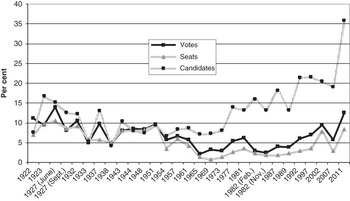
At the Irish general election in 2011, for example, almost 40 per cent of candidates were independents, of whom 15 were elected – to a parliament of 166. As Figure 1 indicates, this performance was not a one-off occurrence. Independents have been ever-present in parliament in the modern Irish state. In total, in the post-war period there have been 114 independent MPs (out of a total of 2,972; that is, 4 per cent) elected to the Dáil (lower house of parliament), 59 times the proportion elected in Britain and 32 times that in the US, 10 times in Canada and 5 times the Australian ratio.
Independents as a Proportion of Votes, Seats and Candidates, Irish Dáil Elections 1922–2011

While there have been limited explanations for the success of independents in Ireland, primarily focusing on the importance of ‘local loyalties and personal ties’ (Carty Reference Carty1981: 58), few of these have been systematic analyses. In addition, the comparative angle has not been explored, limiting the generalizability of the claims.
Explanations for the Success and Failure of Independents
The aim of this article is to explain a significant presence of independents. If they are considered such political atavisms, however, why have they persisted in some jurisdictions? The limited comparative literature points to four particular factors – size, political culture, the electoral rules and the party system – which are discussed in the following section and used to construct a number of hypotheses concerning independent strength.
Size
Given a conducive political culture (discussed in the next section), size can matter in three ways: the size of the population, the size of the territory and the size of the parliament. In a jurisdiction with either a small population or small territory, the levels of personal interaction are higher than in larger communities and there is usually a greater premium placed on face-to-face contact (Anckar Reference Anckar2000). Such a culture, combined with a small-sized society, reduces the necessity of parties, which are not needed as heuristic cues to mobilize voters. This in part explains the absence of parties before the nineteenth century, when the limited suffrage meant that candidates had little need for party organization to mobilize support. Instead, it was assumed that the strength of a candidate’s name was enough of a voting cue (Cox Reference Cox1987). Small societies are also likely to be more homogeneous, with fewer social divisions, further reducing the need for political parties (Anckar and Anckar Reference Anckar and Anckar2000). In general, therefore, we might expect independents to be more prevalent the smaller the society (below a particular threshold). Indeed, when we consider small island states, there is some evidence to support this hypothesis. One study of 31 such states indicates that eight of them lack political parties; parties are absent in the three smallest states of Micronesia, Marshall Islands and Tuvalu (Anckar Reference Anckar2000).
The third means by which size can affect independents relates to parliament. In general, the smaller the assembly, the fewer the pay-offs arising from the formation of a party. In small arenas it might be easier and more beneficial for members to form temporary coalitions; this would allow them to reap both the benefits of collective action in parliament and non-partisanship in the electoral arena. Sharman (Reference Sharman2013) cites the size of the Tasmanian Legislative Council (15 members) as a potential factor as to why it has never been controlled by political parties; a similar case could be made for the assemblies of the Nunavut and Northwest Territories in Canada, the non-partisan state legislature of Nebraska and territorial assemblies in the Falkland Islands, Guernsey and the Isle of Man. Similarly, the mean size of the parliaments of the five Pacific island states without parties is 25. While there are many other small assemblies controlled by parties, all those with a dominant presence of independents are small.
Political Culture
While size may be a factor in whether independents are present, it is not the sole criterion, as there are many small political bodies without independents. Accordingly, a second determinant of an independent presence is an appropriate political culture, with such key values being personalism and localism, as well as an apathy, or perhaps antipathy, to parties. Personalism implies that electoral behaviour is motivated by personal knowledge of, and interaction with, candidates; localism implies that it is affinity to the local community and how the candidate deals with its primary issues that matter. In such a culture, party label is less of an asset than in an environment where national issues and policies are to the fore and where parties are seen as the only viable organs of political representation. The importance of localism and personalism to independent success has been identified in Australia (Sharman Reference Sharman2002: 64), England (Copus et al. Reference Copus, Clark, Reynaert and Steyvers2009), Ireland (Weeks Reference Weeks2014), Russia (Gallo Reference Gallo2004) and the Pacific island states (Anckar and Anckar Reference Anckar and Anckar2000). Further, for voters disillusioned with political parties, voting for non-party candidates can be one means of registering their protest. Evidence of this has been found in Australia (Sharman Reference Sharman2002: 64–5) the US (Allen and Brox Reference Allen and Brox2005; Owen and Dennis Reference Owen and Dennis1996) and Ireland (Marsh et al. Reference Marsh, Sinnott, Garry and Kennedy2008; Weeks Reference Weeks2011).
Electoral Rules
The third determinant of an independent presence is the set of institutional rules in place, particularly the electoral system. At the nomination level, these typically comprise deposit and signature requirements, but under party list systems, they can also include compulsory party formation, a death-knell for any prospective independent. Some independents get round this by forming a personalized party group, à la the Brian Harradine Group in Tasmania (Harradine was an independent member of the Australian Senate from 1975 to 2005), while others join a party list, as was the case for the Ordinary People and Independent Personalities group in Slovakia, which ran under the Freedom and Solidarity Party’s list in 2010 before forming its own list in 2012. At the campaign level, regulations concerning expenditure limits, donations, public funding and access to broadcasting rights can all affect independents. More restrictive regimes favour independents as they lessen the ability of well-oiled and well-heeled campaign machines to make a difference – that is, they limit the effectiveness of the extensive resources on which parties can draw.
It is the election level that is perhaps the most decisive. The more proportional the electoral system, and the more it is oriented towards candidates over parties, the better independents are likely to fare (Weeks Reference Weeks2014). In this respect, most of the electoral systems used across industrial democracies are not very favourable to independents. They either do not permit independent candidacies (by requiring them to compete as part of a list, as is the case in the Czech Republic, Iceland, Israel, Italy, Latvia, Norway, Portugal, Slovakia, Sweden and Switzerland) (Brancati Reference Brancati2008), are not ordinal (as in the French two-ballot and British single-member plurality systems) or have high electoral thresholds (as in most plurality systems). Brancati (Reference Brancati2008) found that majority and plurality systems, with their candidate-centred nature and small constituency size, help independents. Rising district magnitude has converse effects on independents, strengthening them in majority and plurality systems, but weakening them in proportional representation. Weeks (Reference Weeks2014) echoes some of these findings, but also stresses the importance of ballot access requirements, and in particular ballot design.
Party System
The final factor to consider relates to the party system and the nature of party competition. In general, the weaker the parties and the consequently weaker premium placed on party affiliation, the greater the incentive to choose an independent status rather than form or join a party (Bolleyer and Weeks Reference Bolleyer and Weeks2009). This is the case in some Pacific island states (Anckar and Anckar Reference Anckar and Anckar2000), in some of the former Soviet republics, and is still particularly the case in Russia (Hale Reference Hale2007). This argument can also be applied to party organization. The more decentralized the party structure and the weaker the organization in terms of its ability to offer loyalty-inducing incentives (in the form of patronage, for example), the more likely we are to see politicians veer between party and independent status.
The importance of social cleavages, such as a church–state or owner–worker divide, in structuring party competition has been well established (Lipset and Rokkan Reference Lipset and Rokkan1967). Parties compete on issues emanating from these cleavages, appealing to particular sides of a social conflict. In a system where the roots of such a conflict run deep and political competition is consequently polarized, loyalty to parties can be quite fixed, making it difficult for anyone outside the political system, such as independents, to gain an electoral foothold. Conversely, a party system not built on deep social cleavages is more fluid and open to the emergence of challengers. Of course, if there is a persistent electoral phenomenon such as independents, it might suggest that their continuance is not simply due to weak social cleavages, but in fact the presence of a cleavage, or at least a social divide, that binds their support in place. It has been shown in the case of Russia, for example, that the success of some independents rests on their ability to exploit a centre–regional conflict by appealing to local interests (Gallo Reference Gallo2004).
These four factors of size, political culture, electoral rules and the party system are the usual factors cited to explain the widespread absence and occasional presence of independents within liberal democracies. However, this does not provide conclusive evidence; to get to the root of an independent presence we examine in the next section the premier case of independent success in a liberal democracy. This is done in two ways: first, by discussing the nature of the relationship between our four variables and independents in Ireland, and second, by then employing a more rigorous methodological test using constituency-level data. Before doing so, the next section examines the role of independents in Irish democracy, a necessary precursor to understanding their significance.
Independents in Ireland
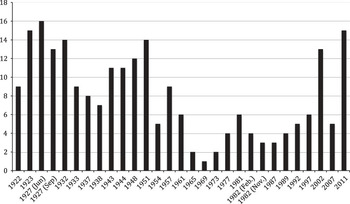
Independents have been a persistent feature of the political landscape in Ireland. Chubb (Reference Chubb1957) claims that the introduction of the single transferable vote (STV) electoral system in the 1920s – with its candidate-oriented nature – initially encouraged independents to run, but this does not explain why they continued to run and why they continued to win seats long after the adoption of the system. Figure 2 details the numbers of seats won by independents per general election in Ireland. For the first three decades of the state, from 1922 to 1951, the mean number of seats won per election was almost 12, a considerable figure given that the mean number of independent candidates was 32.
Numbers of Seats Won by Independents at Dáil Elections, 1922–2011 Source: https://independentforum.wordpress.com.

The presence of independents in parliament declined considerably in the 1950s, up to the nadir election of 1969, when just one was returned. This decline was due to a number of factors, including the retirement of incumbents who had been in political life since the early years of the state, the crossover by a number of independents to the party benches, a reduction in district magnitude in regions where independents traditionally had a presence, and a redesign of the electoral ballot to include party labels.
While a pattern of success for independents in the early decades of a fledgling state and party system and subsequent decline is not unique to Ireland, what is exceptional is the recent revival of independents. Since the late 1970s support for independents has begun to rise again. In part this was the product of an increase in the number of independent candidates, which averaged 26 per election before 1977, but trebled to 76 between 1977 and 2011. It may also reflect declining levels of party identification amongst the electorate. This is explored further in the analysis section.
The type and nature of independents has changed considerably (Weeks Reference Weeks2009). Where once in the 1920s and 1930s they made up a pro-establishment group, many of whom were from a business background and had a national focus, in more recent times independents have tended to be of an anti-establishment nature, with a primarily constituency-driven agenda. In general, independents are very much a heterogeneous residual group, ranging from former government ministers, political prisoners to reclusive mavericks. In addition, it is not always clear what exactly they are independent of – some are aligned to political parties, while others are the designated mouthpieces of interest groups.
By virtue of their numbers, and in a parliament where government majorities are small if not non-existent (40 per cent of governments between 1922 and 2011 were minority administrations), independents in Ireland have a significant political presence, often holding the balance of power in parliament. In these situations, although tending to remain outside cabinet, independents have been the keystone on which government stability has depended. In the 1981–2 period, for example, there were three elections in 18 months, in part because independent TDs (MPs) brought about the downfall of minority governments; on one occasion they contributed to the defeat of the government’s budget. A repeat of this occurrence was threatened in 2009 when independents had to be courted to prevent the defeat of a budget on which a bailout from the European Union and International Monetary Fund depended.
This pivotal position has made independents important political players, able to extract significant policy concessions (Weeks Reference Weeks2009). This has tended to materialize in the form of particularistic-oriented arrangements, where additional funding, primarily for infrastructure, is directed to independents’ home constituencies. One especially significant such arrangement was the eponymous ‘Gregory Deal’ of 1982, when an independent parliamentarian was promised around £250 million worth of projects for his inner-city constituency.
A particularly striking feature of Ireland’s ‘earthquake’ election of 2011 (the third most volatile in post-war Europe; Mair Reference Mair2011: 288) was the performance of independents. As many as 221 ran, more than any political party, and 15 were elected, the largest number since 1927. While in other countries disillusioned voters might have migrated to extreme parties no serious new party emerged in Ireland at the time, despite rumours to the contrary. Support for independents grew as they were seen as a genuine alternative, even overtaking all the parties in opinion polls in 2014. While it might seem that independents’ electoral success was a product of the economic crash, it is difficult to isolate this as the sole explanatory factor. After all, as has been highlighted, independents have had varying degrees of electoral success in Ireland, during both good and bad economic times. As recently as 2002, at the height of the so-called Celtic Tiger economic boom, as many as 13 independents were elected to the Dáil. What is evident from Figures 1 and 2 is that support for independents has been on a steady incline, with the 2007 election the sole blip on this rise. Two factors that possibly explain the high numbers elected in both 2002 and 2011 relate to the fait accompli nature of these elections. In 2002 the re-election of the Fianna Fáil–Progressive Democrat coalition, presiding over a period of unprecedented economic growth, was widely predicted, and in the absence of a credible opposition alternative, voters switched to independents. In 2011, the election of a Fine Gael-led government was a formality given the collapse in support for Fianna Fáil, and in the absence of a credible choice voters again switched to independents. This lack of a choice could also explain the surge in support for independents after 2011. In the absence of a new party, varieties of which had emerged in many European political systems since the onset of the economic crisis, Irish voters saw independents as the main conduit for change. To examine the roots of the independent presence in Ireland further, it is necessary to examine the four factors previously discussed related to size, culture, electoral rules and party system. The next section examines the general evidence.
Analysis: The General Evidence
Beginning with size, although Ireland’s population and territory might classify the country as ‘large’ compared with Pacific island states, it is still considered small from a comparative point of view. Twenty-two of the 36 industrial democracies have a population that exceeds Ireland’s 4.5 million inhabitants; 25 have a larger territory. In the small close-knit Irish communities, political competition is quite candidate-centred (Marsh et al. Reference Marsh, Sinnott, Garry and Kennedy2008), giving independents with an established profile and local reputation a reasonable chance of winning a seat. For example, the average number of first-preference votes for winning candidates at the 2011 Dáil election was 8,338, a figure not beyond the bounds of possibility for a candidate with a considerable local profile, whether party or independent.
The experience of independents in other small states in Europe, however, indicates that smallness is not a sufficient condition for electoral success. Luxembourg, Cyprus, Malta, Latvia, Lithuania, Estonia and Slovenia all have smaller populations and territories but no independents. They are also absent in Israel, Belgium, the Netherlands and Switzerland, all of which have smaller jurisdictions than Ireland.
In addition, although the Irish parliament is small – 158 members, only 10 industrial democracies have a smaller lower house – it far exceeds the size of the Tasmanian Legislative Council or the Pacific assemblies, parliamentary chambers with a dominant independent presence. The Dáil is too large for independents to form a government on their own, even in the unlikely scenario of their winning a majority of seats.
Moving on to political culture, certainly localism and personalism seem present in Ireland. At Irish elections ‘choosing a candidate to look after the needs of the constituency’ has consistently been cited as the primary voting incentive (Marsh et al. Reference Marsh, Sinnott, Garry and Kennedy2008). This is relevant for independents, because when other factors are controlled for, the higher the level of orientation toward the individual candidate and the locality, the higher the likelihood of voting for an independent (Weeks Reference Weeks2011). Evidence from the Eurobarometer and Comparative Study of Electoral Systems (CSES) data sets suggests that the level of anti-party sentiment in Ireland exceeds that in most other countries (Weeks Reference Weeks2011: 33–5). From a level of 37 per cent in 1978, as many as 67 per cent in 2007 said they did not feel close to any political party, second only to the Netherlands. In terms of specific measures of anti-party sentiment, Irish voters also ranked top of the league table of negative attitudes. Data from the Comparative Study of Electoral Systems suggest that anti-party levels in Ireland (49 per cent) are far higher than elsewhere; indeed, they are almost twice that of the second-placed country, Belgium (26 per cent) (Weeks Reference Weeks2011: 35–6).Footnote 3 Of course, anti-party sentiment on its own is not enough to ensure an independent presence; otherwise the trend of rising disaffection from parties in most democracies would have resulted in an independent breakthrough in at least some of these systems. Nevertheless, the significant presence of non-identifiers in Ireland is an important point. It means that independent candidates are fishing in a large, well-stocked pool compared with most other countries.
In terms of institutional factors, the relative ease of ballot access in Ireland increases the possibility of independent emergence. Abedi’s (Reference Abedi2004) study of cartelization in Western democracies deemed only Luxembourg and Denmark less cartelized than Ireland. The Irish electoral system of proportional representation by the single transferable vote is seen as the most favourable for independents (Weeks Reference Weeks2014), primarily for four reasons. The first is the presence of multi-member constituencies, which lowers the electoral threshold. An increasing district magnitude also brings with it a rise in the importance of personal reputation, as candidates focus on their own characteristics to distinguish themselves from a larger pool (Carey and Shugart Reference Carey and Shugart1995: 418). This aids independents who have little other than reputation on which to campaign. The second factor is the preferential nature of the single transferable vote system. This can put independents at an advantage, as their non-partisan nature can attract higher preferences; Brancati (Reference Brancati2008: 656) thus finds higher support levels for independents in preferential vis-à-vis non-preferential voting systems. Preferential systems should also encourage ‘sincere voting’ (Bartholdi and Orlin Reference Bartholdi and Orlin1991), lessening the likelihood that voters will fear ‘wasting’ their vote on an independent. The third reason why the single transferable vote might help independents is its candidate-centred nature, which puts independents at far less of a disadvantage than a party-centred ballot. Indeed, Farrell and McAllister (Reference Farrell and McAllister2006) ranked the Irish system as the most candidate-centred electoral system of 29 democracies. The fourth factor is that the single transferable vote is believed to favour independent-minded behaviour, primarily because of its candidate-centred nature (Hart Reference Hart1992: 97). Indeed, the party-structured aspect of the same system in the Maltese parliament, and especially the Australian Senate, is a key factor why these two chambers, the only other national parliaments elected by the single transferable vote, are almost devoid of independents (since 1945 Malta has had one independent MP and Australia six independent senators).
While party weakness has been linked to independent strength elsewhere (Hale Reference Hale2007), the evidence from Ireland is not so clear cut. Indeed, this is what makes the case of an independent presence there all the more puzzling. Irish parties are strong organizations, tightly disciplined and prone to increasingly centralized power structures (Weeks Reference Weeks2009: 298). Although defections from parties do occur, parties quite often tolerate the existence of such independents because it rids them of volatile and disruptive members (and without losing a vote in parliament since dissident parliamentarians often vote for their party of origin; Hansen Reference Hansen2010: 653–4).
Although the Irish party system is historically not weak – in fact, it was remarkably stable up until the earthquake election of February 2011 – there are no obvious cleavages in Irish society. Whyte (Reference Whyte1974) famously describes it as ‘politics without social bases’. For example, even at the height of the divisions in the early 1920s, when the issue of the recently ended civil war (the progenitor of the party system) was most to the fore, the mean level of support for the non-civil war options at the first three general elections in the new state (1922, 1923, 1927) was 40 per cent. The consequence of this is an open political system that caters for challengers such as independents.
Analysis: The Specific Evidence
The general evidence does not provide conclusive findings concerning the factors that affect independents. To further examine these relationships in a more systematic methodological fashion, this section uses aggregate-level data from Irish general elections. A number of hypotheses are tested to determine the causes of an independent challenge to parties. These are outlined here and are derived from the four key factors that affect independents – size, political culture, electoral rules and the party system.
First of all, to measure an independent presence two dependent variables are considered: the vote for such candidates and their emergence (i.e. the numbers running independent).
The four factors discussed in the previous section touched on a considerable number of variables that affect this presence. Beginning with size, this is measured by the geographic size of the constituency and its electorate. For the reasons already discussed, larger sizes should disadvantage independents:
Hypothesis 1: The smaller the constituency and electorate, the stronger the presence of independents.
Indicators of political culture can be accrued from election studies, but the validity of using individual-level data in an aggregate-level study is questionable, and the data are only available for elections since 2002 in any case. Instead, intra-party transfer solidarity (here the mean of the intra-party rates within Fianna Fáil and Fine Gael, historically the two main parties) is used as a proxy for party attachment, localism and personalism. The higher the transfer rates, presumably the higher the levels of party attachment, whereas lower rates are driven by localistic and personalistic forces that run counter to party loyalism. Thus, higher intra-party solidarity means higher party attachment and lower personalism and localism, which should be associated with lower support for independents.
Hypothesis 2: The higher the level of personalism and localism and the lower the level of party attachment, the stronger the presence of independents.
In terms of an independent vote being a protest vote, from a comparative perspective, protest voters are usually drawn to more extreme parties on the right or left. In Ireland such parties have not been very common; the more ideological anti-establishment parties that have made an electoral impact have generally been confined to the left. Irish voters wanting to make a protest with their ballot have therefore primarily two choices: a left-wing party or an independent. Given the stigma that has been attached to left-wing politics in a country that was up until recent decades dominated by a Catholic, rural way of life, in many cases the only option to cast a protest vote was a vote for independents. It can thus be hypothesized that the independent vote is a protest that voters are more likely to choose in regions where left-wing politics has little support. Where left-wing politics is more pervasive (measured by the mean support for left-wing parties – there being no openly right-wing parties in Ireland) we can expect to see a weaker independent vote due to the additional competition faced by the latter.
Hypothesis 3: The lower the level of support for more ideological parties, the stronger the presence of independents.
Because this is a case study there is little point including a measure of assembly size, ballot requirements or ballot design, all of which are constant across constituencies. What can be used to measure the impact of electoral rules, however, is the effective electoral threshold (Taagepera and Shugart Reference Taagepera and Shugart1989), which is the number of votes that will most likely secure representation. This is formally calculated as 75/(Magnitude+1). Under the single transferable vote in Ireland, the Droop quota for election is (100/(M+1))+1, but in many cases the winner of the last seat does not reach this quota. The hypothesized relationship here is:
Hypothesis 4: The lower the electoral threshold, the stronger the presence of independents.
Three features of the party system are examined. The first relates to its degree of institutionalization. The more institutionalized the party system, the more deep-rooted the cleavages binding it in place, and the less likely independents are to attract support. To measure institutionalization, the proxy used is electoral volatility, replicating the methodology of Lago and Martínez (Reference Lago and Martínez2011) in their analysis of new party emergence. Volatility is measured using the Pedersen index (Reference Pedersen1983), which is half of the sum of parties’ loss or gain in votes. Lower levels of volatility indicate higher levels of party institutionalization, as voters are less likely to switch between parties, which makes it more difficult for independents to make a breakthrough.
Hypothesis 5: The lower the level of party system institutionalization, the stronger the presence of independents.
The second feature is the capacity of the electoral market to cater for demand. Again replicating the methodology of Lago and Martínez (Reference Lago and Martínez2011), it can be hypothesized that the larger the gap in the market, the more likely we are to see support for independents. The market gap is measured by turnout, since it can be surmised that the greater the level of dissatisfaction with the electoral market, the less likely voters are to cast a ballot.
Hypothesis 6: The more open the electoral market, the stronger the presence of independents.
In terms of social cleavages, a continuous presence of independents can indicate something that binds them in place: a social divide, perhaps. Similar to the discussed example from Russia, although it could not be called a conflict, a centre–periphery divide exists in Ireland. This is not geographic; rather, it refers to a socioeconomic gap between the ‘haves’ and the ‘have-nots’. Although this may not be a full-blown cleavage in the essence that it was defined by Lipset and Rokkan (Reference Lipset and Rokkan1967), it is a divide that is very much evident in the rhetoric of voters and politicians from the peripheries. For example, when a new parliament met following the May 1997 election, in his opening speech one independent stated that his county was ‘marginalised more than any other … it has the highest rate of unemployment in the country and the lowest income per head of population. One of the main reasons for this is the neglect of the county by all Governments and State agencies’ (Dáil Parliamentary Debates 1997: vol. 480(1) col. 48). Another said that his constituency has ‘some of the most disadvantaged communities, socially and economically, anywhere in the country’ (Dáil Debates 1997: vol. 480(1) col. 36). As is evident from these examples, independents appeal to those on the peripheries who feel neglected by the political parties and are frustrated at their disadvantaged status. It can therefore be hypothesized that the larger the centre–periphery divide, the greater the support for independents. A number of measures could be utilized for this divide, such as government spending per constituency, but these data are not readily available, and even if they were, evidence of it may not be clearly observable to voters. More tangible and obvious measures include the unemployment rate, the numbers attending third-level education and the socioeconomic occupational class divisions.Footnote 4
Hypothesis 7: The greater the centre–periphery divide, the stronger the presence of independents.
To test these seven hypotheses, data are drawn from the constituency level at 10 national parliamentary elections in Ireland between 1981 and 2011. With just over 40 constituencies per election, this produces 415 cases for analysis. The electoral data are drawn from official publications of electoral statistics and from Took and Donnelly’s website, http://electionsireland.org. The economic data were sourced from annual reports of the Irish Central Statistics Office (www.cso.ie). The variables for analysis are: territorial size of constituencies, size of electorate, effective threshold, intra-party solidarity, left-wing party support, electoral volatility, turnout, unemployment rate, proportion with a third-level qualification and proportions of ABC (employers, higher and lower professionals) and D (semi- and unskilled) workers. A strong independent vote may reflect an established independent presence, so to cater for this effect, variables measuring the level of support for independents at the previous election and the mean number of independent candidates per constituency are included.
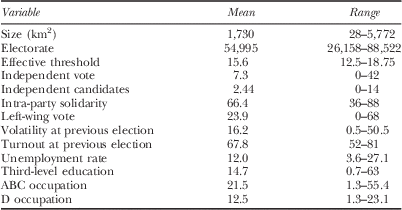
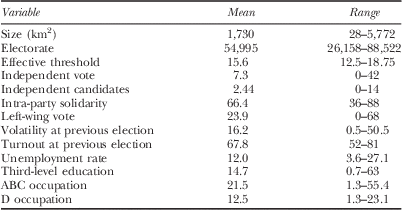
Table 1 provides summary statistics for each of these variables. Constituencies are pretty small in size, with the largest less than 6,000 square kilometres and the smallest just 28 square kilometres. Whether this plays a role in the support for independents is explored in the next section, but whatever the causal factors, the mean vote is a significant 7 per cent, reaching a high of over 40 per cent in some cases, a considerable feat in multi-member contests. The decline in both turnout and intra-party solidarity and the rise in electoral volatility in recent years are perhaps indicative of the declining linkages between parties and the electorate. There is considerable variation in the socioeconomic indicators, evidence that tentatively supports the presence of the hypothesized socioeconomic divide. With the measures of an independent presence being the support for independents and the numbers of independent candidates, these data are used in two separate regression models in the next section to put the hypotheses to the test.
Summary Statistics per Constituency Level, 1981–2011
Results
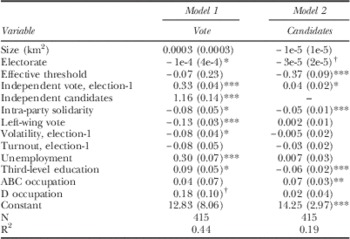
Two models are considered here. The first is an OLS regression with support for independents the dependent variable. As Table 2 indicates, an established independent presence makes a difference, with both the number of independent candidates and the independent vote at the previous election having a positive effect on support for independents. Although territorial size has no significant effect, the size of the electorate is important and has a significant negative impact, in line with our expectation: the more voters independent candidates have to canvass, the less support they attract. Intra-party transfer solidarity has the predicted negative effect, confirming that decreasing levels of party attachment help independents. There appears to be evidence supporting the hypothesis concerning the protest element of the independent vote for those with an anathema to left-wing parties, as there is a strong negative relationship between the two vote levels.
Models of Independent Significance

Note: Standard errors are in parentheses. Significance levels: †p<0.10, *p<0.05, **p<0.01, ***p<0.001.
The negative coefficient for volatility is not as predicted, suggesting that a deinstitutionalizing party system is not necessarily associated with an increasing independent vote. There is mixed support for the importance of the centre–periphery divide. Some socioeconomic variables were found to have an effect on support for independents, but not all in the predicted direction. While higher levels of unemployment have a positive effect on support for independents, as does the proportion of unskilled workers, increased numbers of those with third-level education result in a higher independent vote, contrary to our expectations.
An OLS regression model is also used to explain independent emergence. Beginning with the number of candidates, this model explains half the level of variation of the independent vote model. Most of the patterns from Model 1 are repeated, but there are a few differences. The effective threshold has a significant negative effect on the numbers of independents running, but support for left-wing candidates and turnout at the preceding election have no such effect. In terms of the socioeconomic measures, third-level education reverses its effect, with higher levels resulting in fewer independent candidates. Unemployment does not have a significant effect but higher proportions of ABC professionals are associated with more independents.
What do all these results mean? In Table 3 the dependent variables and hypotheses are summarized to allow for an overview of the findings. There is mixed evidence for the size hypothesis; both geography and electorate matter for candidates, but just the latter for voters. In terms of our limited proxy for political culture, higher levels of intra-party solidarity have a negative effect for independents. While support for independents is negatively correlated with a left-wing vote, it does not matter for candidates, which is not surprising since this hypothesis concerning the protest element centred on voters. Electoral rules matter for independent candidates, but not for voters, probably because the former have more at stake. The other institutional factors of the party system (as measured by volatility) and electoral market (as measured by turnout) by and large have insignificant effects. Finally, the evidence is mixed concerning the centre–periphery divide. Of the four variables used in each of the two models, only three of the eight have a significant effect in the predicted direction. Obviously, four variables are not enough to measure the depth of a socioeconomic division. It may be that the divide is not as important as imagined, or that it has not been captured accurately by these variables, or that independents do not profit from this divide. This is something that warrants further exploration.
Summary of Hypotheses

Note:−signifies a significant negative effect, +a significant positive effect, X no effect of significance.
Relating these findings to the comparative world, we can say that independents are more likely to emerge in smaller populations, while geography and thresholds do not necessarily matter. Hence independent candidates have been elected in large single-seat constituencies in Australia, Canada and the US. What contributes to an independent presence is a conducive personalistic and localistic political culture where attachments to parties are not as embedded as elsewhere. Hence the proliferation of independents across some South Pacific island states. Independents are obviously a protest vote, particularly in systems with electoral market failure and where there is a clear political vacuum. They are also an option that may be more appealing in countries such as Australia, Ireland, the UK and the US, where extreme ideological parties have traditionally had little electoral impact. Finally, a strong and persistent presence of independents, such as in Russia or Ireland, suggests that they may be no flash-in-the-pan protest vote and that they may be indicative of a deeper political division. However, conclusive evidence to support the existence of a cleavage on which independents mobilize was not found. While independents do appeal to certain socioeconomic groups, the extent to which this is a real political divide is not clear.
Conclusion
This article examines the source of a non-party threat in an established party democracy. Because it is an idiosyncratic phenomenon, independents have largely been understudied and dismissed as an aberration. Commenting in the Australian context (the only other industrial democracy where independents have a meaningful impact), former state and federal independent MP Ted Mack noted:
There has to be unusual circumstances for an independent to ever get elected. There has to be a set of factors that make it possible. Every state and federal election I get all these people ringing up … who want to stand as independents – and they think I’ve got the magic secret of success. Most of them are just nutcases.Footnote 5
Although this article has not found a magic formula, it does indicate a number of patterns for independent success. It has shown that size, political culture and the party system all matter. Those worried about a growing independent vote would be best advised to focus on re-establishing voter attachment to parties, on addressing market failure by attempting to re-engage the voluntarily disenfranchised and on alleviating some socioeconomic regional disparities. If all this fails, they can also create constituencies with larger populations.
The significance of some institutional, cultural and socioeconomic variables suggests that an independent presence is more than just the product of fleeting sentiment, that it has some kind of structural basis. This could explain why independents have persisted in Ireland, where elsewhere their presence is temporary. Both these theories require further expansion and testing, but the preliminary results are promising.
Because theoretical and empirical research on independents is still at an early stage, it is necessary first to focus on the dominant example of independent strength in an industrial democracy, which allows us to draw further conclusions about independents in other states. Of all the features that were discussed that can contribute to an independent presence, none is unique to Ireland, and since independents have begun to re-emerge in a number of party democracies in recent years, the next step is to test the validity of the hypotheses discussed here in these comparative contexts. Since independents share many common features across jurisdictions, these findings have a wider generality. They are elected in primarily regional constituencies, campaign on local issues and, if elected, tend to focus on providing goods and services for their constituencies. In particular, independents appear to be a phenomenon of Anglo-American democracies, having emerged at various stages in Australia, Canada, India, the UK and the US. One reason for this is that most of these polities have political cultures and systems more oriented to candidates than other established democracies. This is a theme that could be expanded on in a future comparative study. It could also be widened to include Pacific island states, some of which, it has been noted, are dominated by independents. Is such omnipotence more likely in those with a British colonial background?
With the threat of non-party actors unlikely to abate, there is an increasing need for an understanding of the different variants of this phenomenon. The literature on interest groups and social media movements is expanding, but that on the independent politician remains quite limited. Whether they are viewed as a destabilizing force that should be eradicated or as a promoter of pluralism that should be encouraged, the independent is a phenomenon that warrants further attention.
Acknowledgements
This article is based on research undertaken by the author at the Department of Politics and International Relations, Macquarie University, Sydney, when in receipt of a Marie Curie and CARA Fellowship co-financed by the Irish Research Council and the European Union.
I thank colleagues at the Department of Government, University College Cork for their comments on previous drafts, and Yvonne Murphy and staff at the Irish Central Statistics Office for their help in sourcing data.