Introduction
The genus Stirtonia is a tropical genus of corticolous lichens, with 18 species known so far (Alves et al. Reference Alves, Aptroot, Lacerda and Cáceres2014; Xavier-Leite et al. Reference Xavier-Leite, Menezes, Andrade, Aptroot and Cáceres2014). It is characterized by a crustose thallus with trentepohlioid algae bearing asci in ascigerous areas, with anastomosing interascal hyphae that do not differ markedly from sterile thallus tissue hyphae and are not glued together with hymenial gel. The ascospores are only transversely septate, with thickened walls and septa leaving somewhat rounded to lentiform lumina. Species of this genus are mostly rather inconspicuous in the field, and best found during ecological studies where all different species on certain trees are investigated. The genus was thought to be most speciose in the Palaeotropics, with only one species known from the Neotropics as recently as 2009 (Aptroot Reference Aptroot2009). In the last few years, however, five new species have been described from Brazil (Alves et al. Reference Alves, Aptroot, Lacerda and Cáceres2014; Xavier-Leite et al. Reference Xavier-Leite, Menezes, Andrade, Aptroot and Cáceres2014) and two palaeotropical species have been reported from the Neotropics (Lücking et al. Reference Lücking, Seavey, Common, Beeching, Breuss, Buck, Crane, Hodges, Hodkinson and Lay2011; Cáceres et al. Reference Cáceres, Aptroot and Ertz2014).
Three additional new species of the genus Stirtonia and one new species of Crypthonia were found during our ongoing studies of the biodiversity of lichens in the Neotropics. They originate from two sources: various collecting trips by the second author; and recent, partly joint, collecting trips by the other authors. None of this material was readily available when the revision of this genus was made by Aptroot (Reference Aptroot2009), either because it was not recognized as belonging to the genus, or was out on loan, or because it was not yet collected. The new species are described below, and a revised world key to the known species is presented. Together with an additional report given below, the total number of Stirtonia species known from the Neotropics is now 12, an equal number to the 12 species that are known from the Palaeotropics.
Material and Methods
Identification and descriptive work was carried out in Itabaiana, Universidade Federal de Sergipe, using a Leica EZ4 stereomicroscope and a Leica DM500 compound microscope, and also in Soest using an Olympus SZX7 stereomicroscope and an Olympus BX50 compound microscope with interference contrast, connected to a Nikon Coolpix digital camera. The chemistry of the type specimens was investigated by thin-layer chromatography (TLC) using solvents A, B & C (Orange et al. Reference Orange, James and White2001).
The New Species
Crypthonia divaricatica Aptroot & Sipman sp. nov.
MycoBank No.: MB808537
Crypthonia with an irregular, thick thallus with divaricatic and usnic acids and flat white ascigerous areas, and macrocephalic 5–9-septate ascospores 20–27×9·5–12·5 µm.
Type: Mexico, Chiapas, La Trinitaria, Parque Nacional Lagunas de Montebello, Paso del Soldado, on Quercus sapotifolia bark, 16°07′07″N, 91°43′09″W, 1500 m alt., 29 November 1994, J. Wolf & H. J. M. Sipman 2124 (B 60 0114951—holotype; CIES—isotype).
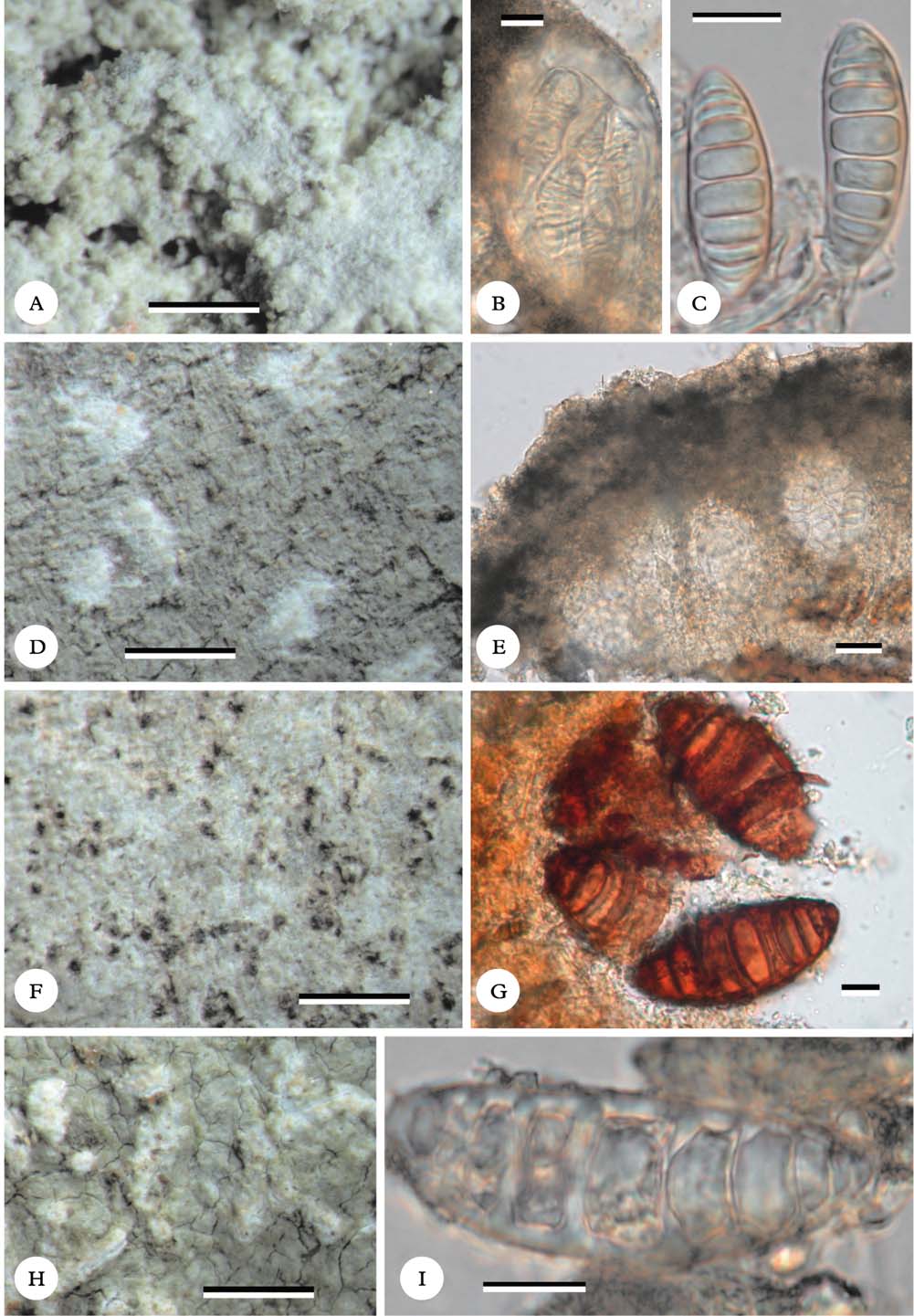
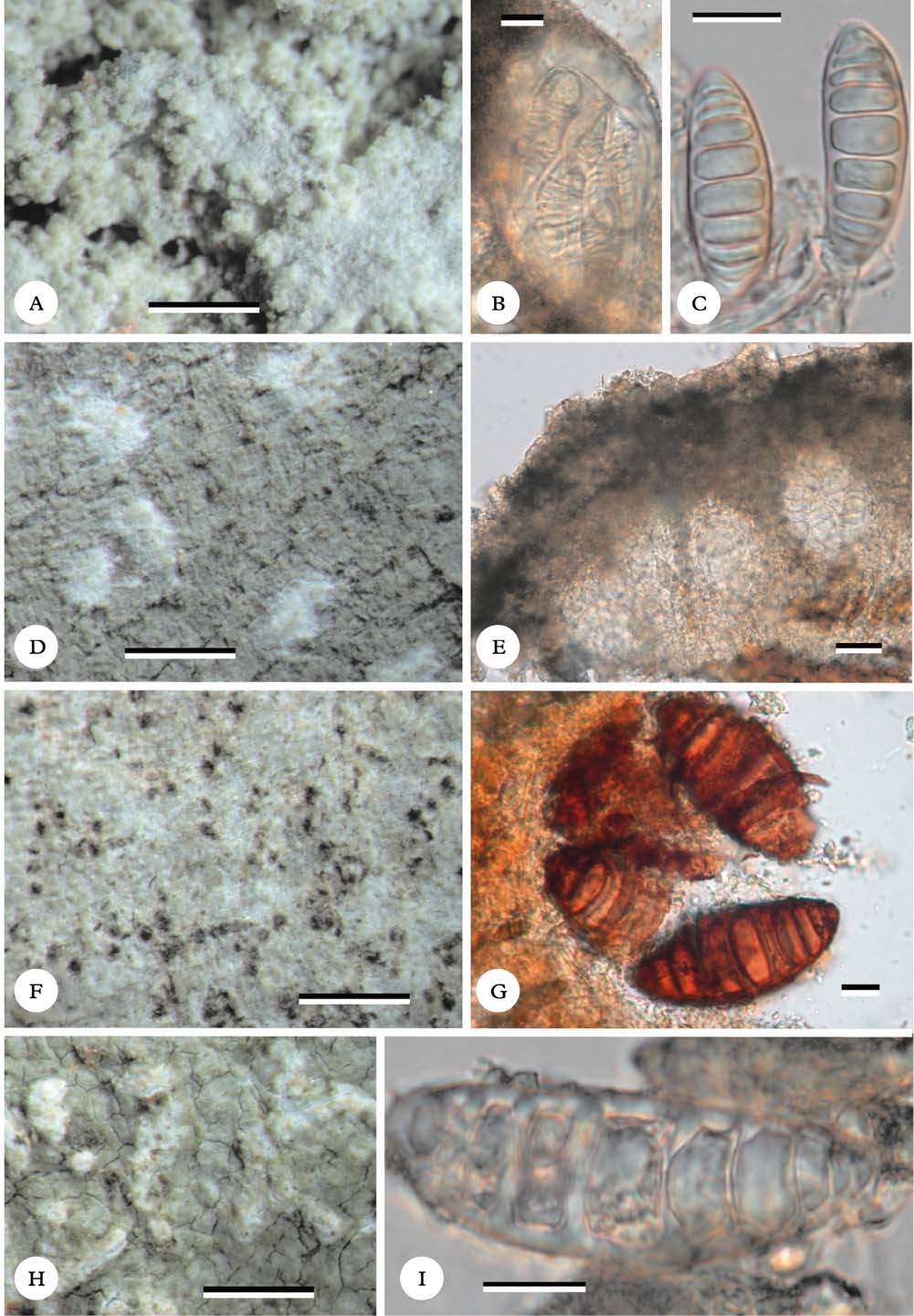
A & B, Crypthonia divaricatica, holotype; A, habitus; B, ascus with ascospores. C–E, Stirtonia ibirapuitensis, isotype; C, ascospores; D, habitus; E, section through ascigerous structure. F–G, Stirtonia punctiformis, holotype; F, habitus; G, ascospores. H–I, Stirtonia viridis, holotype; H, habitus; I, ascospore. Scales: A, D, F & H=0·5 mm; B, C, E, G & I=10 μm. In colour online.
Thallus crustose, continuous, not corticate, pale mineral greenish, c. 0·3–0·5 mm thick, consisting of loose fluffy granules c. 0·2 mm diam., with very irregular surface, on a continuous to somewhat hyphal white hypothallus, that extends as a white prothallus. Algae trentepohlioid.
Ascigerous structures more or less rounded in outline, not higher than the thallus, whitish, flat, 1·0–1·6 mm diam., 0·2–0·5 mm high. Interascal tissue consisting of anastomosing paraphysoids, IKI+ blue. Asci abundant, hyaline, pyriform, 45–73×35–50 µm; wall c. 10 µm thick in the upper part, much thinner at the sides. Ascospores 8 per ascus, hyaline, 5–9-septate, broadly clavate, 20–27×9·5–12·5 µm, IKI−, septa thin, upper cells largest (macrocephalic); also lowest cell larger than the others except the upper cell.
Pycnidia not observed.
Chemistry
Thallus UV+ white, C−, P−, K−; ascigerous structures UV+ white, C−, P−, K−. TLC: divaricatic and usnic acids.
Ecology and distribution
On rough Quercus sapotifolia bark in montane forest. Known only from Mexico.
Discussion
So far, 13 species are known in the genus Crypthonia (Menezes et al. Reference Menezes, Xavier-Leite, de Jesus, Aptroot and Cáceres2013). This species is well characterized by the chemistry, which is unique in the genus, and by the irregular thallus that is reminiscent of a Lepraria. There is only one other species known in the genus with 7-septate ascospores, viz. C. lichexanthonica A. A. Menezes et al. (Menezes et al. Reference Menezes, Xavier-Leite, de Jesus, Aptroot and Cáceres2013), which contains lichexanthone and has a thinner and smoother thallus.
The species is treated here because of its close resemblance to Stirtonia species. It differs from species of that genus by the byssoid hypothallus, the fluffy thallus, the thin ascospore septa and the pyriform asci.
Stirtonia ibirapuitensis Aptroot, Käffer & S. M. Martins sp. nov.
MycoBank No.: MB808538
Stirtonia with whitish to cream amoeboid ascigerous areas with lichexanthone, on a greenish thallus without lichexanthone, and ascospores 27–32×9·5–12·5 µm.
Type: Brazil, Rio Grande do Sul, Santana do Livramento, Estância São Maurício, Ibirapuitã Environmental Protection Area (APA do Ibirapuitã), on tree bark, 30°37′82·1″S, 55°34′09·3″W, 972 m alt., 15 November 2012, M. Käffer 763 (HAS—holotype; ABL—isotype).
Thallus crustose, continuous, not corticate, olive greenish, dull, surrounded by a narrow brown prothallus. Alga trentepohlioid.
Ascigerous structures not raised above the thallus, with irregular amoeboid outline, whitish to cream, especially in the centre of the structures, 0·3–0·6 mm diam., 0·10–0·15 mm high. Interascal tissue consisting of an up to 100 µm thick layer of anastomosing paraphysoids, filled with tiny yellowish brown lichexanthone crystals, especially above the algal cells, IKI−. Asci rather abundant, not directly visible from above but causing the interascal tissue to swell and become cream, hyaline, nearly globose to pyriform, 32–43×27–35 µm; wall c. 5 µm thick, equally thick all around. Ascospores 8 per ascus, hyaline, 5–7(–9)-septate, broadly fusiform to slightly clavate, 27–32×9·5–12·5 µm, IKI−, septa up to 2 µm thick at the sides, middle cells largest.
Pycnidia not observed.
Chemistry
Thallus UV−, C−, P−, K−; ascigerous structures UV+ yellow, C−, P−, K−. TLC: lichexanthone.
Ecology and distribution
On smooth bark of tree in riparian forest in a native grassland matrix. Known only from Brazil.
Discussion
This species differs from all known species of Stirtonia, except S. nitida Xavier-Leite et al. (Xavier-Leite et al. Reference Xavier-Leite, Menezes, Andrade, Aptroot and Cáceres2014) and S. lucida M. M. E. Alves et al. (Alves et al. Reference Alves, Aptroot, Lacerda and Cáceres2014), by the presence of lichexanthone. However, in the new species lichexanthone is present only in the ascigerous areas, while in S. lucida and S. nitida it is also present in the thallus. Stirtonia nitida has much larger ascospores (68–79×18–28 µm) than S. ibirapuitensis, and a corticated thallus, while S. lucida has smaller ascospores (17–19×8–10 µm) with occasional longitudinal septa. The new species is also characterized by the well-delimited ascigerous areas that differ markedly in colour from the thallus. It resembles some species of Arthonia, but lacks a clearly defined hymenium and has the typical ascospores of Stirtonia.
Stirtonia punctiformis Aptroot & Sipman sp. nov.
MycoBank No.: MB808539
Stirtonia with ascigerous structures concolorous with the thallus, consisting of one or more brown asci which have brown walls with surrounding tissue, in groups or irregular lines and brown ascospores of 61–73×27–35 µm.
Type: Costa Rica, Puntarenas, Reserva Biológica Carara, c. 15 km SSW of Orotina, on tree bark in disturbed primary forest, 50 m alt., 20 November 1988, H. J. M. Sipman & P. Döbbeler 42237 (B 60 0179794—holotype; CR—isotype).
Thallus crustose, continuous, not corticate, whitish to cream-grey, smooth, dull, surrounded by a narrow black prothallus. Alga trentepohlioid.
Ascigerous structures of thallus colour, consisting of one or more brown asci with surrounding tissue, in groups or irregular lines. Interascal tissue consisting of a thin layer of anastomosing paraphysoids surrounding the asci, IKI+ blue. Asci abundant, visible from above and often almost superficial, brown, nearly globose, c. 90–110 µm diam.; wall up to c. 15 µm thick, brown, equally thick all around. Ascospores 8 per ascus, initially hyaline, but soon becoming brown, especially when mature, 9–11-septate, broadly fusiform, 61–73×27–35 µm, IKI−, septa up to 2 µm thick at the sides, middle cells largest.
Pycnidia not observed.
Chemistry
Thallus UV−, C−, P−, K−; ascigerous structures UV−, C−, P−, K−. TLC: no substances detected.
Ecology and distribution
On smooth bark of tree in (disturbed) primary lowland rainforest. Known from Costa Rica and Guyana.
Discussion
This species is characterized by the brown asci with brown walls, and the brown ascospores. It is the first species known in the genus with brown ascospores. In overall appearance it resembles S. neotropica Aptroot, but lacks the characteristic gyrophoric acid chemistry of that species. It is unlikely that the brown ascospores and asci are just old material of this or another species.
Additional specimen seen. Guyana: Upper Takutu: northern Rupununi savannah, Karanambo Ranch, surroundings of headquarters, alt. c. 100 m, periodically inundated, low forest, c. 2 km on track to Yupukari, 1992, H. J. M. Sipman 57232 (B 60 0164227).
Stirtonia viridis Aptroot, L. I. Ferraro, Sipman & M. Cáceres sp. nov.
MycoBank No.: MB808540
Stirtonia with ascigerous structures mostly linear, branched and anastomosing, whitish, and contrasting with the often greenish thallus and with ascospores 50–58×15–22 µm.
Type: Argentina, Misiones, Puerto Iguazú, near Hotel Selvático Don Horacio, on tree bark, 25°36′20″S, 54°33′33″W, 230 m alt., 2 February 2013, L. I. Ferraro, A. Aptroot & M. E. S. Cáceres 10520 (CTES—holotype; ABL—isotype).
Thallus crustose, continuous, not corticate, smooth, whitish grey to pale mineral to olive green, dull, surrounded by a wide brown prothallus. Alga trentepohlioid.
Ascigerous structures mostly linear, branched and anastomosing, whitish, 0·2–0·4 mm wide, up to 2·0 mm long. Interascal tissue consisting of a c. 200 µm thick layer of anastomosing paraphysoids, IKI+ blue. Asci abundant, immersed in the interascal tissue, not visible from above, hyaline, nearly globose, c. 70–80 µm diam.; wall c. 10 µm thick all around. Ascospores 8 per ascus, hyaline, 5–7-septate, broadly fusiform, 50–58×15–22 µm, IKI−, septa up to 3 µm thick at the sides, middle cells largest, lumina somewhat angular.
Pycnidia not observed.
Chemistry
Thallus UV−, C−, P−, K−; ascigerous structures UV−, C−, P−, K−. TLC: no substances detected or only some substances with a high Rf that probably originate from the bark.
Ecology and distribution
On smooth bark of tree in rainforest. Known only from Argentina.
Discussion
This species differs from S. punctiformis Aptroot & Sipman, which has brown ascospores 61–73 µm long, by the whitish ascigerous structures that are mostly linear, branched and anastomosing, and contrast with the often greenish thallus.
Additional specimen seen. Argentina: Misiones: same as the type, L. I. Ferraro, A. Aptroot & M. E. S. Cáceres 10519 (CTES; ABL). Jujuy: Parque Nacional Calilegua, Camping Aguas Negras, L. I. Ferraro 7588 (CTES; B 60 0179959).
World key to the species of Stirtonia
-
1 Ascospores with enlarged upper cell ... 2
Ascospores without enlarged upper cell ... 4
-
2(1) Ascospores<30 µm long ... S. microspora Xavier-Leite et al.
Ascospores>30 µm long ... 3
-
3(2) Thallus whitish, with perlatolic acid ... S. alba Makhija & Patw.
Thallus brownish, without substances ... S. santessonii Makhija & Patw.
-
4(1) Ascigerous zones linear, branched or anastomosing, usually not raised above thallus level ... 5
Ascigerous zones mostly rounded, often distinctly raised above thallus level ... 13
-
5(4) Ascospores 15–30 µm long ... 6
Ascospores 35–65 µm long ... 8
-
6(5) Ascigerous zones inconspicuous ... S. dubia A. L. Sm.
Ascigerous zones conspicuous, amoeba-shaped, white, contrasting in colour with the green thallus ... 7
-
7(6) Ascospores 27–32 µm long ... S. ibirapuitensis Aptroot et al.
Ascospores 17–19 µm long ... S. lucida M. M. E. Alves et al.
-
8(5) Ascospores 4–6-septate; ascigerous zones pale brown anastomosing lines ... S. ramosa Makhija & Patw.
Ascospores 7–11-septate; ascigerous zones different ... 9
-
9(8) Thallus and ascigerous zones partly C+ red (TLC: gyrophoric acid), sometimes also partly UV+ yellow (TLC: lichexanthone) ... S. neotropica Aptroot
Note: A specimen was observed with traces of lichexanthone, also visible as some UV+ yellow spots: Netherlands Antilles, St. Eustatius, 2 February 2008, H. J. M. Sipman 56804 (B 60 0163074).
Thallus and ascigerous zones C− and UV− ... 10
-
10(9) Ascospores 35–55 µm long ... 11
Ascospores 55–73 µm long ... 12
-
11(10) Ascigerous area IKI+ violet above, IKI+ blue at the base; ascospores usually curved; thallus with perlatolic acid ... S. curvata Aptroot
Note: this species is reported here with some doubt also from the Neotropics: Netherlands Antilles, Saba, W of Windwardside, 11 March 2007, H. J. M. Sipman 54930 (B 60 0183887); Brazil, Rio de Janeiro, PN Serra dos Orgãos, 17–18 October 1952, F. Mattick 476e (B 60 0190859). TLC of these specimens revealed no substances.
Ascigerous area partly IKI+ reddish, partly IKI+ blue; ascospores straight; thallus without substances ... S. nivea Xavier-Leite et al.
Note: this species is reported here also from the Northern Hemisphere: Puerto Rico, Arecibo, Reserva Forestal Cambalache, 25 May 1989, H. J. M. Sipman 26055 (B 60 0078574).
-
12(10) Ascigerous zones conspicuous, linear and anastomosing, white, contrasting in colour with the green thallus; ascospores hyaline, 55–58 µm long ... S. viridis Aptroot et al.
Ascigerous zones inconspicuous, linear or round or consisting of individual asci, of thallus colour; ascospores brown, 61–73 µm long ... S. punctiformis Aptroot & Sipman
-
13(4) Thallus UV+ bright white or yellow, with 2′-O-methylsuperphyllinic acid or lichexanthone ... 14
Thallus UV− (at least not bright white or yellow) ... 15
-
14(13) Thallus UV+ white, with 2′-O-methylsuperphyllinic acid ... S. alboverruca Makhija & Patw.
Thallus UV+ yellow, with lichexanthone ... S. nitida Xavier-Leite et al.
-
15(13) Thallus Pd+ yellow, with psoromic acid ... 16
Thallus Pd−, without psoromic acid ... 18
-
16(15) Ascospores 36–45 µm long ... S. schummii Aptroot
Ascospores 50–87 µm long ... 17
-
17(16) Ascospores 50–60 µm long; ascigerous zones>1 mm wide ... S. indica Makhija & Patw.
Ascospores 75–87 µm long; ascigerous zones<1 mm wide ... S. psoromica Aptroot & Wolseley
-
18(15) Thallus brownish ... 19
Thallus whitish ... 20
-
19(18) Ascigerous zones raised, ochraceous ... S. ochracea M. M. E. Alves et al.
Ascigerous zones not raised, white ... S. obvallata (Stirt.) A. L. Sm.
-
20(18) Thallus with confluentic acid ... S. rhizophorae Kalb & Mongkolsuk
Thallus with 2′-O-methylperlatolic acid or unknown substances ... S. macrocarpa Makhija & Patw.
The CNPq (Conselho Nacional de Desenvolvimento Científico e Tecnológico) is thanked for a research grant to MESC (Processo 311706/2012-6) and for supporting the collecting trips in NE Brazil (CNPq-Sisbiota Processo 563342/2010-2), a postdoctoral fellowship to MK and a visiting professorship grant to AA. The Stichting Hugo de Vries-Fonds is warmly thanked for a travel grant to AA.