INTRODUCTION
Digenean trematodes are common parasites of molluscs (Lauckner, Reference Lauckner and Kinne1980, Reference Lauckner and Kinne1983; de Montaudouin et al., Reference de Montaudouin, Kisielewski, Bachelet and Desclaux2000; Thieltges et al., Reference Thieltges, Krakau, Andresen, Fottner and Reise2006), especially in coastal systems where they can achieve their complex life cycle within their different potential hosts. Following digenean species, molluscs can serve as first host or second intermediate host. In their first intermediate host, these parasites reproduce asexually, generally in the gonad and the digestive gland of their host, leading at individual scale to growth perturbation (Rothschild, Reference Rothschild1941; Curtis, Reference Curtis1995; Gorbushin, Reference Gorbushin1997; Mouritsen et al., Reference Mouritsen, Gorbushin and Jensen1999; Probst & Kube, Reference Probst and Kube1999; Curtis et al., Reference Curtis, Kinley and Tanner2000), reproduction failure (Schulte-Oehlmann et al., Reference Schulte-Oehlmann, Oehlmann, Fioroni and Bauer1997; Oliva et al., Reference Oliva, Olivares, Diaz and Pasten1999; Krist, Reference Krist2001; Rice et al., Reference Rice, McGraw, O'Brien, Reverter, Jackson and Degnan2006; Lajtner et al., Reference Lajtner, Luciæ, Marušiæ and Erben2008) and sometimes death (Curtis, Reference Curtis1995; Jensen et al., Reference Jensen, Latama and Mouritsen1996). Prevalence is generally low (<5%) (Thieltges et al., Reference Thieltges, de Montaudouin, Fredensborg, Jensen, Koprivnika and Poulin2008) and effects on the host population are not measurable (Kube et al., Reference Kube, Kube and Bick2006). However, cases of episodic high prevalence leading to host mortalities are cited (Jonsson & André, Reference Jonsson and André1992; de Montaudouin et al., Reference de Montaudouin, Blanchet, Kisielewski, Desclaux and Bachelet2003; Fredensborg & Poulin, Reference Fredensborg and Poulin2006; Thieltges, Reference Thieltges2006a). Conversely, digenean parasites using molluscs as their second intermediate host can display high prevalence (de Montaudouin et al., Reference de Montaudouin, Kisielewski, Bachelet and Desclaux2000; Thieltges et al., Reference Thieltges, Krakau, Andresen, Fottner and Reise2006; Gam et al., Reference Gam, Bazaïri, Jensen and de Montaudouin2008). Their larvae remain in the tissues of their host as metacercariae. This larval stage is often considered as energically inert and causes little or no immediate physiological or behavioural responses in the adult host (Lauckner, Reference Lauckner and Kinne1983). They can however impact their host when the number of metacercariae is high (Lauckner, Reference Lauckner, Tougaard and Asbirk1987a; Desclaux et al., Reference Desclaux, de Montaudouin and Bachelet2004, Reference Desclaux, Russell-Pinto, de Montaudouin and Bachelet2006) or when the host is at the juvenile stage (Lauckner, Reference Lauckner1987b; Wegeberg & Jensen, Reference Wegeberg and Jensen1999). Nevertheless no study has ever tried to estimate the impact of trematode parasites on the second host bivalve population dynamics.
The most integrative parameters of population health are certainly the secondary production defined as the quantity of matter synthesized per surface and time units and the secondary elimination defined as the quantity of matter lost by the population per surface and time units (Crisp, Reference Crisp, Holme Holme and McIntyre1984). Indeed production–elimination calculation is based on the different parameters of population dynamics such as individual recruitment rate, growth and mortality.
The edible cockle Cerastoderma edule (L.) is one of the most common intertidal bivalves on the sandy shores and estuaries of the north-eastern Atlantic. It ranges from the Barents Sea to the Moroccan coasts (Tebble, Reference Tebble1966; Gam et al., Reference Gam, Bazaïri, Jensen and de Montaudouin2008; de Montaudouin et al., in press). Like other suspension feeders, cockles are parasitized mostly through their ventilatory activity (Wegeberg et al., Reference Wegeberg, de Montaudouin and Jensen1999). The aim of the present study was to calculate the production, elimination, P/B and E/B of two cockle (Cerastoderma edule) populations displaying different dynamics patterns through the monthly monitoring of a single cohort (2005 recruitment) and to estimate the share that metacercarial infection may have in production drop. Anderson & Gordon (Reference Anderson and Gordon1982) and Kennedy (Reference Kennedy1984) suggested that it would be useful to study metacercarial digenean stages in hosts to detect parasite-induced host mortality. Cockles are excellent models for digenean–host studies because they can harbour a wide variety of species (de Montaudouin et al., Reference de Montaudouin, Kisielewski, Bachelet and Desclaux2000; Thieltges & Reise, Reference Thieltges and Reise2006) sometimes with very high parasitic abundance (Gam et al., Reference Gam, Bazaïri, Jensen and de Montaudouin2008; de Montaudouin et al., 2009). The difficulty is that digeneans rarely leave any scar on the host shell (Bartoli, Reference Bartoli1976), thus preventing inference of their role in host mortality events. Parasite-induced host mortality can however be estimated by monitoring either the variance to mean ratio (Anderson & Gordon, Reference Anderson and Gordon1982; Kennedy, Reference Kennedy1984) or the mean abundance or prevalence of metacercariae in host cohorts (Lester, Reference Lester1984; de Montaudouin et al., Reference de Montaudouin, Blanchet, Kisielewski, Desclaux and Bachelet2003; Desclaux et al., Reference Desclaux, de Montaudouin and Bachelet2004). The decrease of these variables may result either from emigration of parasitized animals, recruitment or immigration of unparasitized animals, or metacercariae death of the most infected individuals in the host cohort (Anderson & Gordon, Reference Anderson and Gordon1982; Kennedy, Reference Kennedy1984; Wilson et al., Reference Wilson, Bjørnstad, Dobson, Merler, Poglayen, Randolph, Read, Skorping, Hudson, Rizzoli, Grenfell, Heesterbeek and Dobson2002). A decrease of parasite abundance due to mortality can also be balanced by an infection event, and the final result will consequently be misinterpreted. It is therefore necessary to acquire a good knowledge of infection kinetics. Consequently, the study area was also chosen due to good knowledge of parasite and cockle dynamics, and environmental features. Arcachon Bay (south-western France) has been monthly monitored since 1997 and Merja Zerga (north-western Morocco) since 2005.
MATERIALS AND METHODS
Study area
This study was conducted at Arcachon (on the banc d'Arguin) (44°35′N 1°13′W) on the south-western Atlantic coast of France and at Merja Zerga (34°52′N 6°17′W) on the north-western coast of Morocco. The banc d'Arguin is a sandy bank situated at the most oceanic part of Arcachon Bay, where salinity remains high year-round (32 to 35 psu) (Robert et al., Reference Robert, Guillocheau and Collos1987). Mean surface water temperature usually fluctuates between 7°C in winter and 23°C in summer but surface sediment temperature can reach −1°C and 32°C, respectively (de Montaudouin et al., Reference de Montaudouin, Blanchet, Kisielewski, Desclaux and Bachelet2003). Tide is semi-diurnal with a maximum tidal range of 4.35 m. Sediment type is medium sand (grain-size median = 350 µm). The cockle population was situated 1.9 m above mean low water level. The sampling station in Merja Zerga, a shallow 37-km2 lagoon, was situated also at the most oceanic part where salinity and sediment temperature annual ranges are 8–36 psu (Labbardi et al., Reference Labbardi, Ettahiri, Lazar, Massik and El Antri2005) and 11–28°C (Gam et al., Reference Gam, Bazaïri, Jensen and de Montaudouin2008), respectively. Tides were semi-diurnal and the mean tide ranges between 0.15 and 1.50 m (Gam et al., Reference Gam, Bazaïri, Jensen and de Montaudouin2008). The sediment grain-size median is ~300 µm.
Study organisms and sampling procedure
HOST (COCKLES)
Cockles were sampled monthly at Arcachon and Merja Zerga between May 2005 and April 2007, corresponding to the 2005 cohort lifespan in both sites. On each occasion, six 0.25-m2 quadrats were used to collect cockles through a 1-mm mesh sieve. Cockle individuals were counted and measured to the nearest mm shell length.
PARASITES (TREMATODES)
Each month, between 10 and 20 cockles from this cohort were dissected and trematode parasite species were identified and counted under stereomicroscope following the method outlined in de Montaudouin et al. (in press). Only digenean parasites were studied. The parasite abundance of each trematode species was defined as the number of parasite individuals per cockle (Bush et al., Reference Bush, Lafferty, Lotz and Shostak1997).
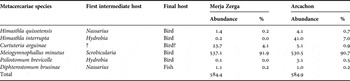
The same six species were found at Merja Zerga and Arcachon (Table 1). In both sites, Meiogymnophallus minutus was largely dominant (>90% of metacercariae in cockles). At Merja Zerga, the second most abundant species was Curtuteria arguinae whereas in Arcachon it was Himasthla interrupta. When calculating trematode-dependent mortality, it was decided to consider two pools of species gathered by their family status: Gymnophallid (namely M. minutus) and Echinostomatids (Himasthla spp. and C. arguinae), i.e. 99% of metacercariae. Indeed, due to similarity in their level of abundance and the identical ecological equivalents, the different Echinostomatid species are considered as ecological equivalents (Babirat et al., Reference Babirat, Mouritsen and Poulin2004; Leung & Poulin, Reference Leung and Poulin2007) and can be gathered for the present purpose.
Mean abundance and mean prevalence (%) of metacercariae of digenean trematodes of the 2005 cohort of the cockle (Cerastoderma edule) at Merja Zerga and Arcachon.

Cohort analysis, growth and mortality
Cohorts were determined using a modal progression analysis (Bhattacharya's method (Reference Bhattacharya1967)) subroutine (Gayanilo et al., Reference Gayanilo, Sparre and Pauly2005). Each representative component, with a separation index greater than 2, was assumed to be a single cohort. Cohorts were identified using the Bhattacharya method on FISAT software and the 2005 cohort was extracted for a posteriori calculations. For the next step in the analysis (effect of trematodes on cockle production/elimination) determination of growth and mortality was necessary.
Growth parameters of the von Bertalanffy function (VBGF) were estimated from growth increment data produced from linking of the means belonging to the 2005 cohort derived from the Bhattacharya analysis and the Appeldoorn method (Gayanilo et al., Reference Gayanilo, Sparre and Pauly2005). The VBGF was defined as:

where L t is the shell length (mm) at time t, L ∞ is the theoretical asymptotic shell length (mm), K is the curvature parameter (yr−1) and t0 is the theoretical age at zero length (yr).
The estimates L ∞ and K were used to calculate the growth performance index Φ′ (Pauly & Munro, Reference Pauly and Munro1984) using the equation:

The mortality rate (Z, in yr−1) was estimated by a length converted catch curve method (Gayanilo et al., Reference Gayanilo, Sparre and Pauly2005). It is expressed in the single negative exponential mortality model:
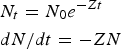
where N t is the number of individuals of a cohort at (relative) age t (yr), N 0 the number of individuals at (relative) age 0, and t the relative age. Z was calculated for individuals older than 6 months, i.e. when parasite-dependent mortality began to occur.
Production–elimination
Production P and elimination E of the 2005 cockle cohort were assessed according to incremental and removal summation methods reviewed by Crisp (Reference Crisp, Holme Holme and McIntyre1984) for populations with non-continuous recruitment and distinguishable year-classes:
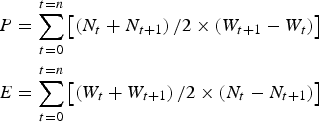
where N t is the cockle abundance at time t, W t is the mean individual flesh weight at time t and n the number of sampling occasions at different times t.
The mean biomass was calculated by:
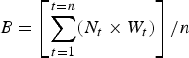
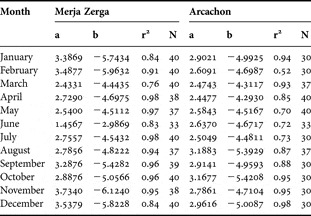
Size–mass relationship between shell length and flesh dry weight (log 10W = alog 10L + b) was monthly estimated at Merja Zerga during one year. At Arcachon, we used equations previously established by Madani (Reference Madani1989) in the same area (Table 2).
Parameters of the length (L in mm)–weight (W in g) relationship of cockles Cerastoderma edule from Merja Zerga and Arcachon: log10(W) = alog10(L) + b. r2, determination coefficient; N, number of analysed cockles. Arcachon data adapted from Madani (Reference Madani1989).

Influence of parasites on cockle production and elimination
To calculate the role of parasites in cockle production P and elimination E, cockle mortality due to parasites was assessed using the method outlined in Desclaux et al. (Reference Desclaux, de Montaudouin and Bachelet2004). Assuming that, in a cohort, the decrease of parasite abundance resulted from the mortality of the most infected cockles, we estimated the number of cockles that should have disappeared. Significant decreases between two or more consecutive months were identified for each trematode family (Gymnophallids and Echinostomatids) using the Mann–Whitney U-test (Statistica 6.0 software). This non-parametric test was preferred to one-way ANOVA because of strong variance heterogeneity (Sokal & Rohlf, Reference Sokal and Rohlf1981). For these dates, a matrix was constructed with the parasite abundance of each cockle. The mean parasite abundance before decline was calculated. Then the cockle with the highest parasite abundance was taken off, simulating the death of this cockle and thus obtaining a new, lower mean parasite abundance. This was sequentially reiterated until the infection abundance calculation reached the value of the following month. Cockles that were theoretically re-introduced in the population were constrained with the growth (K, L ∞) and the mortality (Z) parameters of the natural cohort during the following months until cohort death. It was consequently possible to build a new theoretical database of what would have been the evolution of the 2005 cohort without parasite-dependent mortality. With this database, production and elimination calculation was reiterated as previously described.
RESULTS
Dynamics and production of the 2005 cohort
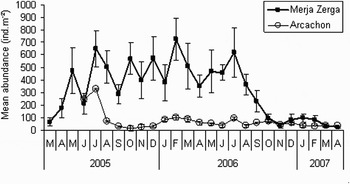
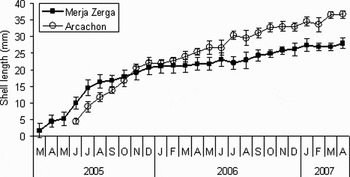
At Merja Zerga, recruitment (i.e. size >1 mm mesh size) started in March but the peak was in May with 475 ind.m−2 (Figure 1). The abundance remained high until July 2006 (approximately 450 ind.m−2). A sudden decrease occurred in August when abundance dropped below 100 ind.m−2 and stayed low until April 2007 when the cohort disappeared. The average mortality rate Z (see Materials and Methods for concerned period) was 3.68 yr−1 (SD = 0.29 yr−1). VBGF parameters were K = 1.5 yr−1 (SE = 0.5 yr−1) and L ∞ = 31.2 mm (SE = 2.9 mm) (Figure 2). Cockle growth performances Φ′ was 3.16. Production and elimination during the life of the cohort were similar (48.5 and 45.0 gDW.m−2, respectively), and P/B and E/B were 2.4 and 2.2 yr−1, respectively (Table 3).
Cockle (Cerastoderma edule) abundance (ind.m−2, ±1 SE) of the 2005 cohort at Merja Zerga and Arcachon.

Growth curves of cockles (Cerastoderma edule) (shell length (L) in mm, SD) from the 2005 cohort at Merja Zerga and Arcachon.

Mean annual biomass (B, g dry weight.m−2), production (P, gDW.m−2.yr−1), elimination (E, gDW.m−2.yr−1) and productivity (P/B, E/B, yr−1) of the 2005 cohort of the cockle (Cerastoderma edule) at Merja Zerga and Arcachon, from the population data set with and without effect of parasites. (Remark: when considering that population dynamics parameters are constant over the years the unit of the production/elimination can be in gDW.m−2.cohort−1 or in gDW.m−2.yr−1).

At Arcachon, recruitment started later than at Merja Zerga (June instead of March) and with a lower peak abundance of 326 ind.m−2 in July (Figure 1). The decrease of the abundance was important during the two following months. The average mortality rate Z was 2.67 yr−1 (SD = 0.22 yr−1). VBGF parameters were K = 1.5 yr−1 (SE = 0.4 yr−1) and L ∞ = 38.3 mm (SE = 4.6 mm) (Figure 2). Cockle growth performances Φ′ was 3.33. Production and elimination during the life of the cohort were 22.2 g DW.m−2 and 8.1 gDW.m−2 respectively, and P/B and E/B were 2.6 and 1.0 yr−1 respectively (Table 2).
Trematode infestation in cockles
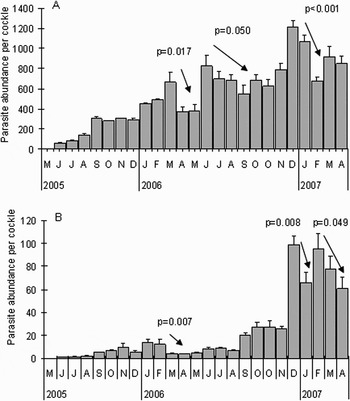
At Merja Zerga, the Gymnophallid infection regularly increased with time to reach ~1200 metacercariae per cockle (MPC) after 1.5 years. However, there were three significant (P < 0.05) decreases of MPC between consecutive months: March (669.4 MPC, SE = 92.3 MPC)/April 2006 (375.9 MPC, SE = 42.7 MPC), June (827.0 MPC, SE = 111.3 MPC)/September 2006 (550.5 MPC, SE = 79.4 MPC) and December 2006 (1209.8 MPC, SE = 70.1 MPC)/February 2007 (682.4 MPC, SE = 36.5 MPC) (Figure 3A). For Echinostomatids, the level of infection was lower (<100 MPC) and there were also three episodes of parasite decreases (P < 0.05) in February (12.5 MPC, SE = 4.5 MPC)/March 2006 (4.2 MPC, SE = 0.6 MPC), December 2006 (99.2 MPC, SE = 7.3 MPC)/January 2007 (66.1 MPC, SE = 9.1 MPC), February (95.2 MPC, SE = 13.7 MPC)/April 2007 (60.7 MPC, SE = 9.9 MPC) (Figure 3B).
Mean abundance of Gymnophallid (A) and Echinostomatid (B) metacercariae per cockle (Cerastoderma edule) from Merja Zerga (+1SE). The arrows indicate when the decrease between successive months is significant. P value of Mann–Whitney U-test between the highest and the lowest values is indicated.

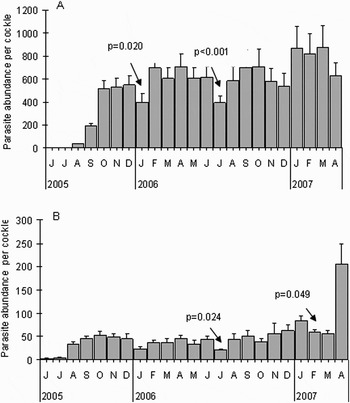
At Arcachon, levels of infection were similar to what was observed in Merja Zerga. There were two significant (P < 0.05) decreases of Gymnophallid metacercariae abundance between consecutive months: December 2005 (547 MPC, SE = 78.3 MPC)/January 2006 (401 MPC, SE = 76 MPC), June (614 MPC, SE = 92 MPC)/July 2006 (396 MPC, SE = 61 MPC) (Figure 4A). For Echinostomatids, there were two episodes of parasite decrease (P < 0.05) in June (44 MPC, SE = 7 MPC)/July 2006 (21 MPC, SE = 2 MPC), and January (85 MPC, SE = 10 MPC)/February 2007 (59 MPC, SE = 5 MPC) (Figure 4B).
Mean abundance of Gymnophallid (A) and Echinostomatid (B) metacercariae per cockle (Cerastoderma edule) from Arcachon (+1SE). The arrows indicate when the decrease between successive months is significant. P value of Mann–Whitney U-test between the highest and the lowest values is indicated.

Effect of trematodes on cockle production–elimination
The impact of metacercariae on cockle production and elimination at Merja Zerga were −35 and −25%, respectively (Table 3). Parasites had no effect on P/B in both sites but reached 14% for E/B (2.2 yr−1 with parasites and 1.9 yr−1 without parasites).
At Arcachon, the impact on production was higher than at Merja Zerga when cockles are parasitized (−34%) and similar for elimination (−22% versus −25% at Merja Zerga) (Table 3). Effect on P/B was nil and reached 20% for E/B (1.0 yr−1 with parasites and 0.8 yr−1 without parasites).
DISCUSSION
This study was the first attempt to evaluate the effect of trematode parasites on host-population dynamics. Results mostly derived from the postulate that the decrease of parasite abundance in a host cohort can be ascribed to the mortality of the most parasitized hosts (Anderson & Gordon, Reference Anderson and Gordon1982; Kennedy, Reference Kennedy1984; Desclaux et al., Reference Desclaux, de Montaudouin and Bachelet2004). The decrease of the mean parasite abundance in a cockle Cerastoderma edule cohort can be due to: (1) immigration of the less heavily infected cockles or emigration of highly parasitized cockles; (2) the death of metacercariae in cockles; or (3) the death of the most heavily infected cockles. Hypothesis 1 can be excluded because of the low locomotive capacity in adult or sub-adult cockles (Zwarts & Wanink, Reference Zwarts and Wanink1989) and the semi-sheltered habitat at both sites. Death of metacercariae could be observed for Echinostomatids because the individuals leave an empty cyst. The number of empty cysts was always very low as mentioned in a previous study (Desclaux et al., Reference Desclaux, de Montaudouin and Bachelet2004). Conversely, Gymnophallid metacercariae are not encysted. However, the colour and the shape change when metacercariae fitness decreases. At Arcachon, such metamorphosis was never observed but at Merja Zerga, a significant number of metacercariae were hyperparasitized, presumably by the pathogenic sporozoan Unikaryon legeri (James et al., Reference James, Sannia, Bowers, Nelson-Smith and Bridges1977; Goater, Reference Goater1993; Gam et al., Reference Gam, Bazaïri, Jensen and de Montaudouin2008). The effect of hyperparasitized Gymnophallid metacercariae on cockles in comparison with the effect of healthy Gymnophallid metacercariae was unknown and consequently the total number of metacercariae was considered. Hypothesis 2, that decrease of the mean parasite abundance in cockles is due to the death of metacercariae, can be rejected. Therefore, hypothesis 3 is the most likely to explain the decrease in parasite abundance per cockle within a cohort. However, the method has one major flaw. When cockles are re-introduced in the database to compensate parasite dependent mortality, they theoretically continue to grow and therefore have a mortality rate. Considering that the impact of metacercariae on bivalve growth is poorly documented and generally considered as moderate (Wegeberg & Jensen, Reference Wegeberg and Jensen2003; Thieltges, Reference Thieltges2006b), we decided to apply K, L ∞ and Z from the natural cockle population of each site (Arcachon and Merja Zerga) to these theoretical cockles.
In both sites, Merja Zerga and Arcachon, parasite communities were similar in species and abundance. As previously observed, cockles were already heavily infected in their first autumn (Desclaux et al., Reference Desclaux, de Montaudouin and Bachelet2004, Reference Desclaux, Russell-Pinto, de Montaudouin and Bachelet2006). Therefore, the parasite pressure on the cockle population could be considered intrinsically even in both sites. For each parasite species, the level of infection was in the average range of what could be observed elsewhere (de Montaudouin et al., in press).
Conversely, cockle populations displayed contrasted features between sites. At Merja Zerja, cockle growth performances Φ′ were slightly lower than at Arcachon Bay; 3.16 compared to 3.33. Apart from the different environmental characteristics, the two-fold higher mean biomass at Merja Zerga could explain lower individual growth through intraspecific competition (Jensen, Reference Jensen1992, Reference Jensen1993; de Montaudouin & Bachelet, Reference de Montaudouin and Bachelet1996). However, these values of Φ′ could be considered as high compared to values found elsewhere which range between 2.35 and 2.93 (Brock, Reference Brock1980; Sanchez-Salazar et al., Reference Sanchez-Salazar, Griffith and Seed1987; Iglesias & Navarro, Reference Iglesias and Navarro1990; Ramón, Reference Ramón2003). P/B and E/B ratios were in the range of what is generally observed (Hibbert, Reference Hibbert1976; Möller & Rosenberg, Reference Möller and Rosenberg1983; Ramón, Reference Ramón2003; Beukema & Dekker, Reference Beukema and Dekker2006). It was particularly elevated at Merja Zerga due to low mortality in a high biomass context. At Arcachon, elimination was low compared to production mainly due to increase of cockle abundance in June 2006. This increase was due to sand migration that concentrated cockles within a narrower area.
P/B was not affected by parasites. Conversely, E/B was strongly increased by parasitism at both sites, increasing between 14 to 20% in parasitized condition. The parasite-dependent mortality pattern displayed similarities following sites and parasite species. For Gymnophallids in both sites, mortality events occurred at any season and when mean number of metacercariae had reached at least ~500 metacercariae per cockle. This parasite was already known to display very high abundances in cockles (de Montaudouin et al., in press). Echinostomatids were also involved in mortality and usually during the winter/spring period as previously recorded (Desclaux et al., Reference Desclaux, de Montaudouin and Bachelet2004). At Arcachon, parasite-mortality events occurred when mean metacercariae abundance in cockles reached 50. In the same site, previous studies showed that the threshold for mortality was similar for the Echinostomatid Curtuteria arguinae (Desclaux et al., Reference Desclaux, Russell-Pinto, de Montaudouin and Bachelet2006), but lower (~10) for Himasthla quissetensis (Desclaux et al., Reference Desclaux, de Montaudouin and Bachelet2004). At Merja Zerga, the threshold was lower than at Arcachon (15 metacercariae per cockle). The vulnerability of cockles from Merja Zerga compared to Arcachon was certainly due to interaction with other factors such as temperature (Jensen et al., Reference Jensen, Latama and Mouritsen1996), Morocco being at the southern limit of C. edule distribution (Gam et al., Reference Gam, Bazaïri, Jensen and de Montaudouin2008).
This study suggested the significant role of digenean parasites in their second intermediate host populations, and the probable interaction with other environmental factors (the reaction of Merja Zerga and Arcachon's populations being different for Echinostomatids). Even though the loss of productivity (E/B) remained moderate (−14 to −20%), that was in a context of normal trematode infestation. It can be expected that the increase of E/B would be even more significant at high metacercariae infestation and of course in the case of mass infestation of the first intermediate host (Jonsson & André, Reference Jonsson and André1992; Thieltges, Reference Thieltges2006a).
ACKNOWLEDGEMENTS
This study has been financed jointly by CNRS (France), CNRST (Morocco), and by the French National Research Agency (ANR) through the project Multistress (Coordinator: X. de Montaudouin). Thanks to H. Rguibi, P. Lebleu and P. Marraco for valuable help in the field work and to SEPANSO for authorizing sampling in the National Reserve of Banc d'Arguin. The authors acknowledge Guy Bachelet and the Swedish twin for their comments, Amelia Curd for improving the English, and the three anonymous referees.