Introduction
Unnatural deaths among released prisoners are more common than would be expected in the general population (Joukamaa, Reference Joukamaa1998; Graham, Reference Graham2003; Stewart et al. Reference Stewart, Henderson, Hobbs, Ridout and Knuiman2004), especially in the first 12 months after release (Harding-Pink, Reference Harding-Pink1990; Binswanger et al. Reference Binswanger, Stern, Deyo, Heagerty, Cheadle, Elmore and Koepsell2007). In England and Wales, released males were found to be eight times and released females 36 times more likely to die by suicide within 1 year of release from prison than would be expected in the general population (Pratt et al. Reference Pratt, Piper, Appleby, Webb and Shaw2006). In custody, prisoners' suicide risk is increased in those awaiting trial (Bogue & Power, Reference Bogue and Power1995), serving longer sentences (Dooley, Reference Dooley1990), committing violent offences (Fruehwald et al. Reference Fruehwald, Frottier, Matschnig, König and Bauer2004), having psychiatric problems (Goss et al. Reference Goss, Peterson, Smith, Kalb and Brodey2002; Shaw et al. Reference Shaw, Baker, Hunt, Moloney and Appleby2004) and drug or alcohol misuse (Dooley, Reference Dooley1990; Winter, Reference Winter2003). Risk factors for suicide by offenders following their release from prison have yet to be established. This study examines the characteristics that differentiate released prisoners dying from suicide from other prisoners post-release.
Method
Participants
The cases in this study were ascertained from the 3-year cohort of released prisoners previously reported by Pratt et al. (Reference Pratt, Piper, Appleby, Webb and Shaw2006). Information on suicides and probable suicides was obtained from the database of the National Confidential Inquiry into Suicide and Homicide by People with Mental Illness (Appleby et al. Reference Appleby, Shaw, Sherratt, Amos, Robinson, McDonnell, McKann, Parsons, Hunt, Burns, Bickley, Kiernan, Davies and Harris2001), which contains information on all people who receive a verdict of suicide or an open verdict at the coroner's inquest. This information was received from the Office for National Statistics for England and Wales. Most open verdicts are cases of suicide and it is conventional to adopt this inclusive definition of suicide (Neeleman & Wessley, Reference Neeleman and Wessley1997). Suicide and open verdicts are referred to as suicides in the rest of this paper.
Cases of suicide, occurring between 1 January 2000 and 31 December 2002, identified by the National Confidential Inquiry were linked with discharge extract files of the Inmate Information System (IIS), a Home Office database containing information on all prisoners in England and Wales whose most recent release from prison was between 1 January 1999 and 31 December 2002. As there was no unique personal identifier common to both datasets, linkage was achieved using surname, initials and date of birth.
The inclusion criteria for cases were that they committed suicide while in the community and that death occurred within 12 months of their release from prison. After excluding those selected as cases, the IIS discharge extract files comprised a complete list of all released prisoners who had not committed suicide post-release. Controls were selected randomly from this list, matched by gender and date of release from prison to cases. When more than one control was identified for a case, a random number generator was used to select the control for inclusion in the study.
Procedures
The study received approval from the Department of Health (DoH) and HM Prison Service to access national data sources containing detailed information about the participants. Offence histories were obtained from the Home Office Offender Index System, a database containing details of a person's full criminal history dating back to 1963. Post-release contact with mental health services was identified using the National Health Service (NHS)-Wide Clearing Service (NWCS), a database containing details of all in-patient, out-patient and accident and emergency contact. Prisoners who had post-release contact with substance misuse services were identified using the National Drug Treatment Monitoring System, a national database managed by the National Treatment Agency for Substance Misuse, containing details about contact with services, treatment history and drug use. To identify prisoners registered with general practitioners, the study accessed the NHS Strategic Tracing Service, another national NHS-maintained database that holds key administrative information for all NHS-registered patients in England and Wales.
In addition to the data obtained from the various official databases, for every case and control in the study, the offender's Inmate Medical Record (IMR) was requested from their discharging prison establishment. Access to the IMR enabled a detailed review of the offender's psychiatric history, contact with health services and clinical management while in prison. In addition, Chief Probation Officers in England and Wales were contacted to identify post-release contact with the Probation Service.
Confidentiality and use of identifiable information
As described earlier, because of the absence of any unique identifier recognized by both the criminal justice system and the NHS, data collection for the study involved processing confidential patient information (i.e. surname, initials and date of birth). According to ethical guidelines, access to such identifiable information should only be provided after obtaining the participant's informed consent. As the cases in the study were deceased, consent could not be obtained; however, the controls for the project were living subjects, some of whom may have had contact with NHS services. Obtaining consent from this group of subjects presented a series of problems.
Contact details for the controls could have been requested from the releasing prisons, but such information is extremely unreliable when attempting to locate the person following release from prison. This was thought to be particularly problematic because control subjects would not have been recruited into the study until at least 12 months following their release from prison. Hence, potential frequent failure to obtain consent would have reduced the sample size and the statistical power of the study. Additionally, the sample would have consisted only of those willing to participate and so would not be typical of the population as a whole, leading to inherent selection biases. Furthermore, the rate of response expected from this approach would be low, as similar research that attempted to re-establish contact with persons 12 months after a court appearance achieved a response rate of only 10% (Shaw, Reference Shaw1997).
Regulations set out under Section 60 of the Health and Social Care Act 2001 make it possible for studies to lawfully obtain access to confidential patient information held by NHS organizations without obtaining the informed consent of the patient. We received Section 60 approval from the DoH (Patient Information Advisory Group, 2006) because the study was seen to serve a wider public good and there was no practicable way the research could have been conducted by either obtaining consent or using anonymized data.
Statistical analysis
Conditional logistic regression modelling was used to identify risk factors for post-release suicide (Hosmer & Lemeshow, Reference Hosmer and Lemeshow2000). Univariate models were fitted for each potential predictor. These models were complemented by a multivariate model comprising variables whose univariate test had a p value <0.05; however, variables that contained less than 10 cases or controls were not included in the model due to potential instability. As the study was exploratory in nature, and with only limited evidence available from previous studies, it was considered premature to match for any potential risk factors suspected of being confounders for this participant group (e.g. age); therefore, all other factors were allowed to vary.
Backwards elimination of explanatory variables, with probability for exclusion set at 0.05, was used to produce parsimonious models. From these models, odds ratios (ORs) and corresponding 95% confidence intervals (CIs) were generated as estimates of the relative risks of suicide in those exposed to each risk factor compared to those not exposed.
Intercooled Stata 9.0 for Windows (Stata Corporation, USA) was used for all statistical analyses.
Ethics committee approval
This study was approved by the Thames Valley NHS Multi-Centre Research Ethics Committee.
Results
Between 2000 and 2002, 384 suicides were identified within a year of release from custody. Of these 384 suicides, 350 (91%) were male and 34 (9%) female. The mean age at time of death was 33.3 years (s.d.=9.7), with ages ranging from 16 to 66 years.
A total of 381 matched controls were identified (348 male and 33 female) with a mean age of 29.7 years (s.d.=9.59) ranging from 16 to 74 years. For three cases, no prisoner of the same gender was released from prison on the same day, therefore no controls could be identified. These cases (two male and one female) were thereby excluded from subsequent case-control comparisons.
Compared with figures from Prison Statistics: England and Wales, 2000 (Home Office, 2001) the sample of controls selected was not significantly different from the population of all prisoners discharged during 2000, in terms of gender (χ2=1.07, df=1, p=0.30), grouped age at release (χ2=5.17, df=7, p=0.64) and type of releasing prison (χ2=6.88, df=3, p=0.08).
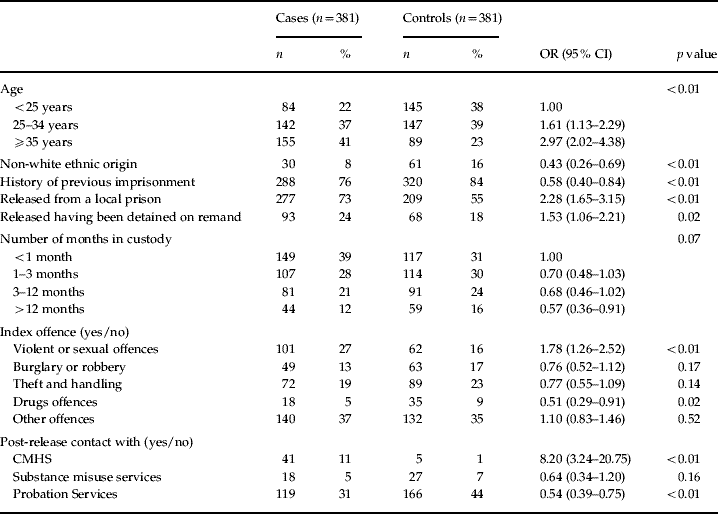
The results from the univariate conditional logistic regression analysis of the personal and criminal characteristics of cases and controls for the whole sample are shown in Table 1. Compared to controls, cases were significantly more likely to be older, to be of white ethnic origin, to have no history of previous imprisonment, and to have been released from a local prison, where those awaiting trial, those serving short sentences, and those serving the early part of longer sentences are located. Cases were also more likely to have been detained pre-trial or pre-sentence and to have been charged or convicted of a violent or sexual offence. A longer stay in prison prior to release was a protective factor, with strong evidence of a falling linear trend in ORs by increasing number of days in custody (χ2 test for trend=6.4, df=1, p=0.01). Cases were significantly more likely than controls to have had contact with Community Mental Health Services (CMHS) following their release from prison, although there was no significant difference between cases and controls in terms of post-release contact with Community Substance Misuse Services. The odds of receiving supervision by probation services following release from prison for cases was half that for controls.
Univariate conditional logistic regression analysis of personal and criminological information for cases and controls

OR, Odds ratio; CI, confidence interval; CMHS, Community Mental Health Services.
Each of the above univariate models was then stratified by age (<30 v. ⩾30 years). However, no significant age interaction effects were found.
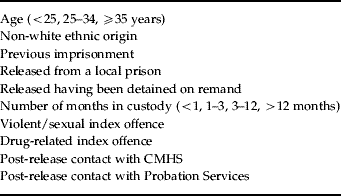
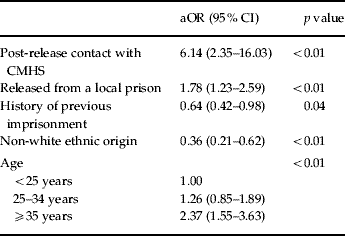
All variables with univariate tests producing p values <0.05 were considered for entry into a multivariate conditional logistic regression model of personal and criminological information (see Table 2). The multivariate model indicated that a higher risk of post-release suicide was associated with requiring CMHS follow-up after release from prison, increasing age over 25 years, being discharged from a local prison and no history of previous imprisonment. Non-white ethnicity was an independent protective factor (see Table 3).
Variables considered for entry into the multivariate conditional logistic regression model of personal and criminological information

CMHS, Community Mental Health Services.
Multivariate conditional logistic regression analysis of personal and criminological information for cases and controls

CMHS, Community Mental Health Services; aOR, adjusted odds ratio; CI, confidence interval.
All 381 of the case-control pairs eligible for inclusion in the model were included.
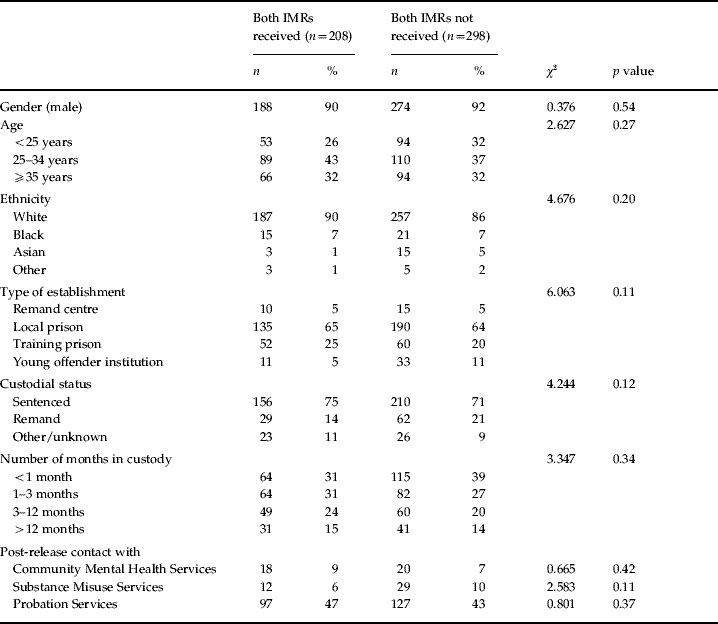
The IMRs provided by the prisoner's releasing prison were significantly more likely to have been made available for more recent suicides (χ2=24.386, df=2, p<0.001) and their matched controls (χ2=14.927, df=2, p<0.001). Because of the low number of IMRs provided for year 2000, analysis was restricted to years 2001 and 2002. For these two years, the study received IMRs for 168 (66%) of the 253 suicides and 151 (60%) of the 253 matched controls. Only those matched pairs for which an IMR had been received for both the case and the control were included in the analysis, that is 104 case-control matched pairs (41% of all pairs for 2001 and 2002). No significant differences were found with respect to any personal or criminological variable between the case-control pairs included in the analysis and those excluded (see Table 4).
Characteristics of case-control pairs whose Inmate Medical Records (IMRs) were and were not received (years 2001 and 2002)

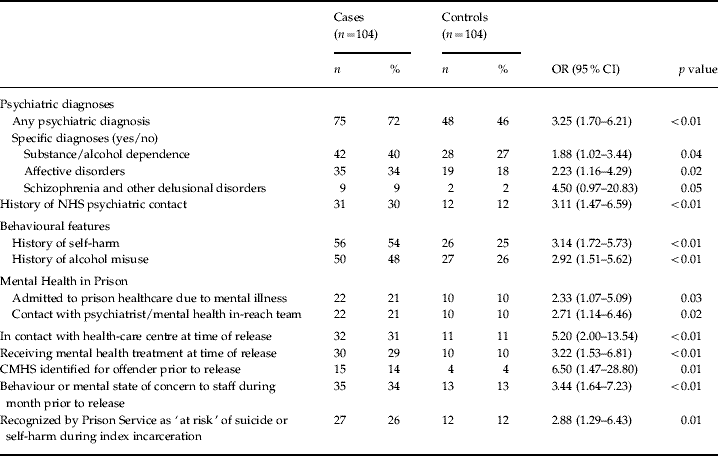
Results from the univariate conditional logistic regression analysis of the IMR information for the 104 matched pairs are shown in Table 5. A significantly increased risk of post-release suicide was associated with having a psychiatric diagnosis, previous contact with NHS psychiatric services prior to custody, history of self-harm, and history of alcohol misuse. While in prison, those who committed suicide on release were more than twice as likely as their controls to have been admitted to a prison health-care centre with mental health problems and to have had contact with a psychiatrist or a prison mental health in-reach team. During the month prior to release, cases were significantly more likely than controls to have been in contact with a health-care professional. Those who committed suicide were also more likely to have been receiving treatment for a mental health problem at the time of release. Cases were significantly more likely than controls to display a behaviour or mental state of concern to prison staff, such as low or depressed mood, or withdrawal from others, during the month prior to release from prison. Finally, those who committed suicide were significantly more likely than controls to have been recognized by the Prison Service's system of assessment and management of ‘at-risk’ prisoners during their most recent time in custody.
Univariate conditional logistic regression analysis of IMR information for cases and controls

IMR, Inmate Medical Record, NHS, National Health Service; CMHS, Community Mental Health Services; OR, odds ratio; CI, confidence interval.
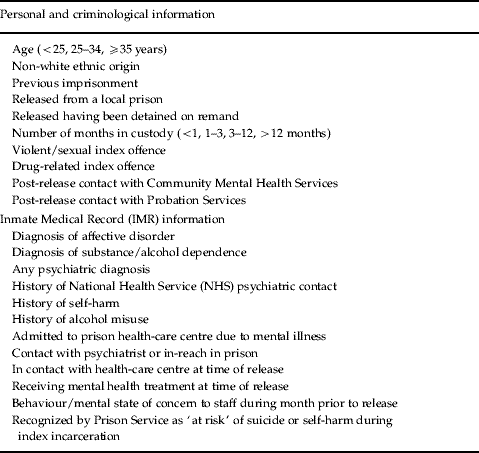
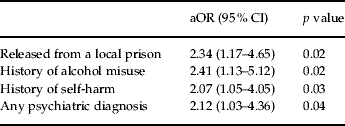
As described earlier, all variables with univariate tests producing p values <0.05 were considered for entry into a multivariate conditional logistic regression model of all personal, criminological and IMR variables (see Table 6). The backwards elimination approach produced a model comprising four risk factors for suicide following release from prison (Table 7). This model suggested that, independent of all other factors in the model, offenders were more likely to commit suicide following release from prison if they had been released from a local prison, or had a history of alcohol misuse or self-harm or a psychiatric diagnosis.
Independent variables considered for entry into the multivariate conditional logistic regression model

Final multivariate conditional logistic regression model

aOR, Adjusted odds ratio; CI, confidence interval.
All 104 of the case-control pairs eligible for inclusion in the model were included.
Discussion
Risk factors associated with suicide following release from prison were: increasing age over 25 years, being released from a local prison, and requiring post-release contact with CMHS. Non-white ethnicity and a history of previous imprisonment were independently protective. Clinical factors associated with an increased risk included having a psychiatric diagnosis, having a history of self-harm or a history of alcohol misuse and, during index incarceration, having been admitted to the prison health-care centre due to mental illness, and having had contact with the prison mental health services. These factors have been shown in both controlled (Fruehwald et al. Reference Fruehwald, Frottier, Matschnig, König and Bauer2004) and uncontrolled (Dooley, Reference Dooley1990; Bogue & Power, Reference Bogue and Power1995; Shaw et al. Reference Shaw, Appleby and Baker2003) studies to be indicators of suicide risk among prisoners in custody. It seems that such factors are also associated with suicide on release from prison.
The cases were more likely to have contact with the prison health-care centre during the index incarceration with ongoing community mental health treatment suggested. They were also more likely to have been recognized by the Prison Service as ‘at risk’ of suicide or self-harm at the time of their release from prison. After release, the cases were likely to have re-established contact with NHS mental health services, but less likely to be eligible for, or to have received, supervision from the Probation Services. An increased risk of suicide for people in recent contact with mental health services has also been reported for suicides in the general population (Harris & Barraclough, Reference Harris and Barraclough1997; King, Reference King2001; Luoma et al. Reference Luoma, Martin and Pearson2002).
Methodological issues
The methodological issues associated with the study's identification of cases have been discussed previously (Pratt et al. Reference Pratt, Piper, Appleby, Webb and Shaw2006) and equally apply to the identification of controls.
Information for each prisoner was obtained from official databases maintained by governmental departments, within the Ministry of Justice or the DoH. Further information for each offender was requested directly from prison establishments responsible for providing custodial services. The locally held records were reviewed by a single researcher. This method of data collection presented the study design with a potential systematic observer bias, as the researcher was not blind to outcome. The effects of any observer bias were limited by extracting the required information from the personal records using a bespoke structured questionnaire based on one with proven psychometric properties used in an ongoing study of suicide in current prisoners (Shaw et al. Reference Shaw, Appleby and Baker2003).
The study reported here was also prone to a potential response bias because the personal records provided to the study may not necessarily have been representative of the whole sample. However, a comparison of study offenders with and without a returned IMR showed no differences with respect to any demographic, custodial or post-release service contact variable (see Table 3). A further limitation of this retrospective study was the potential inaccuracies or omissions within personal records. Finally, the limited number of IMRs provided to the study by the offenders' discharging prisons resulted in a loss of statistical power, as only 41% of the case-control matched pairs for years 2001 and 2002 were available for analysis.
Risk of post-release suicide is highest in the first few weeks after release from prison (Pratt et al. Reference Pratt, Piper, Appleby, Webb and Shaw2006). It would be desirable to stratify by time between release and death to identify specific risk factors pertinent to the highest risk period immediately following release. A lack of power due to the low IMR availability rate prevented such an analysis.
Implications
Suicide prevention may be improving in prisons following the introduction of a strategy to address the continuing rise in self-inflicted deaths (HM Prison Service, 2001). Indeed, the current study identified post-release suicides as more likely to have been in contact with prison mental health in-reach services and recognized by the Prison Service's system of assessment and management of ‘at-risk’ prisoners during their most recent time in custody. However, once the individual walked out through the prison gates, far less emphasis seemed to be placed upon suicide prevention. As prisoners are known to be at an increased risk of suicide, especially during the immediate post-release period (Pratt et al. Reference Pratt, Piper, Appleby, Webb and Shaw2006), one of the ways that prisons and the NHS could reduce the number of suicides is by focusing on those most at risk. The current study has highlighted the key factors associated with an increased suicide risk.
The DoH (2005) recommended that prisoners with mental health problems or at risk of suicidal behaviour should receive follow-up contact from their appropriate community mental health team with intensive post-release support provided according to need. The current study further emphasizes the importance of ensuring such follow-up contact.
The high suicide risk in recently released prisoners could be explained by the reluctance experienced by ex-prisoners in accessing adequate health and social care in the community (Joukamaa, Reference Joukamaa1998). However, the lack of available transitional services designated for the continuity of care of released prisoners may also contribute to offenders' ongoing risk of suicide (Freudenberg et al. Reference Freudenberg, Daniels, Crum, Perkins and Richie2005; Lincoln et al. Reference Lincoln, Kennedy, Tuthill, Roberts, Conklin and Hammett2006). Therefore, it is especially important that the release planning process should promote continued engagement with health and social services. As recommended for patients discharged from mental health in-patient services (DoH, 2002, 2003), prisoners recognized as being at high risk of suicide should be followed up after their release. Continued engagement could be ensured by allocating a case manager to each high-risk individual who would assertively follow up the prisoner upon release for a short crucial time period pending full engagement with the local community mental health team and other services.
Furthermore, because of the unpredictability of a prisoner's release from prison, particularly if they are pre-conviction, the release plan for those identified as at risk of suicide should be developed as soon as the risk is identified. This may be as early as reception into custody. The release plan should be amended according to need while in custody, to ensure that an appropriate and up-to-date release plan is available whenever release occurs.
Released prisoners are likely to come into contact with a plethora of community services including probation (for those leaving prison after a sentence of more than a year), primary health care, community mental health, substance/alcohol misuse and social services. Therefore, it is important that all services operate in an integrated way, sharing information and best practice.
Post-release contact between Probation Officers and released prisoners (Home Office, 2000; HM Inspectorates of Prisons and Probation, 2001) places the Probation Service in an important position for suicide prevention for released sentenced prisoners. The National Probation Service (2004) has begun to address the issues associated with suicide prevention in Approved Premises, which provide controlled accommodation and 24-hour enhanced supervision for offenders in a structured environment with an overnight curfew. The DoH (2007, 2008) is developing the Offender Health and Social Care Strategy to help meet government targets for addressing health inequalities and to help reduce reoffending. The development of this strategy intends to build upon the Prison Service's current suicide prevention initiatives by undertaking further work around reducing suicide in recently released prisoners and offenders being supervised by the Probation Service.
Finally, further research would establish the health, social and criminological factors that make released prisoners vulnerable to suicide. Such research would then permit services to be designed and delivered around the needs of these vulnerable and high-risk individuals.
Acknowledgements
We are grateful to N. Hancock, Safer Custody Group, HM Prison Service, for his assistance in the collection of data. This study was funded by the National Forensic Mental Health Research and Development Programme within the Department of Health, UK.
Declaration of Interest
L. Appleby is National Director for Mental Health in England and overseas England's National Suicide Prevention Strategy. M. Piper is Senior Public Health Adviser, Offender Health, Department of Health.