Introduction
The date palm, Phoenix dactylifera L., is one of the oldest cultivated crops with multipurpose. Central and South America, Spain, Italy, and Africa collectively grow approximately 105 million date palm trees (Heselmans, Reference Heselmans1997). Date palms are the main source of income for approximately 10 million people in North Africa (Zouine et al., Reference Zouine, El Bella, Meddich, Luc Verdeil and El Hadrami2005). Egypt, Saudi Arabia, Iraq, Algeria, Iran, and Libya are the main producing countries in the Middle East (FAO, 2018).
Egypt is one of the largest producing countries, with about 21% of the total world production (FAO, 2020). The latest census of date palms in Egypt was about 16 million trees belonging to different varieties and distributed among different governorates. The production of the different cultivars in Egypt exceeds 1.67 million metric tonnes annually and is favoured by local and foreign consumers alike (Egyptian Ministry of Agriculture, 2020).
Egypt was not even one of the top ten countries exporting dates in 2021, but by 2022 it had risen to the eighth position on the global ranking. Despite being the world's greatest producer of dates, Egypt is still only exporting a very small portion. The challenges that were present in the pre-industrialisation phase, such as inadequate fruit packing used in collecting the fruits to deform and harm the fruits, inadequate storage conditions, and infestation with date pests, were the main reasons Egypt was not exporting more until recently (FAO, Reference FAO2022).
Dried and semi-dried dates have a long shelf life, but many factors including date verity, storage condition, and insect infestation can limit their marketability (Sen et al., Reference Sen, Meyvaci, Turanli and Aksoy2010). Infestation during storage by stored date pests causes post-harvest losses in both quality and quantity, as well as decrease in the market value of dates (USDA-AMS, 2013; Riudavets et al., Reference Riudavets, Pons, Gabarra, Castañé, Alomar, Vega and Guri2014). In Egypt, the major date pests are the almond moth, Ephestia cautella (Walker) (Lepidoptera: Pyralidae) and the Indian meal moth Plodia interpunctella (Hübner) (Lepidoptera: Pyralidae). They are external feeders, and their larvae continuously spin a silk web both inside and on top of the food surface and feed within the web (El-Shafei, Reference El-Shafei2020; El-Shafei et al., Reference El-Shafei, Zinhoum and El-Deeb2020; Assous et al., Reference Assous, El-Shafei, Lewaa and Salem2022).
Several beetles of the order Coleoptera have also been reported as serious pests of dates. The adults and larvae of the saw-toothed grain beetle, Oryzaephilus surinamensis Linnaeus (Coleoptera: Silvanidae), feed on dates by tunnelling between the external fruit skin and flesh (El-Shafei et al., Reference El-Shafei, Zinhoum and El-Deeb2020; Assous, et al., Reference Assous, El-Shafei, Lewaa and Salem2022). In severe infestations, the beetles consume all date contents leaving only the skin or exocarp intact (El-Shafei et al., Reference El-Shafei, Zinhoum and El-Deeb2020). The red flour beetle Tribolium castaneum (Herbst) (Coleoptera: Tenebrionidae) is a polyphagia general feeder and infests a variety of foods including grain cereals, flour, and stored dates. These beetles produce an unpleasant odour, and their presence encourages mould growth (Ahmed et al., Reference Ahmed, Zinhoum, Naroz and Hussain2017). The drugstore beetle Stegobium paniceum (L.) (Coleoptera: Anobiidae) is considered a major pest of stored spices and spice products but attacks such a wide variety of foods and materials that an anonymous author stated that they ‘eat anything but cast iron' and causes tremendous damage and economic losses to post-harvest crops and packaged food products (Ignatowicz et al., Reference Ignatowicz, Janczukowicz and Olejarski2011).
For many years, phosphine gas fumigation was the most effective method of protecting and disinfesting stored grains and other commodities. Now, the development of phosphine resistance in many stored-product insects is a greater challenge in several parts of the world (Nayak et al., Reference Nayak, Daglish, Phillips and Ebert2020). Therefore, phosphine should be replaced by safer and more environmentally friendly alternative methods.
Vapour heat treatments (VHTs) are recommended as an effective method for eliminating fruit flies from infested exported fruits by International Standard for Phytosanitary Measures no. 28. VHT depends on using heated air water vapour to heat commodities at a designated temperature and time to eradicate immature fruit flies within them (Hallman, Reference Hallman1990). VHT for fruit relies on using water vapour at 40–50°C to eliminate pest eggs and immature larvae (Aphis, 2011). Due to their efficiency as fungicidal and insecticidal treatments, the convenience of administration, and lack of chemical residual issues, heat treatments are now frequently utilised as quarantine disinfestation treatments for a variety of tropical fruits in several countries (Srimartpirom, Reference Srimartpirom2013).
Therefore, the objective of this study was to evaluate the effectiveness of VHT as a novel method to control stored date pests and their effect on the quality of the treated dates.
Materials and methods
Insect culture
All insect species utilised in this study were obtained from naturally infested semi-dried dates in the Department of Stored Grain and Product Pests, Plant Protection Research Institute. Adults were obtained from cultures that were sieved daily. Once collected, insects were kept in glass jars (1 l capacity) containing semi-dried date fruits (Siwi cultivar). These jars were maintained in an incubator at 27 ± 2°C and 65 ± 5% relative humidity (RH). The dates were sterilised before use by continuous freezing (−10°C) for at least 2 months; then kept under laboratory conditions for 12 h, before use (Hussain, Reference Hussain2008). After completing the life cycle, newly emerged adults were separated from the dates. The colony was maintained at similar conditions for up to five generations before undergoing treatments. The immature stages (egg, larvae, and pupa) of lepidopterous species; E. cautella and P. interpunctella were separately evaluated, while in the case of coleopterous species; O. surinamensis, T. castaneum, and S. paniceum of all stages were tested.
Preparing the insect species samples for bioassay tests of vapour heat
A total of 50 E. cautella and P. interpunctella eggs were kept in small organza bags (10 × 20 cm2) filled with approximately 25 dates and closed with rubber bands. Thirty fourth instar larvae and 30 pupae (0–2 days old) were placed separately with 25 dates each. In the case of O. surinamensis, T. castaneum, and S. paniceum, 30 larvae (fourth instar), 30 pupa (0–3 days old), and 30 adults (0–2 days old) of each species were placed in small organza bags (10 × 20 cm2) filled with approximately 25 dates and closed with rubber bands. Additionally, the numbers of eggs for each beetle, which resulted from the 15 pairs of adults after 24 h, were carefully transferred to Petri dishes, then examined under a binocular microscope to eliminate injured or abnormal ones (malformed or pale white). The eggs were carefully transferred to small organza bags. All treatments were repeated five times and compared to untreated controls.
VHT chamber
A VHT chamber has outside dimensions of 10 × 10 × 6 m3. The chamber is designed to accommodate fruit holding boxes, which were used as treatment boxes. Infested dates were loaded into plastic boxes, which were randomly distributed horizontally on the land of the treatment chamber in three positions (A, B, and C) depending on proximity or distance from the source of vapour pipes. They were arranged as follows: site A is the closest location to the door, which is far from the steam pipes; then site B; then site C, which is the nearest to source of steam. The boxes were distributed at three heights in the room: first at 40 cm, second at 80 cm, and third at 120 cm. The chamber was then closed for 30 min at 46.5°C. The different positions contained five replicates, each replicate consisted of 100 fruits representing all stages of the different pests (25 fruits infested with eggs, 25 fruits infested with larvae, 25 fruits infested with pupa, and 25 infested with adults). Thermographs were fixed at each site where infested dates were located. Internal sensors were inserted inside one of the infested fruits to measure temperature changes inside the fruit. The sensors were put inside the treatment chamber for observation of temperature changes and were connected to an electronic panel outside the chamber. When the temperature of the treated fruit reached 46.5°C, the internal thermographs began recording. After 30 min, the treatment chamber was opened and immediately cooled using fans. All treatments were removed from the chamber and treated and untreated immature stages with date fruits were transferred into glass jars, closed with muslin, secured tightly with rubber bands, and transferred to incubators at 27 ± 2°C and 70 ± 5% RH and were examined daily to record adult emergence percentages until the emergence of adults stopped. Examination for treated adults occurred 24 h after treatment to record the number of dead insects.
Microbial counts determination
Two samples (treated date in position (C2) and control date) were added to 90 ml of saline solution (0.85%) and serial dilutions of samples were prepared in test tubes containing 9 ml saline solution up to the fifth dilution. Then 1 ml of each dilution was poured into Petri plates followed by pouring of plate count agar medium. The plates were then incubated at 37°C for 24–48 h. Total yeast and mould counts were determined using the plate count method with potato dextrose agar and the plates were incubated at 25°C for 5–7 days according to the Salfinger and Tortorello (Reference Salfinger and Tortorello2015).
Determination of chemical contents of treated stored date fruits by different VHT
The effects of VHT on some chemical characteristics of stored date fruits variety Siwi in tamr stage (quality) were evaluated. Three replicates of ten stored Siwi dates were exposed to the different treatments of (treated date in position A3, B3, C2, and control date) vapour heat, then the following analyses were conducted using randomly selected samples: moisture percentage, determination of total, reducing, and non-reducing sugars were determined according to the AOAC (2000). Total soluble protein levels were calculated according to Bradford (Reference Bradford1976); total amino acids were estimated using ninhydrin as described by McGrath (Reference McGrath1972). The estimation of total phenol contents was conducted by Folin–Ciocalteu's method according to Ainsworth and Gillespie (Reference Ainsworth and Gillespie2007); total indoles were determined according to Selim et al. (Reference Selim, Fayek and Sewidan1978).
Sensory evaluation of dates
The sensory evaluation of exposing date (treated in position C2 and control) a taste panel was conducted using the sensory procedure developed by Ismail et al. (Reference Ismail, Haffar, Baalbaki and Henry2001). Ten panel members on a 10-point scale carried out sensory evaluation for five defined quality: colour, appearance, fruit texture, mouth feel, and flesh thickness (table 1). Panellists rated each sample separately.
Quantitative scoring guide for date fruits

Statistical analysis
The number of dead insects, insect mortality (%), adult emergence, and dates' chemical content were analysed and one-way analysis of variance (ANOVA) was performed at a 5% significance levels using SAS for regression analysis (SAS Institute, 2006) followed by least significant difference (LSD) test to examine the significant differences between the treatments.
Results
Effect of vapour heat on different stages of coleopterous beetles
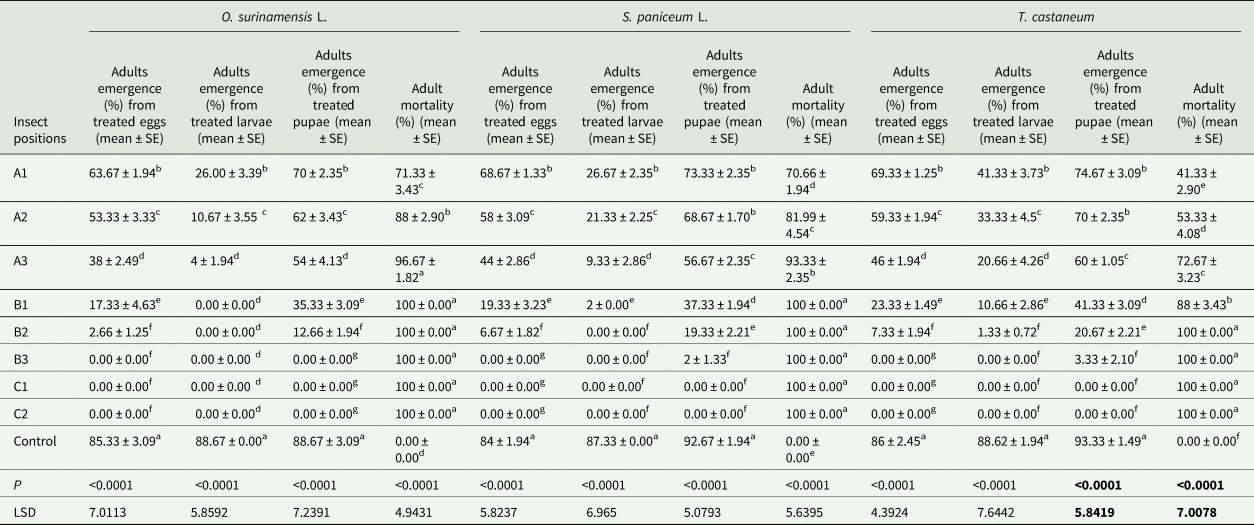
Results concerning the evaluation of the efficacy of vapour heat in eight positions (A1, A2, A3, B1, B2, B3, C1, and C2) on different stages of O. surinamensis, T. castaneum, and S. paniceum are shown in table 2. In adults, the lowest mortality percentages were observed at position A1 (71.33, 70.66, and 41.33) for O. surinamensis, S. paniceum, and T. castaneum, respectively. Complete mortality at five positions (B1, B2, B3, C1, and C2) for O. surinamensis and S. paniceum were recorded, but in the case of T. castaneum, complete mortality occurred at four positions (B2, B3, C1, and C2). No adult emergence from treated eggs of all insects was observed in three positions (B3, C1, and C2) while in larvae, adult emergence was observed in five positions (B1, B2, B3, C1, and C2) for O. surinamensis, four positions (B2, B3, C1, and C2) for S. paniceum, and three positions (B3, C1, and C2) for T. castaneum. Simultaneously, no adult emergence from the treated pupae of O. surinamensis at the last three positions (B3, C1, and C2) and two positions (C1 and C2) for other insects was observed. Results indicated that T. castaneum was the most tolerant insect against vapour heat. Furthermore, the date indicated that the larval stages of all coleopterous beetles were more sensitive to vapour heat. Additionally, the best positions for control of all stages of coleopterous beetles were C1 and C2.
Effect of vapour heat on adult emergence and mortality percentage of some coleopterous date fruit pests

Means followed by different letter are significantly different at 5% level.
Effect of vapour heat on developmental stages of lepidopterous moths
Results of the evaluation of the efficacy of VHT in eight positions (A1, A2, A3, B1, B2, B3, C1, and C2) on immature stages of E. cautella and P. interpunctella are shown in table 3. No adult emergence from the treated eggs of these tested moths was observed in five positions (B1, B2, B3, C1, and C2). The same results were observed for the treated pupae of E. cautella. In contrast, no adults emerged from the treated pupae of P. interpunctella at four positions (B2, B3, C1, and C2). Additionally, adult emergence from treated larvae was recorded only in one position (A1) for the two tested moths. Thus, the larval stage was more sensitive to VHT than other developmental stages.
Effect of vapour heat on adult emergence of some lepidopterous date fruit pests

Means followed by different letter are significantly different at 5% level.
Effect of vapour heat on microbial loads of Siwi dates
Data present in table 4 show the efficacy of exposing dates to VHT at 46.5°C for 30 min. The results indicated that exposing dates at 46.5°C for 30 min and 95% RH reduced the microbial load of the total bacterial count and yeasts and moulds to 4 × 10⁴ and 1 × 10³ cfu g−1, respectively, compared to untreated dates (control) which were 3 × 10⁵ and 1.4 × 10⁴ cfu g−1, respectively.
Effect of vapour heat on microbial load of Siwi date fruits

Effect of vapour heat on certain chemical components of stored dates
Results of the evaluation of the efficacy of VHT in three positions (A3, B3, and C2) on chemical content characteristics of dates as fruit moisture %, percentage, total sugars, reducing sugars, non-reducing sugars, total protein, total amino acid, total phenol, and total indoles are shown in table 5. Results of fruit moisture percentage determination exhibited significant differences between the treatments A3, B3, and C2 was recorded as 27.73, 18.13, and 15 mg g−1 f.w., respectively, compared with the control that recorded as 13.81 mg g−1 f.w.
Effect of vapour heat on certain chemical components of stored date fruits

Means followed by different letter are significantly different at 5% level.
Total sugar percentages in the treated dates recorded were 70.68, 75.47, and 79.95 mg g−1 f.w. after exposure to treatments A3, B3, and C2, respectively, compared to the control which was 69.47 mg g−1 f.w.
Reducing sugar percentages had the same order 50.12, 51.18, and 60.46 mg g−1 f.w., respectively, for treatments A3, B3, and C2, respectively, while the control treatment recorded 49.88 mg g−1 f.w., with insignificant differences observed between the control and treatments A3 and B3, and significant difference with the C2 treatment.
The same trend for non-reducing sugar percentages was found which had insignificant differences between the controls and different date treatments
The date total proteins were measured at 0.15, 0.15, and 0.11 mg g−1 f.w., respectively, for treatments A3, B3, and C2 with significant differences (P < 0.0001) observed between the control and the treatments.
The date total amino acids (mg g−1 f.w.) were 0.31, 0.34, and 0.35 with significant differences between the control at 0.25 mg g−1 f.w. and all treatments.
The phenol contents increased under all treatments and revealed stress. Date phenol contents showed insignificant variance between different hot vapour controlling treatments were 1.72, 1.64, and 1.62 mg g−1 f.w. compared to the control at 1.62 mg g−1 f.w. Examining total indoles showed insignificant differences between all treatment and control.
Effect of vapour heat on sensory evaluation of dates
The results in table 6 indicated that there was no significant effect of exposing dates to VHT or control on the colour, texture, appearance, flavour and flesh thickness (at 5% level of probability).
Sensory evaluation of date exposed to vapour heat

Means followed by different letter are significantly different at 5% level.
Discussion
In this research, we investigated the efficacy of vapour heat to control different stages of E. cautella (Walker); P. interpunctella (Hübner); O. surinamensis Linnaeus; T. castaneum (Herbst); and S. paniceum (L.) of stored dates. The results indicate that VHT had a significant effect on the developmental stages of coleopterous beetles and lepidopterous moths and was directly proportional to the proximity of the heat source within the vapour heat chamber. Moreover, it was found that the rate of failed adult emergence increased with increasing treatment temperatures in all stages that were treated. It was also found that treatment C (120 cm) was the most efficacious treatment and had the highest effect on the tested insects because it had the highest height. Because the density of hot water vapour is lower than air, it rises and thus the highest concentration of hot steam is obtained when the treatment is at the highest position. The same findings were observed by Lestari et al. (Reference Lestari, Wijonarko, Murdita and Suputa2017) who stated that VHT at 47°C for 40 min was effective at decreasing the number of eggs and larvae of Bactrocera dorsalis (Diptera: Tephritidae) and that mortality of eggs and larvae increased along with increasing treatment temperatures. The results are in the same trend with Srimartpirom et al. (Reference Srimartpirom, Rakkrai, Phankum, Intarakamhang, Sonsiri, Buchatian, Phanglerk, Jinnalite, Khongthawie, Unahawutti and Follett2023) who tested VHT against different stages of B. dorsalis in papaya fruit and reported that VHT at 46.5°C for 30 min was enough to cause 100% mortality to different stages of B. dorsalis in papaya fruit. Mohammed et al. (Reference Mohammed, El-Shafie and Sallam2019) revealed that exposing dates to 55°C for 60 min resulted in total mortality for both eggs and larvae of the almond moth E. cautella.
In contrast, Abdel-Hady et al. (Reference Abdel-Hady, Ramadan, Lü and Hashem2021) showed that the total development period of T. castaneum increased with increasing temperature shocks. The larval stage reduced with increasing thermal shocks and greater exposure times, and the pupal stage increased with increasing high-temperature shocks. Additionally, Loganathan et al. (Reference Loganathan, Jayas, Fields and White2011) stated that insect resistance against heat was strong according to species, with its place inside the fruit, and was associated with a combination of temperature and time exposure, as well as insect stage development. Meanwhile, Wigglesworth (Reference Wigglesworth1977) described that the inability of insects to survive high temperatures was caused by metabolic imbalances inside their bodies, which resulted in the formation of a number of secondary metabolites that were secreted from their bodies, exhausting the food reserves in them and causing their death.
The present study found that insects in the order Coleoptera were more tolerant to VHT than insects in the order Lepidoptera. These findings agree with Vearasilp et al. (Reference Vearasilp, Chanbang, Suriyong, Akaranuchat, Krittigamas, Thanapornpoonpong, Sa-nguansak, Hörsten and Pawelzik2015) who reported that the temperature duration of radio frequency heat treatment for efficient control for pests of stored products differed among the insect varieties and that the temperatures used for pest control ranged from 55 to 74°C, for periods of 1–3.40 min.
The obtained results reported that among the insects in the order Coleoptera, including O. surinamensis, T. castaneum, and S. paniceum, the pupa stages were the most tolerant to VHT. This might be because the larva and egg stages contain higher moisture than the pupae stage. This agrees with Loganathan et al. (Reference Loganathan, Jayas, Fields and White2011), who showed that pupae and adult stages of the cowpea beetle, Callosobruchus maculatus (F.) (Coleoptera: Bruchidae), were the most heat tolerant. Additionally, Johnson et al. (Reference Johnson, Wang, Tang, Carvalho, Fields, Adler, Arthur, Athanassiou, Campbell, Fleurat-Lessard, Flinn, Hodges, Isikber, Navarro, Noyes, Riudavets, Sinha, Thorpe, Timlick, Trematerra and White2010) found that the pupal stage of C. maculatus was the most heat tolerant.
The present results revealed that the egg and pupae stages of the order Lepidoptera (E. cautella and P. interpunctella) were more resistant to VHT than larvae and adult stages of the same order. This may be because pupae and eggs can withstand harsh environmental conditions better than larvae or adults. Additionally, this may also be related to differences in the range of activities in the lower respiratory systems of pupae and egg stages compared to larvae and adult stages (Vearasilp et al., Reference Vearasilp, Chanbang, Suriyong, Akaranuchat, Krittigamas, Thanapornpoonpong, Sa-nguansak, Hörsten and Pawelzik2015).
In the current study, the VHT treatment reduced the microbial load of the total bacterial count and yeasts in date compared to control. This agrees with Sakudo (Reference Sakudo2017) who mentioned that high-temperature treatments had gained wide recognition due to their significant efficacy in food decontamination and microbial inactivation. Food thermal processing is a traditional and effective method for microbial decontamination and remains a widely used technique for eliminating pathogenic and spoilage-causing microbes in food products (Khan et al., Reference Khan, Tango, Miskeen, Lee and Oh2017). Direct hot air/steam, hot water baths, shells, plates, or tube heat exchangers are commonly used for the thermal processing of food products to eliminate or reduce the microbial loads in foods (Taylor et al., Reference Taylor, Tsai, Rasco, Tang and Zhu2018).
The obtained data showed that VHT treatment applied to stored dates significantly reduced total protein and increase amino acids in all treatments compared to the control sample. An explanation for this could be that the exposure of dates to VHT led to the stimulation of protein decomposition enzymes that led to the decomposition of total protein molecules into their basic components of amino acids. This decreased the proportion of total proteins and increased the proportion of amino acids. These data are in a harmony with He et al. (Reference He, Liu and Huang2005), who mentioned that when a plant was exposed to heat (40°C), the total proteins increased, and the activity of the protease enzyme and the total amino acids increased. Additionally, Wang et al. (Reference Wang, Yuan, Xu and Huang2018) revealed that in response to heat stress, total amino acid content improved, while the total soluble protein level decreased in both the tested cultivars.
Since sugars are the main constituent of dates, there is a correlation between calorific value and sugar content. Therefore, dates are a preferred main food for the general population, especially during the holy fasting month (Ramadan). Overall, current dates showed that there was a significant increase in sugar content in all treatments compared to control. These findings concur with those of Mohammed et al. (Reference Mohammed, El-Shafie and Sallam2019), who found that dates could be heated to 55°C for 60 min right after harvesting without significantly altering the total soluble solids, colour, or sugar content. Additionally, El-Nazir and Abdelhafeez (Reference El-Nazir and Abdelhafeez2014) revealed that exposing ripened dates to solar energy with a mean temperature of 57.4°C for 24 h did not lead to highly significant changes in the chemical composition, except that some sucrose was inverted to reducing sugars.
The impact of heat treatment on date quality properties is an important factor to consider. The sensory evaluation of date exposing to VHT show a low insignificant decrease in all characteristics compare to control. This is in the same trend with El-Shafei (Reference El-Shafei2015) who evaluated the side effects of microwave heat treatments and the use of direct solar heat as a means of date disinfestation against E. cautella, and reported that the two treatments seemed to not affect the tested physical characteristics or chemical contents of the treated dates. In addition, Hazbavi et al. (Reference Hazbavi, Khoshtaghaza, Mostaan and Banakar2015) said that the effect of post-harvest heat treatment did not affect fruit quality.
Conclusions
VHT is a safe alternative technique for getting rid of quarantine pests of stored dates. Our findings showed that treat dates by VHT at 46.5°C for 30 min caused total mortality to all stored date pests in different stages with no negative effect on chemical or physical characteristics of dates.
Competing interests
None.