Introduction
Glioblastoma multiforme, the most aggressive and invasive type of primary brain tumour, is generally refractory to all treatment modalities, including chemotherapy. Despite advances in surgical techniques, chemotherapy, radiotherapy, prognosis for patients with high-grade astrocytic tumours is extremely poor (Reference Chang and Prados1). Gliomas comprise about 45% of all primary brain tumours and re-associated with a high rate of morbidity and mortality (Reference Newton2).
Antidepressants, including selective serotonin reuptake inhibitors (SSRIs) and tricyclic antidepressants (TCAs), are used to ameliorate the depression (Reference Lieberman3). Antidepressants such as imipramine, clomipramine and citalopram ((S)-1-[3-(dimethylamino)propyl]-1-(4-fluorophenyl)-1,3-dihydroisobenzofuran-5-carbonitrile) have been shown to exert antineoplastic effects both in vivo and in vitro (4–8). SSRIs are among the most commonly used antidepressants because of their efficacy, safety and tolerability (Reference Stafford, MacDonald and Finkelstein9). SSRIs have been shown to possess potent cytotoxic and apoptotic activities in different cell lines. Apoptosis is an active form of cell suicide that is characterised by cell shrinkage, membrane blebbing, chromatin condensation and DNA fragmentation (Reference Wyllie10,Reference Thompson11). In addition, some antidepressants have been suggested to have neuroprotective effects. For instance, the SSRI fluoxetine and TCA amitriptyline reduce cell death because of hydrogen peroxide or lipopolysaccharide in PC12 cells and hippocampus-derived cell line (Reference Chiou, Chen and Peng12,Reference Kolla, Wei, Richardson and Li13). Antidepressants inhibit the decrease of the level of serotonin secreted from the brain. Monoamine oxidases (MAO) inhibit serotonin. SSRIs keep up high MAO by inhibiting the level of serotonin. Compared to SSRIs, MAO inhibitors are rarely used in the treatment of depression in Parkinson's disease (Reference Youdim and Bakhle14). Selective inhibitors of MAO-A usually are more effective in treating major depression than type B inhibitors (Reference Murphy, Mitchell, Potter, Bloom and Kupfer15). In addition, MAO-A is suggested to be involved in the induction and regulation of apoptosis in neurodegenerative disorders (Reference Naoi, Maruyama, Akao, Yi and Yamaoka16). In glioma and neuroblastoma cell lines, it has been reported previously that fluoxetine and paroxetine, not imipramine and mianserin though, induced a rapid increase in p-c-Jun levels, cytochrome c release from mitochondria and caspase-3 activation, suggesting the involvement of the mitogen-activated protein kinase (MAPK) pathway in the proapoptotic process (Reference Levkovitz, Gil-Ad, Zeldich, Dayag and Weizman17). The monocyclic SSRI fluoxetine and zimelidine have been shown to inhibit the proliferation of prostate carcinoma cells (Reference Abdul, Logothetis and Hoosein18). Clomipramine, imipramine and citalopram have been found to induce apoptosis in myeloid leukaemia HL-60 cells (Reference Xia, Bergstrand, DePierre and Nassberger19). In Burkitt lymphoma cells, the SSRIs paroxetine, fluoxetine and citalopram induced apoptosis are accompanied by the activation of caspase and reversed by the overexpression of Bcl-2 (Reference Serafeim, Holder and Grafton20). In fact, SSRIs have been reported to induce a specific apoptosis in Burkitt lymphoma cells (Reference Serafeim, Grafton and Chamba21). In their most recent work, Meredith et al. (Reference Meredith, Holder and Chamba22) have extended these earlier observations to additional drug targeting serotonin uptake and B-lymphoid cell types including multiple myeloma cell lines.
In this study, we examined effects of the escitalopram, an SSRI inhibitor, on cytotoxicity and apoptotic activity in glioma C6 cell line.
Materials and methods
Cell culture and treatment
C6 rat glioma cells obtained from ATCC (CCL-107) were cultured at 37°C in water saturated air containing 5% CO2 in RPMI 1640 (Sigma-Aldrich Co., St. Louis, MO, USA) (pH = 7.4) medium supplemented with 10% heat-inactivated foetal calf serum (Biochrom, Berlin, Germany), 1% penicillin–streptomycin (10 000 U/ml and 10 mg/ml, respectively) (Biochrom) and were passaged every 3 days. NIH3T3 (mouse fibroblast cell line) cells were obtained from the ATCC (CRL 2795). NIH3T3 fibroblast cells, used as negative control, were cultured in Dulbecco's modified Eagle's medium (Invitrogen Corporation, Carlsbad, CA, USA) with high glucose, supplemented with 10% (v/v) foetal bovine serum and 1% (v/v) penicillin/streptomycin. Escitalopram oxalate was provided from Abdi İbrahim Pharmaceuticals, Inc. (Istanbul, Turkey). As a stock solution, escitalopram dissolved in phosphate-buffered saline (PBS) and was stored at −20°C until its use. For each experiment, the stock solutions were further diluted in medium to obtain final concentrations. Both C6 glioma and NIH3T3 cells were treated with different concentrations of escitalopram, while the untreated cells cultured in medium were used as control.
Cell proliferation assay/cytotoxicity
The proliferation of the cells was assessed by MTT [3-(4,5-dimethylthiazol-2-yl)-2-5-diphenyltetrazolium bromide] assay, which was based on the reduction of MTT by the mitochondrial dehydrogenase of intact cells to a purple formazan product. Yellow MTT is reduced to purple formazan in the mitochondria of living cells. This reduction takes place only when mitochondrial reductase enzymes are active, and therefore conversion can be directly related to the number of viable (living) cells (Reference Fotakis and Timbrell23,Reference Mosmann24).
C6 and NIH3T3 cells were seeded into 96-well culture plates at densities of 3 × 10³ cells/well. After 24 h, they were treated with the concentrations (25, 50, 100 and 200 µM) of escitalopram for 24 and 48 h. After the treatment, 10 µl of MTT (5 mg/ml) was added to each well of 96-well plate and incubated for 3 h at 37°C. After incubation the purple MTT-formazan crystals were dissolved by adding 100 µl of dimethyl sulfoxide (DMSO). The absorbance of the samples was measured with an enzyme-linked immunosorbent assay (ELISA) reader (OD570 nm). In the experiment, each group was performed in eight wells. The data are mean values from three different experiments. MTT reduction is used to estimate cell proliferation at the end of the assay. The per cent cell proliferation values were calculated relative to controls, whose cell proliferations accepted as 100%. The IC50 value was calculated from the plots of cell proliferations against concentrations by applying regression analyses on the results of MTT assay.
Apoptosis detection by staining with Annexin V-fluorescein isothiocyanate and propidium iodide
Apoptotic effect was evaluated on the C6 glioma cells through flow cytometry analysis because of the fact that in our study the cytotoxic effect of escitalopram in C6 cells was more significant than NIH3T3 cells. The Annexin V-fluorescein isothiocyanate (FITC) Apoptosis Detection Kit (BD Biosciences Pharmingen, San Diego, California, USA, Cat. No. 556547) was used to detect apoptosis as described by the manufacturer. Briefly, C6 cells (5 × 10⁵/well) were seeded in six-well plates and treated with different concentrations of escitalopram (25, 50, 100 and 200 µM) for 24 h. After the treatment, cells were centrifuged at 1200 rpm for 5 min and the pellets were washed twice with 1 ml of cold PBS. The cells were re-suspended in 100 µl of binding buffer and stained with 5 µl of Annexin V-FITC solution and 5 µl propidium iodide (PI) solution for 20 min at room temperature in the dark. Then, the samples were diluted with 400 µl of 1× binding buffer and processed for data acquisition and analysed on a Becton–Dickinson FACS Aria flow cytometry using FACSDiva Version 6.1.1. Software. At least 10 000 cells were analysed per sample. The fraction of cell populations in different quadrants was analysed using quadrant statistics. The X- and Y-axes indicate the fluorescence of Annexin V (green) and PI (red), respectively. Quadrant settings were based on the control (without escitalopram). It was possible to detect and quantitatively compare the percentages of gated populations in all the four regions delineated. Four distinct phenotypes were distinguishable: viable [Annexin V (−)/PI (−); lower left quadrant, Q3], early apoptotic [Annexin V (+)/PI (−); lower right quadrant, Q4], late apoptotic [(Annexin V (+)/PI (+); upper right quadrant, Q2] and necrotic cells [(Annexin V (−)/PI (+); upper left quadrant, Q1] (Reference Belkaid, Copland, Massillon and Annabi25,Reference Atsumi, Tonosaki and Fujisawa26).
Statistical analysis
The percentage data from MTT experiments were expressed as the mean ± standard error of the mean (SEM) and analysed statistically using one-way analysis of variance (ANOVA). When ANOVA showed significant differences between groups, Tukey's post hoc test was applied to determine the specific pairs of groups showing statistically significant differences. A p-value of less than 0.05 was considered as statistically significant.
The apoptotic results (Annexin V-FITC) were evaluated by flow cytometry using FACSDiva Version 6.1.1. Software and, the apoptotic cells (early and late apoptotic) were determined as the percentage of cells.
Results and discussion
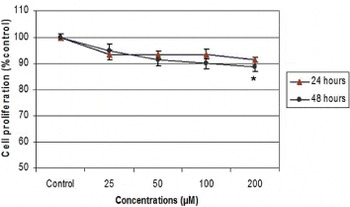
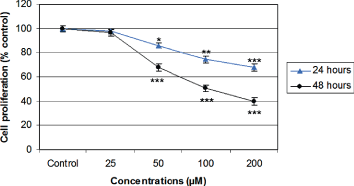
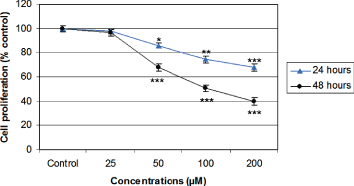
Escitalopram was evaluated for in vitro cytotoxic and apoptotic activities on C6 cell line and NIH3T3 cell line using MTT assay method. Incubation of NIH3T3 cells with escitalopram (25, 50, 100 and 200 µM) was resulted in per cent proliferation of 93.2, 93.3, 93.6 and 91.3 after 24 h incubation and in per cent proliferation of 94.9, 91.3, 90.1 and 88.6 after 48 h incubation, respectively (Fig. 1). When compared to controls there was a significant decrease (p < 0.05) in cell proliferation with escitalopram concentration of 200 µM after 48 h incubation, while no significant cytotoxicities (p < 0.05) were determined on NIH3T3 cells with its other concentrations, which were also applied onto C6 glioma cells (Fig. 1). In contrast to these findings, an increase in cytotoxic effect and a consequent significant decrease cell proliferation were observed with C6 glioma cells depending on increased concentration and prolonged incubation period. C6 cell proliferations relative to controls were determined after 24 h incubation as percentage of 97.7, 85.9, 74.5 and 67.9, and after 48 h incubation as percentage of 96.5, 68.0, 50.7 and 39.9 for 25, 50, 100 and 200 µM concentrations of escitalopram, respectively. As seen in Fig. 2, per cent proliferation values of C6 glioma cells relative to controls were found to be statistically significant depending on escitalopram concentration and incubation time (p < 0.05, 0.01 and 0.001). IC50 value, which was able to be calculated for 48 h incubation period, was determined as escitalopram concentration of 106.97 µM.
Cytotoxicity analysis of escitalopram oxalate in different concentrations against NIH3T3 cells for 24 and 48 h. Cell proliferation (%) was presented as mean ± SEM from three independent experiments. *p < 0.05 compared with control.

Cytotoxicity analysis of escitalopram oxalate in different concentrations against C6 glioma cells for 24 and 48 h. Cell proliferation (%) was presented as mean ± SEM from three independent experiments. *p < 0.05, **p < 0.01, ***p < 0.001 compared with control.
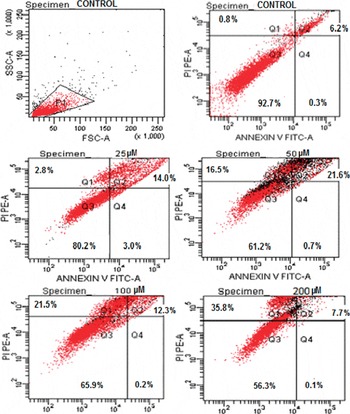
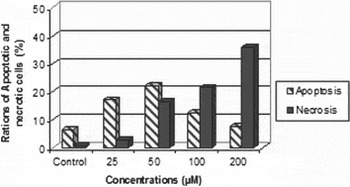
After 24 h incubation period, apoptotic effects of escitalopram concentrations, which were analysed for C6 glioma cells based on Annexin V-PI binding capacities in flow cytometry, were depicted in Figs 3 and 4. Following flow cytometric analyses, early and late apoptotic effects of escitalopram concentrations (25, 50, 100 and 200 µM) were calculated as percentage of 17, 22.3, 12.5 and 7.8, respectively, while their necrotic effects were determined as percentage of 2.8, 16.5, 21.5 and 35.8, respectively. As seen in Fig. 3, especially late apoptotic effects were found to be increased. Percentages of late apoptotic effects at concentrations of 25, 50, 100 and 200 µM escitalopram were 14.0, 21.6, 12.3 and 7.7, respectively (Figs 3 and 4). According to these findings, cytotoxic effect of escitalopram was increased on C6 glioma cells depending on concentration and prolonged incubation period. But the maximum apoptotic effect (21.6%) was found at concentrations of 50 µM escitalopram on C6 glioma cells.
Increasing by escitalopram oxalate of apoptosis on C6 cell line with stained Annexin V-PI by using flow cytometry.

Comparison of percentages of apoptotic (early + late apoptosis) and necrotic cells on C6 cell line with stained Annexin V-PI by using flow cytometry.

Many in vitro studies have shown that antidepressants possess potent anticancer properties with respect to type of antidepressants, mechanisms of their action and cancer cell types (Reference Levkovitz, Gil-Ad, Zeldich, Dayag and Weizman27–Reference Volpe, Ellison, Parchment, Grieshaber and Faustino29). Being unrelated to their mechanisms of action, the antidepressants cause damage in the cells (Reference Levkovitz, Gil-Ad, Zeldich, Dayag and Weizman27,Reference Arimochi and Morita28) arrest their proliferations and convert chemotherapy refractory cells to chemotherapy sensitive (Reference Peer and Margalit30). Similar to our results, Parker and Pilkington (Reference Parker and Pilkington31) explained that clomipramine hydrochloride (CLOM), a TCA in use for over 30 years, selectively killed neoplastic glial cells in vitro whilst leaving normal brain cells were unaffected. Cell lines, derived from a number of patients with malignant glioma, were displayed in different sensitivities when exposed to CLOM. They reported that CLOM targeted the mitochondria of tumour cells and triggered caspase 3 mitochondrially mediated apoptosis, was Annexin V flow cytometry. This assay was used to determine the mechanism of cell death, either necrosis or apoptosis. In some studies, CLOM had previously been reported to exert an apoptotic effect on human myeloid leukaemia HL-60 cells (50 µM) (Reference Xia, DePierre and Nassberger32), and on C6 glioma cells (25 µM) and human neuroblastoma SH-SY5Y cells (20 µM) (Reference Levkovitz, Gil-Ad, Zeldich, Dayag and Weizman27).
Xia et al. (Reference Xia, Bergstrand, DePierre and Nassberger19) found that imipramine, clomipramine and citalopram induced apoptosis in human peripheral resting lymphocytes and human lymphoblastoid cells. Also they showed that the antidepressants used here increased reactive oxygen species (ROS) generation on human acute myeloid leukaemia HL-60 cells, which is an effect compared to the occurrence of DNA fragmentation (Reference Xia, Bergstrand, DePierre and Nassberger19,Reference Xia, Lundgren, Bergstrand, DePierre and Nässberger33). In another study, imipramine, desipramin and amitriptyline (TCAs) and fluoxetine (one of the SSRIs) were shown to cause their cytotoxic actions on HT29 colon carcinoma cells (Reference Arimochi and Morita28).
In conclusion, we observed in this study that escitalopram had cytotoxic and apoptotic effects on C6 glioma cells more significant than those on NIH3T3 cells being representative of healthy cells. To the best of our knowledge, this is the first study reporting the apoptotic effects of escitalopram on C6 glioma cells, and our results provide evidence that escitalopram may be useful cytotoxic drugs on cancer cells. As there is no experimental study on this subject, findings obtained in this study seem to be important. However, it still remains to elucidate the detailed mechanism(s) underlying the cytotoxic actions of SSRIs and, they may be applicable for the clinical treatment of cancers in combination with other anticancer agents. Therefore our studies related to the effects of these drugs on the apoptotic pathway are in progress.
Acknowledgements
Flow cytometry analyses of the present work were carried out at Medicinal Plants, Drugs and Scientific Research Center (BIBAM), Anadolu University. Authors gratefully thank to Abdi İbrahim Pharmaceuticals, Inc. The authors declare that there are no conflicts of interest.