In 1374 the Augustinian canons of England, one of the largest religious orders in the land, were facing a pressing problem: the issue of what canons were wearing on their feet and on their legs. In this year representatives of the order were meeting at Northampton for one of their thrice-yearly general chapters, where superiors of the various Augustinian abbeys and priories would meet to discuss matters of interest to the order, such as discipline and education. The chapter issued a decree warning that some of the canons of the order were breaking the Rule of St. Augustine; that the support of the people for the Augustinian canons was diminishing; that scandals and injuries were plaguing the order and would continue to do so if nothing were done. What was distressing the canons at the Northampton general chapter so greatly was “the abuse of shoes and hose” (abusu caligarum et sotularium).Footnote 1
This may seem a little extreme to us—what harm could a shoe really do to one's soul?—but the adoption of shoes and hose and the abandonment of boots by some members of the order was worrying to those canons who sought to protect the traditional habit from the influence of lay fashion. These seemingly trivial disagreements about specific garments and footwear masked real anxieties about establishing and preserving monastic identity in a changing society. The concern about monastic attire in the late Middle Ages is also representative of the larger issue of the intrusion of the secular world into the cloister and the threat this might have posed to the integrity of religious life. In addition, these controversies reflect a continuing desire to achieve a uniformity of practice regarding dress within every religious order, with the result being a more clearly defined corporate identity for each order. Church bodies from the thirteenth to the early sixteenth centuries endeavored to legislate modest, plain, and distinctive dress for members of the religious orders, but such legislation was never entirely successful in achieving uniformity of dress or in preventing the infiltration of lay clothing styles into the cloisters.
Such attempts to control the outward appearance of members of religious orders should not be seen in isolation from the actions taken by a range of authorities in the later Middle Ages to restrict what clothing could be worn and by whom. In this period, secular rulers and civic governments alike expressed concern about the attire worn by laypeople and members of the clergy and attempted to regulate it through the enactment of sumptuary laws. In Europe in the twelfth to fifteenth centuries, urban expansion and the growth of trade contributed to the greater availability of a range of textiles and wider opportunities for consumer consumption.Footnote 2 Beginning in the twelfth century in western Europe, secular authorities issued decrees aimed at limiting the type and value of clothing and accessories worn by the laity. Pinning down the reasons for the appearance of sumptuary laws has been somewhat elusive. The secular authorities may have been influenced, it has been suggested, by ecclesiastical pronouncements of the time against the wearing of stylish clothing by members of the clergy and of religious orders.Footnote 3 François Piponnier and Perrine Mane, referring to fifteenth-century laws, drew attention to the moral component of such legislation. In examples from Germany, the acquisition and display of luxurious dress was one of a number of behaviors such as alcohol abuse, gambling, and dancing that urban governments deemed illicit. In a sumptuary law of 1403 from Savoy, the limits on clothing were justified on the basis that immodest dress was sinful and “might arouse the wrath of God and cause plague and other miseries.”Footnote 4 Other historians have seen the sumptuary laws primarily as instruments of social control—attempts by members of civic or aristocratic elites to construct a stable system of visual reference points that would “fix” an individual's status.Footnote 5 Sarah-Grace Heller has also noted that French sumptuary laws could be used to delineate the difference between cleric and layperson.Footnote 6
Whatever the social issues behind the appearance of the sumptuary laws—and it is likely that these issues varied according to time period and geographic location—it is clear that they reflect a concern with the definition and enforcement of norms regarding appropriate attire that was pervasive in western Europe in the twelfth to fifteenth centuries. As E. Jane Burns has pointed out in reference to clothing in courtly literature, “clothing, through its unique positioning between the body and society, can articulate a politics of gender and status that might trouble ruling paradigms, whether economic or ideological.”Footnote 7 Evidence of this unease over dress can be seen, for example, in late medieval English books of advice for children and young people, the authors of which urged parents to ensure that their children were dressed “modestly and decently, according to their social rank.”Footnote 8 Anxiety over being unable to properly identify “the other” in medieval society also led to the imposition of a host of regulations on members of various marginal groups. Ecclesiastical and secular authorities in later medieval Europe decreed that lepers and prostitutes had to wear distinctive clothing or identifying marks on their dress in order to make their identities known to members of “mainstream” society and prevent any accidental mixing of the groups.Footnote 9 The fear over miscegenation was a factor in the decision of Church officials meeting at the Fourth Lateran Council in 1215 to issue a decree that Jews henceforth had to wear some sort of unique badge.Footnote 10
The Fourth Lateran Council was also concerned with the issue of members of the secular clergy wearing lay-associated dress. The secular clergy did not have a habit per se, the tonsure being the defining visual mark of a man in holy orders, but conciliar and synodal pronouncements had long emphasized the importance of modest, unadorned, and inexpensive dress for clergy.Footnote 11 Canon 16 of the Fourth Lateran Council reasserted this position and provided more specific directions on what a cleric ought not to wear: garments of immoderate length, divided outerwear, red or green clothes, garments with sleeves (“unless a justifiable fear requires a change of dress”), and pointed-toe or embroidered shoes.Footnote 12 Synodal legislation from England in the thirteenth century continued to include decrees against the adoption of colorful, extravagant clothing by clerics and consistently stressed that such apparel represented indulgence in the sin of pride and a blurring of lines between clergy and laity.Footnote 13 The creation and enforcement of a set of rules fixing the external representations of clerical identity was an enduring challenge for Church officials.
Some scholars have delved into the changes in clerical and monastic dress in the later medieval period, but the field remains understudied.Footnote 14 There has been relatively little attention directed toward how one of the larger religious orders of the Middle Ages, the Augustinian canons, dealt with these issues. Fortunately, documentation does survive that provides some insight into the tensions within this order between those who wished all canons to dress modestly and consistently and those who wished to either preserve local variations within the habit or incorporate elements of lay costume. From the time of the Fourth Lateran Council in 1215, the canons, like the Benedictine and the Cistercian monks, were required to hold general chapters every three years. A selection of the proceedings and decrees of the chapters of the English Augustinian canons has survived, as have papal responses to requests from English canons who sought to get around these decrees. From the thirteenth century up to the early sixteenth century, one topic that came up at the general chapters in England, time and time again, was that of dress.
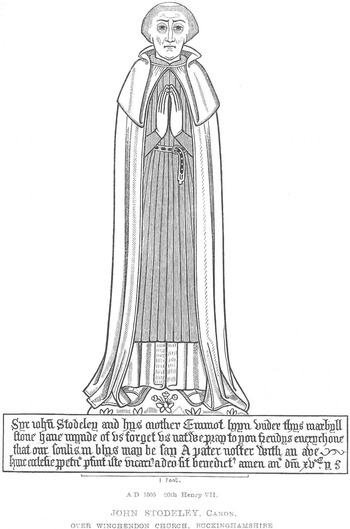
In order to understand what the canons who attended the general chapters and issued decrees on dress were attempting to achieve, it is useful to have some idea of what the standard elements of the habit of the Augustinian canons were. One immediately encounters the difficulty, however, that from the time of its origins in the eleventh century, the order of the regular canons consisted of a wide range of communities, with adherence to the Rule of St. Augustine only gradually acting as a unifying factor.Footnote 15 One of the appealing characteristics of this Rule was the generality of its guidelines, which on the issue of clothing are limited to proscriptions against dress that is notable or offensive.Footnote 16 Certain traditions did develop, however, chiefly that regular canons, unlike monks, could wear linen garments such as the rochet, which would be worn over a sheepskin-lined cassock (the pellicea or pellicium). In addition, the short capelet known as the almuce, the black choir cloak (capa nigra), and the rain cloak (capa pluviale) became associated with the Augustinian canons (see fig. 1).Footnote 17 However, given the extremely loose
—An Augustian canon wearing a hooded cloak and a tight-sleeved rochet over a fur-lined cassock. Source: Rev. Charles Boutell, The Monumental Brasses of England (London: George Bell, 1849).

organization of the Augustinian order before the Fourth Lateran Council, it should not be surprising that while some articles of clothing were adopted by a significant number of canons and became associated with the order, a uniform habit that was worn exclusively by Augustinian canons and consistently by every member of the order did not exist. Indeed, one of the functions of the general chapters of the order, when they began to be held in the thirteenth century, seems to have been to attempt to eliminate the diversity of practices—regarding clothing and other matters—within the order.
Searching for a description of the habit of a “typical” Augustinian canon, then, is ultimately a rather frustrating enterprise. The Liber Memorandorum Ecclesie de Bernewelle, which contains a section on the Observances of Barnwell Priory in Cambridgeshire, provides a useful delineation of the expectations of the attire of an Augustinian canon at one house in thirteenth-century England.Footnote 18 Few such documents survive from English Augustinian houses, so the glimpses that this text provides of the norms pertaining to dress at this one house are particularly welcome, although one must keep in mind its limited perspective. At Barnwell, the obedientiary in charge of the clothes of the canons was the chamberlain, and it was his responsibility to employ a servant for the tailery.Footnote 19 Twice a year the chamberlain would distribute the servant's creations to the canons. At Easter, each canon would receive a surplice, three pairs of linen breeches, a pair of leather summer hose that extended up above the knees, a pair of leather shoes, a pair of serge or canvas leggings, and a cape made of the nappy woollen cloth called frieze, which was not to be lined with fur. Just before Michaelmas, the second distribution of clothing was to occur, and this time each canon could choose between a new tunic of blanket cloth or a cassock of lambskin; he could also expect a black lambskin with which to repair the hood of his choir cloak. In addition, he would receive a pair of leather felted boots, a pair of leggings, and two pairs of shoes of blanket cloth.Footnote 20 Other than the black hood, no other color is mentioned specifically, but the text goes on to say that a canon cannot wear a garment “of a colour other than that which the observances in accordance with the Rule demand.”Footnote 21
The regulations concerning the robing of novices at the time of their acceptance of the habit provide some insight into how the clothes of an Augustinian canon were worn. After being shaved and having removed his own clothes, a novice was to “dress himself in new drawers (femoralia), gaiters (caligae), shoes (sotulares),” and fur-lined cassock, over which he would wear a gown and almuce.Footnote 22 After being questioned to the satisfaction of his superior, he would remove the gown and almuce and put on the surplice (superpellicium) and quire-cope.Footnote 23
It is difficult to know how representative the Barnwell Priory Observances are of the clothing practices of Augustinian houses in thirteenth-century England, or even of the priory itself. Some points that recurred in the statutes of the general chapters do emerge here, however. Almuces, rochets, surplices, and black capes were essential parts of the canon's habit, and the house's tailor was to ensure that none of these garments, or any others, violated the Rule of St. Augustine through their “notability.” This concern is echoed in one of the earliest records of an Augustinian general chapter. In 1234, the canons attending the chapter of the southern province of England in Oxford declared that members of the order were to wear black capes in the monastic enclosure and outside.Footnote 24 The general chapter also specified that, in imitation of the Levites in the time of Moses (a reference to Exod. 28:39–43), all canons were to wear linen tunics; a canon was to choose a tunic with narrower sleeves for trips outside the monastery and fuller sleeves when staying within the enclosure. Moreover, the Augustinian canons could wear shirts of linen or, with their superiors’ permission, linsey-woolsey, as well as white tunics, white stockings, and round shoes that extended up to the middle of the shin; they were not allowed to trim their garments with squirrel or rabbit fur. The canons meeting at Oxford firmly reminded all members of the order—both canons and conversi (lay brothers)—of the prohibition in the Rule against clothes that were in any way “notable.”Footnote 25
The drive for uniformity of appearance in the dress of the Augustinian canons continued into the fourteenth century, as evidenced from a reference in the records of the general chapter of the southern province held in London in 1318. The abbot of Cirencester and the prior of Lanthony, presidents of the chapter, made the decision to request contributions from all superiors of Augustinian houses in England and Wales to help pay the legal expenses of fighting the appeals of certain canons to the courts of Canterbury and Rome.Footnote 26 The canons who undertook these appeals were upset that previous presidents of the chapter had decreed that Augustinian canons were no longer to wear white cloaks. One superior who resisted was the prior of Twynham, who appealed to the pope, insisting that the canons of his house had previously worn surplices and white cloaks in summer but now the presidents of the chapter were telling him the canons could only ever wear black cloaks. It is unclear why some Augustinian canons would ever be wearing white cloaks rather than the usual black; most probably it was just another instance of the persistence of a local custom. But for those interested in establishing a corporate identity for the order of the Augustinian canons, such variations were frustrating because they led to confusion. How would one recognize an Augustinian canon if he were wearing white, especially since this was the color of the habit of other orders, such as the Premonstratensians?
Clearly the appearance of the cloak was of utmost importance in marking the identity of the order to which the wearer belonged: as Michel Pastoureau pointed out, “for medieval culture, any cloak is a medium for signs.”Footnote 27 Pastoureau was referring to the medieval legend that the Carmelite Order was founded by the prophet Elijah, who handed his cloak, striped with flame marks, to his follower Elisha and thereby indicated what the habit of the order would be. While the cloaks of the Augustinian and Premonstratensian canons may have been less attention grabbing than the striped ones worn by the early Carmelites, they nonetheless made clear to the observer that the people inside the cloaks were members of certain groups.Footnote 28 Not only was the wearer obviously a religious, he or she could be identified as a particular kind of religious, and perhaps even as a religious of a particular order from a particular region. Writing about the twelfth century, the period of expansion for the Augustinian and Premonstratensian canons, Caroline Walker Bynum described the competition between the various religious orders of the era as an expression of a desire “by each of the competing groups to define itself … [and] to underline and articulate differences.”Footnote 29 The color of the cloak was a key component in conveying a group's self-definition.Footnote 30
Effective expression of the identity of a religious order, however, required agreement on the form such expression would take. Pastoureau noted that the iconographical evidence suggests that there was great variation in the colors and types of stripes on the cloaks worn by the early Carmelites; the only consistent point was that the cloaks were striped.Footnote 31 Similarly, some Augustinian canons in England felt that local traditions concerning the color of their cloaks were valid and rejected the idea that only black was acceptable. As early as 1232, a general chapter of the northern province meeting at Gisburn forbade rain cloaks that were burnet (brown) or russet, decreeing that all should be in conformity of habit in summer and winter.Footnote 32 Such decrees indicate that reaching unanimity on such a basic part of the outward identity of a religious order—the color of the outerwear of its members—was no easy task. The Premonstratensian canons, who, like the Augustinian canons, followed the Rule of St. Augustine, were mired in controversy in the fifteenth century over the attempts of some Premonstratensians to adopt elements of the Augustinian habit, particularly the black garments and the linen rochets.Footnote 33 If this trend had been allowed to continue, it is hard to imagine how the unique corporate identity of the Premonstratensian order could have been maintained. Barbara Harvey found that the Benedictine monks of Westminster Abbey displayed a “sustained loyalty to black” throughout the late Middle Ages and thereby “affirmed their corporate identity and solidarity with other monks of their order”; on the other hand, the fact that one of the recurring themes in legislation that was aimed at the Benedictines from the thirteenth to fifteenth centuries was the insistence on drab colors for the garments of monks and, in particular, black for their outerwear, suggests that not all Benedictines in England were happy with their somber attire.Footnote 34 Even in the monastic context, the desire for self-expression through color could not be completely suppressed.
By 1328, when the general chapter of the southern province of the Augustinian canons met in Huntingdon, there seems to have been less anxiety about enforcing uniformity within the order and more about preventing the adoption of unusual lay fashions. And no wonder: the fourteenth century saw the advent of new styles of dress and the greater availability of a range of fabrics in a variety of colors.Footnote 35 Such novelties did not win universal acclaim, especially when those adopting the new fashions were members of religious orders. Contemporary satirical writings on the various social estates flourished, and authors condemned monks of this period for wearing fine furs (especially gris, fine gray squirrel fir), jewels, and “fashionable tight shoes” rather than boots.Footnote 36 Popes, Benedictine general chapters, and even King Henry V of England attempted to legislate against the monks’ adoption of brightly colored, form-fitting clothes or garments with openings on the front or sides.Footnote 37
Perhaps the most famous commentary on monastic fashion in fourteenth-century England is that of Chaucer, who describes the attire worn by the character of the monk in The Canterbury Tales. In the General Prologue to the tales Chaucer depicts the monk as someone who rejects the traditional ideal of monastic asceticism. Daun Piers is devoted to hunting, and he is not interested in strict adherence to a monastic rule; he would rather be out in the world than confined to a cloister reading books. He is fat (perhaps a glutton) and he rides a fine horse. Central to this image of a comfortable monk who is focused more on aristocratic pursuits than on spiritual ones is a description of his dress: the sleeves on his gown are “purfiled” or trimmed with “grys” (gris) at the hand (i.e., at the cuff), he has a gold pin shaped like a lover's knot to fasten his hood, and his boots are made of “souple” (supple) leather.Footnote 38 Laura Hodges attempts to soften the negative interpretations of Chaucer's monk by pointing out that only on one point (the wearing of gris) is Daun Piers in violation of the clothing forbidden to monks in a mid-fourteenth-century decree of a Benedictine provincial chapter (ca. 1363). That decree prohibited the wearing of tight, buttoned tunics and surcoats; excessively wide, long, or short garments; colored garments; jewelled or silken belts; riding cloaks or unconventional cloaks; tight boots and boots with pointed tips; and any other fur or fur trim besides black. In comparison to what he might have been wearing, then, Daun Piers's costume appears to be relatively modest.Footnote 39 One must keep in mind, too, that especially as the fourteenth century advanced, monks were not the sole targets of social commentators. Critics fixed their gimlet eyes on the clothes worn by members of the clergy and by laypeople as well. With the appearance of more form-fitting garments and clothes decorated in unusual ways, chroniclers condemned all who embraced such fashions.Footnote 40 One monastic chronicler, John of Reading, asserted that laypeople in England in 1344 had “abandoned the old, decent style of long, full garments for clothes which are short, tight, impractical, slashed, every part laced, strapped, or buttoned up, with the sleeves of the gowns and the tippets of the hoods hanging down to absurd lengths, so that, if truth be told, their clothes and footwear make them look more like torturers, or even demons, than men. Clerics and other religious adopted the same fashions, and should be considered not regulars but irregulars.”Footnote 41 Attempts made by the Augustinian order in England to prevent its canons from following such trends must be viewed in the light of contemporary negative reaction to the adoption of these fashions by laity, clergy, and religious alike. For those endeavoring to maintain discipline in a large religious order, the attraction of some of its members to form-fitting, body-conscious clothing must have seemed especially worrisome.
In addition to medieval satirists, many discipline-minded prelates were concerned with the fact that Church decrees were ineffective in preventing the adoption of lay fashions by members of religious orders. The frequency with which these decrees were passed by Church councils, synods, and chapter meetings indicates how entrenched this attraction to lay dress was.Footnote 42 This should not be surprising. By the late Middle Ages, many monks, canons, and nuns were accustomed to living lives of material comfort, and they would have had little taste for the plain habits of coarse cloth of earlier centuries.Footnote 43 For religious from wealthier families, the requirements of the habit resulted in a basic conflict over identity. In a profoundly status-conscious society, must they really reject every single trapping of the station they were born into, down to their last pair of fine shoes? For the purists, the answer was yes; one did not adopt a partial habit when one joined an order, one adopted it all and for life. The habit proclaimed that one was removed from the sins and distractions, fashions and fads of secular life and was instead focused on the eternal, unchanging spiritual realm.Footnote 44 The importance of the habit to monastic identity is indicated by the fact that if members of a religious order discarded the habit for secular clothing, the assumption was that they were rejecting their monastic vows and were consequently guilty of apostasy.Footnote 45 But those who threw off their habits were probably always a small minority. It appears that much more common—and much more difficult to eradicate—was the desire to indulge in the human tendency toward ornament, display, and differentiation in dress.
One must also not rule out the desire to firmly establish a gender identity as a motivating factor among members of religious orders who adopted elements of lay dress. The new slashed or knife-shaped elements in male attire of the fourteenth century have been linked with “the virile look and form-enhancing sharpness of innovative knightly plate armour.”Footnote 46 As well, with the advent of the short, tight tunics which so shocked John of Reading, the new fashions emphasized the shape of the male form in a way that the long gowns of the previous era had not.Footnote 47 One French chronicler asserted that in his country in the early 1340s the tunics had been “so short that both their buttocks and their private parts were pretty well visible.”Footnote 48 While the English Augustinian canons may not have adopted fashions that were quite so extreme, they could hardly have been unaware that the long garments of their habits left them in an ambiguous position once clothing that drew attention to men's lower bodies became normative, an idea that historians have also considered. Jacqueline Murray has recently discussed how some male monastic writers in the twelfth and thirteenth centuries equated the habit with strength and virility and secular clothing with effeminacy.Footnote 49 Some canons, especially those who attended the general chapters and pushed for legislation condemning the adoption of lay dress, may have shared this point of view. However, others, especially younger members of the order who were studying at Oxford or Cambridge, relished the opportunity that the change of fashion had provided to reveal the outlines of their bodies and even to revel in the attention this gained them.
The infiltration of the regular life of the English Augustinian canons by lay trends was not an entirely new development: as far back as 1247 the general chapter for the northern province held at Newburgh had strongly condemned the desire of some canons to acquire, “just as a dog returns to its vomit,” lay-associated objects, such as footwear with folds (maxime calciamenta plicata), painted belts, sharp, gilded knives for bread, and horse trappings with crescent pendants.Footnote 50 The first inkling that some Augustinian canons of the fourteenth century were scandalized by the clothing of some of their brothers can be found in the records of the general chapter held at Huntingdon in 1328. At this meeting, the canons issued a decree prohibiting the wearing of tunics, surcoats, or any other garment with a split front whose oddness or ugliness would attract attention and thereby render them unacceptably “notable.”Footnote 51
The general chapter of the Augustinian canons of the southern province, meeting at Dunstable in 1334, voiced concerns about dress in the context of allegations about canons’ participation in secular activities. Among the decrees were prohibitions against the wearing of blue cloaks and surcoats with either broad, hanging sleeves or buttoned sleeves—trends that were popular in contemporary lay clothing.Footnote 52 In addition, there were bans against the singing of “unseemly secular songs,” dancing, or being present at dances. Clearly some people in the order felt that canons were being led astray by association with frivolous lay activities, and discipline needed to be imposed. Deviation from the accepted habit for canons was part of a worrying set of behaviors that suggested that the line between lay and religious manners was blurring. The limited effectiveness of the statutes of the general chapters is reflected in the fact that at the next meeting of the canons of the southern province, in 1337, those in attendance reaffirmed the decree from the previous chapter condemning the participation of canons in lay activities. In addition, the canons in 1337 declared that members of the order were not allowed to engage in archery with laypeople in public, go out without their leggings, or frequent taverns.Footnote 53 That some canons were actively trying to thwart the restrictions on clothing is reflected in another statute of the general chapter of 1334, which states that during the period of vacancy after the death of an abbot or prior, there was to be no easing of the regulations governing the canons’ habits or food allowances, not even if there had been oaths taken about this before the superior's death.Footnote 54 This statute makes clear that at some houses those aspiring to become abbots or priors had made promises to their brother canons to allow greater freedom in these areas if elected. Enforcing monastic discipline in matters of dress and food must have been a challenge when the only pressure to adhere to the statutes came from external sources, the visitors of the order or the local bishop, rather than internal figures of authority.
Anxiety about the state of discipline among the religious orders reached the highest levels of the Church in the fourteenth century. In 1337, Pope Benedict XII drew up new constitutions for the Benedictine monks, and in 1339, he turned his attention to the Augustinian canons.Footnote 55 In his constitutions for the canons, Benedict laid down the law on clothing: outside monastic grounds, the canons were not to wear other clothes on top of their habits, except for capes, decent mantles, riding capes, or ankle-length cloaks. Prohibited was the use—or abuse (usum seu verius abusum)—of travelling bags (manticarum), surcoats (tabardorum), or riding cloaks or other cloaks of remarkable shortness. Short choir cloaks were also banned, as were very long ones. Hoods also merited attention: canons could not wear them in churches, cloisters, chapter houses, refectories, or dormitories and had to substitute almuces, the shoulder cape traditionally worn by canons. Hoods could be worn outside these places if they were respectable and were worn with capes or riding cloaks of the same color.
The almuces of the canons had to be woollen and of the same color as the cloaks; they were specifically not to be lined with squirrel fur, whether it was from the belly of the squirrel, or both the belly and back. In this period, the whole pelt of the squirrel was referred to as “vair” since a “varied effect” would come from the alternation of gray back fur and white belly fur. “Gris” or just “grey” was fur that came just from the gray backs of the winter pelts of squirrels (“miniver” came just from white belly fur). Vair and gris came from Baltic squirrels, with the thick winter pelts from the most northerly regions being the most prized.Footnote 56 Fur-trimmed almuces were clearly signs of status, as the many petitions to the pope from English noblemen and kings asking for their chaplains to be able to wear them attest.Footnote 57 The constitutions of Pope Benedict XII tried to confine the Augustinian canons to more modest almuces, but, as we shall soon see, not all canons accepted this situation.
Regarding other garments, Pope Benedict XII insisted that in churches and the cloisters, the canons wear ample surplices with long sleeves extending beyond the hand and a hem no shorter than midcalf; surplices could also be worn outside the monasteries underneath cloaks as long as the sleeves came down at least to the elbow.Footnote 58 A rochet, another characteristic garment of the Augustinian canons, was acceptable as long as it was not too short and its sleeves covered the whole arm.Footnote 59 In addition to enforcing low hemlines and long sleeves, Pope Benedict tried to nip in the bud monastic interest in form-fitting and brightly colored clothing by restricting the colors that canons could wear to white, brown, black, or a sort of off-black (quasi nigri) and by limiting the shape of any outer garment (it could only be round like a bell) and its length (not too short or long). It definitely could not be divided (fissa). Surcoats (supertunicali), cotehardies (cotardia), and overtunics with hanging sleeves (guarnacia) were completely unacceptable.Footnote 60
The Benedictine Constitutions, as they were known to the Augustinian canons, were promulgated in England as elsewhere, but the strictures regarding dress were not observed with fidelity by all members of the order. Seven years after Pope Benedict XII had issued his new regulations for the order, the canons attending the general chapter held at Leicester in 1346 revisited the issue of the laicization of monastic clothing. They issued a statute declaring that no Augustinian canon would be allowed to wear overly tight or buttoned tunics, capes, cloaks, riding capes, or clothes and hoods decorated with silk or fine linen in contrasting colors, or boots with pointed toes.Footnote 61 If an offending canon did not cease from wearing such items after having been warned, his superior had the right to confiscate the forbidden piece of clothing and give it to the poor. This statute did not deter some members of the order, however, and by the time of the general chapter in 1374 at Northampton, the burning issue of fashionable footwear had come to the fore. At this meeting, some attendees voiced complaints about some of their fellow canons: the accusation was that some Augustinian canons, in particular those studying at Oxford and Cambridge, were not immune to the siren call of pointed-toe shoes and were enthusiastically embracing them. The heightened hostility toward these shoes is likely due to the fact that by the late fourteenth century the fashionable were rejecting the modestly pointed tips of shoes of previous decades in favor of shoes with lengthy tips or “poulaines.” If any of the young student canons had been caught strolling around wearing poulaines like the one found in an excavation in London, which was nearly five inches (120 millimeters) in length, it is not hard to imagine that some senior canons would have been scandalized.Footnote 62
Certainly the representatives of the order who met at Northampton were appalled by this. They pointed out that the traditional footwear of their order had been gaiters or leggings (ocreas) and high boots (botas tibias); such plain footwear revealed their great humility and contempt for worldly honor (in signum maioris humilitatis et contemptus mundialis honoris).Footnote 63 In response to the rebelliousness of some troublemakers on this point, a previous general chapter (probably the one held at Dunstable in 1337) had decreed that no canon could go about, in or outside his monastery, without gaiters or high boots; yet still some canons continued to wear in public places—for example, in the city of London—tight hose and pointed-toe shoes laced in various ways (diversimode ligulatis).Footnote 64 These delinquents were even said to draw up their capes and rochets to show the form of their lower legs to onlookers, “glorying rather in their own flesh than in the crucified Christ” (potius in eorum carne quam in Cristi cruce gloriantes). The authors of this statute pointed out that such actions violated clauses of the Rule of St. Augustine concerning notable and offensive clothing. And offense, it was alleged, had been taken. The canons at Northampton asserted that everyone, high and low, lay and religious, had been shocked by this behavior and was now saying that soon most of the members of the order would abandon their habit and adopt less seemly secular clothes. The potential loss of public regard for the order distressed these men greatly: their consciousness of the importance of popular support for the canons is reflected in their claim that “the enthusiasm and affection of the people for the order lessens and grows lukewarm” (zelus et affeccio populi erga dictum ordinem pro magna parte minuitur et tepescit). Aside from the reputation of the order, the canons preaching adherence to the traditional ways felt that the deeper symbolism of the habit had to be maintained: for religious, the “exterior habit ought to be unique and uniform, as the interior habit is of one soul and heart in God” (quibus ex regula precipitur quoad habitum interiorem esse animam unam et cor unum in deo, habitus eciam ipsorum exterior sit unicus et conformis). After the canons at the Northampton chapter reissued the statute demanding that members of the order wear leggings and boots in public, they established penalties, ranging from instant recall from university if the violator was a student to suspension from divine services to imposition of a diet of bread and water until the hardened shoe wearer repented of his ways.Footnote 65
But the canons who reissued the ban on shoes and hose at Northampton could not close every loophole to those interested in curiously laced shoes. The Augustinian general chapters held in 1383 and 1401 acknowledged the fact that some canons were getting around the statutes by obtaining privileges from their bishops that would exempt them from some of the disciplinary regulations.Footnote 66 The canons who attended the chapters were not prepared to let this go, and on both occasions, they raised levies on their member houses to pay for the expenses of fighting the privilege-wielding or privilege-seeking canons at the papal curia. The papal records contain the successful appeals of those who wished to be free of certain restrictions; they do not tell us how many canons found their requests denied in the face of arguments from the representatives of their order. And of course, they do not reveal how many canons simply flouted the rules and wore hose and shoes, confident in the indifference of their abbot or prior. Nonetheless, it is interesting that in the early fifteenth century, four English Augustinian houses went through the expense of appealing to Rome for dispensations from the statutes compelling them to wear boots. In 1401, the canons of wealthy Plympton Priory gained the right to wear shoes and hose, whereas the canons of the miserably poor Healaugh Park Priory more modestly asked for papal permission just to wear shoes.Footnote 67 The next year, it was the canons of Haltemprice Priory asking to be allowed to wear low, ordinary shoes (calciamentis seu sotularibus bassis et communibus).Footnote 68 The canons of Worksop Priory provided a particularly detailed rationale in 1409 for why the gaiters or leggings were impractical: they said that by the customs and statutes of their monastery and order, they had to wear the leggings up to their drawers (usque ad femoralia). This caused their rochets and other clothes and vestments to get very soiled and worn.Footnote 69 Papal permission was granted (as it was in the other cases): the canons of Worksop Priory could henceforth wear shoes, as long as they were of “a decent sort.” The paucity of fifteenth-century documents from the Augustinian general chapters makes it difficult to know whether further attempts were made to regulate the canons’ footwear after these dispensations were granted. The controversy did briefly resurface at a general chapter held at Barnwell in 1506, however; the canons at that meeting issued a decree prohibiting any canon from wearing pattens (calipodiis) or slippers (semisotularibus), except at night.Footnote 70
The only other dress-related decree surviving from an Augustinian general chapter of this period pertained to cloaks. As may be recalled, the constitutions of Pope Benedict XII decreed that the canons could not wear cloaks that were slit or slashed; the intent was probably to prevent the slashed decorative effects of fashionable secular dress from being employed on monastic garments. The associations of such slit or “dagged” clothing with luxury, pride, and excess in contemporary literature suggests that it would have been seen as particularly inappropriate for members of religious orders.Footnote 71 However, a consequence of the Benedictine decree against divided garments was that even practical developments like armholes were forbidden.Footnote 72 One prior, John Shaldon of Plympton Priory, the same one who had petitioned the pope for the right to wear shoes and hose, decided a few years later in 1418 to appeal to the pope again for permission for him and his canons to wear “black cloaks (mantellis sive collabiis) open at the sides, with slits for armholes (scissuras quoque et foramina inibi habentibus)” so that they might be able to use their arms more easily when walking or riding.Footnote 73 It is unlikely that John Shaldon and the canons of Plympton were alone in pushing the boundaries on outerwear at this time, as the issue came up at the chapter at Leicester in 1431. The canons who attended this meeting were clearly of the camp that was trying to maintain the integrity of the original habit and enforce adherence to the Benedictine Constitutions. They issued a decree ordering canons of the order in England to refrain from wearing rain cloaks with armholes.Footnote 74
Perhaps the priors of Plympton in the mid-fifteenth century decided to ignore the decree or comply with it, for there is no record of another request to the pope for the right to wear cloaks with armholes. However, sartorial matters seem to have been in the air at the Plympton Priory in the fifteenth century. As one of the wealthier houses of the Augustinian order in England, it must have been hard for the priors and canons not to think that their attire should reflect the social and economic importance of their monastery. For these men, their identities as religious were complex: they were Augustinian canons, of course, but they were also canons of a particular house whose extensive agricultural, social, and ecclesiastical interests meant they were frequently in the company of the clerical and lay elites of their region. These canons of Plympton probably thought that those in the order who banned shoes and cloaks with armholes were petty and small-minded. Another one of their priors, William Hill, also chafed at the restrictions on dress, but his attention was focused on the almuce. As has been mentioned above, almuces were supposed to be made of wool, but almuces made of or trimmed with squirrel fur marked a churchman out as being above the common herd. Prior Hill of Plympton, not wishing to be left out of this elite group, obtained papal permission in 1450 for him and his successors to wear an almuce of vair both in the priory church and elsewhere “after the manner of other prelates of those parts.”Footnote 75 Prior Hill was not the only superior of an Augustinian house in the fifteenth century to appeal to the pope for this privilege: the prior of Holy Trinity in London obtained the right to wear an almuce of vair at Mass and at other divine offices in 1414.Footnote 76 Worksop Priory, where the canons were now allowed to wear shoes, appears in this group as well. In 1453, its prior, Charles Fleming, wrote to the pope for the right to hold a benefice other than his position as prior; he justified this request by saying that Worksop Priory got many visitors because it was on the York-to-London road and the priory could not afford all the grain that was needed to feed them. If he was allowed to hold an extra benefice, the increase in income would be very helpful to his house. In the same letter, however, Prior Fleming sought permission to wear an almuce of gris. The papal letter granting Charles Fleming his requests noted that the prior was “of noble birth,” which perhaps goes some way to explaining the importance to the prior of “keeping up appearances” even when his house was supposedly in financial difficulties.Footnote 77
For the English Augustinian canons, then, the issue of dress was a divisive one within the order for many decades. Controversies surrounding the habit pitted the traditionalists, who looked to the customs of the order, the Rule of St. Augustine, and the regulations of Pope Benedict XII for guidance and clarity, against those canons who felt that alteration in the external appearance need not lead to alteration in the interior disposition of the religious. It is impossible to know how devout the canons who wished to wear tight shoes or almuces of vair were: there may have been some who, once they got to wear what they wanted, continued to perform their duties conscientiously. There may have been others for whom such accommodations truly were part of a set of behaviors that sent them down a slippery slope away from strict adherence to the religious, communal life and into the realm of self-expression and valorization of the individual.
The debates concerning dress that regularly consumed the time and energy of those attending the general chapters of the English canons also reflect the power of clothing in the Middle Ages to unsettle individuals and communities. As Linda B. Arthur has commented in regard to dress as “a symbol of social control” among conservative American religious groups, “strict dress codes are enforced because dress is considered symbolic of religiosity. … While a person's level of religiosity can not be objectively perceived, symbols such as clothing are used as evidence that s/he is on the ‘right and true path.’”Footnote 78 With a large and diverse group such as the Augustinian canons, however, effective control of these symbols was a constant challenge, if not an unattainable goal. Establishing a consistent external expression of the order's identity through the adoption of a single habit was difficult enough; eliminating all examples of lay-associated material culture from the reach of the canons and sealing them off from the changes going on in secular society was impossible. Clearly there were limits to the ability of ecclesiastical authorities such as monastic general chapters, Church councils, and the popes to enforce decrees requiring standardization of dress among the religious. Like those who drafted sumptuary laws, the hard-liners in the Augustinian order believed that fashion and the social transformations it reflected could be managed, or even eliminated. The fact that as late as 1506—thirty years before the beginning of the dissolution of the monasteries in England—the topic of footwear could still be an issue for discussion at a general chapter of the order suggests that this was not the case.