Introduction
Knowledge of foliicolous lichens from extra-tropical areas, especially in the so-called Thetyan region (Lücking Reference Lücking2003), is growing as new sites are found and explored (Puntillo & Puntillo Reference Puntillo and Puntillo2004; Aslan et al. Reference Aslan, Vězda, Yazici and Karagoz2005; Llop & Gómez-Bolea Reference Llop and Gómez-Bolea2006; van den Boom Reference van den Boom2007). In addition, new taxa are also being described from these areas (Sérusiaux & Diederich Reference Sérusiaux and Diederich2005; Sérusiaux et al. Reference Sérusiaux, Coppins and Lücking2007).
Recently, the authors conducted an ecological survey in a protected area close to Barcelona (Spain). Despite the proximity of the city, well preserved holm oak forests are present in the area. One of the sites surveyed, Sant Medir, is located at the bottom of a small ravine with an understorey of Laurus nobilis, Hedera helix, Ilex aquifolium and Ruscus aculeatus, the living leaves of which represent a suitable substratum for foliicolous lichens (Puntillo et al. Reference Puntillo, Bricaud and Sérusiaux2000). The site hosts species such as Arthonia leptosperma (Mül. Arg.) R. Sant., Bacidina vasakii (Vězda) Vězda, Fellhanera seroexspectata Sérus., Porina hoehneliana (Jaap) R. Sant. and P. oxneri R. Sant., already observed in the foliicolous lichen flora elsewhere in the NE Iberian Peninsula (Llop & Gómez-Bolea Reference Llop and Gómez-Bolea2006). However, several specimens with perithecia resembling those of Pocsia Vězda, currently included in Phylloblastia Vain. according to Lücking Reference Lücking(2008), are identical to unidentified material collected from other sites. The recent description of Phylloblastia inexpectata Sérus., Coppins & Lücking (Sérusiaux et al. Reference Sérusiaux, Coppins and Lücking2007) and P. bielczykiae Flakus & Lücking Reference Flakus and Lücking(2008) led us to study these specimens in detail. This paper is dedicated to the results of this study. One new species of Phylloblastia is described from the Iberian Peninsula and the presence of two further species reported for the first time.
Material and Methods
Specimens have been examined macroscopically and microscopically and are deposited in BCN. Anatomical characteristics were observed on hand-cut sections mounted in distilled water and 10 % KOH (K). The amyloid reaction of the ascus was studied in Lugol's solution (IKI) after pretreatment with KOH. All measurements refer to material mounted in distilled water.
Selected species examined for comparison: Phylloblastia borhidii (Farkas & Vězda) Lücking, Flora Neotropica Monograph 103: 201, 2008; Macentina borhidii Farkas & Vězda, Acta. Bot. Hung. 33: 296, 1987; Pocsia borhidii (Farkas & Vězda) Lücking & Kalb, Bot. Jahrb. Syst. 122: 47. 2000; Tanzania: East Usambara Mts., Kihuhwi Forest Reserve, in lowland to intermediate rainforest along a forest path leading from Kihuhwi to Kwamkoro, 220–320 m, 3 November 1986, E. Farkas 86228 (VBI—holotype!).
Phylloblastia dolichospora Vain., Ann. Acad. Sci. Fenn Ser. A, 15: 323; 1921; Philippines: Island of Portillo, supra folia Euphorbiae cinereae, 10 November 1909, R. C. McGregor (TUR-V—holotype!).
Results
Phylloblastia fortuita Llop & Gómez-Bolea sp. nov
Mycobank No. MB513117
Phylloblastia inexpectata similis sed periphysibus longioribus et ascosporis submuriformibus, 5–9 transversaliter 1–6 longitudinaliterque septatis, (16–) 20–35 (–40) × (4·5–) 5–9 (–10) μm differt.
Typus: Spain, Barcelona, Sant Cugat del Vallès, Sant Medir, N 41° 26′ 37.8″, E 002° 07′ 17.2″, 220 m, on leaves of Ilex aquifolium, 24 August 2006, R. Escobedo, A. Gómez-Bolea & E. Llop (BCN-Lich 16420–holotypus; BCN-Lich 16421–isotypus).
(Figs 1 & 2)
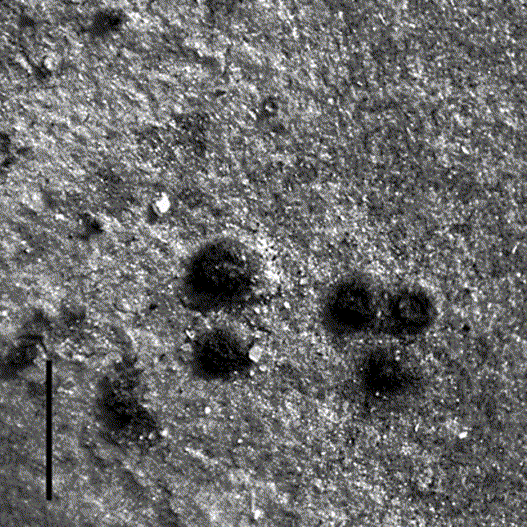
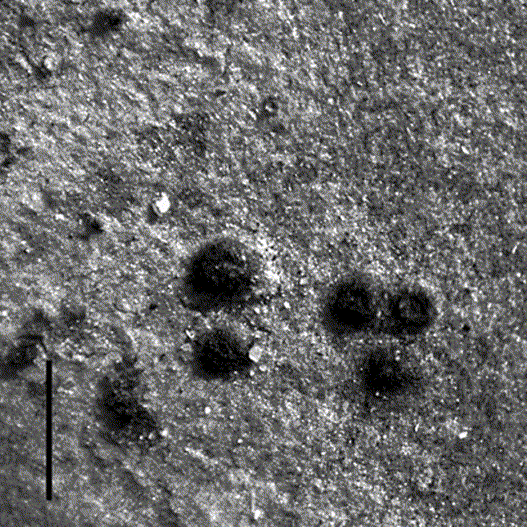
Phylloblastia fortuita, habitus (holotype BCN). Scale = 400 μm.
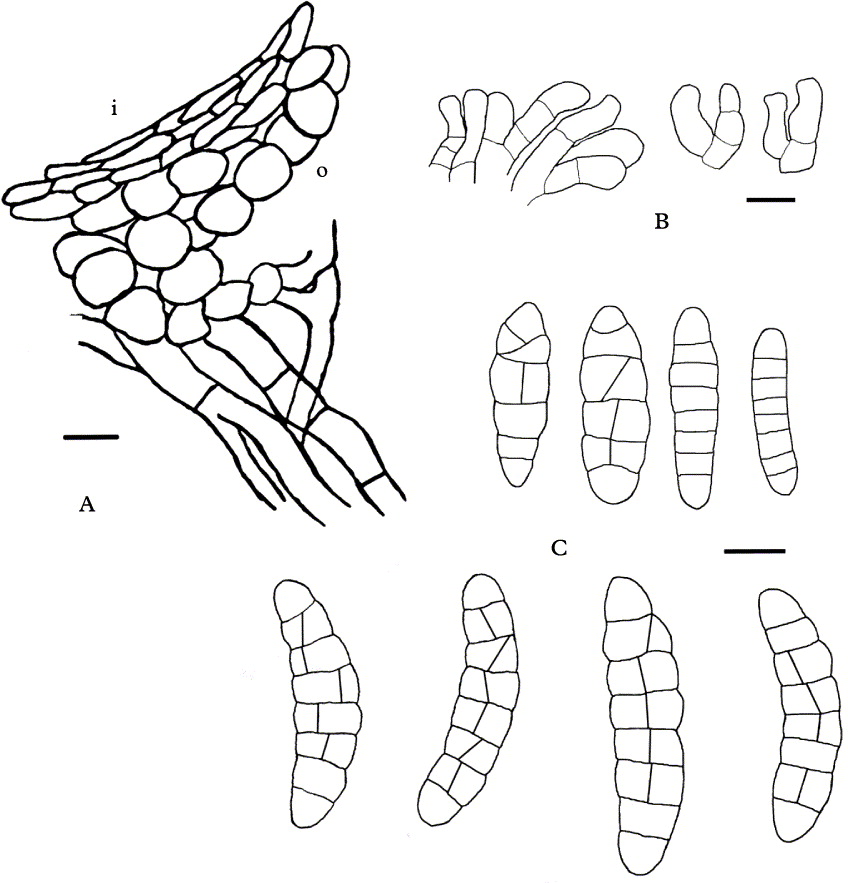
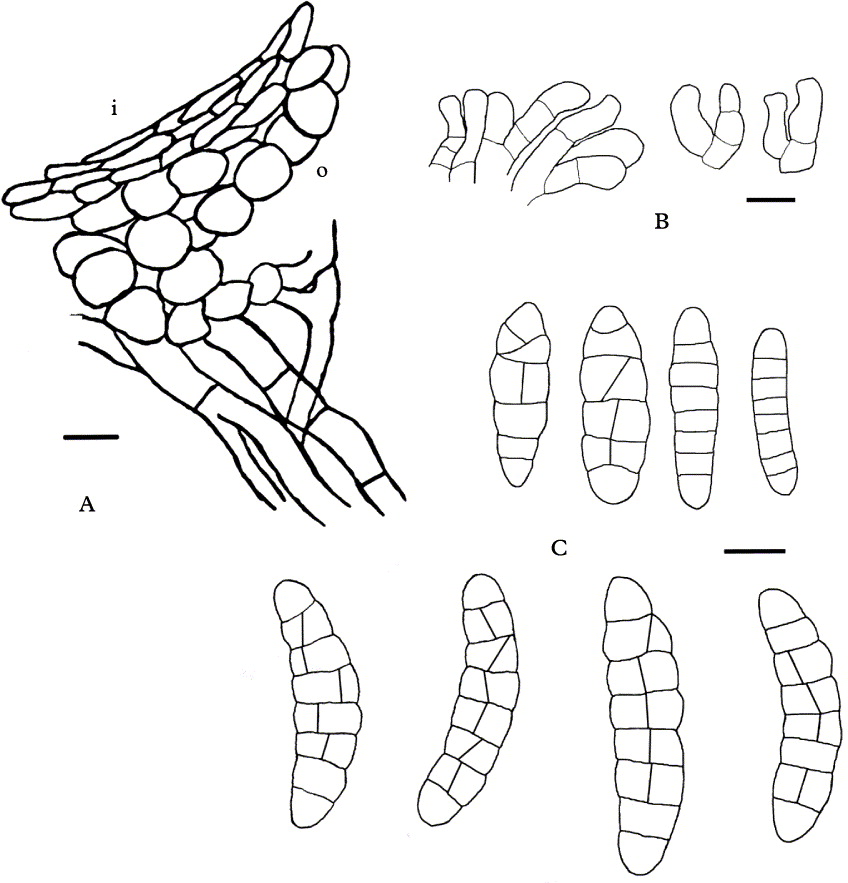
Phylloblastia fortuita. A, section of excipulum, with the inner (i) and outer (o) layers; B, periphyses. C, ascospores. Scales: A–C = 8 μm.
Thallus mainly scattered on the leaf surface, well developed around the perithecia, thin, diffuse, cobweb-like, greenish grey, composed of hyaline, interwoven hyphae, 3–4 μm thick. Photobiont chlorococcoid, algal cells 6–10 μm diam., forming irregular to rounded aggregates surrounded by fungal hyphae.
Perithecia sessile, subglobose to hemispherical, with a flattened to depressed top, 0·1–0·2 (–0·24) mm diam., up to 0·1 mm high, greyish brown to dark brown, the outer wall with a felted aspect. Involucrellum absent. Excipulum 18–32 μm thick; outer layer subparaplectenchymatous, resembling a textura globularis, olivaceous brown, 10–20 μm thick, composed of 1–2 rows of globular cells, 8–12 μm wide; inner layer paraplectenchymatous, textura angularis, pale brownish to colourless, 8–12 μm thick, formed of compressed and elongate cells, 5–10 × 1·5–2 μm. Paraphyses absent. Periphyses always present, colourless, made up of one basal layer of ± isodiametric cells, 4–6·5 μm thick, and 1–2, oblong apical cells, 6·5–12 × 3·5–5 μm. Asci clavate to obovoid, 8-spored, 40–60 × 15–20 (–25) μm, ascus apex slightly thickened, I–, and protoplasm I–. Ascospores ellipsoid to fusiform, with round ends, straight to slightly bent, submuriform, with (3–) 5–9 transverse septa and 1–6 longitudinal septa except in the apical cells, slightly constricted at septa, occasionally transversely septate only, (16–) 20–35 (–40) × (4–5–) 5–9 (–10) μm, 3–5 times as long as broad.
Pycnidia not found.
Remarks. The species falls within the genus Phylloblastia as circumscribed by Lücking Reference Lücking(2008), although there are slight differences, mainly in the morphology of periphyses and ascospores. Most species of Phylloblastia have long and narrow periphyses. The periphyses of P. fortuita are similar to those of P. inexpectata, but are longer, sometimes as long as 12 μm, and wider. Both species also differ in the morphology and size of ascospores (5–9-septate to submuriform and 20–35 × 5–9 μm in P. fortuita; and 1–3-septate and 14–16 × 4.5–5 μm in P. inexpectata).
Three other species have submuriform to muriform ascospores: P. amazonica Kalb & Vězda, P. bielczyckiae and P. dolichospora Vain. However, they can be distinguished from P. fortuita by the morphology of their periphyses and ascospores. Phylloblastia amazonica, described from Brazil (Kalb & Vězda Reference Kalb and Vězda1992) and widespread in the Neotropics (Lücking Reference Lücking2008), has orange perithecia, long and narrow (25–50 × 1–1·5 μm) periphyses and ascospores measuring 80–100 × 6–8 μm with 30–35 transverse septa. Phylloblastia bielczyckiae, recently described from Bolivia (Flakus & Lücking Reference Flakus and Lücking2008), has slightly different ascospores as they are 3–9 transversely septate to submuriform and measure 40–55 × 7·5–13 μm. Phylloblastia dolichospora, a pantropical species described from SE Asia (Vainio Reference Vainio1921; Santesson Reference Santesson1952; Vězda Reference Vězda1973; Vězda & Kalb Reference Vězda and Kalb1991), has prominent, black perithecia, long and slightly wider periphyses (25 × 2–3 μm), and the longest ascospores in the genus, 150–160 × 5–7 μm, with 47–71 transverse septa.
Ecology and distribution. The new species is known from several sites with foliicolous lichens and an oceanic type Mediterranean climate in the north-east of the Iberian Peninsula, (Llop & Gómez-Bolea Reference Llop and Gómez-Bolea2006). The species grows on the surface of leaves of Buxus sempervirens, Hedera helix, Ilex aquifolium and Quercus ilex, forming irregular patches and can be locally abundant. Phylloblastia fortuita is associated with Phylloblastia inexpectata, Bacidina apiahica, Fellhanera christiansenii and F. bouteillei, and less frequently with Arthonia leptosperma, Bacidina vasakii, Fellhaneropsis myrtillicola, Gyalectidium setiferum, Porina hoehneliana and P. oxneri.
Additional specimens examined. Spain: Barcelona: Alt Penedès, Mediona, Sant Joan de Mediona, near to CanMontori, N 41° 28′ 28.2″, E 001° 34′ 36.1″, 600–650 m, on leaves of Buxus sempervirens, 30 January 2002, M. P. Hoyo (BCN); ibid., Torrent de Valldellós, N 41° 27′ 25.2″, E 001° 37′ 1.0″, 560–600 m, on leaves of Buxus sempervirens, 17 April 2003, E. Llop (BCN); Osona,El Brull, stream of Picamena, N 41° 48′ 17.5″, E 002° 18′ 31.6″, 560 m, on leaves of Buxus sempervirens, 21 January 2003, A. Gómez-Bolea, A. Longán & E. Llop (BCN); Vallés Occidental, Sant Cugat del Vallès, Sant Medir; N 41° 26′ 37.8″, E 002° 07′ 17.2″, 220 m, on leaves of Quercus ilex, 24 August 2006, R. Escobedo, A. Gómez-Bolea & E. Llop (BCN); ibid., on leaves of Hedera helix (BCN). Girona: Garrotxa, Montagut, Cal Quic (Oix), N 42° 17′ 0.2″, E 002° 29′ 4.5″, 700 m, on leaves of Buxus sempervirens, 12/13 v 1991, A. Gómez-Bolea (BCN).
Phylloblastia dispersa (Vězda) Lücking
Flora Neotropica Monograph 103: 201 (2008).—Pocsia dispersa Vězda, Folia Geobot. Phytotax. 17: 390 (1982).
Several specimens have cylindrical ascospores narrower than those of P. fortuita and with 3–7 transverse and no longitudinal septa. In addition, their periphyses are 1 μm wide, as in most Phylloblastia species. All these features point to P. dispersa, so far known only from the Democratic Republic of Congo (Vězda Reference Vězda1982).
The species has been found in a single locality (Picamena), one of the best sites with foliicolous lichens in the Iberian Peninsula (Llop & Gómez-Bolea Reference Llop and Gómez-Bolea2006). This is the first record of this species in Europe.
Specimen examined. Spain: Barcelona: Osona, El Brull, stream of Picamena, N 41° 48′ 17.5″, E 002° 18′ 31.6″, 560 m, on leaves of Buxus sempervirens, 21 i 2003, A. Gómez-Bolea, A. Longán & E. Llop (BCN).
Phylloblastia inexpectata Sérus., Coppins & Lücking
Lichenologist 39: 104 (2007); type: Great Britain, Scotland, V. C. 74, Wigtownshire, Portpatrick, Dunskey Glen Woods, alt. c. 30 m, on living leaves of Prunus laurocerasus by stream, 21 April 1989, B. J. Coppins 13118a (E—holotype!).
Our specimens match the main features of this species, except that they always possess one-septate ascospores. The septation of ascospores is the same as in material from Madeira and Italy.
This species has been found growing with P. fortuita. Both species are difficult to distinguish macroscopically, but the morphology of periphyses and the size and septation of ascospores clearly separate the two species.
Phylloblastia inexpectata is not as abundant as P. fortuita. It has been found only in two localities, Oix, which is a well-known site for foliicolous lichens, and Sant Medir, a new locality for foliicolous lichens in the north-eastern Iberian Peninsula. This is the first report of P. inexpectata for Spain.
Specimens examined. Spain: Barcelona: Vallés Occidental, Sant Cugat del Vallès, Sant Medir; N 41° 26′ 37.8″, E 002° 07′ 17.2″, 220 m, on leaves of Ilex aquifolium, 24 vii 2006, R. Escobedo, A. Gómez-Bolea & E. Llop (BCN); ibid., on leaves of Hedera helix (BCN); ibid., on leaves of Laurus nobilis (BCN). Girona: Garrotxa, Montagut, Cal Quic (Oix), N 42° 17′ 0.2″, E 002° 29′ 4.5″, 700 m, on leaves of Buxus sempervirens, 12/13 v 1991, A. Gómez-Bolea (BCN).
Key to the European species of Phylloblastia
1 Ascospores submuriform ... P. fortuita
Ascospores only transverse-septate ... 2
2(1) Ascospores 1–3-septate ... P. inexpectata
Ascospores 3–7-septate ... 3
3(2) Ascospores 4–4·5 μm wide, periphyses narrow 10 × 1 μm, perithecia reddish brown ... P. dispersa
Ascospores 5–9 μm wide, periphyses oblong 6·5–12 × 3·5–5 μm, perithecia greyish brown to dark brown ... ... P. fortuita
Discussion
The genus Phylloblastia is mainly distributed in the tropics (Lücking Reference Lücking2008), except for P. mucronata (McCarthy) Lücking, which is present in subtropical areas of Australia (McCarthy Reference McCarthy1999, sub Pocsia mucronata) and southern United States (Lücking Reference Lücking2008), and P. inexpectata described from temperate Western Europe and Madeira (Sérusiaux et al. Reference Sérusiaux, Coppins and Lücking2007). The description of the new species, P. fortuita, and the new record of P. dispersa, previously known only from the Democratic Republic of Congo, reinforce the importance of extra-tropical areas such as the Mediterranean region for the presence of foliicolous lichens. These localities deserve special conservation status and management to maintain the environmental conditions that allow the development of such a foliicolous lichen flora.
The curators of the herbaria E, TUR-V and VBI are warmly thanked for loans of type specimens. Two anonymous reviewers are thanked for their comments and suggestions on the manuscript. This investigation has been funded by the Patronat del Parc de Collserola and Departament d'Universitats, Recerca i Societat de la Informació (2005SGR01047).