Haminoea cyanomarginata Heller & Thompson, Reference Heller and Thompson1983, is a cephalaspidean mollusc belonging to the family Haminoeidae described from a single live specimen of 5.5 mm long and 2.5 mm wide found at Harvey Reef (Sudanese Red Sea coast, between Port Sudan and Suakin) amongst coral rubble on 7 April 1980 (Heller & Thompson, Reference Heller and Thompson1983).
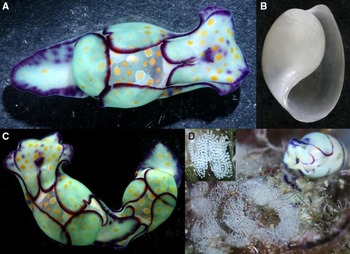
It is a somewhat elongated animal characterized by a cephalic shield deeply bifurcate posteriorly and divided into a pair of well-developed flaps. Its parapodial lobes are short and fold up over the anterior half of the shell, but do not meet dorsally, while the posterior pallial lobe encloses the posterior end of the shell. The background colour of the soft parts is greenish-white with many patches of cream-white and with some yellow blotches sprinkled over it. The margins of the mantle are a very conspicuous purple-blue, contrasting very strongly with the pale ground colour of the animal; the fringes of the parapodia, of the posterior pallial lobe and of the part of the pallial lobe enclosing the shell are all of this colour. The purple-blue line breaks up into a series of bluish spots in the anterior margin of the head and a large bluish spot separating the two eyes. Some dark purplish-blue spots are also visible beneath the shell (Figure 1A). See also Heller & Thompson (Reference Heller and Thompson1983) and Zenetos et al. (Reference Zenetos, Gofas, Russo, Templado and Briand2004) for a full description.
Haminoea cyanomarginata from Saline Joniche (RC). (A) A single specimen of 18 mm; (B) its shell (8.0 × 5.9 mm); (C) a couple showing trailing behaviour; (D) egg-masses.

The animal is commonly from 5 to 15 mm in size and the shell can be up to 10 mm (Zenetos et al., Reference Zenetos, Gofas, Russo, Templado and Briand2004). The shell is whitish or creamy-white coloured, bubble-shaped, fragile, translucent, smooth and with no traces of ornamentation (Figure 1B).
It can be easily distinguished from the other Mediterranean congeners by its mantle bordered with purple or dark-blue and the scattered vivid-yellow blotches all over (Heller & Thompson, Reference Heller and Thompson1983; Zenetos et al., Reference Zenetos, Gofas, Russo, Templado and Briand2004; Mifsud, Reference Mifsud2007).
Haminoea cyanomarginata is considered one of the recent lessepsian immigrants entering into the Mediterranean Sea through the Suez Canal (Zenetos et al., Reference Zenetos, Gofas, Russo, Templado and Briand2004, 2005b; Mifsud, Reference Mifsud2007). Although its distribution has not been published extensively in literature (Zenetos et al., Reference Zenetos, Gofas, Russo, Templado and Briand2004), we know that about 30 live specimens were first recorded from the Mediterranean at Porto Germeno (Korinthiakos, Greece) in 2001 (Rudman, Reference Rudman2003; Zenetos et al., 2005a) and one year later, in 2002, several other specimens were recorded from Çeþme (Ýzmir, Turkey) (Rudman, Reference Rudman2003). All the specimens were usually seen at night, between 15 and 30 m deep on rocky surfaces covered with algae (Rudman, Reference Rudman2003; Zenetos et al., Reference Zenetos, Gofas, Russo, Templado and Briand2004). At the moment this species seems to be quite common in many areas of Greece and Turkey (Zenetos et al., Reference Zenetos, Gofas, Russo, Templado and Briand2004).
Only in 2006 was this species recorded from Mgarr (Malta), where Mifsud (Reference Mifsud2007) found, in a stretch of coastline of about 5 km, 21 live specimens in weeds and algae brought up in fishermen's tackle from around meadows of Posidonia oceanica at a depth of between 20 and 50 metres.
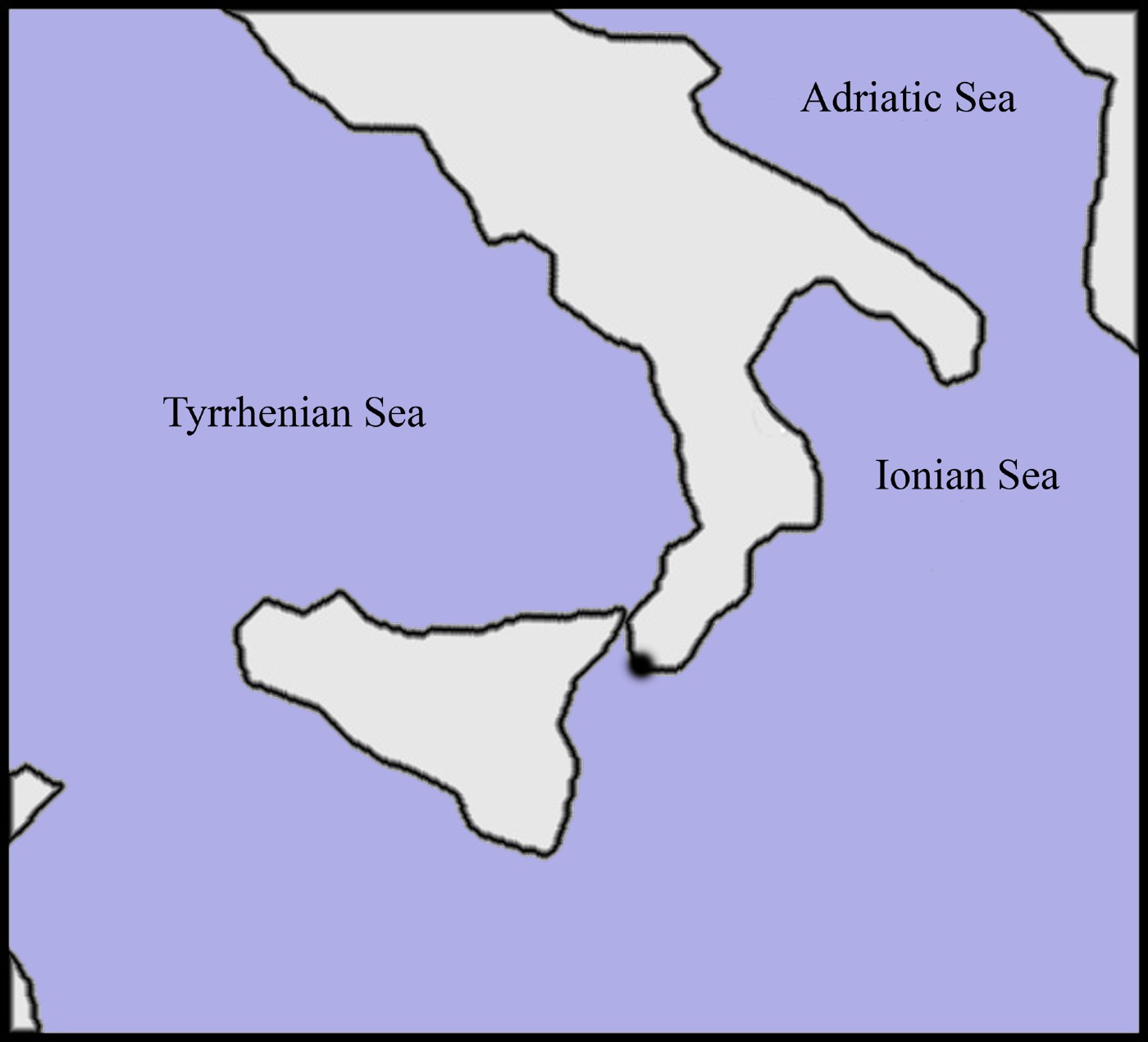
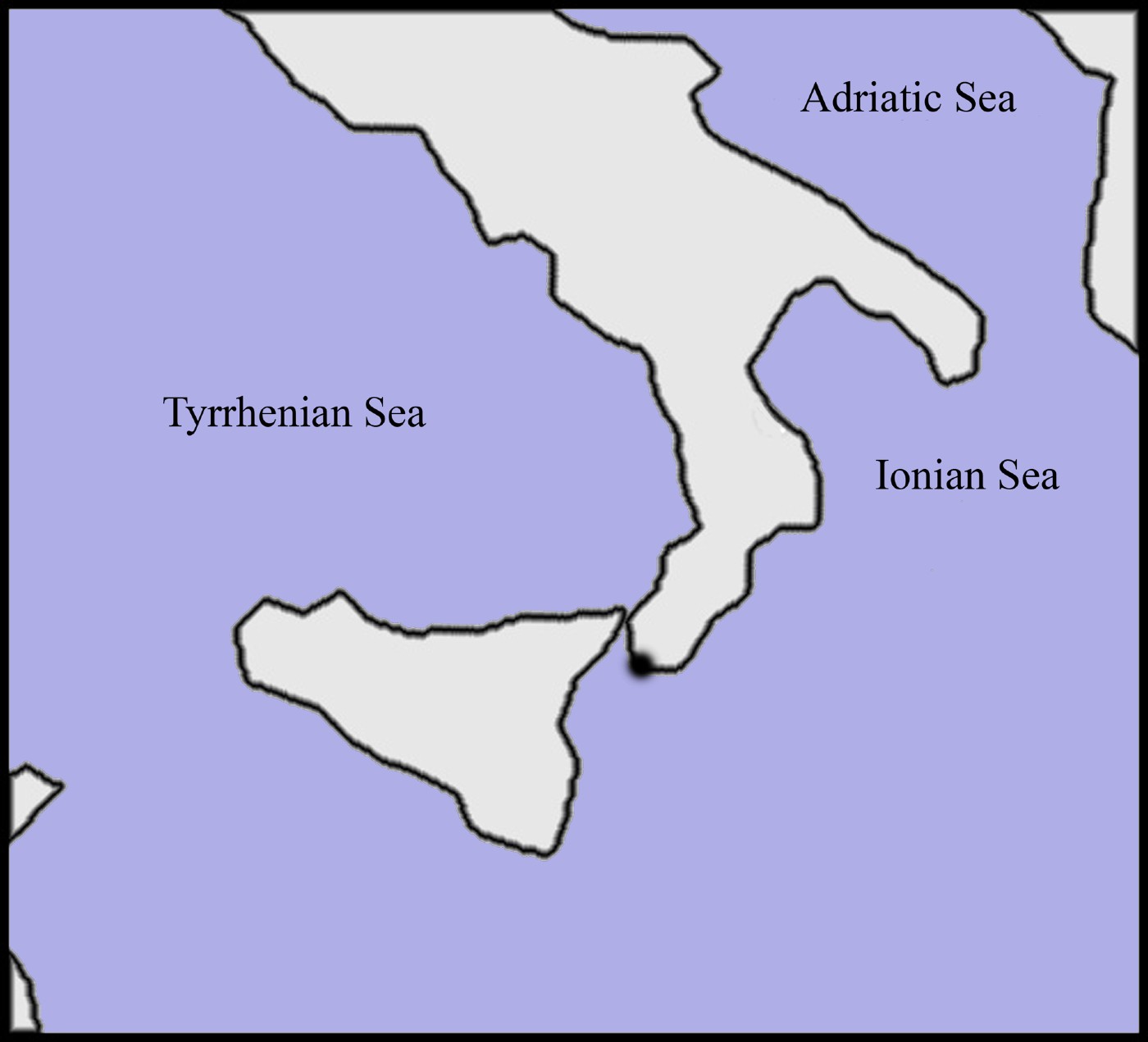
On 16 September 2007, while SCUBA diving at Saline Joniche (Reggio Calabria, Italy), 37º55′34″N 15º44′26″E (Figure 2), a couple of H. cyanomarginata showing trailing behaviour (Figure 1C) were found in daytime at a depth of about 6 m on some calcareous boulders (coming from the harbour just opposite after a severe sea-storm), covered by a thin algal film and colonized by Cystoseira sp., other algae and rare sessile organisms such as sponges, vermetids and molluscs (Spondylus gaederopus, Ostrea edulis and Chama gryphoides).
The Ionian Sea with the location (•) where Haminoea cyanomarginata was found.
After a few days (on 23 September, with a water temperature of about 21°C on the bed), in the same place, about 70 specimens (both adults and juveniles from 6 to 20 mm in length) and several egg-masses (principally on Cystoseira sp.) of translucent colour and whitish capsules of H. cyanomarginata were found (Figure 1D), suggesting that the species seems to be well adapted to this habitat, being one of the most abundant invertebrates. Trailing behaviour, until now known only for some species of Chromodorididae, was observed both in ambient waters and in aquaria, as also reported by M.B. Yokes in Rudman (Reference Rudman2003).
Specimens were observed both in ambient waters and in aquaria feeding on filamentous algae and probably on diatoms, supporting what was presumed by Zenetos et al. (Reference Zenetos, Gofas, Russo, Templado and Briand2004) and observed for other Haminoea spp. (Malaquias et al., Reference Malaquias, Condinho, Cervera and Sprung2004).
Although we are not sure about how H. cyanomarginata arrived on the Italian coasts, we suppose that this latest Mediterranean record could be attributable to natural dispersal, since Saline Joniche is far from any commercial route and major port.
CONCLUSIONS
Our record, the first for Ionian and all Italian seas, is the furthest north-west Mediterranean station known for Haminoea cyanomarginata, and considerably extends its present distribution. It can also be seen in the light of the established trend of warm/temperate marine fish and invertebrates, expanding their geographical range from the eastern/southern to the western and northern Mediterranean, possibly related to a general change in climate (Vacchi et al., Reference Vacchi, Sarà, Morri, Modena, La Mesa, Guidetti and Bianchi1999; Bianchi & Morri, Reference Bianchi and Morri2000). This new finding of specimens and egg-masses, together with the previous records, supported the hypothesis that H. cyanomarginata is not an occasional species in the Mediterranean as asserted also by Zenetos et al. (2005b), and that some real populations have now permanently settled in the eastern and middle Mediterranean.