I. INTRODUCTION
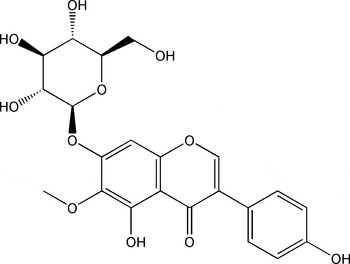
The title compound tectoridin (Figure 1), systematic name 5-hydroxy-3-(4-hydroxyphenyl)-6-methoxy-7-[(2S,3R,4S,5S,6R)-3,4,5-trihydroxy-6-(hydroxymethyl)oxan-2-yl]oxychromen-4-one, is an isoflavonoid compound extracted from the rhizome of Belamcanda chinensis (L.) Redouté, which has properties of heat-clearing, detoxifying, eliminating phlegm, and relieving sore throat. It is commonly used as anti-inflammation antipyretic, antiviral, and diuretic (Qu et al., Reference Qu, Gao, Sun, Zhang, Makino and Yuan2012). As time flies, there are a number of different methods to extract tectoridin from B. chinensis (Lee et al., Reference Lee, Kim, Kim, Lee, Jung and Lim2011). At present, about 20 isoflavonoid glycosides including tectoridin can be separated from B. chinensis. The purity of tectoridin could be influenced by those materials, such as tectorigenin, iridin, irisflorentin, belamcanidin, etc. Hence, it is necessary for the qualitative analysis by powder diffraction data of tectoridin for the purpose of identifying tectoridin easily.
Structural formula of tectoridin.

Up to now, both the single-crystal structure and powder diffraction data of tectoridin have not been published.
II. EXPERIMENTAL
A. Sample preparation
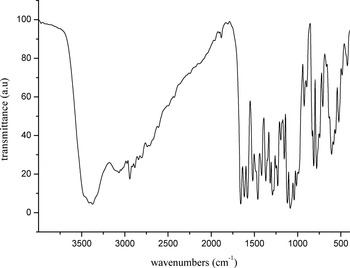
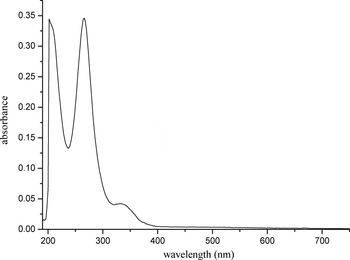
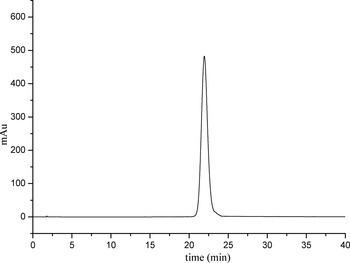
The title compound was extracted from B. chinensis. It was re-crystallized by slow evaporation of a compound solution in 3:2 (v/v) ethanol and water at room temperature. Then the crystallized product with a needle-like shape was dried and ground into powder. Three parallel determinations showed that the experimental density of the title compound was 1.204 × 10³ kg m−3 at 25 °C. The structure of tectoridin was characterized by Fourier transform infrared spectrometer (FTIR, Thermo Fisher Scientific, USA; Figure 2), ultraviolet (UV, Beijing Purkinje General Instrument, China; Figure 3) and high-performance liquid chromatography (HPLC, Agilent Technologies, USA; Figure 4). The purity of isolated tectoridin was proven using microscope, melting point test, and HPLC (detailed in supplementary information).
FT-IR spectra of tectoridin recorded by employing Nicolet 6700 FT-IR spectrometer, scanning from 4000 to 400 cm−1.

UV absorption spectra of tectoridin from 190 to 750 nm.

HPLC analysis of tectoridin use Agilent 1200 DAD detector at 265 nm with mobile phase in 32:68 (v/v) methanol and water.

B. Diffraction data collection and reduction
The diffraction pattern for the title compound was collected at room temperature using an X'Pert PRO diffractometer (PANalytical Co. Ltd., the Netherlands) with a PIXcel one-dimensional detector and CuKα 1 radiation (λ = 1.540 56 Å, generator setting: 40 kV and 40 mA). The diffraction data were collected over the angular range from 4 to 50°2θ with a step size of 0.013 13°2θ and a counting time of 30 ms step−1. Data evaluation was performed using the software package Material Studio 4.2 (Accelrys Co., Ltd., USA) in the State Key Laboratory of Polymer Materials Engineering (Sichuan University, China), which we used to successfully solve organic crystal structures such as normethisterone, gestonoronacetat (Wu et al., Reference Wu, Tang, Pan, Cheng and Li2013), and norandrostenedione (Tang et al., Reference Tang, Wu, Pan, Zhang, Cheng and Li2013).
The first stage of structure determination involves determination of the unit cell {a, b, c, α, β, γ} by analysis of the peak positions in the powder X-ray diffraction pattern. This task is referred to as “indexing” the powder pattern, and involves assigning the miller indices (h, k, l) to each observed peak in the experimental pattern (Harris, Reference Harris2012). Indexing was carried out using peak positions obtained from the powder diffraction profiles by the X-Cell method, and then the indexing result was refined with the type of Pawley (Pan et al., Reference Pan, Guo, Duan, Cheng and Li2012). After Pawley refinement of the unit cell, the final R wp and R p of the structure were converged at 7.47 and 5.10%, respectively.
III. RESULTS
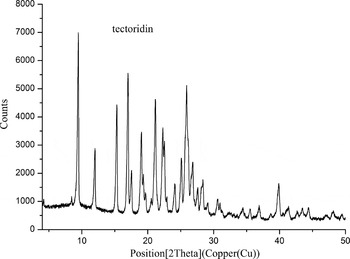
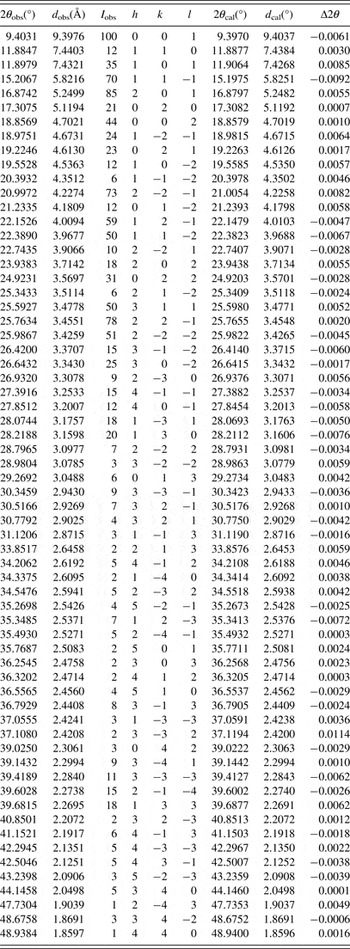
The experimental powder diffraction pattern is depicted in Figure 5. Indexing results show that tectoridin is triclinic with space group P1 and unit-cell parameters: a = 13.577 (2) Å, b = 10.466 (8) Å, c = 9.454 (7) Å, α = 85.709 (4)°, β = 94.855 (3)°, γ = 101.485 (3)°, unit-cell volume V = 1309.50 Å3, Z = 2, ρ = 1.179 × 10³ kg m−3, and space group P1 (Table I). After Pawley refinement, the unit-cell parameters of tectoridin were solved. All lines of powder data were indexed and consistent with the P1 space group.
X-ray powder diffraction pattern of the tectoridin, using CuKα 1 radiation (λ = 1.54 056 Å).

Indexed X-ray powder diffraction data of tectoridin, C22H22O11. Only the peaks with I rel of 1 or greater are presented reported [a = 13.577 (2) Å, b = 10.466 (8) Å, c = 9.454 (7) Å, α = 85.709 (4)°, β = 94.855 (3)°, γ = 101.485 (3)°, unit-cell volume V = 1309.50 Å3, Z = 2, ρ = 1.179 × 10³ kg ·m−3, and space group P1]. The d-values were calculated using CuKα 1 radiation (λ = 1.540 56 Å).

SUPPLEMENTARY MATERIALS AND METHODS
The supplementary material for this article can be found at http://dx.doi.org/10.1017/S0885715615000810