

According to Richards (Reference Richards1933–7, p. 57), 170 state lotteries were issued in London between 1694 and 1826. Lotteries were thus part of the 1690s Financial Revolution and later continued to be an important source of state financing. However, after a series of successes, the failure of the second lottery in 1697 proves exceptional. Out of the 140,000 issued, only 1,763 tickets were sold. Although financial historians mention this failure, there has never been a detailed analysis of it.
There are two objectives in this article: first to show the emergence of the technical features of ‘lottery loans’ between 1693 and 1697. Second, underscoring that, in order to be sold successfully, a financial instrument should be enticing for investors.Footnote 1 North and Weingast's thesis (Reference North and Weingast1989) on the importance of the state debt being backed by Parliament and no longer by an unreliable king may be considered as a necessary but not a sufficient condition for the successful launching of a financial asset. And, in that respect, the 1697 failure presents an interesting case study.
The article is organised as follows: Section I shows that three lotteries served as blueprints for the technical features of English state lottery loans for more than a century. Sections II and III analyse the ‘bond’ and ‘lottery’ features of the 1697 Malt Lottery Loan. Section IV details the strange solution of giving the Exchequer the unsold tickets to be used as cash. Section V measures the anticipated and the expected costs of the 1697 Malt Lottery Loan. Section VI explains the failure by the absence of the three prerequisites needed for a successful issue: financial features appealing for investors, as regards both the return and the redemption security, absence of other competing assets, and an optimistic political and economic environment. Section VII summarises the findings of the study in a brief conclusion.
I
First let us introduce a most remarkable man, Thomas Neale, a genius for new projects and ideas in a number of fields. He was a Member of Parliament for 30 years, and he served as Head of the Postal Service of America for 21 years without ever crossing the Atlantic. In 1677, he was appointed Master of the Mint under Charles II and remained in office under James II and, more surprisingly, William III and Mary (with Isaac Newton as his successor). This position explains why Neale published extensively on coinage and different financial matters. He was interested in everything new, exciting and potentially profitable. In the last 11 years of his life alone, between 1688 and his death in 1699, he was involved in no less than 39 projects, five of which concerned lotteries (Thomas Reference Thomas1979, p. 269).
His involvement in lotteries may be explained by another of his numerous official functions. In 1678, he was appointed Charles II's Groom Porter, an office he would hold until his death. As such, he was responsible for the comfort of the king's apartments, including the provision of cards and dice. He would also serve as referee whenever disputes arose over cards or bowling matches. As Groom Porter, he was entitled to license (in or out) gambling houses and to prosecute unlicensed ones.
These were hectic times, which witnessed a furious craving for gambling. According to Dickson (Reference Dickson1967, p. 45), ‘[there] was the addiction of contemporaries to gambling on a massive scale … This helps to explain the keen public interest in lotteries.’Footnote 2 In such an age, it is no surprise that Neale organized a private lottery (Neale, March Reference Neale1693).
Neale simply copied a Venetian state lottery launched in early March 1693 for a draw three months later. This was a ‘pure’ lottery: with 150,000 tickets sold for 2 ducats each, 410 tickets – the ‘benefits’ – receiving a lot for a total of 200,000 ducats paid by the 149,590 blanks. There was a meagre ratio of one benefit for 366 blanks due to the Venetian Exchequer's taking over one-third of the receipts.
Neale's First Profitable Adventure Footnote 3 proved much more profitable for adventurers. Neale kept all the features of the Venetian lottery but with a much lower intake: only 10 per cent (as against 33 per cent). His lottery offered 50,000 tickets sold for 10 shillings each with 250 benefits ranging from £20 to £3,000. Thus, one benefit for 200 tickets was more generous than the one for 366 in Venice. This led to a more favourable expected valueFootnote 4 of 8.92 shillings for a 10 shilling purchase as compared to the 1.32 ducats for a 2 ducat purchase in Venice.
At least six technical features of the English state lottery loans were inherited from these two experiments: (1) the lottery was open to foreigners as well as natives; (2) how subscription books should be made and organised; (3) the fact that tickets should be presented in three parts; (4) two urns would be used for drawing: one for tickets sold with a number, and one for benefits and blanks; (5) as would become the custom, two special draws would receive a lot: the first ticket drawn (besides the benefit which might come along with it) and the ticket drawn after the last ticket with a benefit (which terminated the draw); (6) if there were unsold tickets, the number of benefits and the total amount of prizes would be reduced in proportion.
Neale's 1693 private lottery proved a real success. Besides its profitability, there was the respectability of the Groom Porter office and the security of eleven goldsmiths, among whom were Sir Francis Child and Richard Hoare, who were responsible for collecting the purchases and paying the lots. Adventurers came from all ranks of society: from Evelyn's coachman (who got a £40 lot) to aristocracy and courtiers. The climax was reached with the 1,000-ticket wager of Queen Mary herself (Thomas Reference Thomas1979, pp. 271–2).
In 1694, England had been at war with France for five years. The War of the League of Augsburg (1688–97) was very costly. Constantly increasing existing taxes and creating new ones was not sufficient and the government badly needed more money. The success of Neale's lottery and his pleading in the Commons (Thomas Reference Thomas1979, p. 272) led to a second venture called ‘the Million Adventure’, the first state lottery loan which was instituted by an Act of Parliament, 5 & 6 Will. & Mar. c. 7.
From a technical point of view, there was little innovation in it (Neale Reference Neale1694). Sections 34 to 59 basically reproduced the Venetian technicalities used by Neale's private lottery. However, all these technicalities are fully detailed, with two very precise drawings presenting the tickets to be sold (sect. 36) and the special printed sheet for receiving annuities (sect. 46).
The innovation consisted in the financial instrument itself, ‘a lottery and a loan’. Indeed, the government was facing a dilemma.Footnote 5 On the one hand, issuing a lottery would bring in a profit thanks to the gambling craze that was rife at the time. On the other hand, some in society were strongly criticising private lotteries, as can be seen from the draft in January 1693 of a one-clause bill intended to abolish lotteries.Footnote 6 The solution found shows Neale's ingenuity: no one would lose money; the lucky ones would receive a prize from the ‘lottery’ whereas the unlucky ones would receive a financial return from the ‘loan’.
Being state-issued, the ‘loan’ granted some advantages to the subscriber, the most important one being the explicit appropriation of given taxes, here upon salt and beer (sect. 31), for paying the financial returns promised by the issue. Other advantages were: (1) if all tickets were not sold, the deficit could be borrowed (at 8 per cent per annum); (2) the money lent was free of tax; (3) a financial advantage for quick payment (an unreasonable 14 per cent rebate computed on the time between the subscription and the closing of the issue). Such a rate is very telling about the urgent needs of the Treasury.
The financial features of the Million Adventure were quite straightforward. A total of 100,000 £10 tickets was issued. The advantages were twofold: as a ‘loan’, each ticket was entitled to receive a £1 annuity (i.e. 10 per cent) for 16 years. As a ‘lottery’, there were 2,500 prizes, each being a 16-year annuity ranging from £10 to £1,000. For the state, the yearly cost was £40,000 for prizes and £97,500 for blanks with a total of £137,500 over 16 years. The yield thus was 11.25 per cent – a figure somewhat different from the 14 per cent advanced by Dickson (Reference Dickson1967, pp. 48–9).Footnote 7
This scheme proved a huge success for the Treasury. Its 11.25 per cent cost was very favourable since it was much lower than the Treasury's former financial operations: the sale of life-annuities at 14 per cent in 1693Footnote 8 and 1694Footnote 9 (which were eventually reduced to 11.50 per cent by forced conversion).
Lotteries continued to be successful during the following years. In 1694 and 1695, Ann Murphy (Reference Murphy2005, pp. 27–8) lists no less than 12 private lotteries, the prizes of which were either money or silver plate or physical goods. Between 1695 and 1696, Neale organised three successful lotteries (Thomas Reference Thomas1979, p. 274). In 1697, on the verge of bankruptcy, calling in Neale's expertise was thus the obvious choice for the Treasury. The more so since he had just suggested a new lottery scheme (Neale 1696–7), which eventually became the blueprint for the new issue.
II
The 1697 lottery loan was instituted by Royal Assent on 16 April 1697 (8 & 9 Will. III c. 22), having been voted by the House of Commons on 10 April and by the House of Lords on 15 April.Footnote 10
As usual since Magna Carta, the Act consisted of two parts. The first part presented the taxes to guarantee the loan. On this occasion, new taxes were established on sweetened drinks. ‘Six Pence for every Bushel of Malt’ (hence the name ‘Malt Lottery’), ‘for every Barrel of Mum … Ten Shilling … for all Cyder & Perry… Four Shilling for every Hogshead…’ (sect. 1). The urgency was such that the writers of the Act failed to appropriate these taxes explicitly to the new issue. Consequently, a year later a new Act specified that the 1697 issue had priority over the revenues from the malt tax.Footnote 11 As a further (standard) guarantee, the Act specified that if these amounts were not obtained, the ‘deficiency… shall be supplied and made good out of the First Aid to be granted in Parliament’ (sect. 26)
The second part of the Act presented the ‘Clause of Loan for £1,400,000’ (sect. 27): 140,000 tickets at £10 each were issued. Purchases could be made using newly minted or old coins or silver goods. Silver would be accepted at the advantageous rate of 6 shillings the TroyFootnote 12 ounce.
As was usual with English state loans, the subscription was open to ‘any p[er]son or persons Natives or Foreigners’ (sect. 37). The subscribers were called either ‘contributors’ or more often by a much more vivid name: ‘adventurer’ – a term already used for Elizabeth I's ‘General Lottery’ in 1569. Speedy subscriptions were enticed by the same annual interest rate as in 1694, an exorbitant 14 per cent granted for the period between the actual subscription date and the closing day of the issue, 24 June 1697. Just as in 1694, the instrument proved a hybrid between a bond and a lottery ticket. It had the two basic features of a bond: it bore interest and it was redeemable. However, these characteristics were somewhat unorthodox.
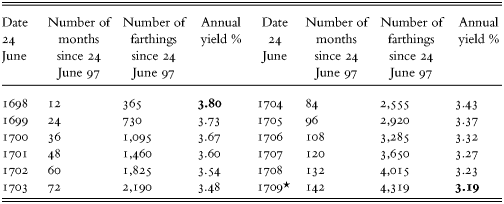
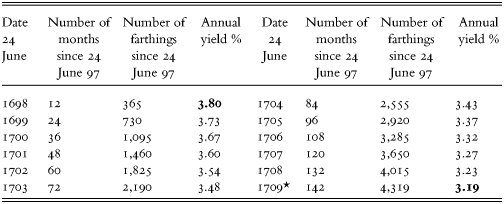
Section 28 stipulated that blanks would earn one farthing a day until redemption, which meant 365 farthings a year or £0.38. Thus the rate of interest seemed to be £0.38 divided by the £10 lent or 3.80 per cent. However, there was a subtle financial trap: instead of being a compound interest rate – to which we are accustomed – this interest rate was a simple, not compounded one. Thus the interest would prove inversely proportional to the period of investment since the yearly interest was not added to the principal and previous interest payments for the calculus of the interest for the present year.
Presenting this perverse effect requires two assumptions: (1) the repayment extended over a 140-month period with 1,000-ticket blocks paid monthly (as explained below); (2) the Treasury was to receive the list of persons having won a prize by the end of August; we may thus suppose these repayments started in September. As blank tickets bore interest from 24 June 1697, repayments were then to take place from 24 September 1697 to 24 April 1709.
Table 1 shows the compound rate of interest actually received by an adventurer depending on the length of the period of his investment (the ‘benefit’, if any, not being taken into account).
Rate of interest as function of the length of the investment period
*24 April.
Source: The authors. It is the yield on the fixed income part of any 1697 lottery loan ticket.
The annual compound rate of interest is the solution of the compound rate formula:
 $$[\rm K * (\rm I + \rm x)^{\rm \wedge } \rm n = (\rm K + \rm I)]$$
With K = £10 (subscription price), x is the yield, n = the exact number of days divided by 365; I = number of farthings earned converted into pounds.
The meaning of these figures is clear. Either the adventurer was not financially educated and believed he would earn 3.80 per cent a year, which would be abnormally low in a country at war (in which the interest rate would usually amount to about 8 per cent) and as compared to the Treasury recent borrowings at 14 per cent. Or the adventurer would be smart enough to understand that the interest would amount to less than 3.80 per cent if his investment were not be paid off in the first year. The longer the period, the smaller the interest rate.
The second component of the asset, its redemption feature, presented some other rather unusual characteristics for there was no schedule showing any precise due dates of payment. Blanks were to be reimbursed and prizes paid whenever the 1,000-ticket block to which their numbers belonged was called for payment. The absence of a precise payment schedule is due to the fact that payments were dependent on the taxes appropriated to this loan: ‘Tickets shall be payable and be paid as soon as the same be raised and levied from and by the Fund aforesaid.’ Besides, the tax revenue had to be such as to pay for a full block of 1,000 tickets at a time: ‘The said Duties upon Malt hereby granted should be applied to the Satisfaction of the said Tickets … so that as soon as there shall be sufficient to pay off the First Thousand Tickets’ (sect. 34).
This quotation seems to indicate that repayments were to take place every month. The more so as section 35 stipulated that the 1,000-ticket block called for payment would be published in the press on the first Monday of the month: ‘Time of Payment published on the First Monday in every Month’ (sect. 35).Footnote 13
The call for payment of the 140 ticket blocks was very ingenious, as it was done by draws. Section 34 stipulated that before the very first draw, a preliminary draw would be made out of 140 tickets numbered from 1 to 140 in order to determine the order in which blocks of 1,000 tickets would be paid. Indeed, on the ticket number, the thousand figures were distinguished from the rest of the number so as to indicate which of the 140 blocks of 1,000 the ticket belonged to, the other figures indicating the number of the ticket within that block.
III
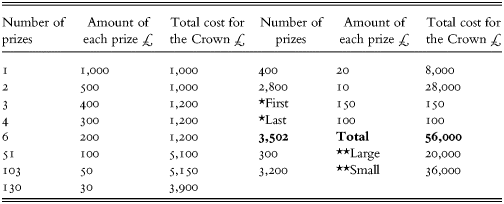
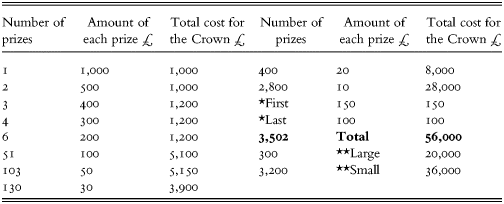
The second feature of the 1697 asset is its ‘lottery’ characteristic. There were 3,500 prizes (‘benefits’) for the 140,000 tickets, which meant a one to 40 ratio.Footnote 14Table 2 shows the distribution of prizes.
Distribution of the prizes in the Malt Lottery
*First and last ticket drawn. **Large = prizes over £20; small: £20 and £10 prizes
Source: The authors from Section III.
Section 33 distinguished two groups of ‘Fortunate Ticketts’. Winners of ‘large’ prizes, over £20, received their prizes without redemption or interest. Winners of ‘small’ prizes of £20 and £10 received their prizes plus their ticket redemption and the interest due. (It is to be noted that this scheme granted the £20 prizes a better benefit than the £30 prizes: the prize plus redemption adding up to £30, to which the interest due was added. Thus, the repayment on the 140th month meant a maximum of £4 10s interest.) Besides, two ‘gratuities’ of Venetian origin were kept: the first and last tickets drawn received an extra prize (respectively £150 and £100).
Section 33 stipulated that ‘The said Lottery [was] to be drawn on 10 August 1697’ and set forth how to proceed.
The text of the Act describing the management of the lottery followed the rules established by the Million Adventure Act, the selfsame rules which were kept in force until the end of lottery loans in 1826. Over the intervening 136 years, only minor changes were made to improve efficiency. In the Malt Lottery case, there was one single change. It concerned Box B, which contained the ‘fortunate’ tickets (i.e. those granting a prize) and the blanks. In 1694, Box B contained as many tickets as had been subscribed, i.e. 100,000 tickets. The draw proved awfully long, 12 days, according to Murphy (Reference Murphy2005, p. 12), in the presence of an excited crowd of people. In 1697, to reduce drawing time, section 30 established that Box B would contain only 5,000 tickets: the 3,500 ‘fortunate’ tickets and 1,500 blanks; whereas Box A would contain the 140,000 tickets sold.
On 24 June 1697, the subscription closed and the situation proved dramatic: only 1,763 tickets out of 140,000 had been purchased. Just over 1 per cent of the loan was covered … The lottery directors organised the lottery draw based on 121,763 tickets, 120,000 tickets being delivered to the Exchequer plus the 1,763 which had actually been purchased.Footnote 15 It represented 86.97 per cent of the objective, the deficit being 18,237 tickets.Footnote 16
IV
Due to the unfavourable political and economic situation (as outlined below), the possibility of deficiency had been considered but never to an extent which makes the 1697 issue one of the largest failures – if not the largest – in financial history. So, contrarily to the 1694 issue, for which only an 8 per cent loan was to cover any sale deficiency, section 28 introduced an extraordinary solution whereby unsold lottery tickets would be handed over to the Treasury to be used as legal currency. Neale may have been behind that strange solution, which was a variant of his former idea of issuing short-term bonds bearing interest and guaranteed on a tax on malt.Footnote 17
As regards the financial status of these ‘cash tickets’, it was clear for the writers of the Act that ‘The Owners or Bearers of such Tickets … be esteemed Contributors or Adventurers as if such Owners or Bearers had originally paid to the said Receivers…’ In short, the Exchequer received these tickets and used them to pay its creditors who became forced Malt Lottery subscribers. In practice, things did not prove that easy. Reimbursement with interest according to the draw order of payment did not raise technical problems, but the lottery prizes did. Fairness would have required all cash-tickets to be distributed before drawing in order to give each paid creditor an equal chance, but it does not seem to have always been the case. The Calendar of Treasury Books (1697, pp. 303–13) gives detailed information on how these cash-tickets were used as money in payment for services rendered or salaries. Some were used before the draw. The Calendar thus gives lists of names of creditors who were paid with that ‘notional’ money. For instance, on 16 July 1697 (just before the draw on 10 August) the Exchequer paid £106,100, some of it going to the Secret Service. However, most of the payments seem to have been made early in 1698, after the draw. For instance, on 12 February 1698 Percival Brunskill received £20 in the form of two £10 cash-tickets; on 15 February Nicho Baker received £1,000 (100 tickets) ‘for Crown Law costs’; on 18 February Mr Corbett and Mr Doddington each received £20,000 ‘in Malt tickets for money’. Orders of payments (warrants) were issued in cash-tickets. On 20 January 1698, the dukes of Southampton, Grafton and Northumberland received £1,250 each, whereas the ‘Master of the Horse for extraordinaries of the Stables’ received £3,000. As for remunerations, on 14 January 1697, £1,825 were paid to the Lord of the Privy Seal and £702 12s 6d were paid to seven sergeants-at-arms.
On 9 and 10 September 1697, William Lowndes, Secretary of the Treasury, sent two letters to the Earl of Ranelagh ordering him to issue Malt Lottery tickets and explaining the reason for using these cash-tickets ‘as [they] are in the remotest course of payment and have no benefits attending them’.Footnote 18
Of course, lottery tickets used as legal currency were highly unpopular. Thus the Wynn Papers (2007, p. 5) reveal how dissatisfied officers on the battlefield on the Continent were when, in July 1697, they received these strange ‘bank notes’. The inn holders of Middlesex, who quartered the Earl of Oxford's horse regiment, complained but eventually accepted these tickets only with a heavy 40 to 60 per cent discount. The Navy Victualling Board refused to take them (L'Estrange Ewen Reference L'Estrange Ewen1932, p. 133). The only persons who were happy with them were speculators. The detailed analysis of the ledgers of Sir Francis Child by Quinn (Reference Quinn2001, pp. 604–5) shows very profitable (and rapid) operations on Malt tickets. Otherwise, it is rather surprising that a spontaneous market for so many blank tickets seems not to have emerged, as had been the case for the Million Adventure's blank tickets (Murphy Reference Murphy2005, p. 26).
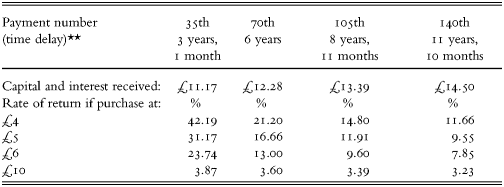
Indeed, the best financial option of the time was to buy a blank ticket with a heavy discount and hoard it until redemption. As Table 3 shows, the result was highly dependent on the time of redemption. Computations were made for four periods: the 35th payment, the 70th, 105th and 140th (the last one). Such figures need no comment: the nearer the payment, the larger the return.
Annual rate of return* on the purchase at discount of a blank ticket to be kept until redemption
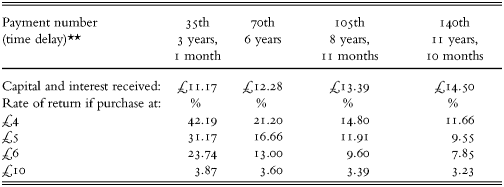
* Yield to maturity is computed on the exact number of days.
**The payments are assumed to have started on 24 September 1697, three months after 24 June, when interest began to run. So, for instance, the 35th payment means 37 months of interest.
Source: the authors.
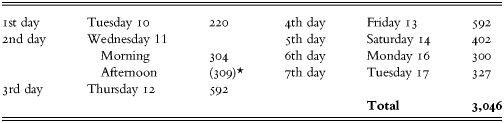
As the Act stipulated, on Tuesday 10 August 1697, the managers brought the three necessary boxes (‘sold’ tickets, benefits and special tickets for establishing the course of payments) into the Guildhall in the City of London. The British Library possesses a pamphlet published by the City of London Corporation in 1697 listing all the ‘fortunate’ numbers, which provides invaluable first-hand information. Despite bearing on only 5,000 tickets, the draw took seven days. Table 4 shows the number of prizes drawn each day.
Drawing schedule of the Malt Lottery
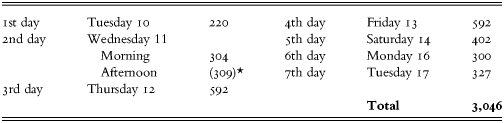
*Missing information. It is estimated by the difference between the total number of benefit tickets drawn and the number of known tickets drawn.
Source: City of London Corporation (1697).
As can be noted, only 3,046 benefit tickets were drawn instead of the announced 3,500. Thus, as stated in the 1694 Lottery Loan Act, the number and the amount of benefit tickets were reduced in due proportion to the sums collected. The reduction of 13.03 per cent suppressed 454 tickets.
V
Thanks to the figures at hand it is possible to measure the two main characteristics of the lottery loan: its expected cost to the Treasury – or its equivalent, its expected return for the adventurers – and its effective cost. However, in both cases, there is the problem of a lack of payment schedule. The computation of a yield to maturity (as opposed to a return) requires knowing the precise dates for each payment. Since section 35 stated that each month ‘what Thousand Tickets are to be paid that Month’ would be published, we deduce that each month one single 1,000-ticket block would be paid (payment of prizes, redemption of capital plus interest due). According to our second assumption, monthly payments started on 24 September 1697, three months after 24 June, the date interest began to run.
Based on these two assumptions, measuring the expected cost of the ‘loan’ component is a straightforward matter: 136,500 blanks had to be reimbursed at £10 each, amounting to a total of £1,365,000. A monthly repayment of the principal over 140 months means 975 tickets or £9,750, to which must be added interest which increased with the number of passing months (but decreased with the redemption of tickets). The yield obtained is 3.39 per cent over a 12-year period. This yield is far from the nominal rate of return of 3.80 per cent for the first year, the difference coming from the decrease in the compounded interest over time.
Measuring the expected cost of the ‘lottery’ component is another story. Only estimates can be made due to two factors. First, the dates of prize payments are not known since they depended on the order of payment of the blocks they belonged to. Second, and more importantly, the computation of the interest poses a problem. The interest of one farthing per day is computed on the purchase price of the ticket (£10) and not on the prize obtained. Thus the interest due would be the same whatever the prize obtained. Further, ‘large’ prizes did not receive any interest, so the Treasury would save more as it paid them later. For instance, if some ‘large’ prize was paid during the first month, the Treasury saved only 30 farthings, whereas if payment took place on the 140th month, the saving would amount to 4,322 farthings or £4 10s.
This may serve as a clue for estimating the two extreme figures of the lottery-loan cost: making three simulations as to the dates upon which ‘large’ and ‘small’ prizes might have been paid.Footnote 19 The process is as follows: (1) the 136,500 blanks are supposed to be redeemed (principal plus interest) by groups of 1,000-ticket blocks over 140 months, excluding the months in which the prizes were paid in priority; (2) the 3,500 prizes were organised in 1,000-ticket blocks and paid over three and a half months.
The results of the three simulations are as follows. (1) The most favourable situation for the Treasury would be if all prizes were paid during the final months, in effect from the 137th to 140th month. In that case, the yield would be 3.81 per cent. (2) The worst situation would be if all prizes were paid during the first three and a half months. The yield would then be 4.05 per cent. (3) The more probable result – on which more sophisticated mathematical simulation methods would converge – would be that obtained if all prizes were paid at mid-schedule and in a well-balanced way at five (and not three) months, from the 69th to the 73rd month. The yield would then be 3.91 per cent. Table 5 summarises these results, to which is added the cost of the ‘loan’ component, which can be used as a benchmark.
Summary of the possible expected costs of the Malt Lottery (yields to maturity)

Source: The authors.
From these figures we can infer three things. First, the span of the spread which ranges from a minimum of 3.81 per cent to a maximum of 4.05 per cent, equal to 24 basis points, is surprisingly small. Second, the most probable cost for the Treasury must have been 3.91 per cent. This estimate is the most plausible due to the small size of the spread. Third, this 3.91 per cent estimate totally contradicts the 6.3 per cent figure advanced by Dickson (Reference Dickson1967, pp. 48–9), a figure which is obviously erroneous. Paradoxically, the 1697 yield did not come from the relatively small amount of prizes used as an inducement for subscribing to the lottery loan but from the amount of ‘simple’ interest.
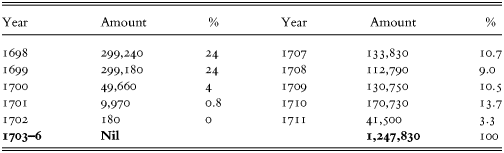
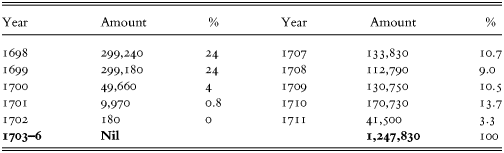
The effective cost of this unsuccessful operation can also be measured thanks to the Parliamentary Report on the National Debt (1898). Table 6 shows the annual payments relative to the principal alone, i.e. the payments of the prizes and ticket redemption. The figures relative to interest payments had to be estimated.
Effective yearly payments relative to the principal and the prizes of the Malt Lottery (£)
Source: British Parliamentary Papers (1898), pp. 284–7.
This table is rich both in information and in unknowns. First, the Treasury seems not to have paid blocks of 1,000 tickets since no figure is a multiple of 1,000. The £180 annual payments in 1702 are unexplained and one may wonder if they represent a unique payment of three prizes: £100, £50 and £30? Besides, annual payments were uneven. During the first two years, payments were considerable and amounted to half the debt, whereas there were years during which almost nothing was paid, before a complete stop in payments for four years, from 1703 to 1707, due to the heavy expenditures of the War of the Spanish Succession. The second remaining half of the debt was repaid at an annual rate of 10–11 per cent from 1707 to 1710, with the balance finally paid in 1711. Thus, the total payment of the prizes and redemption of the blanks was spread over 14 years, a little more than the 11 and a half years originally considered by William III's Act.
An estimate of the effective cost of this lottery loan can be made using some reasonable assumptions. The process used was as follows. (1) The prizes were reduced by 13 per cent. Such a reduction was applied to the amounts to be paid to the four types of tickets, ‘large’ prizes, £20 and £10 prizes and blanks. (2) The percentage effectively paid each year (columns 3 and 6 of Table 6) was applied to the four kinds of tickets. It provided the annual amount of payments the different tickets benefited from. (3) These annual amounts were divided by 12 in order to estimate the monthly payments. (4) The number of tickets eligible for interest payment was deducted from the monthly payments. (5) Computations were made separately for the four types of tickets. Then the four totals were added up and the yield was computed based on the effective time-schedule. Two results were estimated due to an important change in the interest rate. An Act doubled the interest: from 25 March 1699 onwards the interest became two farthings a day.Footnote 20 This measure may have been due to the complaints of subscribers who, not being able to get rapid repayment, required better remuneration; a gesture of generosity favoured by the Ryswick Peace. With such a doubling of interest, the total effective cost of the Malt Lottery Loan can be estimated at £1,823,774 over 14 years, representing a 5.84 per cent yield to maturity.
Relative to the cost of competing financial instruments, this 1697 lottery loan was a real bargain for the Treasury. It would have been even cheaper had the interest not been doubled: 3.55 per cent. This yield is quite different from and much smaller than the apparent nominal return of 3.80 per cent. A yield of 3.55 per cent is the direct consequence of the perverse effect of a remuneration based on a ‘simple’ rather than a ‘compound’ rate of interest, a feature which makes the 1697 loan a fruitful case study.
VI
The reasons for this complete failure deserve to be explained. Dickson (Reference Dickson1967, p. 57) says that it ‘showed how desperate a financial crisis the government had stumbled into’. Murphy (Reference Murphy2009, p. 63) says almost the same: ‘[it] was a powerful expression of the public's discontent’. We consider these two statements to be too limited. Launching any large issue is always a delicate matter demanding at least three preconditions, namely: (a) it must offer appealing financial features (return and redemption); (b) there must be an absence of competitive assets; and (c) psychologically, there must be a surge in trust in the future amidst troubled times.
When the return on a financial asset is not proportional to its risks, the asset cannot be sold. As Ashton (Reference Ashton1893) said in the foreword to his book: ‘With bad paper, one's best is impossible.’ Such was the case with the Malt Lottery. Both its ‘bond’ and its ‘lottery’ components offered too low a return.
The ‘flag’ of a lottery is its first prize. The £1,000 of the 1697 lottery loan was a very poor prize compared to the first prizes of the two previous lotteries. Neale's 1693 lottery gave a prize of £3,000 for a 10-shilling ticket to be paid immediately, and the 1694 lottery loan gave £1,000 over 16 years. Besides, the 1697 winner had to wait for a more or less long period of time before receiving his or her due.Footnote 21
In order to measure the relative attractiveness of lotteries, it is possible to compute their ‘expected value’, which is the sum of the prizes obtainable (including zero) weighted by their respective probability. The Million Adventure's expected value was £14 5s 10d for 16 years, adding up to a cumulative nominal total of £22 for tickets costing £10. This would have appeared a good bargain, making for success; but not so in 1697. The Malt Lottery's expected value was only £12 11s 2d, i.e. the redemption amount (£10) and a meagre £2.5 as interest.Footnote 22
As for the ‘bond’ component of the Malt ‘loan’, considering that the second rule for the success of an issue is to offer more than other available assets, the 1697 issue offered less, a very low 3.39 per cent (3.91 per cent if the lottery component was taken into account).Footnote 23 Both yields were very low compared to recent offerings by the Treasury: a tontine loan at 10 per cent in 1693,Footnote 24 whereas the Crown borrowed at 8 per cent in 1694 from the newly founded Bank of England, while the Goldsmiths lent money at 12 per cent and the Million Adventure yielded 11.25 per cent. More importantly, just before the Malt Lottery Act, Parliament had passed an Act specifying that the tallies accepted at par for the subscription to the Bank of England capital (for four-fifths of the subscription) had an 8 per cent rate of interest.Footnote 25 This 8 per cent figure can thus be used as a benchmark.
However, the actual rate of interest was much higher. Two contemporaries, Sir Francis Child (n.d; cited by Quinn Reference Quinn2006, p. 29) and Oldmixton (Reference Oldmixton1735, p. 150), both say that banknotes were valued with a 20 per cent discount and that some English funds bore a 40 to 60 per cent discount. With such investment opportunities, a paper yielding less than 4 per cent would have had some trouble being purchased willingly.
The third reason for the Malt Lottery failure was the uncertainty as to redemption dates. On this account, we consider that North and Weingast (Reference North and Weingast1989) are basically right – the transfer of financial power from the king to Parliament was revolutionary – but this must not be considered as the whole story since the actual features of an issue are of paramount importance for its success.
The uncertainty as to redemption dates was due to four factors, the major one being the fact that the Million Adventure subscribers were not receiving their annuities and were petitioning Parliament. The Chancellor of the Exchequer, Charles Montagu, wrote to his friend William Blathwayt: ‘I was always fearful of the success of a new Lottery when the old tickets were not pay'd but wee must make the best wee can of it’ (Murphy Reference Murphy2005, p. 9). This was an awkward situationFootnote 26 owing to the fact that Parliament had suppressed the king's power to renege his financial commitments but was not able to enforce its own.Footnote 27 In fact (and this was the second uncertainty factor), the Million Adventurers were not the sole investors not being paid. Just before the Malt Lottery issue, Parliament had been faced with the fact that tax revenues for 15 previous issues proved to be largely overestimated, leading to a deficit of £5 million (see note 25 above). Therefore it was not considered a good omen for the Malt Lottery guarantee and it forced Parliament to legislate again at the beginning of 1698, although too late since the draw had already taken place. An Act (8 and 9 Will. III c. 8) was passed once more ordering that any revenue coming from the tax upon malt be used in priority for payments to the Malt Lottery and, as mentioned above, it increased its interest from 1 to 2 farthings a day.
The third uncertainty factor concerned more astute investors. The Malt Act specified that the new malt tax was to be in force for (only) two years and three months (sect. 1). It was thus obvious that the state could not collect £1,400,000 in 27 months. Had it been possible, the state would have had no need to issue a lottery loan. This schedule may have resulted from the Parliament's reluctance for long-term financing, which probably was a way to control the king's expenditures.Footnote 28 Practically, it meant that the 1697 investors had to trust that Parliament would extend the collection of the taxes appropriated to them.
The fourth uncertainty factor – though a minor one – was the lack of a precise redemption schedule due to its being dependent on tax revenue.
Our third requirement for a successful issue is linked to the economic and political environment. States launch large issues because they need ready money (most often due to the waging of wars). Thus issues are made in times of crisis, which, by definition, are not favourable to subscriptions. So, two things are needed: first and foremost an appeal to patriotic feelings, and second, a surge of optimism for the near future.
Such was not the situation in England in 1697 since it was a time of economic crisis and of gloomy political atmosphere. D. W. Jones cited by Murphy (Reference Murphy2009, p. 56) concisely summarises the situation as ‘the gravest economic crisis of the century’.Footnote 29 It had two main causes, namely: the Great Recoinage and the War of the Augsburg League. The Great Recoinage took place from December 1695 to 4 May 1696. Horsefield (Reference Horsefield1956, p. 234) concludes that ‘the years 1695 and 1696 showed a real, though mild, inflation, followed by an equally real, though briefer, deflation’. Hence, the 1697 lottery loan was launched in the middle of a credit crunch and at a time when people were hoarding the newly minted coins.
In 1697, the War of the Augsburg League had been going on for eight years. It was unexpectedly costly since England had to finance both its allies and its own troops fighting on the Continent. For Englishmen, it meant a continuous increase in existing taxes and the introduction of new ones. This did not prevent belligerents from being financially exhausted. Secret peace talks were underway at the very time the lottery loan was announced. Had they been known about, the result might have been different. Though this is not certain since the Peace Conference had convened in Ryswick on 9 May, before the closing of the subscription on 24 June 1697, and that good news had, obviously, no incentive effect on investors. The political environment remained gloomy, certainly due to the constant increase in taxes, and to the fact that King William III had not inherited the popularity of Queen Mary (who died in 1694), whereas there was a growing feeling he was favouring his native country.Footnote 30
Instead of acknowledging the inadequate design of the Malt Lottery, which was not fit for the general economic conditions of the day and for the needs of potential subscribers, it was private lotteries which came under attack, and criticisms bore not only on those who had organised them but also on those who had participated:
Whereas severall evill-disposed Persons … have sett up many mischievous and unlawfull Games called Lotteries … have thereby most unjustly and fraudulently gott to themselves great Sums of Money from the Children and Servants of severall Gentlemen Traders and Merchants …to the utter Ruine and Impoverishment of many Families … Be it enacted …That all such Lotteries and all other Lotteries are common and publick Nuisances (and are) against Law.
This is the preamble of the Act which forbade private and state lotteries at the end of 1698.Footnote 31 This virtuous stance was not to last. In 1710 when, due to the War of the Spanish Succession, the financial situation once more became tight, an Act was passed issuing a new lottery loan.Footnote 32 This type of financial asset was to be used until the new prohibition a century later in 1826, only to reappear in modern times and still in use today under the name of ‘Premium bonds’.
VII
The aim of this article was to demonstrate how the technical features of state lottery loans, in use for more than a century, emerged from a Venetian lottery, then from a private lottery in 1693 and from the Million Adventure in 1694. However, whatever the technicalities adopted, what is paramount are the financial characteristics which are required to appeal to potential investors. And this is not an easy task, as shown by the 1697 failure: its 3.91 per cent expected return was lower than other investment opportunities, and its reimbursement was uncertain. Moreover, the country was facing a major economic crisis and the political environment was gloomy. Thus the Malt issue presented none of the three necessary conditions for the successful issue of a financial asset. No wonder that it failed.