Introduction
The hemlock woolly adelgid, Adelges tsugae Annand (Hemiptera: Adelgidae), is an introduced insect that feeds on eastern hemlock (Tsuga canadensis (L.) Carrière) and Carolina hemlock (Tsuga caroliniana Engelmann) in the Eastern USA. Adelges tsugae was first reported in the Eastern USA near Richmond, Virginia, in 1951 (Stoetzel, Reference Stoetzel, Onken, Reardon and Lashomb2002) and was subsequently determined to have been introduced there from Southern Japan (Havill et al., Reference Havill, Montgomery, Yu, Shiyake and Caccone2006). In the 1980s, A. tsugae began spreading rapidly throughout the range of eastern hemlock causing high levels of tree mortality. It is now found in eighteen eastern states from Georgia to Southern Maine (Havill et al., Reference Havill, Montgomery, Keena, Onken and Reardon2011).
Adelges tsugae is a minute (0.4–1.4 mm long), sucking insect that remains stationary for most of its life within cottony flocculence near the base of hemlock needles. Adelges tsugae inserts its mouthparts into the stem and feeds on the xylem ray parenchyma. There are two generations per year, with oviposition occurring in late winter (progrediens eggs) and early summer (sistens eggs). A mobile crawler emerges from the egg and seeks out an unoccupied leaf base where it settles and molts to a first instar nymph (McClure, Reference McClure1987). In early spring and summer, the crawler stage can disperse to new trees via wind, the nursery trade, birds, mammals, or humans (McClure, Reference McClure1990; Ward et al., Reference Ward, Montgomery, Cheah, Onken and Cowles2004). The first instar nymph of the sistens generation will undergo a 2 to 4 months aestival diapause during late summer. There is no reported sexual reproduction of A. tsugae in North America; all individuals reproduce parthenogenetically.
Since the early 1990s there has been considerable effort devoted to the development of classical biological controls for A. tsugae. Because A. tsugae has no reported parasitoids, the most promising biological control agents are adelgid specialist predators and/or entomopathogens (Cheah et al., Reference Cheah, Montgomery, Salom, Parker, Costa and Skinner2004). Explorations in its native ranges in Asia and western North America have identified several potential biological control agents (Onken & Reardon, Reference Onken and Reardon2011). To date, the biological control program has focused primarily on two predatory beetles, Sasajiscymnus tsugae (Sasaji and McClure), a coccinelid imported from Japan, and Laricobius nigrinus Fender, a derodontid imported from western North America. Between 1995 and 2010, over 2 million S. tsugae were released at more than 400 sites in 16 eastern states (Cheah, Reference Cheah, Onken and Reardon2011). Between 2003 and 2010, several hundred thousand La. nigrinus adults and eggs were released at hundreds of sites in 14 eastern states (Mausel et al., Reference Mausel, Davis, Lamb, Zilahi-Balogh, Kok, Salom, Onken and Reardon2011). Despite the large numbers of S. tsugae and La. nigrinus released and their establishment at numerous sites, there is no indication that they are significantly impacting A. tsugae populations or reducing the rate of hemlock mortality. Consequently, exploration for additional predators to release in the Eastern USA is continuing.
A beat sampling survey of 116 A. tsugae infested western hemlocks (Tsuga heterophylla (Raf.) Sarg.) across 16 sites in Western Oregon and Washington over 23 months resulted in the collection of over 6000 adult and immature predators representing 55 species from 43 genera, 14 families, and four orders (Kohler et al., Reference Kohler, Stiefel, Wallin and Ross2008). Laricobius nigrinus was found to be the most abundant, comprising 43% of all predators collected. Collectively, two species of Leucopis (Diptera: Chamaemyiidae), Le. argenticollis Zetterstedt and Le. piniperda Malloch (misidentified as Le. atrifacies Aldrich, see Grubin et al., Reference Grubin, Ross and Wallin2011), were the second most abundant predators, comprising 16% of the total. Since we do not know the efficacy of beat sampling for the different species, the actual relative abundance of La. nigrinus to Leucopis species is likely different than these numbers suggest. The ratio of immatures to adults was over three times higher for the chamaemyiids (9.2) compared with the derodontids (2.6) or hemerobiids (3.1), the third most abundant group, suggesting that beat sampling was less effective at collecting adult chamaemyiids than adults of other species, and that they are more abundant relative to the other predators than indicated by counts from beat sampling. Laricobius nigrinus, Le. argenticollis, and Le. piniperda were the only adelgid specific predators that were both frequently encountered and abundant in the survey. This was the first record of either Le. argenticollis or Le. piniperda collected in association with A. tsugae, although both species have been collected in association with other Pineus and Adelges species in other parts of North America (Ross et al., Reference Ross, Gaimari, Kohler, Wallin, Grubin, Onken and Reardon2011). The abundance of Leucopis spp. larvae and Le. argenticollis adults was positively correlated with A. tsugae population and no Leucopis spp. were collected from uninfested T. heterophylla during the survey. The results of this survey suggest that the two Leucopis spp. merit further study as potential biological control agents for use in the Eastern USA.
The primary objective of the study reported here was to evaluate the degree of synchrony between life cycles of the two Leucopis spp. pooled and A. tsugae to further evaluate their potential as biological control agents. Specifically, we were interested in determining what life stage of A. tsugae was present when actively feeding Leucopis spp. larvae were most abundant. In addition, we recorded the abundance of La. nigrinus on the same trees for comparison with Leucopis spp.
Materials and methods
Heavily infested T. heterophylla that would support populations of chamaemyiid predators are most likely to be found in orchard or ornamental plantings. Six T. heterophylla infested with A. tsugae were sampled at 1–4 week intervals at a seed orchard near St. Paul, Oregon from May 2007 to May 2008. Seven T. heterophylla infested with A. tsugae were sampled at 2–3 week intervals in an ornamental planting in Olympia, Washington from September 2007 to August 2008. On each collection date, two terminal twig samples per tree were cut from randomly selected A. tsugae infested branches below 2.5 m in height. The length of twig samples ranged from 3 to 10 cm. Twig samples were brought to the laboratory and carefully inspected with a dissecting microscope. All stages of living A. tsugae were counted, except eggs, which were always present with adults. The instar of A. tsugae nymphs was determined by counting exuvia (Zilahi-Balogh et al., Reference Zilahi-Balogh, Humble, Lamb, Salom and Kok2003). Counts of third and fourth instar A. tsugae nymphs were pooled because they were sometimes difficult to distinguish. All live Leucopis spp. eggs, larvae, and puparia were counted. Leucopis spp. have three larval instars (McAlpine & Tanasijtshuk, Reference McAlpine and Tanasijtshuk1972; Tanasijtshuk, Reference Tanasijtshuk2002). The first instar is identifiable by size and lack of pigment. Counts of second and third instar Leucopis spp. larvae were pooled because they are difficult to distinguish reliably. Larvae and adults of La. nigrinus were also counted. The density of insects is reported as individuals per cm twig length.
Analyses
Mean densities were calculated separately for each location at each sample date. Means were calculated for all Leucopis spp. larval instars pooled, La. nigrinus larvae, A. tsugae instars 2–4 pooled, and A. tsugae adults and eggs. Leucopis spp. and La. nigrinus larval densities were graphed against A. tsugae instars 2–4 and A. tsugae adults and eggs.
Results
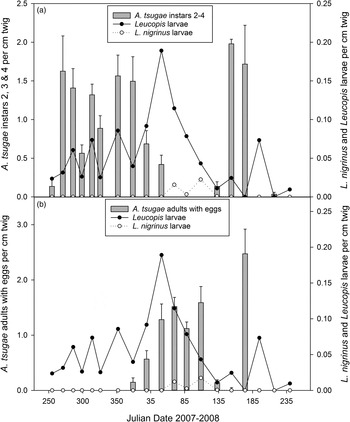
Leucopis spp. larvae can be found throughout the year on A. tsugae infested twigs in the Pacific Northwest (PNW) (figs 1 and 2). All Leucopis spp. eggs were found at the base of hemlock needles in contact with A. tsugae wool. All Leucopis spp. and La. nigrinus larvae were found within A. tsugae wool, either in contact with live A. tsugae or in unoccupied ovisacs.
Seasonal abundance of A. tsugae second to fourth instar nymphs (a) and adults with eggs (b) and Leucopis spp. and La. nigrinus larvae on western hemlocks in a seed orchard near St. Paul, OR.

Seasonal abundance of A. tsugae second to fourth instar nymphs (a) and adults with eggs (b) and Leucopis spp. and La. nigrinus larvae on western hemlocks in an ornamental planting in Olympia, WA.

The approximate period when A. tsugae progrediens and sistens eggs were observed across the two locations was from March to mid-May (Julian dates 60–135) and early June to mid-July (Julian dates 160–200), respectively (figs 1 and 2). At both locations, Leucopis spp. larvae were collected during periods when both A. tsugae progrediens and sistens eggs were present. Although at the St. Paul, OR location, Leucopis spp. larvae were collected only during the latter part of the progrediens egg generation in early May 2007 (Julian dates 122–128) and not during the same period in 2008 (fig. 1). At both locations, La. nigrinus larvae were collected only during periods when A. tsugae progrediens eggs were present (figs 1 and 2).
The peak abundance of Leucopis spp. larvae coincided more closely with the presence of A. tsugae adults and eggs than nymphs at both locations (figs 1 and 2). The peak abundance of La. nigrinus larvae also coincided more closely with the presence of A. tsugae adults and eggs than nymphs at both locations (figs 1 and 2), although they were not present after early May (about Julian date 130) at either site because they pupate in the soil over the summer. Consequently, La. nigrinus larvae do not prey on the sistens egg stage.
At the St. Paul, OR location, the peak abundance of La. nigrinus larvae in 2008 was slightly higher than the peak abundance of Leucopis spp. larvae in 2007 (fig. 1). However, Leucopis spp. larvae were present for a much longer period of time and 3.5 times more Leucopis spp. were collected than L. nigrinus. A total of 42 Leucopis spp. (five eggs, 30 larvae, and seven puparia) were collected compared with 12 La. nigrinus (all larvae) at this location. A total of 3846 A. tsugae (125 crawlers, 2257 first instar nymphs, 527 second instar nymphs, 442 third and fourth instar nymphs, and 498 adults) were collected at this location. At the Olympia, WA location, the peak abundance of Leucopis spp. larvae was much greater than the peak abundance of La. nigrinus and, again, they were present for a much longer period of time (fig. 2). Leucopis spp. were collected 2.3 times more than La. nigrinus at this location. A total of 102 Leucopis spp. (93 larvae and nine puparia) were collected compared with 44 La. nigrinus (41 larvae and three adults). A total of 3075 A. tsugae (102 crawlers, 704 first instar nymphs, 517 second instar nymphs, 875 third and fourth instar nymphs, and 877 adults) were collected at this location.
Discussion
Leucopis spp. and La. nigrinus larvae were both most abundant at times when A. tsugae were present as adults and eggs. This confirms previous reports of the phenology of these species in Southwestern British Columbia, Oregon, and Washington (Zilahi-Balogh et al., Reference Zilahi-Balogh, Humble, Lamb, Salom and Kok2003; Kohler et al., Reference Kohler, Stiefel, Wallin and Ross2008; Grubin et al., Reference Grubin, Ross and Wallin2011). Leucopis spp. larvae were also present when all A. tsugae were nymphs, but La. nigrinus larvae were never found at those times. These results confirm that Leucopis spp. and La. nigrinus larvae feed on A. tsugae adults and/or eggs, but only Leucopis spp. larvae potentially feed on A. tsugae nymphs. Furthermore, Leucopis spp. larvae are present during both generations of A. tsugae, while La. nigrinus larvae are only found during the progrediens egg stage, i.e. mid-March to mid-May, Julian dates 70–133.
Between 2.3 and 3.5 times more Leucopis spp. than La. nigrinus were collected on the clipped branch samples. This is just about opposite of the relative abundance of the two genera of predators found in a beat sampling survey of A. tsugae infested hemlocks in the same region where La. nigrinus were 2.7 times more abundant than Leucopis spp. (Kohler et al., Reference Kohler, Stiefel, Wallin and Ross2008). However, it has been suggested previously that the beat sampling technique is likely more efficient at collecting adult La. nigrinus than adult Leucopis spp. and overestimates the abundance of the former compared with the latter (Ross et al., Reference Ross, Gaimari, Kohler, Wallin, Grubin, Onken and Reardon2011). Therefore, the numbers from the clipped branch sampling technique used in this study are probably more representative of the relative abundance of the two genera of predators.
Since the two species of Leucopis are found along with La. nigrinus throughout the PNW, it is likely that they will compliment rather than compete significantly with one another after release in the Eastern USA. The results of this study support previous findings that Leucopis spp. are important predators of A. tsugae in the PNW and, furthermore, are deserving of continued study as potential biological control agents for A. tsugae in the Eastern USA.
Acknowledgements
The authors thank the staff at the Oregon Department of Forestry J.E. Schroeder Seed Orchard and the Thurston County Title Company for cooperation in establishing and maintaining field sites. This research was funded in part by the USDA Forest Service, Forest Health Technology Enterprise Team (FHTET), Morgantown, WV. This research was also supported by the Oregon State University College of Forestry and the Oregon Sports Lottery Scholarship Fund.