Introduction
Where do individual values and preferences come from? Why do people want what they want? Some social scientists and biologists have explored the origin of values (Emerson, Reference Emerson and Cook1987; Hechter et al., Reference Hechter, Nadel and Michod1993) while economists have remained mute on the issue. Their traditional answer to the question of individual values and preferences is: De gustibus non est disputandum (Stigler & Becker, Reference Stigler and Becker1977). There's no accounting for tastes, and one cannot explain individuals' idiosyncratic values and preferences, although Becker (Reference Becker1996) has later attempted to explain them. A theory of revealed preferences, which is often used in micro-economics, only measures individuals' preferences empirically and does not explain where they come from or why actors have them. Despite many attempts and some promising starts (Wildavsky, Reference Wildavsky1987; Schwartz, Reference Schwartz and Zanna1992; Hechter et al., Reference Hechter, Ranger-Moore, Jasso and Horne1999), there currently is no satisfactory general theory of values.
Some argue that evolutionary psychology can provide such a general theory of values (Ben-Ner & Putterman, Reference Ben-Ner and Putterman2000; Kanazawa, Reference Kanazawa2001a; Horne, Reference Horne2004). Evolutionary psychology is the study of universal human nature, or sex-specific male human nature and female human nature, and their interaction with the environment. It can therefore in principle explain both universal preferences (as a function of the universal human nature) and individual preferences (as a function of the interaction between the universal human nature and individual circumstances and experiences).
This paper will discuss recent theoretical developments in evolutionary psychology and offer one possible explanation of individual values and preferences, called the Savanna-IQ Interaction Hypothesis. It explains how the level of general intelligence affects the acquisition of certain evolutionarily novel values and preferences. The Savanna-IQ Interaction Hypothesis will be tested at the macro level with respect to three evolutionarily novel values (liberalism, atheism and monogamy). The empirical analyses will show that, consistent with the Hypothesis, nations with higher average intelligence are more liberal, less religious and more monogamous than nations with lower average intelligence.
The Savanna Principle
Adaptations, physical or psychological, are designed for and adapted to the conditions of the environment of evolutionary adaptedness, not necessarily to the current environment (Tooby & Cosmides, Reference Tooby and Cosmides1989). This is easiest to see in the case of physical adaptations, such as the vision and colour recognition system.
What colour is a banana? A banana is yellow in the sunlight and in the moonlight. It is yellow on a sunny day, on a cloudy day, on a rainy day. It is yellow at dawn and at dusk. The colour of a banana appears constant to the human eye under all of these conditions, despite the fact that the actual wavelengths of the light reflected by the surface of the banana under these varied conditions are different. Objectively, it is not the same colour all the time. However, the human eye and colour recognition system can compensate for these varied conditions because they all occurred during the course of the evolution of the human vision system, and can perceive the objectively varied colours as constantly yellow (Cosmides & Tooby, Reference Cosmides and Tooby1999, pp. 17–19).
So a banana looks yellow under all conditions, except in a parking lot at night. Under the sodium vapour lights commonly used to illuminate parking lots, a banana does not appear natural yellow. This is because the sodium vapour lights did not exist in the ancestral environment, during the course of the evolution of the human vision system, and it is therefore incapable of compensating for them. (Fans of the 1989 movie The Abyss may recall a scene toward the end of the movie, where it is impossible for a diver to distinguish colours under artificial lighting in the otherwise total darkness of the deep oceanic basin.)
The same principle holds for psychological adaptations. Pioneers of evolutionary psychology (Symons, Reference Symons1990; Tooby & Cosmides, Reference Tooby and Cosmides1990; Crawford, Reference Crawford1993) all recognized that the evolved psychological mechanisms are adapted for the conditions of the environment of evolutionary adaptedness, not necessarily to the conditions of the current environment. Kanazawa (Reference Kanazawa2004a) systematizes these observations into what he calls the Savanna Principle: The human brain has difficulty comprehending and dealing with entities and situations that did not exist in the ancestral environment. Burnham & Johnson (Reference Burnham and Johnson2005,pp. 130–131) refer to the same observation as the Evolutionary Legacy Hypothesis, while Hagen & Hammerstein (Reference Hagen and Hammerstein2006, pp. 341–343) call it theMismatch Hypothesis.
The Savanna Principle can potentially explain why some otherwise elegant scientific theories of human behaviour, such as the subjective expected utility maximization theory or game theory, often fail empirically, because they posit entities and situations that did not exist in the ancestral environment. For example, many players of one-shot Prisoner's Dilemma games may make the theoretically irrational choice to cooperate with their partner, possibly because the human brain has difficulty comprehending completely anonymous social exchange and absolutely no possibility of knowing future interactions (which together make the game truly one-shot). Neither of these situations existed in the ancestral environment, but they are crucial for the game-theoretical prediction of universal defection.
As another illustration of the Savanna Principle, individuals who watch certain types of TV shows are more satisfied with their friendships, just as they are if they had more friends or socialized with them more frequently (Kanazawa, Reference Kanazawa2002). This may be because realistic images of other humans, such as television, movies, videos and photographs, did not exist in the ancestral environment, where all realistic images of other humans were other humans. As a result, the human brain may have implicit difficulty distinguishing their ‘TV friends’ (the characters they repeatedly see on TV shows) and their real friends.
Evolution of general intelligence
General intelligence refers to the ability to reason deductively or inductively, think abstractly, use analogies, synthesize information, and apply it to new domains (Neisser et al., Reference Neisser, Boodoo, Bouchard, Boykin, Brody and Ceci1996; Gottfredson, Reference Gottfredson1997). The g factor, which is often used synonymously with general intelligence, is a latent variable which emerges in a factor analysis of various cognitive (‘IQ’) tests. They are not exactly the same thing. g is an indicator or measure of general intelligence; it is not general intelligence itself.
The concept of general intelligence poses a problem for evolutionary psychology. Evolutionary psychologists contend that the human brain consists of domain-specific evolved psychological mechanisms, which evolved to solve specific adaptive problems (problems of survival and reproduction) in specific domains. If the contents of the human brain are domain-specific, how can evolutionary psychology explain general intelligence?
In contrast to views expressed by Cosmides & Tooby (Reference Cosmides, Tooby, Sternberg and Kaufman2002) and Chiappe & MacDonald (Reference Chiappe and MacDonald2005), Kanazawa (Reference Kanazawa2004b) proposes that what is now known as general intelligence may have originally evolved as a domain-specific adaptation to deal with evolutionarily novel, non-recurrent problems. The human brain consists of a large number of domain-specific evolved psychological mechanisms to solve recurrent adaptive problems. In this sense, our ancestors did not really have to think in order to solve such recurrent problems. Evolution has already done all the thinking, so to speak, and equipped the human brain with the appropriate psychological mechanisms, which engender preferences, desires, cognitions and emotions, and motivate adaptive behaviour in the context of the ancestral environment.
Even in the extreme continuity and constancy of the ancestral environment, however, there were probably occasional problems that were evolutionarily novel and non-recurrent, which required our ancestors to think and reason in order to solve. To the extent that these evolutionarily novel, non-recurrent problems happened frequently enough in the ancestral environment (different problem each time) and had serious enough consequences for survival and reproduction, then any genetic mutation that allowed its carriers to think and reason would have been selected for, and what we now call ‘general intelligence’ could have evolved as a domain-specific adaptation for the domain of evolutionarily novel, non-recurrent problems. General intelligence may have become universally important in modern life (Herrnstein & Murray, Reference Herrnstein and Murray1994; Gottfredson, Reference Gottfredson1997; Jensen, Reference Jensen1998) only because our current environment is almost entirely evolutionarily novel. The new theory suggests, and empirical data confirm, that more intelligent individuals are better than less intelligent individuals at solving problems only if they are evolutionarily novel but that more intelligent individuals are not better than less intelligent individuals at solving evolutionarily familiar problems, such as those in the domains of mating, parenting, interpersonal relationships and wayfinding (Kanazawa, Reference Kanazawa2004b). Two recent studies, employing widely varied methods, have both shown that the average intelligence of a population appears to be a strong function of the evolutionary novelty of its environment (Ash & Gallup, Reference Ash and Gallup2007; Kanazawa, Reference Kanazawa2008a).
Savanna-IQ Interaction Hypothesis
The logical conjunction of the Savanna Principle and the theory of the evolution of general intelligence suggests a qualification of the Savanna Principle. If general intelligence evolved to deal with evolutionarily novel problems, then the human brain's difficulty in comprehending and dealing with entities and situations that did not exist in the ancestral environment (proposed in the Savanna Principle) should interact with general intelligence, such that the Savanna Principle holds stronger among less intelligent individuals than among more intelligent individuals. More intelligent individuals should be better able to comprehend and deal with evolutionarily novel (but not evolutionarily familiar) entities and situations than less intelligent individuals.
There has been accumulating evidence for this Savanna-IQ Interaction Hypothesis. First, individuals' tendency to respond to TV characters as if they were real friends, first discovered by Kanazawa (Reference Kanazawa2002), appears to be limited to those with below-median intelligence (Kanazawa, Reference Kanazawa2006a); individuals with above-median intelligence do not become more satisfied with their friendships by watching more television.
Second, net of age, race, sex, education, marital history and religion, less intelligent individuals have more children than more intelligent individuals, even though they do not want to. This may possibly be because they have greater difficulty effectively employing evolutionarily novel means of modern contraception (Kanazawa, Reference Kanazawa2005). Another indication that less intelligent individuals may have greater difficulty employing modern contraception effectively is the fact that the correlation between the lifetime number of sex partners and the number of children is positive among the less intelligent but negative among the more intelligent. The more sex partners less intelligent individuals have, the more children they have; the more sex partners more intelligent individuals have, the fewer children they have.
Third, more intelligent individuals stay healthier and live longer than less intelligent individuals possibly because they are better able to recognize and deal with evolutionarily novel threats and dangers to health in modern society (Deary et al., Reference Deary, Whiteman, Starr, Whalley and Fox2004; Gottfredson & Deary, Reference Gottfredson and Deary2004; Kanazawa, Reference Kanazawa2006b). Consistent with the Hypothesis, however, general intelligence does not appear to affect health and longevity in sub-Saharan Africa, where many of the health threats and dangers are more evolutionarily familiar than elsewhere in the world. Within the United States, state IQ (average intelligence of a state population) predicts measures of health of the state population, such as life expectancy at birth, age-adjusted death rate, infant mortality rate and percentage obese (Kanazawa, Reference Kanazawa2008c).
Finally, criminologists have long known that criminals on average have lower intelligence than the general population (Wilson & Herrnstein, Reference Wilson and Herrnstein1985; Herrnstein & Murray, Reference Herrnstein and Murray1994). From the perspective of the Hypothesis, there are two important points to note (Kanazawa, Reference Kanazawa, Walsh and Beaver2009a). Much of what we call interpersonal crime today, such as murder, assault, robbery and theft, were probably routine means of intrasexual male competition in the ancestral environment. This is how men probably competed for resources and mating opportunities for much of human evolutionary history; they beat up and killed each other, and they stole from each other if they could get away with it. We may infer this from the fact that behaviour that would be classified as criminal if engaged in by humans, like murder, rape, assault and theft, is quite common among other species (Ellis, Reference Ellis1998), including other primates such as chimpanzees (de Waal, 1998), bonobos (de Waal, Reference de Waal, Nishida, McGrew and Marler1992) and capuchin monkeys (de Waal et al., Reference de Waal, Luttrell and Canfield1993).
At the same time, the institutions that control, detect and punish criminal behaviour in society today – CCTV cameras, the police, the courts and the prisons – are all evolutionarily novel; there was very little formal third-party enforcement of norms in the ancestral environment. Norms then were probably enforced by either second-party enforcement (victims and their kin and allies) or informal third-party enforcement (ostracism). Thus it makes sense from the perspective of the Savanna-IQ Interaction Hypothesis that men with low intelligence may be more likely to resort to evolutionarily familiar means of competition for resources (theft rather than full-time employment) and mating opportunities (rape rather than computer dating) and not to comprehend fully the consequences of criminal behaviour imposed by evolutionarily novel entities of law enforcement.
There thus appears to be some evidence for the Savanna-IQ Interaction Hypothesis. Applied to the origin of preferences and values, the Hypothesis suggests that more intelligent individuals may be more likely to acquire and espouse evolutionarily novel preferences and values than less intelligent individuals, while general intelligence may make no difference for the acquisition and espousal of evolutionarily familiar values. In particular, the Hypothesis leads to predictions about three evolutionarily novel values of liberalism, atheism and, for men, sexual exclusivity, and how general intelligence may affect their acquisition and espousal.
General intelligence and openness to experience
Research in personality psychology has shown that one of the Five-Factor Model personality factors – openness to experience – is significantly positively correlated with intelligence (Ackerman & Heggestad, Reference Ackerman and Heggestad1997). The similarity and overlap between intelligence and openness are apparent from the fact that some researchers call this personality factor ‘intellect’ rather than ‘openness’ (Goldberg, Reference Goldberg1992; McRae, Reference McRae1994). While it is widely accepted by personality psychologists that intelligence and openness co-vary across individuals, it is not known why (Chamorro-Premuzic & Furnham, Reference Chamorro-Premuzic and Furnham2006). The Savanna-IQ Interaction Hypothesis can potentially explain why more intelligent individuals are more open to new experiences and are therefore more prone to seek novelty. It is instructive to note from this perspective that only the actions, ideas and values facets of openness to experience are significantly correlated with general intelligence, not the fantasy, aesthetics and feelings facets (Holland et al., Reference Holland, Dollinger, Holland and MacDonald1995; Gilles et al., Reference Gilles, Stough and Loukomitis2004).
At the same time, the Hypothesis suggests a possible need to refine the concept of novelty and to distinguish between evolutionary novelty (entities and situations that did not exist in the ancestral environment) and experiential novelty (entities and situations that individuals have not personally experienced in their own lifetime). While the Five-Factor Model does not specify the type of novelty that open individuals are more likely to seek, the Savanna-IQ Interaction Hypothesis suggests that more intelligent individuals are more likely to seek only evolutionary novelty, not necessarily experiential novelty.
For example, everybody who is alive in the United States today has lived their entire lives in a strictly monogamous society, and, despite recent news events, very few contemporary Americans have any personal experiences with polygyny. Therefore monogamy is experientially familiar for most Americans whereas polygyny is experientially novel. The Five-Factor Model may therefore predict that more intelligent individuals are more likely to be open to polygyny as an experientially novel idea or action. In contrast, humans have been mildly polygynous throughout their evolutionary history (Alexander et al., 1977; Leutenegger & Kelly, Reference Leutenegger and Kelly1977), and socially imposed monogamy is a relatively recent historical phenomenon (Kanazawa & Still, Reference Kanazawa and Still1999). The Savanna-IQ Interaction Hypothesis would therefore predict that more intelligent individuals are more likely to be open to monogamy and less likely to be open to polygyny. In fact, more intelligent men are more likely to value monogamy and sexual exclusivity than less intelligent men (Kanazawa, Reference Kanazawa2008b).
As another example, for most contemporary Americans, traditional names derived from the Bible, such as John and Mary, are experientially more familiar than untraditional names like OrangeJello and Loser (Levitt & Dubner, Reference Levitt and Dubner2005). So the Five-Factor Model may predict that more intelligent individuals are more likely to name their children untraditional names like OrangeJello and Loser than less intelligent individuals. From the perspective of the Hypothesis, however, both John and OrangeJello are equally evolutionarily novel (because the Bible itself and all the traditional names derived from it are evolutionarily novel), so it would not predict that more intelligent individuals are more likely to name their children untraditional names. In fact, there is no evidence at all that more intelligent individuals are more likely to prefer untraditional names for their children (Lieberson & Bell, Reference Lieberson and Bell1992; Fryer & Levitt, Reference Fryer and Levitt2004).
The Savanna-IQ Interaction Hypothesis underscores the need to distinguish between evolutionary novelty and experiential novelty. It can potentially explain why more intelligent individuals are more likely to seek evolutionary novelty, but not necessarily experiential novelty. It further suggests that the established correlation between openness and intelligence may be limited to the domain of evolutionary novelty, not necessarily experiential novelty.
Evolutionarily novel values
Liberalism
It is difficult to provide a precise definition of a whole school of political ideology like liberalism. Further, what passes as liberalism varies by place and time. The Liberal Democratic Party in the United Kingdom is middle-of-the-road, while the Liberal Democratic Party in Japan is conservative. The political philosophy which originally emerged as ‘liberalism’ during the Enlightenment is now called ‘classical liberalism’ or ‘libertarianism’, and represents the polar opposite of what is now called ‘liberalism’ in the United States (Murray, Reference Murray1998).
This paper will adopt the contemporary American definition of liberalism. It provisionally defines liberalism (as opposed to conservatism) as the concern for the welfare of genetically unrelated others and the willingness to contribute larger proportions of private resources for the welfare of such others. In the modern political and economic context, this willingness usually translates into paying higher proportions of individual incomes in taxes toward the government and its social welfare programmes.
Defined as such, liberalism is evolutionarily novel. Humans (like other species) are designed by evolution to be altruistic toward their genetic kin (Hamilton, Reference Hamilton1964), their repeated exchange partners (Trivers, Reference Trivers1971) and members of their deme (a group of intermarrying individuals) or ethnic group (Whitmeyer, Reference Whitmeyer1997). They are not designed to be altruistic toward an indefinite number of complete strangers whom they are not likely ever to meet or exchange with. This is largely because our ancestors lived in a small band of 50–150 individuals all their lives, and large cities and nations with thousands and millions of people are themselves evolutionarily novel. The Savanna-IQ Interaction Hypothesis would therefore predict that more intelligent individuals are more likely to espouse liberal political ideology than less intelligent individuals.
In an earlier study, Eaves & Eysenck (Reference Eaves and Eysenck1974) discover that political attitude (on the ‘radical-conservative’ scale) has the heritability of 0.65. More recently, Alford et al. (Reference Alford, Funk and Hibbing2005) show that roughly 43% of the variance in political attitudes on the conservative–liberal dimension is determined by genes, and parental socialization has a relatively minor role, accounting for only 22% of the total variance. In a comprehensive meta-analysis, Jost et al. (Reference Jost, Glaser, Kruglanski and Sulloway2003) uncover a large number of personality correlates with conservatism such as death anxiety and intolerance of ambiguity. Their study, however, does not include general intelligence as a correlate of political attitude, except that they show that openness to experience is negatively correlated with conservatism, and we know from studies cited above that openness correlates positively with intelligence. Consistent with the prediction derived from the Hypothesis, Deary et al.'s (Reference Deary, Batty and Gale2008a,Reference Deary, Batty and Galeb) recent studies show that more intelligent British children are more likely to become liberal adults.
Atheism
While religion is a cultural universal (Brown, Reference Brown1991), recent evolutionary psychological theories (Guthrie, Reference Guthrie1993; Boyer, Reference Boyer2001; Atran, Reference Atran2002; Kirkpatrick, Reference Kirkpatrick2005; Haselton & Nettle, Reference Haselton and Nettle2006) suggest that religiosity (belief in higher powers) may not be an adaptation in itself. It may instead be a by-product of other evolved psychological mechanisms, variously known as ‘animistic bias’ (Guthrie, Reference Guthrie1993) or ‘the agency-detector mechanisms’ (Atran, Reference Atran2002).
When our ancestors faced some ambiguous situation, such as rustling noises nearby at night or a large fruit falling from a tree branch and hitting them on the head, they could attribute it either to impersonal, inanimate unintentional forces (wind blowing gently to make the rustling noises among the bushes and leaves, a mature fruit falling by its own weight from the branch by the force of gravity and hitting them on the head purely by accident) or to personal, animate intentional forces (a predator sneaking up on them to attack, an enemy hiding in the tree branches and throwing fruits at their head).
Given that the situation is inherently ambiguous, our ancestors could have made one of two errors of inference. They could have attributed the events to intentional forces when they are in fact caused by unintentional forces (false-positive or Type I error) or they could have attributed them to unintentional forces when they were in fact caused by intentional forces (false-negative or Type II error). The consequences of Type I errors were that our ancestors became unnecessarily paranoid and looked for predators and enemies where there were none. The consequences of Type II errors were that our ancestors were attacked and killed by predators or enemies when they least suspected an attack. The consequences of committing Type II errors are far more detrimental to survival and reproduction than the consequences of committing Type I errors. Evolution should therefore favour psychological mechanisms which predispose their carriers to commit Type I errors but avoid Type II errors, and thus over-infer (rather than under-infer) intentions and agency behind potentially harmless phenomena caused by inanimate objects. Evolutionarily speaking, it is good to be paranoid, because it might save your life (Haselton & Nettle, Reference Haselton and Nettle2006).
Recent evolutionary psychological theories therefore suggest that evolutionary origin of religious beliefs in supernatural forces may stem from such an innate bias to commit Type I errors rather than Type II errors. The human brain may be biased to perceive intentional forces (the hands of God at work) behind a wide range of natural physical phenomena whose exact causes are unknown. If these theories are correct, then it means that religion and religiosity have an evolutionary origin. It is evolutionarily familiar and natural to believe in God, and evolutionarily novel not to be religious. The Hypothesis would therefore suggest that more intelligent individuals are more likely to be atheist than less intelligent individuals.
Consistent with this prediction, Lynn et al. (Reference Lynn, Harvey and Nyborg2009) find that average intelligence of a population is positively associated with atheism across 137 nations. While they only employ bivariate correlations and show that r=0.60 between national IQ and atheism without any controls, the multiple regression analysis below will show that, once one controls for potential confounds, the correlation between national IQ and atheism is much greater than 0.60.
Monogamy
Throughout human evolutionary history, humans were mildly polygynous. A species-typical degree of polygyny correlates with the extent of sexual dimorphism in size; the more sexually dimorphic the species (where males are bigger than females), the more polygynous the species (Alexander et al., 1977; Leutenegger & Kelly, Reference Leutenegger and Kelly1977). This is either because males of polygynous species become larger in order to compete with other males and monopolize females (Alexander et al., 1977; Leutenegger & Kelly, Reference Leutenegger and Kelly1977) or because females of polygynous species become smaller in order to mature early and start mating (Harvey & Bennett, Reference Harvey, Bennett, Ghesquiere, Martin and Newcombe1985; Pickford, Reference Pickford, Pickford and Chiarelli1986; Kanazawa & Novak, Reference Kanazawa and Novak2005). Thus strictly monogamous gibbons are sexually monomorphic (males and females are about the same size), whereas highly polygynous gorillas are equally highly sexually dimorphic in size. On this scale, humans are mildly polygynous, not as polygynous as gorillas, but not strictly monogamous like gibbons.
Under polygyny, one man is married to several women, so a woman in a polygynous marriage still (legitimately) mates only with one man as a woman in a monogamous marriage does. In contrast, a man in a polygynous marriage concurrently mates with several women quite unlike a man in a monogamous marriage who mates with only one woman. So throughout human evolutionary history, men have mated with several women while women have mated with only one man. Sexual exclusivity prescribed under socially imposed monogamy today is therefore evolutionarily novel for men, but not for women. The Hypothesis would therefore suggest that more intelligent men may value sexual exclusivity more than less intelligent men, but intelligence may not affect women's likelihood of espousing the value of sexual exclusivity.
Empirical analysis
Method
Data
The implications of the Savanna-IQ Interaction Hypothesis with regard to liberalism, atheism and sexual exclusivity at the micro level across individuals have been tested elsewhere (Kanazawa, Reference Kanazawa2008b). The empirical analysis below will test the Hypothesis at the macro level across nations. If more intelligent individuals are more likely to acquire and espouse evolutionarily novel values, such as liberalism, atheism and sexual exclusivity for men, then it follows that societies where the average intelligence is higher should have greater tendency toward liberalism, atheism and monogamy, than societies where the average intelligence is lower. These macro-level implications will be empirically tested. Data for the macro-level analyses come from a variety of published sources.
Dependent variables
Macro-level measures of liberalism will include the highest marginal tax rate on individual income (as a measure of individual contribution toward the government and its social programmes) and income inequality (measured by the Gini coefficient, as a consequence of income redistribution from the wealthy to the poor, produced, among other mechanisms, by progressive taxation). Data on both are available from the World Bank (http://devdata.worldbank.org/wdi2006/contents/Section5.htm and http://www.worldbank.org/data/wdi2004/pdfs/table2-7.pdf).
For macro-level measures of religiosity, the analysis will use the third wave (1995–1997) of the World Values Survey (WVS), which is a multiwave international survey of values and norms with large samples from 72 nations and regions (Inglehart et al., Reference Inglehart, Basañez and Moreno1998). For the following analyses, only data from 62 sovereign nations will be used and sub-national regions, such as Northern Ireland, Puerto Rico and Basque Country, will be excluded. Three measures of religiosity will be used. For belief in God, the analysis will use the question: ‘Do you believe in God?’ WVS respondents can answer ‘Yes’ or ‘No’ to this question. For an international comparison, the analysis will use the proportion of respondents in each country who answer ‘Yes’. For the importance of God, the analysis will use the question: ‘How important is God in your life? Please use this scale to indicate – 10 means very important and 1 means not at all important’. For an international comparison, the analysis will use the mean score on this 10-point scale by respondents in each nation. For religiosity, the analysis will use the question: ‘Independent of whether you go to church or not, would you say you are: (1) a religious person; (2) not a religious person; or (3) a convinced atheist’. For an international comparison, the analysis will use the proportion of respondents in each country who identify themselves as a religious person.
For a macro-level measure of polygyny, the analysis will use Kanazawa & Still's (Reference Kanazawa and Still1999) polygyny scores, compiled from the Encyclopedia of World Cultures (Levinson, 1991–Reference Levinson1995). The score for each nation varies continuously from 0=monogamy is the rule and is widespread, to 3=polygyny is the rule and is widespread (see Kanazawa & Still (Reference Kanazawa and Still1999) for details). It is important to point out that the polygyny scores used here are not devised for the current purposes, but were instead originally compiled more than a decade ago for a comparative study of marriage institutions (Kanazawa & Still, Reference Kanazawa and Still1999), and have subsequently been used for analyses of crime (Kanazawa & Still, Reference Kanazawa and Still2000), menarche (Kanazawa, Reference Kanazawa2001b) and civil wars (Kanazawa, Reference Kanazawa2009b).
Independent variable
For a measure of average intelligence of a population, the analysis will use data on national IQ (the mean IQ of a national population) from Lynn & Vanhanen (Reference Lynn and Vanhanen2006), which is an updated and expanded edition of Lynn & Vanhanen (Reference Lynn and Vanhanen2002). Lynn & Vanhanen (Reference Lynn and Vanhanen2006) compile a comprehensive list of national IQs of 192 nations in the world (all the nations with a population of at least 40,000), either by calculating the mean scores from a large number of primary data or carefully estimating them from available sources.
In the 2006 edition, Lynn and Vanhanen increase the number of nations with measured (as opposed to estimated) national IQ from 81 to 113, and the total number of nations in their data from 185 to 192. They also address the criticisms levelled against their national IQ data presented in their 2002 book. First, they demonstrate the validity of the national IQ estimation procedure (as do Kanazawa (Reference Kanazawa2006b) and Templer & Arikawa (Reference Templer and Arikawa2006)), by showing that the correlation between the estimated national IQs of 27 nations in the 2002 book and their subsequently measured values in the 2006 book and Lynn (Reference Lynn2007) is 0.9230 (Lynn & Vanhanen, Reference Lynn and Vanhanen2006, pp. 53–55).
Second, Lynn and Vanhanen establish the reliability of the construct of national IQ by showing that the correlation between two extreme scores (the highest and the lowest) across 71 nations for which two or more IQ scores are available is 0.92. The correlation between the second highest and the second lowest scores across fifteen nations for which five or more scores are available is 0.95 (Lynn & Vanhanen, Reference Lynn and Vanhanen2006, pp. 61–62).
Third, they underscore the validity of the construct of national IQ by showing that the correlation between national IQ and national scores on tests of mathematics and science range from 0.79 to 0.89 (ps<0.01). Correction for measurement errors, by assuming the reliability of 0.95 for national IQ and of 0.83 for test scores, produces a corrected correlation of 1.0 (Lynn & Vanhanen, Reference Lynn and Vanhanen2006, pp. 62–66). Lynn & Vanhanen's (Reference Lynn and Vanhanen2006) national IQs correlate nearly perfectly (r=0.9691, p<0.0001, n=192) with Rindermann's (Reference Rindermann2007) data on national intelligence, which are mostly compiled from entirely different sources (international assessment studies of student academic performance) from Lynn and Vanhanen's.
At the bivariate level, national IQ correlates r=0.08 (ns, n=112) with the highest marginal tax rate, and r=−0.510 (p<0.001, n=127) with income inequality for the measures of liberalism. For the measures of religiosity, national IQ correlates r=−0.577 (p<0.001, n=58) with belief in God, r=−0.750 (p<0.001, n=60) with importance of God and r=−0.565 (p<0.001, n=60) with religiosity. National IQ correlates r=−0.615 (p<0.001, n=187) with polygyny.
Control variable: economic development
National IQ is very highly correlated with economic development (Lynn & Vanhanen, Reference Lynn and Vanhanen2002, Reference Lynn and Vanhanen2006), which in turn is highly correlated with a host of economic and social conditions across nations. The multiple regression analysis will therefore control for the natural log of GDP per capita. Data on GDP per capita are available from the United Nations (http://unstats.un.org/unsd/demographic/products/socind/inc-.eco.htm).
Control variable: education
National IQ is highly correlated with the educational achievement of a population (Lynn & Vanhanen, Reference Lynn and Vanhanen2006). In order to separate the effect of national IQ from that of educational achievement, the multiple regression analysis will control for ‘school life expectancy’. Comparable to life expectancy, school life expectancy is the number of years that an average child in a country can expect to spend in formal education at all levels. Data on school life expectancy are available from the UNESCO (http://stats.uis.unesco.org/ReportFolders/reportfolders.aspx).
Control variable: sub-Saharan Africa
National IQ is significantly lower in sub-Saharan Africa than elsewhere in the world (Kanazawa, Reference Kanazawa2004b, p. 521). In order to make sure that national IQ measures what it is intended to measure and is not confounded with the nation's geographic location, the multiple regression equation will include a dummy variable for sub-Saharan African nations (1 if a country is in sub-Saharan Africa).
Control variable: communist history
A country's communist history has important implications for liberalism and atheism. Communist states have an explicit goal of achieving egalitarian income distribution, and they are officially atheist. The multiple regression analysis will therefore control for a nation's communist history with a dummy variable (1 if a country previously was or currently is a communist state) for models predicting liberalism and atheism.
Control variable: relative size of the government
Models predicting the nation's level of liberalism (the highest marginal tax rate and income inequality) will control for the relative size of the government. A nation may have a higher marginal tax rate, not only because its population is more liberal and concerned with the welfare of a large number of genetically unrelated others, but because its government is larger and more expensive to finance. The analysis will control for the relative size of the government with the percentage of GDP which the government at all levels consumes. Data on the relative size of the government are available from the United Nations (http://unstats.un.org/unsd/snaama/dnltransfer.asp?fID=16).
Control variable: Islam and income inequality
The model predicting the nation's degree of polygyny will control for Islam (1 if the national population is predominantly Muslim). Islam is the only major world religion that sanctions polygyny, and it is therefore necessary to control for it in estimating the effect of national IQ on the level of polygyny. In addition, because an earlier study (Kanazawa & Still, Reference Kanazawa and Still1999) demonstrates that one of the major determinants of polygyny is income inequality among men, the model further controls for income inequality (measured by the Gini coefficient; see above).
Results
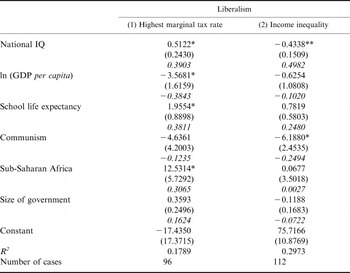
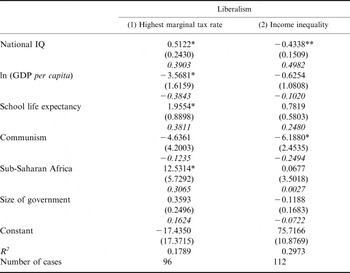
Table 1, column (1), shows that, net of economic development, educational achievement, communist history, geographic location and relative size of the government, national IQ has a significantly positive effect on the rate of highest marginal individual income tax (b=0.5122, p<0.05, β=0.3903). Net of these variables, the more intelligent the population is on average, the more citizens contribute toward the government and its social programmes. The unstandardized coefficient of 0.5122 means that each point in national IQ increases the highest marginal individual tax rate by more than half a percentage point. If one increases the national IQ by 10 points, the highest marginal tax rate increases by more than 5%.
The effect of national IQ on liberalism across nations
Main entries are unstandardized regression coefficients.
Numbers in parentheses are standard errors.
Numbers in italics are standardized coefficients (βs).
* p<0.05;
** p<0.01;
*** p<0.001;
**** p<0.0001.
Table 1, column (2), shows that, net of the same variables, national IQ has a significantly negative effect on the nation's income inequality (b=−4338, p<0.01, β=−0.4982). Even controlling for such relevant factors as economic development and a history of communism, the more intelligent the population is on average, the more egalitarian the nation's income distribution is. In fact, contrary to Lenski's (Reference Lenski1966, pp. 308–318) thesis that economic development, beyond advanced agrarian state, will tend to reduce economic inequality, the analysis shows that, once national IQ is controlled, GDP per capita does not have a significant effect on income inequality (b=−0.6254, ns, β=−0.1020).
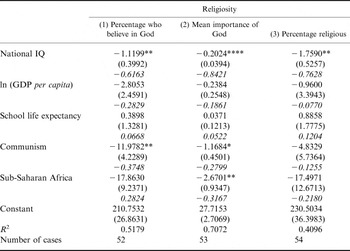
Table 2, columns (1)–(3), show the effect of national IQ on religiosity across nations. Column (1) indicates that, net of economic development, educational achievement, communist history and geographic location, national IQ has a significantly negative effect on the proportion of the population who believes in God (b=−1.1199, p<0.01, β=−0.6163). The unstandardized coefficient of −1.1199 means that each point in national IQ decreases the proportion of the population who believes in God by more than a percentage point.
The effect of national IQ on religiosity across nations

Main entries are unstandardized regression coefficients.
Numbers in parentheses are standard errors.
Numbers in italics are standardized coefficients (βs).
* p<0.05;
** p<0.01;
*** p<0.001;
**** p<0.0001.
Table 2, Column (2), shows that, net of the same variables, national IQ has a significantly negative effect on the mean importance of God among the nation's population (b=−0.2024, p<0.0001, β=−0.8421). The standardized coefficient of −0.8421 means that national IQ alone accounts for more than 70% of the variance in the mean importance of God across nations.
Finally, Table 2, column (3), shows that, net of the same variables, national IQ has a significantly negative effect on the proportion of the population who identify themselves as religious (b=−1.7590, p<0.01, β=−0.7628). The unstandardized coefficient of −1.7590 means that each point in national IQ decreases the proportion of the population who identify themselves as religious by nearly two percentage points. The standardized coefficient of −0.7628 means that national IQ alone accounts for nearly 60% of the variance in the dependent variable. Table 2, columns (1)–(3), collectively show that, contrary to the secularization hypothesis, economic development and education have no significant effect on religiosity across nations, once national IQ is controlled for.
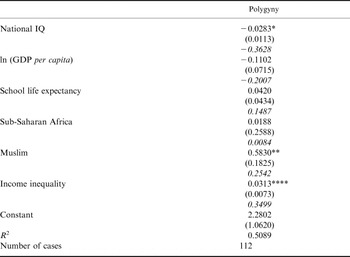
Table 3 shows that, net of economic development, educational achievement, geographic location, Islam and income inequality, national IQ has a significantly (p<0.05) negative effect on the country's level polygyny. The higher the average intelligence of the population, the more monogamous the society is. Even though sub-Saharan Africa is the most polygynous region of the world, the dummy for this region has no effect on the degree of polygyny once national IQ is controlled. Predictably, Islam also significantly (p<0.01) increases the degree of polygyny, as does income inequality (p<0.0001), replicating the finding from an earlier study (Kanazawa & Still, Reference Kanazawa and Still1999). The comparison of standardized coefficients, however, indicates that national IQ has the strongest effect on the degree of polygyny, stronger than the effect of either Islam or income inequality.
The effect of national IQ on polygyny across nations

Main entries are unstandardized regression coefficients.
Numbers in parentheses are standard errors.
Numbers in italics are standardized coefficients (βs).
* p<0.05;
** p<0.01;
*** p<0.001;
**** p<0.0001.
Cross-national results presented in Tables 1–3 support the macro-level implications of the Savanna-IQ Interaction Hypothesis. The comparison of standardized regression coefficients in Tables 1–3 shows that national IQ is the strongest determinant of the evolutionarily novel values of liberalism, atheism and monogamy across nations in every single model. Such seemingly important factors as economic development (measured by GDP per capita) and educational achievement (measured by UNESCO's ‘school life expectancy’) have no significant effect, except in Model (1) in Table 1, predicting the highest marginal individual tax rate.
Discussion
The Savanna-IQ Interaction Hypothesis, derived from the logical conjunction of the Savanna Principle and a theory of the evolution of general intelligence, suggests that more intelligent individuals may be more likely to acquire and espouse evolutionarily novel values, such as liberalism, atheism, and, for men, sexual exclusivity, than less intelligent individuals, while general intelligence may have no effect on the acquisition and espousal of evolutionarily familiar values. Macro-level analyses across nations presented above are consistent with the implications of the Hypothesis; they show that nations with higher average intelligence are more liberal (by having higher marginal individual tax rate and, partly as a result, lower income inequality), more atheist (where smaller proportions of the population believe in God and consider themselves religious, and the mean importance of God is lower) and more monogamous.
Given the high heritability of intelligence (Jensen, Reference Jensen1998, pp. 169–202), political attitudes (Eaves & Eysenck, Reference Eaves and Eysenck1974; Alford et al., Reference Alford, Funk and Hibbing2005) and religiosity (Bouchard et al., Reference Bouchard, T., McGue, Lykken and Tellegen1999; Koenig et al., Reference Koenig, McGue, Krueger and Bouchard2005), one alternative explanation for the effect of national IQ on political ideology and religiosity is the genetic transmission of all three traits. Intelligent parents beget intelligent children; liberal parents beget liberal children; religious parents beget religious children.
Such behaviour genetic explanations, while undoubtedly true, cannot explain the origin of the covariance between general intelligence and certain values. Why do intelligent parents tend simultaneously to be liberal and atheist, to pass on their genetic tendencies toward liberalism and atheism to their intelligent children? Why are there not an equal (or greater) number of intelligent parents who are conservative and/or religious, to pass on their conservative and religious tendencies to their intelligent children? Why are there not many less intelligent parents who are liberal and atheist? The Savanna-IQ Interaction Hypothesis can offer one possible explanation for the coexistence of general intelligence and certain values.
What other values are evolutionarily novel? At the individual level, another such value is vegetarianism. Humans are naturally omnivorous, and anyone who eschewed animal protein and ate only vegetables in the ancestral environment, in the face of food scarcity and precariousness of its supply, was not likely to have survived long and stayed healthy enough to have become our ancestors. Vegetarianism would therefore be an evolutionarily novel value, and the Hypothesis would predict more intelligent individuals are more likely to choose to be a vegetarian than less intelligent individuals. Consistent with this prediction, Gale et al. (Reference Gale, Deary, Schoon and Batty2007) find in their analysis of the 1970 British Cohort Study that, net of sex, social class and education, childhood IQ at age 10 significantly increases the probability that individuals become vegetarian as adults at age 30.
At the macro level, another evolutionarily novel value is representative democracy. Whether one traces its birth to classical Athens or the United States in 1776, and however one defines it, representative democracy is evolutionarily novel. While hunter-gatherer societies are often more egalitarian than agrarian and early industrial societies (Boehm, Reference Boehm1999), most of the institutions of representative democracy, such as universal suffrage, one person-one vote, secret ballot and the separation of powers, are evolutionarily novel. The Hypothesis would therefore predict that nations with higher average intelligence are more democratic than nations with lower average intelligence. Consistent with this prediction, the analysis of Vanhanen's (Reference Vanhanen2003) Index of Democratization shows that, net of economic development, educational achievement, communist history and geographic location, national IQ has a significantly (p<0.05) positive effect on the level of democratization. However, once Islam is controlled, the effect of national IQ becomes only marginally significant (p<0.06), and it ceases to have any effect on democracy once income inequality is controlled. The effect of general intelligence on democracy therefore appears to be entirely mediated by liberalism (results available upon request).
The origin of values and preferences is a very important theoretical puzzle for social and behavioural sciences, and the Savanna-IQ Interaction Hypothesis is but one possible explanation for it. The current work must be extended into several directions in the future. First, the Hypothesis must be tested against other competing theories of the origin of values and preferences. Second, future empirical work must consider other evolutionarily novel and familiar values besides the ones considered and tested in this paper. For example, in addition to vegetarianism referred to above, the Hypothesis would predict that more intelligent individuals are more likely to espouse such other evolutionarily novel values as feminism and environmentalism. So the average intelligence of a population should be positively correlated with national values in feminism and environmentalism, among others.
Acknowledgment
The author thanks an anonymous reviewer for comments on an earlier draft.