


Introduction
The term paranoia describes thinking of a persecutory nature in which a person may believe themselves to be under serious and intentional threat of harm from others (Freeman and Garety, Reference Freeman and Garety2000). Continuum models of psychosis (van Os et al., Reference van Os, Hanssen, Bijl and Ravelli2000) suggest that paranoid thinking is not unique to those meeting criteria for serious mental health conditions, but can be experienced in varying levels of severity in the general population. Research using non-clinical samples (e.g. Ellett et al., Reference Ellett, Lopes and Chadwick2003) has helped to develop understanding of the processes and mechanisms underlying clinical paranoia. Over the past decade, experimental paradigms to assess paranoid thinking have been developed. These have allowed for more stringent tests of models of paranoia, including the investigation of possible mediating and moderating factors of paranoid thinking (e.g. Ellett and Chadwick, Reference Ellett and Chadwick2007; Lincoln et al., Reference Lincoln, Peter, Schafer and Moritz2010).
Attachment theory (Bowlby, Reference Bowlby1969) provides an important theoretical framework for understanding psychosis, and may be particularly relevant to understanding paranoia (Berry et al., Reference Berry, Barrowclough and Wearden2007; Wickham et al., Reference Wickham, Sitko and Bentall2015). The theory emphasizes the significance of positive early experiences with primary caregivers in the development of affect regulation, and beliefs about the self and others, which guide interpersonal experiences throughout the lifespan. Insecure attachment develops as a result of unresponsive or inconsistent early caregiving experience (Mikulincer and Shaver, Reference Mikulincer and Shaver2012). Insecure attachment is hypothesized to operate along two dimensions, anxious and avoidant. Anxious attachment is typified by a pre-occupation with establishing and maintaining interpersonal relationships, in the context of being fearful of rejection, whereas avoidant attachment is associated with fear and distrust of others and the avoidance of interpersonal relationships (Mikulincer and Shaver, Reference Mikulincer and Shaver2012). Both anxious and avoidant attachment have been found to be associated with paranoid thinking in clinical (Berry et al., Reference Berry, Barrowclough and Wearden2008; Wickham et al., Reference Wickham, Sitko and Bentall2015) and non-clinical (Berry et al., Reference Berry, Wearden, Barrowclough and Liversidge2006; Pickering et al., Reference Pickering, Simpson and Bentall2008) samples. There is also evidence to suggest that insecure attachment mediates the relationship between childhood adversity and paranoia (Sitko et al., Reference Sitko, Bentall, Shevlin and Sellwood2014).
A number of studies demonstrate the positive effects of priming secure base representations. For example, asking people to imagine an accepting and loving other increases empathic responses to others (Mikulincer et al., Reference Mikulincer, Gillath, Halevy, Avihou, Avidan and Eshkoli2001a) and decreases negative response to psychological pain (Cassidy et al., Reference Cassidy, Shaver, Mikulincer and Lavy2009). The effect of secure base priming and the interaction between dispositional attachment and secure base priming is yet to be examined in relation to paranoid cognitions.
This study's novel contribution to the literature is to merge two previously separate foci of investigation: (1) paranoia and attachment styles; and (2) induction of paranoid thinking in college students. Exploring the effect of attachment style and attachment primes on paranoia induction will test theoretical models of attachment and paranoia, and also assess the potential role of secure primes in reducing paranoia. Although the role of attachment styles in paranoia has been investigated, these findings are largely correlational. In this paper we present the first known study to experimentally test the relationship between paranoia and attachment. We will use attachment imagery to moderate paranoia induction and as such provide an analogue of the potential role of insecure attachment styles in increasing vulnerability to the development of paranoia and to the potential role of secure attachment imagery in alleviating feelings of paranoia.
The following hypotheses were tested: (1) dispositional attachment insecurity would be positively associated with state and trait paranoia; (2) exposure to a secure attachment prime would result in attenuated reactivity in paranoid thoughts following a paranoia induction; (3) dispositional insecure attachment would predict greater reactivity of paranoid thoughts following the paranoia induction; and (4) dispositional attachment and secure base priming would interact to predict paranoid responding, specifically that the buffering effects of the secure prime will be lower in people with high levels of insecure attachment.
Method
Participants
Sixty participants were recruited from a UK university via posters and advertisements on the internet, giving details of a study investigating the effect of mood on task performance. The sample participants were 18–35 years old (mean = 21, SD = 3.5) and 80% were female.
Measures and manipulations
Paranoia and Depression Scale (PDS; Bodner and Mikulincer, Reference Bodner and Mikulincer1998) is a state measure of depression and paranoia with a 6-point scale (1 = not at all to 6 = very often). Only the seven paranoia items were measured at baseline as most depression items relate directly to task performance. Both depression and paranoia items were administered following the paranoia induction. These subscales have shown good discriminant and convergent validity and internal consistency (Bodner and Mikulincer, Reference Bodner and Mikulincer1998). In the current study, Cronbach's alpha values were α = .79 for the paranoia and α = .87 for the depressive subscales.
Paranoia Scale (PS; Fenigstein and Vanable, Reference Fenigstein and Vanable1992) is a measure assessing trait levels of paranoia with a 5-point scale (1 = not at all applicable to me, 5 = extremely applicable to me). The measure has been shown to have good internal consistency and test–retest reliability in student samples (Fenigstein and Vanable, Reference Fenigstein and Vanable1992). For the current sample, Cronbach's alpha was .90.
Experiences in Close Relationships Scale Revised (ECR-R; Fraley et al., Reference Fraley, Waller and Brennan2000) is a self-report scale designed to measure dispositional levels of attachment avoidance and attachment anxiety in the context of attachment relationships in adulthood. Participants rate how much they agree with each item on a 7-point scale (1 = strongly agree, 7 = strongly disagree). Low scores on each dimension represent more secure attachment. The measure has been shown to have good test–retest reliability and convergent validity (Sibley et al., Reference Sibley, Fischer and Liu2005). Cronbach's alpha values were .93 for anxious attachment and .95 for attachment avoidance.
Depression, Anxiety and Stress Scale (DASS; Lovibond and Lovibond, Reference Lovibond and Lovibond1995) assesses symptoms of depression, anxiety and stress over the last week. Depression items were used in this study to assess group equivalence at baseline. Items are rated using a 4-point Likert scale of frequency or severity. Good discriminant and concurrent validity (Antony et al., Reference Antony, Bieling, Cox, Enns and Swinson1998) and internal consistency values have been reported in normative samples. In the current sample, the Cronbach's alpha for the depression subscale was .91.
Attachment priming and control tasks
Guided imagery is a well-established attachment priming methodology demonstrating moderate to large effect sizes (Mikulincer et al., Reference Mikulincer, Shaver and Rom2011). This methodology has been used in a range of attachment priming studies (Mikulincer and Arad, Reference Mikulincer and Arad1999; Mikulincer et al., Reference Mikulincer, Gillath, Halevy, Avihou, Avidan and Eshkoli2001a; Mikulincer and Shaver, Reference Mikulincer and Shaver2001; Mikulincer et al., Reference Mikulincer, Shaver, Gillath and Nitzberg2005; Mikulincer et al., Reference Mikulincer, Shaver and Rom2011). In addition to the attachment prime, two control conditions were included consisting of a neutral and positive affect prime (see Appendix for scripts used). All scripts were based on those used in previous research (Mikulincer and Shaver, Reference Mikulincer and Shaver2001). Secure attachment is thought to have a positive affective component, therefore the latter control condition was included to help delineate the impact of this from the broader activation of secure base representations, thought to be associated with attachment priming. All three conditions made reference to other people and the only variable that differed in the attachment prime was the representation of secure attachment. An audio recording with prompts was used to guide participants through the task which lasted for two minutes. Following exposure to the prime, participants rated current affect across four domains (good, bad, happy, sad) on a 7-point Likert scale. After reversing positive domain scores, a total mean affect score, ranging from 1 to 7, was calculated (Mikulincer et al., Reference Mikulincer, Hirschberger, Nachmias and Gillath2001b). The methodology was piloted in a small sample (n = 3) with the primary aim being to practise and refine the experimental procedures. Qualitative data indicated that the primes were operating in line with priming expectations.
Paranoia induction
An established paranoia induction paradigm was used with previously reported large effect sizes in non-clinical samples (Ellett and Chadwick, Reference Ellett and Chadwick2007). Participants completed an unsolvable task that involved presenting them with pictures with different dimensions and values and asking them to indicate which dimensions contain the correct value. Participants were filmed using a video recorder whilst completing an unsolvable task, with their recorded image being clearly visible to them on a monitor screen.
Procedure
The study had institutional ethical approval from the University of Manchester Ethics Committee and all participants gave written, informed consent. The experiment was conducted by J.H. who was blind to priming group allocation. Participants were randomized to one of the three priming conditions using a computer-based random number generator, resulting in 20 participants per condition. One participant was excluded from the attachment prime group due to language difficulties.
Following administration of baseline measures (PDS paranoia items, PS, ECR-R and DASS), participants completed one of the three guided imagery primes followed by the post-prime affect ratings. Participants then underwent the paranoia induction, following which the PDS (paranoia and depression items) and ECR-R were completed.
Distress protocol
As part of the consent procedures, participants were advised that ‘Part of the study involves inducing a negative mood state, however the effects of this are expected to be short lived. Other studies using very similar techniques are not known to have caused any lasting effects in participants. You can stop the study at any time should you feel upset.’ Following the experiments, the researcher asked whether participants felt distressed by any portion of the study and were offered a positive mood induction task. Participants were also given the contact details of the department, researcher, their GP and/or university counselling service.
Data analysis
Pearson's correlations were used to test for associations between dispositional attachment and measures of paranoia (hypothesis 1). To investigate whether the primes buffered the effects of the paranoia induction (hypothesis 2), a one-way analysis of variance (ANOVA) was conducted, with Time 2 state paranoia scores as the dependent variable and induction type (secure attachment prime, positive affect prime and neutral prime) as the between-subjects factor. A hierarchical regression was used to test the hypotheses that attachment insecurity would be independently associated with post-manipulation levels of paranoia (hypothesis 3) and that there would be an interaction between dispositional attachment and the attachment prime (hypothesis 4). To reduce possible effects of multicollinearity, scores for continuous predictors were centred on their respective means, and key assumptions of regression analysis were checked before conducting the analysis (Osborne and Waters, Reference Osborne and Waters2002). Two dummy variables representing the three priming conditions were created, one contrasting the attachment prime to the two control conditions (dummy variable 1) and the other contrasting the positive affect prime to the other conditions (dummy variable 2). In the first step of the regression, the two dummy variables and the mean centred attachment variables (anxiety and avoidance) were entered as predictors, with Time 2 state paranoia scores as the dependent variable. In the second step, product terms representing interactions between group and both attachment anxiety and attachment avoidance were entered into the model.
Results
Sample characteristics and group comparisons
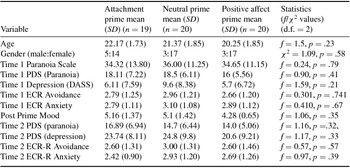
The three groups did not differ significantly in terms of sample characteristics or study measures (see Table 1). The groups also did not differ in terms of post-prime affect scores, suggesting that at a group level the prime did not have a differential impact on affect across the priming conditions.
Sample characteristics and study measures

SD, standard deviation; PDS, Paranoia and Depression Scale; ECR-R, Experiences in Close Relationships Scale Revised; DASS, Depression, Anxiety and Stress Scale.
Associations between dispositional attachment and paranoia (hypothesis 1)
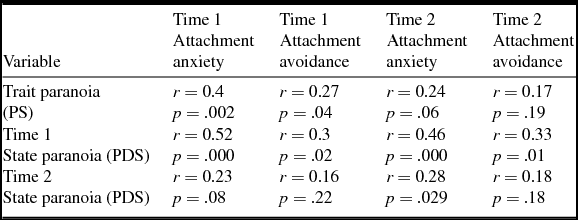
Correlational analyses (Table 2) showed that trait paranoia was positively correlated with baseline measures of attachment anxiety and avoidance. Baseline state paranoia was positively correlated with both baseline and post-prime measures of attachment anxiety and attachment avoidance. State paranoia at Time 2 was significantly correlated with attachment anxiety at Time 2.
Correlational analysis: attachment and paranoia

Effect of attachment prime on paranoia (hypothesis 2)
There was no difference in state paranoia scores at Time 2 between the three priming groups (see Table 1), indicating that the primes did not differentially impact participants’ responses to the paranoia induction. Given that depressed mood co-occurs with paranoia, and may legitimately be induced by failure feedback, we also assessed group differences in state depression at Time 2. No effect of group on state depression was found (see Table 1).
Effects of dispositional attachment style on post-manipulation paranoia (hypotheses 3 and 4)
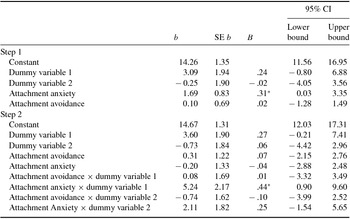
The regression model is summarized in Table 3. The first step of the model approached significance, with attachment anxiety observed to be the only significant predictor of state paranoia at Time 2 in the model, providing initial support for the role of insecure attachment in response to the paranoia induction task (hypothesis 3).
Summary of hierarchical regression with PDS paranoia (Time 2) as the outcome variable

n = 59; step 1 R 2 = .14 (n.s.); for step 2, R 2 = .27, *p < .05. Dummy variable 1 (attachment prime versus neutral and positive affect primes), dummy variable 2 (positive affect prime versus attachment and neutral primes).
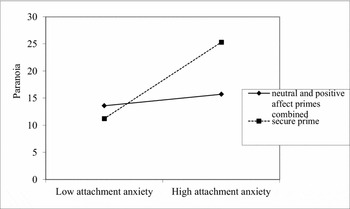
In step 2, the model was significant at the p < .05 level and explained 27% [R 2 = .27, 95% confidence interval (CI) .10 to .43] of the variance, which corresponds to a medium effect size (Ferguson, Reference Ferguson2009). Although attachment anxiety no longer made a significant independent contribution to the model, a significant interaction between attachment anxiety and group was observed. Taken together, this suggests that the association between attachment anxiety and post-manipulation paranoia was better accounted for by an interaction between attachment anxiety and the secure attachment prime, providing support for hypothesis 4. Simple slope tests suggested that higher levels of paranoia were observed in those who received the secure attachment prime, but only for those with high levels of dispositional attachment anxiety (see Fig. 1).
Interaction effect of group and attachment anxiety on state paranoia

The regression reported above refers to findings related to the second administration of the attachment measure. When the regression was conducted using the baseline measure of global attachment, the interactions between global attachment and group were not significant.
Discussion
This study investigated the role of dispositional attachment and contextually primed secure base attachment representations in the occurrence of paranoid thinking in a non-clinical student sample. There was some evidence of associations between dispositional insecure attachment and paranoid thinking. However, the secure attachment prime did not appear to buffer paranoid thinking and had a negative impact for participants with high levels of attachment anxiety. The fact that we found an interaction effect for attachment anxiety and not attachment avoidance may be explained by the possibility that people with higher levels of avoidant attachment are more effective in supressing negative affect including any negative affect associated with the secure attachment prime. Associations between dispositional insecure attachment and paranoia support existing literature highlighting the role of insecure attachment in the development of paranoia.
Although the predicted buffering effects of the secure attachment prime were not observed (the potential reasons for this are considered further below), exposure to the secure base prime was found to predict paranoid thinking in those with high levels of dispositional attachment anxiety. This was not observed in those with high levels of attachment avoidance. While this finding should be viewed with caution, it has a number of theoretical and clinical implications. Attachment anxiety was more consistently and strongly correlated with both state and trait paranoia than attachment avoidance, in line with findings reported by Berry and colleagues (Berry et al., Reference Berry, Wearden, Barrowclough and Liversidge2006), who also used a non-clinical sample.
Attachment anxiety is associated with hypervigilance for interpersonally threatening information, which may leave people more vulnerable to paranoid thinking (Ein-Dor et al., Reference Ein-Dor, Mikulincer, Doron and Shaver2010). Attachment avoidance was less strongly and consistently associated with state and trait paranoia in the present study. In contrast, associations between these variables have been reported in clinical samples (Berry et al., Reference Berry, Barrowclough and Wearden2008). Attachment avoidance is characterized by withdrawal from social relationships and lack of disclosure of thoughts and feelings to others. In the context of psychosis, these coping strategies may reinforce paranoid thinking. However, in non-clinical populations, such strategies may be less extreme and thus have a less significant impact on paranoia (Ein-Dor et al., Reference Ein-Dor, Mikulincer, Doron and Shaver2010).
The predicted buffering effects of the secure attachment prime were not supported as paranoia did not vary as a function of prime type. It does, however, seem premature to reject the possible buffering effects of the secure prime, as there are several alternative explanations that could account for this null finding. While the reduction of paranoia from Time 1 to Time 2 may suggest that the paranoia induction was not successful, this seems unlikely given that (a) the induction used is an established paradigm, which has been shown to induce paranoia in a number of studies (Bodner and Mikulincer, Reference Bodner and Mikulincer1998; Ellett and Chadwick, Reference Ellett and Chadwick2007; Flower et al., Reference Flower, Newman-Taylor and Stopa2013; Kingston and Ellett, Reference Kingston and Ellett2014), and (b) data from the current study show a significant interaction of dispositional attachment and secure base priming predicting paranoid responding. Another possibility is that state paranoia reduced as the experiment progressed; a subsequent re-activation of paranoia following the induction paradigm may have been masked by initially elevated baseline levels. This hypothesis is in line with findings reported by Kingston and Ellett (Reference Kingston and Ellett2014), who measured paranoia at three time points within their experiment. The lack of a post-prime measure of state paranoia in the current study makes it difficult to separate out the effects of the primes and the paranoia induction.
Despite the absence of buffering effects, the findings from the current study show empirically for the first time, associations between dispositional attachment and (post-manipulation) state paranoia. Attachment anxiety predicted greater reactivity of paranoid thoughts following the paranoia induction. Interestingly, higher levels of paranoia were observed in those who received the secure attachment prime, but only amongst those participants with high levels of dispositional attachment anxiety. The latter is consistent with the findings reported by Mikulincer and colleagues (Reference Mikulincer, Shaver and Rom2011), who demonstrated that the positive effects of a guided imagery prime were not observed in people with high dispositional attachment anxiety. It was suggested that the overt processing of attachment-related material may have detrimental effects in those with high levels of attachment anxiety, potentially via the activation of negative attachment experiences. Indeed, this is consistent with qualitative statements reported by participants in the current study, in that a number reported feeling ‘distressed’, ‘upset’ or ‘hopeless’ following the secure prime. These findings also fit with the concept of a ‘fear of compassion’ (Gilbert et al., Reference Gilbert, McEwan, Matos and Rivis2011), which involves experiencing negative responses to compassion received both from others and the self and has been associated with insecure attachment (Gilbert et al., Reference Gilbert, McEwan, Gibbons, Chotai, Duarte and Matos2012). Future research might usefully examine interactions between insecure attachment style, fear of compassion, and paranoia.
The findings that dispositional insecure attachments can increase distress in response to secure attachment primes highlight the importance of always assessing dispositional attachments in such research and routinely assessing interactions effects. The possibility that those with insecure attachment may react negatively to secure attachment primes also has clear ethical implications for research in this area and highlights the need for appropriately sensitive distress protocols in attachment priming research. The finding also has particularly important implications in the context of clinical work, suggesting that clinicians should always use a formulation-based approach when using secure attachment imagery that takes into account the individual person's attachment history. Although this idea makes intuitive sense, our study provides empirical evidence that applying imagery strategies without such individualized conceptualizations may increase distress.
Due to different views within the attachment priming literature regarding when to measure dispositional attachment (Cassidy et al., Reference Cassidy, Shaver, Mikulincer and Lavy2009; Mikulincer et al., Reference Mikulincer, Gillath, Halevy, Avihou, Avidan and Eshkoli2001a), the ECR-R measure was administered at two time points, baseline (Time 1) and following the paranoia induction (Time 2). Given the reported stability of the ECR-R (Lopez and Gormley, Reference Lopez and Gormley2002), both administrations were expected to result in comparable findings. However, examination of the data suggested that total attachment scores were higher at Time 1 (mean = 2.86, SD = 1.01) than at Time 2 (mean = 2.71, SD = 1.09). This was an interesting and unexpected finding and raises the exciting possibility that self-reported attachment patterns might be amenable to experimental manipulation. A related issue is that the interaction between group and dispositional attachment was significant only with Time 2 attachment scores, and not with Time 1 attachment scores. It seems unlikely that the second administration of the measure was affected by the attachment prime as no significant group differences were observed. Alternatively, the differing context of the administration at the two time points in the experiment may explain the discrepant findings. In particular, exposure to threat is thought to activate attachment schemas, thus making them more available to conscious processing (Mikulincer et al., Reference Mikulincer, Shaver and Pereg2003). The second administration of the measure in a threat-laden context (i.e. after the paranoia induction) could have made the attachment schema more available and may therefore provide a more accurate measure of attachment. On the other hand, the elevated state paranoia scores at Time 1 suggest that participants experienced Time 1 as more threat laden. Overall, the apparent fluctuation in self-reported attachment across different contexts is an interesting finding and one that warrants further research in studies comparing threat-laden versus neutral experimental contexts.
This study has a number of strengths including the use of well-established priming and paranoia induction techniques, the use of randomization and experimenter-blinding procedures, and outcome measures of both depression and paranoia. There are, however, a number of limitations. The lack of a measure of state paranoia following the priming conditions meant that we were not able to demonstrate the differential effects of the primes and paranoia induction. However, we were able to conclusively demonstrate that participants were equivalent at baseline on the key variables measured in the study. Future experimental research might usefully include multiple measures of state paranoia, whilst simultaneously ensuring that analyses are appropriately controlled for repeat testing of variables.
Additionally, the reliance on a self-report measure of attachment may not adequately tap covert attachment dynamics. Future research might consider using subliminal attachment primes, alongside both self-report and interview-based measures of attachment, such as the Adult Attachment Interview (Main et al., Reference Main, George and Kaplan1985), to provide a more thorough and robust assessment of attachment. Finally, the non-clinical nature of the sample limits generalizability of findings to clinical populations. However, when treated with appropriate caution, non-clinical samples continue to offer great utility in psychological research.
Conclusions and clinical implications
Paranoia was associated with levels of insecure attachment, which is consistent with previous research and supports the hypothesis that attachment is important in paranoia. This study provides important evidence that asking people with an anxious attachment style to think about secure attachment experiences has the potential to increase, rather than decrease, state paranoia, and potentially has important implications for clinical practice. In particular, it demonstrates the potentially aversive effects of exposure to secure base material in those with elevated levels of attachment anxiety, which could result in people who are high in attachment anxiety being vulnerable to guided imagery or other therapeutic interventions that attempt to expose them to positive attachments. As such, therapists should always adopt a formulation-based approach that takes into account the person's attachment history in determining the potential risks of attachment-based imagery. The findings suggest that this might be particularly important in any therapeutic work carried out in the context of paranoia. An attachment-informed model of therapy would suggest that therapists may need to work additionally hard to develop trusting relationships and a secure therapeutic base with those with insecure attachment patterns and associated difficulties in earlier attachment relationships. However, the provision of a reliable, sensitive and responsive therapy relationship over time may result in the development of a good therapeutic alliance which provides a platform to help the person make changes in their lives. In such circumstances the relationship with the therapist and associated feelings of security may provide the basis for coping with difficult feelings or the challenges associated with making changes in behaviour (Berry and Danquah, Reference Berry and Danquah2016).
Main points
-
(1) We investigated how attachment styles interact with secure base attachment representations during an experiment to induce paranoia.
-
(2) We randomly allocated sixty participants to a secure attachment priming condition, a positive affect condition or a neutral control condition. All participants were then exposed to a paranoia induction.
-
(3) We found that insecure attachment style was associated with paranoid thinking.
-
(4) However, unexpectedly, the secure attachment prime did not appear to buffer paranoid thinking and had a negative impact for participants with high levels of attachment anxiety.
-
(5) Our findings suggest that exposing people with insecure attachment styles to secure attachment material could increase rather than decrease distress.
Ethical statement
The authors assert that all procedures contributing to this work comply with the ethical standards of the relevant national and institutional committees on human experimentation and with the Helsinki Declaration of 1975, and its most recent revision.
Acknowledgements
None.
Conflicts of interest
There are no conflicts of interest relating to the publication of this manuscript.
-
(1) To learn about the role of insecure attachment in paranoia.
-
(2) To learn about the use of experiments to induce paranoia and test models of paranoia.
-
(3) To learn about the use of secure attachment primes in buffering distress.
-
(4) To increase awareness of the possibility that asking people with insecure attachment styles to think about images of secure attachment figures may increase distress.
Appendix
Secure prime script
‘Imagine yourself in a problematic situation that you cannot solve on your own, and imagine that you are surrounded by people who are sensitive and responsive to your distress, want to help you only because they love you, and set aside other activities in order to assist you.’
Neutral prime script
‘Imagine yourself going to a supermarket and buying products you need for your house. Imagine other persons who are also buying products, talking among themselves about daily issues, examining new brands, and comparing different products.’
Positive affect prime script
‘Imagine yourself receiving a notice that you win a large amount of money in the national lottery, and imagine other students or colleagues in your class hearing about this notice, approaching you, congratulating you, and telling others about your good fortune.’



Comments
No Comments have been published for this article.