


INTRODUCTION
Lakes are one of the most dynamic natural systems, with sediment composed of clastic, chemical, and biological fractions, making them one of the richest paleoenvironmental archives. By trapping sediment, they record past environmental and climatic changes that have taken place within the waterbody and in its basin during its existence (Smol, Reference Smol1992; Cohen, Reference Cohen2003). Proglacial lakes, which may be in direct contact with glaciers or linked by a proglacial drainage system, are dominated by clastic glacial sediment (Carrivick and Tweed, Reference Carrivick and Tweed2013; Carrivick et al., Reference Carrivick, James, Grimes, Sutherland and Lorrey2020). The area and volume of proglacial lakes has increased by about 50% globally during the last three decades (Shugar et al., Reference Shugar, Burr, Haritashya, Kargel, Watson, Kennedy, Bevington, Betts, Harrison and Strattman2020; Sutherland et al., Reference Sutherland, Carrivick, Gandy, Shulmeister, Quincey and Cornford2020). These lakes strongly depend on the regional climate, the type and scale of glaciers in their basin, and their local geology and dam type (Tweed and Carrivick, Reference Tweed and Carrivick2015). Proglacial lake sedimentation is controlled on a first order by the proximity of the glacier front and fluvial input. The bulk density of turbid sediment inflows determines its position and dispersal within the water column. The final sediment distribution is further affected by sediment grain size and settling velocity, as well as lake mixing processes (Van Wyk de Vries et al., Reference Van Wyk de Vries, Ito, Shapley and Brignone2021, Reference Van Wyk de Vries, Ito, Shapley, Brignone, Romero, Wickert, Miller and MacGregor2022).
Although there are multiple studies of proglacial lakes in the literature, their relation to glacier retreat and sediment dynamics is not yet completely understood. Even though glacial lake outburst floods are increasingly frequent due to accelerated glacier melting during the last few decades and they pose a risk to local communities and associated infrastructure downstream (Harrison et al., Reference Harrison, Kargel, Huggel, Reynolds, Shugar, Betts and Emmer2018; Veh et al., Reference Veh, Korup and Walz2020), few studies have focused on the sedimentary signature created by past catastrophic events (Piret et al., Reference Piret, Bertrand, Nguyen, Hawkings, Rodrigo and Wadham2022). In this study we show that sediments deposited in proglacial lakes represent a rich and complex climatic archive and that they can record both short- and long-term patterns of glacier change, but that their registration of extreme hydrologic events may defy expectations.
We investigated post-Little Ice Age (LIA) glacial and sedimentary changes from a lacustrine perspective by studying two gravity and two piston cores from Canal de los Témpanos, one of the main conveyors of water and sediment from the Southern Patagonian Ice Field (SPI) to Lago Argentino in southern Argentina (Fig. 1). Owing to its proximity to glaciers, the sediment record allows insight into the evolution of the glaciers in the region and contributes to a broader understanding of their dynamics.
Location of the study area within the Southern Patagonian Ice Field and position of the glaciers in Lago Argentino basin and the sedimentary cores in Canal de los Témpanos. Post-Little Ice Age (LIA) retreat of Ameghino Glacier is also shown.

We carried out a detailed sedimentologic description, granulometric analysis, and compositional analyses (X-ray fluorescence, XRF) of these core sediments. With these data, we evaluate the relative importance of sediment contributions from large lake-terminating glaciers in southwestern Lago Argentino and test our initial working hypothesis: The energetic Perito Moreno ice-dam outburst events would provide a dominant sedimentary signature in proximal Canal de los Témpanos locations.
Since the beginning of the twentieth century, repeated ice-damming events (23 outburst events since the first occurrence until the coring campaign; Supplementary material no. 4) have produced recurring large floods by impounding the southernmost branches of the lake and then, during ice-dam failure, releasing great surges of water towards Canal de los Témpanos producing a sudden lake-level rise (Pasquini & Depetris, Reference Pasquini and Depetris2011; Richter et al., Reference Richter, Marderwald, Hormaechea, Mendoza, Perdomo, Connon, Scheinert, Horwath and Dietrich2016).
Previous studies have elucidated (1) seasonal fluctuations in glacial melt, temperature, and fluvial discharge contributing in varying degrees to the formation of varves across the lake basin (Van Wyk de Vries et al., Reference Van Wyk de Vries, Ito, Shapley and Brignone2021, Reference Van Wyk de Vries, Ito, Shapley, Brignone, Romero, Wickert, Miller and MacGregor2022); (2) temporal changes in the sediment mass accumulation rate and sediment pixel intensity recording paleoclimate in the Lago Argentino region, including resolving the local periodicity of the Southern Annular Mode (Van Wyk de Vries et al., Reference Van Wyk de Vries, Ito, Romero, Shapley and Brignone2023a); and (3) proposed climatic controls on sedimentation across different zones of Lago Argentino (Van Wyk de Vries et al., Reference Van Wyk de Vries, Ito, Shapley, Romero and Brignone2023b). Here we aim to provide a detailed case study of the effect of changes in glacier extent on sedimentation in a multisource lake system, and understand what the advantages and challenges are of using this understanding for paleoenvironmental reconstruction.
BACKGROUND AND REGIONAL SETTING
Lago Argentino is the largest ice-contact lake located in the SPI, Argentina, which hosts multiple lake-terminating glaciers (Fig. 1; Van Wyk de Vries et al., Reference Van Wyk de Vries, Ito, Shapley, Brignone, Romero, Wickert, Miller and MacGregor2022). The majority of these glaciers have recently thinned and receded in response to climate warming since the LIA (Davies and Glasser, Reference Davies and Glasser2012). Historical records and remotely sensed data have allowed monitoring the magnitude of such changes throughout the twentieth and twenty-first centuries, and reveal both high and accelerating ice loss in the Lago Argentino basin (Abdel Jaber et al., Reference Abdel Jaber, Rott, Floricioiu, Wuite and Miranda2019; Van Wyk de Vries et al., Reference Van Wyk De Vries, Romero, Penprase, Ng and Wickert2023c). Geologic data retrieved from moraines (Strelin et al., Reference Strelin, Kaplan, Vandergoes, Denton and Schaefer2014; Kaplan et al., Reference Kaplan, Schaefer, Strelin, Denton, Anderson, Vandergoes and Finkel2016) and tree rings (Mercer, Reference Mercer1968; Aniya, Reference Aniya1996; Masiokas et al., Reference Masiokas, Rivera, Espizua, Villalba, Delgado and Aravena2009) in the Lago Argentino region provide a broader and longer term context of glacial and climatic fluctuations in the pre-observational era.
Lago Argentino is a hydrologically open, ultra-oligotrophic proglacial lake located in the Andean region of the province of Santa Cruz, Argentina (49.9–50.7°S/72–73.3°W), at 185 meters above sea level (Richter et al., Reference Richter, Marderwald, Hormaechea, Mendoza, Perdomo, Connon, Scheinert, Horwath and Dietrich2016; Goyenechea, Reference Goyenechea2017). Its maximum depth is greater than 600 m (Sugiyama et al., Reference Sugiyama, Minowa, Sakakibara, Skvarca, Sawagaki, Ohashi, Naito and Chikita2016; Magnani et al., Reference Magnani, Fedotova, Peterson and MacPhail2019). The current morphology of Lago Argentino is the result of the glaciations that occurred since the Miocene/Pliocene transition (Rabassa et al., Reference Rabassa, Coronato and Salemme2005). The local climate is characterized by strong westerly winds (southern westerly winds), with greatest wind speeds during the summer (Garreaud et al., Reference Garreaud, Vuille, Compagnucci and Marengo2009). Rainfall is heavy on the western flank of the Patagonian Andes, with annually averaged values of around 5 m, but decreases markedly towards the east to about 200 mm per year in El Calafate (Garreaud et al., Reference Garreaud, Lopez, Minvielle and Rojas2013; Lenaerts et al., Reference Lenaerts, Van Den Broeke, Van Wessem, Van De Berg, Van Meijgaard, Van Ulft and Schaefer2014).
Sedimentation for most parts of Lago Argentino is varved (annually laminated), mainly controlled by seasonal changes in glacially sourced sediment and fluvial input, as well as seasonal changes in lake mixing (Van Wyk de Vries et al., Reference Van Wyk de Vries, Ito, Shapley and Brignone2021, Reference Van Wyk de Vries, Ito, Shapley, Brignone, Romero, Wickert, Miller and MacGregor2022). The eastern part of the lake is a 60-km-long basin elongated in a west–east direction and more than 16 km wide (Strelin and Malagnino, Reference Strelin and Malagnino1996). Towards the west, the basin presents multiple brazos, valleys that are structurally controlled and deepened by glacier erosion that make up the eastern terminations of the SPI. The Upsala, Perito Moreno, and Spegazzini glaciers calve directly into Lago Argentino, while the Onelli, Ameghino, and Mayo glaciers each calve into their own proglacial lake (Fig. 1). These proglacial lakes are separated from Lago Argentino either by glaciofluvial plains or by dams created by previously deposited moraines. Rio La Leona drains Lago Viedma into the eastern part of Lago Argentino, while Rio Santa Cruz drains Lago Argentino into the Atlantic Ocean.
Perito Moreno Glacier (50°29′S; 73°04′W; Fig. 1, #10) is one of the largest outlet glaciers of the SPI, with a surface area of 259 km2, reaching Lago Argentino at the intersection between Canal de los Témpanos and Brazo Rico (Fig. 1, #6 and #11). Its current extent indicates that it advanced past its LIA position but did not record major advances/recessions during the last 4000 years (Aniya and Skvarca, Reference Aniya and Skvarca1992, Reference Aniya and Skvarca2012; Rott et al., Reference Rott, Stuefer, Nagler, Riedl, Lacoste and Ouwehand2004; Masiokas et al., Reference Masiokas, Rivera, Espizua, Villalba, Delgado and Aravena2009; Sugiyama et al., Reference Sugiyama, Skvarca, Naito, Enomoto, Tsutaki, Tone, Marinsek and Aniya2011; De Angelis, Reference De Angelis2014). Aniya and Skvarca (Reference Aniya and Skvarca2012) collected samples for 14C dating from the shore of Brazo Sur and Brazo Rico (Fig. 1, #11 and #12), and they concluded that Perito Moreno advanced in 1650 CE, while generating an ice-dam that submerged trees that had been developing on the lakeshore for at least a few hundred years. These authors also determined that during the LIA, Perito Moreno Glacier advanced twice, first, in 1650 CE and again, between 1820 CE and 1850 CE.
Ameghino Glacier (50.45°S, 73.3°W; Fig 1, #8) is located 9 km west of Canal de los Témpanos, and its front calves directly into an ice-contact lake called Laguna Ameghino (Fig. 1, #9). This lake is connected to Canal de los Témpanos by a 3-km-long proglacial river and an outwash plain (Warren, Reference Warren1994; Aniya and Sato, Reference Aniya and Sato1995). According to Aniya (Reference Aniya1996), frontal moraines located in this outwash plain are thought to be records of Neoglacial advances. The eastern margin of Laguna Ameghino is defined by the LIA moraines (1600–1700 CE) (Warren, Reference Warren1994; Aniya and Sato, Reference Aniya and Sato1995; Aniya, Reference Aniya1996), based on 14C dates obtained from trees on trimlines nearby. At that time, the Laguna Ameghino did not exist since its basin was occupied by ice, and the sedimentary material mobilized by the glacier was transported as fluvioglacial sediments onto the outwash and, through it, to Canal de los Témpanos. This glacier thinned following construction of the LIA moraines and, between 1870 CE and 1880 CE (Warren, Reference Warren1994; Aniya Reference Aniya1996), allowed the progressive development of Laguna Ameghino, which increased its size due to accelerated glacier shrinkage after 1967 CE (Fig. 1; Minowa et al., Reference Minowa, Sugiyama, Sakakibara and Sawagaki2015).
METHODS
Core acquisition
We used the 108 m of core recovered from 47 sites during the austral winter of 2019 using a combination of a Kullenberg coring system and a gravity coring system deployed onboard a local ferry. Core recovery ranged up to ~6.5 m, with coring locations distributed across the main lake basin and brazos (glacial fjords). The coring sites were chosen according to a reflection seismic survey (Magnani et al., Reference Magnani, Fedotova, Peterson and MacPhail2019; Fedotova and Magnani, Reference Fedotova and Magnani2021) that preceded the coring operation. In this study, we selected a subset of four cores recovered from the southwesterly branch of Lago Argentino, Canal de los Témpanos. We selected cores from locations that we thought were most likely to contain records addressing the influence of known outburst flooding on sedimentation patterns.
Core processing
At the Continental Scientific Drilling Facility (CSD Facility), we carried out whole-core scans of magnetic susceptibility, gamma-beam density, and P-wave velocity, then split the cores and imaged them, employing a 20 pixels/mm resolution Geotek Geoscan-III optical line-scanner. Moreover, we performed near-ultraviolet to near-infrared spectrophotometric and magnetic susceptibility scans on the split core surface with a Geotek MSCL-XYZ scanner. We described sediment properties, lithologic units, and sediment structures using the logging software PSICAT (Reed, Reference Reed2007) following the criteria established by Schnurrenberger et al. (Reference Schnurrenberger, Russell and Kelts2003). During visual lithologic description, smear slides were made and examined under a petrographic microscope using plane- and cross-polarized light. Smear slides were made from visually distinct portions of the cores to examine minerals, grain characteristics, and any other material contained in the sediment.
Grain-size analysis
We performed 194 laser-diffraction particle size analyses (LD-PSA) of 66 selected core intervals using a Horiba LA-920 LD-PSA. Each sample was measured two to three times in order to test reproducibility. In addition, we measured the standard Aluminum Oxide # 240 at the beginning and at the end of each working day to check for instrument drift over time. No sample pre-processing was needed due to the extremely low concentration of biogenic material. We selected sampling locations that visually appeared representative of different sediment packages, trying to capture all grain sizes present in the cores.
X-ray fluorescence
A COX Analytical Systems ITRAX XRF Core Scanner with a Cr source at the Large Lakes Observatory, University of Minnesota, Duluth, was used to obtain elemental composition and X-radiographic images on split cores. For XRF, a 1-cm-wide central swath of the split core section was scanned, and measurements were taken every 10 mm for cores 33A and 34A. Cores 17A and 18A were scanned at a 5 mm resolution. We focused on elements Si, K, Ca, Ti, Mn, and Fe. Calcium was chosen as the most likely indicator of plagioclase; Si, K, Ti, and Fe were chosen as source indicators, while Mn was used as a redox indicator. The X-radiographic images were taken at a 200 μm resolution (5 pixels/mm) after the XRF scan on the same 1-cm-wide swath. Each elemental signal intensity was normalized by dividing by total counts per second.
RESULTS
Cores
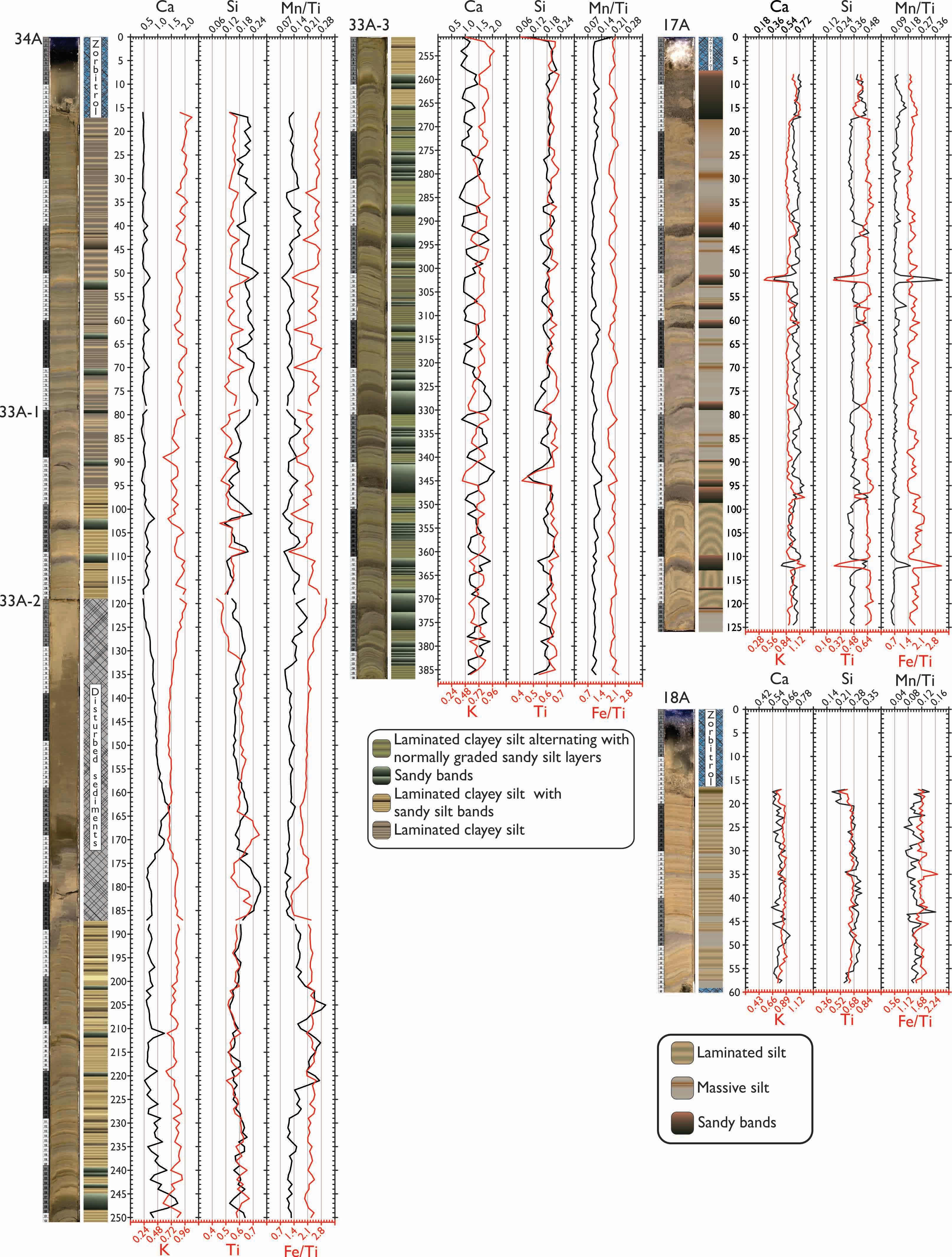
Here we present the general characteristics of the sedimentary cores retrieved from Canal de los Témpanos (Table 1), and results obtained from sediment description (Figs. 2 and 3), magnetic susceptibility (Fig. 4) and density measurements, grain-size analysis (Figs. 5 and 6, Supplementary material no. 1), and XRF analysis (Fig. 7, Supplementary material no. 2).
General information about the cores

Core 34A (left) and 33A (right). From left to right: the core image, sediment units, stratigraphic column, and profile of grain-size boxplots. Presented is the analysis carried out on the different units (delineated by dashed lines on the profiles) present in these cores, from silt-to-sand bands to clayey silt laminae. A decrease in grain size is observed from the deepest section (33A-1) to the upper sediments (33A-1 and 34A). Note that the sand fraction can be underrepresented due to the technique used.

Cores 18A (left) and 17A (right). From left to right: the core image, sediment units, stratigraphic column, and profile of grain-size boxplots. Dashed blue lines delineate units on the profiles. Presented is analysis carried out on silt-to-sand bands, massive silt, and laminated sediments comprehending the main grain-size fractions present in these cores.

Variation in magnetic susceptibility (MS) with depth in cores 33A, 34A, 17A, and 18A. An increase in MS values towards the deeper sediments is observed through the sections of 33A. This reflects the increase in grain size observed from the top to the bottom of the core.

Summary of sedimentary units present in cores 33A and 34A. The coarse fraction (sand) was not fully represented by the grain-size analysis.

Summary of sedimentary units present in cores 17A and 18A. The coarse fraction (sand) was not fully represented by the grain-size analysis.

(a) Ternary diagrams illustrating compositional trends. Core sections 33A-2 and 33A-3 reflect a dominant sediment source from Ameghino Glacier, whereas cores 17A, 18A, 33A-1, and 34A predominantly contain sediments from Perito Moreno Glacier. (b) Ca and K profiles relative to core depth and stratigraphy presented for the upper section (composite of cores 34A and 33A-1) and the deeper section (33A-3) of core 33A. These plots illustrate compositional changes along the longer core and between them, highlighting the variations related to the discussed source change.

The cores consist of two pairs, cores 17A and 18A, and cores 33A and 34A. The cores 17A, 18A, and 34A each have one section, while 33A has three, labeled 33A-1 (1.41 m), 33A-2 (1.33 m), and 33A-3 (1.37 m) from the top to the bottom.
Initial core description
Cores 33A and 34A (Fig. 2) consist of layered detrital sediments, from submillimeter-thick laminae to bands over 5 cm thick. Sediments show a near-absence of carbonate minerals, biogenic silica, and organic matter. Magnetic susceptibility presents a variable pattern along these cores, fluctuating from 11.6 SI × 10−5 to 578.7 SI × 10−5, while gamma density shows a similar pattern, with values ranging from 1.69 to 2.29 g/cm3.
The sedimentary record in 33A shows the presence of coring artifacts or deformations that affect and modify the original properties of the sediments. The most evident example is found within the upper 67 cm of section 33A-2 where the sediment was subject to vertical faulting that resulted in a ~2 to ~3 cm offset of the left side relative to the right, as viewed in core images (Fig. 2).
Similarly to cores 33A and 34A, the sediments in 17A and 18A (Fig. 3) are detrital and devoid of carbonates and organic matter. Magnetic susceptibility values are between 9.1 and 122.2 SI × 10−5, while gamma ray density ranges between 1.91 and 2.32 g/cm3. The sediments of 17A comprise massive silt with occasional sandy bands and laminated intervals of silt. Towards the base of the core there are intervals of clayey silt laminae (from 99 to 121 cm). Sedimentary structures display coring artifacts along the entire length of the core. The upper interval of the core was lost due to difficulties during coring, and the length of the missing material is unknown. Core 18A is composed of clayey silt laminae with sandy silt laminae and silt bands towards the bottom. Visible deformations or coring artifacts occur between 48 cm and the bottom of the core at 60 cm, where the layers are tilted and thickened relative to undeformed intervals.
Laminated sediments
These units are dominated by bundles of clayey silt laminae intercalated with sandy silt layers. The sandy silt layers are normally graded, ranging from <1 to 10 mm thick, with sharp basal and diffuse upper contacts.
The magnetic susceptibility measurements recorded a maximum value of 136.4 SI × 10−5, a minimum of 11.6 SI × 10−5, and an average of 35.99 SI × 10−5.
We identified three subunits based on abundance of sandy silt layers along the longest core, 33A (Fig. 2): (a) laminated clayey silt alternating with normally graded sandy silt layers; (b) laminated clayey silt with sandy silt bands; and (c) laminated clayey silt.
Sandy bands
These units consist of normally graded sandy bands and laminations ranging from 5 mm to >5 cm thick. They exhibit sharp and diffuse contacts at the bottom and top, respectively (Figs. 2 and 3).
Sandy bands are present in cores 33A, 34A, and 17A. In sections 33A-2 and 33A-3, there are sets of successive bands, while in the upper section 33A-1, single band units are observed. Additionally, the abundance of sandy bands decreases towards the top of the core. The thickness, grain size, and magnetic susceptibility values of these sandy bands also decrease upsection (Fig. 4).
These sandy bands have the highest magnetic susceptibility values of the cores, ranging from 25.6 SI × 10−5 to 578.7 SI × 10−5, with an average of 174.35 SI × 10−5.
Grain-size analysis
In cores 33A and 34A, grain-size values range from clay (<3.9 μm) to medium sand (>250 μm) (Figs. 2 and 5). The laminated unit is mostly dominated by clayey silt, but with a variable abundance of sandy silt layers intercalated within the finer sediments. The coarsest sediments in these cores are represented by the sandy bands whose grains can reach over 400 μm in diameter.
The other cores, 17A and 18A, contain sediments ranging from clay (<3.9 μm) to medium sand (>250 μm) (Figs. 3 and 6). They present laminated clayey silt sediments with sporadic submillimetric-thick sand laminae, coarser massive silt, and sandy bands.
X-ray fluorescence
For 33A and 34A, calcium (Ca) values decrease from the deepest sediments in section 33A-3 to the shallowest in core 34A, with maximum values in the sandy bands. Potassium (K), on the other hand, shows opposite fluctuations, with increasing values from the oldest to the most modern sediments, with minimum values in the sandy bands. Titanium (Ti) and silicon (Si) values show a similar behavior, with no clear trend along the sedimentary record, although a small decrease in Ti and a slight increase in Si are observed towards section 33A-1 and core 34A. In some sandy bands of section 33A-3, the values of both elements are minimal (especially for Si), while in the sandy bands in 33A-1 and 34A they are maximal. The Mn/Ti and Fe/Ti ratios show close patterns and do not vary significantly between the laminated sediments and sandy bands in 33A-3 and 33A-2. However, in younger sediments in 33A-1 and 34A, the sandy bands exhibit the lowest Mn/Ti and Fe/Ti values, with the trend more noticeable for the Fe/Ti ratios.
In cores 17A and 18A, no marked tendencies were found for the elements analyzed along the sedimentary record, but lower values of Ca and Ti together with increases in K and Si were identified in some sandy bands of core 17A. In core 18A, the massive silt shows maximum values of Ca and minimum values of Si and Ti. The Mn/Ti and Fe/Ti values show similar variations, with greater fluctuations of Mn/Ti in 18A, while the highest values for both ratios are associated with the sandy bands in core 17A and the massive silt in 18A. We present our full XRF results in Supplementary material no. 3.
Overall, the XRF measurements show both similarities and differences in sediment composition within and between the cores. The sediments from sections 33A-3 and 33A-2 exhibit the highest Ca and lowest K values of the entire analyzed record, including both sandy layers and laminated sediments. On the other hand, the shallower sediments from section 33A-1 and 34A, as well as cores 17A and 18A closer to the Perito Moreno Glacier, display a different compositional trend, with higher K values (Fig. 7).
DISCUSSION
Our detailed analysis of the Canal de los Témpanos cores shows the evolution of the lake system in response to glacier retreat and the influence of Perito Moreno ice-dam outburst events in the sedimentation of Canal de los Témpanos. The sedimentologic, grain-size, and geochemical data reveal key spatial and temporal changes in the local sedimentary environment.
In particular, we see that: (1) the dominant background sediment grain size in this section of Lago Argentino is fine silt to clay (1–10 μm), interspersed with abundant bands of coarse silt to sand (75–300 μm); (2) there are more than 60 identified coarse silt-to-sand bands consisting of 30 packages with one to eight individual beds each displayed in core 33A, while only 23 outburst flood events were recorded; (3) in core 33A, the abundance of sandy bands decreases towards the top of the core; the thickness, grain-size, and magnetic susceptibility values of these sandy bands also decrease up-core; and (4) XRF analyses reveal two distinct compositional trends, with higher Ca/K in the lower two sections of core 33A and lower Ca/K in the uppermost section of 33A and 17A, 18A, and 34A.
Several key interpretations are therefore immediately evident from these data: (1) there are both more packages of coarse silt-to-sand layers and many more individual coarse silt-to-sand bands than there were Perito Moreno dam-breach floods since the first modern ice-blockage of Canal de los Témpanos was observed in 1917 CE (Guerrido et al., Reference Guerrido, Villalba and Rojas2014); (2) the abundance of these coarse silt-to-sand bands is greatest in the deepest (oldest) section of the core and decreases towards the surface, suggesting a decreasing source of coarse sediment; and (3) the XRF results show that the uppermost portion of 33A matches the composition of sediment near Perito Moreno (17A and 18A), but that the deeper sections of this core have a different composition. This suggests that the deeper sections of 33A likely have a different dominant sediment source, potentially related to Ameghino Glacier, as we discuss in the following sections.
Sedimentologic characterization
We observed variations in sediment grain size between laminae, which we attribute to changes in sediment supply reflecting seasonal glacial dynamics. Sediments are transported to the lake from the ablation zone by meltwater flows, categorized as overflows, interflows, or underflows based on their bulk density relative to the lake water (Smith, Reference Smith1981; Fitzsimons and Howarth, Reference Fitzsimons, Howarth, Menzies and van der Meer2018). Coarser sediments (silt with occasional fine sands) at the base of some graded beds likely resulted from rapid deposition by hyperpycnal flows caused by high meltwater discharge during warm seasons (Ashley, Reference Ashley and Menzies2002; Lamoureux et al., Reference Lamoureux, Gilbert and Lewis2002). Finer sediments, such as clayey silt, lacking apparent internal gradation, are transported in suspension by overflows and interflows over longer periods, typically associated with colder seasons (Francus et al., Reference Francus, Bradley, Lewis, Abbott, Retelle and Stoner2008). The absence of coarse grains during cold seasons indicates sedimentation under reduced meltwater input.
Turbidity currents and sandy bands
In cores 33A-2 and 33A-3, we identified repetitive sequences of normally graded sandy bands, interpreted as deposits from subaqueous landslide-triggered turbidity currents. These currents typically move as underflows over extensive distances due to their density contrast with the lake water (Lewis et al., Reference Lewis, Gilbert and Lamoureux2002). Landslides can induce additional instabilities in the vicinity, causing successive retrograde landslides until stability is reestablished (Fig. 8A; Mulder and Cochonat, Reference Mulder and Cochonat1996; Mulder and Alexander, Reference Mulder and Alexander2001). Increased glacial meltwater during summer months can promote hyperpycnal flows capable of carrying coarser and denser sediments, leading to enhanced sedimentation near the source area. High sedimentation rates, rapid deposition, and insufficient consolidation can result in sediment overload. On steep slopes like a delta foreset, a single landslide can trigger one or several turbidity currents that travel significant distances before settling (Bornhold et al., Reference Bornhold, Ren and Prior1994; Mulder and Alexander, Reference Mulder and Alexander2001).
Schematic diagram illustrating the fluvioglacial plain of Ameghino Glacier and the sedimentary processes occurring in Canal de los Témpanos (adapted from Ballantyne, Reference Ballantyne and Evans2005). (a) shows the situation during the Little Ice Age until the beginning of glacier retreat. (b) shows the situation after the formation of Laguna Ameghino.

In contrast, correlative cores 33A-1 and 34A present isolated sandy bands that are generally thinner, composed of finer grains, and exhibit lower magnetic susceptibility than those in the deeper sections of 33A. Their composition matches that of individual silt-to-sand bands found in cores 17A and 18A near the Perito Moreno glacier front. It is plausible that these bands originate from ice-dam breaches and the associated transport of water and sediments from Brazo Rico to Canal de los Témpanos by the Perito Moreno glacier (Fig. 1), although we cannot securely establish the absolute chronology for each one of these events or compare them to distinctive sediment compositions characteristic of Brazo Rico.
These sedimentologic insights offer valuable perspectives on the dynamic interplay of glacial processes and sedimentation patterns within this complex lake system.
Paleoenvironmental reconstruction
Given the locations of our cores and strong sensitivity of glacial sedimentation to distance from the ice front (Koppes and Hallet, Reference Koppes and Hallet2002), the observed changes in sediment characteristics are likely influenced by frontal variations of the Perito Moreno and Ameghino glaciers. To better understand these changes, we placed our sedimentary record within the context of glacier fluctuations over recent centuries (Masiokas et al., Reference Masiokas, Rivera, Espizua, Villalba, Delgado and Aravena2009).
Core 33A-3: proglacial, non-ice-contact environment
In core 33A-3, we observe alternating laminated sediments and sandy bands. Laminated sediments reflect seasonal melt variations, while sandy bands result from quasi-instantaneous events. These sedimentation patterns are typical of proglacial, non-ice-contact environments where outwash plains terminate in lacustrine deltas, akin to some fjord-type proglacial lakes (Sturm and Matter, Reference Sturm, Matter, Matter and Tucker1978; Ashley, Reference Ashley and Menzies2002; Ballantyne, Reference Ballantyne and Evans2005; Boes et al., Reference Boes, Van Daele, Moernaut, Schmidt, Jensen, Praet, Kaufman, Haeussler, Loso and De Batist2018).
The two possible sources for the sandy sediments in 33A-3 are Perito Moreno Glacier and Ameghino Glacier. However, a subaqueous moraine associated with the late Herminita glacial advance of Perito Moreno Glacier (Kaplan et al., Reference Kaplan, Strelin, Schaefer, Denton, Finkel, Schwartz, Putnam, Vandergoes, Goehring and Travis2011, Reference Kaplan, Schaefer, Strelin, Denton, Anderson, Vandergoes and Finkel2016; Strelin et al., Reference Strelin, Denton, Vandergoes, Ninnemann and Putnam2011, Reference Strelin, Kaplan, Vandergoes, Denton and Schaefer2014; Lodolo et al., Reference Lodolo, Donda, Lozano, Baradello, Romeo, Bran and Tassone2020) could topographically inhibit the supply of coarse sediments to the 33A site. On the other hand, Ameghino Glacier retreated from its subaerial moraine during the mid-twentieth century (Masiokas et al. Reference Masiokas, Rivera, Espizua, Villalba, Delgado and Aravena2009), leading to the formation of Laguna Ameghino and isolating its coarse sediment supply from the 33A site. In light of our sedimentary interpretation, the documented glacier retreat (Masiokas et al. Reference Masiokas, Rivera, Espizua, Villalba, Delgado and Aravena2009), and the down-core compositional divergence across core 33A (upper section 33A-1 is similar to Perito Moreno Glacier cores 17A and 18A while 33A-3 is dissimilar), we could conclude that the sediments in 33A-3 are primarily sourced from Ameghino Glacier and that they should predate the formation of Laguna Ameghino.
Temporal variability in sediment composition
Core 33A-2 has a reduced sand content, a notable decrease in stacked sandy bands, and an increased abundance of laminated sediments. Additionally, the upper interval of the cores (section 33A-1 and core 34A) primarily comprises rhythmically laminated pelagic sediments, with fewer individual sandy bands up-core. These changes may be attributed to diminishing water flow energy and decreased sediment supply, suggestive of a more open lacustrine environment, with the glacier source becoming distal, as a result of the retreat of Ameghino Glacier and the development of Laguna Ameghino.
Recent sediments and their sources
Distinct geochemical signatures in sediments can reveal contributions from different inputs. In our core sites, the main sediment sources are Ameghino Glacier and Perito Moreno Glacier; both traverse the Cerro Toro Formation, characterized by shales, sandstones, and turbidites, as well as the El Quemado Complex, consisting of volcanics, acid pyroclastics, sandstones, and claystones. However, Ameghino Glacier uniquely crosses the Bahía de la Lancha Formation, composed of quartzites and low-grade “leptometamorphized” shales (Nullo et al., Reference Nullo, Blasco, Risso, Combina and Otamendi2006). Recent sediments found in section 33A-1 and core 34A appear to originate primarily from Perito Moreno Glacier, as their geochemical signature aligns with a similar compositional trend observed in cores 17A and 18A, which exclusively receive sediments from this glacier (Fig. 7). In contrast, older sediments in sections 33A-2 and 33A-3 display a distinct chemical composition, likely reflecting sediments sourced from Ameghino Glacier prior to the formation of Laguna Ameghino.
These interpreted temporal associations are supported by the only external chronological control made on these cores by Miller et al. (Reference Miller, MacGregor, Van Wyk de Vries, Ito, Shapley, Brignone and Romero2022) using cesium-137. With this technique, they found the peak of atmospheric radionuclide fallout from 1962 to 1965 CE (Garcia Agudo, Reference Garcia Agudo1998) at the bottom of core section 33A-1. This age, marking the onset of the expansion of Laguna Ameghino, is consistent with the sedimentologic and geochemical changes associated with the development of this lake.
Isolated sandy bands and ice-dam rupture events
Isolated sandy bands in 34A and 33A-1 differ in composition from those in sections 33A-2 and 33A-3, although they share a geochemical similarity with cores 17A and 18A. This relation could be consistent with these isolated sandy bands recording Perito Moreno ice-dam rupture events. However, the number of these sandy bands does not match the number of historic ice-dam rupture events, nor does their spacing down-core reflect the known temporal clustering of these events. Therefore, while the geochemical signatures of these bands are potentially consistent with an ice-dam rupture source, we do not find any further evidence for this, and cannot rule out other potential origins. We note that evidence of LIA ice-dam rupture events from Perito Moreno Glacier was detected in the southernmost basin of the Lago Argentino basin, Brazo Sur, which experiences major changes in water level during damming and draining events (Caffau et al., Reference Caffau, Lodolo, Donda, Zecchin, Lozano, Nasi, Bran, Tassone and Caburlotto2021). This suggests that the ice-damming events may primarily affect sedimentation through changes in water level, which are negligible across most of Canal de los Témpanos but significant in some areas of Brazo Rico and Brazo Sur (Pasquini and Depetris, Reference Pasquini and Depetris2011), particularly in small marginal inlets. Overall, these findings shed light on the sedimentary evidence that may have been produced by different glacier fluctuations.
Broader implications
In this investigation, we delved into the production and deposition of glaciolacustrine sediments within Canal de los Témpanos, Lago Argentino. We also observed that the remarkable ice-dam rupture occurrences generated by the Perito Moreno glacier, while resulting in the redistribution of substantial volumes of water throughout the lake system, do not leave a pronounced sedimentary imprint and likely have a minor role in the movement of sediment around the lake basin.
These results tie in with and build on our team's work understanding complex glacier lake interactions and their paleoclimatic and paleoenvironmental implications in the Lago Argentino basin (Van Wyk de Vries et al., Reference Van Wyk de Vries, Ito, Romero, Shapley and Brignone2023a, Reference Van Wyk de Vries, Ito, Shapley, Romero and Brignone2023b, Reference Van Wyk De Vries, Romero, Penprase, Ng and Wickert2023c). We showed that the effects of seasonal fluctuations (glacial melt, temperature, and fluvial discharge), that contribute to the formation of varves across the lake basin (Van Wyk de Vries et al., Reference Van Wyk de Vries, Ito, Shapley and Brignone2021, Reference Van Wyk de Vries, Ito, Shapley, Brignone, Romero, Wickert, Miller and MacGregor2022), are less obvious in the Canal de los Témpanos region of the lake because of numerous silt-to-sand deposits. Our work in the southern branches of Lago Argentino has improved our understanding of the Holocene stratigraphy and glacial moraine record, and provides new constraints on the timing of retreat and sediment redistribution from the main source, Perito Moreno Glacier (e.g. Lodolo et al., Reference Lodolo, Donda, Lozano, Baradello, Romeo, Bran and Tassone2020; Lozano et al., Reference Lozano, Donda, Bran, Lodolo, Baradello, Romeo, Vilas, Grossi and Tassone2020).
These findings underscore the potential of comprehensive lake core analyses to shed light on regional glacial and sedimentary dynamics, even for intricate systems characterized by multiple competing sources. In our case, the initial working hypothesis—that the energetic Perito Moreno ice-dam outburst events would dominate the sedimentary record in Canal de los Témpanos leaving well-defined turbidity flow deposits—was proven wrong, and the interplay in sedimentation between two glaciers proved to be the dominant signal. Demonstrating this would have been challenging without the length and wide spatial distribution of cores at our disposal. Moreover, our study highlights the utility of sediment records to serve as critical archives for resolving the complex interplay between glacier fluctuations and sedimentation processes, thereby enhancing our understanding of past environmental changes on proglacial landscapes. This knowledge is crucial for interpreting the implications of a warming climate in regions impacted by glacier dynamics.
CONCLUSIONS
Our study provides insight into the sedimentologic, petrophysical, and geochemical changes that have occurred in Canal de los Témpanos over time. We establish temporal associations between these changes and the Late Holocene oscillations of the Perito Moreno and Ameghino glaciers. This work documents the transition in the primary sediment source within our study area, shifting from Ameghino Glacier to Perito Moreno Glacier following the recession of Ameghino Glacier and the formation of the marginal ice-contact lake into which the latter glacier currently calves.
The analysis of cores 33A, 34A, 17A, and 18A has enabled us to develop a conceptual model of the sediment sources in the region, determining that abundant pulses of coarse sediment were deposited in the Canal de los Témpanos during the LIA, when Ameghino Glacier was larger than present. With glacier retreat, once the formation of Laguna Ameghino was initiated, it trapped the glacier's coarse sediment export and limited its input into Lago Argentino. Shortly after, sedimentation in Canal de los Témpanos closely matches the compositional fingerprint of Perito Moreno Glacier sediment output.
Moreover, we do not find a clear signal of the Perito Moreno glacier-dam outburst floods in Lago Argentino, with the largest coarse silt-to-sand bands likely originating from the Ameghino Glacier delta. Several isolated sand bands in the upper section of core 33A may be produced by these glacier-dam outbursts, but the evidence for this is inconclusive. Overall, our findings contribute to a better understanding of the transient drivers of sedimentary change in this region, and underscore the importance of paleolimnological analyses in reconstructing past environmental changes.
Finally, the recognition of shifts in sediment composition during the LIA and subsequent periods underscores the importance of XRF analysis in detecting changes in sediment sources. This work emphasizes the efficacy of XRF as a tool for identifying such shifts without the requirement for detailed provenance work.
Supplementary material
The supplementary material for this article can be found at https://doi.org/10.1017/qua.2024.39
Acknowledgments
We acknowledge the critical role played by the logistical and design expertise of Ryan O'Grady and Anders Noren of the CSD Facility in planning and field phases of this research. Kristina Brady Shannon, Jessica Heck, Alex Stone, and Rob Brown seamlessly coordinated core processing and analytical activities at the CSD Facility. We thank Anastasia Fedotova, Cristina San Martín, Guillermo Tamburini-Beliveau, Alexander Schmies, and Shanti Penprase for their help with core recovery and processing. Pedro Skvarca, scientific director of the Glaciarium Interpretive Center, provided important planning and logistical assistance during initial phases of work. We particularly thank Capitán Alejandro Jaimes for his expert handling of the MV Janet, and for sharing his incisive knowledge of Lago Argentino. We acknowledge Dr. Andrew Wickert for constructive suggestions which improved this manuscript. We also extend our gratitude to Lic. Jorge Strelin for his valuable support and recommendations during the initial stages of this research. This material is based upon work supported by the National Science Foundation under a collaborative research award EAR-1714614 to Wickert, Ito, and Noren, coordinated by Lead PI Maria Beatrice Magnani.
Competing interests
The authors declare that they have no known competing financial interests or personal relationships that could have appeared to influence the work reported in this paper.