


INTRODUCTION
One of the parameters required to calculate mass balance for the Antarctic ice sheet is the rate of movement of the ice sheet and the net changes at its margins. Of particular importance is the calving along the edges of major ice shelves from which 62% of the annual discharge of ice into the sea takes place (Suyetova 1966). Thus, knowledge of the temporal variation of ice shelf edges together with estimates of ice velocities along the edges give first clues on major loss mechanisms of Antarctica.
During recent German Antarctic expeditions in 1979/80, 1982/83 and 1983/84 careful surveys and mappings of the ice fronts in the eastern and southern Weddell Sea were conducted (Fuchs and others 1981; Kohnen 1982; Lange and others 1983; Lange 1984). The ‘ aim of the present study is a comparison of the observed ice edge positions and tentative interpretations of the ice shelf movements based on shelf edge variations and on approximate ice velocities along the ice shelf margin.
OBSERVATIONS AND DATA PROCESSING
During cruises of Polarsirkel in 1979/80 and of RV Polarstern in 1982/83 and 1983/84 (in the following referred to as cruise I, 2 and 3 respectively) we determined the distance and the true azimuth of points on the ice edge relative to the current position of the ship. Measurements were made using the ship’s radar system which gave distances and azimuths with accuracies of ± 0.2 nm (±370 m) and ± 0.2°, respectively, for total distances between ice edge to ship of ? 10-12 nm. Continuous surveying of a number of points along the ice edge allows determination of the entire outline of the ice shelf margin. The position of the ship at each measurement was obtained through the ship’s satellite navigation system (Magnavox, INDAS V) with an overall accuracy of ± 100 m (after graphically adjusting dead reckoned positions with satellite fixes).
The processing of the data includes plotting of the ship’s position together with the associated distance and azimuth of measured points on Mercator plotting sheets with a scale of up to 1 : 250 000.
The combined error of this process varies between ± 425 to 750 m depending on the scale of the map used and results in total errors of ice edge geographical positions shown in Figures 1 and 2 of t 0,23 to ±0.4 nm (426 - 741 m).
During cruises 1, 2 and 3 we covered the ice edge from 8°W to 62 °W, from 8°W to 42 °W and between 8°W to 60 °W, respectively. Thus we obtained the positions of the Ekstrom, Riiser-Larsen, Brunt and Filchner-Ronne ice shelves (in the following the Filchner-Ronne Ice Shelf will be referred to as the Filchner Ice Shelf). The data were mostly obtained January to February of 1980, 1983 and 1984.
POSITIONS OF THE ICE EDGES IN THE EASTERN AND SOUTHERN WEDDELL SEA, 1980 TO 1984
Figures 1 and 2 give maps of the ice edge in the eastern and southern Weddell Sea for the years 1980, 1983 and 1984. The 1956/57 position is shown for comparison (Admiralty Chart No. 3170).
As can be seen, changes vary in magnitude depending on location. At some places, ice edge positions apparently did not change with time. This reflects either a near equilibrium between ice advance and ablation due to iceberg calving or extremely low ice velocities. Table 1 gives the apparent advance of selected points along the ice edge (apparent in recording only measured changes without taking calving into account) as well as apparent advance rates (ie ice edge advance divided by time interval between mappings). The largest apparent advances occur on parts of the Brunt Ice Shelf, where the maximum change between 1983 and 1984 position amounts to about 5000 m. The offset between the 1981 (not shown. Admiralty Chart No. 3176) and 1984 ice edge position results in apparent advance rates of nearly 5900 m/a. If we take the 1956/57 edge into consideration, an apparent ice advance of 56 000 m up to 1984 results, yielding a long-term apparent ice velocity of 2000 m/a. There is a distinctly different part of the Brunt Ice Shelf (around Halley Station) which apparently moves much slower, and calving consumes much of the supplied ice (cf Thomas 1973).
The Riiser-Larsen Ice Shelf is characterized by two zones of differently moving parts. The northern part from about 72 S to 73 S is in near equilibrium or characterized by slow ice movement, while the southern part between 73 to 74 yields apparent advance rates up to 1600 m/a.
Most parts of the Ekstrom Ice Shelf are apparently slow moving and/or a close equilibrium between ice supply and iceberg calving exists. Note however the calving of a large iceberg after 1980 at 70°30’S and 9°W.
The ice edge from about 27 °W to 37 °W (Luitpold Coast) is characterized by steep falling glaciers which discharge their ice more or less directly into the sea resulting in near equilibrium between ice supply and calving. Field observations of iceberg distributions and iceberg frequency support this conclusion.
The eastern part of the Filchner Ice Shelf falls into two apparently differently moving portions, on either side of the large inlet at 42 °W. The eastern part moves with apparent advance rates of nearly 1000 -1100 m/a to north-east, while the western part moves to north-west with an apparent velocity of about 1200 m/a (results based on 1980 and 1984 data).


West of Berkner Island, an apparent increase in ice advance and/or apparent advance rates with the ice moving westward is noted. Apparent advance rates increase from 790 m/a at 48°30’, over 1075 m/a at 50° (adjacent to the Filchner summer station) and 1300 m/a at 51°30’ to a more or less constant value of 1450 m/a from 53 °W to 55 °W. The western part of the Filchner Ice Shelf is characterized by steadily increasing apparent advance rates as a function of increasing distance from the western confinement of the ice shelf (the Orville Coast). Apparent advance rates rise from 930 m/a at 60°4S’W to a maximum of 1740 m/a at 58°W.
These apparent advance rates are in most cases determined at an azimuth normal to the older ice edge at a particular point. Approximate azimuths of ice movement are also given in Table 1.

QUANTITATIVE ESTIMATES OF ICE EDGE VELOCITIES
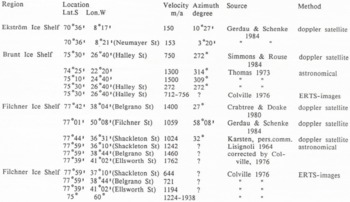
Although not the subject of the paper, we will briefly discuss quantitative estimates of ice edge velocities in the eastern and southern Weddell Sea. Table 2 gives values for a number of points at or close to the ice edge. Accuracy varies considerably according to methods used. The most reliable velocity estimates come from doppler satellite observations, the least accurate are probably represented by the analysis of ice front movements by use of ERTS-1 images. However due to the present lack of more numerous doppler satellites positionings, we will tentatively accept all of the data given in Table 2 in order to derive first (qualitative) estimates on recent net changes along the ice edges in the eastern and southern Weddell Sea.
INTERPRETATIONS/CONCLUSIONS
Based on the observed apparent advance rates of ice shelf edges (Table 1) together with quantitative estimates of ice edge velocities (Table 2) and information on large scale ice movements in West Antarctica (Hughes 1977: Figure 3) the following conclusions can be drawn.
Ekstrom Ice Shelf
Although reliable velocity estimates exist, interpretations for this ice shelf are hampered by the fact that the ice movement exhibits extreme spatial variability due to partially or completely grounded portions of the ice shelf (Swithinbank 1957). These give rise to large differences in ice velocity which have to be taken into account. This explains the difference between velocities given in Table 2, obtained close to the Georg-von-Neumayer Station, and apparent advance rates derived for a different part of the ice shelf. Observed ice advance along the Ekstrom Ice Shelf suggest a predominance of ice supply versus ice loss for most parts of the ice shelf.
Riiser-Larsen Ice Shelf
At present, there exist two quantitative ice velocity estimates for the Riiser-Larsen Ice Shelf. Orheim (1984) reports apparent ice advance rates of 200 to 700 m/a for a region between about 16 to 17 °W and at about 72°30’S while Gjesing and Wold (1981) determined ice velocities in the same region reaching 130 m/a near the ice front. The latter value, obtained by repeated triangulation of marked points from rock, should be more reliable than Orheim’s values based on interpretation of Landsat images in conjunction with direct mappings in 1977 and 1979. As stated above, it is this region where our measurements suggest either near equilibrium or slow moving ice, in qualitative agreement with Gjessing and Wold’s (1981) result. The part of the ice shelf south of 73°S is characterized by relatively high apparent advance rates (1600 m/a). The difference could be caused either by local effects (ie locally grounded ice in particular near Blaenga ice rise; Orheim 1984) or by a more general process. Figures 1 and 3 give approximate positions of ice shetf grounding lines. As can be seen, the lateral extent of the northern part of this ice shelf is smaller than for the southern part. This could cause a more frequent calving of small ice bergs in the northern half of the Riiser-Larsen Ice Shelf (Robin 1979).

Brunt Ice Shelf
As pointed out by Thomas (1973), the Brunt Ice Shelf is divided into three differently moving units. This is partly reflected in the observed ice advance along the ice edge. However, as outlined above, present maximum advance rates in the northern part of the ice shelf (zone 1) are much higher than would be expected based on the ice velocity of 1300 to 1500 m/a (Thomas 1973; the latter value is for Thomas’s zone 2, which we have treated in the advance rate estimate together with zone 1). Ice velocities around Hailey Station are reliably determined to lie at 750 m/a. There has been an apparent rapid acceleration in the velocity of the Stancomb-Wills ice stream at around 1973/74 (Simmons and Rouse 1984) which also explains the difference in ice velocity at Hailey compared to the value (349 m/a) given by Thomas (1973). If a comparable increase in ice velocity also applies for zone 1 and 2, the extremely high advance rate could be explained. The nearly constant advance rate from 1981 through 1984 indicates that calving has resulted only in small or no ice discharges along zone 1 and 2 during this time. The rough estimate of the long term apparent advances rate of 2000 m/a from 1956 to 1984 however does not only reflect the above mentioned possible increase in ice velocity but also a considerable mass loss due to calving prior to 1981.
The ice edge along the Luiipold Coast
As can be seen in Figure 3, along this coast from 27° to 37 ‘W inland, ice arises at the ice edge at a high gradient forming steep falling glaciers along the coast. This prevents formation of sizable ice shelves in this region and leads to a near immediate discharge of the supplied ice by calving. Unfortunately, no velocity estimates exist which would allow estimates of the yearly discharge along the Luitpold Coast.
Filchner Ice Shelf
Movements on the Filchner Ice Shelf is supplied by several distinct inland ice streams (Hughes 1977; Crabtree and Doake 1980), characterized by different apparent velocities (Figure 3). This is partly reflected in our apparent ice edge advance rates. Unfortunately, reliable ice velocity estimates for the Filchner Ice Shelf are rare. However there is a fairly good agreement between the doppler satellite velocity for Shackleton Station (1024 m/a) and the obtained ice edge advance rate of 1230 m/a for the years 1983 to 1984. This would indicate that calving is not significant at this point of the ice edge.
The second satellite doppler point near Filchner Station yields a two-year ice edge velocity (1980 - 1982) of 1069 m/a which is in excellent agreement with the advance rate of 1075 m/a for the years 1980-1984. These near identical figures indicate that at least since 1979/80 no considerable calving has taken place in this part of the Filchner Ice Shelf.
The astronomically derived velocities of Ellsworth, Belgrano, and Shackleton decrease from west to east, indicating a clockwise rotation of this part of the Filchner Ice Shelf around a breaking point close to the eastern end of the Grand Chasm (Crabtree and Doake 1980). Our apparent advance rates support this conclusion. The smaller magnitude in the apparent advance rates compared with the ice velocities suggests that considerable calving occurs along the eastern part of the ice front.
Separated from this part of the Filchner Ice Shelf by the large inlet at 42 °W is another portion which moves with a distinctly different direction as compared to the eastern part. Advance rates of this unit appear to be higher than for the eastern portion, but nothing can be said about net changes because of lacking velocity estimates.
The most striking feature of the apparent advance rates along the portion of the Filchner Ice Shelf west of Berkner Island is the increase in advance rates towards a maximum close to the center of the ice shelf. This is in good agreement with general theories about the flow of ice shelves which predict increasing velocities away from the stagnant, solid confinement of the shelf. Another fact to be noted is the difference in advance rates for a number of units of the ice shelf corresponding to different ice streams feeding the ice shelf (Figure 3, Table 1).
The only velocity estimate aside from the satellite doppler-value close to Filchner Station comes from ERTS-image analysis (Colville 1976) for the westernmost part of the ice shelf. The values are in qualitative agreement with our advances rates for this region, also indicating an increase in velocities away from Orville Coast. Since no other velocity determinations exist at present, nothing quantitatively can be said about net changes along the ice front. However the very good agreement between velocity and apparent advance rate at Filchner Station indicating lack of significant calving and the increase of velocities to 1700 m/a near the center of the ice shelf leads us to suggest that calving along the front of this part of Filchner Ice Shelf was negligible for the last four years.
This conclusion is supported by Robin’s (1979) prediction that calving along large ice shelves with high ice velocities and flow lines that diverge at small angles will produce large ice bergs but at a less frequent rate than seen for smaller, slower moving ice shelves with divergent flow lines.
Also shown in Figure 2 are ice edge positions of the Filchner Ice Shelf as of 1956/57. Although of lesser accuracy than the more recent mappings, we have determined apparent advance rates for the period 1957-1984 and compared these values with advance rates for the period 1980-84. We find that these apparent long term advance rates are smaller than the recent short term rates by <40% west of Berkner Island and east of Orville Coast and by some 20-30% near the center of the ice shelf (at 55 W). This indicates that some calving must have taken place since 1957 assuming that the ice movement was constant during this period. However, the general picture that emerges leads us to suggest that there has been a general extension of the Filchner Ice Shelf for the last 26 years.
Summarizing the measurements we observe a general advance of the West Antarctic ice shelves between 6°W and 61 °W since 1956 except for the glacierized Luitpold Coast and the northern part of the Riiser Larser. Ice Shelf where the ice fronts seem to be in near equilibrium. The overall advance is particularly expressed at the Filchner Ice Shelf as already discussed by Kohnen (1982). This might reflect a general behavior of large ice shelves, which apparently advance for many years before major calving occurs. This has also been proposed earlier by Zakharov and Kotlyakov (1980). The survey of the ice fronts will be carried out routinely also in future to substantiate this hypothesis.
ACKNOWLEDGEMENTS
First we thank all the colleagues who helped in the measurements, spending many long hours on watch. In particular we acknowledge the help and cooperation of the officers of Polarsirkei and RV Polarstern. We thank Dipl. Geograph Brunk (IFAG Frankfurt) and Professor A. Karsten (Fachhochschule, Hamburg) for providing us with unpublished results and Drs Orheim, Simmons, Rouse and Wold for providing us with unpublished manuscripts.



