



Response
Opportunity one: prognosis
Prognostic models estimate individual-level risk of adverse outcomes to inform clinical decision-making. Several such models have been developed and validated in psychiatry, including those estimating risk of psychosis onset, relapse, metabolic syndrome and suicide. Reference Oliver, Arribas, Perry, Whiting, Blackman and Krakowski1 Reliable risk estimation for these outcomes could inform follow-up intensity, continuity of care and collaborative safety planning. However, despite the potential of prognostic models for suicide, current UK guidelines for suicide risk assessment are unusually definitive, strongly recommending against the use of structured prediction tools. 2,Reference Seyedsalehi and Fazel3 This contrasts sharply with other areas of medicine, such as QRISK for the prediction of cardiovascular events, where imperfect tools are continuously improved and refined rather than abandoned.
Opportunity two: treatment matching
Because ‘one-size-fits-all’ treatment approaches in psychiatry are increasingly questioned, prediction models may help estimate differential treatment response and align care with patient preferences. Reference Seyedsalehi, Scola and Fazel4 Even modest improvements in matching individuals to more effective or acceptable interventions could yield substantial benefits at the population level. For example, the most recent Cochrane review supports the use of cognitive–behavioural therapy (CBT) for self-harm, Reference Witt, Hetrick, Rajaram, Hazell, Taylor Salisbury and Townsend5 but the recommendation in the feature by Cockburn and Large, that everyone who self-harms should receive the same management, Reference Cockburn and Large6 does not account for real-world constraints on service capacity. Clinical prediction models could ease this burden by recommending CBT to those predicted to benefit most.
Challenge one: low base rates
Concerns are often raised about low base rates of psychiatric outcomes, but advances in data availability and methodology have largely mitigated this issue. Large, population-based data-sets have provided the sample sizes needed to model uncommon but clinically important outcomes, accompanied by improved handling of missing data, modern modelling techniques and adherence to reporting standards (e.g. Transparent Reporting of a Multivariable Prediction Model for Individual Prognosis or Diagnosis). Consequently, research in psychiatry is increasingly characterised by robust models that can be transparently evaluated, externally validated and implemented.
Challenge two: generalisability
Concerns about generalisability are frequently raised, particularly when models are developed using data from a single country or healthcare system. Providing that high-quality methods are used, a model demonstrating adequate performance in its development setting sets a strong foundation for validation elsewhere. For example, differences in national suicide rates do not undermine a model’s ability to estimate relative risk (the central function of prognostic models). Absolute risks can be recalibrated for new populations when required, as is standard practice across medicine. Reference Steyerberg and Vergouwe7 Decades of evidence demonstrate the generalisability of well-constructed prediction models across settings. Reference Oliver, Arribas, Perry, Whiting, Blackman and Krakowski1,Reference Salazar de Pablo, Studerus, Vaquerizo-Serrano, Irving, Catalan and Oliver8
Challenge three: mechanisms and causality
Psychiatric models are often criticised for predicting outcomes without advancing understanding of the underlying mechanisms. Models closest to clinical use typically rely on readily available, clinically relevant predictors rather than on data directly reflecting aetiopathology. Biomarker-based models may better capture biological processes but remain rarely validated in psychiatry, Reference Salazar de Pablo, Studerus, Vaquerizo-Serrano, Irving, Catalan and Oliver8 limiting their clinical applicability and highlighting the trade-off between mechanistic ambition and real-world feasibility.
Causal artificial intelligence has been proposed as a means of modelling individual patient trajectories under different hypothetical scenarios, by generating ‘counterfactual’ predictions. Although conceptually promising, evaluating such models is challenging because counterfactual outcomes cannot be observed.
Importantly, the absence of biological or causal interpretation does not preclude clinical usefulness. Although simpler, more feasible models using routine clinical data might not fully capture the complexities of mental disorders, many widely used prediction models across medicine inform decision-making without explaining disease mechanisms. Conflating prediction with explanation risks holding clinical prediction models in psychiatry to a standard not applied elsewhere in medicine.
Challenge four: what is ‘good enough’?
Whether a prediction model is ‘good enough’ is not a single challenge. Rather, it comprises several distinct elements: adequate and fair predictive performance, stakeholder acceptability, system-level benefit and a clearly defined clinical decision.
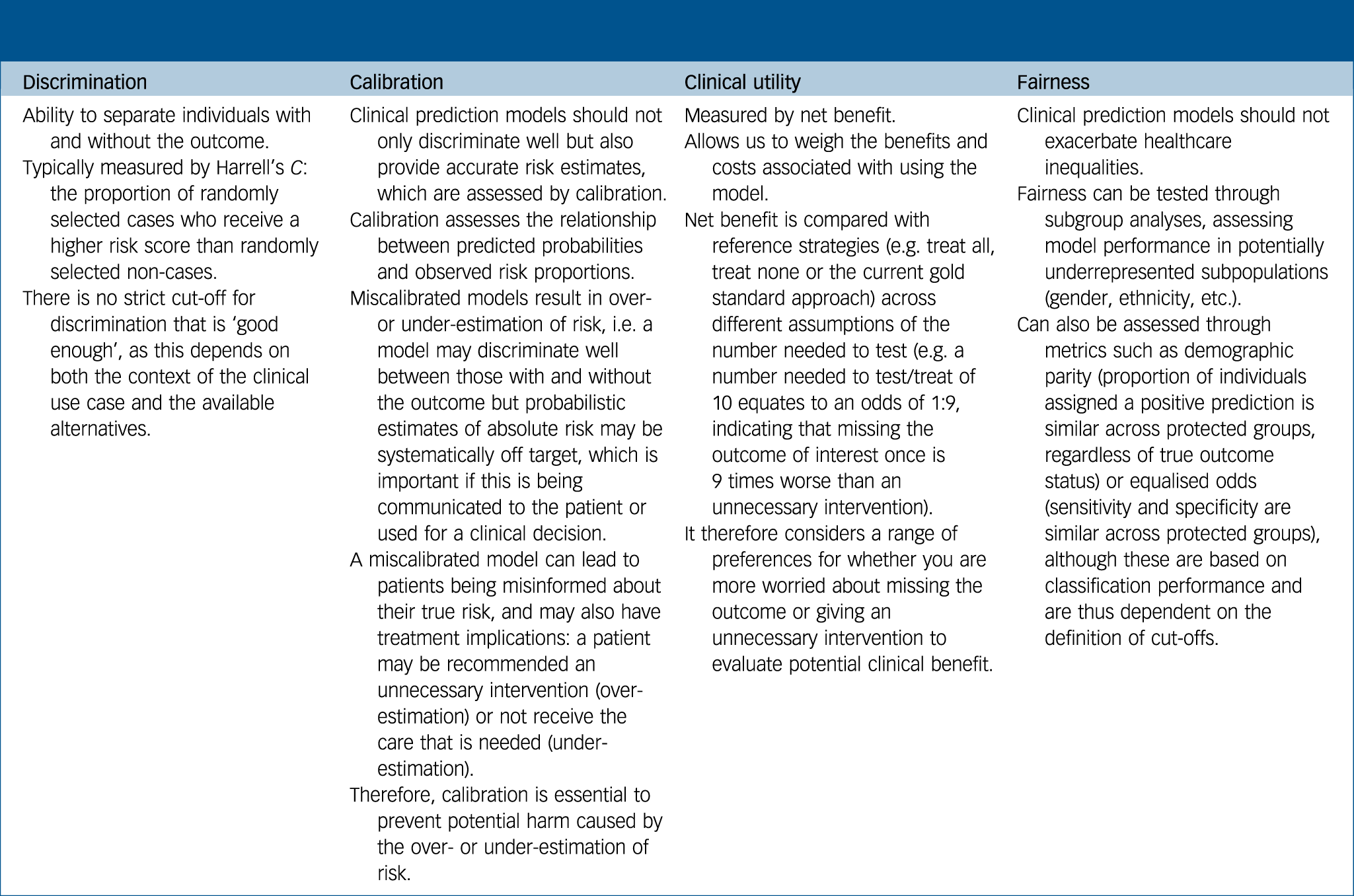
First, a model must demonstrate adequate performance, namely discrimination, calibration, clinical utility and fairness (Table 1). Performance should be evaluated using robust external validation in independent data-sets representative of intended use, and should be compared against real-world practice rather than an idealised notion of clinical judgement.
Definitions of key considerations for clinical prediction model performance: discrimination, calibration, clinical utility and fairness. Adapted from Oliver et al Reference Oliver, Arribas, Perry, Whiting, Blackman and Krakowski1

Second, a model should be acceptable to relevant stakeholders. Even models with perfect accuracy have limited value if clinicians are unwilling to adopt them. Patients value models that are accurate, transparent, secure and empowering. Reference Kéri, White, Oliver and Fusar-Poli9,Reference Whiting, Glogowska, Mallett, Maughan, Lennox and Fazel10 Patient and clinician input can therefore be useful to inform effective model development and implementation: for example, small gains in performance may not justify substantial increases in clinical burden or assessment time.
Third, a model must show potential benefit at the system level and consider the downstream effects of implementation: for example, a model detecting risk for psychosis may increase referrals to early detection services. Whether such effects are beneficial depends on the available resources. Cost-effectiveness is therefore critical: a model that systematically recommends more expensive interventions with limited incremental benefit may be inappropriate for widespread adoption.
Fourth, a model should relate to a clear clinical decision point. This could correspond to a specific treatment decision, analogous to QRISK and statin prescription. However, psychiatry lacks analogues for many outcomes. Beyond treatment selection, models may inform referral pathways, support collaborative risk management, improve communication and consistency within and between services and raise the baseline level of expertise in settings with variable clinical experience, including primary care and junior clinical staff. Reference Seyedsalehi, Scola and Fazel4 In many cases, the key decision is simply whether to intervene at all, where inaction is often the default.
Advances in data availability and methodology have created real opportunities for clinical prediction models to improve prognosis and treatment selection in psychiatry. Assessing risk in psychiatry depends on balancing clinical judgement with data: this will require promoting new research and openness to changing the current approaches to risk assessment. As in other fields of medicine, the key question should not be whether psychiatric prediction models are perfect, but whether they are ‘good enough’ to improve upon current practice.
Author contributions
All authors drafted the manuscript and revised the content.
Funding
D.O. and S.F. are supported by the National Institute for Health and Care Research (NIHR) Oxford Health Biomedical Research Centre. The views expressed are those of the authors and not necessarily those of the National Health Service, NIHR or the Department of Health and Social Care.
Declaration of interest
None.



eLetters
No eLetters have been published for this article.