Background
Bulimia nervosa (BN) is characterized by binge eating, behaviour to prevent weight gain, and usually shame and secrecy about behaviour (Fairburn & Cooper, Reference Fairburn and Cooper1982; APA, 2000). The lifetime prevalence of BN is estimated at 2–4% (Favaro et al. Reference Favaro, Ferrara and Santonastaso2003; Keski-Rahkonen et al. Reference Keski-Rahkonen, Hoek, Linna, Raevuori, Sihvola, Bulik, Rissanen and Kaprio2009). It is commonly associated with mental and physical problems, such as depression, hypokalaemia from vomiting, and gastrointestinal consequences.
Cognitive behavioural therapy (CBT) is the most established treatment (National Institute for Health and Care Excellence, 2004; Hay et al. Reference Hay, Bacaltchuk, Stefano and Kashyap2009). Interpersonal therapy (IPT) is effective but has been reported to take longer to achieve the same effect (National Institute for Health and Care Excellence, 2004). Most people are treated individually, but a substantial proportion (estimated at 15–37%) are treated in groups (Newton et al. Reference Newton, Robinson and Hartley1993; Rosenvinge & Klusmeier, Reference Rosenvinge and Klusmeier2000; Von Ranson & Robinson, Reference Von Ranson and Robinson2006). An appealing aspect of group therapy for BN is that its direct cost is lower than individual therapy (Mitchell et al. Reference Mitchell, Peterson, Agras and Miller1999). It is not clear, however, how individual therapy and group therapy compare in terms of effectiveness. There are differences in processes and dynamics between group and individual therapy, even if the therapy modality is the same (Yalom & Leszcz, Reference Yalom, Leszcz, Yalom and Leszcz2005). Indeed, in depression, individual CBT has been found to be more effective than group CBT at the end of therapy, but not at follow-up (Huntley et al. Reference Huntley, Araya and Salisbury2012).
One hypothesis is that an individualized approach for BN would be superior to group in terms of treatment effect, as individual therapy may allow for more specific formulation of the person's difficulties and for the therapy to be tailored to these (Morrison, Reference Morrison2001). On the other hand, group treatment for BN might be more effective than individual because of its potential to normalize shameful experiences (Lavender et al. Reference Lavender, Startup, Naumann, Samarawickrema, Dejong, Kenyon, van den Eynde and Schmidt2012), and shorter waiting times (Morrison, Reference Morrison2001) which may improve motivation for treatment (Schmidt et al. Reference Schmidt, Andiappan, Grover, Robinson, Perkins, Dugmore, Treasure, Landau, Eisler and Williams2008). One of the contentious issues in the literature is whether attrition rate is higher in the group setting (Mahon, Reference Mahon2000).
To our knowledge, no recent systematic review addresses how individual and group therapies compare, or how group therapies compare with no treatment. Neither the NICE guideline (National Institute for Health and Care Excellence, 2004) nor the Cochrane review for BN (Hay et al. Reference Hay, Bacaltchuk, Stefano and Kashyap2009) discriminate between the individual and group settings. The Cochrane review excluded studies that compared individual and group therapy, noting that this comparison would entail a new review. NICE recommends CBT, or IPT as an alternative. CBT targets abnormal eating patterns and underlying thinking processes, and attempts to introduce more adaptive cognitions and behaviour. IPT focuses on interpersonal problems that trigger binge-eating. An older systematic review did discriminate between settings, but did not include any studies that directly compared individual with group therapies (Thompson-Brenner et al. Reference Thompson-Brenner, Glass and Westen2003).
The main objective of this review is to assess the effects of group therapies for BN for out-patients with the condition. We compare the effects of group therapies with the same therapy delivered individually, no treatment, and with other therapies. Our primary measures of therapy effect are remission from binges and binge frequency. Given the uncertainty about whether attrition is higher from group therapy, we included drop-out from therapy as a secondary outcome measure.
Method
We conducted a systematic review and meta-analysis of randomized controlled trials (RCTs) of group psychological therapies for BN, following standard guidelines (Centre for Reviews and Dissemination, 2009; Higgins & Green, Reference Higgins and Green2011).
Search strategy
Electronic searches were made of Medline, PsycINFO and EMBASE on 6 May 2011 and updated on 5 April 2013. We used the following search algorithm: (exp Bulimia Nervosa/ OR bulimia OR eating dis$) AND (exp Randomised Controlled Trials as Topic/ OR random$) AND (exp Psychotherapy, Group/ OR group tr$ OR group ses$ OR group therapy). We sourced additional papers from prior systematic reviews, reference lists of included papers, and the Cochrane Central Register of Controlled Trials.
Inclusion and exclusion criteria
These were specified a priori.
Types of studies
This review included studies if they were RCTs. We had no language restrictions.
Types of participants
We included studies if participants were aged 18 years or over and had BN [Diagnostic and Statistical Manual of Mental Disorders, fourth edition (DSM-IV; APA, 2000)]. For studies that did not use DSM-IV, we examined the participant characteristics and study inclusion criteria, and if participants appeared to correspond to DSM-IV BN the study was included.
If studies contained participants with other diagnoses, where possible we extracted data for participants with BN. If this was not possible then studies were excluded if >20% of the participants had other diagnoses. There were no restrictions on gender, co-morbidity or medication use. Participants with binge-eating disorder or eating disorder not otherwise specified (EDNOS) were excluded.
Types of intervention
We included face-to-face psychological therapies for BN delivered in a group setting. In line with other reviews, we defined group treatment as consisting of three or more participants (Huntley et al. Reference Huntley, Araya and Salisbury2012). Studies of out-patient or community treatment were included; those of in-patients were excluded. As this review focused on face-to-face therapy, guided self-help was excluded.
Types of comparator arms
The comparator arms were the same therapy delivered individually, no treatment (including waiting list), or another therapy either in individual or group format.
Outcome measures
To allow comparison with NICE and Cochrane, we used similar measures.
Main outcomes
-
(1) Remission from binge eating, defined as 100% cessation of binge eating. If studies only reported remission from binge eating and vomiting combined, this was used.
-
(2) Mean frequency of binges per week.
Secondary outcomes
-
(1) Mean score on a scale measuring depressive symptoms. If more than one measure was reported we used clinician-rated scales preferentially.
-
(2) Drop-out, defined as the ending of therapy by the patient. (Note this outcome is not measured for the second comparison, as treatment drop-out is not applicable to ‘no treatment’ arms.)
Time points
-
(1) End of therapy (primary time point).
-
(2) Longest follow-up reported (secondary time point).
Selection of studies and data extraction
One author (A.P.) read all the abstracts of papers found in the literature search. We then obtained all potentially eligible papers and two authors (A.P. and V.J.) reviewed them collaboratively against the inclusion and exclusion criteria. Any disagreements were resolved by discussion and a consensus reached. Reasons for exclusion were noted. We extracted data into Excel and later RevMan (Review Manager version 5.2; Nordic Cochrane Centre, Denmark), with two authors checking for accuracy of transcription. We attempted to contact the first author of studies where appropriate to ask for further outcome data. As well as outcomes, information extracted included: study author; year of publication; nature of sample; type of intervention and comparisons; sample size; number of sessions; and therapist level.
Risk of bias
We applied the Cochrane Collaboration's tool for assessing risk of bias (Higgins & Green, Reference Higgins and Green2011) to each included study. This consists of six domains: sequence generation; allocation concealment; blinding; incomplete outcome data; selective outcome reporting; and other sources of bias. Each domain was rated as high, low, or unclear risk of bias. For clinical trials of therapies, blinding of therapists and participants to treatment allocation is clearly not possible, and in line with a previous meta-analysis (Leichsenring & Rabung, Reference Leichsenring and Rabung2008) we did not judge a study as high risk of bias from inadequate blinding for this reason alone.
Dealing with missing data
We preferentially extracted intention-to-treat outcome data, where available, over ‘per-protocol’ or ‘treatment-received’ analyses. We described data as intention-to-treat when participants remained in the groups to which they had been randomized regardless of adherence to intervention or control; outcome measures were sought on all participants (and authors may have attempted to impute missing data). In accordance with the Cochrane guidelines, we did not impute data on missing individuals ourselves, but assessed the potential impact of incomplete outcome data in the risk of bias section.
Measures of treatment effect
For dichotomous outcomes relative risk (RR) was calculated, which is the proportion of adverse events in the intervention group divided by the proportion of adverse events in the comparison group. A RR of < 1 indicates a favourable outcome for the intervention group. For continuous outcomes standardized mean difference (SMD) was calculated.
Assessment of heterogeneity
A meta-analysis was considered if there were two or more studies for a particular comparison. We assessed heterogeneity using the I 2 test, with a value <30% considered to indicate mild heterogeneity, 30–50% moderate heterogeneity and >50% substantial heterogeneity (Higgins & Green, Reference Higgins and Green2011). If heterogeneity was mild, studies were combined in a meta-analysis. If moderate or substantial heterogeneity was detected, we examined the studies for possible differences in study participants, intervention (intensity and level of training of therapist) and study quality – on the basis of this a decision was made whether studies were similar enough to combine in a meta-analysis.
Studies with multiple arms
If within a particular meta-analysis there was a trial with multiple relevant arms, to prevent double-counting of participants in a common arm, if appropriate we collapsed groups to create, effectively, a two-arm trial. If this was not possible we planned to split the common group into two or more smaller groups, and entered two or more comparisons into that meta-analysis. For studies with multiple relevant arms within a particular meta-analysis, we assessed heterogeneity according to the Cochrane Handbook, section 16.5.5 (Higgins & Green, Reference Higgins and Green2011).
Pooling of data
Where meta-analyses were considered appropriate, a fixed-effects model was used if heterogeneity was mild, and a random-effects model used where heterogeneity was moderate or substantial.
Quality of evidence
Flowchart 2 from the NICE guideline (National Institute for Health and Care Excellence, 2004) was used to guide the interpretation of size and precision of effects. Where there was sufficient evidence to reach conclusions the quality of evidence was assessed using the Grading of Recommendations, Assessment, Development and Evaluation (GRADE) system (Atkins et al. Reference Atkins, Best, Briss, Eccles, Falck-Ytter, Flottorp, Guyatt, Harbour, Haugh, Henry, Hill, Jaeschke, Leng, Liberati, Magrini, Mason, Middleton, Mrukowicz, O'Connell, Oxman, Phillips, Schünemann, Edejer, Varonen, Vist, Williams and Zaza2004) and tables created using GRADEpro (version 3.6).
Results
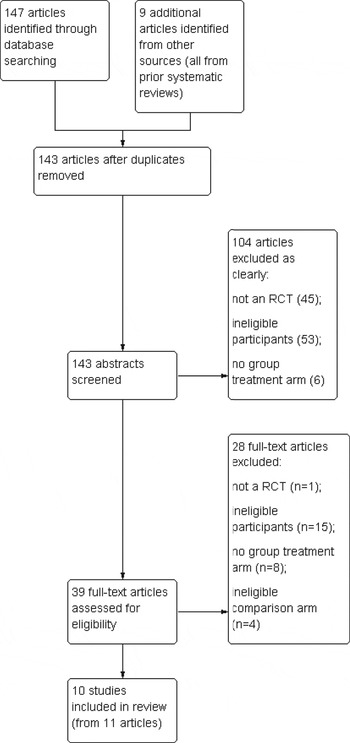
The literature search yielded 143 articles [for PRISMA (Preferred Reporting Items for Systematic Reviews and Meta-Analyses) study flow diagram, see Fig. 1]. After screening the abstracts 39 full-text articles were reviewed for eligibility. In all, 11 articles were included describing 10 studies involving 484 participants in total (Yates & Sambrailo, Reference Yates and Sambrailo1984; Freeman et al. Reference Freeman, Sinclair, Turnbull and Annandale1985, Reference Freeman, Barry, Dunkeld-Turnbull and Henderson1988; Kirkley et al. Reference Kirkley, Schneider, Agras and Bachman1985; Lee & Rush, Reference Lee and Rush1986; Laessle et al. Reference Laessle, Waadt and Pirke1987; Leitenberg et al. Reference Leitenberg, Rosen, Gross, Nudelman and Vara1988; Wolf & Crowther, Reference Wolf and Crowther1992; Sundgot-Borgen et al. Reference Sundgot-Borgen, Rosenvinge, Bahr and Schneider2002; Chen et al. Reference Chen, Touyz, Beumont, Fairburn, Griffiths, Butow, Russell, Schotte, Gertler and Basten2003; Nevonen & Broberg, Reference Nevonen and Broberg2006). Online Supplementary Table S1 lists excluded studies with rationale for exclusion.
PRISMA (Preferred Reporting Items for Systematic Reviews and Meta-Analyses) study flow diagram. RCT, Randomized controlled trial.

Characteristics of included studies
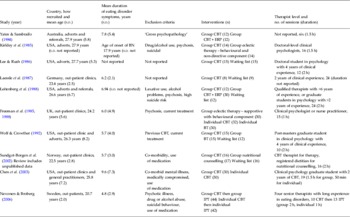
Table 1 shows a summary of study characteristics.
Characteristics of included studies

s.d., Standard deviation; CBT, cognitive behavioural therapy; ERP, exposure with response prevention; BN, bulimia nervosa; BT, behavioural therapy; IPT, interpersonal therapy.
Studies and participants
All studies were carried out in developed countries. Studies were published between 1984 and 2006, with six out of 10 published in the 1980s. Participants were recruited from out-patient clinics (Freeman et al. Reference Freeman, Sinclair, Turnbull and Annandale1985, Reference Freeman, Barry, Dunkeld-Turnbull and Henderson1988; Laessle et al. Reference Laessle, Waadt and Pirke1987; Sundgot-Borgen et al. Reference Sundgot-Borgen, Rosenvinge, Bahr and Schneider2002; Nevonen & Broberg, Reference Nevonen and Broberg2006), via advertisements (Kirkley et al. Reference Kirkley, Schneider, Agras and Bachman1985; Lee & Rush, Reference Lee and Rush1986), out-patients and advertisements (Yates & Sambrailo, Reference Yates and Sambrailo1984; Leitenberg et al. Reference Leitenberg, Rosen, Gross, Nudelman and Vara1988; Wolf & Crowther, Reference Wolf and Crowther1992) and from out-patients and general practitioners (Chen et al. Reference Chen, Touyz, Beumont, Fairburn, Griffiths, Butow, Russell, Schotte, Gertler and Basten2003). All participants were female. The mean age was 24.3 years (s.d. = 5.8). Of 270 participants assigned to group therapy, 50 (18.5%) dropped out of treatment (range of drop-out was 0% to 37%). Of the studies, two studies did not report exclusion criteria (Lee & Rush, Reference Lee and Rush1986; Laessle et al. Reference Laessle, Waadt and Pirke1987). For the remainder, typically patients were excluded with psychiatric co-morbidities (including drug/alcohol problems), high suicide risk, or were medically compromised. Also, three studies excluded participants if patients were taking medication (Sundgot-Borgen et al. Reference Sundgot-Borgen, Rosenvinge, Bahr and Schneider2002; Chen et al. Reference Chen, Touyz, Beumont, Fairburn, Griffiths, Butow, Russell, Schotte, Gertler and Basten2003; Nevonen & Broberg, Reference Nevonen and Broberg2006).
Interventions
The mean number of sessions was 16.5 (s.d. = 6.1, range 6–24), two studies were brief therapy (less than 12 sessions) (Yates & Sambrailo, Reference Yates and Sambrailo1984; Wolf & Crowther, Reference Wolf and Crowther1992) and the remainder were medium term (12–24 sessions). The therapists were qualified clinicians (Freeman et al. Reference Freeman, Sinclair, Turnbull and Annandale1985, Reference Freeman, Barry, Dunkeld-Turnbull and Henderson1988; Kirkley et al. Reference Kirkley, Schneider, Agras and Bachman1985; Sundgot-Borgen et al. Reference Sundgot-Borgen, Rosenvinge, Bahr and Schneider2002; Nevonen & Broberg, Reference Nevonen and Broberg2006), psychologists in training (Lee & Rush, Reference Lee and Rush1986; Wolf & Crowther, Reference Wolf and Crowther1992; Chen et al. Reference Chen, Touyz, Beumont, Fairburn, Griffiths, Butow, Russell, Schotte, Gertler and Basten2003), a mixture of qualified clinicians and those in training (Leitenberg et al. Reference Leitenberg, Rosen, Gross, Nudelman and Vara1988), or unclear (Yates & Sambrailo, Reference Yates and Sambrailo1984; Laessle et al. Reference Laessle, Waadt and Pirke1987).
Of the studies, three (Leitenberg et al. Reference Leitenberg, Rosen, Gross, Nudelman and Vara1988; Wolf & Crowther, Reference Wolf and Crowther1992; Sundgot-Borgen et al. Reference Sundgot-Borgen, Rosenvinge, Bahr and Schneider2002) contained three treatment arms and contributed to more than one comparison.
Risk of bias
Only two studies provided sufficient information to assess the adequacy of random sequence generation or allocation concealment (Kirkley et al. Reference Kirkley, Schneider, Agras and Bachman1985; Chen et al. Reference Chen, Touyz, Beumont, Fairburn, Griffiths, Butow, Russell, Schotte, Gertler and Basten2003). In one study it appeared that the outcome assessor for the primary outcome was not blind to treatment allocation (Chen et al. Reference Chen, Touyz, Beumont, Fairburn, Griffiths, Butow, Russell, Schotte, Gertler and Basten2003). Three studies were judged as high risk of bias from incomplete outcome data (Yates & Sambrailo, Reference Yates and Sambrailo1984; Kirkley et al. Reference Kirkley, Schneider, Agras and Bachman1985; Leitenberg et al. Reference Leitenberg, Rosen, Gross, Nudelman and Vara1988). In terms of selective reporting, 80% of studies reported on all outcomes as specified in the methods, although we note that no study protocols were available. In one study the behavioural therapy (BT) arm had a higher frequency of binges at baseline compared with the other study arms (Wolf & Crowther, Reference Wolf and Crowther1992). In another study the no-treatment arm had a lower frequency of binges at baseline compared with the other arms (Sundgot-Borgen et al. Reference Sundgot-Borgen, Rosenvinge, Bahr and Schneider2002). Overall, the level of bias across studies was unclear, introducing some doubt into the results. (See online Supplementary Fig. S1 for assessment of methodological quality table.)
Sample size
The sample size in the studies was low; one study had eight participants in the intervention arm, six studies had 10–19 participants per arm, two studies had 20–39 participants per arm and one study had 40–50 participants per arm. Freeman et al. (Reference Freeman, Barry, Dunkeld-Turnbull and Henderson1988) was the only study to report a power calculation to inform sample size. Chen et al. (Reference Chen, Touyz, Beumont, Fairburn, Griffiths, Butow, Russell, Schotte, Gertler and Basten2003) based their sample size on guidelines but did not do a formal power calculation.
Comparison 1 – group therapy versus the same therapy delivered individually
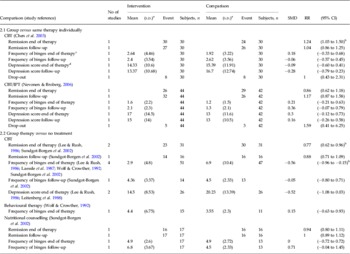
There was one study of CBT (Chen et al. Reference Chen, Touyz, Beumont, Fairburn, Griffiths, Butow, Russell, Schotte, Gertler and Basten2003), and one of sequenced CBT then IPT (CBT/IPT) (Nevonen & Broberg, Reference Nevonen and Broberg2006). Table 2 (section 2.1) shows the results and analyses.
Summary of effects for comparisons 1 and 2

s.d., Standard deviation; SMD, standardized mean difference; RR, relative risk; CI, confidence interval; CBT, cognitive behavioural therapy; IPT, interpersonal therapy.
a If more than one study per comparison, the combined mean and s.d. are reported.
b Limited evidence of a clinically relevant difference.
c Frequency of binges is per week.
d Depression symptoms: all studies used Beck Depression Inventory (BDI-I).
Remission
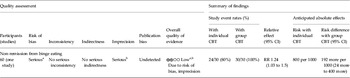
For CBT there is limited evidence suggesting that there is a clinically relevant difference in remission from binge eating and vomiting at the end of therapy, with group CBT (30/30 non-remission) inferior to individual CBT (24/30 non-remission) [N = 1, n = 60; RR 1.24, 95% confidence interval (CI) 1.03–1.50]. At follow-up there is insufficient evidence to allow conclusions (N = 1, n = 60; RR 1.04, 95% CI 0.86–1.25).
For CBT/IPT there is insufficient evidence to determine if there is a clinically relevant difference in terms of remission from binge eating and vomiting between group (26/44 non-remission) and individual (29/42 non-remission) CBT/IPT at end of therapy (N = 1, n = 86; RR 0.86, 95% CI 0.62–1.18) or at follow-up.
Frequency of binges, depression symptoms and drop-out from treatment
There is insufficient evidence to determine if there is a clinically relevant difference in these outcomes between group and individual CBT, or between group and individual CBT/IPT (see Table 2, section 2.1).
Comparison 2 – group therapy versus no treatment
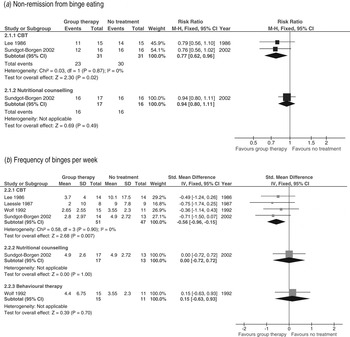
There were five studies of CBT (Lee & Rush, Reference Lee and Rush1986; Laessle et al. Reference Laessle, Waadt and Pirke1987; Leitenberg et al. Reference Leitenberg, Rosen, Gross, Nudelman and Vara1988; Wolf & Crowther, Reference Wolf and Crowther1992; Sundgot-Borgen et al. Reference Sundgot-Borgen, Rosenvinge, Bahr and Schneider2002); one of BT (Wolf & Crowther, Reference Wolf and Crowther1992); and one of nutritional counselling (Sundgot-Borgen et al. Reference Sundgot-Borgen, Rosenvinge, Bahr and Schneider2002). See Table 2 (section 2.2) for a summary of results, and Fig. 2 for forest plots of primary outcomes.
Forest plots of primary outcomes for group therapy versus no treatment at end of therapy. (a) Non-remission from binge eating. (b) Frequency of binges per week. M-H, Mantel–Haenszel; CI, confidence interval; CBT, cognitive–behavioural therapy; df, degrees of freedom; SD, standard deviation; IV, inverse variance.

CBT
Remission
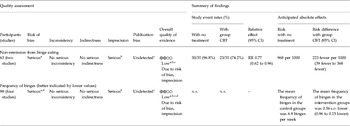
There is limited evidence suggesting that there is a clinically relevant difference in remission at the end of therapy, with group CBT (23/31 non-remission) superior to no treatment (30/31 non-remission) (N = 2, n = 62; RR 0.77, 95% CI 0.62–0.96).
Heterogeneity as measured by I 2 was 0%. At follow-up there is insufficient evidence to allow conclusions.
Frequency of binges
The baseline mean frequency of binges per week across both arms was 8.0 (s.d. = 10.2; N = 4, n = 100). There is limited evidence suggesting that there is a clinically relevant difference in mean frequency of binges per week at the end of therapy, with group CBT (mean = 2.9, s.d. = 4.8) superior to no treatment (mean = 6.9, s.d. = 10.4) (N = 4, n = 98; SMD = −0.56, 95% CI −0.96 to −0.15, I 2 = 0%)Footnote 1 Footnote †. At follow-up there is insufficient evidence to allow conclusions.
Depression symptoms
There is insufficient evidence to determine if there is a clinically relevant difference at the end of therapy between group CBT and no treatment in terms of depressive symptoms (N = 2, n = 52; SMD = −0.52, 95% CI −1.08 to 0.03, I 2 = 0%). This outcome was not reported for follow-up.
BT
There was insufficient evidence to allow conclusions about effect on frequency of binges at end of therapy. The one study did not report on other outcomes.
Nutritional counselling
There was insufficient evidence to allow conclusions regarding effect on remission from binge-eating or frequency of binges. The one study did not report depression symptoms.
Comparison 3 – group therapy versus another therapy
Group CBT was compared with the following group therapies: CBT + exposure with response prevention (ERP) (Yates & Sambrailo, Reference Yates and Sambrailo1984; Leitenberg et al. Reference Leitenberg, Rosen, Gross, Nudelman and Vara1988); BT (Wolf & Crowther, Reference Wolf and Crowther1992); eclectic therapy (involved behavioural and non-directive components) (Kirkley et al. Reference Kirkley, Schneider, Agras and Bachman1985); nutritional counselling (Sundgot-Borgen et al. Reference Sundgot-Borgen, Rosenvinge, Bahr and Schneider2002). One study compared group eclectic therapy with individual CBT (Freeman et al. Reference Freeman, Sinclair, Turnbull and Annandale1985, Reference Freeman, Barry, Dunkeld-Turnbull and Henderson1988).
For all comparisons and outcomes there was either insufficient evidence to reach conclusions, or the outcome was not reported. Online Supplementary Fig. S2 shows details of these results and forest plots of effects.
Quality of evidence
There was sufficient evidence to reach conclusions for group CBT versus individual CBT (remission), and group CBT versus no treatment (remission and frequency of binges).
A strength of the evidence was that the participant characteristics were relevant to the research question. We were unable to assess risk of publication bias, as there were too few studies to carry out a funnel plot.
Group CBT versus individual CBT
A limitation of the evidence for this comparison lies in the imprecise estimate of effect. Furthermore, there is risk of bias, as it appeared that the outcome assessor was not blind to treatment allocation.
Group CBT versus no treatment
The results appeared consistent across studies. However, the randomization and allocation were inadequately described, and the estimate of effect was imprecise – these factors lower the quality of evidence.
Overall quality of evidence
Tables 3 and 4 show overall quality of evidence using the GRADE system, which was assessed as low for both comparisons.
GRADE profile: should group CBT versus individual CBT be used for bulimia nervosa?

GRADE, Grading of Recommendations, Assessment, Development and Evaluation; CBT, cognitive behavioural therapy; CI, confidence interval; RR, relative risk.
a It appears that the outcome assessor was not blind to treatment allocation.
b The CI includes an area of small clinical effect.
GRADE profile: should group CBT versus no treatment be used for bulimia nervosa?

GRADE, Grading of Recommendations, Assessment, Development and Evaluation; CBT, cognitive–behavioural therapy; CI, confidence interval; RR, relative risk; n.a., not applicable.
a The potential limitations across studies are likely to lower confidence in the estimate of effect.
b The CIs include an area of small clinical effect.
c There were insufficient studies to use a funnel plot, and publication bias cannot be ruled out.
d In Sundgot-Borgen et al. (Reference Sundgot-Borgen, Rosenvinge, Bahr and Schneider2002) the control group had less severe frequency of binges at baseline – the effect of group CBT may have been underestimated in this study.
Discussion
Main findings
This review addresses two questions in the treatment of BN: the efficacy of group therapy; and how individual and group therapies compare. The findings are summarized in Tables 3 and 4.
We found five studies comparing group CBT with no treatment. Low-quality evidence suggests a clinically relevant difference in favour of group CBT for both remission (23/30 did not remit with group CBT, 30/31 with no treatment; RR 0.77, 95% CI 0.62–0.96) and frequency of binges (mean binges per week 2.9 with group CBT, 6.9 with no treatment; SMD = −0.56, 95% CI −0.96 to −0.15) at the end of therapy. There was insufficient evidence at follow-up for further conclusions.
The situation for group CBT compared with individual CBT is less clear, with a single study providing low-quality evidence that individual CBT may be superior at end of therapy in terms of remission (30/30 did not remit with group CBT, 24/30 with individual therapy; RR 1.24, 95% CI 1.03–1.50). There was insufficient evidence to reach conclusions at follow-up, or for frequency of binges at any time point.
There was insufficient evidence to conclude how drop-out compared between individual and group therapy. However, we note that the drop-out rate of participants assigned to group therapy arms across all studies was 18.5%, which is fairly low.
For other therapies and comparisons there was either insufficient or no evidence on which to draw conclusions.
Strengths and limitations
The studies described here are relevant to clinical practice, as the patient characteristics are similar to those treated in groups in out-patient clinics, i.e. tending to be patients without significant suicide or medical risk, or significant co-morbidity. In addition, the experience of the therapist and the duration and intensity of the interventions correspond to clinical practice.
One limitation, however, lies in the inclusion of female patients only, given that 8–10% of people with BN are male (Bushnell et al. Reference Bushnell, Wells, McKenzie, Hornblow, Oakley-Browne and Joyce1994; Garfinkel et al. Reference Garfinkel, Lin, Goering, Spegg, Goldbloom, Kennedy, Kaplan and Woodside1995).
The main limitation is that studies of group therapy are small and CIs large, making it difficult to draw precise and, often, any conclusions. By contrast, when the individual and group settings are pooled, conclusions can be reached for CBT, IPT, focal supportive psychotherapy and CBT + ERP (National Institute for Health and Care Excellence, 2004).
The strengths of the review process are that we followed standard guidelines and applied rigorous methods for assessing bias and quality of evidence. Furthermore, there was no language restriction in the search and we approached authors directly for further outcome data. In terms of possible limitations, we did not assess the effect of the number of sessions on outcome. Second, we could not take into account any tendency for individuals treated within a single therapy group to have similar outcomes to each other. To overcome this it would be necessary to compare the variance between and within actual therapy groups.
Finally, the approach of comparing effects of therapy settings may be a simplification – there may be patients with BN for whom group treatment is likely to be more successful than individual, and vice versa (Polivy & Federoff, Reference Polivy, Federoff, Garner and Garfinkel1997).
Implications
Clinicians who offer or wish to offer group CBT for BN may feel a degree of reassurance from its superiority over no treatment. However, the uncertainty of its effect invites further research (see below).
The lack of clear evidence in BN about how group and individual CBT compare is shared across conditions as a whole (Tucker & Oei, Reference Tucker and Oei2007). The direct cost of group CBT for BN is one-fifth to two-fifths of that for individual CBT (Mitchell et al. Reference Mitchell, Peterson, Agras and Miller1999) – while this may appeal to those planning services, the relative efficacy needs to be clarified to establish overall how the two settings compare in terms of cost-effectiveness.
The Cochrane review (Hay et al. Reference Hay, Bacaltchuk, Stefano and Kashyap2009), pooling individual and group settings, reported the effect of CBT compared with no treatment to be RR 0.69 (95% CI 0.61–0.79) for remission, and SMD = −0.94 (95% CI −1.19 to −0.70) for frequency of binges. These effects are somewhat larger than in our review. Interpreting indirect comparisons is problematic, as two sets of trials may differ in relevant aspects such as characteristics of participants and the intervention. Studies of individual therapy for BN tend to be more recent than those of group, and it has been suggested than improvements in therapy techniques could partly account for the observed higher effect in individual therapy studies (Keel, Reference Keel2004). As it stands, however, the quality of evidence is stronger for individual CBT.
To resolve the question of whether the treatment setting of CBT matters would be a matter of conducting a further RCT of group versus individual CBT, which is adequately powered and has robust methodology to minimize risk of bias. Such a trial would measure outcomes at follow-up as well as end of therapy, to test whether group CBT might have a delayed effect relative to individual CBT. To widen its relevance men should be included, documenting reasons if they decline to participate or drop-out. Given the finding of a comparable effect for individual IPT and CBT at follow-up (National Institute for Health and Care Excellence, 2004), there would also be interest for future trials of group IPT compared with an established treatment.
Another avenue for research would be to evaluate if tailoring the treatment setting to the patient adds benefit. A RCT could be designed where in one of the treatment arms patients are assigned, through a process of assessment, to the setting that appears to best suit the patient (i.e. individual or group CBT); the comparison arm would assign all patients to the most established treatment, currently individual CBT.
Finally, the question of the efficacy of group CBT for BN needs to be viewed in context of developments in BN treatment as a whole. In particular, a large RCT (n = 293) found that a stepped-care sequence was more successful and cost-effective than individual CBT and fluoxetine at follow-up (Mitchell et al. Reference Mitchell, Agras, Crow, Halmi, Fairburn, Bryson and Kraemer2011; Crow et al. Reference Crow, Agras, Halmi, Fairburn, Mitchell and Nyman2013). In this stepped-care sequence, individual CBT was offered as a third stage if patients had ongoing bulimic symptoms after guided self-help and then fluoxetine. For services interested in delivering feasible and cost-effective treatment for BN, the strong evidence reported in support of this stepped-care approach puts the limited evidence that our review found for group CBT in perspective. This stepped-care research also raises the question of when might be the most beneficial stage to offer patients group CBT.
Supplementary material
For supplementary material accompanying this paper visit http://dx.doi.org/10.1017/S0033291713002791.
Acknowledgements
We would like to thank Professor Andrew Mcintosh, Professor of Biological Psychiatry, University of Edinburgh, for his contributions to the design of the article and helpful comments. The present review received no financial support.
Declaration of Interest
None.