Detonation of a nuclear device in a major city would eclipse any prior terrorist and natural disaster in terms of infrastructure damage, mortality, and morbidity (both physical and mental, acute and chronic). 1 - Reference DiCarlo, Maher and Hick 5 In addition, the potential for unprecedented widespread social disruption compounded by fear of exposure is a unique after-effect that may complicate disaster response and recovery efforts.
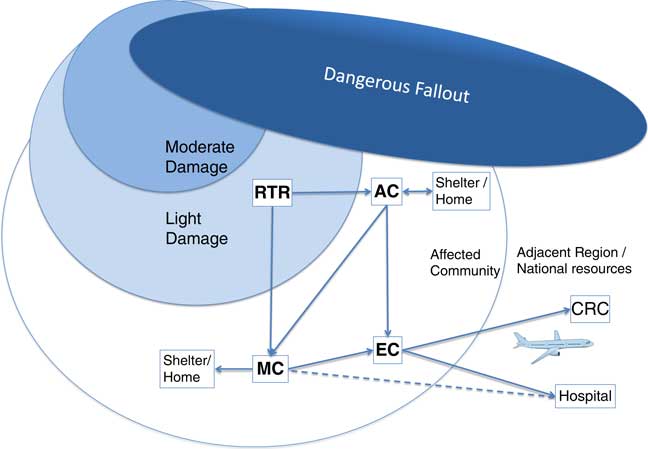
Computer modeling of the number and type of casualties for various scenarios of nuclear detonation has been performed by several federal and nongovernmental agencies. 1 - Reference DiCarlo, Maher and Hick 5 The Planning Guidance for Response to a Nuclear Detonation 1 names and describes various zones resulting from the nuclear detonations, including the severe, moderate, and light damage zones, and the dangerous fallout zone. The severe damage zone contains few salvageable survivors. The other zones are represented in Figure 1 along with the health and medical components described below. These zones correlate with the numbers and types of injuries expected. 1 Some areas receive prompt radiation via the initial blast and other areas delayed radiation via fallout. Survivors who receive delayed radiation exposure in the dangerous fallout zone are the primary subject of this report, but we do refer to generic damage and fallout zones to incorporate the other areas of potential exposure.
Functional Illustration of Survivor Care Operations at 48 h After Detonation. Notes: this is a simplified version of the more detailed RTR system.Reference Hrdina, Coleman and Bogucki 12 Figure 1 is not to scale and does not represent the full spectrum of activities. Abbreviations: RTR, Radiation Triage, Treatment, Transport (initial triage and treatment of traumatic injuries and transport to medical care or assembly center [spontaneous sites]); MC, medical care facility (eg, hospital, field hospital); EC, evacuation center (at airport, railhead, bus staging area, etc); AC, assembly center (may be spontaneous or planned; note that this function may occur at other locations as well); CRC, community reception center (formal screening for radiation contamination where resources are adequate; can be established closer to the point of detonation later as resources improve and infrastructure is reconstituted); shelter/home, general shelter or housing in nondamaged/nonradiation areas (not shelter-in-place activity during fallout during first 24 h) as available pending later evaluation and evacuation (survivor can later go to a CRC when it opens near them).

Ground-level detonations are expected to produce more fallout debris compared to air-burst detonations, which tend to produce more burns and traumatic injury over a wider area. Various factors influence the number of expected casualties and injury types in the modeled metropolitan areas. These factors include but are not limited to: location, detonation yield (kiloton or kT), topography, weather, population size, time of day, ground or air burst, dose rate, radiation quality (neutrons, x-rays, beta radiation), and infrastructure elements at risk.Reference Buddemeier and Dillon 2 - Reference DiCarlo, Maher and Hick 5 Some detonation scenarios yield potential casualty numbers in the hundreds of thousands or millions.Reference Buddemeier and Dillon 2 - Reference Knebel, Coleman and Cliffer 6 For example, a 10-kT Los Angeles, CA, detonation model estimated that over 500,000 persons would be located in the dangerous fallout zone 2 hours after the detonation.Reference Buddemeier and Dillon 2 Planning an appropriate medical response of this magnitude is very complex and requires thoughtful and detailed advance planning in order to maximize the number of survivors, efficiently use scarce resources, and rapidly establish a coordinated approach to victim identification, triage, treatment, and transfer.
Currently, most state and local plans for radiation incident response focus on much smaller events including nuclear power plant failures, industrial accidents, and use of radiation dispersion devices (RDDs, often referred to as “dirty bombs,” although nonexplosive dispersal methods can also be used). 7 Compared to nuclear detonations, these scenarios involve a much smaller number of persons, with typically less serious effects. The acute medical care system would seldom be overwhelmed, and concentrated efforts could be applied to detailed screening of those involved with the support of intact community infrastructure. In contrast, a nuclear event creates massive casualty and community demands in the setting of severely damaged infrastructure. Although some states have conducted RDD and even improvised nuclear device (IND) exercises, none have operationalized survivor prioritization for receipt of myeloid cytokines and evacuation.
In the aftermath of a radiation event that mainly results in contamination, such as the use of an RDD that may be constructed by using a variety of potential isotopes, well-described models such as the Centers for Disease Control and Prevention’s Community Reception Center (CRC) are valuable for careful assessment of external or internal radiation exposure.Reference Miller, Ansari and Martin 8 - 10 The CRC is intended for asymptomatic ambulatory population screening and is a public health asset. The CRC process is thorough and requires significant resources.
In the aftermath of a nuclear detonation, the major radiation exposure risk is high-intensity gamma irradiation, and the relative risk from remaining external or internal contamination is low. Therefore, the priority is not on carefully documenting remaining contamination but on rapid assessment of potential exposure and clinical symptoms to prioritize early treatment and evacuation. Many of the survivors with significant acute radiation syndrome (ARS) will be ambulatory and have minimal or no symptoms as they enter the latent phase of their disease. By the time they develop later complications it will be too late to easily move them and likely too late to save their lives.
To minimize mortality and morbidity, public health and medical response leaders are expected to implement 4 lifesaving strategies during the first 96 hours after a nuclear detonation:
1. Issue “shelter-in-place” orders immediately for the population in the fallout areas to minimize exposure. Generally, these orders would be for at least 24 hours and would minimize or eliminate significant radiation exposure for potentially hundreds of thousands in the affected area.Reference Buddemeier and Dillon 2 , Reference Brandt and Yoshimura 11
2. Organize and provide trauma care to the overwhelming number of patients with acute injuries. The medical care system and facilities will be focused on trauma care and referral throughout the first several days.
3. Establish screening of survivors to establish risk for radiation-related illness and assign priority for treatment and evacuation to adjacent regions or areas of the nation where the medical care system is intact. Assembly centers (ACs) should be stood up adjacent the dangerous fallout and damage zones to provide this population-based function. AC sites may be based on spontaneous congregation of survivors or established at preplanned centers. The screening function may also be carried out in general shelters, at evacuation points, or other locations as required.
4. Identify survivors with significant but not fatal radiation exposure who are most likely to benefit from myeloid cytokines in conjunction with supportive care. These survivors should receive cytokine injections as soon as possible and be expeditiously evacuated to intact health care infrastructure outside of the attacked region for continued evaluation and care. Those at lower risk or with extremely severe radiation injury will receive cytokines and evacuation as resources permit.
The screening function must be integrated into an overall nuclear detonation response plan. Prior planning has defined the role of sites in the community for rapid triage, medical care, and evacuation centers to meet a host of coincident demands on a damaged and overwhelmed public health and medical system.Reference Hrdina, Coleman and Bogucki 12 , Reference Hick, Weinstock and Coleman 13 The AC was described as part of that framework but its functions were not well defined until now (Figure 1). Although these screening functions have received little planning priority, they likely have an impact on mortality greatly exceeding the initial trauma care. A nuclear detonation response will require a balance of multiple sites and systems with complementary functions to ensure the greatest good for the greatest number of survivors is provided.
Considerable human and animal data show that supportive care and myeloid cytokines can significantly mitigate the effects of ARS and save lives if cytokines are administered early enough (within 24 to 48 hours after exposure).Reference Reeves 14 - Reference Dainiak, Gent and Carr 17 Myeloid cytokines are available in the US Strategic National Stockpile 18 , 19 and are widely available clinically, as they are used to mitigate effects of cancer chemotherapy.Reference Smith, Bohlke and Lyman 20 , Reference Herbst, Naumann and Kruse 21
Although lymphocyte depletion kinetics are a well-described marker for dose estimation and the hematologic subsyndrome of ARS 22 - Reference Andrews, Auxier and Lushbaugh 25 and could identify candidates for treatment, large-scale ability to perform serial tests will be lacking in the affected area in the early aftermath of a detonation. Dicentric chromosome analysisReference Wilkins, Romm and Kao 26 , Reference Prasanna, Moroni and Pellmar 27 is a very accurate estimate of dose, but this test currently takes over 72 hours to complete and is difficult to scale up for a mass casualty situation. Additional clinical screening tools require training and experience and are not well suited for field use. New point-of-care diagnostics are being developed that may provide future assistance but are not yet ready for implementation (personal communication, JB and NC, 2017).
Given the austere conditions in the immediate post-detonation environment, the expected limited initial local supply of myeloid cytokines, and the absence of readily available diagnostics, a simple screening tool is needed to support initial assessment and triage after a nuclear detonation to help fairly allocate scarce resources.
METHODS
The authors, a federally convened group of government and civilian medical planners of various disciplines from multiple agencies with experience in radiation incident planning and response, developed this proposed triage tool to help medical providers and public health staff assess survivors for radiation injury in ACs and at other sites where screening is required. This tool is for population-based screening and not on-scene first responder use. First responders should use usual trauma and medical triage criteria and refrain from radiation triage owing to the wide variability in symptoms and onset. Current literature was reviewed and assessed for value by the workgroup members. Multiple virtual and in-person meetings were held over time to develop and refine the proposed tool.
Data
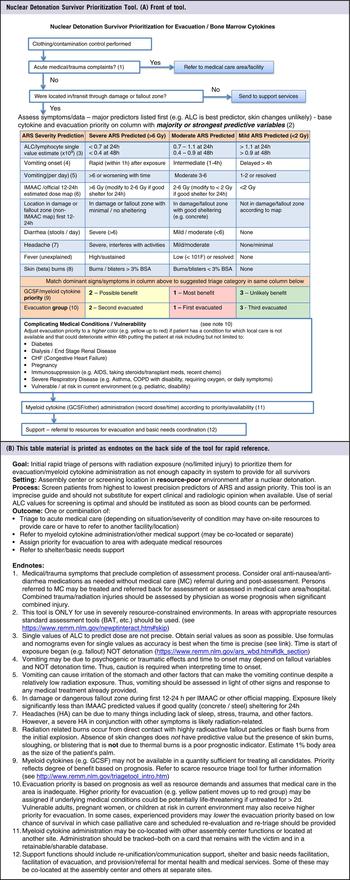
The EAST tool (Exposure And Symptom Triage) is shown in Figure 2A with important “endnote” clarifications in Figure 2B. The tool is printed on a single page (front and back side), facilitating rapid categorization of survivors on the basis of a brief interview by a medical provider (nurse, advanced practice provider, physician, or other personnel). It uses a single value for the ALC (absolute lymphocyte count) when available along with exposure and sheltering information and selected clinical signs and symptoms known to be associated with radiation injury and ARS to prioritize patients. Although rough cutoffs are listed on the table for the ALC value, for expediency accuracy is sacrificed, and proper interpretation should use available nomograms and interactive tools 28 if available.
Nuclear Detonation Survivor Prioritization Tool. (A) Front of tool.

The tool is designed for use only in a resource-poor screening environment. The tool output establishes priority for myeloid cytokines and transport to definitive medical care for ongoing assessment and management of ARS. More detailed triage tools have been developed for use in medical care facilities that can be adjusted to the resources available.Reference Coleman, Weinstock and Casagrande 29
DISCUSSION
As the whole-body dose from acute exposure to radiation exceeds 2 Gy, the risk of clinically significant ARS increases, especially among those with special vulnerabilities, eg, immunosuppression, young age, old age, chronic illness, concurrent physical trauma, burns. The estimated LD 50/60 for an untreated adult (an estimate of lethal dose in 50% of the population at 60 days) after rapid whole-body exposure is about 4 Gy. 30 With appropriate care, the curve is shifted to the right and the LD 50/60 is higher. Standard current clinical practice for ARS includes providing myeloid cytokines and supportive care as soon as possible after significant whole-body exposure in excess of 2 Gy.Reference Reeves 14 , Reference Dainiak, Gent and Carr 17 Waselenko’s expert working group established a threshold of 3 Gy of whole-body irradiation as an appropriate level at which to institute cytokine therapy after a nuclear detonation with a 2-Gy threshold for pediatric and elderly patients or those with combined traumatic and radiation injury.Reference Waselenko, MacVittie and Blakely 31
Recognizing the uncertainty in estimating dose, the need for easy-to-use categories, and also to be somewhat conservative in providing medical treatment to persons on the border of benefitting from it, Coleman et al. defined 2 priority groups for treatment after a nuclear detonation event: a moderate exposure group between 2 and 6 Gy and a severe exposure group of ≥6 Gy.Reference Coleman, Weinstock and Casagrande 29 In a scarce resource environment, treatment of victims with moderate exposures takes precedence over those with severe exposures, who will require significantly more resources and have a much worse prognosis even with maximal support.Reference Casagrande, Wills and Kramer 32 Our group similarly prioritized the moderate dose range survivors, 2-6 Gy, who would be most likely to benefit from myeloid cytokines and specialized medical support, but not likely to require intensive medical support in a scarce resource environment.
As with all triage tools, the goal is to avoid both over-triage (ie, assigning a higher than appropriate priority and providing treatment that was not necessary) and under-triage (ie, categorizing patients to a lower than appropriate priority and failing to provide beneficial treatments).
Under-triage of a small number of survivors who have exposure >2 Gy and are asymptomatic may be unavoidable. When resources allow, all survivors (even those whose initial dose estimate is ~1-2 Gy) should undergo repeat assessment so that their exposure and risk can be more clearly defined.
Over-triage (categorizing patients to a higher than appropriate priority) is also a potential problem. Many observable symptoms consistent with ARS (vomiting, headache, confusion) are commonly associated with acute emotional stress as well as physical trauma, which is expected after a nuclear detonation. This may result in large numbers of unexposed persons falling into a high priority category for immediate treatment, thus burdening and diluting the resources. Therefore, re-triage based on ALC should be performed when resources allow.
The EAST tool sorts survivors into 3 groups—note that the colors reflect priority, and not severity—similar to Coleman’sReference Coleman, Weinstock and Casagrande 29 work: the highest priority in this scarce resource environment goes to the moderately affected group with a high likelihood of benefit for a low resource investment. The sickest individuals are a secondary priority as resources allow:
1. Priority 1 – Red/Highest. Most likely to benefit from myeloid cytokines and priority evacuation and require moderate medical care interventions (moderate exposure of 2-6 Gy predicted).
2. Priority 2 – Yellow/Intermediate. Possible benefit from cytokines but likely to need intensive medical support after evacuation (severe exposure >6 Gy predicted).
3. Priority 3 – Green/Lowest Priority. Unlikely to benefit from cytokines or require medical care interventions (mild exposure/ARS not predicted<2 Gy).
Exposure
Although survivors arriving at an AC may receive routine decontamination including clothing control or rapid screening for gross radiologic contamination, quantifying external radiation contamination is not included in the EAST assessment. Presence or absence of residual radiation is helpful information and if resources are available should be included in the screening process. However, this introduces personnel, training, equipment, and time issues that could inappropriately delay the initial sorting function. Formal CRC functions for mass community population monitoring should be established for this purpose in areas when adequate resources exist. 9 , 10 In general, self-decontamination is effective after chemical events and more rapid than traditional decontamination and would likely be the most efficient strategy in this setting.Reference Chilcott and Amlot 33
Survivors presenting to an AC with acute medical or trauma needs must be referred to appropriate medical care locations as expeditiously as possible. Depending on the situation, some medical care may be co-located or transport to a medical care site may be required. Usual medical care facilities are likely to be overwhelmed, and alternate systems of care will be needed. The AC should understand the range of options available to survivors in their area. This tool is not designed for use in a medical care facility where combined traumatic and radiation injuries can have much worse prognosis than either injury alone and where the focus should be on serial ALCs. 28 , Reference Sandgren, Salter and Levine 34
Survivors should first be asked about their potential exposure (ie, is there a reason to believe based on location at the time of the blast that the individual was in or near areas where there was prompt radiation and/or fallout radiation). This assessment should be based on the best dose maps available at the time, optimally those generated by the Department of Homeland Security’s Interagency Modeling and Atmospheric Assessment Center (IMAAC) 35 although early maps may be rougher predictive models based on weather conditions. Because the IMAAC maps generally contain the most reliable information linking geography and doses, they are listed first of the maps on the tool. The patient should be asked for an address or indicate on a map where they were, and that location should compared to the dose maps. Maps will be refined as field monitoring data is incorporated.
Access to these maps is critical to screening success. Public health, emergency management, and the medical care sector should already be engaged in a local health care coalition, which can serve as a vital link to disseminate mapping information to key stakeholders in the health and medical community. Printing and distributing current maps to the AC and medical care locations is a high priority that should be understood and planned for by the jurisdictions in advance of an event.
Type and duration of sheltering should be considered. Optimal shelter is generally defined as being in the center or basement of buildings with thick concrete walls. Persons sheltering within a wood frame building still have considerable protection compared with those outside without shelter. Several hours in a dangerous fallout zone with inadequate shelter is a reliable predictor for significant radiation exposure. 1 - Reference Buddemeier 4 , Reference Knebel, Coleman and Cliffer 6
Persons presenting to the AC found not to be at risk for prompt radiation or exposure from fallout on the basis of their location should be released without further evaluation needed. Those determined to be at risk should proceed to the symptom screening process to further inform their triage category.
Acute Radiation Syndrome
Developing a valid assessment tool for ARS by using signs and symptoms is fraught with difficulty, because the typical signs and symptoms of ARS are not unique to radiation injury, the symptoms are often subjective, and the time course is variable. However, clinical assessment is likely to be the only tool available early on after a nuclear detonation as field laboratory capacity is unlikely. As soon as resources allow, complete blood counts (CBCs) with serial ALCs should be obtained and patients re-assessed and re-triaged, because ARS progresses over time. 28 , Reference Sandgren, Salter and Levine 34
The CBC is a common test available at hospitals and some clinics and national capacity for CBCs performed in reference laboratories is robust.Reference Adalja, Watson, Wollner and Toner 36 However, difficulties coordinating sample acquisition, transport, and test result communication in the local damaged and chaotic environment will preclude most field-based sampling. Single-value ALCs are less accurate than serial values, owing to several factors including host variability, partial body exposure, and difficulty defining the exact time the exposure began. The uncertainty about dose rate, especially during exposure to fallout, is additionally problematic because the variable intensity of exposure over time can affect the lymphocyte depletion rate. Nevertheless, even a single ALC is likely better at estimating dose than observable symptoms and is included on the template to encourage planners to integrate access to blood counts as soon as possible (eg, flow cytometer access, large-scale management of clinical samples), particularly at evacuation points and myeloid cytokine administration sites.
Common and easily observable symptoms were taken from standard ARS categorization and other triage tools.Reference Mettler and Voelz 37 - Reference Gorin, Fliedner and Gourmelon 40 Some of the thresholds from these common sources were combined to yield 3 groups to be consistent with usual triage constructs (red/yellow/green) or were otherwise modified to properly fit survivors into 1 of the 3 groups. Note that fatigue, anorexia, cognitive impairment and abdominal pain, often a component of the tools, were not included owing to the high potential for subjective variability as well as numerous potential confounders such as lack of sleep and severe psychological stress.
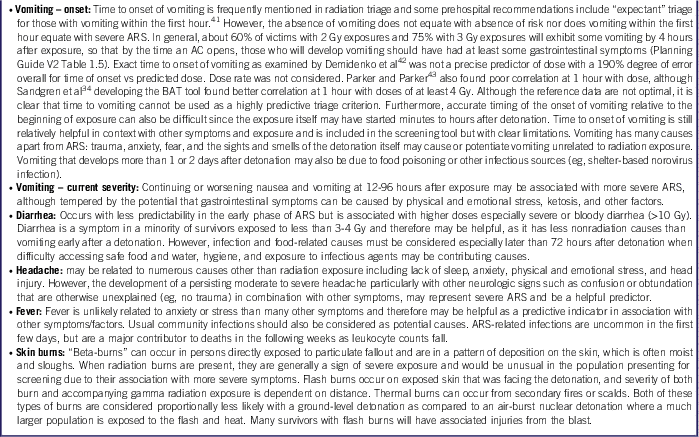
In the tool, the higher the row, the more characteristic and determinative the symptom parameter. Figure 2B includes notes on the symptoms and signs and should be printed on the back of the tool for reference. The screener asks the survivor about the presence and severity of specific symptoms in each row of the table without sharing the triage table itself to avoid self-reporting bias.
Vomiting is the most familiar and prevalent symptom associated with ARS, and some triage tools use time to onset of vomiting as a key factor.Reference Lerner, McKee and Cady 41 Unfortunately, several authors offer strong caveats about the validity of time to vomiting as a clinical parameter for assessing the severity of radiation injury (see Table 1).Reference Demidenko, Williams and Swartz 42 - 45
Symptoms Included in the Tool With Comments and LimitationsFootnote a

a Note: The table is not included in the triage tool. It provides additional background information on the specifics of the clinical categories. Abbreviations: AC, assembly center; ARS, acute radiation syndrome; BAT, Biodosimetry Assessment Tool.
The tool’s other clinical parameters (diarrhea, headache, fever, and skin burns) are well known side effects of whole-body or localized radiation. The manifestations of these will vary significantly from victim to victim depending on the details of exposure, but are useful clinical benchmarks that require assessment and management, sometimes urgently. See Table 1 for additional information.
Contributing factors such as pregnancy, age (eg, childhood), and underlying medical conditions such as immunodeficiency may prompt assignment to a higher priority for evacuation due to higher risk, higher benefit, or vulnerability in their current situation.Reference Waselenko, MacVittie and Blakely 31
After the provider assesses all the rows of the tool, the column with the most predictive information/dominant symptoms drives the assigned triage category (Priority 1, 2, or 3). No single symptom or indicator is definitive, and answers may fall into more than one column (Severe, Moderate, Mild). Therefore, the screener must assess the totality of answers by the survivor and assign the survivor to the column that has the predominance of matching factors, understanding that the first rows are generally more predictive. A tag or wrist band or card system should be developed by the jurisdiction to be worn or carried by each survivor. The jurisdiction may choose to use a lettering or numbering system to avoid visual association of the red/yellow/green colors with the survivor’s category.
Limitations and Caveats
The predictive value of a symptom-based screening tool for ARS is limited. None of the individual factors are sufficiently predictive to allow for clear-cut assignment of patients into groups based on individual factors, precluding a simple and binary triage tool. Because of this, multiple factors are included for consideration that may complicate the screening process by introducing complexity and a degree of subjectivity. However, we feel that having some structure and guidance to follow is superior to a first-come, first-served approach that could result in an unjustifiable allocation of scarce resources. A large number of people will be expected to converge on ACs seeking assessment, information, and available treatments, and the ability to implement a first-order triage tool may make a big difference in preserving limited medical countermeasures and other resources for those who can most benefit.
The EAST tool should also help focus planning efforts on the screening process, evacuation process, and the ability to expediently administer myeloid cytokines because benefit declines rapidly over time.Reference Farese, Brown and Smith 46 These efforts are critical in the days following the detonation and have the potential to save thousands of lives if executed properly and efficiently. Although the EAST tool helps with prioritization, determining how and where the cytokine administration will be performed and tracked is an under-appreciated aspect of planning that we hope can be emphasized in future exercises. Evacuation center functions have generally not included laboratory screening nor countermeasure administration, but the availability of both of these prior to transport could preserve transport resources for those survivors with suggestive ALC values and provide at least some bone marrow support prior to evacuation.
There is a risk that once categorized, patients may not receive further screening as additional resources become available. This is not acceptable, as signs and symptoms of ARS and the ALC values change over time. The AC function is for areas that lack sufficient resources for usual diagnostics and routine care. When adequate resources become available, all survivors from the affected area should receive serial ALC, evaluation at a CRC, and registry into a long-term monitoring database.
Regional and national receiving communities also need to plan for laboratory screening, CRCs, and medical countermeasure administration functions to support the survivors arriving in their area. This is particularly important for those communities that have commitments through the Radiation Injury Treatment Network 47 and are likely to receive a large number of survivors. Most of these survivors will not require immediate hospitalization, but all will require initial evaluation, ALC monitoring, and potentially ongoing provision of myeloid cytokine and other medical interventions. Many of these functions can occur in a shelter or other processing or screening site for efficiency and to relieve the burden on the health care system, but these strategies must be planned before an event in order to be successful.
Future validation of the EAST tool is recommended by the authors. Public health and medical community testing is vital to be sure providers (1) understand the issues being assessed, (2) understand the limits of the tool, and (3) feel comfortable using the tool. Creating an app to automate the tool and integrating the data into an electronic database would also be helpful, although wireless and other data systems should not be relied on to work after a nuclear detonation.
CONCLUSION
One of the biggest challenges after a nuclear detonation will be sorting the hundreds of thousands of survivors to identify the presence or degree of radiation injury, prioritize the survivors for myeloid cytokine administration, and evacuate those with severe but survivable exposure and injuries to an area with more intact health care resources in a timely fashion. This requires an easy-to-use tool for a complex function.
Unfortunately, this sorting must occur in the setting of damaged local infrastructure and very limited availability of medical resources, likely including inadequate medical countermeasures, diagnostics, supplies, and transport resources. AC planning is critical to rapid screening of large numbers of persons. The EAST tool could be helpful for prioritizing survivors into groups based on their exposure history and signs and symptoms of ARS. Assignment to the appropriate triage groups will help to ensure that resources are used appropriately to save the most lives possible. Further validation, evaluation, and exercises involving AC functions are critical to furthering nuclear detonation preparedness activities.
Acknowledgments
The authors acknowledge Dwayne Myal, Erik Gaull, Daniela Stricklin, and Jane Koska for their assistance with the manuscript.
Disclaimer
The views expressed in this article are those of the authors; no endorsement by their institutions or by the National Cancer Institute, National Institutes of Health, Office of the Assistant Secretary for Preparedness and Response, Centers for Disease Control and Prevention, or the US Department of Health and Human Services or any other US government agency has been given or inferred.