INTRODUCTION
The genus Notobryon Odhner, Reference Odhner1936 is composed of cryptic, translucent brown-coloured medium-sized sea slugs of the family Scyllaeidae Alder & Hancock, 1855, which bear long rhinophoral sheaths, a keel in the tail and two pairs of dorsal lobes with the gills between them. Shortly after the description of the type of the genus, Notobryon wardi Odhner, Reference Odhner1936, another author, Baba (Reference Baba1937), named two additional species, both from Japan: Notobryon bijerecum Baba, Reference Baba1937 and Notobryon clavigerum Baba, Reference Baba1937, which were illustrated in colour by Baba (Reference Baba1949: figures 133, 134), together with N. wardi (figures 131, 132). No other species has been introduced posteriorly until the paper of Pola et al. (Reference Pola, Camacho-Garcia and Gosliner2012), which establish the diagnosis of Notobryon and tackled an overview of the Scyllaeidae, as context to a molecular and morphological revision of the genus in which two new species were described: Notobryon thompsoni Pola, Camacho & Gosliner, Reference Pola, Camacho-Garcia and Gosliner2012 and Notobryon panamica Pola, Camacho & Gosliner, Reference Pola, Camacho-Garcia and Gosliner2012.
The latter authors initially assumed that it was the external and internal anatomical differentiation between the species being so small that has been the cause of the records of N. wardi in all the oceans, but concluded that there are indeed remarkable morphological differences across the species, mainly in the genital system.
The first record for a species of Notobryon in the Atlantic is owed to Valdés et al. (Reference Valdés, Hamann, Behrens and DuPont2006), who cite Notobryon cf. wardi from several localities in the Caribbean (Honduras, St Lucia, Virgin Islands and St Vincent & the Grenadines). These authors also remark that the identification is provisional because the species could be undescribed, and they point out that they could have illustrated several species instead of only one.
Pola et al. (Reference Pola, Camacho-Garcia and Gosliner2012), based on their studies, state that ‘eastern Pacific, Indo-Pacific, and temperate biotas consist largely of distinct faunas’, but they assign to their newly described Pacific species, N. panamica, the specimens known for the genus in the Caribbean (Valdés et al., Reference Valdés, Hamann, Behrens and DuPont2006).
The expedition ‘Karubenthos’, hosted by the Muséum National d'Histoire Naturelle (MNHN) in Paris, took place in Guadeloupe (Lesser Antilles, Caribbean Sea) in May and December 2012. The objective was the total inventory of the mollusca from the archipelago, for which 92 stations distributed in all the possible habitats were sampled. As a result of this expedition, the inventory of the sea slugs in Guadeloupe was established as 149 species (Ortea et al., Reference Ortea, Espinosa, Caballer and Buske2012, Reference Ortea, Espinosa, Buske and Caballer2013), including one new genus, nine new species and 100 new records for the fauna of the area.
The objective of this paper is the description of a new Caribbean species of the genus Notobryon, the sixth known in the world, based on the valid anatomical characters established by Odhner (Reference Odhner1936) and Pola et al. (Reference Pola, Camacho-Garcia and Gosliner2012).
MATERIALS AND METHODS
The holotype was found by examination of algae collected by wading in Pointe-Noire, Guadeloupe, during the expedition ‘Karubenthos’ organized by the MNHN, from 1–28 May 2012. During this field trip a total of 71 stations were visited, from the shore to 36 m depth, and sampled by direct search, scraping, brushing, underwater vacuuming and dredging, from the shore to 258 m depth (Ortea et al., Reference Ortea, Espinosa, Caballer and Buske2012). All samples were processed onshore; placed in trays for examination and selection of specimens in a temporary laboratory installed by the MNHN in the Marine Biology facility of the Guyana University.
The animal was photographed alive and then preserved in ethanol 96%. An Olympus SZX16 stereomicroscope was used to take data on internal anatomy. The following abbreviations are used: am, ampulla; bb, buccal bulb; bc, bursa copulatrix; cg, cerebroid glanglia; dd, deferent duct; fmg, female gland mass; hd, hermaphroditic duct; n, nephroproct; o, ovotestis; oe, oesophagus; ov, oviduct; p, penis; pb, penial bulb; pr, prostate; r, rectum; s, stomach; sg, salivary glands; sl, stomach lobes; sp, stomach plates; v, vagina.
SYSTEMATICS
Order NUDIBRANCHIA Cuvier, 1817
Family SCYLLAEIDAE Alder & Hancock, 1855
Genus Notobryon Odhner, Reference Odhner1936
Notobryon caribbaeus sp. nov.
(Figures 1–4)
Notobryon cf. wardi: Valdés, Hamann, Behrens & Dupont, Reference Valdés, Hamann, Behrens and DuPont2006: 232–233.
TYPE MATERIAL
Holotype: adult, 11 mm long preserved, collected in a seagrass meadow of Halophila stipulacea inside Anse Caraïbe (type locality), 16°12.37′N 61°47.2′W, Pointe-Noire, Guadeloupe, ‘Karubenthos’: Station GD16, 11 May 2012. Dissected: jaw and radula mounted for optical microscopy, the remains preserved in 96% ethanol and deposited in the molluscan collections at the MNHN (IM-2000-27252).
DIAGNOSIS
Body translucent orange with reddish-brown and white spots. Reddish-brown pigment concentrated on the crests. Anterior pair of body lobes remarkably bigger than the posterior pair, both separated by a large gap. Jaws amber, elongate and oval. Masticatory border expanded like a flap. Radular formula 14 × 20.0.20. Radular teeth with denticles on both sides of the cusp. Eyes small lacking optic nerve, emerging directly from the cerebroid ganglia. Stomach with eight thick triangular plates. Digestive gland composed of two distinct lobes. Ovotestis composed of two asymmetrical gonads. Ampulla black and very wide. Sponge-like prostate present. Penis unarmed, conical and smooth. Bursa copulatrix big and lemon-shaped.
DESCRIPTION
Body limaciform, translucent orange, bearing scattered small tubercles, with reddish-brown spots, mainly on the sides, and the same coloration concentrated on the crenulated crest that runs from the posterior side of each rhinophoral sheath to the tail, passing though the dorsal lobes (Figure 1A). White dots disperse on surface of the body, but concentrated on the crest, velum, rhinophoral sheaths, rhinophores, tubercles and gills. Sole of the foot translucent with an orange tinge. Velum bilobated and crenulated (Figure 1B). Rhinophoral sheaths long and slender, expanded in the aperture. Rhinophores perfoliate, retractile, visible by transparency (Figure 1C), bearing 10 lamellae and a white apex. Body lobes asymmetrical; the anterior pair remarkably bigger and more quadrangular than the posterior pair. Separated on each side by a gap longer than the first's lobes extended. Gills on the inner side of the lobes, tripinnate, crystalline with some white dots (Figure 1D). Upper margin of the lobes and rhinophoral sheaths crenulated. Internal organs whitish orange seen through the body. Anal opening on the right side, at the posterior base of the anterior lobe. Nephroproct close to the anus. Genital opening below the base of the right rhinophore.
Notobryon caribbaeus sp. nov., holotype: (A) dorso-lateral view of the living animal; (B) dorsal view of the head; (C) lateral view of the rhinophore; (D) gill.

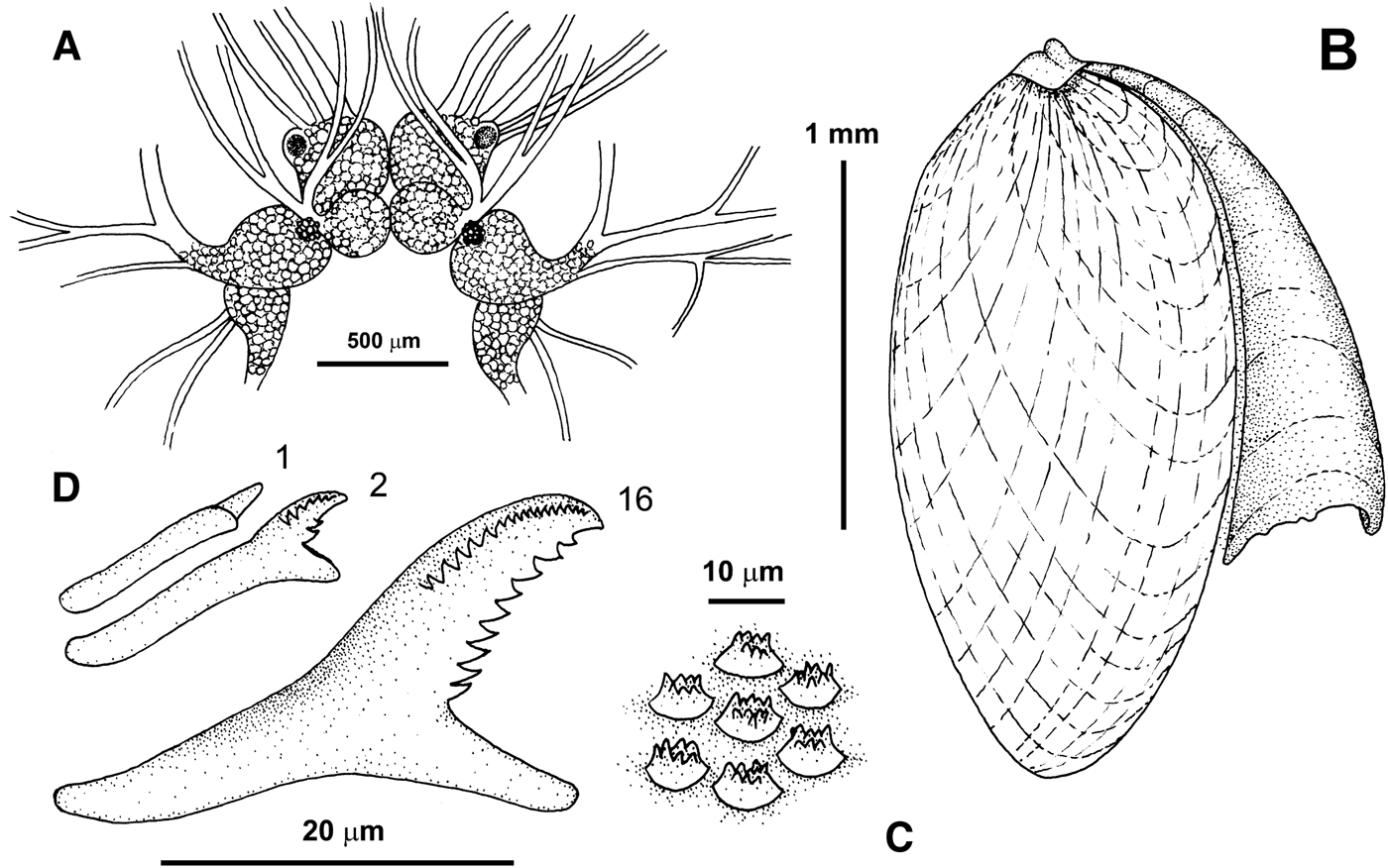
Jaws amber, elongate, oval and 2016 µm long (Figure 2B). Masticatory border expanded like a flap, with hundreds of rounded to polygonal rodlets on its entire surface. Each rodlet conical with a blunt apex which bears several small denticles (Figure 2C).
Notobryon caribbaeus sp. nov., holotype: (A) cerebroid ganglia; (B) jaw; (C) jaw rodlets; (D) radular teeth (1, innermost; 2 and 16, outermost).
Radular formula 14 × 12–20.0.12–20. Radula lacking rachidian teeth. Radular teeth with denticles on both sides of the cusp; less but stronger on the outer side (up to 10) than in the inner (up to 18). Innermost lateral teeth small and usually lacking denticles, growing in size and number of denticles to the outer margin (Figure 2D). The last teeth can be slightly smaller.
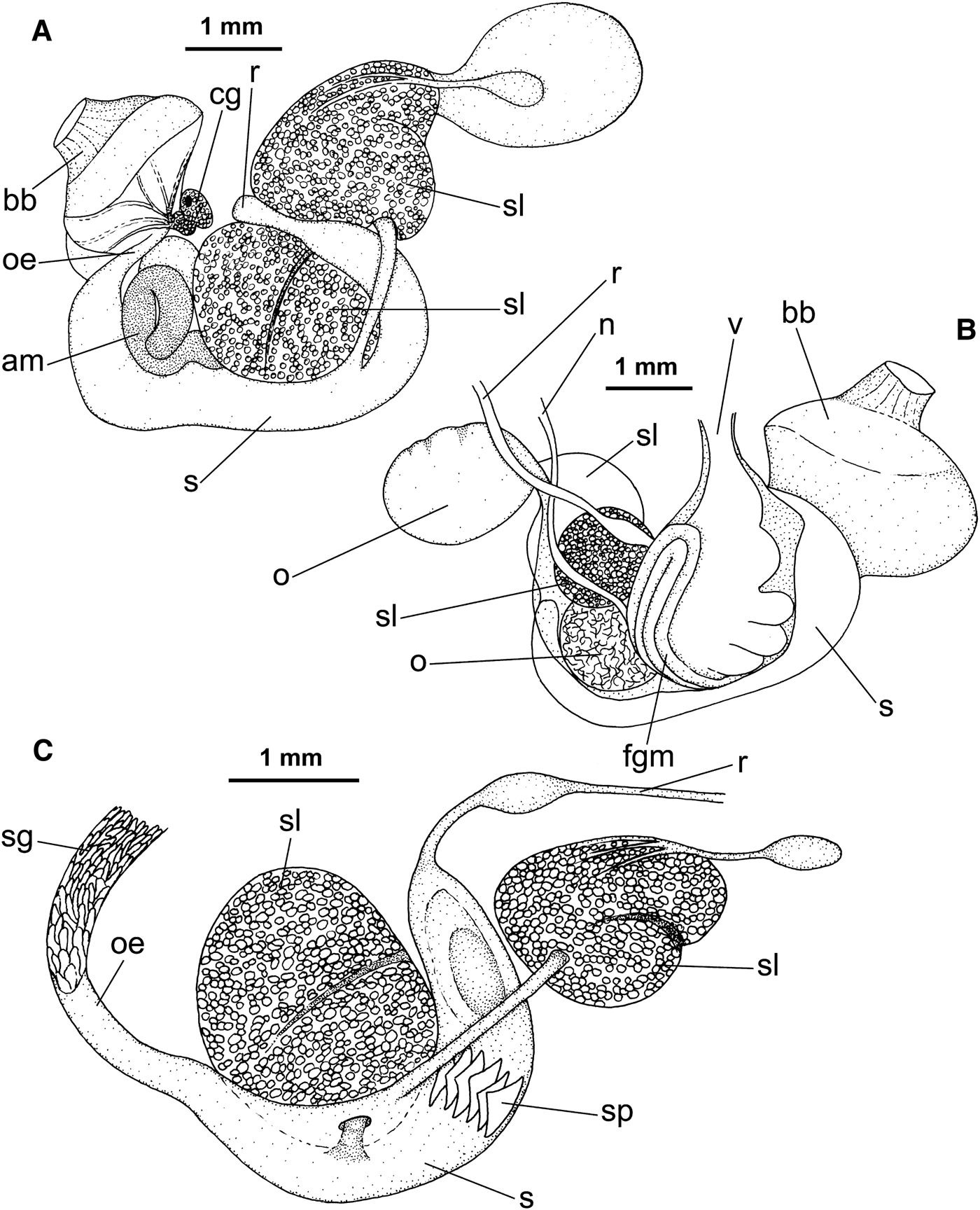
Buccal bulb prominent and very strong, with an angle in the posterior side where the jaws are visible. Cerebroid ganglia (Figure 2A) forming a ring around the digestive duct at the base of the buccal bulb (Figure 3A), composed of 4 principal lobes on each side, with a refringent sphere between the central ones. Eyes small and very simple, emerging from the most dorsal lobes, lacking optic nerve (Figure 2A). Oesophagus long and narrow, at the beginning. Salivary glands longitudinally attached to the oesophagus, surrounding it. Stomach long and wide, bearing eight thick triangular plates with a wide base and a sharp apex (like the spines of a rose), arranged in a transversal ring, completely coating the inner side of the tube (Figure 3C: only six plates figured for practical reasons). Digestive gland composed of two distinct lobes, the small one connected with the stomach by a long conduct and bearing an accessory gland (Figure 3C).
Notobryon caribbaeus sp. nov., holotype: (A) scheme of the internal anatomy, left side of the body; (B) scheme of the internal anatomy, right side of the body; (C) digestive system, left side of the body.
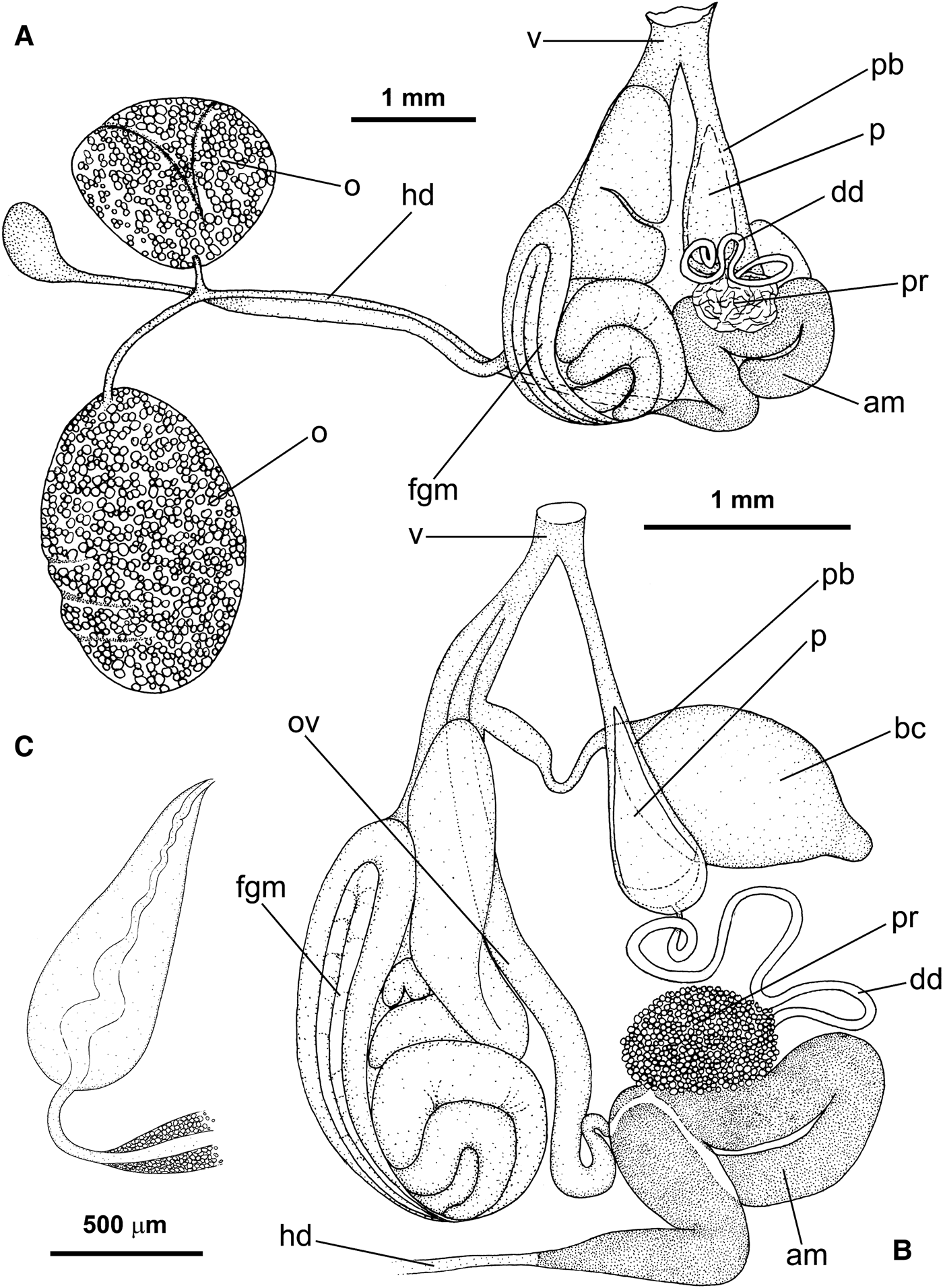
Ovotestis composed of two gonads; one almost oval and big and the other more rounded and half as big (Figures 3B and 4A). Both united by a very thin duct connected to the hermaphroditic duct. Ampulla very wide, convoluted, black and branched in the deferent duct and the oviduct (Figure 4B). Oviduct straight, long and wide, connected to the apical side of the female gland mass. The deferent duct, at the beginning, goes through a sponge-like, granulose and well-differentiated prostate, composed of hundreds of small rounded glands (Figure 4B). After the prostate the deferent duct is a pearl-white colour, long, thin, convoluted and very strong duct that narrows abruptly to end in the penial duct. Penial duct pear-shaped, containing the penis. Penis large, unarmed, conical and smooth, with a narrow apex (Figure 4C). Vagina elongate and narrow with a very big lemon-shaped bursa copulatrix.
Notobryon caribbaeus sp. nov., holotype: (A) reproductive system with the ovotestis; (B) detail of the reproductive system; (C) penis.
ETYMOLOGY
This species is named to honour the sea in which it inhabits, the Caribbean, and also to honour the people who lives on its coasts.
HABITAT
Found on seagrass meadow of Halophila stipulacea. Very rare, only one specimen captured after an intensive expedition.
DISTRIBUTION
Guadeloupe.
DISCUSSION
The genital system with a granulose prostate, well differentiated and distinct from the deferent duct, relates Notobryon caribbaeus sp. nov. with Notobryon bijecurum and separates it from all the other described congeners, in which the prostate is only a thickening in the deferent duct (Pola et al., Reference Pola, Camacho-Garcia and Gosliner2012: figure 5).
Notobryon caribbaeus sp. nov., is distinguished from N. bijecurum by the much longer and convoluted deferent duct and by the presence of a big, lemon-shaped bursa copulatrix (absent in N. bijerecum), a black ampulla and two big gonads in the ovotestis instead of two groups of four and five, among other characters. Regarding the external morphology, the anterior lobes of the dorsum of N. bijecurum are much bigger and the posterior ones much smaller, than these in N. caribbaeus sp. nov., additionally, the tail in the first species is sharp whilst in the latter is blunt.
Supported by the molecular evidence, Pola et al. (Reference Pola, Camacho-Garcia and Gosliner2012) infer that there are ‘morphological differences amongst closely related species’ of Notobryon, useful to distinguish them, ‘especially in the structure of the male genital system’. Based on their conclusions, the presence of a granulose, complex and well-differentiated prostate in N. bijerecum and N. caribbaeus sp. nov. seems to be an informative synapomorphy. The possibility of developing this complex organ twice independently in the evolution of the genus is apparently less parsimonious. That would suggest that both taxa could share a common ancestor and represent a distinct evolutive lineage in the genus, with a disrupted distribution that we cannot explain. Given that the molecular phylogeny of Notobryon conducted by Pola et al. (Reference Pola, Camacho-Garcia and Gosliner2012) included only three of the five species known for that time, a future phylogenetic and biogeographical approach including all the species of the clade would be desirable.
Notobryon panamica was described in base to samples from Mexico, Costa Rica and Panama. Astonishingly, all the records for Notobryon cf. wardi in the Caribbean (Valdés et al., Reference Valdés, Hamann, Behrens and DuPont2006: possibly undescribed and/or more than one species), were considered to belong to N. panamica by Pola et al. (Reference Pola, Camacho-Garcia and Gosliner2012), in the absence of samples for molecular or anatomical studies to support this statement. The external morphology of N. caribbaeus sp. nov., but fundamentally the anatomy of the genital system clearly distinguish it from N. panamica, which is confined to the eastern Pacific. The presence of two different species, one in the Caribbean and other in the Pacific is consistent with the idea that ‘eastern Pacific, Indo-Pacific, and temperate biotas consist largely of distinct faunas’ (Pola et al., Reference Pola, Camacho-Garcia and Gosliner2012).
Two specimens from St Lucia and St Vincent whose external anatomy is quite similar to that of N. caribbaeus sp. nov. have been illustrated by Valdés et al. (Reference Valdés, Hamann, Behrens and DuPont2006: 232) under the name Notobryon cf. wardi. These authors include Honduras, St Lucia, Virgin Islands and St Vincent & the Grenadines in the distribution of the latter. However, the illustration from the Virgin Islands possibly corresponds to a different species, as Valdés et al. (Reference Valdés, Hamann, Behrens and DuPont2006) remark; thus, the distribution of Notobryon in the Caribbean is in need of revision.
With the record of N. caribbaeus sp. nov. in Guadeloupe, the number of sea slugs in the archipelago raises to 150, 10 of them recently described (Ortea et al., Reference Ortea, Espinosa, Caballer and Buske2012, Reference Ortea, Espinosa, Buske and Caballer2013).
ACKNOWLEDGEMENTS
The material was collected in Guadeloupe in May 2012 during the ‘Karubenthos’ expedition (Principal Investigator: Philippe Bouchet), organized jointly by the National Park of Guadeloupe, Muséum National d'Histoire Naturelle (MNHN), Université des Antilles et de la Guyane (UAG), and Université Pierre et Marie Curie (UPMC). We are also indebted to Hervé Magnin, Olivier Gros, to all the other participants of the expedition and to Charles Muñoz for his support.
FINANCIAL SUPPORT
‘Karubenthos’ was carried out with funding from Fonds Européen de Développement Régional (FEDER) and Port Autonome de la Guadeloupe.