INTRODUCTION
Patients with anxiety disorders display an attentional bias for concern-related material that is perhaps largest and best documented in post-traumatic stress disorder as well as specific phobias. The available evidence suggests (for reviews, see Mathews & MacLeod, Reference Mathews and MacLeod2005; Williams et al., Reference Williams, Mathews and MacLeod1996) that, for example, spider-phobic individuals need longer duration to name the color of a Stroop stimulus carrying concern-related information (e.g., the word “web” or “spider” written in blue) relative to a neutral word (e.g., the word “desk”). The mechanism behind this effect is subject to an ongoing scientific debate, and two main theoretical explanations have been put forward. First, anxiety patients may have problems to disengage from the distractor (Georgiou et al., Reference Georgiou, Bleakley, Hayward, Russo, Dutton, Eltiti and Fox2005). Second, a lowered perceptual threshold or hypervigilance for concern-related material may cause a dysfunctional processing advantage for the distractor, thus delaying the response to the target (Kolassa et al., Reference Kolassa, Buchmann, Lauche, Kolassa, Partchev, Miltner and Musial2007; Wieser et al., in press). In other words, it is unclear whether a spider-phobic patient spots spiders more easily or whether the subject, once he/she has spotted the spider, is petrified and not able to redirect attention to other things. The latter process could be willed (e.g., urge to keep track of the spider in order to, for example, kill it or prevent that it hides) or beyond mental control.Footnote a
An attentional bias has not been found for all patients subsumed under the umbrella term “anxiety disorders.” In particular, there are inconsistent reports on obsessive–compulsive disorder (OCD). OCD is a severe psychiatric illness characterized by intense worries and intrusions (so-called obsessions, for example, that someone could break into the house) frequently resulting in compulsions (e.g., excessive checking that the door is properly locked). Both cognitive (Olley et al., Reference Olley, Malhi and Sachdev2007) and anatomical (Rotge et al., Reference Rotge, Guehl, Dilharreguy, Tignol, Bioulac, Allard and Aouizerate2009) hypotheses, the latter especially highlighting the orbitofrontal and subcortical regions, have been put forward to explain OCD symptoms. Whereas some studies have confirmed greater interference for emotional material in OCD (Foa et al., Reference Foa, Ilai, McCarthy, Shoyer and Murdock1993; Lavy et al., Reference Lavy, van Oppen and van den Hout1994; Novara & Sanavio, Reference Novara and Sanavio2001), others failed to find processing differences (Kyrios & Iob, Reference Kyrios and Iob1998; McNally et al., Reference McNally, Amir, Louro, Lukach, Rieman and Calamari1994, Reference McNally, Rieman, Louro, Lukach and Kim1992; McNeil et al., Reference McNeil, Tucker, Miranda, Lewin and Nordgren1999; Moritz et al., Reference Moritz, Fischer, Hottenrott, Kellner, Fricke, Randjbar and Jelinek2008, Reference Moritz, Jacobsen, Kloss, Fricke, Rufer and Hand2004). As OCD is considered by many researchers a misfit/outlier in the anxiety disorder category (e.g., obsessions often evoke concern, tension, or disgust rather than fear), the absence of an attentional bias has sometimes been taken as further evidence for a segregation of OCD from other anxiety disorders (Summerfeldt & Endler, Reference Summerfeldt and Endler1998).
Before dismissing the existence of an emotional bias in OCD, several moderators need to be thoroughly taken into account that may have plagued prior studies. For example, some studies on OCD employed general anxiety stimuli instead of stimuli relevant to the disorder. Besides, the idiosyncratic nature of many OCD beliefs makes it harder to delineate stimuli that are relevant for the majority, even for members of the same subtype, than in other anxiety disorders. Unlike spider-phobic individuals who, as a group, are drawn and distracted by similar stimuli, some washers may be concerned only for items such as “HIV,” whereas others are solely distracted by words like “asbestos” or “bacteria.” In addition, there are some patients who, for example, clean because something “does not feel right” (Coles et al., Reference Coles, Heimberg, Frost and Steketee2005) and at times provide secondary explanations (i.e., fear of infection) so that the disturbance may appear excessive but not entirely irrational. For these patients, it is often difficult to unveil specific triggers. Thus, an attentional bias in OCD might not have been detected because the adopted material was not optimally tailored to the personal concerns of the subjects. In addition, the possibility has to be considered that verbal material is not sufficiently attention-grabbing compared to pictures (Moritz et al., Reference Moritz, Fischer, Hottenrott, Kellner, Fricke, Randjbar and Jelinek2008).
Several recent studies have adopted the emotional inhibition of return (IOR) paradigm (Amir et al., Reference Amir, Elias, Klumpp and Przeworski2003; Fox et al., Reference Fox, Russo, Bowles and Dutton2001) which according to Amir et al. (Reference Amir, Elias, Klumpp and Przeworski2003) allows to fractionate attentional processes involved in emotion processing. Unlike in the original paradigm, developed by Posner and Cohen (Reference Posner, Cohen, Bouma and Bouwhuis1984), which utilizes simple luminance cues (e.g., the short brightening of a box outline), participants in the present study were presented picture cues (e.g., the picture of a broken door or a shark). The signature of a hypervigilance toward certain classes of stimuli is a facilitated response to spatially congruent cue–target pairs (valid trials). This process is assumed to be automatic which according to the cognitive literature (Neely, Reference Neely, Besner and Humphreys1991) is best tapped via short cue–target intervals (i.e., stimulus onset asynchrony of less than 500 ms). In contrast, the signature of a failure to disengage from certain stimuli is a delayed response to spatially incongruent cue–target pairs (invalid trials). Disengagement is assumed to be a process governed by controlled willed process, which is best tapped by longer cue–target intervals as disengagement needs time to establish.
In a recent attempt to establish such an effect (Moritz & von Mühlenen, Reference Moritz and von Mühlenen2008), we failed to detect any group differences for checking-relevant words in the emotional IOR paradigm. While the findings are suggestive of an absence for emotional biases in OCD, we were reluctant to draw firm conclusions before ruling out other factors. As stated earlier, verbal material may not be sufficiently attention-grabbing relative to pictures (Moritz et al., Reference Moritz, Fischer, Hottenrott, Kellner, Fricke, Randjbar and Jelinek2008). In addition, the cue stimuli in our study were presented only for a short duration and might not have been adequately identified by the subjects. Finally, subjective valence of the stimulus material was not determined.
The present study built on the framework of the emotional IOR task and addressed some limitations of the forerunner studies using this paradigm (e.g. Moritz et al., Reference Moritz, Fischer, Hottenrott, Kellner, Fricke, Randjbar and Jelinek2008). We employed visual material presented for a longer duration than in the previous study to assure that the material was properly perceived and processed. Finally, valence of each stimulus was individually determined. We predicted an attentional bias in OCD that would be most pronounced for items with high negative valence and particularly for items corresponding to the particular OCD subtype.
MATERIALS AND METHODS
Participants
Forty-two participants meeting Diagnostic and Statistical Manual, 4th Edition (DSM-IV) criteria for OCD took part in the study. Diagnoses were verified with the Mini International Neuropsychiatric Interview (MINI; Sheehan et al., Reference Sheehan, Lecrubier, Sheehan, Amorim, Janavs, Weiller, Hergueta, Baker and Dunbar1998). In- and outpatients from the Cognitive-Behavioral Unit of the University Medical Center of Hamburg who were consecutively admitted took part in the study (16 males, 26 females; age: M = 37.05 years, SD = 12.50 years; years of education: M = 11.02, SD = 2.11; number of previous hospitalizations: M = 2.29, SD = 1.44). The healthy control group consisted of 31 participants (10 males, 21 females; age: M = 34.19, SD = 9.24; years of education: M = 11.61, SD = 1.58) drawn from an established subject pool at the University Medical Center of Hamburg.
Medical records of patients were carefully screened for symptoms incompatible with a diagnosis of OCD (e.g., delusions, hallucinations, manic symptoms). None of the participants revealed a history of comorbid drug/substance dependence, substantial brain injury (e.g., stroke, multiple sclerosis, head trauma, previous brain operations) including OCD spectrum disorders (e.g., Tourette’s syndrome), or current or previous psychosis. To quantify the degree of OCD symptomatology, the Yale–Brown Obsessive–Compulsive Scale (Y-BOCS; Goodman et al., Reference Goodman, Rasmussen, Price, Mazure, Heninger and Charney1991; German translation by Hand & Büttner-Westphal, Reference Hand and Büttner-Westphal1991) was administered (M = 25.84, SD = 6.49). The severity of depressive symptomatology (M = 12.74, SD = 7.68) was determined with the Hamilton Depression Rating Scale (Hamilton, Reference Hamilton1960). Eighteen patients (43%) fulfilled criteria for major depression. Eleven patients were unmedicated, 15 patients were on antidepressant agents, and 1 patient received a neuroleptic agent.
OCD subtypes, particularly for checking and washing, were determined via the Y-BOCS checklist (Hand & Büttner-Westphal, Reference Hand and Büttner-Westphal1991). Twenty-three were washers (sole washers: 8), 15 patients were checkers (sole checkers: 3), 4 had order compulsions (sole order: 1), and 3 showed hoarding compulsions (sole hoarding: 0).
Healthy participants were all screened for major psychopathological syndromes or substance dependence with the MINI which would have led to exclusion. All participants gave written informed consent to participate after they had been fully informed about the study. Data included in this manuscript were obtained in compliance with the Helsinki Declaration.
Apparatus and Stimuli
Stimuli were presented on an Apple Macintosh Computer with a graphic resolution of 640 × 480. Participants viewed the monitor from a distance of approximately 60 cm. The initial display contained three objects drawn in black (line thickness = 1 pixel, luminance = 0.02 cd/m2) on a white background (72.21 cd/m2): one fixation cross (size 1.2° visual angle) presented at the center of the screen and two peripheral outline boxes (width 7.7°, height 5.5° visual angle), one to the left and the other to the right of the fixation cross. The cue stimulus pictures were presented inside one of the outline boxes. The target dot, a small filled black circle (0.6° visual angle), was presented at the center of one of the two boxes.
Forty stimulus pictures were compiled, representing four groups of affective stimulus classes: 10 neutral pictures (e.g., cup, chair, glass), 10 anxiety-relevant pictures with no relevance for OCD (e.g., shark, spider, bear), 10 OCD checking-relevant pictures (e.g., broken door, fire, police car), and 10 OCD washing-related pictures (e.g., dirty toilet, soap, mold). Most of the neutral and anxiety-relevant pictures and some of the OCD-relevant pictures were taken from the International Affective Picture System (Lang et al., Reference Lang, Bradley and Cuthbert1999). Other neutral and anxiety-relevant stimuli were derived from a study on attentional biases in schizophrenia (Moritz & Laudan, Reference Moritz and Laudan2007). A third group of pictures was obtained from the internet using Google Image Search. The final set of pictures was chosen by consensus rating among 10 clinical experts (clinical psychologists and psychiatrists) to reflect typical OCD themes. Furthermore, pictures that were ambiguous or hard to identify at first glance were replaced in order to ensure that all objects could easily be identified at a presentation rate of 400 ms.
Procedure and Design
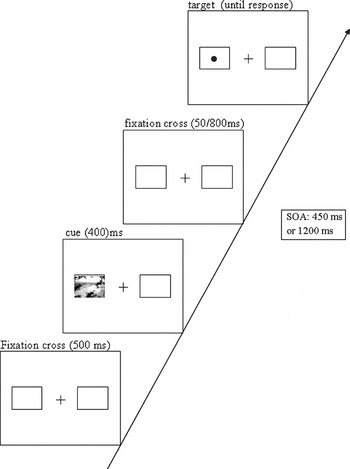
The sequence of trial events is presented in Figure 1. Throughout the trial, a fixation cross was presented in the center of the display together with two peripheral boxes, one to the left and one to the right of the fixation cross. Each trial was initiated by the participant, and 500 ms later, a cue picture was presented in one of the two peripheral boxes with equal probability. Participants were instructed to attend but not to respond to the cue picture. After 400 ms, the cue picture was removed and followed by a gap of either 50 or 800 ms before the target dot appeared at the center of one of the two boxes. Thus, the interval between the onset of the cue and the onset of the target was either 450 (sensitive to automatic processing) or 1200 ms (more sensitive to willed processes that need time to establish). Subjects were requested to press either the left or the right key (key locations corresponding to a “z” or an “m” on an American keyboard) that spatially matched the location of the target as soon as they spotted the target. After the response, the monitor turned gray for 1000 ms, and the next trial was automatically initiated. In 7% of all trials, no target was presented (catch trials) and participants were instructed to refrain from pressing any key for a duration of 1500 ms.
An example for a trial sequence (SOA = stimulus onset asynchrony).

In total, the experiment had 354 trials, including 10 practice trials, 320 experimental trials, and 24 catch trials. The experiment had three within-subject factors: picture type (neutral, anxiety-relevant, OCD washing-relevant, OCD checking-relevant), interval (short, long), and cue validity (valid, invalid). Throughout the experiment, each picture was repeated eight times. The main dependent variables were reaction time (RT) and percentage error. RTs smaller than 300 ms or larger than 4000 ms were counted as errors. After finishing the experimental trials, each cue picture was presented on its own, and participants were asked to rate its subjective valence (i.e., participants were told that their individual valence had to be judged irrespective of other people’s appraisal) on a five-point scale ranging from 1 (very negative) to 5 (very positive; 3 was neutral).
RESULTS
Background Characteristics
The two samples did not significantly differ on sociodemographic background variables (p > .2; see Methods section for descriptive statistics). The data of one OCD participant had to be removed from the analysis because she refused to complete the valence ratings at the end of the experiment.
Errors
Overall, participants committed very few errors (i.e., RTs <200 or >4000 ms; wrong key press on target trials), and there was little difference between healthy control participants and OCD participants (0.61% vs. 0.93%, respectively). A four-way repeated-measure analysis of variance (ANOVA) on the errors with the main variables Picture Type (neutral, anxiety-relevant, washing-relevant, checking-relevant), Interval (short, long), and Cue Validity (valid, invalid) as within-subject factors and Group (OCD, healthy) as between-subjects factor revealed no significant effects involving Group as a factor (all p > .1). It is therefore unlikely that the RT data were distorted by a speed–accuracy trading relationship. Catch trials were not analyzed.
Reaction Time
Correct target trials were used to calculate mean RTs for each participant and condition. Target RTs were then submitted to a four-way mixed ANOVA with Picture Type (neutral, anxiety-relevant, washing-relevant, checking-relevant), Interval (short, long), and Cue Validity (valid, invalid) as within-subject factors and Group (OCD, healthy) as between-subjects factor.
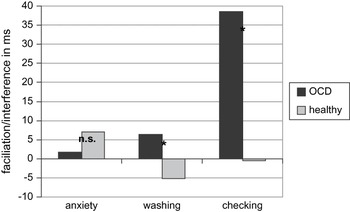
All main effects, Picture Type, F(1,210) = 3.44, p = .02; Interval, F(1,70) = 75.91, p < .001; Cue Validity, F(1,70) = 25.35, p < .001; and Group, F(1,70) = 5.58, p = .02, reached significance: Checking-relevant pictures relative to all other pictures, short relative to long intervals, and valid relative to invalid cues were all associated with slower RTs. Moreover, OCD patients had overall slower response times compared to healthy controls. Furthermore, the interaction between Group and Picture Type was significant, F(3,210) = 3.39, p = .02. Post hoc comparisons revealed that this interaction reflected slower baseline-corrected RTs in patients relative to controls for targets following washing-relevant, t(70) = 2.11, p = .04, and checking-relevant, t(70) = 2.10, p = .04, cues (i.e., we calculated the difference between RTs in the two OCD conditions from the mean RT in the two non-OCD cue conditions). No differences emerged for OCD-unrelated anxiety pictures, t(70) = 1.22, p > .2 (Figure 2). Other higher order interactions involving group failed to reach significance.
Means RT difference in milliseconds between RTs in the two OCD conditions from the mean RT in the two non-OCD cue conditions, averaged across stimulus onset asynchrony and cue validity. Relative to controls, OCD patients showed significantly slowed responses to targets following washing- and checking-relevant cues. No differences emerged for OCD-unrelated anxiety pictures. *p < .05.

When the OCD sample was split according to presence of washing and checking compulsions using the Y-BOCS checklist (see Methods section), differences remained essentially unchanged (i.e., significant group differences, p < .05, for both washing and checking items relative to control items).
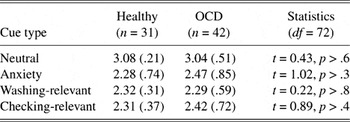
Table 1 presents the subjective valence ratings for the anxiety- and OCD-relevant cue pictures. As can be seen, the two groups of pictures received comparable ratings. A two-way ANOVA with Group as between-subject factor, Picture Type as within-subject factor, and Valence Rating as dependent variable yielded a significant effect of Picture Type, F(3,213) = 45.12, p < .001. Simple paired t tests revealed that neutral cue pictures received significantly higher ratings (i.e., more toward very positive ratings) than cues from all other classes (all p < .001), which in turn did not differ significantly from each other (all p > .2).
Valence ratings across conditions (1 = very negative, 3 = neutral, 5 = very positive)

DISCUSSION
The present study was concerned with cognitive biases involved in the processing of emotional material in OCD. Cognitive and psychophysiological studies have consistently suggested that stimuli with fear-inducing properties have a processing advantage over nonfearful stimuli such as flowers (Lipp & Derakshan, Reference Lipp and Derakshan2005), particularly those depicting items of evolutionary relevance (e.g., snakes). Concurrently, several anxiety disorders are thought to share an exaggeration of this bias (Mathews & MacLeod, Reference Mathews and MacLeod2005; Williams et al., Reference Williams, Mathews and MacLeod1996). The question whether or not this bias manifests in OCD, and if so, whether it is governed by abnormalities of hypervigilance (as indicated by facilitation for valid trials, particularly at short cue–target intervals) or dysfunctional disengagement (as indicated by slowed responses for invalid trials, particularly at long cue–target intervals), was addressed in this study. To meet this purpose, we set up a new task based on the emotional IOR paradigm (Amir et al., Reference Amir, Elias, Klumpp and Przeworski2003; Fox et al., Reference Fox, Russo, Bowles and Dutton2001): First, visual instead of verbal material was used as visual material might be more attention-grabbing (Moritz et al., Reference Moritz, Fischer, Hottenrott, Kellner, Fricke, Randjbar and Jelinek2008). Second, as OCD concerns are more idiosyncratic than fears in other anxiety disorders, we compiled OCD-relevant pictures according to expert consensus and determined subjective appraisals. Third, unlike in the forerunner study, we compiled items relevant for the two most prevalent subtypes (i.e., checking and washing).
We found that patients with OCD, irrespective of subtype, responded slower to OCD-relevant material than healthy controls. As this effect did not interact with interval and validity (i.e., spatially cued and uncued targets), we are left to conclude that OCD patients are generally more distracted by such pictures than healthy controls resulting in enhanced latencies for the primary task (target detection at one of two locations). Interestingly, this bias occurred despite comparable valence ratings for all classes of stimuli. Surprisingly, OCD patients did not rate OCD-relevant items as more negative than control subjects perhaps owing to item choice, which may have elicited disgust (e.g., dirty toilet) or fear (e.g., broken door) even in healthy subjects. Concern-related items with less obvious negative content (e.g., a picture of an intact door/window instead of a broken door/window) may be more sensitive to group differences. Alternatively, as all pictures were presented several times, habituation may have occurred at the time of appraisal.
In line with our previous studies (Moritz & von Mühlenen, Reference Moritz and von Mühlenen2005, Reference Moritz and von Mühlenen2008), no group differences were found on the IOR effect. Both groups displayed facilitation for uncued (invalid) locations at the long interval. Thus, OCD patients do not show a deviant response pattern on this aspect of inhibitory functioning.
Enhanced attention devoted to fear-related objects may impact on the maintenance of OCD as concern-related stimuli in the environment receive more weight than other stimuli. Based on the current findings and drawing upon Anderson’s (Reference Anderson1974) fan effect (i.e., semantic associations compete for associative strength: creating new associations to a cognition or strengthening existing ones decreases the strength of other associations), we have recently developed a new treatment method entitled “association splitting” aimed to decrease the undue attentional focus toward concern-related cognitions in OCD patients (Moritz & Jelinek, Reference Moritz and Jelinek2007). Patients are instructed to generate meaningful but concern-irrelevant neutral or positive associations to core OCD cognitions (e.g., words like cancer or accident, numbers like 13 and 666, visions of catastrophes). For example, in a patient with obsessive fears that his mother could die of cancer if certain rituals are not performed, the associations of cancer with astrology and an animal should be selectively strengthened. According to the fan effect, this process automatically weakens the association cancer–illness. It is hoped that priming alternative concepts dilutes some of the associative strength of core OCD cognitions with corresponding concerns and urges. A pilot study with 38 patients has gathered promising results (Moritz et al., Reference Moritz, Jelinek, Klinge and Naber2007). Depending on the outcome criterion, 33%–42% of the patients reported a symptom decline of more than 35%. In our view, the results are a stimulating example how basic research on the cognitive underpinnings of OCD may translate into treatment approaches.
Some limitations should be brought to the readers’ attention. For example, our argument could have been strengthened if we have compared visual versus verbal material. However, this would have considerably lengthened the experiment. Furthermore, we only assessed valence but not salience (e.g., personal meaningfulness) and arousal. Finally, more subtle OCD-relevant stimuli may best discriminate between OCD versus control participants. Some of the pictures have likely raised disgust and worry also in healthy participants.
To conclude, the study found evidence for an attentional bias in OCD patients for concern-related material, which is evident at both early and late stages of processing. Effects may be stronger when using more subtle material that will elicit negative responses only in patients.
ACKNOWLEDGMENT
This study was conducted with the support of the University Medical Center of Hamburg who awarded the first author a young scientist award. No other financial support was received.