Introduction
The law titled No Child Left Behind (NCLB), passed by U.S. Congress in 2001, offers a striking instance of high-stakes educational testing functioning as de facto language policy. Although NCLB is an education policy meant for all students attending government-supported schools in the United States, one of its many consequences is that it has generated numerous language policy by-products in schools, particularly due to its high-stakes testing requirements.Footnote 1 This article describes how NCLB is shaping language policies in educational contexts, and the overall effects it is having on English language learners (or ELLs, the term currently used in the United States to describe language minority students receiving language support services in school as they acquire English).
After a background description of the law's assessment mandates, the article is organized thematically. Although the law is relatively recent, a considerable body of research has been published about it, in large part due to the controversies surrounding its testing requirements. Much research from a psychometric perspective has been focused on the complications of NCLB's testing requirements for ELLs, especially the limitations of the tests as instruments to carry out the law's demands. There has also been some research from a language policy perspective analyzing the wording of NCLB and the law's implications. Far less research has explored the ways that the law actually affects instruction and the educational experiences of ELLs within schools, with explicit attention paid to language policy.
Background: NCLB Testing Mandates
No Child Left Behind is the most recent reauthorization of the Elementary and Secondary Education Act (ESEA), the main federal law funding public education in the United States. The ESEA was first enacted in 1965 as part of President Lyndon Johnson's “War on Poverty” to ensure funding for poor children, and it has been reauthorized eight times since then. Recent reauthorizations of the ESEA have increasingly focused on accountability, with the goal of offering policymakers and politicians proof that federal investments in education yield measurable results in terms of student achievement. This demand for accountability was galvanized by the National Commission on Excellence in Education's publication of A Nation at Risk in 1983, which reaffirmed public suspicions that schools are failing, by documenting the overall poor quality of teaching and learning in U.S. schools.
High-stakes testing is the core of NCLB, as tests are used to hold each school, district, and state accountable for student performance, therein affording the federal government greater control over the constitutionally decentralized national system of U.S. education. Though each state has the freedom to develop its own assessment system, the law specifies testing in both English and mathematics and requires that ELLs be included in the same statewide testing procedure that is administered to native-English speakers. Under NCLB, each school must meet “adequate yearly progress” (AYP) goals for student performance, using a complex formula determined by the state; if a school fails to achieve these goals, either because students fail the tests or do not progress in the ways required, then the school faces sanctions such as loss of federal funding or closure.
ELLs must therefore take and pass tests administered in English. Not only must they participate in tests of English language proficiency to prove they are progressing in their acquisition of English, but they must also take the same tests of academic content as native-English speakers. Since a federal memorandum in 2007, the academic content requirement of NCLB has meant that ELLs must also pass the same state tests of English language arts as those taken by native-English speakers. To ensure that ELLs are included in all of NCLB's assessment requirements, the law mandates a 95% participation rate and calls for all students in U.S. schools to achieve a level of “proficient” on state tests by the year 2014.
Analyses of the Wording of NCLB
Several scholars have in recent years drawn a direct connection between No Child Left Behind and language policy by comparing NCLB to previous education policy for ELLs in the United States, as well as by analyzing the law's wording. Many authors have noted that NCLB terminated Title VII, the Bilingual Education Act, which had been part of the ESEA since 1968, and that the word bilingual has now been entirely expunged from the legislation (Crawford, Reference Crawford2002, Reference Crawford2004; Evans & Hornberger, Reference Evans and Hornberger2005; Gándara & Baca, Reference Gándara and Baca2008; González, Reference González2002; Johnson, Reference Johnson2007; Menken, Reference Menken2008a; Wiley & Wright, Reference Wiley and Wright2004). Passed in the midst of the civil rights movement, the Bilingual Education Act was very significant for ELLs in the United States because it acknowledged that language can be a source of educational inequity when students are unable to access the curriculum. The act sought to address the challenges that ELLs face in school by funding programs such as bilingual education and English as a second language (ESL), and thereby provided federal support for the development and expansion of numerous bilingual programs nationwide (González, Reference González2002; Menken, Reference Menken2008). Moreover, the Bilingual Education Act acknowledged bilingual education as a viable approach (National Clearinghouse for English Language Acquisition, 2006).
Researchers have observed the change in the federal approach to language, with a focus only on English acquisition in No Child Left Behind. For example, Olneck (Reference Olneck2005) noted that the Bilingual Education Act was replaced with what is now called Title III of NCLB: the English Language Acquisition, Language Enhancement, and Academic Achievement Act. Similarly, González (Reference González2002) pointed out that the Office of Bilingual Education and Minority Language Affairs of the U.S. Department of Education was renamed the Office of English Language Acquisition, Language Enhancement, and Academic Achievement for Limited English Proficient Students.
Evans and Hornberger (Reference Evans and Hornberger2005) showed that although federally funded programming varied in the degree of use of children's native languages in instruction, the various reauthorizations of the law from 1968 until the passage of NCLB in 2001 always allowed space for bilingual education programming. Building on Ruiz (Reference Ruiz1984), they described the recent shift in orientation:
Title VII has suggested, at various times, a language as resource orientation and possibly a language as right orientation. The title, the Bilingual Education Act, indicated a role for a child's native language in developing English language proficiency and achieving academic success.. . . The discourse of Title III, however, reflects a language as problem orientation and certainly provides little or no evidence of either a language as resource or a language as right orientation. . . [T]his U.S. policy shift away from a view of multilingualism as resource and toward the imposition of monolingual English-only instruction in U.S. schools occurs in a global context in which both multilingualism and multilingual language policies are as much in evidence as they ever were. (Evans & Hornberger, Reference Evans and Hornberger2005, pp. 91–92)
Citing the text of NCLB, these authors argued that the legislation promulgates English-only policy within educational contexts. Crawford (Reference Crawford2002) drew similar conclusions:
Under No Child Left Behind, federal funds will continue to support the education of English language learners (ELLs). But the money will be spent in new ways, supporting programs likely to be quite different from those funded under Title VII. One thing is certain: the rapid teaching of English will take precedence at every turn. “Accountability” provisions, such as judging schools by the percentage of ELLs reclassified as fluent in English each year, are expected to discourage the use of native-language instruction. . .. This marks a 180-degree reversal in language policy. Whereas the 1994 version of the Bilingual Education Act included among its goals “developing the English skills . . . and to the extent possible, the native-language skills” of ELLs, the English Language Acquisition Act stresses skills in English only. (p. 1)
Crawford indeed predicted that NCLB will result in a reduction of native-language instruction as schools are pressured to increase the rate at which students acquire English.
Wiley and Wright (Reference Wiley and Wright2004) located NCLB within a long history of language used as a vehicle for social control in the United States, reflecting an ideology of English monolingualism. They regard NCLB as one point within a far longer trail of efforts to promote English-only schooling.
The stated purpose of Title III is “to ensure that children who are limited English proficient, including immigrant children and youth, attain English proficiency” (Title III, Sec. 3102). . . . Title III does allow funding for transitional bilingual education programs (without referring to them by name) but not maintenance bilingual programs. Despite the allowances for transitional and dual-immersion programs, the new law is more likely to discourage bilingual education and promote English-only approaches. (Wiley and Wright, Reference Wiley and Wright2004, pp. 155–156)
The focus on English in NCLB, combined with measures built into the law to ensure that ELLs quickly exit language support programs, will clearly have a negative impact on programs that have as their goals the development of bilingualism and biliteracy.
Limitations of the Required Tests for English Language Learners
Most states have implemented the NCLB requirement to measure academic achievement by simply giving ELLs the same set of standardized tests as those already being used to assess native-English speakers. This is typically done by granting ELLs certain test accommodations intended to separate language proficiency from content knowledge, such as extended time, test translations (for subjects other than English), and the use of bilingual dictionaries. There is great variance at the state level with regard to which accommodations, if any, are permitted (Rivera & Collum, Reference Rivera and Collum2006). Only a few states permit accommodations that actually help ELLs on tests administered in English; of the 34 states that permit some type of accommodations, 22 allow nonlinguistic accommodations that may help students feel more comfortable during an exam but do not actually support them linguistically (Stansfield & Rivera, Reference Stansfield, Rivera, Lissitz and Scafer2002). For example, only five states use test translations (Center on Education Policy, 2005). A meta-analysis of research on testing accommodations conducted by Pennock-Roman and Rivera (Reference Pennock-Roman and Rivera2007) found that while some accommodations are more helpful than others, most of those currently being used fail to reduce the achievement gap between native-English speakers and ELLs.
Researchers have highlighted numerous problems with the assessment mandates of NCLB, which require testing ELL students in a language in which they are not yet proficient and using tests that were normed on native-English speakers. Wright and Li (Reference Wright and Li2008) carried out a detailed analysis of math test items currently being used in Texas and showed their linguistic complexity for ELLs. Solórzano (Reference Solórzano2008) reviews over 40 studies on NCLB high-stakes testing of ELLs, noting the following:
ELLs are typically administered achievement tests in the English language after 1 year of language services. The tests are given to ELLs to determine their academic achievement levels and progress. As will be discussed below, these achievement tests were not designed with ELLs in mind. As a result, the validity of inferences from these tests can compromise the educational decisions that educators make based on test results. The student population for which the test is designed and developed is a crucial aspect that eventually affects the integrity of the test, not to mention subsequent decisions based on the results. (Solórzano, Reference Solórzano2008: 282)
The research makes evident that a test given in English to an ELL is not a valid measure of academic content knowledge. The practice of including ELLs in standardized tests normed on a native-English speaking population has raised new issues for it seems that under NCLB the available tests are being used for purposes that extend far beyond what the creators of those tests intended. This practice has been found to be particularly harmful, given the high-stakes consequences attached to a single test score.
Instructional Effects of NCLB
In the discussion of NCLB in their book on the social dimensions of language testing, McNamara and Roever (Reference McNamara and Roever2006, p. 235) described how determining a test's validity necessitates investigating the consequences of test use.
Writers have made a distinction between two sorts of consequence: the effect on the language teaching and learning leading up to the test, which is termed washback . . ., and effects beyond the immediate language learning situation, which is termed impact. (McNamara and Roever, Reference McNamara and Roever2006, p. 235)
Although this section offers research documenting the washback effect of NCLB on classroom instruction, the next section of this article explores the impact of NCLB on ELL students and the schools serving them.
Shohamy (Reference Shohamy2001) argued that testing policy is de facto language policy, particularly when high-stakes decisions are attached to test scores. She recently extended this argument to the case of NCLB:
Two specific cases are often referred to in order to illustrate this phenomenon of the effect of tests on “de facto” language policies. The first is the very policy to introduce language tests in order to measure achievements in schools, a policy that has been adopted by a large number of countries and in many educational systems. One very well known case that has been widely referred to, researched and discussed is that of “No Child Left Behind”. . . . The scores that students and schools obtain in these tests lead to major sanctions and consequences, such as the closing of failing schools, moving students to other schools as well as cutting funds. Thus, the introduction of these tests represent a given testing policy which is problematic by itself, but it is even more problematic when one examines the impact and effect of these tests on people, schools and educational systems. (Shohamy, Reference Shohamy2008, p. 366)
Shohamy (Reference Shohamy2008) explained that assessment for accountability purposes creates a context in which testing is likely to impact language policy in problematic ways.
The reduction of bilingual education programs in U.S. schools since the passage of NCLB provides compelling evidence of the link between testing and language policy. As schools are under tremendous pressure to ensure that ELLs pass tests in English—a language in which they by definition are not yet proficient—many schools respond to this pressure by increasing the amount of English instruction that students receive. As Goldenberg (Reference Goldenberg2008) described, in his comprehensive review of recent research on bilingual education, ELL students in bilingual programs typically will not perform as well as their peers in English-only programs during the first few years of instruction, but with time they will achieve superior educational results. Gándara and Baca (Reference Gándara and Baca2008) contended that testing therefore poses a great threat to bilingual programs within the NCLB context, because students are not immediately able to compete with their peers in English-only programs on tests administered in English. Because NCLB does not permit the time required for bilingual programs to reach fruitful outcomes, many schools respond to testing pressures by eliminating their bilingual education programs and replacing them with ESL programs in which instruction is solely in English.
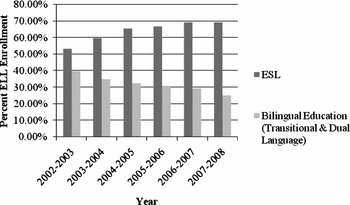
The data from New York City in Menken (Reference Menken2008a, Reference Menken2008b) support this point, which is noteworthy given that the state of New York has historically been supportive of bilingual education. Of 10 New York City high schools studied in depth after the passage of NCLB, Menken (Reference Menken2008a) showed that the schools with bilingual programs typically increased English language instruction as a result of testing mandates. This trend is consistent with citywide data. As Figure 1 indicates, 39.7% of all ELLs in the 2002–2003 school year were enrolled in bilingual education programs, and 53.4% of all ELLs were enrolled in ESL programs. By the 2007–2008 school year, however, just 25.2% of ELLs were in bilingual programs, and 69.2% were in ESL.
Program enrollment of New York City ELLs by school year post-NCLB, 2002–2008 (Source: New York City Department of Education, 2008 as cited in Menken, Reference Menken2008b)

Although the United States does not have reliable national data about the program enrollment of ELLs, Zehler et al. (Reference Zehler, Fleishman, Hopstock, Stephenson, Pendzik and Sapru2003) reported that enrollment of ELLs in bilingual education programs nationally dropped from 37% to 17% over the past decade. Crawford (Reference Crawford2007) attributed this loss of bilingual education programs to the recent passage of anti-bilingual education measures in California, Arizona, and Massachusetts in combination with the accountability mandates of NCLB.
The argument that NCLB is a de facto English-only language policy has ramifications extending beyond bilingual education for immigrant students. For example, Byrnes (Reference Byrnes2005) linked NCLB to a recent decline in foreign language program enrollment in U.S. schools and a corresponding loss of such programs nationally. NCLB does not require that progress in foreign language learning be measured and so discourages the teaching of languages other than English as a by-product of its accountability requirements. This is part of a wider trend since the law's passage, whereby “teaching to the test” is commonplace, and school curricula have narrowed to tested subjects (Nichols & Berliner, Reference Nichols and Berliner2007).
While these findings show the connection between NCLB and English-only instruction, studies conducted inside schools and school districts show that the reality is more complex, reflecting the elaborate structure of schools and educational agencies. Some research highlights the agency of educators in the process of language policy implementation, as teachers and school administrators interpret, negotiate, and at times resist the demands of federal legislation at the local level. For example, rather than eliminating bilingual education, one of the secondary schools in Menken's (Reference Menken2008a) sample chose to increase native language instruction as a test preparation strategy. Likewise, because New York allows test translations for certain subjects, some bilingual teachers were found to use the tests to determine language of instruction, teaching monolingually in either English or the students’ native language, and thus matching the language of teaching and testing. Research by Palmer and Lynch (Reference Palmer and Lynch2008) in Texas, another state where test translations are used, supports this finding; they showed how bilingual teachers at the elementary level teach in the language in which their students are tested. As Menken (Reference Menken2008a) wrote, “the perspective on language education policy that is proposed here accounts for the reality that there are language policymakers at every layer of the education system” (p. 172).
Johnson (Reference Johnson2007) and Hornberger and Johnson (Reference Hornberger and Johnson2007) offered further evidence of the negotiation of top-down language policy, and showed how spaces for multilingual instruction can still be created in the NCLB era. Ethnographic research by Johnson (Reference Johnson2007) in the School District of Philadelphia found that practitioners at the local level interpret policy in differing ways, according to their own ideologies, and produce language policies accordingly. For example, while one district administrator was found to interpret NCLB in ways that support the implementation of developmental bilingual programs, another interpreted it by promoting transitional bilingual programs instead; although both are de facto language policymakers, their views shape their understandings of how to put the law into practice, thus resulting in quite different language policies (Hornberger & Johnson, Reference Hornberger and Johnson2007; Johnson, Reference Johnson2007). In effect, educators charged with implementing NCLB are de facto language policymakers who can still “carve out ideological and implementational spaces” for multilingual education (Chick, 2001, as cited in Hornberger & Johnson, Reference Hornberger and Johnson2007).
Effects of NCLB on ELL Students and Schools
To understand NCLB as de facto language policy, it is necessary to turn to empirical investigations of the effects of this law on those whose lives are most directly impacted, the ELL students themselves. Testing has become a high-stakes phenomenon for all U.S. students, including immigrants in the process of learning English, resulting from test-based education reforms stimulated by NCLB. A single standardized test score is now used in many states not only to evaluate schools and school districts, but also to determine grade promotion, high school graduation, and placement into tracked programs for individual students (Heubert & Hauser, Reference Heubert and Hauser1999). Researchers are in general agreement that tests administered in English are actually tests of English proficiency as well as content knowledge; the scores ELL students receive will be influenced by their levels of language proficiency (Gándara & Baca, Reference Gándara and Baca2008; Menken, Reference Menken2008a; Wright & Li, Reference Wright and Li2008; Solórzano, Reference Solórzano2008). In a comprehensive review of research on high-stakes testing for the National Research Council, Heubert and Hauser (Reference Heubert and Hauser1999) found:
If a student is not proficient in the language of the test, her performance is likely to be affected by construct-irrelevant variance—that is, her test score is likely to underestimate her knowledge of the subject being tested. (p. 225)
National studies reveal that ELL students perform anywhere from 20 to 50 percentage points below native-English speakers on statewide assessments—on tests of English language arts as well as other subjects, such as math (Abedi & Dietal, Reference Abedi and Dietal2004; Sullivan et al., Reference Sullivan, Yeager, Chudowsky, Kober, O'Brien and Gayler2005). In the majority of states, ELLs as a group are failing to achieve a score of “proficient” in state language arts and math tests or to meet adequate yearly progress (AYP) goals (Government Accountability Office, 2006).
The focus on test scores, in combination with the reality that English learners typically do not perform as well as native-English speakers on the tests being used, has meant that a great deal of attention is currently being paid to the achievement gap. However, there is disagreement in the field as to whether this new attention is harmful or helpful. For some, the rationale for including ELLs in testing regimens is to ensure that services are provided to these students, and that they receive the same quality of education as all students (Rivera & Collum, Reference Rivera and Collum2006). The belief is that holding schools and educators accountable for student tests scores, with stringent accountability measures, will increase ELLs’ access to a high-quality education (Heubert & Hauser, Reference Heubert and Hauser1999). Thus two major Latino civil rights organizations in the United States, the Mexican American Legal Defense and Educational Fund and the National Council of La Raza, have emerged as what Crawford (Reference Crawford2007, p. 32) termed “uncompromising defenders of the No Child Left Behind law.”
Given the limitations of the standardized tests being used under NCLB to accurately measure the performance of ELLs, however, much recent research concentrates on the ways the law may negatively impact the very students it ostensibly seeks to help. Because ELLs are often unable to pass the high-stakes standardized tests currently being used across the United States to comply with NCLB, these students are more likely to be punished than others. A case in point is the advent of high school exit exams, currently being used in about half of all states to determine high school graduation (Solórzano, Reference Solórzano2008). In their discussion of such exams in California, where testing is only available in English, Rogers, Holme, and Silver (Reference Rogers, Holme and Silver2006) found that ELLs were far more likely than other students to fail the state's high school exit exams. In fact, they found that approximately 40% of ELLs failed both subject tests in 2006—math and English language arts—and so were ineligible to graduate that year. The same holds true in states such as New York and Texas, where exit exams are also required for high school graduation, even though these states offer translated versions of the exams for subjects other than English. In New York, ELL students each year perform an average of 25–50 percentage points below native-English speakers on the high school exit exams for English and other subjects (Menken, Reference Menken2008a). Because students taking translated versions of the test usually receive most if not all instruction in English, there is usually a mismatch between language of instruction and language of testing, which negatively impacts performance (Abedi, Hofstetter, & Lord, Reference Abedi, Hofstetter and Lord2004).
Although research is unclear on a causal relationship between high-stakes testing and high school dropout rates, there appears to be some connection (Heubert & Hauser, Reference Heubert and Hauser1999; Solórzano, Reference Solórzano2008; Sullivan et al., Reference Sullivan, Yeager, Chudowsky, Kober, O'Brien and Gayler2005). For example, studies by Dee and Jacob (Reference Dee and Jacob2006) and Warren, Jenkins, and Kulick (Reference Warren, Jenkins and Kulick2005) show that when states that require high school exit exams are compared to states without them, dropout rates are higher and high school graduation rates are lower in states with exit exams. In New York, for example, ELLs have the highest dropout rate of all students (29.4%) and the lowest four-year graduation rates (25.2%) (Reyes, Reference Reyes2008).
Due to the accountability mandates of NCLB, schools serving large numbers of ELLs are also disproportionately likely to be labeled “failing” and at risk of sanctions. This is documented by Gándara and Baca (Reference Gándara and Baca2008) in California, in their study of a lawsuit by nine school districts and several organizations against the state for its policy of English-only testing and corresponding punishment of ELLs and their schools.
In this article we examine the case of a group of small school districts with very high percentages of ELsFootnote 2 attempting to literally survive in the face of a convergence of federal and state policies that have labeled the districts as educational failures and threatened to take them over. Their “failing” is that their ELs cannot pass standardized tests that are administered in a language that they do not understand. Federal policy, which on its face, appears to be sensitive to issues of ELs, in fact creates the conditions that exacerbate bad state policy by forcing the school districts to test them in English, even though by definition they do not have sufficient command of the language to be tested in it. (p. 202)
This is supported by findings in New York City, where ELLs are overrepresented at the majority of schools currently being sanctioned for failing to meet the state's NCLB accountability mandates (Menken, in press). Such policy may actually create a disincentive for schools to admit or serve low-performing students such as ELLs (Rotberg, Reference Rotberg2000). The practice of using a single test score for high-stakes decision making is questionable in terms of validity and fairness, given the wide range of side effects it produces (Heubert & Hauser, Reference Heubert and Hauser1999; Kopriva, Reference Kopriva2000; Solórzano, Reference Solórzano2008).
Conclusion
This article has reviewed studies of the effects of No Child Left Behind on language education policy for English language learners. Comparisons of NCLB to prior education policy for ELLs in the United States and analyses of the law's wording reveal the English-only focus in the legislation. Empirical studies of standardized tests currently being used across the United States for NCLB accountability highlight the limitations of these assessments when administered to ELLs, drawing into question the results they yield. In spite of these limitations, test scores are extremely fateful for students, teachers, schools, and school systems, as ELLs are far more likely than their native-English speaking peers to fail standardized tests. Thus, many educators have responded by focusing instruction and curricula on test preparation, resulting in a wide range of new language education policies and practices in classrooms. Many ELL students are unable to graduate from high school, and the schools that serve them are more likely than others to be labeled as “failing.” Although some feel the heightened focus on ELLs will result in improvements to the quality of education they receive, many researchers raise concerns that current language policy marginalizes and penalizes these students in U.S. schools. Thus, NCLB provides an example of educational policy that is de facto language policy due to its testing requirements.