INTRODUCTION
Toxoplasma gondii is a protozoan parasite with a global distribution. Sexual reproduction only occurs in cats and other felids. In contrast, T. gondii is able to complete an asexual cycle in all warm-blooded vertebrate species. Human infection occurs by uptake of cysts containing bradyzoites in the meat of infected intermediate hosts, or by accidental ingestion of oocysts which are excreted by cats. Transmission frequency depends on humidity and temperature (which influence the survival of oocysts in the soil), as well as on eating habits (consumption of raw or undercooked meat which favours infection by tissue cysts). In Europe, for example, the prevalence ranges from 10% in Norway to more than 50% in France. It is important to note that an infection leads to a lifelong persistence of the parasite leading to a protective immunity towards subsequent infections. Therefore, only primary infection with T. gondii leads to materno-foetal transmission. While postnatally-acquired toxoplasmosis is almost always benign, congenital infection may lead to severe pathology, mostly retinochoroiditis which develops during childhood or adolescence. In the case of early transmission in pregnancy, neurological abnormalities may lead to severe malformation or stillbirth.
The development of a vaccine which could prevent such materno-foetal transmission is hampered by our limited knowledge of protective mechanisms against infection. The protective role of Th1 type immune responses, and especially the production of IFN-γ, is well established for acquired toxoplasmosis. However, this role is less clear for protection of the foetus, as this review shows.
MODELS TO STUDY CONGENITAL TOXOPLASMOSIS
Limited data have so far been obtained from clinical studies. This is partly due to the relatively low number of human cases. Furthermore, central processes that are going on in the placenta can only be studied at the end of pregnancy when transmission has usually already occurred and the kinetics are difficult to elucidate. On the other hand, human pregnancy is difficult to model in animal studies. In particular, the short duration of murine gestation of about three weeks restricts the value of such models. The guinea pig model, with a gestation time of three months, could be a good compromise for future research. Nevertheless, the use of the mouse and other small mammal models can provide valuable answers to specific questions. Currently, the mouse still seems to be the most promising model species. The existence of numerous transgenic and knock-out strains allows the researcher to select and investigate single mechanisms. For this reason, insights gained from such work in mouse models occupy a substantial part of this review.
STRUCTURE AND FUNCTION OF THE PLACENTA
Before discussing the role of the placenta in the T. gondii transmission, it is useful to appreciate the placental structure with regards to control of pathogen transmission. The placenta is a unique organ that is formed both by maternal and by foetal cells. The main function of this complex structure is to ensure exchange of nutrients and waste products between mother and foetus, while avoiding adverse reactions of the mother's immune system towards the foetus. Given the transient nature of the placenta, this has to be a dynamic process. Following implantation of the conceptus in the uterus, trophoblast progenitor cells start to invade the uterine tissue and the maternal blood vessels. There, they replace the maternal endothelial cells, which allows the foetus to control the blood flow in the uterine wall. For a more detailed insight of the placentation process, numerous reviews describe current state of knowledge (Staun-Ram and Shalev, Reference Staun-Ram and Shalev2005). For our purpose, it is important to state that a syncytium of trophoblast cells ultimately forms a continuous layer at the materno-foetal interface. While assuring metabolic exchange between mother and foetus, this layer constitutes a very effective barrier against foetal infection. Only very few pathogens are able to cross this barrier, mostly viruses but also Listeria monocytogenes, Trypanosoma cruzi and also T. gondii.
To explore the mechanisms at play, mouse models were established for different pathogens. Despite the obvious differences, the placentae of mice and humans have in common their haemochorial structure with the foetal trophoblasts bathing directly in maternal blood (Georgiades, Ferguson-Smith and Burton, Reference Georgiades, Ferguson-Smith and Burton2002). The resulting direct exposure of placental cells to cells of the maternal immune system poses a problem because the latter should naturally be treated as immunologically ‘non-self’ and thus be rejected. The entire process is far from being elucidated, but the present knowledge reveals a highly complex construction designed to suppress anti-foetal immunity within the placenta (Moffett and Loke, Reference Moffett and Loke2004). A central feature is the absence of classical MHC molecules and the expression of non-polymorphic MHC types, like HLA-G by trophoblast cells (Hunt et al. Reference Hunt, Petroff, McIntire and Ober2005). Secreted immunosuppressive molecules, like progesterone and prostaglandin E inhibit the intraplacental production of Th1 or inflammatory cytokines by maternal immune cells. Production of indoleamine 2,3 dioxygenase (IDO) and subsequent tryptophan starvation of maternal T cells plays a crucial role in the avoidance of maternal rejection (Munn et al. Reference Munn, Zhou, Attwood, Bondarev, Conway, Marshall, Brown and Mellor1998).
CONTROL OF MATERNO-FOETAL INFECTION
It is important to note that primary maternal toxoplasmosis does not necessarily result in foetal infection. Of the 200 000 to 300 000 cases of primary infection which are estimated each year in France, 2 700 occur in pregnant women. These result in 600 cases of congenital transmission. One hundred and seventy four of these patients show or will ultimately show clinical sequelae, essentially ocular toxoplasmosis (Derouin, Bultzel and Roze, Reference Derouin, Bultzel and Roze2005)
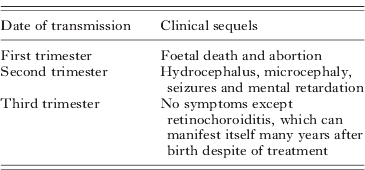
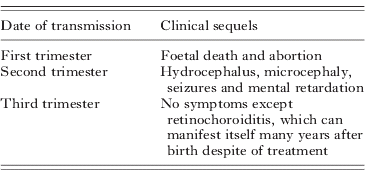
Importantly, the transmission rate depends on the time of infection during pregnancy. Conversely, the clinical consequences decrease when infection occurs at a later gestational age (Table 1). While only 10 to 25% of infections during the first trimester result in foetal infection, this number climbs to about 30% and 60% for infections during the second and third trimester, respectively (Desmonts and Couvreur, Reference Desmonts, Couvreur, Thalhammer, Baumgarten and Pollak1979; Dunn et al. Reference Dunn, Wallon, Peyron, Petersen, Peckham and Gilbert1999). This clearly implicates the existence of critical steps of transmission, which ‘decide’ whether the parasite infects the foetus or not. As for the Toxoplasma strains found in congenital toxoplasmosis, at least in a French study, about 85% were due to infection with a type II (avirulent) strain. Type I strains, albeit reputedly more virulent, were rarely (8%) found (Ajzenberg et al. Reference Ajzenberg, Cogne, Paris, Bessieres, Thulliez, Filisetti, Pelloux, Marty and Darde2002). Several mechanisms have been implicated in this protection. Most of the studies focused on cell mediated mechanisms, but recent work shows that antibodies also play a protective role. Clearly, this is difficult to investigate in humans. The importance of cell mediated protective mechanisms can be deduced from a study which showed a limited but clear risk of HIV infected women to pass on their T. gondii infection to their offspring (Minkoff et al. Reference Minkoff, Remington, Holman, Ramirez, Goodwin and Landesman1997). Despite the obvious discrepancies, animal studies have given some insights into the mechanisms at play. The mouse strain BALB/c shares central features with the human case of congenital toxoplasmosis. First, primo-infection during pregnancy also results in about 50% of transmission. Second, this infection confers resistance to materno-foetal infection during subsequent infections (Roberts and Alexander, Reference Roberts and Alexander1992). Vaccination with soluble T. gondii antigens conferred a certain degree of protection to the foetus (Roberts, Brewer and Alexander, Reference Roberts, Brewer and Alexander1994). This was associated with an enhanced Th1-type immune response. The importance of such a Th1-type immune response, especially mediated by CD8+ cells and IFN-γ production, has been extensively proven (Denkers and Gazzinelli, Reference Denkers and Gazzinelli1998). However, data obtained in non-pregnant mice have to be extrapolated carefully to congenital models, since pregnancy modifies the balance between Th1 and Th2 immune responses by generating a Th2-type environment essential to maintain pregnancy (Ng et al. Reference Ng, Gilman-Sachs, Thaker, Beaman, Beer and Kwak-Kim2002).
Clinical manifestations of congenital toxoplasmosis
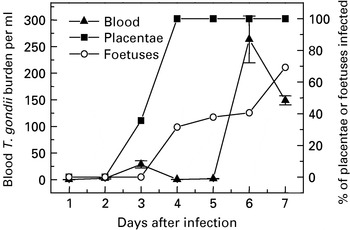
For this reason, we conducted experiments in pregnant BALB/c mice, in which we investigated the mechanisms of transmission control. The foetal infection is an early event occurring mostly during the first week of infection (Fig. 1). Therefore, in the absence of immunological memory to T. gondii infection, mechanisms of the innate immune response occupy a central place. Interestingly, knock-out BALB/c mice (RAG-2−/−), which are unable to produce T and B cells, showed a significantly lower transmission rate than the wild-type controls. This was associated with an enhanced splenocyte production of IFN-γ in response to T. gondii infection thought to be due to greater NK cell production relative to the BALB/c control mice (Abou-Bacar et al. Reference Abou-Bacar, Pfaff, Georges, Letscher-Bru, Filisetti, Villard, Antoni, Klein and Candolfi2004a). Cell enumeration revealed considerably enhanced numbers of circulating NK cells. Other studies have shown that this cell type is very important for a quick reaction to T. gondii infection, through IFN-γ production (Sher et al. Reference Sher, Collazzo, Scanga, Jankovic, Yap and Aliberti2003) and by inference from in vitro studies, cytotoxic activity (Hauser and Tsai, Reference Hauser and Tsai1986). This role of NK cells was confirmed by a considerable increase of T. gondii transmission by depletion of NK cells in the RAG-2−/− mice.
Kinetics of maternal blood parasitaemia and of placental and foetal infection in BALB/c mice following oral infection with the avirulent PRU strain of T. gondii at day 11 of gestation, demonstrating that 68·4% of the foetuses are already infected at the end of the first week of infection.

THE ROLE OF THE PLACENTA IN T. GONDII TRANSMISSION
The above results generally show that regulation of materno-foetal transmission is correlated with parasite density in the maternal peripheral blood. However, it is always important to bear in mind the above mentioned differences of infection in pregnant and non-pregnant mice. It is evident that the placenta, owing to its capacity to secrete hormones, cytokines and chemokines, not only assures maternal tolerance towards the foetus, but indeed actively participates in the regulation of the systemic immune response (Szekeres-Bartho, Reference Szekeres-Bartho2002). Additionally, some data directly show the existence of a placental barrier function which is independent from maternal Toxoplasma-induced immune response. The first argument is that an increased transplancental Toxoplasma transmission is observed with the increase of the gestational age. Human studies gave further insights to the protective role of the placenta. When placental samples of mothers, who had acquired T. gondii infection during pregnancy, were checked at birth, some placentae proved to be positive in the absence of foetal infection (Fricker-Hidalgo et al. Reference Fricker-Hidalgo, Pelloux, Racinet, Grefenstette, Bost-Bru, Goullier-Fleuret and Ambroise-Thomas1998; Ajzenberg et al. Reference Ajzenberg, Cogne, Paris, Bessieres, Thulliez, Filisetti, Pelloux, Marty and Darde2002). This proves that the placenta acts as a relatively efficacious barrier. However, it is often difficult to draw conclusions from findings in term placentae, when the actual infection may date back several months. In fact, the same studies found a considerable number of T. gondii-negative placentae despite proven transmission to the foetus. T. gondii may persist as cysts, poorly detectable, in the placenta. In sheep, those cysts were detected in placentae (Dubey, Reference Dubey1987), and it is probable that the parasite is also able to form cysts in human placentae. However, nothing is known about the frequency or relevance of such parasite persistence in the placenta.
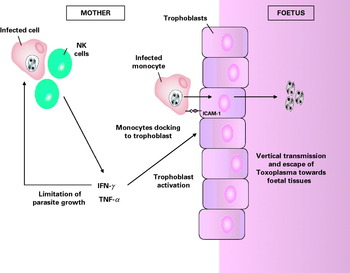
The above mentioned study, using knock-out BALB/c mice (Abou-Bacar et al. Reference Abou-Bacar, Pfaff, Letscher-Bru, Filisetti, Rajapakse, Antoni, Villard, Klein and Candolfi2004b), revealed an unexpected finding. When IFN-γ was completely neutralised, a considerable increase in parasite numbers in the maternal peripheral blood was observed, whereas the materno-foetal transmission rate was diminished. This indicates a transmission-enhancing effect of IFN-γ production which is effective within the placenta. We observed that infection of the placenta occurred very early, and was immediately followed by infection of the first foetuses (Fig. 2). Consequently, any protective responses have to act very quickly. This explains the importance of fast-acting NK cells specifically for the control of materno-foetal transmission. This finding also shows that the placental barrier can, at least in some cases, be rapidly overcome. As for the mechanisms of transplacental infection, immunohistochemical studies in a rat model suggest that the parasite first infects placental trophoblast cells, which form a barrier between maternal blood and foetal tissue. The foetal part of the placenta, and ultimately the foetus itself, is then infected (Ferro et al. Reference Ferro, Silva, Bevilacqua and Mineo2002). Consequently, trophoblast cells play a major role in materno-foetal infection. The very small numbers of parasites actually seen in such immunohistochemical studies make it very difficult to draw conclusions. Therefore, in vitro studies using trophoblast cell lines have been conducted. Trophoblast cells support productive T. gondii infection (Abbasi et al. Reference Abbasi, Kowalewska-Grochowska, Bahar, Kilani, Winkler-Lowen and Guilbert2003), but then so do virtually all cell types. Other ways of transmission, for example through breaches in the trophoblast layer, are not excluded. Studies on the human trophoblast cell line BeWo suggest that IFN-γ is necessary for adhesion of T. gondii-infected monocytes, thereby facilitating materno-foetal transmission (Pfaff et al. Reference Pfaff, Villard, Klein, Mousli and Candolfi2005b). Following infection, trophoblast cells are not able to limit T. gondii multiplication when stimulated by IFN-γ, in contrast to most other cell types (Pfaff et al. Reference Pfaff, Georges, Abou-Bacar, Letscher-Bru, Klein, Mousli and Candolfi2005a). This shows, once again, the delicate balance between infection control and pregnancy maintenance.
Model of the control of transplacental passage of T. gondii during a primary infection. IFN-γ-mediated immune response leads to a control of parasite proliferation and induces an escape of the parasite through the placenta by an increased docking of infected maternal cells on the trophoblast surface.

Combining in vivo and in vitro results, the parasite therefore depends on the immune system and its production of IFN-γ to facilitate its transmission to the foetus. The available means of investigation and model systems revealed some details of how materno-foetal T. gondii transmission is controlled. Although many questions remain unresolved, current evidence suggests that the placenta is actively involved in transmission control and that transmission occurs rapidly following infection. Fig. 2 shows our current understanding of protective mechanisms during a primary T. gondii infection.
SECONDARY INFECTION AND DEVELOPMENT OF VACCINES AGAINST CONGENITAL TOXOPLASMOSIS
The results presented above show that IFN-γ production is indispensable for host protection from uncontrolled parasite multiplication. On the other hand, too much IFN-γ will result in death by exaggerated immunopathological reactions. This is even more important when a developing foetus is involved. As we mentioned above, T. gondii infection, via IFN-γ production, can lead to abortion in early gestation. Thus, we appreciate that recent publications include the outcome of gestation in their vaccine studies (Mevelec et al. Reference Mevelec, Bout, Desolme, Marchand, Magne, Bruneel and Buzoni-Gatel2005; Ismael et al. Reference Ismael, Dimier-Poisson, Lebrun, Dubremetz, Bout and Mevelec2006).
At this point, it is important to keep in mind that transmission of T. gondii occurs only during primary infection of the mother. In subsequent infections, the mother's immune system is able to eliminate the parasites before they reach the materno-foetal barrier (Remington et al. Reference Remington, McLeod, Thulliez, Desmonts, Remington and Klein2000). The ultimate goal of any vaccine should consequently be to imitate this ideal natural protection. Therefore, it is useful to study the mechanisms of protection against re-infection. Protection against materno-foetal transmission during secondary infection is diminished when CD8+ cells are depleted or IFN-γ is neutralized (Abou-Bacar et al. Reference Abou-Bacar, Pfaff, Letscher-Bru, Filisetti, Rajapakse, Antoni, Villard, Klein and Candolfi2004b). This underlines the importance of CD8+ cells as IFN-γ-producing cells for protection of congenital toxoplasmosis, which has been demonstrated previously in vaccination studies of non-pregnant mice (Denkers, Reference Denkers1999). CD4+ cells, while not completely redundant, seem to play a minor role in such recall responses.
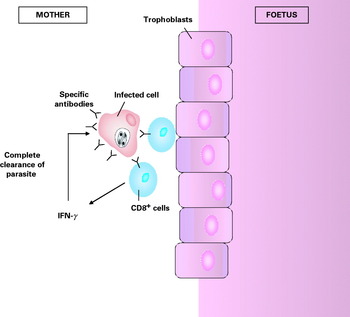
Apparently contradictory results of vaccine studies reveal the subtleties of foetal protection. Whereas one study (Couper et al. Reference Couper, Nielsen, Petersen, Roberts, Roberts and Alexander2003), which used SAG1 DNA as vaccine, found protection for the mother but not the foetuses, another study, using SAG1 protein, but the same mouse strain, did find a protective effect for the offspring (Letscher-Bru et al. Reference Letscher-Bru, Pfaff, Abou-Bacar, Filisetti, Antoni, Villard, Klein and Candolfi2003). This latter study showed also the interaction between genetic background, pregnancy and stimulation of the immune system by comparing the results of two mouse strains. Vaccination with the major surface protein, SAG1, in BALB/c mice resulted in a mixed Th1–Th2 response and conferred partial protection to congenital infection. In contrast, the same vaccination protocol induced in another mouse strain (CBA/J) caused a biased Th2 response to SAG1, and resulted in an increased materno-foetal transmission of T. gondii. Consequently, a finely-tuned balance between the anti-parasitic Th1 response and the pregnancy-induced Th2 response has to be achieved when developing vaccines. Further studies in our laboratory showed that antibody production, probably in close interaction with CD8+ cells, do indeed have a role in the case of re-infection or vaccination (Letscher-Bru, unpublished results). This involvement of antibodies in a secondary response might also prevent a pronounced inflammatory response, which is characteristic of primary responses. As antibodies neutralise most of the invading parasites, a limited IFN-γ-activated response is enough to eliminate the parasite completely and to prevent materno-foetal transmission. Fig. 3 summarises our model of foetal protection in the case of re-infection or a successful vaccine. In the light of recent work, it seems clear that sterile immunity might not be an absolute requirement for a vaccine. For example, some studies, using different strategies, show that materno-foetal transmission can be drastically reduced without completely eliminating maternal infection (Letscher-Bru et al. Reference Letscher-Bru, Pfaff, Abou-Bacar, Filisetti, Antoni, Villard, Klein and Candolfi2003; Ismael et al. Reference Ismael, Dimier-Poisson, Lebrun, Dubremetz, Bout and Mevelec2006). Multiple novel delivery techniques have now been tested against toxoplasmosis: T. gondii RNA (Dimier-Poisson et al. Reference Dimier-Poisson, Aline, Bout and Mevelec2006), adenoviruses (Caetano et al. Reference Caetano, Bruna-Romero, Fux, Mendes, Penido and Gazzinelli2006), dendritic cells (Ruiz et al. Reference Ruiz, Beauvillain, Mevelec, Roingeard, Breton, Bout and Dimier-Poisson2005), and many others. Each of them showed its specific response pattern. When we combine these tools with the rationale extracted from the more fundamental research, considerable advances should be possible in the near future. As a last point to consider, it can also be argued that reduction of specific pathology, primarily retinochoroiditis, would be the most appropriate measure of success of a vaccine.
Model of the control of transplacental passage of T. gondii in reinfected or vaccinated individuals. Maternal immune response control transplacental passage through specific antibodies and CD8+ T cell-produced IFN-γ-mediated mechanisms.

The involvement of antibodies and their possible contribution to dampen the IFN-γ-dependent cellular response during secondary responses are not without consequences for vaccine development. It is well known that infectious diseases of different aetiologies can severely harm the foetus, or even lead to its expulsion (Entrican, Reference Entrican2002). Ongoing studies in our laboratory show also the effect of a strong IFN-γ production in response to a primary T. gondii infection to the early conceptus in a mouse model (Senegas and Villard, personal communication). This shows that the mouse model can also include this immunopathological aspect of vaccine studies. In conclusion, it seems clear that the best protection is not given by the strongest Th1 response, but by an equilibrated reaction, which takes into account both the dual role of IFN-γ for transmission, and its potentially harmful effects on the foetus itself.
OPEN QUESTIONS
Despite the large number of studies on toxoplasmosis, relatively little is still known about the importance of different immune and physiological factors which influence the rate of materno-foetal transmission of T. gondii. The intrinsic complexity of this process probably prevents us from reaching complete conclusions from simplistic model systems. The mouse model has allowed us to gain insight into specific points, but will probably not be able to give the answers to some long-standing questions, for example, the reason for the increasing transmission rates during the course of pregnancy. The underlying mechanisms for this feature remain unknown. It might be simply due to the gradual increase in size of the materno-foetal interface, which statistically facilitates transmission. An alternative explanation centres on the augmented exchange activity of the trophoblast cells in the course of pregnancy, which would render them more susceptible to infection, e.g. by enhanced expression of adherence receptors. Interestingly, this problem can also be addressed in the BALB/c mouse model, in which we also observed the following. Infection at day 11 of pregnancy (mouse mid-gestation) resulted in a higher transplacental Toxoplasma transmission rate until the end of pregnancy than did an earlier infection at day 6 (early gestation), despite the shorter infection time-span. When the mice were infected at day 14, more foetuses were already infected at the time of necropsy, 4 days later, than at day 4 following infection at day 11 (Table 2).
Placental and foetal infection in BALB/c mice at day 18 of gestation, inoculated with PRU strain of T. gondii at various time of gestation

Importantly, the results that have been obtained so far could facilitate a more rational evaluation of vaccine studies, by providing the parameters by which to judge the success or failure of vaccination. They should be a warning not to look on protective mechanisms while forgetting that such mechanisms could do more harm than good, especially to a developing foetus. These data also validate the mouse model for the investigation of important aspects of T. gondii transmission and, consequently, for vaccine studies.
ACKNOWLEDGEMENTS
This work was supported in part by Université Louis Pasteur de Strasbourg and Hôpitaux Universitaires de Strasbourg.