Introduction
Vulnerability–stress models emphasize the role of stress in the emergence of psychosis (Zubin & Spring, Reference Zubin and Spring1977; Nuechterlein & Dawson, Reference Nuechterlein and Dawson1984; Nuechterlein et al. Reference Nuechterlein, Dawson, Ventura, Gitlin, Subotnik, Snyder, Mintz and Bartzokis1994). The models differ in detail, but all assume that people have varying levels of vulnerability and the likelihood of psychotic symptoms to be a function of the extent of vulnerability and stress that the individual is encountering. Despite the high face validity, evidence for the basic assumption that stress triggers psychosis is not unequivocal. A frequent method to assess the impact of environmental stressors has been to investigate retrospectively the number of major life-events in periods followed by an increase in symptoms (Brown & Birley, Reference Brown and Birley1968; Birley & Brown, Reference Birley and Brown1970). Many, but not all, studies found life-events to be precipitants of acute schizophrenia (Philipps et al. Reference Philipps, Francey, Edwards and McMurray2007).
This area of research has been criticized repeatedly for methodological limitations (Norman & Malla, Reference Norman and Malla1993b; Philipps et al. Reference Philipps, Francey, Edwards and McMurray2007). The major problem is posed by the nature of retrospective designs, which are unable to determine whether stressful events are causal to psychosis. For instance, a male patient might report that having been left by his wife triggered an episode of psychosis, whereas in fact being left was the consequence of early prodromes (e.g. social withdrawal). In addition, it seems unlikely that singular stressful events will have a strong impact on a complex mental disorder as stressors probably work on a more short-term basis. This notion finds support in studies focusing on smaller everyday stressors (Norman & Malla, Reference Norman and Malla1991, 1993 a; Walker & Diforio, Reference Walker and Diforio1997; Horan et al. Reference Horan, Ventura, Nuechterlein, Subotnik, Hwang and Mintz2005) and in those investigating the association of psychosis and specific environmental stressors, such as migration, isolation and discrimination (Janssen et al. Reference Janssen, Hanssen, Bak, Bilj, De Graaf, Vollebergh, McKenzie and Van Os2003; Cantor-Graae & Selton, Reference Cantor-Graae and Selton2005; Veling et al. Reference Veling, Susser, Van Os, Mackenbach, Selten and Hoek2007), urbanicity (Weiser et al. Reference Weiser, Van Os, Reichenberg, Rabinowitz, Nahon, Kravitz, Lubin, Shmushkevitz, Knobler, Noy and Davidson2007), or exposure to relatives with high-expressed emotion (Butzlaff & Hooley, Reference Butzlaff and Hooley1998; Cutting et al. Reference Cutting, Aakre and Docherty2006). Philips et al. (Reference Philipps, Francey, Edwards and McMurray2007) have emphasized the necessity of more research in high-risk populations to improve the understanding of the transition into psychosis. Only a few studies have taken this approach and those demonstrate exposure to stressors to be a risk factor for high-risk individuals (e.g. Miller et al. Reference Miller, Lawrie, Hodges, Clafferty, Cosway and Johnstone2001; van Os et al. Reference van Os, Hanssen, Bak, Bijl and Vollebergh2003; Mason et al. Reference Mason, Startup, Halpin, Schall, Conrad and Carr2004). Also of interest, high-risk individuals hold intermediate positions between patients and healthy controls in their neurobiological reactions to stress (Thompson et al. Reference Thompson, Phillips, Komesaroff, Yuen, Wood, Pantelis, Velakoulis, Yung and McGorry2007; Soliman et al. Reference Soliman, O'Driscoll, Pruessner, Halohan, Boileau, Gagnon and Dagher2008). Finally, the mechanisms connecting stress to psychotic symptoms have remained speculative. Cognitive conceptualizations of psychosis have theorized that one route to the development of psychotic symptoms involves emotional changes (Garety et al. Reference Garety, Kuipers, Fowler, Freeman and Bebbington2001), proposing anxiety to be the most relevant emotion with regard to paranoia (Freeman et al. Reference Freeman, Garety and Kuipers2001).
Studies by Myin-Germeys and others using the experience-sampling method (ESM; for an overview see Myin-Germeys & van Os, Reference Myin-Germeys and van Os2007) to investigate the association of daily hassles, affect and psychosis overcome many of the methodological limitations of previous studies. They could demonstrate that an increase in stress is generally associated with an increase in negative affect and that this association is stronger for patients than for their relatives and healthy controls (Myin-Germeys et al. Reference Myin-Germeys, Van Os, Schwartz, Stone and Delespaul2001). They also found a clear association between the occurrence of minor stressors and the intensity of psychotic experiences in patients and their first-degree relatives (Myin-Germeys et al. Reference Myin-Germeys, Delespaul and Van Os2005). They conclude that increased emotional reactivity to stress is a vulnerability marker for psychosis and speculate that it might represent the underlying mechanisms for the episodic, positive symptom subtype of psychosis in particular (Myin-Germeys & van Os, Reference Myin-Germeys and van Os2007). Despite the many advantages of the ESM, the interpretation of causal direction between stress and symptoms remains difficult because of the complex interactions between individual behavior and environment in everyday life.
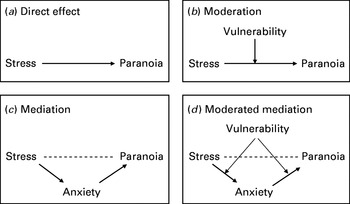
Taken together, the research provides basic evidence for a connection between stress and psychosis but is somewhat less conclusive with regard to causal directions and moderating and mediating mechanisms. The present study investigated the impact of stress on paranoia using a randomized experimental design in healthy individuals with varying levels of vulnerability to psychosis. A more readily interpretable single symptom approach was chosen, investigating paranoia rather than psychosis symptoms in general because delusions of persecution and reference are the most frequent symptoms in psychosis (Sartorius et al. Reference Sartorius, Jablensky, Korten, Ernberg, Anker, Cooper and Day1986; Andreasen & Flaum, Reference Andreasen and Flaum1991), and their continuity in the population is well studied (Freeman et al. Reference Freeman, Garety, Bebbington, Smith, Rollinson, Fowler, Kuipers, Ray and Dunn2005; Freeman, Reference Freeman2006). As demonstrated graphically in Fig. 1, we hypothesized that stress would be positively related to symptoms of paranoia (Fig. 1 a); that this relationship would be moderated by the extent of vulnerability (Fig. 1 b) and mediated by an increase in anxiety (Fig. 1 c), which would also be moderated by the extent of the vulnerability (Fig. 1 d). Finally, to estimate the psychosis specificity of the associations, we compared the impact stress exerts on psychosis symptoms with the impact it has on symptoms of frequent co-morbid disorders, obsessive compulsive disorder (OCD) and depression.
Graphical depiction of the hypotheses.

Method
Participants and procedure
The sample consisted of 64 undergraduate students of psychology, educational sciences or social sciences. The mean age of the sample was 21.7 years (s.d.=2.8, range 18–31 years) and 81% of the participants were female. Participants were not paid but were able to complete curriculum requirements by participating.
Questionnaires
Community Assessment of Psychic Experiences (CAPE; Stefanis et al. Reference Stefanis, Hanssen, Smirnis, Avramopoulos, Evdokimidis and Stefanis2002)
The CAPE is a 42-item self-report instrument developed to rate lifetime psychotic experiences in the affective and non-affective domains. Previous studies have demonstrated good convergent and discriminative validity (Hanssen et al. Reference Hanssen, Peeters, Krabbendam, Radstake, Verdoux and van Os2003) and test–retest reliability (Konings et al. Reference Konings, Bak, Hanssen, van Os and Krabbendam2006). The German version of the CAPE has been found to have good to excellent internal consistency (Cronbach's α=0.94 for the total scale and 0.84, 0.89 and 0.91 for the positive, negative and depression subscales respectively) and validity in discriminating patients with schizophrenia from healthy and clinical controls (Moritz & Laroi, Reference Moritz and Laroi2008).
To assess state symptoms of paranoia, depression and OCD, we created a state symptom scale based on three existing symptom measures:
(1) Paranoia Checklist (PCL; Freeman et al. Reference Freeman, Garety, Bebbington, Smith, Rollinson, Fowler, Kuipers, Ray and Dunn2005). The PCL is a 18-item self-report scale developed to measure paranoid ideation. It includes items assessing ideas of persecution (e.g. ‘I need to be on my guard against others’) and reference (e.g. ‘There might be negative comments being circulated about me’) and has excellent internal consistency (Cronbach's α >0.90) and good convergent validity. For the German version, items were translated into German and back into English by a bilingual English native speaker. Cronbach's α for the German version was 0.86. There was convergent validity of the PCL with the CAPE (r=0.63, p<0.001) and the subscale Paranoid Ideation (r=0.56, p<0.001) of the Symptom Checklist-90-R (SCL-90-R) by Derogatis (Reference Derogatis1983).
(2) Allgemeine Depressions Skala [General Depression Scale] (ADS; Hautzinger & Brähler, Reference Hautzinger and Brähler1993). The ADS is a 20-item German-language self-report scale that is frequently used in clinical and non-clinical samples to assess depressive symptoms. The ADS has good internal consistency and is highly correlated with other measures of depression such as the Beck Depression Inventory.
(3) Obsessive-Compulsive Inventory – Revised (OCI-R; Foa et al. Reference Foa, Huppert, Leiberg, Langner, Kichnic, Hajcak and Salkovskis2002). The OCI-R is a psychometrically sound 18-item self-report measure of obsessive features on six dimensions (e.g. washing, checking, ordering, hoarding, obsessioning and neutralizing) that is also used in non-clinical groups (e.g. Simonds et al. Reference Simonds, Thorpe and Elliott2000). The German version (Gönner et al. Reference Gönner, Leonhart and Ecker2007) has replicated the good psychometric results of the original OCI-R in a large sample of patients with OCD.
The item contents of these scales were left unchanged, but participants were asked to rate the extent to which the items applied ‘at the moment’ on a five-point Likert scale ranging from 1 (not at all) to 5 (very strongly). To obscure the fact that the study focused on paranoia and to prevent memory effects for previous endorsements across the two conditions, the items of the scales were randomly ordered across time-points.
Self-report of emotions
Participants were requested to complete an 11-point intensity rating on six unipolar items (0=not applicable, 10=completely applicable), labeled with four descriptive adjectives, and five bipolar items, labeled with four descriptive adjectives at each end of the 11-point scale dimension. The items were selected to capture (a) expected arousal and valence such as tense versus relaxed (labels: nervous, restless, tense, wound up versus calm, relaxed, placid, at ease) and positive versus negative (labels: positive, pleasant versus negative, unpleasant), (b) emotions such as fear (labels: frightened, timid, afraid, scared), anger (labels: angry, annoyed, mad, sore) and shame (labels: embarrassed, ridiculed, ashamed, foolish), sadness (labels: sad, depressed, miserable, dejected), happiness (labels: happy, gay, cheerful, delighted), (c) cognitive states such as alert versus confused (labels: alert, attentive, receptive, lucid versus confused, baffled perplexed), and (d) motivational states such as interested versus bored (labels: curious, interested, motivated versus bored, indifferent, dull). The items have been validated (Stemmler et al. Reference Stemmler, Heldmann, Pauls and Scherer2001).
Design
The experiment was conducted as a randomized repeated-measures design. At the beginning, participants were informed that the study was being conducted to test the impact of noise on mood and information processing and completed the CAPE. They were then randomized to a stress or a non-stress condition in which they completed cognitive tasks as well as the mood and symptom ratings. The assessments lasted for 1.5 h. In the stress condition stress was induced by loud building-site noise from a computer (75 dB, weblink: www.grsites.com) that continued during the complete assessment as well as by difficult knowledge questions. In the non-stress condition there was no noise and the knowledge questions were replaced by a picture puzzle. To rule out any administration biases, the experimenters followed a clear protocol. To induce some ambiguity that would allow for paranoid interpretations, this protocol also involved ambiguous behavior, such as writing something down that the participant could not see, exchanging glances or whispering briefly with a second experimenter. After assessments, participants completed a form with questions on study conductance and atmosphere. Experimenters were blind to diagnostic status.
After a time interval of 4–6 days the assessments were repeated with the same participants but applying the other experimental condition. Thus, each participant was assessed once in the stress condition and once in the non-stress condition but the sequence of conditions was randomized. Parallel versions of the clinical questionnaires and the script of the experimenter behavior were used, which were randomized to the conditions.
Strategy of data analysis
We tested for the main effect of stress on paranoia, the moderating effect of subclinical symptomatology and the mediating effects of negative emotion (see Fig. 1). A mediation effect occurs when (1) the independent variable (IV) significantly affects the mediator, (2) the IV significantly affects the dependent variable (DV) in the absence of the mediator, (3) the mediator has a significant effect on the DV, and (4) the effect of the IV on the DV shrinks upon the addition of the mediator to the model (Muller et al. Reference Muller, Judd and Yzerbyt2005). Moderated mediation occurs if the mediating process that is responsible for producing the effect of the condition on the outcome depends on the level of a moderator (Muller et al. Reference Muller, Judd and Yzerbyt2005).
The hypotheses were tested in a series of steps, using multilevel linear modeling (MLM) and post-hoc analyses of slopes and mediation. MLM was implemented through SPSS Mixed Models version 15 (SPSS Inc., Chicago, IL, USA) and conducted according to established guidelines (Hox, Reference Hox2002; Tabachnick & Fidell, Reference Tabachnick and Fidell2007). In contrast to analysis of variance, a regression approach generally has the advantage that continuous data need not be split into categories, which would result in loss of information. MLM also has the advantage that it analyzes experiments without the assumption of homogeneity of regression. Thus, in MLM the data collected at different levels of analysis may be studied without violating the assumption of independence in linear multiple regression. Multilevel modeling takes dependencies into account by estimating variance associated with group differences in average response (intercepts) and group differences in association between predictors and dependent variables (slopes). In the hypothesized model, the first-level units were the repeated measures (the stress and the non-stress conditions). Second-level units were the participants of the study.
The hypothesized direct effect of stress on paranoia (Fig. 1 a) is demonstrated if there are higher scores on the PCL in the high-stress condition compared to the low-stress condition, which is indicated by the significance of ‘stress’ as a predictor of paranoia in the fixed part of the model.
The hypothesized effect of vulnerability as a moderator (Fig. 2 b) is demonstrated if higher total CAPE scores are associated with a larger increase in the paranoia scores. This is indicated by the significance of the stress×CAPE interaction as a predictor of paranoia in the fixed part of the model.
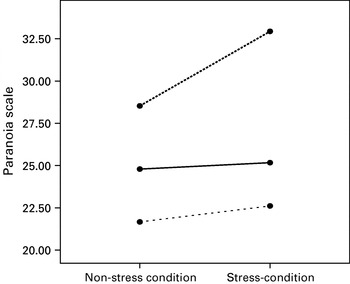
Interaction between subclinical psychotic symptoms and the effect of stress on paranoia.  , Low (coefficient=0.97, s.e.=0.65, n.s.);
 , medium (coefficient=0.38, s.e.=0.75, n.s.);
 , high (coefficient=3.89, s.e.=1.75, p=0.044).

The effect of anxiety as a mediator (Fig. 1 c) is demonstrated if (a) subjective ratings of anxiety are higher in the stress than in the non-stress condition, indicated by the significance of stress as a predictor of anxiety; (b) the higher ratings of subjective anxiety in the stress versus the non-stress condition are related to the increase in paranoia in the stress versus non-stress condition, indicated by the significance of anxiety as a predictor of paranoia; and (c) there is a reduced direct effect of stress as a predictor of paranoia when the anxiety ratings are entered in the model.
The moderated mediation (Fig. 1 d) is indicated by a significant CAPE×anxiety interaction predicting paranoia and a significant stress×CAPE interaction predicting anxiety.
All predictors were centered around the grand mean by subtracting the mean score from each case. The predictors were normally distributed, but some positive skewness was noted for the DV (0.96, s.d.=0.21; curtosis=0.68, s.d.=0.42). Data inspection revealed no outliers.
Results
Manipulation check
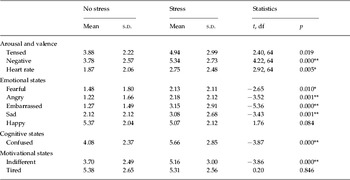
As shown in Table 1, the mean report of subjective heart rate was significantly higher under the stress condition than the non-stress condition and there was a trend with regard to the rating of arousal. There was also a significant difference in the expected direction for the ratings of the question ‘Was the atmosphere during the experiment relaxed?’, which was answered at the end of each experimental condition (t=4.8, df=58, p<0.001).
Mean differences in arousal and emotions between the stress and the non-stress condition

** p⩽0.01 and * p⩽0.05 (with α adjusted for the multiple comparisons within each of the four categories).
There were no differences in the ratings of emotional states in either condition between participants who received the stress condition first and participants who received the non-stress condition first. Thus, the sequence of condition can be ruled out as a confounding variable.
Direct effect of stress on paranoia
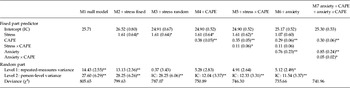
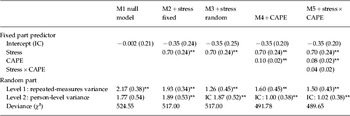
Table 2 shows the results of the multilevel analysis of paranoia. Model 1 is a model that includes only the intercept term, which is simply the average of the PCL scores across individuals and repeated measures. The intra-class correlation is 0.66, indicating that two-thirds of the variance is due to differences between individuals, whereas only one-third is due to the repeated measures (stress versus non-stress). In model 2, stress (thus the experimental condition) is entered as predictor. The model predicts a significant increase of paranoia of 1.61 in the stress condition. It improves overall prediction of paranoia in comparison to the intercept-only model (model 1), indicated by a significant reduction of the Deviance in model 2 compared to model 1 [χ2(1)=6.02, p<0.05]. However, model 2 also showed significant repeated-measures and significant person-level variance in the intercepts (average paranoia varies between individuals and for individuals across repeated measures), indicating room for improvement in the model.
Results of the multilevel linear model of paranoia

CAPE, Community Assessment of Psychic Experience as a measure of baseline vulnerability; M, model.
Values given are coefficient (standard error).
** p⩽0.01 and * p⩽0.05 (p=two-tailed significance value).
Moderating effect of vulnerability
The mean CAPE scores were 1.47 (s.d.=0.23), 1.94 (s.d.=0.37) and 1.38 (s.d.=0.37) for the positive, negative and depression subscales respectively. To reflect the hypothesis that the CAPE scores moderate the association between stress and paranoia (Fig. 1 b), stress was declared a random effect in model 3. In accord with this assumption, model 3 revealed significant person-level variance in the random slope of stress on paranoia [coefficient (coeff.)=25.54, s.e.=8.21, p⩽0.01].
In model 4 (see Table 2) the baseline psychotic symptomatology (total CAPE score) and in model 5 the interaction stress×CAPE were added to the multilevel linear model. The significant stress×CAPE interaction and the significant difference in deviance between models 4 and 5 [χ2(1)=4.59, p<0.05] support the moderation hypothesis (Fig. 1 b). To facilitate interpretation, we calculated the effects of stress on paranoia at different levels of the moderator (CAPE), for which we used the bottom quartile (low range), the second and third quartiles (medium range) and the fourth quartile (high range). The mean scores on the PCL in the stress and non-stress conditions for these three levels of the CAPE are depicted in Fig. 2. The post-hoc regression slopes were only significant for participants in the high range of the CAPE.
Mediating effect of negative emotion
Table 1 displays the mean emotions under the stress and non-stress conditions and also significance levels for differences in emotional states using paired t tests. As can be seen, participants were more anxious, ashamed, angry and sad in the stress condition than in the non-stress condition. To test which of the emotions were most strongly associated with the increase in paranoia, stepwise linear multiple regression analysis was carried out, using the difference scores in the PCL between the stress and the non-stress conditions as the dependent variable and the changes in each of the emotions as predictors, while controlling for changes in cognitive and motivational states. The change in anxiety emerged as the only significant predictor for paranoia (B=–0.99, β=–0.37, p=0.002; corrected R 2=0.13). Thus, the further analyses focused on the impact of anxiety.
To test the mediation effect (Fig. 1 c) we began by demonstrating the four conditions of the heuristic model for mediation (as described above). In Table 2, model 6, it can be seen that anxiety significantly improved the overall prediction of paranoia, indicated by the significance of the fixed coefficient and the significant difference in χ2 between models 6 and 5 [χ2(1)=4.59, p<0.01]. In addition, after entering anxiety, the direct impact of stress on paranoia was no longer significant, nor was the interaction of stress and symptomatology. To test the significant impact of the IV on the mediator, anxiety was used as the dependent variable in an additional multilevel linear model. The results are depicted in Table 3 and reveal a significant effect of the stress versus non-stress condition on anxiety (model 2). In addition to demonstrating the heuristic conditions, we used the Sobel test to formally assess the mediation effect (Krull & MacKinnon, Reference Krull and MacKinnon2001). The Sobel test statistic was significant (Z=2.54; p=0.011), supporting an indirect effect of stress on paranoia through anxiety.
Results of the multilevel analysis of anxiety

CAPE, Community Assessment of Psychic Experience as a measure of baseline vulnerability; M, model.
Values given are coefficient (standard error).
** p⩽0.01 and * p⩽0.05 (p=two-tailed significance value).
Moderated mediation effect
To test for moderated mediation (Fig. 1 d) we first tested the interaction stress×CAPE in predicting anxiety, which was not significant (compare Table 3, model 5). Thus, the increase in anxiety under stress did not depend on the extent of vulnerability as assessed with the CAPE. We then tested the interaction Anxiety×CAPE in predicting paranoia (Table 2, model 7), which was significant, indicating a moderating effect of vulnerability on the association between anxiety and paranoia. These results demonstrate that although stress caused an increase in anxiety regardless of the vulnerability, in more vulnerable participants anxiety was more clearly related to elevated state paranoia.
Specificity
We tested the specificity of the main effect by analyzing the impact of stress on the ADS scores and the scores in the OCI in two additional multilevel models. The results indicated a significant impact of stress on depression symptoms (coeff.=1.94, s.e.=0.82, df=64, p=0.021) but not on symptoms of OCD (coeff.=0.03, s.e.=0.46–82, df=64, p=0.946). In addition, we tested for an interaction of CAPE×stress on depression, which was not significant (coeff.=0.05, s.e.=0.09, df=64), indicating that the CAPE score added to explaining the increase of paranoia but not the increase in depression under stress.
To test whether positive symptomatology is a specific moderator of the impact of stress on paranoia in relation to other aspects of psychosis proneness, we conducted a further MLM of paranoia, testing a model using stress (random and fixed) and the three CAPE subscales (depression, negative symptoms, positive symptoms) as predictors. We found the positive subscale to be a significant predictor (coeff.=0.41, s.e.=0.14, df=64, p⩽0.01), as was the negative subscale (coeff.=0.46, s.e.=0.15, df=64, p⩽0.01), but not the depression subscale (coeff.=0.39, s.e.=0.28, df=64, n.s.), indicating that positive and negative symptomatology moderate the increase of paranoia under stress rather than depression.
Discussion
This study set out to investigate the impact of stress on paranoid thinking and to identify moderators and mechanisms for this association. It produced several significant findings. First, stress induced by noise and knowledge questions led to an increase in state paranoia and depression. Second, this impact was particularly pronounced in individuals with higher baseline levels of subclinical psychosis-prone symptomatology. Third, the effect of stress on paranoia was mediated by an increase in anxiety. Fourth, stress caused an increase in anxiety regardless of the level of vulnerability but anxiety was more clearly related to elevated state paranoia in more vulnerable participants.
The finding that state paranoia was significantly higher in the stress than in the non-stress condition in individuals with higher levels of subclinical symptoms supports models stating psychosis to be a function of stress and vulnerability (Zubin & Spring, Reference Zubin and Spring1977; Nuechterlein & Dawson, Reference Nuechterlein and Dawson1984). It adds to the body of research in support of an association between stress and psychosis, while more readily allowing us to infer that stress was causal to the increase in paranoia.
The mediating effect of anxiety supports the validity of the theoretical framework by Freeman and colleagues on paranoia postulating a direct influence of anxiety on persecutory delusions (Freeman et al. Reference Freeman, Garety, Kuipers, Fowler and Bebbington2002). Our results also add to existing evidence of an association between delusions and anxiety (Garety et al. Reference Garety, Freeman, Jolley, Dunn, Bebbington, Fowler, Kuipers and Dudley2005; Freeman et al. Reference Freeman, Pugh, Antley, Slater, Bebbington, Gittins, Dunn, Kuipers and Garety2008).
Furthermore, the results indicate that people who react to stress with an increase in anxiety might have a higher risk of developing psychotic symptoms. The notion that negative affect plays an important role in the relationship between stress and psychosis is in line with the results from studies using the ESM (Myin-Germeys et al. Reference Myin-Germeys, Van Os, Schwartz, Stone and Delespaul2001; Myin-Germeys & van Os, Reference Myin-Germeys and van Os2007). However, our analysis of the moderated mediation revealed the increase in anxiety under stress not to depend on the extent of vulnerability whereas the association between anxiety and state paranoia did. The discrepancy between our results and those from the ESM might be due to differences in the operationalization of vulnerability.
A direct impact of negative emotions on symptoms was also reported in some experimental studies finding that speech of patients with schizophrenia became more disordered in an affectively negative condition compared to controls (Docherty et al. Reference Docherty, Hall and Gordinier1998; Cohen & Docherty, Reference Cohen and Docherty2004). Furthermore, higher levels of affective reactivity in patients have been shown to be associated with the severity of positive and affective symptoms (Dinzeo et al. Reference Dinzeo, Cohen, Nienow and Docherty2004; Docherty et al. Reference Docherty, St-Hilaire, Aakre and Seghers2008). Our study extends these results by pointing to the relevance of anxiety, rather than negative mood in general, as relevant emotion for developing paranoia.
With regard to specificity of the effects we found that, although the stress condition showed no effect on symptoms of OCD, it affected paranoid thinking and depression in a similar manner. The increase of depression under stress is not surprising. Vulnerability–stress models have been postulated to be equally relevant to depression (Abramson et al. Reference Abramson, Metalsky and Alloy1989) and stressors are found to precede depression (Kessler, Reference Kessler1997; Stroud et al. Reference Stroud, Davila and Moyer2008). In addition, affective disorders possibly share the increased stress sensitivity (Myin-Germeys et al. Reference Myin-Germeys, Peeters, Havermans, Nicolson, DeVries, Delespaul and van Os2003), supporting the notion that stress reactivity may constitute a shared vulnerability for psychosis and affective disorders (Myin-Germeys & van Os, Reference Myin-Germeys and van Os2007; Salokangas et al. Reference Salokangas, Luutonen, Niemines, Huttunen and Karlsson2007). Although the impact of stress on symptoms is not specific to paranoia, the moderating effect of subclinical psychosis seems to be specific as the CAPE added to explaining the increase of paranoia but not the increase of depression under stress.
Finally, our analyses did not support the assumption by Myin-Germeys & van Os (Reference Myin-Germeys and van Os2007) that altered sensitivity to stress might represent the underlying mechanism of the positive syndrome, rather than the negative-syndrome subtype of psychosis, as the negative and positive subscales were equally related to the increase of symptoms under stress.
Strengths and limitations
The study design is characterized by a number of strengths, including the use of a randomized repeated-measure design and the inclusion of specific symptom scales. The sample of healthy participants, rather than patients, was purposefully chosen to demonstrate basic mechanisms on the pathway from vulnerability to psychosis. Limitations might be seen in the use of a student sample, reflecting concerns that there will be insufficient variance of psychosis symptoms. However, students have been found to reveal slightly higher levels of subclinical psychotic symptoms (Lincoln & Keller, Reference Lincoln and Keller2008) and in this sample the CAPE subscale scores were within the range of the mean scores found in population samples (Konings et al. Reference Konings, Bak, Hanssen, van Os and Krabbendam2006). Thus, there was a representative number of high scorers in the sample, although these scores were still clearly below scores obtained in patient samples (e.g. Moritz & Laroi, Reference Moritz and Laroi2008). The self-developed measures of state paranoia, depression and OCD have not been tested for their psychometric properties, although the original scales have. A state paranoia scale for experimental studies produced by Freeman et al. (Reference Freeman, Pugh, Green, Valmaggia, Dunn and Garety2007) was published too late to be used in our study but took a similar approach and was shown to have good psychometric properties. In addition, despite the advantage of taking a single-symptom approach, a replication using a multi-symptom measure is needed before generalizing results to all symptoms of psychosis.
The use of a measure to capture subclinical psychotic symptoms as an operationalization of vulnerability is justifiable because attenuated subthreshold psychotic symptoms have been described in retrospective studies as risk factors, emerging before first episodes or psychotic relapse (Van Os et al. Reference Van Os, Jones, Sham, Bebbington and Murray1998; Møller & Husby, Reference Møller and Husby2000). Moreover, they are frequently used as low-level criteria in high-risk studies (e.g. Yung et al. Reference Yung, Phillips, Yuen, Francey, McFarlane, Hallgren and McGorry2003; Brewer et al. Reference Brewer, Wood, Phillips, Francey, Pantelis, Yung, Cornblatt and McGorry2006). However, it is agreed that using multiple indicators of risk, for example by adding attenuated positive symptoms, functional decline and genetic risk, is likely to yield higher predictive values (close-in-strategy; Bell, Reference Bell1992).
Finally, although laboratory studies have a high reliability due to the standardized approach and the possibility of directly manipulating the variable of interest, ecological validity is higher in the investigation of real-life stressors, such as the studies carried out with the ESM (Myin-Germeys & van Os, Reference Myin-Germeys and van Os2007). Thus, we argue that these two approaches can complement one another.
Implications
Many patients report that the worst thing about psychosis is feeling helpless about relapsing, as episodes often seem to occur without warning. Diathesis–stress approaches to psychosis have been the basis for numerous therapeutic interventions, particularly psycho-education and relapse prevention (Wiedemann et al. Reference Wiedemann, Klingberg and Pitschel-Walz2003; Lincoln et al. Reference Lincoln, Wilhelm and Nestoriuc2007), teaching patients to identify early warning signs and symptoms and monitor these by enhancing coping and reducing stress (Behrendt, Reference Behrendt2001). Our data add to the accumulating evidence indicating that reactivity to stress is a relevant risk factor on the pathway to psychosis and extend it by pointing to the relevance of anxiety reactions to stress. Knowledge of this specific vulnerability is helpful for understanding transition into psychosis. It holds some clinical implications, suggesting that patients might benefit from stress-management programs (e.g. Norman et al. Reference Norman, Malla, McLean, McIntosh, Neufeld and Voruganti2002). The nature of these programs, however, needs to be further explored. As Myin-Germeys & van Os (Reference Myin-Germeys and van Os2007) point out, it remains uncertain whether interventions should aim to reduce stress in the environment or to alter personal reactivity. If future studies are able to replicate the mediating role of anxiety, it could be worthwhile identifying relevant stress- and anxiety-related cognitions and schemas, such as helplessness, and promoting interventions targeted more directly at anxiety.
Acknowledgments
All financial support for this study was provided by the Department of Clinical Psychology, Philipps-Universität Marburg, where the study was conducted. We thank Oliver Christ for his help with the data analysis and all the students who participated in the study.
Declaration of Interest
None.