INTRODUCTION
Research on lexical development in second language (L2) learners can provide important information about L2 acquisition (e.g., Crossley, Salsbury, McNamara, & Jarvis, Reference Crossley, Salsbury, McNamara and Jarvis2011a, 2011b; Zhang & Lu, Reference Zhang and Lu2013; Zheng, Reference Zheng2016). Traditionally, lexical development has been investigated by examining the proportion of relatively advanced or infrequent words in a learner’s output or their knowledge of frequent and infrequent words as found in standardized tests (Read, Reference Read2000). Frequency is an important component of language acquisition because the more times learners are exposed to a linguistic item, the stronger the linguistic representation of that item becomes and the more likely the item will be incorporated into a language system allowing for quicker activation and processing of items (Diessel, Reference Diessel and Aronoff2017; Ellis, Reference Ellis2002a). However, while frequency is an important determinant of language learning, it is only one of many including contingency, recency, and context (Ellis, 2006b; Gries, Reference Gries, Engelberg, Lobin, Steyer and Wolfer2018). A number of cross-sectional studies examining word production report that beginning L2 users produce more frequent words in both writing (Bell, Reference Bell2003; Crossley et al., Reference Crossley, Salsbury, McNamara and Jarvis2011a; Laufer & Nation, Reference Laufer and Nation1995) and speaking (Crossley et al., Reference Crossley, Salsbury, McNamara and Jarvis2011b; Kyle & Crossley, Reference Kyle and Crossley2015) than advanced learners supporting the assertion that more frequent words are learned earlier, likely as a results of frequency effects. However, longitudinal studies of word production for small populations of L2 learners have been mixed, with at least three studies (Crossley, Salsbury, & McNamara, Reference Crossley, Salsbury and McNamara2010; Crossley, Salsbury, Titak, & McNamara, Reference Crossley, Salsbury, Titak and McNamara2014; Kim, Crossley, & Kyle, Reference Kim, Crossley and Kyle2018) demonstrating that the frequency of words produced increases as a function of time. These findings contrast with findings from cross-sectional studies as well as the expectation that more frequent words will be produced in the early stages of acquisition.
In light of these differences, the current study investigates developmental patterns in L2 lexical production in terms of word frequency in a large longitudinal corpus of 50 L2 speakers of English in an English as a second language (ESL) setting. In contrast to previous studies, the current study uses finer-grained indices of word frequency as well as controls for a number of individual differences variables. Spoken data was collected over a 4-month period along with individual difference variables including proficiency, age, gender, and first language distance from English. Word frequency was computed using native speaker and nonnative speaker frequency norms calculated at the type (unique words) and token (all words) level. Linear mixed effects (LME) models were conducted to examine developmental patterns in the L2 speakers in terms of these frequency measures while controlling for individual differences.
FACTORS INFLUENCING LEXICAL DEVELOPMENT
A number of different variables can influence lexical development during acquisition of an additional language, including influence from an L1 (Jarvis, Reference Jarvis2000; MacWhinney, Reference MacWhinney, De Groot and Kroll1997; Odlin, Reference Odlin, Doughty and Long2003), distance between an L1 and the target language (Miller & Chiswick, Reference Miller and Chiswick2005; Odlin, Reference Odlin, Doughty and Long2003; Ringbom & Jarvis, Reference Ringbom, Jarvis, Long and Doughty2011), relative age and age of learning onset (Birdsong & Molis, Reference Birdsong and Molis2001; Cenoz, Reference Cenoz2011; DeKeyser, Reference DeKeyser2000; Dörnyei & Skehan, 2003; Hyltenstam & Abrahamsson, Reference Hyltenstam, Abrahamsson, Doughty and Long2003; Jarvis, Reference Jarvis2000; Johnson & Newport, Reference Johnson and Newport1989; McDonald, Reference McDonald2000), and gender (Baker & MacIntyre, Reference Baker and MacIntyre2000; Pavlenko & Piller, Reference Pavlenko, Piller and Hornberger2008; Roquet, Llopis, & Pérez-Vidal, Reference Roquet, Llopis and Pérez-Vidal2016; Sunderland, Reference Sunderland2000).
Specifically, a large body of research has demonstrated that language learners rely on L1 lexical items when developing knowledge of lexical items in an additional language (Ellis, Reference Ellis2002a; Ellis & Larsen-Freeman, Reference Ellis and Larsen-Freeman2006; Jiang, Reference Jiang2000), and this L1 influence is partially determined by the relative similarity or difference in lexical items between the two languages (Miller & Chiswick, Reference Miller and Chiswick2005; Odlin, Reference Odlin, Doughty and Long2003; Ringbom & Jarvis, Reference Ringbom, Jarvis, Long and Doughty2011). These studies indicate that participants with different L1 backgrounds may develop lexical items in the target language at different rates. Lexical development is also partially influenced by age, both in terms of the relative age of a language learner and the age of learning onset (i.e., when the learner began learning the target language). Studies investigating whether critical periods of age exist for attaining nativelike proficiency generally report that for language features such as pronunciation, initiating language learning at a younger age results in a higher chance of attaining nativelike competence (e.g., Dekeyser, Reference DeKeyser2000). However, in terms of lexical development, age of onset appears to exert less of an influence in attaining nativelike proficiency, but instead is predictive of performance during semantic priming and idiom recognition tasks (see Dekeyser, Reference DeKeyser, Gass and Mackey2012, for a review). These performances represent receptive vocabulary knowledge using automaticity of lexical integration as compared to nativelike production. Additionally, the relative age of a language learner may determine how strongly that learner is influenced by L1 lexical influence during lexical acquisition, with older learners experiencing more L1 influence when compared to younger learners (Cenoz, Reference Cenoz, Cenoz, Hufeisen and Jessner2001). Thus, age is an important feature of language learning that should be controlled for during investigations of language acquisition (Jarvis, Reference Jarvis2000).
Gender is another variable that may exert a potential influence on lexical development. In general, studies investigating the role of gender on language acquisition suggest that females tend to outperform males on a variety of language proficiency tests (Sunderland, Reference Sunderland2000). However, whether this effect reflects an inherent, biological difference in language learning or whether it is a function of cultural norms and stereotypes that serve to gender the types of skills men and women are interested in pursuing is still in question. For instance, Baker and MacIntyre (Reference Baker and MacIntyre2000) compared the motivations and attitudes for language learning among woman and men enrolled in either an immersion or nonimmersion language learning program and found that gender only played a role among students enrolled in the nonimmersion program, with females, in this case, demonstrating significantly higher levels of positive attitude and motivation when compared to the males. The findings suggest that gender may interact with other social and contextual features during language acquisition.
MEASURING LEXICAL PROFICIENCY
Lexical proficiency is generally considered to be a composite of a learners’ metalinguistic knowledge of lexical items, metacognitive strategies related to using those items, and use of lexical items in context (Chapelle, Reference Chapelle1994; Kim et al., Reference Kim, Crossley and Kyle2018; Read, Reference Read2000). One effective method for examining lexical proficiency is through the analysis of lexical output in L2 learners’ speech and writing (e.g., Crossley et al., Reference Crossley, Salsbury, McNamara and Jarvis2011a, Reference Crossley, Salsbury, McNamara and Jarvis2011b; Daller, Milton, & Treffers-Daller, Reference Daller, Milton and Treffers-Daller2007; Meara, Reference Meara, Brown, Malmkjaer and Williams1996; Nation, Reference Nation1990; Read, Reference Read2000; Salsbury, Crossley, & McNamara, Reference Salsbury, Crossley and McNamara2011). Research in this area operates under the assumption that linguistic features found in a learner’s production are reflective of a learner’s lexical proficiency, and therefore different linguistic features within learner’s production may reflect different stages of proficiency and vocabulary acquisition (Crossley et al., Reference Crossley, Salsbury, McNamara and Jarvis2011a, Reference Crossley, Salsbury, McNamara and Jarvis2011b; Daller & Xue, Reference Daller, Xue, Daller, Milton and Treffers-Daller2007; Jarvis, Reference Jarvis2013; Lu, Reference Lu2012; Saito, Webb, Trofimovich, & Isaacs, Reference Saito, Webb, Trofimovich and Isaacs2016).
In general, if a learner’s output contains more sophisticated lexical items, it follows that their lexical proficiency is higher.1 While a large number of different lexical features represent the construct of lexical sophistication (Kyle & Crossley, Reference Kyle and Crossley2015), one of the most common measures used is word frequency. Word frequency represents the relative frequency of use for any particular word in a language and is captured through a representative, large corpus for the language in question. In general, sophisticated words are those that are less frequent (Laufer & Nation, Reference Laufer and Nation1995), and a wealth of L2 studies have demonstrated that the use of less frequent words is positively correlated with higher L2 language proficiency (Crossley et al., Reference Crossley, Salsbury, McNamara and Jarvis2011a, Reference Crossley, Salsbury, McNamara and Jarvis2011b; Daller et al., Reference Daller, Milton and Treffers-Daller2007; Kyle & Crossley, Reference Kyle and Crossley2015, Reference Kyle and Crossley2016; Meara, Reference Meara, Brown, Malmkjaer and Williams1996; Milton, Reference Milton2009).
FREQUENCY EFFECTS
Within a usage-based framework of language learning, frequency effects are regarded as a key influence on development along with other factors such as contingency, context, and recency. Frequency effects refer to learning of language knowledge based on cumulative experience with different linguistic items (Ellis, Reference Ellis2002a, Reference Ellis2002b; Ellis & Collins, Reference Ellis and Collins2009; Ellis, O’Donnell, & Römer, 2013, 2015; Ellis, Römer, & O’Donnell, 2016; Gries, Reference Gries, Engelberg, Lobin, Steyer and Wolfer2018; Tomasello, Reference Tomasello2000). From this perspective, cumulative experiences with language form memories that interact with cognitive learning mechanisms and ultimately drive language acquisition in both first and second languages. In terms of usage-based learning in a second language, repeated language input and interactions drive associative learning of constructions, which are conventionalized form-meaning mappings that range from single words to longer constructions with many possible variations, such as verb argument constructions (Ellis et al., Reference Ellis, Römer and O’Donnell2016; Ellis & Wulff, Reference Ellis, Wulff, VanPatten and Williams2015). Frequency effects are thus related to the relative frequency of a construction, in that more frequent constructions at all levels (e.g., lexical items, phrases, and verb argument constructions) will be more likely to occur as input and allow for interaction, which in turn drives the overall cumulative frequency of exposure for a particular learner (Ellis et al., Reference Ellis, Römer and O’Donnell2016; Ellis & Wulff, Reference Ellis, Wulff, VanPatten and Williams2015).
Frequency effects can therefore explain prototypical learning patterns of constructions, with more frequent constructions being learned before less frequent constructions (Ellis & Ferreira-Junior, Reference Ellis and Ferreira-Junior2009a, Reference Ellis and Ferreira-Junior2009b; Ellis, O’Donnell, & Römer, Reference Ellis, O’Donnell and Römer2014; Wulff, Ellis, Römer, Bardovi-Harlig, & Leblanc, Reference Wulff, Ellis, Römer, Bardovi-Harlig and Leblanc2009). At the same time, other characteristics of constructions can influence typical developmental patterns, specifically related to L1 transfer. For example, corpus and psycholinguistic investigations of verb argument construction production among German and Spanish learners of English demonstrate some consistency with native English speaker production, but also distinct construction patterns associated with features of a learners’ L1 (Römer, Roberson, O’Donnell, & Ellis, Reference Römer, Roberson, O’Donnell and Ellis2014; Römer, Skalicky, & Ellis, Reference Römer, Skalicky and Ellisin press). Thus, while a powerful influence in driving overall acquisition of L2 constructions, frequency effects are still modulated by speakers’ individual experiences and L1s.
In terms of lexical acquisition, empirical studies generally tend to support a strong role for frequency effects. For instance, frequency in L2 output has also been used successfully in a number of studies to discriminate among different L2 proficiency levels (Bell, Reference Bell2003; Crossley, Salsbury, & McNamara, Reference Crossley, Salsbury and McNamara2012; Laufer & Nation, Reference Laufer and Nation1995; Meara & Bell, Reference Meara and Bell2001; Palfreyman & Karaki, Reference Palfreyman and Karakiin press). Studies investigating both learners’ lexical proficiency (i.e., the breadth and depth of lexical knowledge) as well as learners’ speaking proficiency (i.e., fluency and accuracy of L2 speech production) all demonstrate that more advanced language samples contain more infrequent words (Crossley et al., Reference Crossley, Salsbury, McNamara and Jarvis2011a; Crossley & McNamara, Reference Crossley and McNamara2013; Kyle & Crossley, Reference Kyle and Crossley2015). Lastly, studies examining human ratings of L2 proficiency consistently demonstrate that texts with lower frequency words are rated as higher in L2 proficiency (Crossley & McNamara, Reference Crossley and McNamara2012; Crossley et al., Reference Crossley, Salsbury, McNamara and Jarvis2011a; Dabbagh & Enayat, Reference Dabbagh and Enayatin press; Kim et al., Reference Kim, Crossley and Kyle2018; Kyle & Crossley, Reference Kyle and Crossley2015).
In addition, studies measuring the relative frequency of nouns and verbs in target language input demonstrated that frequency of input is a strong predictor of whether the L2 learners’ production will contain specific words from the target language input. Specifically, nouns and verbs with higher frequency in the target language input were more likely to be found in subsequent L2 learner output (Crossley & Salsbury, Reference Crossley and Salsbury2010; Crossley, Subtirelu, & Salsbury, Reference Crossley, Subtirelu and Salsbury2013). More recent investigations have provided evidence that frequency measures based on formulaic sequences are more predictive of proficiency when compared to single-word measures. However, single-word measures were still reported to be important considerations (Bestgen, Reference Bestgen2017).
Frequency effects are also seen during the acquisition of more difficult constructions, such as phrasal verbs in English. For instance, Garnier and Schmitt (Reference Garnier and Schmitt2016) studied L2 learner knowledge of phrasal verbs in English and found that among several different features of phrasal verbs that are thought to aid in their acquisition (e.g., semantic opacity), only corpus frequency of the phrasal verbs and time spent reading (i.e., additional input in the target language) were significant predictors of phrasal verb knowledge. These studies as a whole cohere to suggest that frequency measures are strongly associated with perceptions of proficiency as well as learner knowledge.
However, the majority of the studies reported in the preceding text were cross-sectional and not longitudinal. When L2 longitudinal studies of word production are considered, a frequency effect is often reported such that learners first produce less frequent words followed by more frequent words as a function of time. For instance, using the Salsbury longitudinal spoken corpus (Salsbury, Reference Salsbury2000), Crossley et al. (Reference Crossley, Salsbury and McNamara2010) reported that word frequency increased as a function of time spent learning a second language even as scores on a standardized test of English increased (although these scores were not co-varied with the frequency measures). A follow-up study (Crossley et al., Reference Crossley, Salsbury, Titak and McNamara2014) using the Salsbury longitudinal spoken corpus found that L2 learners produce words with lower frequency values, fewer words in the first frequency band, and more words beyond the most frequent 2,000 words at the beginning of a 1-year longitudinal study as compared to the end of the study. Over time, the data showed significant linear trends toward the production of words with higher frequency values, more words in the first frequency band, and fewer words beyond the most frequent 2,000 words by the end of the observation period. However, when only word types were examined (i.e., the frequency of unique words as compared to all words), trends indicated that L2 learners produce more infrequent word types as a function of time. Other research has reported differences in terms of content and function word frequency. For instance, using the Salsbury longitudinal spoken corpus, Kim et al. (Reference Kim, Crossley and Kyle2018) found that L2 learners produced more frequent content words as a function of time, but less frequent function words.
These frequency effects, however, seem specific to studies that focus on L2 production. Other longitudinal studies that examine lexical development using standardized vocabulary tests find that L2 learners follow expected patterns (i.e., develop knowledge of infrequent words over time). For instance, Zhang and Lu (Reference Zhang and Lu2013) examined lexical development in Chinese university students using the Vocabulary Size Test (VST; Nation, Reference Nation1983, Reference Nation1990). The study was longitudinal and assessed lexical knowledge at three different points in time over 22 months. Zhang and Lu reported that learners in their study demonstrated increased knowledge of infrequent words (described as words beyond the first 3,000 most common words in English). Similar findings were reported by Dóczi and Kormos (Reference Dóczi and Kormos2016), who used the VST to examine changes in lexical knowledge as a function of time for Hungarian L1 EFL students and university-level ESL students in Britain from a variety of L1 backgrounds. Over the course of eight months, learners in both groups demonstrated significant improvements in vocabulary test score that were most strongly explained by word frequency features.
Thus, while production data shows one frequency effect explaining lexical development, receptive vocabulary studies show a different frequency effect. A number of potential reasons may explain why word frequency in L2 output can increase as a function of time spent studying English. One explanation may be due to the relative polysemy of frequent words. For instance, Crossley et al. (Reference Crossley, Salsbury and McNamara2010) examined the polysemy values in L2 production over time and found an initial acquisition of words followed by subsequent acquisition of different senses for those same words. Therefore, production of more frequent words may be a result of learners acquiring less frequent senses for those words, which may not be assessed in receptive tests of vocabulary knowledge. In addition, some highly frequent words, especially function words, can be difficult to acquire depending upon cross-linguistic influences and the salience of the form and function of the word, delaying acquisition until a learner gains a threshold in target language proficiency. Function words are generally not assessed in receptive vocabulary tests. Other contextual variables such as topic and prompt affects may also influence the relative frequency of words in L2 output. For instance, Yoon (Reference Yoon2017) compared a large corpus of argumentative essays written by Chinese EFL learners. The essays were based on two separate prompts, and Yoon’s analysis demonstrated that prompt topics with more complex language resulted in more complex lexical production, including word frequency.
Another potential explanation may come from complex adaptive system approaches, which fall under a usage-based framework. Complex adaptive system approaches describe learning as an emergent process wherein simple language input and social interactions lead to the development of the dynamic networks that underlie language acquisition. The language patterns that emerge during acquisition may not be linear, but rather polynomial with peaks and valleys that shift as learners encounters more input (Ellis & Wulff, Reference Ellis, Wulff, VanPatten and Williams2015). Often, looking at individual parts of the system (i.e., only looking at lexical frequency effects or even the lexicon) will not afford an understanding of the entire system. Zheng (Reference Zheng2016) provides a good example of a complex adaptive system explanation of L2 lexical acquisition. In this study, Zheng analyzed the writing of 15 Chinese L1 English L2 university students over the period of 1 year. The writing was analyzed using measures of lexical diversity, frequency, and formulaic sequences, all of which comprise aspects of lexical sophistication. Their results revealed different developmental trajectories for these three features, with polynomial learning present in frequency development. Moreover, their results suggested that frequency served as a stabilizing mechanism, in that once learners’ frequency stabilized, so did the other measures of lexical sophistication.
Thus, there may be limitations to a frequency account of language learning that posits that lower-level learners would produce more frequent words initially and move toward the production of more infrequent words over time. While these trends are generally supported in cross-sectional studies, they are not strongly supported in longitudinal studies that examine learner production. These studies suggest a more nonlinear and dynamic pattern of lexical proficiency development.
CURRENT STUDY
In the current study, we are interested in examining L2 lexical development in terms of word frequency. We use a longitudinal corpus of 50 L2 speakers’ data between L2-L2 dyads and L1-L2 dyads. The data were collected over a 4-month period. In addition to the spoken data, we collected a number of individual difference variables that may influence lexical production including age, gender, proficiency level, and first language. To assess word frequency production, we used native speaker and nonnative speaker frequency norms. These norms were computed both for token and type frequency to examine the potential for all words (token) and unique words (types) to explain growth patterns. The following research questions guide this study:
1. Are there growth patterns in word frequency production for L2 learners?
2. Are there relationships between individual difference factors and word frequency production in L2 learners?
3. Are there interactions between word frequency production and proficiency level?
METHODS
DATA
In the current study, we examine the naturalistic oral output produced during conversations among English L1 and L2 speakers at a large university located in the southeastern United States. The speakers included 50 nonmatriculated L2 English learners enrolled in an intensive English program (IEP). These 50 IEP students conversed with 50 matriculated L1 and L2 speaking students (25 L1 and 25 L2) enrolled in undergraduate and graduate-level TESOL courses. Conversation sessions occurred once every month over a period of 4 months, lasting for an average of 30 minutes each session, with a maximum of four sessions per learner. Speakers interacted with the same partner each session. Speakers were given no specific topics to discuss. Due to time and cost, only a portion of each conversation session was transcribed. The sections of the conversations that were transcribed were random so that the focus was not on the beginning or the end of conversations. These transcripts were cleaned to remove all filler words and proper names. Proper names with associated social concepts (i.e., Korea, Thanksgiving, English) were retained. Transcriptions for each conversation were split into two separate transcripts: one for the IEP student and one for the matriculated student. Not every student was able to participate in all conversation sessions.
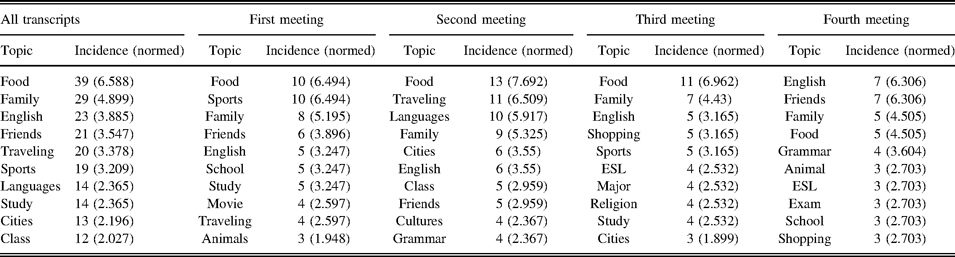
Our analysis focuses only on the transcripts for the 50 IEP students. Thirty-five of these participants were male, and ages ranged between 18 and 55 years old (M = 26.1, SD = 8.26). L1 backgrounds included Korean, Mandarin Chinese, Japanese, French, Mexican Spanish, Malay, Portuguese, Sinhala, Thai, Arabic, and Uzbek (see Appendix A for a detailed list of participants’ L1s and corresponding language distance measures). Table 1 displays descriptive information about the total corpus for the IEP students, including number of transcripts collected, information on missing transcripts, and the average transcribed word counts per month. Table 2 presents the 10 most frequent topics for the entire corpus and by meeting.
Descriptive statistics for corpus

Incidence of top ten topics in transcripts

INDIVIDUAL DIFFERENCE MEASURES
In addition to transcripts of their oral production, we also collected the following individual difference measures from each of the IEP participants: English proficiency level, age, sex, and language distance (i.e., how different a participant’s L1’s linguistic features are from English). We included age, gender, and first language as additional variables because of multiple studies that have demonstrated the influences these variables can have on language learning and use (see preceding text). We computed language distance by using measures reported in Miller and Chiswick (Reference Miller and Chiswick2005). Each L1 is assigned a score from 1 to 3, with a score of 1 (e.g., Korean) being further from English than a score of 3 (e.g., Afrikaans).
English proficiency was measured using an ACT Compass ESL test administered at the beginning of the semester in which the conversations took place. The test included sections related to listening, reading, and grammar, and students were placed into proficiency levels based on recommendations from the test makers. Thus, students who scored 126 or below on the ACT Compass ESL reading/grammar tests were classified as high beginning level. Students that scored 127 to 142 were classified as low intermediate level and those that scored 143 to 162 were classified as high intermediate. Students who scored 163 or higher were classified as advanced. In total, the corpus included 8 high beginner learners, 14 low intermediate learners, 9 high intermediate learners, and 19 advanced learners.
FREQUENCY FEATURES
In this study, we focus on raw frequency features for individual words (i.e., low-complexity features), which fit the criteria for a usage-based language study (Gries, Reference Gries, Engelberg, Lobin, Steyer and Wolfer2018). We calculated frequency features based on NS and NNS corpora. The NS frequency features were calculated from the spoken section of the Corpus of Contemporary American English (COCA; Davies, Reference Davies2008). The NNS frequency features were calculated using the TOEFL11 corpus (Blanchard, Tetreault, Higgins, Cahill, & Chodorow, Reference Blanchard, Tetreault, Higgins, Cahill and Chodorow2013). For both corpora, we calculated frequency features related to word tokens (i.e., each individual lemmas) and word types (i.e., each unique lemmas). The features were automatically calculated using the Tool for the Automatic Analysis of Lexical Sophistication 2.2 (TAALES; Kyle & Crossley, Reference Kyle and Crossley2015; Kyle, Crossley, & Berger, Reference Kyle, Crossley and Berger2018). The features are discussed in more depth in the following text.
NS FREQUENCY NORMS
We selected COCA spoken norms to examine changes in word frequency over time. COCA comprises texts collected between 1990 and 2015 that represent five registers (academic, fiction, magazine, news, and spoken). The total size of the corpus is 520 million words equally divided among the registers. The spoken corpus thus comprises 104 million words. The spoken subcorpus was derived from transcripts of unscripted conversation from around 150 different radio and television shows. We selected both type and token indices for all words. These indices were logarithmically transformed to control for Zipfian distributions. Frequency scores are calculated in TAALES by dividing the sum of the frequency scores for the tokens in a text by the number of tokens in that text that received a frequency score (i.e., words in the text that are not in the selected frequency lists are not included in the frequency counts). Initial results indicated that 97% of the words in the L2 corpus were found in the COCA spoken section.
NNS FREQUENCY NORMS
A large spoken NNS corpus from which to derive frequency norms is not available. As a proxy for NNS spoken frequency, we used the TOEFL11, which comprises 11,000 essays taken from the TOEFL iBT test. This corpus is composed of argumentative essays and contains 3,509,001 words. Test takers, all NNS of English, were required to respond to a brief topic in the time span of 30 minutes. To guarantee a variety of language backgrounds and topics, a total of 11 different language backgrounds (i.e., Arabic, Chinese, French, German, Hindi, Italian, Japanese, Korean, Spanish, Telugu, and Turkish) and eight distinct essay prompts were used as criteria to develop the corpus (Blanchard et al., Reference Blanchard, Tetreault, Higgins, Cahill and Chodorow2013). To create the NNS norms, we excluded tokens whose frequency equaled one (i.e., words that appeared only once in the corpus and its subcorpora). This measure prevented the inclusion of neologisms and rare misspellings. We developed type and token frequency indices using the entire corpus. Like the NS spoken corpus, the indices were logarithmically transformed to control for Zipfian distributions. Initial results indicated that ∼90% of the words in the L2 corpus were found in the TOEFL11 corpus.
STATISTICAL ANALYSIS
We used LME models in R (R Core Team, 2016) using the lme4 package (Bates, Mächler, Bolker, & Walker, Reference Bates, Mächler, Bolker and Walker2015) to examine any changes in frequency over time (i.e., as participants completed conversation sessions over the 4-month period). We opted to use LME models because they offer statistical advantages over traditional repeated measures analyses of variance (RM ANOVAs). Specifically, LMEs account for both pooled and individual variance among participants as opposed to one pooled group mean by including subjects as random effects (i.e., assigning a unique intercept for each participant), resulting in more accurate estimates based on individual participant variation. LMEs also better account for the impact of experimental variables of interest by allowing a researcher to assign random slopes per variable per participant. This process allows for variation attributed to hypothesis-related variables to be better separated from variance attributable to error based on other, unrelated features of the participants.
When building our models, we constructed a unique model for each frequency measure of interest, for a total of four models. The purpose for these four models was because each model included a unique dependent variable (i.e., the different measures of frequency explained previously). The purpose of each model was to test whether any of the independent variables (e.g., age, language distance, session order) significantly predicted changes in word frequency (i.e., the dependent variable), allowing us to determine whether any of the independent variables affected the production of the participants in the study. Accordingly, in each model, we entered the frequency measure as the dependent variable, with age, gender (female or male), language distance (1–3), English proficiency (advanced, high intermediate, low intermediate, or high beginning), session order (1–4), and pair language match (i.e., L1/L2 or L2/L2) as fixed effects (i.e., predictor variables). The baselines for our categorical variables were as follows: proficiency: advanced, gender: female, pair language match: L2/L2. We also included subjects as random effects, with a random slope of session order fit to participants. In each model, we also fit an interaction between session order and English proficiency to measure whether English proficiency influenced word frequency production over time. To properly interpret potential main effects for session order, we first tested models without the interaction between session order and English proficiency and only included significant interactions in our final models.
We also used several other packages to aid in our construction and interpretation of our models. We used lmerTest (Kuznetsova, Brockhoff, & Christensen, Reference Kuznetsova, Brockhoff and Christensen2016) to derive p values from the models, multcomp (Hothorn, Bretz, & Westfall, Reference Hothorn, Bretz and Westfall2008) to obtain full pairwise comparisons between the four proficiency levels (advanced, high intermediate, low intermediate, and high beginner), the effects (Fox, Reference Fox2003) package to retrieve model information for our figures, and the MuMIn package (Nakagawa & Schielzeth, Reference Nakagawa and Schielzeth2013) to obtain two measures of variance explained: a marginal R 2 measuring the variance explained by the fixed effects only, and a conditional R 2 measuring the variance explained by the fixed and random effects combined.
RESULTS
COCA SPOKEN TOKEN INDEX
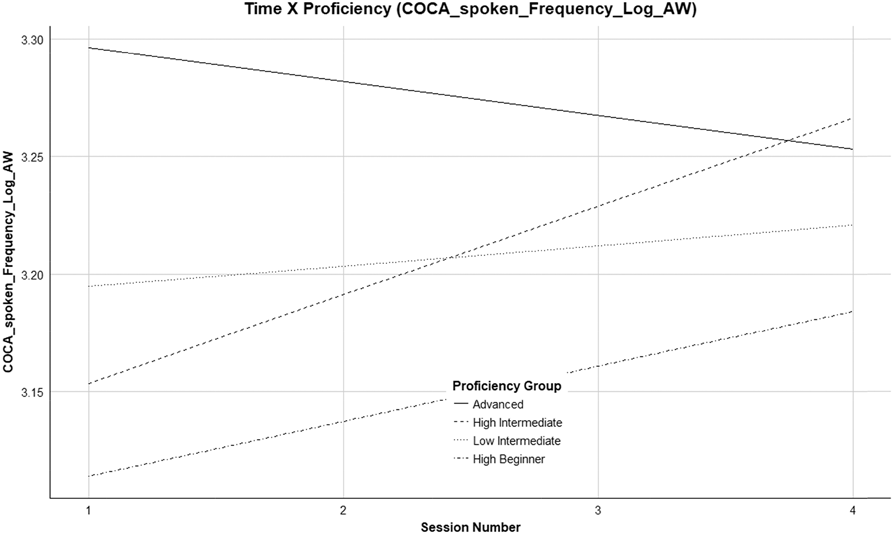
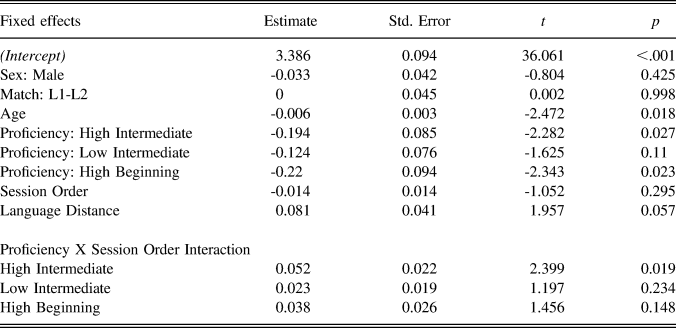
An LME model using COCA spoken token frequency (all words, logarithmic correction) as the dependent variable without interactions (intercept = 3.316) reported a significant, negative main effect of age (coefficient = -.001, t = -2.599, p = .013), proficiency level (high beginner compared to advanced, coefficient = -.113, t = -2.027, p = .049), and a significant, negative effect for language distance (coefficient = .087, t = 2.138, p = .038) such that older learners used less frequent words, high beginner learners produced more infrequent words when compared to advanced learners, and decreasing levels of language distance predicted participants’ spoken frequency values. No other main effects were reported. An LME model with an interaction fit between proficiency and session order reported a significant main effect for age, and a significant interaction between English proficiency (high intermediate learners compared to advanced learners) and session order. In the case of the interaction, the high intermediate participants’ COCA spoken token frequency was significantly lower during earlier sessions when compared to advanced participants, but then increased significantly as session order increased. This interaction is visualized in Figure 1. This model reported a marginal R 2 of .211 and a conditional R 2 of .651. Table 3 displays the estimates, standard errors, t values, and p values for the fixed effects entered into this model.
Interaction plot demonstrating the effect of proficiency and session order on COCA spoken token frequency (all words, logarithmic correction). High intermediate participants’ COCA spoken token frequency (all words, logarithmic correction) was significantly lower during earlier sessions when compared to the advanced participants, and then significantly increased as session order increased.

LME model predicting COCA spoken token frequency (all words, logarithmic correction)

Note: Baselines for categorical variables are as follows: Sex = Female, Match = L2-L2, Proficiency = Advanced
COCA SPOKEN TYPE INDEX
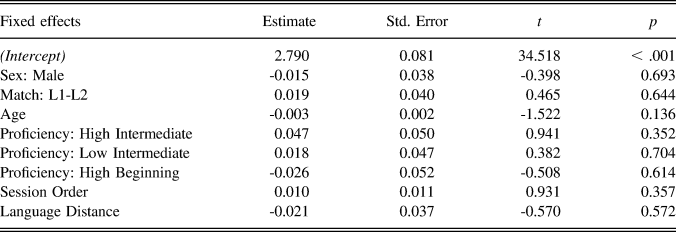
An LME model with COCA spoken type frequency (all words, logarithmic correction) as the dependent variable reported no significant main effects or interactions. This model reported a marginal R 2 of .062 and a conditional R 2 of .358. Table 4 displays the estimates, standard errors, t values, and p values for the fixed effects entered into this model.
LME model predicting COCA spoken type frequency (all words, logarithmic correction)

Note: Baselines for categorical variables are as follows: Sex = Female, Match = L2-L2, Proficiency = Advanced
NNS TOKEN INDICES
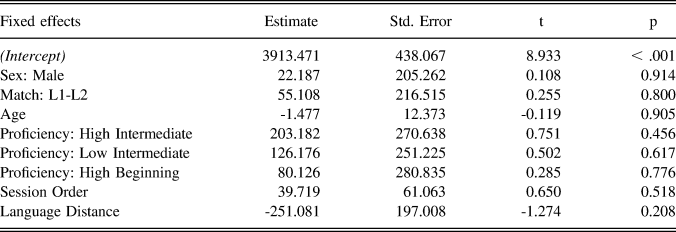
An LME model with TOEFL11 frequency as the dependent variable without interactions reported a significant, positive main effect for proficiency and language distance, such that high beginner learners used less frequent words than advanced learners and decreasing levels of language distance increased participants’ spoken frequency values (see Table 5). No other main effects were reported and post-hoc comparison among proficiency level reported no other significant differences. The model reported a marginal R 2 of .178 and a conditional R 2 of .581. An LME model with an interaction fit between proficiency and session order reported no significant interactions Table 5 displays the estimates, standard errors, t values, and p values for the fixed effects entered into this model.
LME model predicting TOEFL11 frequency (all words, logarithmic correction)

Note: Baselines for categorical variables are as follows: Sex = Female, Match = L2-L2, Proficiency = Advanced
NNS TYPE INDICES
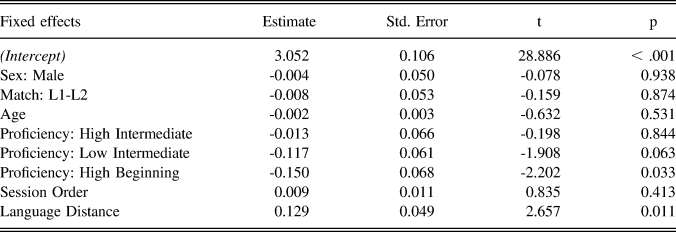
An LME model with TOEFL11 type frequency (all words, logarithmic correction) as the dependent variable reported no significant main effects or interactions. This model reported a marginal R 2 of .032 and a conditional R 2 of .414. Table 6 displays the estimates, standard errors, t values, and p values for the fixed effects entered into this model.
LME model predicting TOEFL11 frequency (all types, logarithmic correction)

Note: Baselines for categorical variables are as follows: Sex = Female, Match = L2-L2, Proficiency = Advanced
POST-HOC ANALYSES
We ran a series of post-hoc analyses to examine potential frequency effects for lexical acquisition resulting from differences in content and function words. Our previous analyses examined all words produced by L2 learners and found a frequency effect wherein lower-level L2 learners produced more infrequent words at the beginning of the study for NS frequency norms calculated at the token level. However, at least one previous study (Kim et al., Reference Kim, Crossley and Kyle2018) has shown that L2 learners produce more frequent content words as a function of time, but less frequent function words. For the post-hoc analyses, we conducted the same LME analyses as in the first initial analysis, but we focused on spoken frequencies taken from COCA for both types and tokens.
COCA SPOKEN TOKEN INDICES (CONTENT AND FUNCTION WORDS)
For COCA content words calculated on word tokens, a significant effect was only reported for age (coefficient = -.009, t = -3.238, p = .002) indicating that older L2 speakers produced more infrequent content words. There were no other main effects or significant interactions. For COCA function words calculated on word tokens, a significant main effect was only reported for language distance (coefficient = .075, t = 2.381, p = .021) indicating that L2 participants whose first language was closer to English produced more frequent function words. There were no other main effects or significant interactions.
COCA SPOKEN TYPE INDICES (CONTENT AND FUNCTION WORDS)
For COCA content words calculated on word types, no significant main effects were reported and there were no significant interactions. Similarly, for COCA function words calculated on word types, no main effects or significant interactions were reported.
DISCUSSION
Linguistic frequency is an important element of language acquisition with a number of L2 studies indicating that more frequent items are acquired earlier (Ellis, Reference Ellis2002a, Reference Ellis2002b; Ellis et al., Reference Ellis, O’Donnell and Römer2013, Reference Ellis, O’Donnell, Römer, MacWhinney and Grady2015, Reference Ellis, Römer and O’Donnell2016; Tomasello, Reference Tomasello2000). These frequency effects are argued to be a principle component of L2 acquisition (Ellis, Reference Ellis2002a; Ellis & Collins, Reference Ellis and Collins2009), although not the only component, and are a key tenet of usage-based theories of language acquisition (Ellis, Reference Ellis2002a). A number of cross-sectional studies investigating L2 lexical production have supported the role of frequency in L2 word learning such that beginning learners produce more frequent words (Bell, Reference Bell2003; Crossley et al., Reference Crossley, Salsbury, McNamara and Jarvis2011a; Crossley & McNamara, Reference Crossley and McNamara2012, Reference Crossley and McNamara2013; Dabbagh & Enayat, Reference Dabbagh and Enayatin press; Kim et al., Reference Kim, Crossley and Kyle2018; Kyle & Crossley, Reference Kyle and Crossley2015; Laufer & Nation, Reference Laufer and Nation1995; Meara & Bell, Reference Meara and Bell2001; Palfreyman & Karaki, Reference Palfreyman and Karakiin press). However, longitudinal studies of L2 lexical production have shown contrasting results with a number of studies indicating that L2 learners begin to produce more frequent words as a function of time (as compared to producing less frequent words as a function of time; Crossley et al., Reference Crossley, Salsbury and McNamara2010, Reference Crossley, Salsbury, Titak and McNamara2014; Kim et al., Reference Kim, Crossley and Kyle2018). These studies relied on a single longitudinal corpus (the Salsbury longitudinal spoken corpus; Salsbury, Reference Salsbury2000) and the results may be specific to that data. Additionally, the majority of the studies focused only on frequency effects in L2 word learning and did not take into consideration individual learner factors such as L1, age, and gender, all of which may affect lexical acquisition.
Thus, the purpose of this study was to examine L2 lexical developmental patterns using frequency measures extracted from a large longitudinal corpus of 50 L2 speakers of English. In contrast to previous studies, the current study used finer-grained indices of word frequency including native speaker and nonnative speaker frequency norms calculated at the type (unique words) and token (all words) level. In addition, the study controlled for a number of individual differences variables including proficiency, age, gender, and first language distance from English.
The findings from this study support earlier longitudinal research conducted by Crossley and colleagues (Crossley et al., Reference Crossley, Salsbury and McNamara2010, Reference Crossley, Salsbury, Titak and McNamara2014; Kim et al., Reference Kim, Crossley and Kyle2018) by demonstrating that lower-level L2 learners produced more infrequent words at the beginning of the study for NS frequency norms calculated at the token level. The token results indicate that high intermediate learners, when compared to advanced learners, produced more infrequent words at the beginning of the study and more frequent words toward the end of the study. Main effects were also reported for proficiency level in the NS frequency indices such that advanced learners generally produced more frequent words than high intermediate and high beginning learners. Main effects were also reported for age such that older learners produced more infrequent words, likely because they have more longer experiences with the distributional patterns of words in English. For the NNS norms, no interactions were reported, and main effects were reported for proficiency and language distance. In terms of proficiency, high beginning learners produced more infrequent words than advanced learners. For language distance, learners whose first language was closer to English produced more frequent words.
No interactions or main effects were reported for NS or NNS type frequency indices, indicating no development at the individual word level. Word types likely tap into productive knowledge (i.e., the words a learner knows) and a lack of any linear trends (either positive or negative) suggests that the L2 learners in this study likely developed words along a nonlinear frequency path.
The interaction findings for NS token measures indicate that not all L2 speakers in this analysis reported a frequency effect in which more frequent words were produced at the beginning of the study. The effect was strongest for high intermediate levels. The interaction indicates that, in general, L2 speakers at the high intermediate level produced more infrequent words at the beginning of the study and more frequent words at the end of the study when compared to advanced learners. In conjunction with the main effects reported for proficiency, which indicated that advanced L2 learners produced more frequent words than high beginning and high intermediate L2 learners, we see a pattern in which beginning and intermediate learners begin to produce more frequent words over time and start to align with the word frequency production of advanced L2 learners. While this finding fits with previous longitudinal studies of lexical production (Crossley et al., Reference Crossley, Salsbury and McNamara2010, Reference Crossley, Salsbury, Titak and McNamara2014; Kim et al., Reference Kim, Crossley and Kyle2018), it runs counter to a number of cross-sectional studies of lexical acquisition (Bell, Reference Bell2003; Crossley et al., Reference Crossley, Salsbury, McNamara and Jarvis2011a, Reference Crossley, Salsbury, McNamara and Jarvis2011b; Kyle & Crossley, Reference Kyle and Crossley2015; Laufer & Nation, Reference Laufer and Nation1995). Indeed, this study, along with previous longitudinal studies, provides counterevidence to the notion that frequency effects based on absolute frequency counts are strong predictors of lexical acquisition for individual words.
Instead of producing more frequent words earlier, high beginning and high intermediate learners initially produce lower frequency words and then begin to attune their production to match the frequency of more advanced learners. It is probable, then, that early learners are not fully attentive to frequency distributions in the language, likely as a result of minimal exposure, while advanced learners are more sensitive to L2 frequency distributions, as has been postulated in previous studies (Paquot, Reference Paquot2017). Without enough exposure to the language, L2 learners may not have enough data from which to develop accurate structural regularities. Over time, in this case 4 months, they begin to produce more frequent words that may be the result of increased language exposure that affords them the opportunity to develop statistical expectations for the lexical items in English.
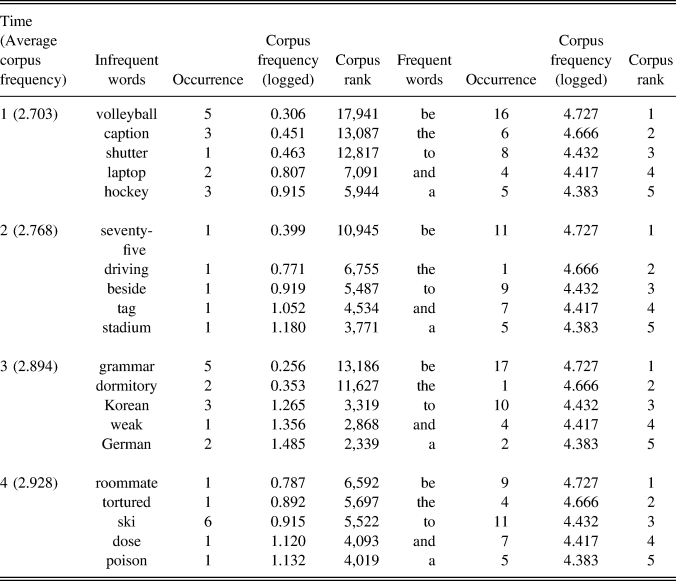
To illustrate these changes, we present frequency data from a single participant (participant 63) over the course of the 4-month study. Table 7 presents the average logged frequency (COCA spoken subcorpus) for the words produced by the participant at each time point. It also includes five low-frequency words and five high-frequency words produced by the participant at each time point as well as the rank of the word within the COCA spoken subcorpus and the number of times each word was produced (a higher rank indicates a less frequent word). The transcripts from this learner along with the frequency scores for each individual word produced by this learner are available as supplemental material for this study (see supplemental material file). Table 7 indicates that the infrequent words produced by participant 63 in the first conversation were quite infrequent and many of these words were repeated (e.g., volleyball and caption). In contrast, participant 63 produced the same top five frequent words each conversation and these words were the most frequent words in the COCA spoken subcorpus. The data in Table 7 provide some support for the notion that L2 learners produce infrequent words at the beginning of the study and later begin to attune their production to match the frequency of native speakers. As mentioned earlier, this is likely the result of L2 learners becoming attuned to the word frequency distributions of language over time.
Frequency data from participant 63

Our post-hoc analysis showed no difference in terms of development over time when we examined the frequency of content and function tokens and types, which helps to rule out the notion that frequency effects may be modulated by larger part of speech constructs. The post-hoc analysis did report that age demonstrated a significant main effect for content words such that older L2 learners produced more infrequent words than younger learners. A main effect was also reported for language distance with respect to function words such that learners with a language closer to English produced more frequent English function words.
It is also important to highlight that this study focused on single lexical items. Most studies that report frequency effects in L2 learning have generally investigated multiword characteristics and not single words. Word and phrase combinations such as construction frequency (e.g., the frequency of verb argument constructions) or type frequency (e.g., the number of lexical types that can fit into various verb argument construction) differ from single words in that they allow for larger abstractions of analogies and language patterns based on form-meaning mappings (Goldberg, Reference Goldberg2003; Robinson & Ellis, Reference Robinson and Ellis2008). These features examine regularities in language that go beyond the individual word, providing additional context for learning. It is possible, then, that frequency effects rely on the additional context provided within frames of words and are not activated for single linguistic items. Indeed, recent studies have found that multiword combinations may be better predictors of proficiency when compared to single-word measures, though the combination of multi- and single-word frequency measures appear to produce the most accurate predictions of L2 proficiency (Bestgen, Reference Bestgen2017; Kyle & Crossley, Reference Kyle and Crossley2015).
In addition, it is important to note that L2 production at early stages of learning is not a random assortment of words, but rather a collection of linguistic items that are self-selected, the result of instruction, or the result of repeated, naturalistic exposure (which may not be perfectly aligned with reference-corpus frequencies). As such, language production is still likely driven by linguistic experience and, in many cases, even for single words, this experience will follow the tenets of usage-based learning theories that go beyond frequency. Thus, while the main findings of this study may provide counterevidence for frequency effects in lexical learning, as described in a usage-based framework, they may not reflect the actual language exposure for each participant, and they do not run counter to other tenets of usage-based learning. Within a complex adaptive systems framework, for example, one would not expect to find the linear trends sought in this analysis. Instead, language learning is seen as a nonlinear process that is affected by a number of intervening factors such as language levels, timescales, and social interactions (Beckner et al., Reference Beckner, Blythe, Bybee, Christiansen, Croft, Ellis and Schoenemann2009; Ellis & Larsen-Freeman, Reference Ellis and Larsen-Freeman2009; Ellis & Wulff, Reference Ellis, Wulff, VanPatten and Williams2015). In addition, a usage-based learning framework posits that learners notice and acquire linguistic items based on the salience and perception of those items (Boyd & Goldberg, Reference Boyd and Goldberg2009; Ellis, Reference Ellis2006a, Reference Ellis, Gries and Divjak2012). At least one previous study (Crossley, Kyle, & Salsbury Reference Crossley, Kyle and Salsbury2016) has examined the role of salience in longitudinal L2 lexical acquisition by examining word properties such as concreteness and meaningfulness and how they interact with learning. Crossley et al. found that more salient words (i.e., more concrete and more meaningful words) demonstrated development over time such that L2 learners’ vocabulary became less salient (i.e., more sophisticated) as a function of time. This finding contrasts with the current frequency results and follows expected learning trends such that learners begin to produce more sophisticated language as a function of time. Indeed, recent studies conducted on larger longitudinal datasets have supported these findings (Crossley & Skalicky, Reference Crossley and Skalickyin press) indicating that other elements of usage-based theories may be driving learning for single items in the absence of frequency effects.
There are other potential reasons for the results reported in this study that are supported by a usage-based framework. For instance, as mentioned by Crossley et al. (Reference Crossley, Salsbury, Titak and McNamara2014), many frequent words, especially function words, are associated with more complex syntactic and grammatical form-function relations and thus are more difficult to produce, especially for beginning L2 learners. Additionally, more difficult, but more frequent, form-function relations may be less phonologically salient and thus be more difficult to learn. Lastly, there may be cross-linguistic influence that interact with lexical acquisition that affect learning. As noted by Ellis (Ellis, Reference Ellis2006a, Reference Ellis2006b), for L2 learners, acquisition is not a matter of development from a blank slate (tabula rasa), but rather development built onto a preexisting first language and any number of additional languages (tabula replete). For instance, Crossley et al. (Reference Crossley, Salsbury, Titak and McNamara2014), argued that lexical experience in the first language likely influences production in a second language such that words that may be frequent in a first language but infrequent in an L2 may be produced before frequent words in an L2. Thus, L2 learners that have L1s that are more dissimilar to English may produce words that do not match English frequency distributions as a result of cross-linguistic influence. There is some evidence for that in the current study. For each of our token frequency indices, there was a marginal or significant main effect for language distance indicating that L2 learners whose first language was closer to English produced more frequent words in English. Thus, L2 learners of English whose first language may share similar frequency distributions with English produced more frequent words, matching the expectations of the L1, while speakers whose first language did not share similar distribution patterns produced more infrequent words, counter to the expectations of the L1. Simply put, L2 learners may rely on the distributional and statistical regularities in their L1 when first learning an L2, and this may influence the frequency of the words they produce. This finding mirrors that of a recent study by Paquot (Reference Paquot2017) in which she reported parallel frequencies between discourse-oriented lexical bundles in L2 learners’ first and second languages leading her to conclude that L1 frequency has an impact on L2 frequency.
CONCLUSION
This study examined links between time spent learning English and a variety of individual difference factors on the word frequency output of L2 learners. The aim of the study was to investigate if word frequency decreased as a function of time learning English, as would be predicted by frequency effects or if word frequency would increase as a function of time learning English, as has been reported in previous longitudinal studies. Unlike previous studies, we used a large, longitudinal corpus of 50 L2 speakers of English and finer-grained indices of word frequency computed from both NS and NNS corpora and calculated at both the type and token level. The findings from the study support previous longitudinal studies of frequency that demonstrated that L2 learners produce more frequent words as a function of time spent learning English. This counters a central tenet of usage-based theories of language learning (frequency effects in lexical acquisition) but does not challenge other premises of usage-based approaches. While we know that frequency is an important element of a usage-based framework, it is not the only usage-based factor that impacts second language acquisition (Ellis & Wulff, Reference Ellis, Wulff, VanPatten and Williams2015). Thus, the results can help refine how tenets of a usage-based framework are applied across linguistic items and potential limitations within the framework. Specifically, it appears that frequency effects are not strong predictors of acquisition for individual linguistic items like words. We are not the first to note this. For instance, Ellis and Wulff (2015, p. 84) wrote that “frequency effects come in different kinds … and they will have differently weighted impacts depending on the target structure under examination.” In the case of single lexical items, other factors important to usage-based learning like salience most likely play an important role. In addition, the study provides evidence that language distance also affects lexical acquisition with L2 learners whose first language is closer to English producing more frequent words that likely meet the distribution patterns of English.
While we used a much larger longitudinal corpus of L2 learners than previously available, the distribution of learners within proficiency levels was not well balanced. While this would not affect the statistical techniques used in the study, a larger sample of high beginner and high intermediate learners is desirable. Beyond a larger sample, the amount of exposure to English participants receive should be tracked in future studies. While it is almost impossible to accurately measure exposure outside of the classroom, surveys could be used to better estimate students’ interactions with L1 and L2 speakers of English along with exposure to English media (both print and visual). In addition, the manner in which proficiency was assigned was less than optimal because the ACT Compass ESL test does not measure speaking or lexical proficiency and instead focuses on listening, reading, and grammar skills. Lastly, this study focused solely on individual words and not on longer segments of linguistic features at the phrasal, utterance, or discourse level. Future studies should consider language development at phrasal, syntactic, and text cohesion levels.