Introduction
‘Politics has become a contest of competitive credibility’, writes Joseph Nye in Soft Power: ‘Governments compete with each other and with other organizations to enhance their own credibility and weaken that of their opponents’.Footnote 1 The information revolution has made the reputation for credibility a critical asset in the struggle for soft power, because the glut of alternative sources of news creates a ‘paradox of plenty’ – ‘a plentitude of information [that] leads to a poverty of attention’.Footnote 2 To stand above the competition, to draw attention and to hold it – and ultimately, to persuade – one needs to have a reputation for providing trustworthy, accurate information.
The huge growth in the amount and variability of information in the international system has also generated an unprecedented degree of visibility and transparency in world politics.Footnote 3 Consequently, interested observers are now able to monitor and evaluate the consistency among various elements in the grand strategies of states, in particular the conformity of words and deeds. Consistency is a strong determinant of credibility (hence the prominence of discrepancy charges in discreditation strategies), and if a state's advocacy is perceived as incompatible with its foreign policy or military action, its reputation and public diplomacy suffer.Footnote 4 Indeed, writing of non-governmental organisations (NGOs) as ‘central players in the image stakes’, Hocking observes that ‘Manipulating the images of other actors, creating what might be termed “image dissonance”, based on the exploitation of differences between images that countries project of themselves and those that other actors can be persuaded to regard as more accurate, has indeed become a new “great game”’.Footnote 5
In this game, the technical aspects of the politics of credibility are one of its most prominent features, and this implies that practices will continue to be affected by the technological advances that lead the information revolution. However, it is important to keep in mind Rosenau's observation that ‘Generating such data is … essentially a task for intelligence communities, but transforming the information into the scientific evidence and proof that is needed to persuade potential friends and enemies abroad of the legitimacy of a position on an issue is a task for foreign offices and their diplomats’.Footnote 6 Thus, in what Rosenau calls ‘relations of proof’,Footnote 7 the rhetoric of establishing (or undermining) credibility – what will be called here ‘credibility talk’ – is not just a verbal ritual of no consequence; it is an act of power – at least in relations that unfold in a context of shared criteria of evidence.
Indeed, the ubiquity of credibility talk, even across cultures (see Appendix A for some notable cases), indicates that the process itself of crediting proffered arguments has deep psychological roots, related to the stability of identities and the emergent social order.Footnote 8 One unknown about the communications revolution is whether the unprecedented intensification of cross-cultural interaction that it has fostered will ultimately generate shared global norms on the meaning of proof and the criteria of evidence (analogous to the status of court proceedings). However, familiarity with accepted criteria permits even those who are not (or not fully) socialised to ‘play along’ strategically, consistent with Goffman's insightful observation on the relationship between performers and social norms: ‘qua performers, individuals are concerned not with the moral issue of realizing these standards, but with the amoral issue of engineering a convincing impression that these standards are being realized’.Footnote 9
The study of credibility naturally involves such issues as the technologies of evidence collection and dissemination, and the determinants of credibility reputations. However, this article is not concerned with the empirical impact of credibility on persuasion, namely with its effectiveness.Footnote 10 Instead, I focus on a related aspect of credibility that has not been sufficiently explored – credibility talk as a practice in public diplomacy: How do states actually go about establishing, protecting, and enhancing their credibility in diplomatic interactions? Is there a systematic basis for anticipating the use of certain rhetorical strategies in certain situations?
To be sure, actors strive for effective (that is, persuasive) communication and for that reason attempt to build their credibility. But what actors think will work (the question of means) and what actually works (the question of outcome) is not one and the same. Moreover, the norms of credibility to which actors appeal are not just out there in ‘nature’; they are produced in interaction, which brings us back to what actors do. Doing, in this case, means talking, and so the construction of credibility through talk is the topic of this article.Footnote 11 Persuasion is indeed one outcome, but so is the emergence of a normative structure that provides the building materials for strategies of credibility construction. On this aspect of strategic communication in public diplomacy surprisingly little has been written, in contrast to the issue of credibility in bargaining situations, to which the literature in strategic studies and game theory has devoted numerous studies (especially during the Cold War). It is toward this lacuna that the current article is directed, and the following pages offer an initial conceptualisation, a theoretical framework, and some evidence from exploratory empirical research.
In pursuing the research questions, my approach is not to try and extract the credibility component from the normal flow of rhetoric, but rather to study it in its context, as it is intertwined with the arguments that states make more generally in their strategic communications. Public diplomacy advocacy Footnote 12 is such an activity, and the practices discussed in this article are instances of it. However, because states argue in a context, and because the meaning of credibility talk as a practice depends on it, this article looks more specifically at one type of context that is prevalent in public diplomacy – situations in which states are held responsible for untoward behaviour and are called upon to account for their actions. Such accounts, then, are often offered in the context of a debate between two international actors (usually two states, or a state and an NGO) that present competing arguments before an audience whose support they would like to secure. Crediting one's own claims while undermining those of an opponent are rhetorical strategies used in these debates in order to persuade and obtain audience acceptance of one's position.
The following section applies rhetorical theory, impression management theory, and social accounts theory in order to: (a) present a general conception of the sociology of credibility contests and how they function in international society; and (b) map out and analyse the particular rhetorical moves that constitute credibility talk in these recurrent public diplomacy situations. The latter discussion is then subjected, in Section 3, to an empirical examination in the context of the debate between Israel and international human rights organisations during the 2006 Lebanon war (called the Second Lebanon War in Israel). Section 4 then summarises the key arguments: the construction of credibility is an inherent part of social accounts, including those pertaining to the use of force; force indeed goes hand in hand with talk, not only for bargaining purposes but also to interpret and persuade, thus requiring accounts to be credited; actors make claims not only with respect to truth and appropriateness but also with respect to sincerity (or character-credibility); since norm-related and identity-related claims cannot be validated directly, actors try to credit them indirectly, through factual appeals; and scientific discourse, in particular, influences the kind of standards that actors adopt in seeking to credit their accounts. Finally, the importance of validation tactics is only expected to grow with technological advances, rising transparency, and the level of contestation they generate in the system.
Theory
Credibility refers to a perception or judgment of the believability of a communicator and his or her message. Given uncertainty about claimed intentions and/or competence of a source, credibility is how an audience perceives the relationship between claimed and actual motivations or intentions, claimed and actual competence. Since Aristotle's Rhetoric, the credibility construct has been seen to comprise three major dimensions – expertise, trustworthiness, and goodwill.Footnote 13 Gass and Seiter note that ‘credibility does not reside in a source. It is bestowed on a source by an audience’.Footnote 14 This observation pertains to credibility as an outcome or product, and ties in with the scientific research agenda pioneered by Hovland, Janis, and Kelley, who related attitude change through persuasion to the characteristics of the source, the message, and the audience.Footnote 15 The research perspective in this article focuses on the process (interaction) by which actors attempt to construct, maintain, and defend their credibility.Footnote 16
The meaning of credibility varies with the context of interaction. Following Schelling,Footnote 17 most of the work in International Relations has been done on credibility in strategic bargaining: In this context, credibility concerns the believability of threats, promises, and commitments – it is related to future events, in that one player seeks to influence the perception of another as to the conformity between present messages and future actions. The problem of credibility arises because future moves cannot be guaranteed in advance, and because the inherent uncertainty about motivations (or preference types) and their stability (the problem in commitment) creates the distinct possibility that players may not be interested in carrying out their threats or promises when the time comes.Footnote 18
In contrast, in rhetorical contests such as propaganda wars or public diplomacy advocacy, at stake is not the convergence on an agreement but rather the persuasion of a target audience.Footnote 19 Walton, discussing various types of argumentative dialogue, defines the (forensic) debate as a situation where ‘there are judges or referees who determine, perhaps by voting, which side had the better argument’. In this situation, ‘the basic purpose … is to win a verbal victory against your opponent by impressing the audience (or referee) of the debate’.Footnote 20 This is different not only from bargaining as described above, but also from persuasion dialogue, where each of two parties seeks to persuade the other of some thesis.Footnote 21 It is this latter type of persuasion that Elster has in mind in observing that ‘when people argue, they make assertions with a claim to validity … When they engage in bargaining, they make threats and promises with a claim to credibility’.Footnote 22 This distinction breaks down, however, in a debate situation, where threats and promises play no role but credibility overrides validity. Cunningham's argument on propaganda applies here: it instrumentalises truth and subjects it to ‘the lesser modalities of mere belief and credibility’.Footnote 23 In the context of a debate, then, the meaning of credibility comes out of the relationship between truth (or accuracy) and persuasion. In particular, where lies and deceit are likely to undermine credibility, especially in an age of transparency, truth and accuracy do not necessarily generate belief – and can even backfire. This issue has been at the centre of discussions in rhetorical theory, which is addressed next.
Rhetorical theory
From an Aristotelian perspective, credibility, or character (ethos), is one of the three means of persuasion (pisteis) that operate in a speech, the other two being logical argument (logos) and emotion (pathos).Footnote 24 In the Rhetoric, Artistotle states that whenever speech ‘is spoken in such a way as to make the speaker worthy of credence’, persuasion ‘through character’ takes place. In fact, ‘character is almost, so to speak, the most authoritative form of persuasion’. Artistotle distinguishes, however, between ‘atechnic’ (non-artistic) and ‘entechnic’ (artistic) means of persuasion, the former preceding the speech and not furnished by the speaker, whereas the latter forming part of the speech and subject to the application of method. Persuasion by character, he argues, is artistic, and ‘should result from the speech, not from a previous opinion that the speaker is a certain kind of person’.
Both before and after Aristotle, philosophical studies of rational reasoning (or what Aristotle called ‘analytical reasoning’ – applying the valid inference of the syllogism) viewed the influence of character on audiences – indeed, rhetorical persuasion as such – as an obstacle to the pursuit of truth. Truth was supposed to exist independently of any speaker or audience. This was the basis of Plato's rejection of the sophists as braggarts.Footnote 25 The identification of the formal syllogism with the essence of logic, to the exclusion of other forms of reasoning, had a long-lasting influence. As Tindale notes, ‘… not only did FDL [formal deductive logic] become synonymous with logic, but “argument” itself became synonymous with deductive argument. A rich tradition of interest in argument as rational persuasion, traceable to Aristotle's own discussions, was left by the wayside’.Footnote 26
The shift, in the twentieth century, from an exclusive focus on formal validity to the admission of informal logic and (everyday) argumentation, resulted in new models of argumentation and in a revival of the Aristotelian view of dialectical and rhetorical reasoning. Perelman's new rhetoric distinguished between argumentation and ‘formally correct demonstration’, as follows: ‘the aim of argumentation is not to deduce consequences from given premises; it is rather to elicit or increase the adherence of the members of an audience to theses that are presented for their consent’.Footnote 27 This distinction, bringing in the audience as an integral element in the act of argumentation for persuasion, was justified by the simple empirical observation that, where self-evident truths are absent, arguments are required to obtain the adherence of others to some thesis. This, in turn, meant that ‘unlike the processes of analytical reasoning, a dialectical argument can not be impersonal, for it derives its value from its action upon the mind of some person’.Footnote 28 Instances of that action ‘are not made up of series of valid and compelling inferences; rather, they advance arguments which are more or less strong, more or less convincing, and which are never purely formal’.Footnote 29
This conception raises some issues related to character-credibility. If persuasion is the objective of rhetoric (indeed, constitutive of it), and if the effectiveness of the process becomes thereby the standard of its evaluation,Footnote 30 then truth is subordinated to credibility. At best, this may result in the ironic decision to suppress a truth whose publication could risk established credibility: Kunczik, citing Daniel Lerner, provides the example of World War II propagandists who did not use true information for fear that it might not be believed by the target audience.Footnote 31 At worst, if an arguer can obtain the adherence of an audience to a falsehood by making it credible, then the persuasion attempt can be deemed successful. Leo Bogart's report on the operating assumptions of the USIA during the Cold War provides an instructive example of these dilemmas in practice. While operators had both ethical and pragmatic reasons for supporting honesty in reporting, there was also an understanding that the appearance of truth and objectivity was important. In Bogart's words, ‘truth in itself is not enough. Propaganda requires “a truth that registers as a truth”’.Footnote 32 In addition, some operators argued that reporting dry facts (for example, 99 per cent voter support in Soviet elections) did not constitute ‘truth’ without simultaneously providing an interpretation of their meaning in their specific context.Footnote 33
The rhetorical approach helps to clarify the relationship between truth, credibility, and persuasion, and reflects the pervasive and unresolved dilemma between principle and pragmatism to which real-life actors must attend. However, this issue needs to be viewed in the broader context of social and political relationships, where the role and objective of strategic communication itself is clarified. I therefore turn to a discussion of impression management theory and accounts theory, and through them examine credibility talk as it is embedded in the ongoing interaction of social actors.
Accounts and impression management
Tedeschi and Riess define impression management through self-presentation as ‘any behavior by a person that has the purpose of controlling or manipulating the attributions and impressions formed of that person by others’.Footnote 34 One explanation of impression management focuses on the attainment of social power, namely the desire of actors to be associated with identities that are more effective in the social influence process, notably those that are high on status, prestige, authority, attractiveness, trustworthiness, expertise, or credibility.Footnote 35 The remainder of the article, however, will address a related explanation – the predicaments framework – which offers a more relevant perspective for the analysis of rhetorical contests.Footnote 36
The predicaments explanation proceeds from the assumption that social rewards and punishments are a function of how responsibility is attributed for the positive or negative consequences of actions. Assuming that actors seek to avoid punishment and obtain rewards, they then have an incentive to affect the attribution of responsibility and the perception of consequences of significant others. A ‘predicament of image protection’ occurs when the public image of the actor is under threat of being held responsible for negative consequences – and thus blamed.Footnote 37 The severity of a predicament is affected by two factors: how undesirable the event in question is considered to be by an audience, and how responsible the actor is held to be for its occurrence.Footnote 38
When an actor finds itself in a predicament of this kind, it is called upon to defend itself by offering what Scott and Lyman called an ‘account’: ‘a statement made by a social actor to explain unanticipated or untoward behavior’.Footnote 39 As Billig notes, ‘If one can speak of a basic rhetorical motive, as opposed to a biologically rooted one, then it is the motive to justify a position and to ward off criticism’.Footnote 40 The role of accounts is to provide an audience with an explanation for the predicament-generating event so as to minimise the apparent severity of the predicament.Footnote 41 Scott and Lyman further argue that ‘[s]uch devices are a crucial element in the social order since they prevent conflicts from arising by verbally bridging the gap between action and expectation’.Footnote 42
Where small everyday transgressions are concerned, accounts are mostly automatic and ritualistic (such as an apology for bumping into someone). In more serious matters, however, social sanctioning is involved, and accounts are the discursive means by which individuals handle blame, restore their reputations, and maintain face.Footnote 43 Accounts, then, are culturally standardised means of coping with social sanctions for untoward behaviour. As Schlenker notes, when an actor offers an account, he or she ‘provides a more acceptable or satisfactory explanation of the event than that contained in a worst-case reading’.Footnote 44 Practically, the severity of a predicament can be lessened if the account succeeds in persuading an audience: (1) to view the event in a more favourable (or less unfavourable) light; and/or (2) to hold the actor less responsible (or not responsible) for the event.Footnote 45 Since neither factor rests on a self-evident truth, and since both require the consent of an audience, accounts place us firmly within Perelman's realm of persuasive argumentation, or rhetoric.Footnote 46
The connection between accounts and credibility, then, is similar to the connection between argumentation and credibility in general. However, rather than deal, as many studies do, with the generic, context-free notion of credibility, this article addresses a specific (yet common) situation in public diplomacy – a predicament of image protection and an account designed to avoid blame. Crediting such an account then means making it believable, which in turn means persuading an audience that, contrary to the claims of an opponent or critic, there is no gap between (a) how the actor presents itself and its actions to be – what account is provided – and (b) who or what the actor ‘really is’. What this shows is that credibility construction and protection are also rhetorical acts, concerned with generating a condition that is close to a necessary one for persuasion to occur.Footnote 47 As Watson argues, rhetoric is not just about persuading others that our arguments are valid, but also ‘to persuade them of our personal validity, credibility and worthiness’.Footnote 48
Rhetorical strategies of constructing and crediting accounts
This section briefly reviews the rhetorical strategies and tactics that comprise generic social accounts (summarised in Tables 1 and 2), then turns to a discussion of what it would mean to credit these accounts – as rhetorical argumentation – and how actors are likely to go about it.
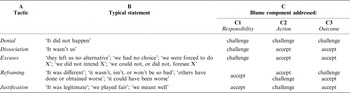
Table 1 summarises the tactics of the blame avoidance rhetorical strategy that actors resort to in predicaments of image protection.Footnote 49 Recall that because blame is proportional to the undesirability of an event and the responsibility of the actor for it, blame reduction tactics are targeted at one or both of these factors. The first three tactics listed – denial, dissociation, and excuses – seek to avoid or reduce blame by challenging the responsibility component (column C1). Following Heider's work, Tedeschi and Riess specify three conditions of responsibility attribution: the person ‘(a) could have reasonably foreseen the consequences of behavior; (b) intended to produce those consequences; and (c) was not forced, pressured, or constrained by circumstances or other factors in the situation’.Footnote 50Excuses, in particular, can separately address each of Heider's conditions, as shown (in col. B) by the typical statements associated with this tactic.
Tactics of blame avoidance in a predicament of image protection

Note:Denial and Dissociation are also known as ‘Defenses of Innocence’, of which there are two corresponding types: ‘defense of nonoccurrence’ (or Denial) and ‘defense of noncausation’ (or Dissociation). See Schlenker, Impression Management, pp. 136–40.
The last two tactics focus on the action or outcome for which the actor is blamed. Reframing seeks to present it (by description, definition, or interpretation) in such a light that its perceived negativity is reduced. This tactic can operate on its own, but it is likely to support either excuses, by providing a description that suggests reduced responsibility as its implication, or justification.Footnote 51 This latter tactic evokes a shared standard, rule, or norm that renders the objectionable behaviour more appropriate and thus more acceptable.Footnote 52Reframing may precede justification by constructing a narrative of the event that more readily brings to mind the norm to which the actor wants to appeal.
In a debate-like situation where the opposing sides are also engaged in conflict ‘on the ground’, the interdependent nature of events opens up the possibility of constructing accounts that are based on blaming or discrediting the opponent. In this context, then, the actors can be thought of as attempting to defend themselves in predicaments while creating them for the opposition. The zero-sumness of most such situations acts to conflate attack and defence, so that by mounting a successful attack on the opponent's argument one in effect contributes to one's own defence.
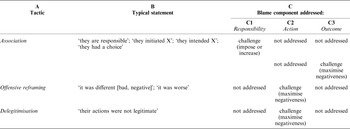
Table 2 lists tactics of blame imposition in predicaments of image protection; they are the components of a rhetorical strategy designed to avoid or reduce blame by shifting it instead onto the opponent, whether the focal event is the one for which the defender is blamed or whether the defender is trying to divert attention to another event, where its position is advantaged. Association, seeking to maximise the perceived responsibility of the opponent for a negative action or outcome, is the mirror tactic of dissociation and excuses. Offensive reframing builds upon the responsibility already attributed to the opponent by an audience and seeks to further enhance the assigned blame by maximising the perceived negativeness of the action or outcome. As with its defensive equivalent, this is done by offering a different description, definition, or interpretation of the event. Likewise, deligitimisation also addresses action rather than responsibility, but the attempt to maximise blame rests on a normative argument that appeals to shared standards, rules, and norms.Footnote 53
Tactics of blame imposition in a predicament of image protection

Accounts are rhetorical acts, designed to persuade an audience to adopt a version of events that reduces or removes blame. Given that credibility is a primary factor in the effectiveness of persuasive messages (that is, in their ability to change attitudes and move audiences to action), rhetors will seek to credit their accounts. Moreover, instrumental considerations in credibility construction are reinforced by cultural conventions of argumentation, which underlie audience expectations to be provided with socially acceptable indicators or markers of credibility when their consent to a message is being sought.
As Tables 1 and 2 indicate, accounts consist of two intertwined components: a normative claim and a factual one. For example, when offering an excuse, an actor argues that: (a) a responsibility-reducing social norm applies in the situation (‘Since I didn't intend X, I shouldn't be blamed’); and (b) he or she in fact did not intend to produce X (see more below). As concerns the first type of claim, Schlenker observes that ‘An account will not be effective in convincing an audience … unless it is fitted to the situation’.Footnote 54 By that he means that the account should be appropriate to the magnitude of the offense, to what the audience knows about the situation, and to the kind of values and beliefs that the social group associates with such situations – those intersubjective understandings that Scott and Lyman call ‘background expectancies’. They suggest that ‘An account is deemed unreasonable when the stated grounds for action cannot be “normalized” in terms of the background expectancies of what “everybody knows”’.Footnote 55 Thus, for the normative claim of an account to be accepted by an audience (that is, to be considered appropriate, right, or legitimate), context must first be established, and in order for context claims to be accepted, their own components require validation (for example, whether one can believe that the situation as described by the rhetor in fact obtained).
As concerns the second, factual type of claim being made as part of an account, credibility appears to be more straightforward. Indeed, such is the case when these claims involve facts that are acknowledged to be observable in principle (for example, whether or not the Soviets were installing missiles in Cuba in 1962). As Bennett remarks, ‘empirical formats are used in accounts when an action can be defended or defined convincingly in terms of observable real world conditions’.Footnote 56 However, when it comes to motives – as in, ‘I did not intend to produce X’ – no direct evidence can be given and inferential interpretations must always be made by the audience. One of C. Wright Mills's examples in his discussion of ‘vocabularies of motive’ illustrates this point (as well as the fusion of norms and facts in accounts): ‘individuals are skeptical of Rockefeller's avowed religious motives for his business conduct because such motives are not now [Mills, at the time, was referring to ‘twentieth-century urban America’] terms of the vocabulary conventionally and prominently accompanying situations of business enterprise’.Footnote 57 Indeed, Bennett makes the interesting point that because political accounts are often constructed from unverifiable and untestable claims about motives, their impact rarely depends on their credibility. Instead, it is the appropriateness of the justification in relation to the actor's social role or official responsibilities that the audience must weigh when considering the contested action.Footnote 58 This is an intriguing proposition (and a matter for empirical investigation), but our concern here is with how actors use talk to achieve credibility for their own motive-related arguments. We turn now to a brief look at each tactic and the kind of credibility enhancement that is likely to be attempted.
When an account challenges responsibility by means of denial or dissociation (see Table 1), then factual claims are being made with respect to the actual occurrence of an event or the identity of the agent behind it. Because both claims are negative in character, they are difficult to substantiate. Therefore, positive evidence that is inconsistent with the accusation is likely to be presented – that something continues to exist or to operate as before (because the negative event did not happen) or that someone else committed the offensive act. Dissociation is likely to be coupled with association (‘they did it’), the latter requiring positive evidence that, once given, is also supportive of dissociation.
When the excuses tactic is used to reduce or avoid blame, then validation has to do with establishing the existence of constraints. As noted, an account based on excuses has two aspects to it: a factual one, which concerns the believability of claims to constraints and which can be validated by evidence that presents such constraints; and a normative-constitutive one, which concerns the issue of whether or not the data presented is indeed ‘evidence’ – in the sense of constituting what the audience considers to be a ‘constraint’. Since constraints are often claimed to derive from the opponent's behaviour, the rhetorical tactic is likely to be excuses + association: ‘because they did X, we had no choice but to do Y’.Footnote 59 In this case, the validation of one tactic (association) serves, through a logical connection (which must be intersubjective), to validate the other tactic (excuses) as well. Likewise, as mentioned above, reframing can be expected to support excuses when evidence on the circumstances of the event is such that it validates responsibility-reducing statements on motivations and intentions. The audience is asked to consider hitherto hidden or unnoticed aspects of the event that are both consistent with the motivations claimed by the actor and inconsistent with those attributed to it by the opposition.Footnote 60
When responsibility is accepted by an actor, an account may still seek to reduce blame by challenging the audience's perception of the action or the outcome. In debate-like situations, the defending actor takes issue with the way in which the opponent represents and evaluates the event. Framing involves ‘selecting and highlighting some facets of events or issues, and making connections among them so as to promote a particular interpretation, evaluation, and/or solution’.Footnote 61 Thus, because the typical rhetorical format of reframing is ‘it was different’, the provision of some new facts (selected and presented with a certain interpretation in mind) lends credibility to the argument. Often the contrast itself between the facts used to impose blame and the modified set presented by the defender is sufficient to introduce doubt and moderate blame – provided the promoted interpretation falls within the ‘background expectancies’ of the audience. Effective reframing, in the sense of backing up with hard evidence at least one of the new factual claims made by the defender, can fracture the credibility of the opponent, and – obeying the logic of a zero-sum game – ipso facto enhance the credibility of the defender. At a minimum, the validation of a key factual claim in a tactic of reframing is often sufficient to defeat a ‘worst-case reading’ of the event, to use Schlenker's criterion.Footnote 62
When an actor attempts to reduce blame using the tactic of justification, the account proffered is based on an argument that the negatively perceived action is actually legitimate, because it can be viewed as consistent with a certain rule, norm, or practice of the community. The invocation of the appropriate norm for the situation is the major component in this type of account, but its acceptance requires two additional claims in which credibility plays an important role. In a first sense, credibility is related to the defender's claim that its actions are indeed an instance of the invoked norm. One element of this claim is factual, and this is where validation plays a role: in order to credit its account, the actor may provide evidence for having in fact performed the actions for which it is seeking justification by appeal to norms. As noted earlier with respect to the USIA, the issue is not accuracy as such but believability. The evidence that the actor is likely to select for presentation will be of the kind that will help support the claim that the presented facts constitute an instance of the invoked norm (for example, that the evidence counts as ‘self-defense’ rather than ‘aggression’; that the target qualifies as ‘combatants’ rather than ‘civilians’; that the action constitutes ‘legitimate resistance’ rather than ‘terrorism’, etc.). Barnett has demonstrated very effectively how debates on the ‘definition of the situation’ in inter-Arab politics served as a means of exerting power: ‘Arab leaders competed long and hard to construct the meaning of these events [for example, the Baghdad Pact, as violating or as consistent with the norm of Arabism], to determine the interpretation of the social situation, because doing so would protect their various interests and control the actions of other Arab states’.Footnote 63
In a second sense, credibility in justification is connected not with the invoked rule itself, but with the believability of the actor's (implicit) claim that the rule actually guided the action and was not seized upon only as post-hoc rationalisation. Credibility in this case pertains to sincerity, or to the consistency between the actor's self-reported motivation when undertaking the action and the motivation attributed to it by a critic.Footnote 64 Bennett argues that ‘Of all the elements of social action, motives are the least subject to proof or disproof. Therefore, the structures of accounts built around motives seldom involve factual propositions or detailed descriptions of behavior’.Footnote 65 However, when actors construct accounts, they usually combine tactics, and the ‘interaction effects’ can be such that validation of one tactic in a ‘package’ can reflect on the credibility of another tactic in the same package. For example, if an actor offers an account based on the rhetorical pattern ‘it was different [reframing], so what we did was legitimate [justification]’, then the ability to prove that the event was indeed different (validation in reframing) – it was an act of self-defence because the actor was fired on – helps to support the credibility of the justification that the actor, in firing back and hitting some bystanders, really meant to defend itself.Footnote 66
Finally, discreditation is about inducing audience disbelief in a proffered account. There are two ways by which an actor can go about it. First, an actor can try to credit its own claims about the opponent, that is, try to maximise the credibility of the tactics of blame imposition (see Table 2), whether it attempts to shift part or all of the responsibility for the negative action to the opponent (association), or whether the latter is portrayed by the actor as having engaged in negative or unacceptable behaviour (offensive reframing and deligitimisation). For example, in research examining IRA ‘defensive propaganda’ campaigns (designed to prepare the home republican community for subsequent violence), Sarma found that the propagandists sought to credit their accusations against selected targets by rallying testimony from authoritative commentators (techniques known as appeals to authority and testimonials).Footnote 67 Second, the actor can try to discredit and thus undermine the claims made by the opponent. A study by Uimonen on nation-building in Malaysia has shown how, in 1998, the reformasi movement had to cope with government charges in the mainstream media that the information disseminated by the movement on the Internet was unreliable; in response, the movement made an effort to link its messages to external sources known to be trustworthy.Footnote 68 As this example demonstrates, if the debate approximates a zero-sum situation, these two methods of discreditation become nearly indistinguishable in practice.
Before turning to the empirical analysis in the next section, it should be noted that because accounts are integral explanations, stories, or narratives that manage blame by the intertwining of several, mutually supportive tactics, in real-life discourse tactics are unlikely to separate out as neatly as conveyed by the tables. The tactics presented above should be interpreted as the building materials – conventional formats (templates) and vocabularies – with which society furnishes socialised actors who construct credible accounts.Footnote 69How the construction is actually accomplished, however, is something that deductive theory necessarily falls short of encompassing, due to the richness of social contexts and the creativity of actors. The practices of real-world actors, then, should be studied in order to establish how credibility is handled in empirical contexts.
From a somewhat broader perspective, it is important to recall that the logic of accounts derives from the conception of social life as an intricate system of shared regulative and constitutive rules; it is these rules that provide the basis for predictability and comprehensibility, without which orderly social life would not be possible.Footnote 70 When these rules are broken, social interaction is impaired, but even in such situations, there are ‘cultural criteria for when and how members who deviate from these guidelines are to be held answerable and accountable for their conduct’.Footnote 71 As a particular type of rhetoric, accounts are subject to what characterises rhetorical communication in general – the credibility requirement and the cultural criteria for establishing it. Intersubjectivity is critical here, and it allows us, by tracing the practices of actors, as is done in the next section, to begin deriving the ‘rules of credibility’. As Neufeld notes (with respect to interpretation), ‘the practices in which human beings are engaged cannot be studied in isolation from the “web of meanings”, which is, in a fundamental sense, constitutive of those practices, even as it is embedded in and instantiated through those same practices’.Footnote 72
This approach informs the empirical analysis in the following section, which seeks – in this article on an exploratory basis – to trace the ‘credibility talk’ involved in one incident in the Second Lebanon War of 2006, the Qana bombing of 30 July. Although the Qana incident was not selected necessarily for its representativeness (but rather for the wealth of materials it offers for analysis), the setting, context, dilemmas, and ensuing debate do exhibit the common features of confrontations in the age of asymmetric conflict.Footnote 73 The rhetorical exchange between Israel and two human rights organisations will be interpreted in light of the accounts framework presented above. But the objective is also inductive, namely to extract and characterise additional tactics not foreseen by the theoretical discussion here.
Credibility talk in the Second Lebanon War
On 12 July 2006, the Lebanon-based Shi'ite organisation Hizbullah crossed the border fence between Israel and Lebanon and attacked an IDF (Israel Defence Forces) reconnaissance unit, killing three soldiers and kidnapping two others. At the same time, the organisation fired Katyusha rockets into northern Israel, causing civilian injuries. In response, Israel launched Operation ‘Change of Direction’. In the ensuing violence, which lasted until a ceasefire came into effect on 14 August, 43 civilians and 117 soldiers were killed on the Israeli side; during that period, Israeli communities were subjected to an unprecedented attack of nearly 4,000 rockets.Footnote 74 Israel's bombardment of Lebanon, in turn, resulted in more than 1,000 dead, mostly civilians.Footnote 75
On 30 July, the Israeli air force struck a three-story building near the south Lebanese village of Qana, killing 28 people, 16 of them children.Footnote 76 Sarah Leah Whitson, the director of the Middle East and North Africa division at Human Rights Watch, said that ‘the deaths in Qana were the predictable result of Israel's indiscriminate bombing campaign in Lebanon’.Footnote 77 Israel was harshly criticised by various European leaders, who condemned the killing of civilians and called for an immediate ceasefire.Footnote 78 At the emergency meeting of the UN Security Council summoned to discuss the incident, the US had to veto a resolution condemning Israel for the bombing.Footnote 79 Thus, on the day of the attack and in its aftermath, Israeli officials had to contend with a storm of international criticism that put the government in a ‘predicament of image protection’.
In a recent study of Israeli public diplomacy in the 2006 war, I analysed the rhetorical tactics used by government officials to reduce blame, and found them mostly consistent with the expectations of the predicaments framework.Footnote 80 Here, as noted, the objective is to focus specifically on credibility talk, which, in the Qana incident, was an integral part of the account offered by the Israeli government. An additional aspect of this study is the incorporation of rhetoric by two NGOs – Amnesty International (AI) and Human Rights Watch (HRW) – which spearheaded the criticism of Israel's actions in Qana and became, for the attentive public in the West, a key arguer in the ensuing debate.Footnote 81 Part of that debate, then, featured the two NGOs in the role of the blame-imposing accuser, Israel as the defender, and world public opinion as the audience to be persuaded.Footnote 82 It is this kind of context for credibility talk with which the discussion in the previous section was concerned.
The texts analysed for this section were drawn primarily from the websites of the Israel Ministry of Foreign Affairs,Footnote 83 Amnesty International, and Human Rights Watch.Footnote 84 In each text, the elements related to accounts (blame imposition and blame avoidance) were identified, and an additional reading was conducted to detect direct or implied references to the credibility of the claims made as well as culturally accepted credibility ‘signifiers’. As this is an exploratory study rather than a confirmatory one,Footnote 85 it does not lay claim to exhaustiveness or representativeness, although an effort was made to analyse a large and varied sample of documents (only some of which are cited here). Thus, the following examples from the texts are designed to illustrate, in one real-world situation, the theoretical idea of credibility talk that was introduced and discussed in the previous section; to generate a feel for the range and type of tactics used by the actors; and to convey the extent to which credibility claims are intertwined with the accounts that states offer for their actions (rhetorical or physical). That actors try to credit their accounts should be taken to mean that, in their contexts, they are acting to enhance, maintain, or repair their social images. In studying how actors do so, we ‘shift from using features of talk to explain behavior (talk as resource) to a focus on the features of talk as the behavior to be explained (talk as topic)’.Footnote 86
In the hours that followed the 30 July Qana attack, as the grim pictures from the collapsed building flashed across screens worldwide, Israeli spokespersons attempted to handle the predicament of image protection by resorting to an ad hoc mixture of blame avoidance tactics in response to probing questions by the foreign media.Footnote 87 At the IDF press conference that evening, the three tactics of dissociation, excuses, and justification comprised the official account, which sought to reduce blame by reducing Israeli responsibility (and shifting it onto Hizbullah) and by legitimating the military action. To credit the argument associated with each tactic, reframing was used: new factual material was introduced so as either to prevent a ‘worst-case reading’ of responsibility or legitimacy, or else to support a new frame leading up to a more lenient interpretation (the question of how the facts themselves were validated is addressed below):
• Reframing + dissociation: Credibility here derives from the presentation of positive evidence – that something continues to exist or to operate as before (because the negative event did not happen) or that someone else committed the offensive act. The IDF presented a narrative of chronological events in which an ‘inexplicable time gap’ appeared between the attack of the Israeli Air Force (IAF) at midnight to 1 am and the collapse of the building seven hours later. This set of facts (accompanied by physical evidence, as mentioned below), led up to dissociation/association: ‘the gap between the time of the attack and the time at which the building collapsed is still not clear to us. It can perhaps be attributed to other munitions present in the building that perhaps ultimately resulted in its collapse’ (IAF Chief of Staff, Brig. Gen. Amir Eshel).Footnote 88
• Reframing + excuses: Credibility in this case relates to evidence on the circumstances of the event that validates responsibility-reducing statements on motivations and intentions. The audience is asked to consider the implication of a set of facts that, when lumped together, are both consistent with the motivations claimed by the actor and inconsistent with those attributed to it by the opponent. Thus, the IDF spokespersons framed the background facts of the incident in such a way as to credit the military's self-proclaimed intentions (that is, to spare civilian lives whenever possible) while undermining those that were attributed to it by its critics: ‘From the first day of fighting, we told the residents of southern Lebanon that they had to move away from those involved in terror and from launch sites, for their own security. We dispersed fliers, we announced it in the media. We moved progressively. And regretfully, last night civilians were killed, who no one had any intention of harming’ (Head of the IDF Operations Directorate, Maj. Gen. Gadi Eizenkot).Footnote 89
• Reframing + justification: Credibility here refers to the actor's ability to marshal evidence that defines the action as an instance of the invoked norm, or the context as appropriate to the norm's application. Because Israel was harshly criticised for the asymmetric nature of its violent response to Hizbullah's attack, it was important for the Israelis to credit their claim that they were engaged in war despite the opponent being a non-state actor. To this end, the Israeli account pointed to facts that constituted Hizbullah as the kind of enemy – a ‘state’ for all practical purposes – to which the normal practices of war applied: ‘this is an organization that has effectively taken over sections of Lebanon and operates with the capabilities of a state, with long-range missiles’ (Maj. Gen. Gadi Eizenkot); ‘Here we are talking about highly organized military organizations that operate different types of weapons; in fact, I would say, almost a regular army’ (Brig. Gen Amir Eshel);Footnote 90 ‘It is important to stress that the size of Hizbullah's arsenal of rockets exceeded that of many regular armies’ (Minister of Defense Amir Peretz).Footnote 91
Besides reframing, Israeli officials also attempted direct validation of account claims by physical evidence. On the morning of 30 July, Prime Minister Ehud Olmert ordered the IDF to release video footage in support of Israel's claim that Hizbullah fired Katyusha rockets from Qana.Footnote 92 In his address to the UN Security Council, Israeli ambassador Dan Gillerman also offered to provide the Council with ‘a film that shows Hizbullah launching a rocket from right behind a three-storey house: a civilian residence very similar to the one that was hit today in Kafr Qana’.Footnote 93 Indeed, in its evening press conference, the IDF Spokesperson Unit displayed aerial photographs and video clips that it claimed demonstrated the launching of missiles from within the village and its surrounding area as well as reinforced the seven-hour time-gap narrative of events. In order to validate another aspect of the Israeli account – that the residents of Qana and the region ‘were warned several days in advance to leave the village’ – the IDF exhibited a sample of the leaflets that it said were dropped over the area (carrying the 25 July date).Footnote 94
Since physical evidence is always presented within the framework of some interpretation, actors also have to persuade their audience that the proffered interpretation is indeed reliable. For example, Air Force Chief of Staff Eshel argued that although the IAF also conducted bombing raids at around 7.30 am (just prior to the building's collapse), an accidental hit of the Qana house could be ruled out, because all the bombs fired during the attack in fact reached their targets: ‘We know this from evidence from the aircraft, from the crews; everything is photographed; also from the reconnaissance sortie which [we] did … So we have verification of the hits on the houses …’Footnote 95 The reliability of the interpretation was also suggested by the care with which information was presumably considered. As the following text demonstrates, the IAF Chief of Staff adopted highly circumspect language in presenting the time-gap version of the incident:
It could be that things of one nature or another were stored in the building, that eventually caused some sort of explosion, that we did not manage to hit or blow up in the assault, and maybe they remained afterwards. But I'm saying this very carefully because right now I don't have the slightest idea to explain the gap. We need to check it out.Footnote 96
The reliability of evidence was also the focus of credibility talk in the communications of the two NGOs, AI and HRW. Commenting on their own methods of data collection, these organisations appealed to shared indicators of evidence reliability, thus conveying their assumptions about what would constitute, for their target audiences, credible evidence in support of their blame imposition strategy. For example, AI's media advisory of 2 August implicitly contained the following standards:Footnote 97
• On-site data collection: AI sent teams of investigators to the location itself (Qana) rather than collect data from secondary sources.
• Use of multiple sources: AI conducted interviews of witnesses from various backgrounds: survivors, humanitarian and aid workers, and villagers. Likewise, upon introducing its detailed report on the Qana incident, HRW described the type, range, and variability of the sources that were consulted: ‘the report is based on extensive interviews with victims and witnesses of attacks, visits to some blast sites, and information obtained from hospitals, humanitarian groups, security forces and government agencies. Human Rights Watch also conducted research in Israel, assessing the weapons used by the Israel Defense Forces (IDF)’.Footnote 98
• Timely collection: AI delegates arrived in Qana ‘within hours of the Israeli air attack …’
• Balanced approach: AI missions were sent to both Lebanon and Israel. Likewise, HRW emphasised that ‘In previous reporting, Human Rights Watch has addressed the conduct of Hezbollah forces, condemning its attacks on civilian areas as serious violations of international humanitarian law amounting to war crimes’.Footnote 99
• Depth: The level of detail provided in the HRW report for each incident conveyed an impression of depth and precision.
The analysed texts also featured calls, especially by the NGOs, to accepted means of verification. In doing so, the organisations conformed to deeply-held cultural standards that are indeed constitutive of credibility itself. Thus, in an appeal to the Security Council, AI called for ‘a thorough, independent and impartial inquiry to establish the facts … Such an inquiry could be conducted by the International Humanitarian Fact-Finding Commission established under Article 90 of Additional Protocol I to the 1949 Geneva Conventions’.Footnote 100 Referring to the IDF's own inquiry of the Qana incident, AI Executive Deputy Secretary General Kate Gilmore stated that ‘Any investigation needs the capacity to cross borders and talk to survivors of the attack as well as to the forces involved … It is not enough that the Israeli army investigates themselves’.Footnote 101 HRW, too, opined that ‘Only an impartial international investigation can find out what really took place’.Footnote 102
More subtle forms of credibility enhancement were also detected in the texts. With those, it is particularly difficult to determine if strategic communication was at play (and if so, for what specific persuasive purpose); these aspects of the texts are raised here to indicate that given social norms of credibility, they could have had such effects on their audience. For example, where credibility pertains to sincerity, namely to the consistency between an actor's self-reported and attributed motivations, HRW promoted its image as an organisation that acts out of strict humanitarian (and not political) considerations: in conclusion to its 1 August call for an international inquiry of the IDF strike, it provided a list of the names and ages of all individuals killed in Qana.Footnote 103 The attention and respect paid to individuals is consistent with, if not constitutive of, a humanitarian organisation. A different kind of example (corresponding to Aristotle's persuasion-by-character) is provided by the impression of sincerity, self-awareness, and reflectivity that characterised the report of IAF Chief of Staff Eshel to the press: ‘We have had several successes; we have not yet reached the point we have striven for. We have not yet reduced the level of terror to smaller volumes. We have not yet reduced their accuracy’.Footnote 104
We turn now to credibility talk in tactics of blame imposition, which is concerned primarily with discrediting the opponent (hence the focus here is on the rhetoric of the NGOs). As noted earlier, there are two ways of addressing credibility in discreditation talk: the actor can try to credit its own claims about the opponent (in support of the tactics listed in Table 2), or it can try to discredit the claims made by the opponent. The zero-sumness of the rhetorical contest renders these two possibilities nearly equivalent. In the texts reviewed, most attempts at discreditation by AI and HRW addressed the IDF account and sought to undermine it.
One tactic of discreditation that was repeatedly used was the charge of insufficient evidence, that is, the argument that the opponent had not successfully credited its own account. For example, AI, in its open letter to the UN Security Council, stated that ‘… the Israeli authorities have claimed that Hizbullah used civilians as “human shields” – a tactic clearly prohibited under international humanitarian law. However, Israel has provided no evidence to support that allegation’.Footnote 105 Taking a more proactive approach to the evidence, HRW claimed that ‘Human Rights Watch researchers who visited Qana on July 31, the day after the attack, did not find any destroyed military equipment in or near the home. Similarly, none of the dozens of international journalists, rescue workers and international observers who visited Qana on July 30 and 31 reported seeing any evidence of Hezbollah military presence in or around the home. Rescue workers recovered no bodies of apparent Hezbollah fighters from inside or near the building’.Footnote 106 Citing witness testimony, a Qana villager was quoted as saying: ‘If they [the IDF] really saw the rocket launcher, where did it go? … We showed Israel our dead; why don't the Israelis show us the rocket launchers?’ Kenneth Roth, the executive director of HRW, stated in introducing the organisation's report, that ‘… in none of the cases of civilian deaths documented in the report is there evidence to suggest that Hezbollah was operating in or around the area during or prior to the attack’.Footnote 107
A related tactic of discreditation was associated with offensive reframing: the presentation of evidence and factual arguments that are not acknowledged by the opponent in its account and that cannot be reconciled with it. Thus, AI sought to counter Israel's claim of having warned civilians prior to attack (see above) by providing the following arguments: a warning to over 400,000 people tends to create panic; some people are afraid they'll be attacked on the road if they do leave; some cannot leave; some are attacked when trying to flee; and the destruction of roads and bridges by the IAF makes the departure itself very difficult.Footnote 108 A similar tactic was used by HRW, which cited the testimony of local villagers: ‘Shalhub vigorously denied that any Hezbollah fighters were present in or around the home when the attack took place. All four roads to Qana village had been cut by Israeli bombs, he said, which would have made it difficult, if not impossible, for Hezbollah to move rocket launchers into the village’. Another villager is quoted as saying, ‘If Hezbollah was firing near the house, would a family of over 50 people just sit there?’Footnote 109
Discreditation was also used in conjunction with association: offering arguments and evidence that undermine the credibility of the opponent's self-proclaimed motivation and suggest, by implication, that since the hidden or denied intentions did in fact guide the action, responsibility (and blame) should be imposed on the opponent. For example, in response to the Israeli defence of not having been aware of civilians in the Qana building, AI countered that ‘survivors of the attack interviewed by Amnesty International researchers in Qana shortly after the bombing, stated that they had been in the building for some two weeks and that their presence must have been known to Israeli forces whose surveillance drones frequently flew over the village’.Footnote 110 HRW, addressing the Israeli claim that IAF attacks on open roads were necessitated by Hizbullah's arms transports, declared that ‘none of the evidence gathered by Human Rights Watch or reported to date by independent media sources indicate that any of the attacks on vehicles documented in the report resulted in Hezbollah casualties or the destruction of weapons. Rather, the attacks have killed and wounded civilians who were fleeing their homes after the IDF issued instructions to evacuate’.Footnote 111
The Israelis also used this tactic of discreditation vis-à-vis Hizbullah, noting, for example, that the evacuation of the building in Qana began only hours after the collapse – once the camera crews arrived on location.Footnote 112 Likewise, in a variation on this tactic, Israeli UN ambassador Gillerman told the Security Council: ‘I have never heard Hizbullah say that they are sorry for a single Israeli – woman, child, elderly person, civilian or innocent – who has been killed. Never. Why? Because they target us specifically. That is their declared aim, and that is what we are fighting’.Footnote 113
Finally, direct charges of non-credibility can be made by invoking the shared constitutive rules of the concept itself (as noted above) and arguing that they have been violated. Because consistency is one of those rules, in the following example HRW sought to present the IDF account as inconsistent: ‘the IDF subsequently changed its story, with one of Israel's top military correspondents reporting on August 1 that, “It now appears that the military had no information on rockets launched from the site of the building, or the presence of Hezbollah men at the time”’.Footnote 114
Summary
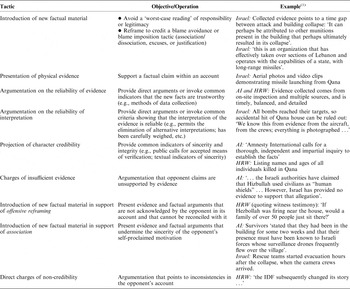
The findings on credibility talk for the Qana case study, as analysed above, are summarised in Table 3. They suggest several observations for further analysis and comparative empirical study (see Appendix A for some additional notable cases of credibility talk). To begin with, it is evident that rhetorical contests (or propaganda wars) that accompany the use of violence are an integral part of any conflict. Aside from self-identity needs, strategic considerations in the contemporary society of states put a premium on soft power means of influence and community status. The application of force has to be accounted for, explained and justified, whether to obtain the support of domestic audiences, win over foreign publics, or undermine the confidence of enemy populations. It is not surprising, therefore, that force goes hand in hand with talk, not only for bargaining purposes (to issue threats and promises and make commitments) but also to interpret and persuade. In doing the latter, actors necessarily appeal to the rules that constitute social structure – beliefs, norms, and identities – by making (as Habermas suggests) validity claims with respect to truth, appropriateness, and sincerity.Footnote 115 These speech acts comprise Tables 1 and 2 (truth and appropriateness) and Table 3 (sincerity, a dimension of credibility), and research of additional cases should help establish their range and variability. As noted earlier, the practices of the actors manifest the underlying rules, because ‘rules constitute the meaning of practices within specific games’.Footnote 116
Summary of credibility talk in the Qana Case

(1) All examples are taken from the text, where citations are provided.
The prevalence of credibility talk, accordingly, reflects the intersubjective understanding that the various claims actors make, especially when presenting accounts, have to be credited. This is one rule that apparently enjoys strong internalisation, because the empirical analysis shows that actors rarely make assertions without simultaneously trying to back them up. How this is done is something we know far less about compared to the practices of establishing credibility in bargaining situations, the focus of extensive research. For example, Table 3 reveals that (at least in Western societies) scientific discourse strongly influences the kind of standards that actors adopt in seeking to credit their accounts: even in this small sample, rhetoric related to methods of data collection and its reliability is pervasive; and it is likely to grow further as technological developments raise expectations about the scope, precision, and diagnosticity of proffered evidence. In referring to the latter characteristic, however, it is essential to heed Rosenau's caveat that ‘evidence is rarely so airtight as to exclude all but one interpretation. Events are inevitably viewed through cultural and political lenses …’Footnote 117 This obviously recommends the importance of conducting studies of intercultural arguments and debates to examine credibility talk in such contexts (the 2003 US-Iraq rhetorical exchange is a case in point, as is the current one between Iran and the West). As noted in the introduction, it is an empirical question whether the criteria for evidence are in fact converging to facilitate the settlement of political conflicts across cultures.
Lastly, the empirical analysis bears out the theoretical argument that since norm-related and identity-related claims cannot be validated directly, actors try to credit them indirectly, through factual appeals (reframing). For example, in order to legitimate the scope and intensity of the violence it employed, Israel tried to construct Hizbullah as a state, thereby appealing to the norms of interstate warfare. Similarly, in order to prove that it did not intend to harm the Lebanese civilian population, Israel pointed to the facts of its activities in the days prior to the attack. But there are no objective criteria for making these claims persuasive. As Carroll Arnold puts it so well in his introduction to Perelman's The Realm of Rhetoric, ‘most of the claims we make in arguing are not self-evidently true; they must be made to seem reasonable. They cannot be “proved” completely; they must be judged to be reasonable by those to whom the claims and their supports are presented’.Footnote 118 This means that one must distinguish, as with the concept of power, between credibility as a strategy and credibility as an outcome (effectiveness). This article was concerned with strategy, or practices, and judging by the case study, actors act as if they believe that credibility, like other impressions, can be managed. We could not account for so much credibility talk if this were not the case, but what works, for which audience, and how, remain questions for further research.
Appendix A
Examples of credibility talk
• On 25 October 1962, during the height of the Cuban missile crisis, US ambassador to the UN, Adlai Stevenson, presented the Security Council with an exhibit of photographs and maps documenting the existence of Soviet offensive missiles in Cuba. Soviet UN ambassador Valerian Zorin retorted that the US ‘ha[d] no such facts on its hands’ and that the information displayed was a CIA forgery.Footnote 119
• On 1 September 1983, Soviet fighter jets shot down a Korean civilian airliner, KAL 007, flying west of Sakhalin island, killing all passengers and crew, including Congressman Larry McDonald. After initially denying knowledge of the incident, the Soviets rejected the American claim that the airliner, en route from New York to Seoul, had strayed into Soviet airspace as a result of a navigational error, and charged instead that the plane was on a spy mission for the US. Evidence of the interception (including the black box tapes) was released by the Russian Federation only in late 1992.Footnote 120
• On 4 June 1989, the Chinese army attacked pro-democracy student protesters in Beijing's Tiananmen Square. The number of demonstrators killed became a bone of contention between the Chinese government, which sought to minimise the figure, and Western sources.Footnote 121
• In 1990–91, during the crisis leading up to the Gulf War, the Kuwaiti government-in-exile hired the services of the American PR giant Hill and Knowlton, among other things to provide Congress with testimonial evidence of Iraqi brutality in occupied Kuwait. Iraq protested, and the so-called ‘Nayirah affair’ was subsequently shown (by Harper's Magazine's publisher John MacArthur) to have been a fabrication.Footnote 122
• Three events in the Second Intifada (Palestinian uprising), which began in September 2000, turned into credibility contests between Israel and the Palestinian Authority: the killing of 12 year old Mohammed al-Dura (on 30 September 2000), caught with his father in the crossfire at the Netzarim Junction in the Gaza Strip, which triggered a protracted debate between the two sides over who was responsible for shooting the boy; the Israeli capture (on 4 January 2002) of the ship Karin A, whose cargo was presented to the press as evidence that the Palestinian Authority was smuggling arms from Iran to covertly support terrorism, a charge denied by Yasser Arafat; Operation Defensive Shield (begun 29 March 2002), during which an incursion of the Israeli Defence Forces into the Jenin refugee camp brought Palestinian allegations of a large-scale massacre, a charge the Israelis have denied.
• In the period leading up to the March 2003 Iraq War, the US and Britain accused Saddam Hussein of developing and deploying weapons of mass destruction and of supporting Al-Qaeda. In his speech to the UN Security Council on 5 February 2003 Secretary of State Colin Powell assured the delegates that ‘every statement I make today is backed up by sources, solid sources. These are not assertions. What we're giving you are facts and conclusions based on solid intelligence’.Footnote 123 He made use of audio tapes, satellite images, photographs, and diagrams in an effort to substantiate his claim of Iraqi deception. However, when evidence of WMDs failed to surface during the war itself and in its aftermath, American and British credibility suffered.Footnote 124