Introduction and background
Since its discovery in Windsor (Ontario, Canada)/Detroit (Michigan, United States of America) in 2002, the emerald ash borer (EAB) (Agrilus planipennis Fairmaire; Coleoptera: Buprestidae) has killed millions of ash trees in both eastern United States of America and Canada and has caused massive ecological and economic damages (Kovacs et al. Reference Kovacs, Haight, McCullough, Mercader, Siegert and Liebhold2010, Reference Kovacs, Haight, Mercader and McCullough2011). Emerald ash borer is a non-native invasive species that is able to attack, reproduce, and cause mortality to all native North American ash species (Fraxinus Linnaeus; Oleaceae) (United States Department of Agriculture Animal and Plant Health Inspection Service 2013). Indeed by some accounts it is considered the most damaging invasive species in recorded North American history (McCullough and Mercader Reference McCullough and Mercader2012). This paper provides a brief review of economic studies related to EAB and describes an economically oriented framework to consider detection strategies – a subject that is critical for decision makers having to deal with policy and management issues associated with EAB.
The economics of invasive species is a broad subject (Perrings et al. Reference Perrings, Williamson and Dalmazzone2000). Relatively few studies have examined economic aspects of EAB, and the few that exist tend to estimate the financial impact of an EAB infestation rather than examine the economic tradeoffs behind the management decisions related to EAB. For example, an estimation of mortality costs among street and backyard trees in Canada by McKenney et al. (Reference McKenney, Pedlar, Yemshanov, Lyons, Campbell and Lawrence2012) were found to be $890 million CAD or more in Canadian communities over a 30-year horizon depending on factors such as spread rates, the inclusion of private backyard trees, and the time value of money used in the calculations. Kovacs et al. (Reference Kovacs, Haight, McCullough, Mercader, Siegert and Liebhold2010) estimated costs of treatment, removal, and replacement of ash in developed land within United States of America communities to be $10.7 billion USD between 2009 and 2019, with the costs growing to $20 billion USD when developed land outside communities was included. In a study of EAB satellite (transplanted) populations, Kovacs et al. (Reference Kovacs, Haight, Mercader and McCullough2011) estimated $12.5 billion in treatment, removal, and replacement costs between 2010 and 2020 on managed landscapes in communities across 30 high-risk states in the United States of America, with a possible 50% reduction in costs from fewer and more slowly expanding EAB satellite populations. As much as $30 million USD is being allocated annually by the United States Department of Agriculture Animal and Plant Health Inspection Service for EAB-related activities including treatment, removal, and regulatory activities to support quarantine (Kovacs et al. Reference Kovacs, Haight, Mercader and McCullough2011). In Canada, precise numbers are difficult to ascertain, but federal and provincial agencies are undoubtedly spending several million dollars annually, directly and indirectly, to deal with the issue.
As the financial impact of EAB is becoming clearer, economic thought is also being incorporated into treatment and removal choices (see Sadof et al. Reference Sadof, Purcell, Bishop, Quesada and Zhang2011; McKenney and Pedlar Reference McKenney and Pedlar2012). A decision of whether to treat or remove a tree can involve minimisation of expected costs as well as perceptions of the benefits associated with ash preservation. Treatments, such as insecticide injections, are costly but so can be the removal of EAB-killed trees near homes or power-lines. Planting costs of replacement trees and lost benefits from the existence of mature ash trees may also play into the cost-benefit calculus that individuals may consider (McKenney and Pedlar Reference McKenney and Pedlar2012). Decision makers in various levels of government are also faced with a number of challenging cost-benefit issues and limited budgets in dealing with EAB. Decisions include whether efforts should be made to attempt to prevent EAB from entering a region, and if so, the type of activities entailed, such as preventing the movement of firewood or the commercial movement of affected ash trees and also attempting to save individual trees or cutting down affected trees (United States Department of Agriculture, Animal and Plant Health Inspection Service 2013). In all cases, choices involve, explicitly or implicitly, comparing the costs and benefits of alternative actions. Vannatta et al. (Reference Vannatta, Hauer and Schuettpelz2012) performed an economic analysis of management options and concluded that retention of ash through treatment was most effective in maintaining urban forest value, followed by inaction, then pre-emptive removal and replacement, and pre-emptive removal without replacement maintaining the least value. Kovacs et al. (Reference Kovacs, Mercader, Haight, Siegert, McCullough and Liebhold2013) studied the effectiveness of publically funded and managed EAB control measures on private land. Aggregating municipal budgets and increasing the number of ash available to public management both greatly improved net benefits from EAB response.
Economic research on EAB, as summarised briefly above, has tended to focus on the costs of an infestation rather than the economics of detection despite its importance in managing EAB although Yemshanov et al. (Reference Yemshanov, Koch, Lu, Lyons, Prestemon and Scarr2014) provide a related analysis using a portfolio approach to broad scale survey designs. There have been some studies on the economics of detection for invasive species in general. For example, Haight and Polasky (Reference Haight and Polasky2010) simulated the optimal control of an invasive species under incomplete information, and concluded that optimal management of an invasive depends heavily on the degree of infestation and monitoring accuracy. Mehta et al. (Reference Mehta, Haight, Homans, Polasky and Venette2007) simulated optimal detection and control strategies for invasive species, and found significant investment in detection was optimal for a high-damage species, even if it is difficult and costly to detect. Elbakidze and McCarl (Reference Elbakidze and McCarl2006) address how characteristics of a disease or infestation and its mitigation options influence the desirability of pre-event investments (such as detection) versus post-event response, and Saak (Reference Saak2012) studied credibility of information from animal disease detection and efficient testing.
The optimal detection method is the one that provides the most valuable information relative to the cost of collecting that information. However, the type of information required, and its subsequent value, will often depend on the decision maker. For example, federal officials may be interested in the presence of EAB in a wide geographic region, whereas municipal officials are more concerned about the intensity and exact location of an outbreak within their jurisdiction. This underscores the importance of information, and its value, in addressing the issue of EAB infestation.
A conceptual framework to understand the economics of detection strategies
Value of information
Information is a resource that has economic value. While not an asset in the typical sense such as capital or labour, information is an asset that increases the productivity of other inputs. Stigler (Reference Stigler1961) was the first to conceptualise information as a valuable economic resource that should be gathered until the incremental benefit of additional information is equal to the marginal cost of collecting that information. Indeed the value of information has been assessed in terms of a number of examples ranging from weather forecasts (Babcock Reference Babcock1990), pest levels (Swinton and King Reference Swinton and King1994), market information (Timko and Lyons Reference Timko and Lyons1989), and information services itself (Gervais et al. Reference Gervais, Lambert and Boutin-Dufrense2001).
The value of information stems from the ability of a decision maker to more fully understand the consequences of a particular action when uncertainty has been reduced. Less uncertainty about the parameters affecting a decision should lead to better, more confident decisions; ones where some necessary actions are taken when they might otherwise be avoided, and other unnecessary actions avoided when they might otherwise be taken. For instance, removing ash trees, which are infested but not showing signs may be necessary, or treating ash in the apparent absence of an EAB infestation may be undesirable. A spectrum of decision options exists because uncertainty does not enable a decision maker to ensure they have identified the decision that will maximise the desired objective. Because of the reduction in uncertainty that results from new information, a decision maker can move closer to the optimal decision and expect a higher return. The additional return realised by this movement is the value of the new information.
The value of information is, therefore, in its ability to create benefits from improved decisions (Miller Reference Miller1975). Hilton (Reference Hilton1979) proposes four determinants of information value: (1) the decision maker’s technology and environment, reflected in their payoff function (the extent to which they derive benefit from certain outputs); (2) the nature of the information system; (3) the decision maker’s initial uncertainty about some aspects of their technology and environment; and (4) the decision maker’s flexibility in acting upon information. These criteria highlight how the nature of information itself is not the only determinant of its value; it is also highly dependent on the decision maker. This concept is important in the accurate evaluation of a detection method’s value, as value will not be constant between decision makers.
How much one would be willing to pay to receive information can be considered a measure of its value. Information on EAB’s presence, spread, and density has value. For instance, with incomplete information on infestation, efforts to mitigate the damage caused by EAB may take place too late or in the wrong area, or mitigation measures may be employed when they are unnecessary (Mehta et al. Reference Mehta, Haight, Homans, Polasky and Venette2007; Haight and Polasky Reference Haight and Polasky2010). The value of an EAB detection strategy is the extent to which damage costs can be avoided through the implementation of an appropriately designed prevention and treatment strategy compared to the costs resulting from EAB without the information on the spatial prevalence of the pest (D’Evelyn et al. Reference D’Evelyn, Tarui, Burnett and Roumasset2008). Hence, the value of detection is the extent to which the information on an area’s infestation status improves a decision maker’s response. The value of this information must be balanced against the cost of obtaining it, with the optimal point defined where the benefits of gathering additional information are equivalent to the incremental costs of doing so.
Costs and benefits of information from detection methods
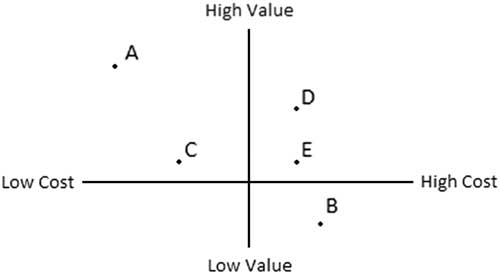
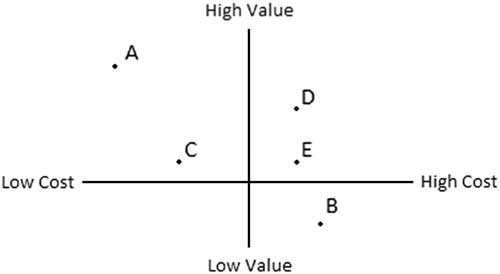
The trade-offs between the cost of gathering information and its value are illustrated in a two-dimensional framework in Figure 1 for alternative EAB detection methods. The vertical axis in Figure 1 represents the value of the information generated by a detection method. As discussed in the previous section, the value of the information is associated with the improvement in the decision made by managers dealing with EAB.
Cost and value of information provided by hypothetical emerald ash borer (EAB) detection strategies.
The horizontal axis represents the cost of detection. These can be split into variable and fixed costs and are likely to vary considerably with the decision maker’s organisational structure. Variable costs depend on the extent to which a detection method is employed (e.g., the number of a particular type of trap used), while fixed costs are structurally necessary for a detection strategy and will not generally vary with the level of effort employed in detection. We note that determining actual numerical values for fixed costs is often not trivial. For example, large organisations such as the Canadian Food Inspection Agency (CFIA) are often addressing multiple issues at any given point in time. Subjective decisions regarding cost allocations are required (see Hof and Field (Reference Hof and Field1987) for a forest management example).
The value of a detection strategy involves judgements (or quantitative analyses) about the benefits of a given approach. Benefits could include cost savings from delaying the impact of EAB as noted above, or even willingness to pay estimates to preserve ash trees for economic or ecological purposes. More on the value of detection methods is provided below.
High value and low cost are preferable, meaning a movement towards the upper-left of the graph leads to a superior outcome. Thus, method A is the optimal choice as it provides the highest value and incurs the lowest cost. The opposite is the case for method B, which is inferior to the other four choices as it provides information of lowest value and involves the highest cost. There is not a clearly superior choice between C and D. This is the dilemma facing most decision makers in reality. The choice between C and D requires the decision maker to determine which of the two variables is most important; is the better information worth the additional cost?
Heterogeneity in detection methods among decision makers
The trade-off between the value of information and cost among competing detection methods will vary with the decision context (what we term as the scale), objectives, and budget of the decision maker. Different mandates result in different responsibilities and information requirements regarding the potential presence of an infestation. As a result, the scale of the axes in Figure 1 will differ depending on the jurisdictional context for the decision maker, as will the location, within the graph, of detection methods. Here we look at three different scales of decision maker: federal/provincial, municipal, and landowner/private.
The difference in benefits from equivalent information between decision makers is known as the difference between the decision makers’ payoff functions. In this case, the difference in objectives and budget resources between decision makers at alternative jurisdictional scales will characterise their payoff functions, and means the relative value of information provided by any given detection method will vary. Thus, in addition to changing the scale of the axes in Figure 1, the relative location of detection methods in Figure 1 could change along with the context of the decision maker, since there is heterogeneity in the types of information provided by different methods. For example, Ryall et al. (Reference Ryall, Fidgen and Turgeon2011b) discuss how visual surveys give information on specific trees but at a late infestation stage; baited traps provide earlier detection but must be followed up with other analysis to determine tree-specific information (Porter Reference Porter2009); and branch sampling can detect an infestation early and detail the infestation density of specific trees. The value of each of these is dependent on the payoff function of the decision maker.
Larger scale decision makers such as those in the CFIA are primarily responsible for broader issues such as quarantine decisions, and consequently have information needs focused on EAB presence (Canadian Food Inspection Agency 2014). Tree-level detail is not of concern; a confirmed infestation is what is necessary in order to update the known infested areas and set the boundaries for quarantine. Density of an infestation may conceivably be of use for estimation of spread beyond the area with confirmed EAB presence. At the largest spatial scale, decision makers experience marginal costs – the cost to use one additional detection unit, such as an additional panel trap – that are reflective of the area over which ash are dispersed and the distance between areas where detection methods are implemented. An example is the checking of panel traps, which may be spaced widely apart over large areas and require extensive transportation or other travel costs for inspectors.
Municipalities have not only an interest in EAB presence and infestation, but also have responsibility for preservation of urban forest value (Kovacs et al. Reference Kovacs, Mercader, Haight, Siegert, McCullough and Liebhold2013), which includes canopy cover, aesthetics and land value, dealing with hazard trees, and dealing with the direct costs of infestation to city residents. At the municipal level, this requires a higher resolution of infested areas, and often knowledge of the infestation status of specific trees. Marginal costs for using detection methods may be lower here due to reduced distances in comparison with the provincial or federal level, but may also not be large enough to reduce average costs through economies of scale.
Treatment has a high marginal cost for a decision maker for privately held land, as treatment of an individual tree represents a larger proportion of total treatment expenditure when the number of trees is low. Unnecessary treatment is likewise a large marginal expenditure; meaning preventative treatment may be most costly to a private landowner. Private landowners may therefore have more of an incentive to determine the infestation status of a tree before treatment, and be inclined to place more value on information on the infestation status of specific trees rather than presence of the beetle in an area. Costs such as travel expenses are not likely to be a concern as they would be more applicable to larger scale decision makers, though may be an issue in isolated communities that require outside expertise.
An application to current detection methods
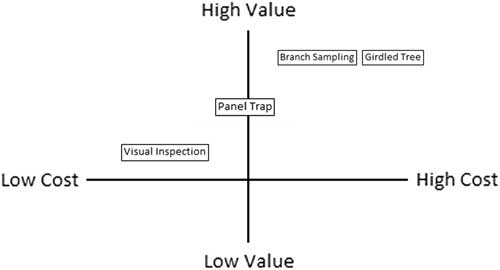
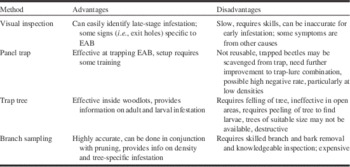
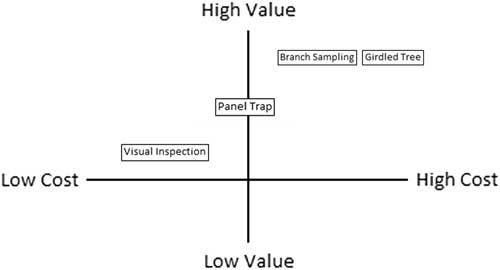
For the purposes of this discussion, we consider four detection methods used to determine if EAB is present: visual inspection, trapping (both panel trap and funnel trap with and without pheromones), trap tree, and branch sampling. These methods are briefly summarised in Table 1. The perceived relative location of each detection method is also illustrated in Figure 2.
Hypothesised relative value and costs of commonly used emerald ash borer (EAB) detection methods in a municipal context.
Advantages and disadvantages of emerald ash borer (EAB) detection methods.

Visual inspection
Visual inspection can be used for up-close, detailed inspection of individual trees with the aim of detecting early visual signs, or drive-by, wide-range inspection to attempt to locate heavily infested areas. A visual inspection is, however, not particularly accurate; Ryall et al. (Reference Ryall, Fidgen and Turgeon2011b) found that 74% of trees with no external signs or symptoms in one sample were infested.
The relevance of how an inspection may be carried out depends on location as well as the decision maker’s needs. Detailed visual inspections may be most appropriate for landowners with a low number of high-value ash, who may want to know whether to begin treatment or removal. For decision makers responsible for large areas, detailed inspections are likely less economically appealing, as information on the infestation status of specific trees becomes less valuable the larger the number of trees in question, and decision makers with larger jurisdictions have to deal with economic questions such as the delineation of quarantine zones.
Non-detailed or even passing inspections that detect only the most overt indicators of infestation may be economical for detecting and clearing groves of ash that are in a late stage of infestation. In some circumstances this could be important for a decision maker with a larger spatial jurisdiction. Larger municipalities may find this method useful if knowledge of EAB presence is incomplete, and provincial and federal level decision makers may get useful information on previously undetected infestations at a comparatively low cost (see also Yemshanov et al. Reference Yemshanov, Koch, Lu, Lyons, Prestemon and Scarr2014).
Trapping
Trapping can detect EAB presence before visual signs are present, but does not provide EAB status for individual trees or an infestation density. Because identification of individual infested trees is necessary for removal or treatment, other identification methods must be employed once presence of EAB has been established. False negatives can also occur, as insects may fall from traps due to weather or predation, or traps may simply fail to catch any beetles (Marshall et al. Reference Marshall, Storer, Fraser, Beachy and Mastro2009).
Traps are a detection method that is useful for many objectives for decision makers from the municipal to the federal level. For municipalities, it functions as a preliminary detection method, informing observers of the beetle’s presence to initiate the transition to high-detail inspection methods, and at larger scales, it provides the information needed to make quarantine decisions. Some cities, such as Oakville, Ontario, Canada, are using average trap catches from year to year in an attempt to determine infestation intensity. Costs for trap placement and inspection are not the same at different scales; over larger areas, traps may be spaced far apart and require extensive travel to inspect, and possibly overnight accommodation for inspectors. For municipalities this is unlikely to be an issue. Some economies of scale for purchase may be possible to decrease the marginal cost of trap purchases at larger quantities. The most important consideration is always whether the “relative” cost of various traps would change. This could affect the cost versus benefit assessment of one trap versus another.
Trap trees
Tree trapping has specific cost considerations. Peeling the trees for larvae is labour intensive, requiring physical skills as well as trained surveyors, and ultimately involves felling of the tree. Trapping adults, on the other hand, is more time efficient, requires fewer skills, but has a higher rate of false negatives (Marshall et al. Reference Marshall, Storer, Fraser, Beachy and Mastro2009). Trap trees become more effective with size, with a preference for trees >25 cm diameter at breast height (Marshall et al. Reference Marshall, Storer, Fraser, Beachy and Mastro2009), which means that reliance on trap trees will have a tendency to deprive the woodlot of larger, older trees.
Trap trees may be an undesirable detection method in urban areas as girdled bark is unsightly and destruction of the tree is necessary (McCullough and Mercader Reference McCullough and Mercader2012). The destruction of a tree is very costly if the number of trees is low. It would be, for example, a poor detection strategy for a homeowner with only a handful of ash trees on their property. Variable costs are labour and specialisation required for preparing the tree and detecting the insect, and are unlikely to experience economies of scale. Provincial and federal institutions may consider using this method, but its high cost in the form of destroyed trees makes it less suited for being a primary detection method, and more for obtaining additional information about a known infestation. Ryall et al. (Reference Ryall, Fidgen and Turgeon2011b) found using a bark window to detect EAB to have 46% accuracy in detecting an existing infestation.
Branch sampling
This method yields a high rate of detection, can identify areas with low EAB infestation, and can provide detection based on finding a single gallery. It can be modified to provide an estimate of density of infestation with a count of all galleries and living larvae in a sample, which may take two to three times longer to ascertain (Ryall et al. Reference Ryall, Fidgen and Turgeon2011b). It requires skilled labour and visual inspection of peeled branches to both detect EAB and ensure the sample branches are within the correct size range and from the appropriate place on the tree. Other cost considerations are that branches can be removed in concurrence with regular pruning, and that branch sampling does not necessitate the felling of the tree as occurs when whole trees are used for trapping (Ryall et al. Reference Ryall, Fidgen and Turgeon2011b). Branch sampling is extremely accurate; Ryall et al. (Reference Ryall, Fidgen and Turgeon2011b) found positives from infested trees 74% of the time.
Branch sampling, because of its specificity, has usefulness that increases with the localisation of a decision maker. Municipalities in particular, with concerns for particular individual trees, are most likely to consider branch sampling an essential part to a detection effort. The level of inspector specialisation and labour required to conduct branch sampling on individual trees means this method may be excessively costly to employ as the primary detection method on a large scale, but at the municipal and private level may yield valuable information that exceeds its implementation costs.
Comparison of net benefits of detection methods
The net benefits of the EAB detection methods are illustrated in Figure 2 within the conceptual framework discussed in the section on understanding the economics of detection strategies. The relative position of each method is based on a qualitative analysis of their relative characteristics as just discussed and from the perspective of a municipal-level decision maker.
Visual inspection is classified as low-cost due to its low equipment and training needs, and its information as low-value because it largely detects only late-stage infestations. Traps provide earlier warning of EAB presence, but not information on individual tree infestation. Because of the importance of early detection, it is considered here to provide more valuable information to a municipality than visual inspection. Trapping has equipment costs and is labour intensive, making it a higher cost option than visual inspection. The positioning of panel versus funnel traps in Figure 2 is based on the tendency for funnel traps to have produced superior results in some studies, but very inconvenient to deploy and store. Branch sampling and girdled trees occupy the upper right corner of Figure 2 because they provide specific information on the infestation status of individual trees, at an earlier stage of infestation than other methods, but are more time intensive and require specialised training. Tree girdling, due to the loss of the tree, is classified as more costly here. Probability of false negatives affect the expected value of the trap, that is, the aggregate value of the information produced, including the possibility of suboptimal decisions.
It is important to note that the positioning of detection methods in this framework is subjective to the needs and restrictions of the decision maker. In this case, the decision maker is a municipality that places a premium on early detection. As another example, a large-scale decision maker is not as likely to value highly specific information at the same premium as a municipality, placing branch sampling or a trap tree lower on the value axis. In contrast, an individual tree owner is likely to derive comparatively less value from a trap, which lacks the ability to confirm infestations of specific trees. Using a trap tree may produce very little value due to the resultant tree mortality. Visual inspection may provide higher value if performed accurately, but branch sampling may be the only effective option.
The positioning of the detection methods in Figure 2 suggests no unequivocally superior option, which would be the case if one of the detection methods was in the upper left quadrant (low cost/high value). Instead, there are trade-offs between the costs of obtaining the information versus the benefits from improved decision making. Thus, the actual choice of detection method requires an empirical analysis that could be guided by the conceptual framework presented in this paper.
Concluding comments
This paper has reviewed some of the information economics literature that is relevant to EAB detection, and laid out a conceptual framework illustrating the trade-offs between the cost of obtaining information on EAB incidence and the value of the information it provides. Also of importance are the characteristics of decision makers, which vary based on their environment (e.g., objectives, priorities,) and flexibility (e.g., budget). Put into the context of different decision makers, EAB detection methods are not always of the same relative value. This framework lays the groundwork for seeing combinations of detection methods for EAB as information systems, the value of which can be economically analysed and optimised for a decision maker. This has implications for future research, which could simulate choice trade-offs using actual numerical estimates of costs and benefits of alternative detection methods.
Acknowledgements
The authors thank Chris MacQuarrie and two anonymous reviewers for their helpful comments on an earlier version of this paper.