




No CrossRef data available.
Article contents
Development of a novel PCR assay capable of detecting a single Schistosoma japonicum cercaria recovered from Oncomelania hupensis
Published online by Cambridge University Press: 10 June 2005
Abstract
Location and time-specific variability in Schistosoma japonicum cercarial density has been shown to be high in the mountainous regions of Sichuan Province, China. A polymerase chain reaction (PCR) assay for the detection of schistosome cercariae in these environments would aid in the determination of environmental risk, and the identification of individual-level risk factors. Here the authors present a highly sensitive and specific PCR assay for the detection of S. japonicum cercariae in laboratory samples. As few as 1 and as many as 300 cercariae, from both laboratory and field-collected S. japonicum strains, produced positive amplification results, and repeated assays showed no positive result for S. mansoni nor for non-japonicum cercariae isolated from infected snails collected in Sichuan Province. There was no difference found between the Chinese and Philippine S. japonicum strains. The results presented demonstrate the successful PCR amplification of a target sequence within the SjR2 retrotransposon from samples of S. japonicum cercariae, with the potential for application to natural water samples from endemic areas.
Keywords
Information
- Type
- Research Article
- Information
- Copyright
- © 2005 Cambridge University Press
INTRODUCTION
Schistosomiasis japonica remains endemic among many agricultural villages situated in Sichuan Province, China, where infection occurs along irrigation ditches and small canals that serve as habitat for the intermediate host snail, Oncomelania hupensis. Location-specific variability in cercarial density has been shown to be high in these environments, complicating the estimation of human exposure and obscuring the relationship between water contact and infection intensity (Spear et al. 2004b). Current practice in China for measuring cercarial density at field sites makes use of sentinel mice. The method involves suspending permeable cages each containing 5 laboratory mice on the water surface for 5 h per day at mid-day for 2 days. The mice are then returned to the laboratory, held for 6 weeks to allow for maturation of the parasite in vivo, then killed, dissected and the resulting worms counted (Zong et al. 2001). While a mid-summer cross-sectional mouse bioassay design has been shown to be predictive of village-level infection risk (Spear et al. 2004a), the method exhibits poor spatial and temporal resolution and therefore cannot inform an analysis of individual-level risk factors. The purpose of this study is to initiate the development of a molecular technique for the detection of cercariae that will improve the resolution of cercarial risk measurements in both time and space.
Polymerase chain reaction (PCR) is one molecular technique that shows potential as an effective method for the detection of schistosomes in the environment, as evidenced by the development of assays for the amplification of sequences from S. mansoni cercariae (Hamburger et al. 1998), as well as for the cercariae of avian schistosomes (Hertel et al. 2002). In the present study, a highly sensitive PCR assay was developed for the detection of S. japonicum cercariae in laboratory samples with the intent to apply the assay to field samples. The primers were designed based on the sequence of SjR2, a retrotransposon that is present in multiple copies in the S. japonicum genome (Laha et al. 2002).
MATERIALS AND METHODS
Schistosome-infected snails required for this research were obtained from the National Institute of Allergy and Infectious Disease funded Biomedical Research Institute (BRI), which provided live Oncomelania hupensis (subspecies chiui and subspecies hupensis) infected with the Chinese and Philippine strains of Schistosoma japonicum. In addition, the Sichuan Institute for Parasitic Disease provided S. japonicum sporocysts from wild Oncomelania hupensis robertsoni snails determined to be infected with either S. japonicum or other local unknown schistosomes. Samples of DNA extracted from adult S. mansoni worms were obtained from the laboratory of Dr George Newport at the University of California, San Francisco. Living snails, such as those provided by BRI, were maintained for a period of 1–2 weeks in facilities at the University of California, Berkeley, until they were crushed on a glass slide to facilitate the extraction of live cercariae. Specific quantities of individual cercariae were isolated by transferring them with a micropipette from the glass crush slide to a 2 ml glass vial containing 500 μl of deionized water. Under a dissecting microscope, the glass vials were examined and the number of cercariae counted. All DNA extractions were performed using the DNeasy™ Tissue Kit (Qiagen, Valencia, CA, USA).
The PCR assay was based on a standard protocol with target gene sequences selected from SjR2, a 3·9 kb long non-long terminal repeat retrotransposon (Laha et al. 2002). Hybridization analysis indicates that approximately 10000 copies of the retrotransposon can be found among the S. japonicum chromosome, which is equivalent to approximately 14% of the entire genome (Laha et al. 2002). The frequent occurrence of this retrotransposon made a sequence within it an ideal candidate for PCR amplification, particularly from samples containing very few cercariae.
A 176 bp target sequence was selected from within the endonuclease domain of the retrotransposon, a region more likely to be species specific than the highly conserved reverse transcriptase domain (personal communication, Paul Brindley). S. japonicum Specific DNA was detected with primer sequences SjR21f 5′-GAG GAA ACC GAA AGG CAC CTA-3′ and SjR21r 5′-CAG CGT TGG GTT GAT TTC G-3′. Before selecting the primers, the SjR2 sequence was compared to the SR2 sequence from S. mansoni (which belongs to the same clade of non-long terminal repeat retrotransposons) using genome analysis software to ensure that an area of significant homology was not selected as the target sequence.
Each PCR assay was performed using 2 μl of DNA in a 25 μl reaction mixture with 2·5 μl of 10× buffer containing MgCl2 (New England Biolabs, Beverly, MA, USA), 0·5 μl deoxynucleotide triphosphates (dNTPs) (10 mM, Roche, Basel, Switzerland), 0·25 μl Taq polymerase (5 units/ml New England Biolabs), and 18·5 μl distilled DNAse and RNAse free water. Also included were 1·25 μl of each primer at 10 μM. An automated PTC-100™ (MJ Research, Waltham, MA, USA) thermocycler was used for the denaturing, annealing, and amplification steps. The program was set to 94 °C for 2 min, and then underwent 40 cycles of 94 °C, 59 °C, and 72 °C for 1 min each. The final extension step took place at 72 °C for 5 min. The amplification products were separated by gel electrophoresis with 2% agarose gel in Tris-acetate-ethylenediaminetetraacetic acid, stained with ethidium bromide and visualized with a UV transilluminator. A 100 bp DNA ladder (Promega, Madison, WI, USA) was used as the size marker.
RESULTS
The results demonstrate a specific and highly sensitive PCR assay that is the first potential molecular detection technique for S. japonicum. Before the samples were subjected to PCR amplification, their genomic DNA content was assessed using a spectrophotometer and by gel electrophoresis visualization (data not shown). The DNA content of samples containing cercariae and water were consistently below the threshold of the spectrophotometer and could not be seen on the gel. Successful PCR amplification of the target sequences from these samples indicated that the assay is sensitive enough to detect amounts of DNA too low for detection by other common methods. The amplification results were consistent in each of 5 replicates. The range of sensitivity of the assay was established by testing varying quantities of cercariae, with as few as 1 and as many as 300 organisms giving positive amplification results (Fig. 1). Although brighter bands tend to appear in samples that contain higher concentrations of cercariae, the assay is clearly only semi-quantitative.

Fig. 1. Typical results of the sensitivity of the SjR21 primer pair using increasing quantities of cercariae recovered from laboratory strains of Oncomelania hupensis chiui. Lane 1, negative control; lane 2, 1 cercaria; lane 3, 2 cercariae; lane 4, 5 cercariae; lane 5, 10 cercariae; lane 6, 25 cercariae; lane 7, 50 cercariae; lane 8, 100 cercariae; lane 9, 300 cercariae.
Tests with other schistosome species revealed the highly specific nature of the selected region of the SjR2 retrotransposon (Fig. 2A). Repeated assays showed no positive result for S. mansoni, and no positive result in 2 different species of non-japonicum schistosomes local to Sichuan Province. Laboratory strains of S. japonicum revealed the same amplification pattern as those obtained from snails collected in the field, and amplification was identical in the Chinese and Philippine strains. A set of universal primers (Rivas et al. 2003) amplifying a universal amplified ribosomal region were used as a positive control for the negative samples, with the PCR assay conditions identical to those described by Rivas et al. (2003) (Fig. 2B).

Fig. 2. (A) Typical results demonstrating that the SjR21 primer pair is specific to Schistosoma japonicum. Lane 1, negative control; lane 2, S. japonicum cercariae recovered from Oncomelania hupensis robertsoni; lane 3, single-tail non-japonicum cercariae recovered from O. h. robertsoni; lane 4, long forked-tail non-japonicum cercariae recovered from O. h. robertsoni; lane 5, S. mansoni DNA isolated from an adult worm; lane 6, S. japonicum (Chinese strain), recovered from laboratory strain of O. h. hupensis; lane 7, S. japonicum (Philippine strain) recovered from laboratory strain of O. h. chiui. (B) Universal amplified ribosomal region as a positive control. Lanes contain samples as in (A).
DISCUSSION
The results presented demonstrate the successful PCR amplification of a target sequence within the SjR2 retrotransposon from samples of S. japonicum cercariae, with the potential for application to natural water samples from endemic areas. Consistent amplification of DNA from a single cercaria suggests that the sensitivity level of this assay is as low as 1 cercaria per unit of water; a result reflective of the repeated occurrence of the SjR2 retrotransposon in the S. japonicum genome. The absence of false-positive results from other available schistosomes indicates that the assay will only amplify S. japonicum DNA sequences, despite the potential presence of other schistosomes in field samples. However, the advancement of the method would benefit from additional specificity tests with other species, such as avian schistosomes.
A quantitative adaptation of the method is currently under development in order to estimate cercarial density in the field in the presence of various interferences inherent to environmental samples. To that end, we are investigating effective water sampling techniques and appropriate methods of DNA isolation and extraction from these environmental samples. In preliminary field tests conducted over the course of 2 days, random water sampling followed by centrifugation provided positive PCR amplifications at 2 of 4 field sites. Mouse bioassays conducted in parallel later revealed the presence of cercariae at all 4 sites, but it should be noted that the mice were subjected to surface waters for a total of 10 h while the water samples represented only 5 litres of water collected within a few minutes. Given the disperse nature of cercariae in natural waters, we consider these results promising and a testament to the adaptability of the assay to field conditions. Following the development of the real-time assay and a more robust sampling methodology, parallel tests of the PCR assay and the mouse bioassay at field sites will provide a comparison of this method with the current gold standard technique. If the PCR assay in fact allows for better temporal and spatial resolution of cercarial density, the authors envision important improvements in estimating environmental risk, improved indices for exposure, and with these, better informed intervention design.
We are grateful for the support and assistance of Dr Robert Spear and Dr Eva Harris and Dr Kara Nelson of the University of California at Berkeley, Dr Paul Brindley of Tulane University and Dr Fred Lewis, of the U.S. National Institute of Allergy and Infectious Disease. This work was supported in part by the U.S. National Institute of Allergy and Infectious Disease (grant R01 AI-50612).
References
REFERENCES
Hamburger, J.,
Xu, Y. X.,
Ramzy, R. M.,
Jourdane, J. and
Ruppel, A. (
1998).
Development and laboratory evaluation of a polymerase chain reaction for monitoring Schistosoma mansoni infestation of water.
American Journal of Tropical Medicine and Hygiene
59,
468–473.CrossRefGoogle Scholar
Hertel, J.,
Hamburger, J.,
Haberl, B. and
Haas, W. (
2002).
Detection of bird schistosomes in lakes by PCR and filter-hybridization.
Experimental Parasitology
101,
57–63.CrossRefGoogle Scholar
Laha, T.,
Brindley, P. J.,
Smout, M. J.,
Verity, C. K.,
McManus, D. P. and
Loukas, A. (
2002).
Reverse transcriptase activity and untranslated region sharing of a new RTE-like, non-long terminal repeat retrotransposon from the human blood fluke, Schistosoma japonicum.
International Journal for Parasitology
32,
1163–1174.CrossRefGoogle Scholar
Rivas, R.,
Velazquez, E.,
Zurdo-Pineiro, J. L.,
Mateos, P. F. and
Monlina, E. M. (
2003).
Identification of microorganisms by PCR amplification and sequencing of a universal amplified ribosomal region present in both prokaryotes and eukaryotes.
Journal of Microbiological Methods
56,
413–426.Google Scholar
Spear, R. C.,
Seto, E.,
Liang, S.,
Birkner, M.,
Hubbard, A.,
Qui, D.,
Yang, C.,
Zhong, B.,
Xu, F.,
Gu, X. and
Davis, G. M. (
2004 a).
Factors influencing the transmission of Schistosoma japonicum in the mountains of Sichuan province.
American Journal of Tropical Medicine and Hygiene
70,
48–56.Google Scholar
Spear, R. C.,
Bo, Z.,
Yong, M.,
Hubbard, A.,
Birkner, M.,
Remais, J. and
Dongchaun, Q. (
2004 b).
Spatial and temporal variability in schistosome cercarial density detected by mouse bioassays in village irrigation ditches in Sichuan, China.
American Journal of Tropical Medicine and Hygiene
71,
554–555.Google Scholar
Zong, B.,
Xiong, M. E.,
Zhao, L. G.,
Lai, Y. H.,
Lai, J.,
Chen, L.,
Yin, H. Z.,
Sha, K. Y.,
Zhang, Y. and
Gu, X. G. (
2001).
Investigation of water contamination situation in Qionghai Lake area, Xichang, Sichuan.
Journal of Practical Parasitic Diseases
9,
97–100.Google Scholar

Fig. 1. Typical results of the sensitivity of the SjR21 primer pair using increasing quantities of cercariae recovered from laboratory strains of Oncomelania hupensis chiui. Lane 1, negative control; lane 2, 1 cercaria; lane 3, 2 cercariae; lane 4, 5 cercariae; lane 5, 10 cercariae; lane 6, 25 cercariae; lane 7, 50 cercariae; lane 8, 100 cercariae; lane 9, 300 cercariae.
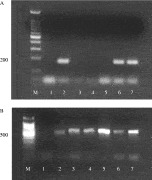
Fig. 2. (A) Typical results demonstrating that the SjR21 primer pair is specific to Schistosoma japonicum. Lane 1, negative control; lane 2, S. japonicum cercariae recovered from Oncomelania hupensis robertsoni; lane 3, single-tail non-japonicum cercariae recovered from O. h. robertsoni; lane 4, long forked-tail non-japonicum cercariae recovered from O. h. robertsoni; lane 5, S. mansoni DNA isolated from an adult worm; lane 6, S. japonicum (Chinese strain), recovered from laboratory strain of O. h. hupensis; lane 7, S. japonicum (Philippine strain) recovered from laboratory strain of O. h. chiui. (B) Universal amplified ribosomal region as a positive control. Lanes contain samples as in (A).
 You have
Access
- 18
- Cited by