The differential susceptibility perspective provides a framework for investigating individual differences in reactivity to environments (Ellis, Boyce, Belsky, Bakermans-Kranenburg, & van IJzendoorn, Reference Bakermans-Kranenburg and van IJzendoorn2011; see also Boyce & Ellis, Reference Boyce and Ellis2005). According to this theory, some individuals are relatively insensitive or resilient to their environment, whereas others are more receptive or vulnerable to their environment. Although this thinking is compatible with the diathesis-stress perspective (Monroe & Simons, Reference Monroe and Simons1991; Zuckerman, Reference Zuckerman1999), the differential susceptibility position further asserts that susceptible individuals will differ in a “for better and for worse” pattern (Belsky, Bakermans-Kranenburg, & van IJzendoorn, Reference Belsky, Bakermans-Kranenburg and van IJzendoorn2007, p. 300); that is, from an evolutionary perspective, these individuals' increased vulnerability in unsupportive environments is countered by better functioning in highly supportive environments.
A number of genetic polymorphisms have been suggested as influencing susceptibility to environmental influences. Research efforts have primarily focused on variation in genes that influence neurotransmitter activity, with intense interest in the serotonin transporter (SLC6A4), and dopaminergic genes such as the dopamine transporter (SLC6A3), dopamine receptors (e.g., DRD4), and monoamine oxidase A (MAOA). Although other reports using the same sample have investigated other genetic variants (Sulik et al., Reference Sulik, Eisenberg, Lemery-Chalfant, Spinrad, Silva and Eggum2012; Taylor et al., Reference Taylor, Sulik, Eisenberg, Spinrad, Silva and Lemery-Chalfant2013), in this manuscript we focus uniquely on the catechol-O-methyltransferase gene (COMT). According to one recent meta-analysis, genes known to affect dopamine can be considered measures of susceptibility to environmental influences (Bakermans-Kranenburg & van IJzendoorn, Reference Bakermans-Kranenburg and van IJzendoorn2011), and there is evidence that COMT (which affects dopamine and other catecholamines) indexes responsiveness to environmental influences (Voelker, Sheese, Rothbart, & Posner, Reference Voelker, Sheese, Rothbart and Posner2009) or plasticity (e.g., Belsky & Beaver, Reference Belsky and Beaver2011).
The manner in which the relations between individual differences, environmental effects, and psychopathology are conceptualized differs dramatically between the diathesis–stress and differential susceptibility perspectives. In the former, individual differences in susceptibility to environmental influences are viewed as a weakness that is only revealed in the presence of negative or toxic environments. In contrast, the differential susceptibility framework is an evolutionary developmental theory (Ellis et al., Reference Ellis, Boyce, Belsky, Bakermans-Kranenburg and van IJzendoorn2011) in which individual differences in susceptibility to environmental influences cannot be interpreted straightforwardly as vulnerability because the same characteristic that gives rise to vulnerability in some environments will yield advantage in other environments. Given the dominance of the diathesis–stress perspective in conceptualizing person–environment interactions in the prediction of psychopathology, it can be difficult for researchers to shift their conceptualization of individual difference variables from a focus on risk and resilience to a focus on developmental plasticity. Nonetheless, the differential susceptibility framework, which has been receiving increasing empirical support, is changing how researchers view the joint role of the environment and individual differences in susceptibility as predictors of psychopathology.
To date, most investigators have focused on a single dependent variable when testing differential susceptibility (e.g., Kochanska, Kim, Barry, & Philibert, Reference Kochanska, Kim, Barry and Philibert2011; Laucht et al., Reference Laucht, Blomeyer, Buchmann, Treutlein, Schmidt and Esser2012; Sulik et al., Reference Sulik, Eisenberg, Lemery-Chalfant, Spinrad, Silva and Eggum2012; for an exception, see Obradović, Bush, Stampterdahl, Adler, & Boyce, Reference Obradović, Bush, Stampterdahl, Adler and Boyce2010). This might be because formal criteria for testing this theory have been limited to a single dependent variable (see Belsky et al., Reference Belsky, Bakermans-Kranenburg and van IJzendoorn2007). There is, however, little reason to expect that differential susceptibility should apply to a single outcome. Instead, consistent with the evolutionary basis of differential susceptibility theory, we might expect trade-offs: susceptible individuals could plausibly demonstrate different behavioral responses depending on the relative advantage and disadvantage of these responses across different environments. In this study, we test whether COMT polymorphisms are associated with children's susceptibility to the influence of parenting across multiple outcomes: mothers' reports of their children's effortful control (i.e., inhibitory and attentional control) and internalizing symptoms. Consequently, our analyses address the issue of domain specificity in differential susceptibility (Ellis et al., Reference Ellis, Boyce, Belsky, Bakermans-Kranenburg and van IJzendoorn2011) by testing (a) whether COMT polymorphisms contribute to plasticity across a range of positive and negative parenting environments, or whether COMT primarily indexes receptivity to highly unsupportive environments (diathesis–stress; Monroe & Simons, Reference Monroe and Simons1991) or receptivity to highly supportive environments (vantage sensitivity; Pluess & Belsky, Reference Pluess and Belsky2012); and (b) whether COMT moderates the association between parenting and multiple outcomes in a similar way, or whether the pattern of associations differs across outcomes. The two outcomes examined in this study (effortful control and internalizing symptoms) were specifically selected for analysis because both have been examined in COMT association studies, with inconsistent results across studies, and both are related to the quality of parenting behavior, which is positively related to effortful control and negatively related to internalizing symptoms. Because COMT has been theorized to act as a “plasticity gene,” we were interested in examining whether it would moderate the effects of parenting in a similar way across these two outcomes. To our knowledge, this is the first study to test the interaction of COMT and parenting as a predictor of internalizing symptoms.
Relations Between Parenting and Effortful Control and Internalizing Symptoms
Effortful control is an aspect of temperament involved in behavioral and attentional self-regulation. According to Rothbart and Bates (Reference Rothbart, Bates, Damon, Lerner and Eisenberg2006, p. 129), it includes “the efficiency of executive attention—including the ability to inhibit a dominant response and/or to activate a subdominant response, to plan, and to detect errors.” There is substantial evidence that high effortful control is protective against the development of psychological symptoms, particularly for children high in negative emotions such as anger and frustration (Eisenberg, Spinrad, & Eggum, Reference Eisenberg, Spinrad and Eggum2010). Although temperament is typically conceptualized as having a biological basis, high-quality laboratory measures of parenting consistently predict the development of effortful control. For example, increases in effortful control have been predicted by aspects of positive parenting such as maternal responsiveness, warmth, respect for autonomy, and limit setting in early childhood (Kochanska, Murray, & Harlan, Reference Kochanska, Murray and Harlan2000; Lengua, Honorado, & Bush, Reference Lengua, Honorado and Bush2007) and by parental warmth in middle childhood (Eisenberg et al., Reference Eisenberg, Zhou, Spinrad, Valiente, Fabes and Liew2005).
Meta-analyses indicate that parenting quality is negatively related to anxiety and depression in childhood and adolescence, although the effect size of this relation tends to be modest (McLeod, Weisz, & Wood, Reference McLeod, Weisz and Wood2007; McLeod, Wood, & Weisz, Reference McLeod, Wood and Weisz2007). Perhaps because the validity of internalizing disorders such as depression in early childhood has only recently been established (Luby et al., Reference Luby, Heffelfinger, Mrakotsky, Brown, Hessler and Wallis2003), few investigators have examined parenting as a predictor of internalizing symptoms in young children. The best evidence for such a relation comes from two large population cohort studies, in which maternal sensitivity observed during parent–child interactions was negatively, albeit modestly, associated with mothers' reports of their children's internalizing symptomatology (Kok et al., Reference Kok, Linting, Bakermans-Kranenburg, IJzendoorn, Jaddoe and Hofman2013). In another study using observed measures of parenting quality and mothers' reports of early childhood internalizing symptoms, negative and intrusive parenting was positively associated with symptomatology, whereas parental warmth was negatively associated with symptomatology for African American children, but was unrelated to symptomatology for European American children (Propper, Willoughby, Halpern, Carbone, & Cox, Reference Propper, Willoughby, Halpern, Carbone and Cox2007). In addition to findings for observed parenting, investigators have also reported relations between questionnaire measures of parenting and internalizing symptoms in early childhood (Bayer, Sanson, & Hemphill, Reference Bayer, Sanson and Hemphill2006). In this study, we contribute to this limited body of literature using a reliable composite measure of early observed parenting quality and a longitudinal design in which symptomatology was assessed multiple times.
COMT
The COMT gene encodes the COMT enzyme that degrades catecholamines, including dopamine, epinephrine, and norepinephrine, and is particularly relevant in brain synapses (Tenhunen et al., Reference Tenhunen, Salminen, Lundstrom, Kiviluoto, Savolainen and Ulmanen1994). Functioning of the prefrontal cortex (PFC) of the brain, using animal models, has been shown to be sensitive to small changes in dopamine and norepinephrine levels (Arnsten & Pliszka, Reference Arnsten and Pliszka2011). In mouse models, the COMT enzyme has been demonstrated to be responsible for approximately half of the dopamine degradation that occurs in the PFC (Yavich, Forsberg, Karayiorgou, Gogos, & Männistö, Reference Yavich, Forsberg, Karayiorgou, Gogos and Männistö2007). One of the more widely studied variants in this gene is a single nucleotide polymorphism (SNP) that results in a valine (Val) to methionine (Met) amino acid substitution to the protein and is commonly referred to as COMT Val158Met (rs4680; Lachman et al., Reference Lachman, Papolos, Saito, Yu, Szumlanski and Weinshilboum1996). The methionine allele results in an estimated three- to fourfold reduction in overall enzyme activity, that is, lower COMT efficiency, compared to that of the valine allele (Lachman et al., Reference Lachman, Papolos, Saito, Yu, Szumlanski and Weinshilboum1996; Lotta et al., Reference Lotta, Vidgren, Tilgmann, Ulmanen, Melen and Julkunen1995).
However, two other common polymorphisms, a promoter SNP in intron1 (rs737865) and a 3′-untranslated region (3′ UTR) SNP just downstream of the last exon (rs165599), show effects on COMT gene expression (i.e., variation in the relative amount of the enzyme that is made, rather than the activity or efficiency of the enzyme). Specifically, the intron1-G and 3′ UTR-G alleles are associated with low COMT expression, and a haplotype constructed of these two alleles along with the valine allele results in the lowest COMT expression in human PFC assays (Bray et al., Reference Bray, Buckland, Williams, Williams, Norton and Owen2003; Meyer-Lindenberg et al., Reference Meyer-Lindenberg, Nichols, Callicott, Ding, Kolachana and Buckholtz2006). These combinations may create a “trade-off” scenario of “efficiency” versus “abundance” that is controlled by protein function and its expression, respectively. For example, having high COMT enzyme activity/efficiency in degrading catecholamines may not be adaptive if an individual has a low enzyme concentration, in contrast to having lower COMT activity but relatively higher concentration of it available when needed. Thus, individuals with COMT-Met enzyme might have lower enzyme activity than those with COMT-Val, but only when we examine the promoter SNPs in conjunction might we know how much of this enzyme is actually available and what side of the trade-off may be adaptive (Bray et al., Reference Bray, Buckland, Williams, Williams, Norton and Owen2003; Lipska et al., Reference Lipska, Mitkus, Caruso, Hyde, Chen and Vakkalanka2006; Shifman et al., Reference Shifman, Bronstein, Sternfeld, Pisanté-Shalom, Lev-Lehman and Weizman2002; Tunbridge et al., Reference Tunbridge, Weickert, Kleinman, Herman, Chen and Kolachana2007). In this respect, evaluation of each of these SNPs and their haplotype combinations in association analyses is necessary to testing these hypotheses, especially in different environments. Analyses of COMT haplotypes often have shown greater associations with various clinical behaviors related to cognitive stability and functioning relative to individual SNPs, and have sometimes been found to interact with sex (e.g., Burdick et al., Reference Burdick, Funke, Goldberg, Bates, Jaeger and Kucherlapati2007; Kocabas et al., Reference Kocabas, Faghel, Barreto, Kasper, Linotte and Mendlewicz2010; Liu et al., Reference Liu, Song, Li, Liu, Li and Yu2010; Shifman et al., Reference Shifman, Bronstein, Sternfeld, Pisanté-Shalom, Lev-Lehman and Weizman2002).
Associations Between COMT and Executive Function/Effortful Control
COMT Val158Met has been examined as a predictor of performance on executive function and attentional control tasks in adulthood. In these studies, the methionine allele has been consistently associated with greater executive function and attentional control (Bishop, Cohen, Fossella, Casey, & Farah, Reference Bishop, Cohen, Fossella, Casey and Farah2006; Blasi et al., Reference Blasi, Mattay, Bertolino, Callicott, Das and Kolachana2005; Egan et al., Reference Egan, Goldberg, Kolachana, Callicott, Mazzanti and Straub2001; Lipsky et al., Reference Lipsky, Sparling, Ryan, Xu, Salazar and Goldman2005; Malhotra et al., Reference Malhotra, Kestler, Mazzanti, Bates, Goldberg and Goldman2002). There is little evidence for moderation of this effect by sex (Barnett, Jones, Robbins, & Müller, Reference Barnett, Jones, Robbins and Müller2007), even though there are sex differences in effortful control favoring girls (Kochanska et al., Reference Kochanska, Murray and Harlan2000; Kochanska, Murray, Jacques, Koenig, & Vandegeest, Reference Kochanska, Murray, Jacques, Koenig and Vandegeest1996). The genetic differences in task performance are consistent with genetic differences in PFC and anterior cingulate activity, two brain regions that are involved in executive function and effortful control and in which dopamine and COMT are thought to play an important role (Bishop et al., Reference Bishop, Cohen, Fossella, Casey and Farah2006; Blasi et al., Reference Blasi, Mattay, Bertolino, Callicott, Das and Kolachana2005; Egan et al., Reference Egan, Goldberg, Kolachana, Callicott, Mazzanti and Straub2001; Mier, Kirsch, & Meyer-Lindenberg, Reference Mier, Kirsch and Meyer-Lindenberg2009). Although a number of studies have examined the association between COMT Val158Met and executive function in adult samples, these associations have not been extensively examined in child samples. In one such study, investigators reported that children's performance on an executive function task was higher for methionine homozygotes (Diamond, Briand, Fossella, & Gehlbach, Reference Diamond, Briand, Fossella and Gehlbach2004).
Val158Met has been found to interact with environmental variables to predict outcomes related to executive function, which provides evidence that this SNP may index plasticity to environmental influences. For example, Val158Met interacted with educational attainment to predict intelligence test scores, which included assessments of working memory and attention (Enoch, Waheed, Harris, Albaugh, & Goldman, Reference Enoch, Waheed, Harris, Albaugh and Goldman2009). In this study, educational attainment was positively related to intelligence scores for methionine carriers and unrelated to scores for valine homozygotes. Val158Met also interacted with socioeconomic status (SES) to predict attention-deficit/hyperactivity disorder symptoms (Nobile et al., Reference Nobile, Rusconi, Bellina, Marino, Giorda and Carlet2009); SES was negatively related to attention-deficit/hyperactivity disorder symptoms for methionine homozygotes but was unrelated for valine carriers.
Associations Between COMT and Internalizing Symptoms
COMT Val158Met has also been related to internalizing symptoms, primarily in adult women, although there is some inconsistency in the direction of the effects. For example, the valine allele predicted relatively high levels of phobic anxiety in a sample of adult women (McGrath et al., Reference McGrath, Kawachi, Ascherio, Colditz, Hunter and De Vivo2004), whereas in another study, the methionine allele predicted panic and phobic anxiety symptoms in women, but not in men (Olsson et al., Reference Olsson, Anney, Lotfi-Miri, Byrnes, Williamson and Patton2005). The methionine allele has also been associated with correlates of internalizing problems, such as high neuroticism, in women, but not in men (Stein, Fallin, Schork, & Gelernter, Reference Stein, Fallin, Schork and Gelernter2005). Finally, the valine allele (Mier et al., Reference Mier, Kirsch and Meyer-Lindenberg2009) and the methionine allele (Montag et al., Reference Montag, Buckholtz, Hartmann, Merz, Burk and Hennig2008; Smolka et al., Reference Smolka, Bühler, Schumann, Klein, Hu and Moayer2007) have been related to greater peripheral and central nervous system responses to affective stimuli that are thought to underlie internalizing disorders. In addition to uncertainty about the direction of these effects, the relation between COMT and internalizing symptoms has not been examined in samples of children.
Research on COMT has not been limited to the Val158Met SNP, and combinations of multiple COMT SNPs have been found to relate to internalizing symptoms and related phenotypes in adults. For example, the combination of Val158Met-A (i.e., the methionine allele), intron1-A, and 3′ UTR-A alleles as a haplotype has been found to predict neuroticism in women, but not men (Stein et al., Reference Stein, Fallin, Schork and Gelernter2005). Furthermore, although the valine allele was only marginally associated with internalizing symptoms in women (but not in men), in one study, a haplotype that combined the Val158Met-G and 3′ UTR-A alleles was more predictive of women's internalizing symptoms than the Val158Met alone (Hettema et al., Reference Hettema, An, Bukszar, van den Oord, Neale and Kendler2008). These studies provide evidence that COMT haplotypes that incorporate multiple variants may provide better prediction than the frequently examined Val158Met SNP alone.
The Present Investigation
Genetic variation at COMT has been found to predict both executive function and internalizing symptoms. However, in factor-analytic studies, the temperament dimensions of effortful control and negative emotionality, as well as the personality dimensions of constraint/conscientiousness and neuroticism/emotional stability, have been found to be largely orthogonal (McCrae & Costa, Reference McCrae and Costa1987; Rothbart, Ahadi, Hershey, & Fisher, Reference Rothbart, Ahadi, Hershey and Fisher2001). In addition, although effortful control may moderate the relation between negative emotionality and internalizing symptomatology (Oldehinkel, Hartman, Ferdinand, Verhulst, & Ormel, Reference Oldehinkel, Hartman, Ferdinand, Verhulst and Ormel2007), direct relations between effortful control and internalizing symptomatology appear to be modest (Eisenberg, Spinrad, & Eggum, Reference Eisenberg, Spinrad and Eggum2010; White, McDermott, Degnan, Henderson, & Fox, Reference White, McDermott, Degnan, Henderson and Fox2011). Because COMT is related to both of these constructs, but they are not strongly related to one another, it makes sense to examine moderators to determine the conditions under which COMT is related to effortful control and the conditions under which it is related to internalizing symptomatology. Moreover, because attentional control overlaps nearly entirely with skills included in measures of executive control, whereas inhibition of behavior (in contrast to inhibition of cognition) is less consistently central to measures of executive functioning, it made sense to explore if these two aspects of effortful control were similarly predicted by parenting and COMT.
A large majority of investigators studying the association of COMT with phenotypes has only examined the Val158Met SNP; however, it is also clear from previous work that high- and low-functioning COMT can be highly dependent on the combination of multiple variants. In this study, we tested the hypothesis that COMT allelic and haplotype variation indexes responsivity to early parenting as a predictor of children's effortful control and internalizing symptoms. At present, there is evidence that haplotypes may improve prediction relative to individual variants alone, although the degree of overlap between individual variants and haplotypes may limit the magnitude of these differences (Voelker et al., Reference Voelker, Sheese, Rothbart and Posner2009). With respect to the specific SNPs chosen for analysis, we have chosen to analyze variation in Val158Met because it is known to affect the efficiency of the COMT enzyme and the intron1 and 3′ UTR SNPs because they are known to affect the quantity of enzyme produced. We tentatively predicted that supportive parenting would have a stronger effect on children with the COMT SNP and haplotype variation associated with low COMT function (i.e., the methionine allele and the GGG haplotype). In contrast, consistent with the differential susceptibility hypothesis, we would predict that this interaction is complex and that both low and high COMT SNP and haplotype functioning have beneficial effects, but these effects likely vary with the parenting environments and, based on prior work, with the sex of the child. Based on prior work in adult samples (described above) and functional evidence from animal studies that COMT is sexually dimorphic (for a review, see Harrison & Tunbridge, Reference Harrison and Tunbridge2008), we expected COMT to play a stronger role in the prediction of internalizing symptoms for girls than for boys. Given the lack of moderation by sex for the relation between COMT and executive function in adults, we included COMT as a moderator in analyses predicting inhibitory control and attention focusing in a more exploratory framework. A major strength of this study was the use of a longitudinal design to examine COMT as a predictor of development in childhood; most studies have used cross-sectional adult samples.
Method
Participants
Participants were 153 children with genetic information who were drawn from a larger study of children's social and emotional development. Mothers and their infants were recruited shortly after birth at three hospitals in a large metropolitan area in the southwestern United States. All infants were healthy, full term, and from adult parents who were able to read English. For details about the larger study, refer to Eisenberg, Spinrad, Eggum, et al. (Reference Eisenberg, Spinrad, Eggum, Silva, Reiser and Hofer2010) and Spinrad et al. (Reference Spinrad, Eisenberg, Gaertner, Popp, Smith and Kupfer2007).
Of the children with genetic data, 8 did not have observed parenting data at the 18-month visit and were therefore excluded from the analyses. We report sample characteristics at the initial (18-month) assessment for the remaining 146 participants (79 male). All participants had mother questionnaire data at one or more assessments (Ns = 114 at 24 months, 143 at 30 months, 143 at 42 months, 126 at 48 months, 139 at 54 months, 139 at 72 months, and 126 at 84 months). Children ranged in age from 17.00 to 19.97 (M = 17.72, SD = 0.52) months at the initial assessment. The median annual family income in 2002 was $45,000–$60,000. Racial composition for children in our sample, as reported by parents, was as follows: 86% Caucasian, 5% Native American, 5% African American, 2% Asian, 1% mixed between two minorities, and 1% other; 21% reported Hispanic/Latino ethnicity. Five percent of mothers did not complete high school, 10% graduated from high school, 41% attended some college, 32% graduated from college, and 12% had a graduate or professional degree.
We examined mean differences on study variables between children included in our analyses and children who were not included due to missing parenting or genetic data. Children included in analyses were from families with higher SES (a composite formed by standardizing and averaging household income and mothers' and fathers' education; M = 0.08) compared to those who were not included due to missing data (M = −0.13), t (241) = −1.98, p < .05. No mean differences were found for the 18-month measure of parenting or for internalizing symptoms or effortful control at any time point.
Procedures
Laboratory visits were conducted when children were age 18, 30, 42, and 54 months, and a home visit was conducted when children were age 72 months. At these visits, children completed a battery of tasks presented as games, and parents completed questionnaires (as well as returned or completed other questionnaires sent a few weeks earlier). In addition, questionnaires were mailed to mothers when their children were age 24, 48, and 84 months. Mothers were paid between $20 (at the 18-month assessment) and $35 (at the 84-month assessment) for filling out questionnaires. Quality of parenting was observed at the 18-month laboratory visit, and cell tissue samples for genetic analyses were collected at the 72-month visit.
Measures
Effortful control
At 42, 54, 72, and 84 months, mothers reported on the attention focusing (14 items; e.g., “When drawing or coloring in a book, shows strong concentration”) and inhibitory control (13 items; e.g., “Is usually able to resist temptation when told s/he is not supposed to do something”) scales from the Children's Behavior Questionnaire (Rothbart et al., Reference Rothbart, Ahadi, Hershey and Fisher2001). One item on the attention focusing scale, “Will ignore others when playing with an interesting toy,” was negatively correlated with the scale score at all four time points and was therefore dropped. Cronbach α for attention focusing and inhibitory control ranged from 0.78 to 0.83 across all time points. At 42, 54, 72, and 84 months, these two scales were substantially correlated, rs = .48, .56, .60, and .66, respectively, so we initially averaged the two scales and analyzed the outcome as a composite measure of effortful control. Although differences were not hypothesized for the two scales, supplemental analyses indicated that COMT was differentially related to attention focusing and inhibitory control. We therefore report results separately for each of these scales (in addition to the composite of both scales). Effortful control was assessed with a different measure (i.e., the Early Children's Behavior Questionnaire) prior to 42 months, so earlier assessments could not be used in the growth curve analyses.
Internalizing symptomatology
At the 24-, 30-, 42-, 48-, and 54-month assessments, mothers reported on children's general anxiety (five items, e.g., “Seems nervous, tense, or fearful”), depression (nine items, e.g., “Seems very unhappy, sad, or depressed”), and anxiety/obsessive–compulsive (five items, e.g., “Is very worried about getting dirty”) symptoms using scales from the Infant–Toddler Social and Emotional Assessment (ITSEA; Briggs-Gowan & Carter, Reference Briggs-Gowan and Carter1998); the ITSEA was not administered at the 72- and 84-month assessments because it is only appropriate for young children. We averaged the ITSEA items, which were rated on a scale ranging from 0 (not true/rarely) to 2 (very true/often), to create a composite measure of internalizing symptomatology. One item from the depression scale (“Laughs easily or a lot,” reverse scored) lowered reliability of the internalizing composite at multiple visits and was therefore dropped from the composite, resulting in an 18-item internalizing scale. The Cronbach α values for this scale at 24, 30, 42, 48, and 54 months were 0.72, 0.64, 0.72, 0.74, and 0.70, respectively. To reduce the influence of outliers, scores that were more than 3 SD above the mean for internalizing at each assessment (n = 1 at 24 months, n = 3 at 30 months, n = 1 at 42 months, n = 2 at 48 months, n = 1 at 54 months) were recoded so that they were only 3 SD above the mean (Tabachnik & Fidell, Reference Tabachnik and Fidell2006). ITSEA scores ranged from 0.00 to 1.06 before recoding outliers, and from 0.00 to 0.82 after recoding outliers. Recoding outliers did not substantively affect the reported results.
Parenting quality
At the 18-month visit, mothers and children were video recorded during free play, a challenging teaching task, and a clean-up task. Maternal sensitivity and intrusiveness were coded during the free-play interaction and teaching task. During a 3-min free-play session, a basket of toys was given to mothers with instructions to play with their child as they would at home. In the teaching task, mothers had 3 min to teach their child to complete a difficult puzzle. For the clean-up task, mothers were told to ask their child to pick up toys and place them in a basket. The task lasted 3 min or until all the toys were cleaned up (Braungart-Rieker, Garwood, & Stifter, Reference Braungart-Rieker, Garwood and Stifter1997; Kochanska, Aksan, & Nichols, Reference Kochanska, Aksan and Nichols2003; Stifter, Spinrad, & Braungart-Rieker, Reference Stifter, Spinrad and Braungart-Rieker1999). Ratings of sensitivity and intrusiveness were made at 15-s intervals during the free-play interaction and at 30-s intervals during the teaching task (Fish, Stifter, & Belsky, Reference Fish, Stifter and Belsky1991). Sensitivity was coded based on maternal behaviors that indicated attention toward the child and responsiveness to the child's emotions, interests, and level of ability (1 = no evidence of sensitivity; 4 = mother was very aware of the toddler, contingently responsive to his/her interests and affect, and had an appropriate level of response/stimulation (interrater reliabilities [interclass correlations (ICC)] = 0.81 and 0.82, for free-play and teaching task, respectively). Intrusiveness was assessed by coding maternal behaviors that evidenced overstimulating the child, physically intruding, or providing help to the child when not needed (1 = no overcontrolling behavior observed; 4 = extreme intrusive or overcontrolling behaviors; ICC = 0.82 and 0.81 for free-play and teaching task, respectively). Ratings of maternal warmth were also made every 30 s during the teaching task. Warmth was assessed using mother's expressions of friendliness and closeness, physical affection, positive affect toward child, supportiveness, and the quality of their tone/conversation (1 = no evidence of warmth; 5 = very engaged with the child, positive affect was predominant, and the mother was physically affectionate; ICC = 0.83). Mothers' verbal control, assertive commands, and prohibitions given without force or threat (e.g., “We have to clean up NOW”) were rated every 15 s during the clean-up task (1 = present, 0 = not present; κ = 0.70). After reverse scoring maternal control and intrusiveness, all measures of parenting were significantly positively correlated, with rs ranging from .19 to .85 (all ps < .05). A composite of parenting quality was created by standardizing these six scores and computing the mean. The standardized α for the composite measure of parenting was 0.72.
Genotyping
After collecting a buccal oral cheek sample from each individual, DNA extractions were conducted using a standard isolation protocol (Sambrook & Russell, Reference Sambrook and Russell2001). Three pairs of polymerase chain reaction primers were designed based on the GenBank human genome sequence draft to amplify three DNA fragments that included three COMT SNPs, respectively, for each individual. Primers included the intron1 G/A SNP (rs737865) as ATG TGT GGT GTG CAG GAC C (forward) and CAA ATC AGC ATG GAG CCA G (reverse), for a 267 base pair (bp) fragment; the Val (G) / Met (A) SNP (rs4680) as CTG TGG CTA CTC AGC TGT GC (forward) and TGG TGT GAA CAC CTG GTG G (Reverse), for a 227-bp fragment; the 3′ UTR G/A SNP (rs165599) as GAC GGA CGC TAA CGC TAA G (Forward) and GAT GCT TCC ACT CTG TGC C (reverse), for a 276-bp fragment. These fragments were cleaned, and full nucleotide sequences were generated and analyzed, following our previous protocol (Claw, Tito, Stone, & Verrelli, Reference Claw, Tito, Stone and Verrelli2010).
Haplotypes and population structure
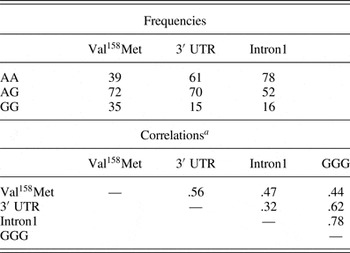
Allele frequencies for each of the three SNPs are shown in Table 1. Chi-squared tests of independence confirmed that genotype frequencies for each of the three SNPs were consistent with Hardy–Weinberg equilibrium (intron1: χ2 = 2.94, p = .09; Val158Met: χ2 = 0.05, p = .82; 3′ UTR: χ2 = 0.36, p = .55), which is an important assumption of subsequent genotype–phenotype association analyses. In addition to association tests with independent SNPs, analyses were conducted with combinations of the SNPs as haplotypes. Thus, we used the PHASE v. 2.1.1 program (Stephens, Smith, & Donnelly, Reference Stephens, Smith and Donnelly2001) to statistically infer and construct haplotypes that included the intron1, Val158Met, and 3′ UTR SNPs. These samples were previously genotyped for 10 unlinked variable number tandem repeats (VNTRs) distributed across the genome to identify and account for any population stratification (Sulik et al., Reference Sulik, Eisenberg, Lemery-Chalfant, Spinrad, Silva and Eggum2012). The VNTRs were D1S1612, D2S1356, D4S1280, D5S1471, D6S1006, D7S2847, D17S1308, D18S535, D19S714, and D20S604 (protocol previously in Egan et al., Reference Egan, Goldberg, Kolachana, Callicott, Mazzanti and Straub2001; Straub et al., Reference Straub, Speer, Luo, Rojas, Overhauser and Ott1993). In an analysis of these VNTR markers using the STRUCTURE program (Pritchard, Stephens, & Donnelly, Reference Pritchard, Stephens and Donnelly2000), genetic variation among individuals was statistically consistent with a single population sample with no significant effects of population admixture. Thus, no correction for population stratification was needed in subsequent analyses of the full sample.
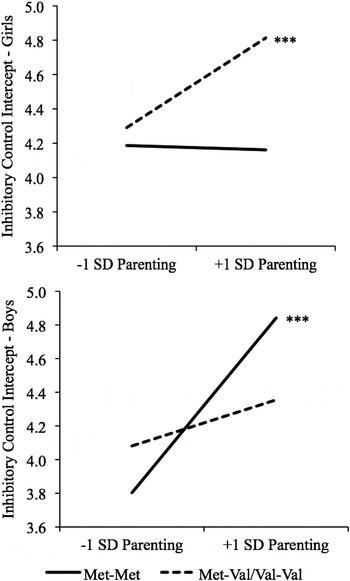
Simple effect of parenting quality on mothers' reports of inhibitory control for children with Val-Val and Met-Val/Met-Met genotype. Val, Valine; Met, methionine. ***p < .001.

Frequencies and correlations among genetic variables

Note: 3′ UTR, 3′ Untranslated region.
aCorrelations are for dominantly coded variables (0 = AA, 1 = AG/GG). The GGG haplotype was coded as follows: 0 = not present, 1 = at least one GGG haplotype present. All correlations are significant at p < .001.
Allele frequencies for each variant are shown in Table 1. Based on the literature on the function of our COMT variants and evidence from association studies previously noted, we also examined a haplotype that combined intron1-G, Val158Met-G, and 3′ UTR-G alleles (henceforth referred to as the GGG haplotype) as a predictor in our analyses. The GGG haplotype has been associated with the lowest COMT enzyme expression, and thus, like the Met (A) allele that has been associated with low COMT enzyme activity, it also reflects reduced COMT and related PFC functioning (Shifman et al., Reference Shifman, Bronstein, Sternfeld, Pisanté-Shalom, Lev-Lehman and Weizman2002). For the GGG haplotype, 95 children had zero copies, 49 children had one copy, and 2 children had two copies. COMT expression appears to be additive with respect to this haplotype combination; that is, the more copies of the GGG haplotype, the lower the COMT expression (Shifman et al., Reference Shifman, Bronstein, Sternfeld, Pisanté-Shalom, Lev-Lehman and Weizman2002). In all analyses involving this haplotype, we collapsed the latter two groups to compare children with and without at least one copy of this haplotype, essentially contrasting groups of lower and higher COMT expression, respectively.
Results
Descriptive analyses
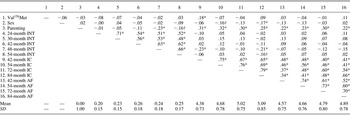
When the genetic variables were coded dominantly (AA = 0, AG/GG = 1, G is dominant), there was considerable overlap between Val158Met, intron1, and 3′ UTR, with correlations ranging from .32 to .56 (see Table 1). The relations between the individual variants (especially intron1) and the GGG haplotype were also substantial, with correlations ranging from .44 to .78. Correlations between other study variables are presented in Table 2. Rank-order stabilities for attention focusing, inhibitory control, and internalizing were high, with rs across time ranging from .52 to .74 for attention focusing, from .65 to .79 for inhibitory control, and from .48 to .71 for internalizing. Internalizing was largely unrelated to attention focusing and inhibitory control; the only significant correlation between these measures was between internalizing at 48 months and inhibitory control at 84 months, r (111) = −.21, p < .05. Sex was significantly correlated with intron1 (coded dominantly), r (143) = −.19, p < .05, but was unrelated to all other study variables; girls were more likely than boys to have AA for intron1. Val158Met, intron1, 3′ UTR, and the GGG haplotype were not significantly correlated with any other study variables. Observed parenting quality, which was assessed at the 18-month visit, was negatively related to internalizing at 48 months, r (124) = −.23, p < .05, and was positively related to attention focusing and inhibitory control across all assessments, with rs ranging from .22 to .32, ps < .05.
Correlations and descriptive statistics
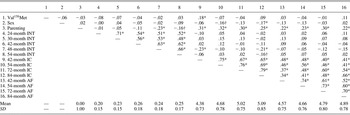
Note: Val, Valine; Met, methionine; INT, internalizing; IC, inhibitory control; AF, attention focusing. Val158Met is coded so that 0 = Met-Met and 1 = Met-Val/Val-Val; sex is coded so that 0 = female and 1 = male.
†p < .10. *p < .05.
Random effects model
Using SAS 9.3 (PROC MIXED), we tested a series of unconditional models of increasing complexity to establish the best-fitting unconditional growth model prior to adding substantive predictors (Singer & Willett, Reference Singer and Willett2003). These models use maximum likelihood estimation as a missing data treatment (Schafer & Graham, Reference Schafer and Graham2002). Likelihood ratio tests were used to compare nested models, and the best-fitting model for each dependent variable was used as the basis for subsequent analyses. Pseudo r 2 statistics are reported as a measure of effect size and were computed by calculating the squared correlation between the actual scores and the model-predicted scores (Singer & Willett, Reference Singer and Willett2003).
Attention focusing
The best-fitting unconditional model included fixed and random effects for the intercept and linear slope. With time centered at the first measurement occasion (42 months), the estimates for the fixed effects were as follows: intercept = 4.57; linear slope = 0.09, t = 5.21, p < .001. The significant, positive linear slope indicates that attention focusing was increasing at 42 months. The random effects were as follows: intercept = 0.427, z = 6.73, p < .001; linear slope = 0.019, z = 3.62, p < .001, indicating that there was significant between-person variability in both the intercept and linear slope. The covariance between the intercept and linear slope was nonsignificant (z = −1.84, ns), indicating that initial levels of attention focusing were uncorrelated with rates of growth. The residual (within-person) variance was 0.159 (z = 11.59, p < .001). This model explained 2.4% of the variance in attention focusing.
Inhibitory control
The best-fitting unconditional model included fixed effects for the intercept, linear slope, and quadratic slope, and random effects for the intercept and linear slope. With time centered at the first measurement occasion (42 months), the estimates for the fixed effects were as follows: intercept = 4.36; linear slope = 0.36, t = 7.74, p < .001; quadratic slope = −0.04, t = −3.35, p < .001. The significant, positive linear slope indicates that inhibitory control was increasing at 42 months, but the significant negative quadratic term indicates that this upward trend decelerated over time. The random effects were as follows: intercept = 0.415, z = 6.88, p < .001; linear slope = 0.015, z = 3.35, p < .001, indicating that there was significant between-person variability in both the intercept and the linear slope. The covariance between the intercept and the linear slope was nonsignificant, z = −0.58, ns, indicating that the initial level of inhibitory control was uncorrelated with rate of growth. The residual (within-person) variance was 0.136, z = 11.45, p < .001. This model explained 12.0% of the variance in inhibitory control.
Internalizing symptomatology
The best-fitting unconditional model included fixed effects for the intercept, linear slope, and quadratic slope, and random effects for the intercept and linear slope. With time centered at the first measurement occasion (24 months), the estimates for the fixed effects were as follows: intercept = 0.21; linear slope = 0.05, t = 3.10, p < .01; quadratic slope = −0.02, t = −2.37, p < .05. The significant, positive linear slope indicates that internalizing symptoms were increasing at 24 months, but the significant negative quadratic term indicates that the rate of change decelerated (i.e., became less positive) over time. The random effects were as follows: intercept = 0.014, z = 5.59, p < .001; linear slope = 0.002, z = 2.83, p < .01; this finding indicates that there was significant between-person variability in both the intercept and the linear slope. The covariance between the intercept and linear slope was nonsignificant (z = −0.38, ns), indicating that initial levels of internalizing symptoms were uncorrelated with rates of growth. The residual (within-person) variance was 0.010 (z = 13.79, p < .001). This model explained 1.2% of the variance in internalizing symptomatology.
Substantive models
For each of the three dependent variables (attentional control, inhibitory control, and internalizing problems), we estimated models containing all lower order terms, and the three-way interaction among Val158MetFootnote 1 (dummy coded: 0 = AA [Met-Met] and 1 = AG/GG [Met-Val/Val-Val], sex (dummy coded: 0 = female, 1 = male), and parenting quality as predictors of the intercept and linear slope. For all three dependent variables, despite significant between-person variability in the linear slopes, there was no prediction of the slope from parenting, COMT genotype, sex, or any two- or three-way interactions between these variables. Consequently, prediction of the slope was dropped from all models to simplify the results.Footnote 2 In addition to examining the Val158Met SNP, we estimated similar models for the intron1 and 3′ UTR SNPs, as well as for the GGG haplotype. None of the genetic predictors, alone or in two- or three-way interactions with sex and parenting, predicted attention focusing. Although there were significant three-way interactions among parenting, sex, and each of the three individual variants (coded dominantly) for internalizing and inhibitory control, the Val158Met SNP explained more variance in these outcomes, and therefore we focus our presentation of results on Val158Met. Consistent with the moderate to high correlations among the genetic variables, when three-way interactions among sex, parenting, and the other genetic variables (intron1, 3′ UTR, and the GGG haplotype) were found, they were highly similar to the results for Val158Met. Consequently, results for these other genetic predictors are reported in abbreviated detail.
For each significant three-way interaction involving Val158Met, we probed the two-way interaction between Val158Met and parenting quality for boys and for girls, and then calculated the simple effects of parenting on the outcome for each combination of genetic group and sex (Aiken & West, Reference Aiken and West1991), resulting in four simple effects for each model. To determine whether genetic differences were primarily found in highly supportive or unsupportive environmental contexts, we also examined the region of significance (Johnson & Neyman, Reference Johnson and Neyman1936) for the genetic effects.Footnote 3 The region of significance corresponds to the boundaries of the significant effect (i.e., the areas in which the simple effect is significant vs. nonsignificant) and has been used to test for differential susceptibility in other studies (e.g., Kochanska et al., Reference Kochanska, Kim, Barry and Philibert2011; see also Roisman et al., Reference Roisman, Newman, Fraley, Haltigan, Groh and Haydon2012).
Attention focusing
There were no main effects of any individual COMT SNPs or the GGG haplotype when predicting attention focusing; nor were there any two- or three-way interactions with sex or parenting for any individual COMT SNPs or for the GGG haplotype.
Inhibitory control
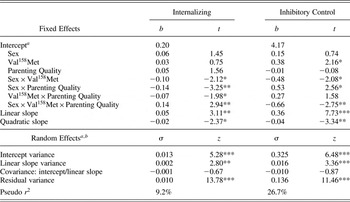
There was a significant three-way interaction among sex, Val158Met, and parenting qualityFootnote 4 (see Table 3; b = −0.66, t = −2.75, p < .01). This model explained 26.7% of the variance in inhibitory control, an increase of 14.7% over the unconditional model. The two-way interaction between Val158Met and parenting quality was significant for boys (b = −0.38, t = −2.34, p < .05), but not for girls (b = 0.27, t = 1.58, ns). Despite a nonsignificant two-way interaction term, there was no effect of parenting on inhibitory control for girls with Met-Met (see Figure 1; b = −0.01, t = −0.08, ns), but there was a positive effect of parenting on inhibitory control for girls with Met-Val/Val-Val (b = 0.26, t = 3.38, p < .001). Conversely, there was a positive effect of parenting quality on inhibitory control for boys with Met-Met (b = 0.52, t = 3.76, p < .001), but there was no effect of parenting on inhibitory control for boys with Met-Val/Val-Val (b = 0.14, t = 1.57, ns). Examining the regions of significance revealed that significant genetic differences were detected at values of parenting ≥0.12 SD below the mean for girls and at values of parenting ≥0.62 SD above the mean for boys.
Substantive models predicting mother-reported internalizing symptomatology and inhibitory control

Note: Val, Valine; Met, methionine; sex was dummy coded: 0 = female, 1 = male. Val158Met was coded dominantly: 0 = Met-Met, 1 = Met-Val/Val-Val. Parenting quality is standardized (M = 0, SD = 1).
aTime is centered at 24 months for internalizing symptomatology and at 42 months for effortful control.
bThe random effects differ as a function of time.
*p < .05. **p < .01. ***p < .001.
There were also significant three-way interactions among parenting, sex, and intron1 (t = −2.63, p < .01, pseudo r 2 = 20.9), 3′ UTR (t = −2.75, p < .01, r 2 = 20.1%), and the GGG haplotype (t = −2.23, p < .05, pseudo r 2 = 25.1%). Consistent with the positive correlations among the various genetic variables, an examination of the simple effects revealed that the pattern of results for intron1, 3′ UTR, and the GGG haplotype were all very similar to the results for Val158Met. Parenting was positively related to inhibitory control for boys with the intron1 AA genotype, for boys with the 3′ UTR AA genotype, and for boys without the GGG haplotype, and for girls with the intron1 GA/GG genotype, girls with the 3′ UTR GA/GG genotype, and for girls with the GGG haplotype. Parenting was not significantly related to inhibitory control for boys with the intron1 GA/GG genotype, boys with the 3′ UTR GA/GG genotype, or boys with the GGG haplotype, or for girls with the intron1 AA genotype, girls with the 3′ UTR AA genotype, or girls without the GGG haplotype.
Internalizing symptomatology
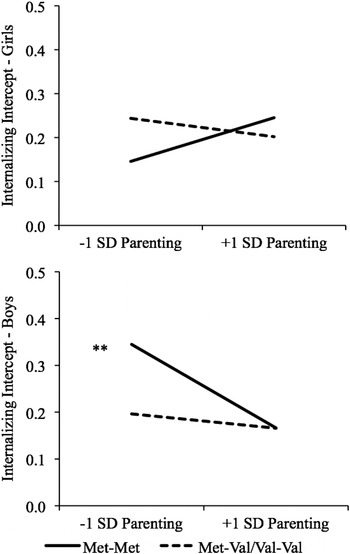
There was a significant three-way interaction among sex, Val158Met, and parenting quality (see Table 3; b = −0.07, t = −1.98, p < .05). This model explained 9.2% of the variance in internalizing, an increase of 8.0% over the unconditional model. The two-way interaction between Val158Met and parenting quality was significant for boys (b = 0.07, t = 2.18, p < .05) and for girls (b = −0.07, t = −1.98, p < .05). For boys with Met-Met, parenting was negatively related to internalizing (see Figure 2; b = −0.09, t = −3.13, p < .01), but for boys with Met-Val/Val-Val, parenting was unrelated to internalizing (b = −0.02, t = −0.84, ns). Despite a significant Val158Met × Parenting Quality interaction, parenting was unrelated to internalizing for girls with Met-Met and with Met-Val/Val-Val (bs = 0.05 and −0.02, ts = 1.56 and −1.30, ns). Examining the regions of significance indicated that significant genetic differences were detected at values of parenting ≤ 0.86 SD below the mean for girls (Val-Val/Val-Met > Met-Met) and at values of parenting ≤ 0.17 SD above the mean for boys (Met-Met > Val-Val/Val-Met).
Simple effect of parenting quality on mothers' reports of internalizing symptomatology for children with Val-Val and Met-Val/Met-Met genotype. Val, Valine; Met, methionine. **p < 01.

There were no main effects or two- or three-way interactions with sex or parenting for the GGG haplotype or for intron1. There was a three-way interaction among 3′ UTR, parenting, and sex, explaining 5.2% of the variance in internalizing symptomatology (b = 0.11, t = 2.29, p < .05). The two-way Parenting × 3′ UTR interactions were not significant for girls or for boys (bs = −0.05 and 0.05, ts = −1.74 and 1.53). Examining the simple effects revealed that parenting was unrelated to internalizing for girls with AA, girls with AG/GG, and boys with AG/GG (bs = 0.03, −0.03, and −0.02; ts = 1.16, −1.35, and −0.92; all ns). Parenting quality was, however, negatively related to internalizing for boys with AA (b = −0.07, t = −2.43, p < .05).
Discussion
In this study, we present evidence that COMT is related to inhibitory control and internalizing symptomatology relatively early in childhood. The longitudinal nature of the data allowed us to determine that this relation was stable over the time period studied (see footnote 2). The pattern of findings in this study was relatively complex, with significant three-way interactions among COMT SNPs (and a haplotype incorporating information from all three SNPs), parenting quality, and sex for internalizing symptoms and inhibitory control, but not for attention focusing. Within males and within females, the interaction between parenting quality and Val158Met was consistent across internalizing and inhibitory control outcomes, although this pattern was reversed across sex: relatively greater internalizing symptomatology in unsupportive environments and greater inhibitory control in supportive environments was predicted by Met-Val/Val-Val in girls and by Met-Met in boys.
Few researchers have attempted to examine differential susceptibility across multiple outcomes; it has typically been evaluated in the context of only a single dependent variable (although see Obradović et al., Reference Obradović, Bush, Stampterdahl, Adler and Boyce2010). Consequently, this study provides evidence that a genetic variant can serve as a vulnerability factor for one phenotype (in this case, internalizing symptomatology) and a promotive factor for a different phenotype (in this case, inhibitory control). Consistent with most studies of psychopathology, differences were most pronounced for internalizing in unsupportive environmental contexts. This result, considered alone, is consistent with the diathesis–stress framework. However, this pattern was reversed for an aspect of effortful control, with differences emerging in more supportive environmental contexts (consistent with vantage sensitivity; Pluess & Belsky, Reference Pluess and Belsky2012). Taken together, our results for inhibitory control and internalizing symptoms provide evidence supporting the differential susceptibility perspective (Ellis et al., Reference Ellis, Boyce, Belsky, Bakermans-Kranenburg and van IJzendoorn2011). Of specific interest is the pattern of for better and for worse responding in particularly supportive and unsupportive environments. Although extreme reductions in dopamine functioning have been tied to behavioral disorders, subtle differences in dopamine at intermediate levels may be “better” in one environment but “worse” in another. These results suggest that the level of COMT activity may have a differential and resulting beneficial impact on boys and girls depending on their environments. Assuming these phenotypes are not the only ones moderated by COMT, this adaptive gene by environment interaction could maintain COMT genetic variation (i.e., multiple SNPs and haplotype combinations) over evolutionary time.
These results highlight the contributions of evolutionary theory that underpin the differential susceptibility perspective. We speculate that population variation in COMT alleles is maintained because each of two alleles is more adaptive in a specific type of environment: in unsupportive environments, vigilant behavior might be more adaptive, whereas in supportive environments, good self-regulation may be more adaptive. Although self-regulatory ability is generally viewed positively, we do see environmental calibration of self-regulatory capacity over time (unsupportive environments are associated with poor self-regulation), which would be consistent with the adaptive calibration and/or biological sensitivity to context theories (Boyce & Ellis, Reference Boyce and Ellis2005; Del Giudice, Ellis, & Shirtcliff, Reference Del Giudice, Ellis and Shirtcliff2011). Furthermore, high levels of self-regulation may be maladaptive in unsupportive contexts, in which behaviors such as delay of gratification can cause individuals to forgo current benefits in favor of future benefits. Under conditions of high uncertainty, this may not represent an optimal strategy, and the development of self-regulation may actually impose high costs (e.g., consumption of metabolic resources for the creation and maintenance of the cortical structures underlying these abilities). Within males and within females, we see a pattern of results that is consistent with this theorizing: within sex, the same allele is associated with greater plasticity to environmental influences, although the nature of these differences depends on the type of environment.
We found evidence that the association between Val158Met and internalizing symptoms was present primarily in the context of unsupportive parenting, whereas the association between Val158Met and inhibitory control was present primarily in the context of supportive parenting. Consequently, although COMT was related to both of these outcomes, it was not related to both outcomes within the same individuals. Within males and within females, there appears to be a trade-off between the possibility of both greater executive function and greater internalizing symptomatology. This finding supports moving away from defining genetic alleles as indicators of risk or resilience based on a medical model, toward a deeper understanding of gene–environment interplay and development (Lemery-Chalfant, Reference Lemery-Chalfant, Reich, Zautra and Hall2010).
The Val158Met SNP has been the most studied variant on the COMT gene; however, as previously noted, there are other COMT SNPs that also may affect expression of the COMT enzyme. For the outcomes examined in this study, neither the intron1 or 3′ UTR SNPs nor the GGG haplotype explained more variance in the outcomes relative to Val158Met, although the three-way interactions for intron1 and the GGG haplotype were significant for inhibitory control, and the three-way interaction for 3′ UTR was significant across inhibitory control and internalizing symptoms. Consistent with the moderate to high positive correlations among the genetic variables, results for Val158Met and the other genetic predictors were largely similar. In addition, our results supported coding Val158Met (as well as the intron1 and 3′ UTR SNPs) dominantly for the outcomes examined in this study. We did not find support for better prediction by the GGG haplotype relative to the individual SNPs, although levels of prediction were comparable for inhibitory control, with 25.1% of the variance explained for the GGG haplotype versus 25.7% for Val158Met. Because the Val158Met SNP seemed to provide better resolution than the intron1 and 3′ UTR SNPs and the GGG haplotype, COMT enzyme activity may be relatively more important than levels of COMT expression. That is, catecholamine degradation (i.e., “availability” of dopamine and other neurotransmitters in the brain over time) and its relation to balancing internalizing and inhibitory behavior may be better regulated by COMT efficiency (i.e., high or low enzyme function) rather than COMT expression (i.e., high or low concentrations of the enzyme regardless of its efficiency). Thus, our findings contribute to understanding of an adaptive trade-off between “efficiency” and “abundance” with respect to the COMT enzyme in different environments. Our study and that by Voelker et al. (Reference Voelker, Sheese, Rothbart and Posner2009) both examined the Val158Met SNP; however, the additional COMT SNPs used to compose haplotypes were different in the two studies. Nonetheless, both studies found that haplotypes provided no significantly greater resolution or increase in variance than the Val158Met SNP alone, partly because there can be a great deal of correlation (i.e., linkage disequilibrium) among some SNPs, and thus, we may expect similar results across studies for haplotype analyses even when different SNPs are used.
Our findings for effortful control were specific to the inhibitory control subscale and not the attentional focusing subscale. Other studies have reported differential patterns of relations with respect to these different aspects of effortful control (e.g., White et al., Reference White, McDermott, Degnan, Henderson and Fox2011), and our finding is in line with specificity reported in Diamond et al. (Reference Diamond, Briand, Fossella and Gehlbach2004), the first study to consider COMT in relation to executive functioning in children. In that study, typically developing Met/Met children (i.e., those with predicted higher PFC dopamine) performed better on a directional Stroop “dots-mixed” task than did Val/Val children (i.e., those with predicted lower PFC dopamine). This task requires working memory and inhibitory control, such that participants must remember two rules and sometimes inhibit the prepotent tendency to respond on the same side as the stimulus. In contrast, COMT did not predict performance on mental rotation, recall memory, or self-ordered pointing tasks that do not require inhibitory control. Different executive functioning and cognitive tasks are differentially sensitive to dopamine in the PFC, and dopamine in the dorsolateral PFC, in particular, appears to affect inhibitory control. Studies with adults that utilize tasks that require working memory and inhibition and recruit the dorsolateral PFC also find associations with COMT (e.g., Wisconsin Card Sorting Test; Bruder et al., Reference Bruder, Keilp, Xu, Shikhman, Schori and Gorman2005; Egan et al., Reference Egan, Goldberg, Kolachana, Callicott, Mazzanti and Straub2001), whereas studies that assess storage, updating of information in working memory, or maintenance of temporal order are not associated (Bruder et al., Reference Bruder, Keilp, Xu, Shikhman, Schori and Gorman2005). Thus, specificity in our findings is in line with existing literature, although too few studies in children have been conducted to draw sweeping conclusions.
Previous work has associated the Val158Met SNP with executive function and with internalizing symptoms. For the latter outcome, however, the direction of this effect has appeared to vary from study to study and has also been moderated by other COMT variants (e.g., Voelker et al., Reference Voelker, Sheese, Rothbart and Posner2009) and by other genes such as the dopamine transporter gene (Holmboe et al., Reference Holmboe, Nemoda, Fearon, Csibra, Sasvari-Szekely and Johnson2010). We provide evidence that this association also depends on measures of environmental quality such as parenting. Our results are similarly in line with the evidence that COMT is sexually dimorphic (Harrison & Tunbridge, Reference Harrison and Tunbridge2008), although our findings with respect to sex differences are not entirely consistent with previous studies using adult samples. We found that parenting was differentially related to our outcomes within each sex but the direction of this effect differed for boys and girls. Gene function can be modified by other genes as well as by nongenetic environmental effects. In this case, being male or female (which is genetically determined) influences an individual's genetic and environmental contexts, either of which could potentially affect COMT, catecholamine levels, or the interplay between COMT and catecholamines. Currently, the mechanism underlying sexual dimorphism in humans for COMT is poorly understood. Nonetheless, it might be the case that, as is the case for any gene by sex relationships, a dosage effect also moderates COMT interactions here. For example, while one allele is more adaptive for females (on average), the other allele is more adaptive for males (on average), thereby contributing to the maintenance of genetic variation in the population. Considering that few sex differences in relations with COMT are found for executive function and that investigators who document sex differences for COMT and internalizing symptoms find effects for women but not for men, the sex differences in this study, as a novel Gene × Environment interaction, should be interpreted with caution (Duncan & Keller, Reference Duncan and Keller2011). This is especially true because the precision of estimates is positively related to sample size (Cohen, Reference Cohen1988), which was relatively modest in our study.
The relatively low-risk nature of the sample was a limitation, especially for the measure of internalizing symptoms. The mean level of problems was low and well within the normative range, and therefore it is unclear whether the findings in this study would generalize to clinical levels of symptomatology. However, restriction of range tends to attenuate measures of association, so the relation between COMT and internalizing may be stronger than indicated by our results. In our sample, there was considerable variability in parenting quality, but extremely poor parenting quality (e.g., abuse or maltreatment) was not observed. This could be considered a limitation insofar as some theorists have argued that the full range of environmental variation is important for testing differential susceptibility (Ellis et al., Reference Ellis, Boyce, Belsky, Bakermans-Kranenburg and van IJzendoorn2011). Another limitation was that our measures were unable to differentiate between different types of internalizing problems (e.g., depression vs. anxiety). Although the reliability of individual ITSEA scales has been demonstrated elsewhere (Briggs-Gowan & Carter, Reference Briggs-Gowan and Carter1998), these scales are short and would not have sufficient reliability to examine separately in this sample. Finally, although the stability of our findings across time contributes to confidence in our results, there is a clear need for replication of these relatively complex three-way interactions among COMT, sex, and parenting in samples with similarly high-quality measures of environment.