Introduction
Mild cognitive impairment (MCI) can represent the symptomatic pre-dementia phase of Alzheimer’s disease and related disorders (ADRD; Albert et al., Reference Albert, DeKosky, Dickson, Dubois, Feldman, Fox and Phelps2011). Individuals with MCI experience declines in memory and other cognitive skills that can negatively impact their quality of life and ability to complete complex everyday tasks (e.g., medication management; Schmitter-Edgecombe, Woo, & Greeley, Reference Schmitter-Edgecombe, Woo and Greeley2009; Teng, Tassniyom, & Lu, Reference Teng, Tassniyom and Lu2012). Care-partners who assist individuals with MCI are also at risk for negative mental health effects (Blieszner & Roberto, Reference Blieszner and Roberto2010; Garand, Dew, Eazor, DeKosky, & Reynolds, Reference Garand, Dew, Eazor, DeKosky and Reynolds2005). A recent meta-analysis suggests that the annual conversion rate from MCI to dementia is approximately 5–10% (Mitchell & Shiri-Feshki, Reference Mitchell and Shiri-Feshki2009), with the majority of individuals diagnosed with MCI remaining static and others reverting to normal. Given the aging of the population and limited efficacy of drug therapies to date (Schneider, Reference Schneider2013; Yuill & Hollis, Reference Yuill and Hollis2011), there is growing need for early, pro-active programs that can delay dementia diagnosis and enhance the well-being of individuals with MCI and their care-partners.
Recently, evidence-based cognitive rehabilitation approaches that support independence have been applied to individuals with MCI (e.g., Belleville et al., Reference Belleville, Clément, Mellah, Gilbert, Fontaine and Gauthier2011; Greenaway, Duncan, & Smith, Reference Greenaway, Duncan and Smith2013; Schmitter-Edgecombe, Howard, Pavawalla, Howell, & Rueda, Reference Schmitter-Edgecombe, Howard, Pavawalla, Howell and Rueda2008; Troyer, Murphy, Anderson, Moscovitch, & Craik, Reference Troyer, Murphy, Anderson, Moscovitch and Craik2008). These approaches aim to maintain everyday functioning and delay dementia diagnosis by teaching practical memory strategies directed at everyday activities (e.g., getting to an appointment). While it has been demonstrated that individuals with MCI can learn to use memory compensation techniques (e.g., memory notebooks, mnemonics; Belleville et al., Reference Belleville, Clément, Mellah, Gilbert, Fontaine and Gauthier2011; Kinsella et al., Reference Kinsella, Mullaly, Rand, Ong, Burton, Price and Storey2009; Kurz, Pohl, Ramsenthaler, & Sorg, Reference Kurz, Pohl, Ramsenthaler and Sorg2009; Lubinsky, Rich, & Anderson, Reference Lubinsky, Rich and Anderson2009), the everyday benefits of these strategies have not yet been convincingly demonstrated (Belleville et al., Reference Belleville, Gilbert, Fontaine, Gagnon, Ménard and Gauthier2006; Greenaway Hanna, Lepore, & Smith, Reference Greenaway, Hanna, Lepore and Smith2008; Rapp, Brenes, & Marsh, Reference Rapp, Brenes and Marsh2002; Schmitter-Edgecombe et al., Reference Schmitter-Edgecombe, Howard, Pavawalla, Howell and Rueda2008; Stott & Spector, Reference Stott and Spector2011; Troyer et al., Reference Troyer, Murphy, Anderson, Moscovitch and Craik2008). To maintain functionality, it has been argued that cognitive rehabilitation strategies need to lead persons with MCI to change their memory-related everyday behaviors and appropriately apply new strategies in their everyday lives (Troyer et al., 2008). These new memory strategies need to become integrated into the everyday routines of individuals with MCI and their care-partners (i.e., care-dyads) at an early stage to help maintain functional independence as cognitive impairment progresses. We report outcomes from a pilot randomized controlled trial designed to evaluate whether the impact of cognitive training on everyday functioning could be increased by combining cognitive rehabilitation techniques with a multi-family group (CR-MFG) psychoeducation format.
Multi-family group is a family education and support intervention that provides patients and family members with knowledge, coping and illness management skills, the provision of problem-solving experiences, and professional and informal support (Dyck, Hendryx, Short, Voss, & McFarlane, Reference Dyck, Hendryx, Short, Voss and McFarlane2002; McFarlane, Reference McFarlane2002). MFG has been found to improve the management of other psychiatric and neurological conditions (e.g., schizophrenia, traumatic brain injury) and decrease health care usage (Dyck et al., Reference Dyck, Hendryx, Short, Voss and McFarlane2002; McFarlane, Reference McFarlane2002; McFarlane, Link, Dushay, Marchal, & Crilly, Reference McFarlane, Link, Dushay, Marchal and Crilly1995; Rodgers et al., Reference Rodgers, Strode, Norell, Short, Dyck and Becker2007). In this intervention, we modified the standard MFG format of McFarlane (Reference McFarlane2002) to include formalized training in cognitive rehabilitation strategies. We also altered the group problem-solving component to allow each care-dyad to tailor the application of the learned strategies to their specific everyday situations. This was done to enhance generalization and transfer of the learned strategies to the everyday context and to individualize treatment (Wilson, Reference Wilson2009).
The intervention was manualized (including a workbook), administered by trained clinical psychology doctoral students and community professionals (i.e., psychologists, social workers), and compared to standard care (SC). Our primary objective was to determine whether combining a family psychoeducation group problem-solving process with cognitive training would support the integration of memory strategies into the care-dyads everyday lives increasing functional independence and improving coping skills. Primary outcome measures included performance-based, self-report and informant-report measures of everyday functioning for MCI participants and self-report of coping behaviors by both care-dyad members. Secondary outcomes included laboratory measures assessing memory abilities of the MCI participants and self-report of depressive symptoms and quality-of-life by both care-dyad members.
METHODS
Study Population
Care-dyads were recruited from April 2011 to June 2013 in Eastern, Washington. Primary recruitment methods included physician referrals, cognitive screenings at senior events, newspaper articles, brochures, newsletters, and talks at local senior organizations. Screening began with a phone interview, which included a brief cognitive screen [i.e., Telephone Interview of Cognitive Status (TICS); Brandt, Spencer & Folstein, 2003] and medical history to rule out potential participants who were significantly cognitive impaired (i.e., likely to meet criteria for dementia) or whose cognitive difficulties could be the result of an alternate medical or psychiatric condition (e.g., head injury, schizophrenia, substance abuse). If participants met the above criteria, the Clinical Dementia Rating (CDR, Morris, Reference Morris1993) instrument was administered to the care-dyad members by a certified examiner. Individuals who scored 0.5 on the CDR (questionable dementia), or a 1.0 on the CDR (possible mild dementia) with a TICS score suggesting generally preserved global cognitive functions (TICS score ≥24; age and education taken into account), were invited to take part in the randomized controlled trial. Figure 1 shows the flow of individuals through the study, which was reviewed and approved by the Washington State University Institutional Review Board.
Flow of individuals through study.

Because this was a group intervention and the groups were conducted at three community sites in Eastern, Washington (Pullman, Spokane, and Tri-Cities), we randomized in blocks based on treatment location and enrollment order. The first group was in Pullman and all participants screened for this location were block assigned to treatment until a group of 5–6 care-dyads had been reached. Participants at the other two locations were assigned to SC until 5–6 care-dyads had been allocated to SC. The second group was in Spokane and all participants at that location were block assigned to treatment until a group of 5–6 care-dyads had been formed, with participants at the remaining two locations assigned to SC until the sample size reached 5–6 care-dyads. This procedure continued with the next group in Tri-Cities, followed by Spokane and then Pullman.
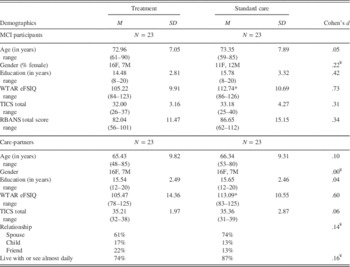
The final analyzed sample included 23 care-dyads in the treatment group and 23 in SC (see Figure 1). Data from five care-dyads were excluded from final analyses because criteria for amnestic MCI as defined below were not met. All reported data refer to the final analyzed sample. Characteristics of the treatment and SC groups can be found in Table 1.
Demographic and cognitive summary data for care-dyads in the treatment and standard care groups

Note. WTAR=Wechsler Test of Adult Reading; eFSIQ=estimated Full Scale IQ; TICS=Telephone Interview of Cognitive Status (maximum possible score 41); RBANS=Repeatable Battery for the Assessment of Neuropsychological Status. ¥Phi coefficient.
*p ≤.05.
Collected medical data, including interview, neuropsychological testing, and collateral medical information (e.g., results of laboratory and brain imaging when available) were carefully examined by two experienced neuropsychologists to determine whether each participant with amnestic MCI met the following study criteria consistent with Petersen et al. (Reference Petersen, Smith, Waring, Ivnik, Tangalos and Kokmen1999): (a) memory complaint of 6 months or longer; (b) objective memory impairment as evidenced by a score >1.5 SD below age matched peers on at least one of the following memory measures from the RBANS: list learning, list recall, story recall or figure recall; (c) generally preserved global cognitive functions (TICS score ≥24); and (d) did not meet Diagnostic and Statistical Manual of Mental Disorders (DSM-IV) dementia criteria (American Psychiatric Association, 2000). These criteria included slowly progressive cognitive decline, objective deficit in two or more cognitive domains and significant impact on everyday functioning documented by informant interview. In addition, participants with MCI had to be aware of their memory difficulties, express a desire for treatment, and exhibit adequate visual, motor, and auditory acuity to allow for memory skills training. Participants with MCI taking an AChE inhibitor (treatment: n=5; SC: n=4) or an ACheE inhibitor and Namenda (treatment: n=2; SC: n=3) were on a stable dose throughout the time of participation. The percentage of MCI participants taking medication for depression, anxiety, and sleep were 26%, 4% and 9%, respectively, for the treatment group, and 22%, 4%, and 4%, respectively, for SC.
Inclusion criteria for care-partners included: (a) spouse, family member, or close friend who assists the participant with MCI; (b) in good health and able to travel to meeting sites; (c) no significant cognitive complaints; and (d) score in the non-impaired range on the TICS taking age and education into account. The majority of care-partners were spouses who lived with the MCI participants (see Table 1). All participants lived in their own homes and identified their ethnicity as Caucasian.
Procedure
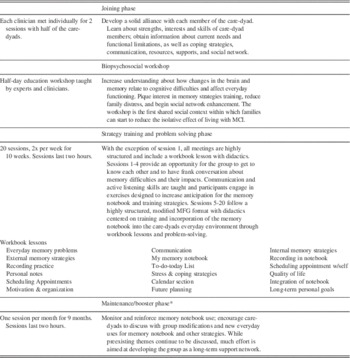
See Table 2 for description of the treatment intervention phases and their purposes. Consistent with MFG format, the five treatment groups were led by two trained clinicians and composed of four to six care-dyads. The intervention was manualized and a workbook was created for study participants. Each clinician read the manual and participated in a 2-hr training session. Treatment administration was closely supervised by licensed psychologists experienced in cognitive rehabilitation and MFG, and included videotape review to monitor fidelity of content and process.
Treatment intervention phases and their purposes

Notes. MCI=mild cognitive impairment; MFG=multi-family Group.
*The results of this phase will be presented in a subsequent report once completed.
CR-MFG intervention structure
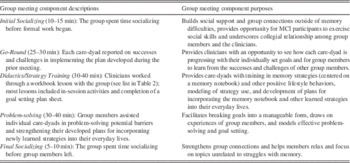
The intervention retained much of the MFG structure, including the joining phase, biopsychosocial workshop and group meetings (see Table 2), but modified the content for MCI. For example, family guidelines referred to frequently throughout treatment were modified for work with the MCI population (e.g., “stay organized and utilize routine to mobilize change”). In addition, a didactic component and workbook lessons were integrated into the group meetings. Group meetings were also held bi-weekly rather than monthly during the strategy training and problem-solving phase. Furthermore, the problem-solving component of the group meetings was directed toward helping care-dyads implement newly learned strategies into their everyday lives. To individualize this component, during sessions 5–20, each care-dyad completed a “goal setting plan sheet”. This sheet required care-dyads to identify a goal (e.g., “to know what is for dinner each night”), indicate why it is important (e.g., “both of us get frustrated when I repeatedly ask what’s for dinner”) and develop a structured plan for reaching the goal (e.g., at daily breakfast meeting, decide dinner menu together; write on kitchen whiteboard; check whiteboard during day when question arises—okay to be reminded to do this until it becomes an over learned habit). In the problem-solving component of the group meetings, the clinicians led the group in discussion of 1–2 of the plans. This included the care-dyad detailing the goal and developed plan followed by a discussion of the strengths and potential challenges of plan implementation and solutions/suggestions for improving plan implementation. With the exception of sessions 1–4, all group meetings were highly structured. Table 3 provides a brief description of each component of the group meeting along with the general purpose.
Structured strategy training and problem solving group meeting stages and their purposes

CR-MFG memory notebook and workbook lessons
Table 2 contains a list of the workbook lessons, which were focused on memory strategies training but also covered topics such as stress and coping, healthy lifestyles and planning for the future. The cognitive training aspect of the intervention was modeled after earlier work with a memory notebook (Schmitter-Edgecombe et al., Reference Schmitter-Edgecombe, Howard, Pavawalla, Howell and Rueda2008; Sohlberg & Mateer, Reference Sohlberg and Mateer1989) and progressed in 4 stages: anticipation, acquisition, application and adaptation. Initial sessions provided psychoeducation about memory and were designed to pique care-dyads interest in learning memory strategies. Early problem-solving exercises were directed toward acquisition and use of the memory notebook and other memory strategies, while later problem-solving exercises focused on the application and adaptation of the learned tools into the care-dyads everyday life. Memory notebook use was modeled and encouraged throughout group sessions (e.g., referring to memory notebook to acquire greater details about a past event during group socializing). Participants were also encouraged to use the memory notebook to assist with plan implementation (e.g., exercise more; schedule exercise time in notebook). The memory notebook included the following three sections:
Daily log with to-do-today list and notes section
Used to record, store and retrieve information about daily activities. The left side of the page contained the hourly daily log, which was used for charting hourly information and scheduling activities and appointments. The right side of the page had a section for prioritizing a to-do-today list and a notes section for recording special event information.
Monthly calendar
Used to record and retrieve information about important appointments and upcoming events.
Personal notes
Used to write and store important personal information (e.g., addresses, medical information, bus routes, recipes, steps for completing new tasks).
Care-dyads in the treatment group attended two sessions per week for 10 weeks, each session lasted approximately 2 hr. Twenty training sessions was chosen because at the conclusion of a pilot 7 week (2×per week) memory notebook intervention (Schmitter-Edgecombe et al., Reference Schmitter-Edgecombe, Howard, Pavawalla, Howell and Rueda2008), we believed that participants with MCI could have benefited from an additional few weeks of instruction. Sessions were well attended with most care-dyads attending nearly all sessions and no care-dyad missing more than 3 sessions. The treatment group was compared to SC. In our region, SC for MCI typically includes routine physician visits, monitoring of disease progression, maintenance of an active lifestyle, and in some cases AChE inhibitors and Namenda.
Assessment
Pre-test (baseline) and post-test assessments were administered by trained research assistants blind to specific study hypotheses. Pre-test assessments were completed approximately 1 week before start of the CR-MFG intervention. Laboratory testing of MCI participants took approximately 1.5 hr. Both care-dyad members also completed approximately 40 min of questionnaires. Post-test assessments were completed during the 2 weeks following treatment, with equal time frame between pre-tests and post-tests for the treatment (M=96.52 days, SD=18.80) and SC (M=102.69 days, SD=13.46) groups, t(44)=1.28.
Outcome instruments have demonstrated reliability and validity (e.g., Baum et al., Reference Baum, Connor, Morrison, Hahn, Dromerick and Edwards2008; Randolph, Tierney, Mohr, & Chase, Reference Randolph, Tierney, Mohr and Chase1998; Wilson, Cockburn, Baddeley, & Hiorns, Reference Wilson, Cockburn, Baddeley and Hiorns1989), and many were developed specifically for use with MCI and AD populations (e.g., Glasko et al., Reference Galasko, Bennett, Sano, Marson, Kaye and Edland2006; Logsdon, Gibbons, McCurry, & Teri, Reference Logsdon, Gibbons, McCurry and Teri1999). With two exceptions (described below), where instructions were modified to allow for pre-planning and/or note-taking that can occur in the everyday environment, all instruments were administered in their standardized format and scored using standardized scoring procedures. The following two tests were used to characterize the sample: (a) the Wechsler Test of Adult Reading (WTAR; Holdnack, Reference Holdnack2001), which provides an estimate of premorbid intellectual abilities from a word reading test, and (b) the Repeatable Battery of Neuropsychological Status (RBANS; Randolph, Reference Randolph1998), which assesses general cognitive functioning across the domains of immediate memory, visuoconstruction, attention, language, and delayed memory.
Primary Outcome Measures
The primary outcome variables targeted ecologically relevant everyday abilities.
Medication Management Ability Assessment (MMAA; Patterson et al., Reference Patterson, Lacro, McKibbin, Moscona, Hughs and Jeste2002)
The MMAA total score, which ranges from 0 to 33 (best), was used as a performance-based measure of everyday functioning. Participants are shown four plastic pill bottles filled with beans and labeled with the name of the medication, how to take it (e.g., 4× per day with food) and other typical label information. After a >45-min delay, participants engage in a role-playing task that simulates a prescribed daily medication regime (e.g., take these 2 pills in morning with meal). The MMAA was modified to allow participants up to 5 min of planning time with paper and pencil before beginning the role-playing behavioral simulation task.
Bill Paying Subtest from the Executive Function Performance Test (EFPT; Baum, Morrison, Hahn, & Edwards, Reference Baum, Morrison, Hahn and Edwards2007)
This performance-based measure requires participants to locate two bills, pay them and balance the account. The bills are mixed with 5 other pieces of mail in a Ziploc bag and located in a box with distractor items as well as a checkbook with checks and a balance sheet ($5.00 less than the bills total), pen and calculator. Five aspects of performance are coded (e.g., moves to box to gather material) using a 6-point cuing system ranging from independent, “no cues required” (0) thru “do for participant” (5). The EFPT bill paying subtest total score ranges from 0 (best) to 25.
Activities of Daily Living–Prevention Instrument (ADL-PI; Galasko et al., Reference Galasko, Bennett, Sano, Marson, Kaye and Edland2006)
The ADL-PI questionnaire was used to assess self-report and care-partner report of the MCI participants’ everyday functioning. The 15 IADL questions (e.g., In the past 3 months, did you select and pay for items when shopping?) are rated as 3=as well as usual, with no difficulty, 2=with some difficulty, and 1=with a lot of difficulty. Responses are also available for “do not know” and “does not do activity”, and scores range from 0 to 45 (best).
Coping Self-efficacy Scale (CSE; Chesney, Neilands, Chambers, Taylor, & Folkman, Reference Chesney, Neilands, Chambers, Taylor and Folkman2006)
To evaluate confidence in performing coping behaviors, both care-dyad members completed the 13-item CSE with reference to themselves. The CSE requires participants to rate their confidence in performing coping behaviors (e.g., break an upsetting problem down into smaller parts) on an 11-point scale with anchor points of 0 (cannot do at all), 5 (moderately certain can do), and 10 (certain can do); scores range from 0 to 130 (best).
Secondary Outcome Measures
Quality of Life-Alzheimer’s disease (QOL-AD; Logsdon et al., 1995)
Both care-dyad members completed the QOL-AD with reference to themselves. This questionnaire requires participants to rate 13 items important to quality of life (e.g., living situation, relationship with friends) on a four-point scale, ranging from “1” being poor to “4” being excellent. The QOL-AD scores range from 13 to 52 (best).
Geriatric Depression Scale- 15 item Short Form (GDS; Sheikh & Yesavage, Reference Sheikh and Yesavage1986)
To measure depressive symptomology, both care-dyad members completed the GDS with reference to themselves. The GDS requires participants to rate the presence or absence of 15 symptoms of depression; scores range from 0 (best) to 15.
Rivermead Behavioral Memory Test - II (RBMT-II; Wilson, Cockburn, & Baddeley, Reference Wilson, Cockburn and Baddeley2003)
Individuals with MCI completed 11 tests that provide analogs of both prospective (e.g., remembering to ask for a hidden belonging at test completion) and retrospective (e.g., remembering a person’s name) everyday memory situations. To increase sensitivity of the RBMT-II to notebook documentation and usage skills being taught during the intervention, we modified instructions to allow note-taking by all study participants. The RBMT-II profile score was used as an analogue measure of everyday memory; scores range from 0 to 24 (best).
Repeatable Battery for the Assessment of Neuropsychological Status (RBANS; Randolph, Reference Randolph1998) immediate and delayed memory index scores
Individuals with MCI completed immediate and delayed memory tests assessing list learning and delayed recall and recognition memory, immediate and delayed story recall, and delayed figural recall. The RBANS memory index scores (standard scores reported) were used as standardized neuropsychological memory measures.
Analyses
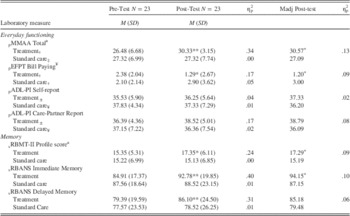
Separate analyses of covariance (ANCOVA) were carried out for each primary and secondary outcome measure. To reduce error variance caused by individual differences before treatment, pre-treatment scores served as covariates. Results of the assumption of homogeneity were satisfactory for each outcome indicator. We also conducted less conservative analyses of variance (ANOVAs) across time for each outcome measure for both treatment and SC groups. Although the large number of comparisons opens our findings up to the possibility of Type 1 error, we also wanted to identify information of potential relevance for future research. The means, standard deviations and effect sizes for the outcome measures at pre-test and post-test, along with the adjusted post-test means and effect sizes can be found in Tables 4 and 5.
Everyday functioning and memory measures for the treatment and standard care groups

Notes: MMAA=Medication Management Ability Assessment; EFPT=Executive Function Performance Test; ADL-PI=Activities of Daily Living –Prevention Instrument; RBMT=Rivermead Behavioral Memory Test; RBANS=Repeatable Battery for the Assessment of Neuropsychological Status.
aMeasures were modified to allow pre-planning and/or note-taking. pIndicates primary outcome measure; sIndicates secondary outcome measure; ¥higher score indicates poorer performance.
Improved pre-test to post-test performance: *p ≤.05, **p ≤.005. Groups differed at post-test, + p≤.05; †n=21; ‡n=22; ±n=19; ¥n=18.
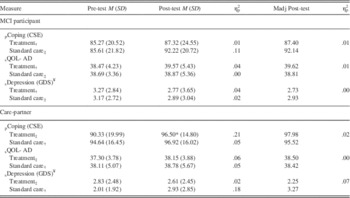
Psychosocial outcome measures for both members of the care-dyad for the treatment and standard care groups

Notes: QOL-AD=quality of life –Alzheimer’s disease; CSE=Coping Self-Efficacy scale; GDS=Geriatric Depression Scale.
pIndicates primary outcome measure; sIndicates secondary outcome measure; ¥higher score indicates more depressive symptomology.
Improved pre-test to post-test performance: *p <.05; † n=19; ‡ n=18.
RESULTS
As seen in Table 1, the MCI participants in the treatment and SC groups did not differ in age, gender, education, TICS score or RBANS total score. Similarly, the care-partners were well matched across groups in age, gender, education, and TICS score. An estimate of premorbid intelligence (i.e., WTAR), however, suggested higher ability level by the SC group for both participants with MCI and their care-partners.
Everyday Functioning Measures
Results of the ANCOVAs conducted on the performance-based functional status measures (primary outcome measures) revealed better post-test performance by the CR-MFG group compared to SC on both the MMAA (modified to allow pre-planning), F(1,40)=5.94, p=.01, ηp 2=.13, and EFPT bill paying subtest, F(1,39)=3.85, p=.05, ηp 2=.09 (see Table 4). Furthermore, ANOVAs conducted separately for each group across time revealed improved performance for the CR-MFG treatment group from pre-test to post-test on the MMAA, F(1,20)=10.20, p=.005, ηp 2=.34, and EFPT, F(1,20)=1.14, p=.05, ηp 2=.17. In contrast, for SC there were no pre-test to post-test differences on either the MMAA, F(1,21)=.00, or EFPT, F(1,20)=1.12 (see Table 4).
Results from the ANCOVAs on the questionnaire measures of everyday functioning (i.e., ADL-PI self and other) showed no significant post-test group differences in self-report, F(1,34)=.64. Care-partner data approached significance at post-test in the direction of informants reporting better everyday functioning for MCI participants in the CR-MFG treatment group, F(1,34)=2.81, p=.10, ηp 2=.08 (see Table 4). ANOVAs revealed no self-reported pre-test to post-test differences in everyday functioning for either CR-MFG, F=.65, or SC, F=.24. Pre-test to post-test differences for the care-partner report approached significance for the CR-MFG treatment group, F(1,17)=3.49, p=.08, ηp 2=.17; there were no differences for standard care, F=.53.
Psychological Measures
For participants with MCI, ANCOVAs revealed no significant post-test group differences in self-report of coping strategies, F(1,34)=.49, quality-of-life, F(1,34)=.28, or depressive symptoms, F(1,34)=.07. In addition, no significant pre-test to post-test differences were found on the psychosocial measures for the CR-MFG group, Fs<.82, or SC, Fs<2.16 (see Table 5).
For care-partners, ANCOVAs also revealed no significant post-test group differences in self-report of coping behaviors, F(1,34)=.38, quality of life, F(1,34)=.01, or depression symptomology, F(1,34)=2.62. More exploratory ANOVAs revealed a significant improvement in care-partner self-reported coping strategies from pre-test to post-test by the CR-MFG treatment group, F(1,17)=4.40, p=.05, ηp 2=.21. The depression measure for SC approached significance, suggesting a tendency toward greater depressive symptomology at post-test for SC care-partners, F(1,18)=4.02, p=.06, ηp 2=.18. No other pre-test to post-test differences were found on the psychosocial measures for care-partners in treatment, Fs<1.12, or SC, Fs<1.04 (see Table 5).
Memory Measures
The ANCOVA revealed that the CR-MFG treatment group performed better than SC at post-test on a more ecologically valid (and modified for note-taking), analogue everyday memory measure (i.e., RBMT-II), F(1,43)=4.20, p<.05, ηp 2=.09. ANOVA analyses further revealed improved RBMT-II performance from pre-test to post-test for CR-MFG, F(1,22)=6.84, p=.01, ηp 2=.24, but not SC, F(1,22)=.02. For the RBANS, ANCOVAs revealed that the post-test Immediate Memory index of the treatment group was greater than that of SC, F(1,43)=4.64, p<.05, ηp 2=.10; findings for the Delayed Memory index were in the expected direction but did not reach statistical significance, F(1,43)=2.73, ηp 2=.06, p=.10. Furthermore, ANOVA analyses revealed that the CR-MFG treatment group exhibited improved performance on both the RBANS immediate, F(1,22)=14.41, p=.001, ηp 2=.40, and delayed, F(1,22)=9.79, p=.005, ηp 2=.31, memory scores at post-test. For SC, no pre-test to post-test differences were found for either the immediate, F(1,22)=.15, or delayed, F(1,21)=.13, indices (see Table 4). Of note, the groups did not differ at post-test on the three remaining non-memory indices (attention, visuoconstruction, language) of the RBANS, Fs<1.87.
DISCUSSION
Questions remain concerning how to best aid individuals with MCI and their care-partners to incorporate effective memory strategies into their everyday lives to help maintain functional independence (Schmitter-Edgecombe et al., Reference Schmitter-Edgecombe, Howard, Pavawalla, Howell and Rueda2008; Stott & Spector, Reference Stott and Spector2011; Troyer et al., Reference Troyer, Murphy, Anderson, Moscovitch and Craik2008). In addition, given that the ultimate goal of rehabilitation is to improve everyday functioning, it is important to account for individual preferences and to focus on personally relevant goals that are useful to individuals in their everyday life (Hampstead, Gillis, & Stringer, Reference Hampstead, Gillis and Stringer2014; Wilson, Reference Wilson2009). The hybrid CR-MFG intervention was designed to mobilize the group format and problem-solving processes of MFG to help care-dyads tailor newly learned cognitive strategies to reach goals specific to their personal everyday contexts.
The memory strategies and problem-solving skills taught during the CR-MFG intervention appeared to generalize to laboratory-based functional assessment. More specifically, compared to SC, individuals with MCI in the CR-MFG group exhibited better scores at post-test on the performance-based functional status measures assessing medication management (i.e., MMAA) and bill paying (i.e., EFPT). This was especially notable given the lower WTAR eFSIQ scores of the treatment group compared to SC. This finding, along with the improved pre-test to post-test performance-based testing scores for the MCI individuals in the CR-MFG group, suggests a positive impact of the intervention on the ability of MCI participants to manage real life challenges. There was also some indication that this positive impact of the intervention on everyday abilities was being perceived by the treatment group care-partners. That is, there was a trend for care-partners in the CR-MFG group to report improved pre-test to post-test everyday functioning for MCI participants; post-test group differences favoring the CR-MFG intervention also trended toward significance.
Unlike the functional task data, no post-test group differences were found in self-reported confidence in coping strategies, depressive symptoms or quality-of-life for either care-dyad member. The care-partners in the CR-MFG intervention, however, self-reported improved confidence in performing coping behaviors at post-test. Interventions directed at improving coping strategies in care-partners have been found to produce improvements in psychosocial stress indicators and biological markers of distress (e.g., Marziali & Garcia, Reference Marziali and Garcia2011; Williams et al., Reference Williams, Bishop-Fitzpatrick, Lane, Gwyther, Ballard, Vendittelli and Williams2010). There was also a trend for care-partners in SC to self-report more depressive symptomology. However, few depressive symptoms were reported by care-partners in both groups. Importantly, there were no negative effects of the intervention on psychosocial function. This is notable as a common theme expressed by both MCI participants and care-partners in focus groups conducted on the final day of the CR-MFG intervention was a greater awareness of the cognitive changes. One might also ask whether the SC and CR-MFG groups may begin to differ on the psychosocial measures following a longer time period. One could hypothesize that the learned strategies, problem-solving methods and group support may assist the CR-MFG care-dyads in dealing more effectively with the progression of cognitive difficulties. Ongoing 1-year follow-up evaluations will evaluate whether the intervention holds promise for contributing to more positive long-term mental health outcomes for both care-dyad members.
The individuals with MCI in the CR-MFG treatment also exhibited improved post-test performances, which differed significantly from SC, on an analogue memory measure (i.e., RBMT-II) and the RBANS Immediate Memory index. The RBANS Delayed Memory index approached significance. There were no post-test group differences on the remaining RBANS indices (i.e., attention, language, visuo-construction), suggesting some specificity of the intervention to the memory domain when measured by standardized assessment. Given the modified administration of the RBMT-II allowed note taking, we expected that the memory notebook skills being taught during the CR-MFG intervention would lead to improved RBMT-II performance at post-test. While the intervention focused on memory strategies training within a real-life context, the benefits also appeared to extend to the standardized administration of memory tests assessing list-learning and story recall abilities. This could reflect application of learned memory strategies during memory test performance. Alternately, general stimulation provided by the intensive intervention may have facilitated cognitive plasticity, which has been documented in other studies with MCI individuals (Huckans et al., Reference Huckans, Hutson, Twamley, Jak, Kaye and Storzbach2013; Schreiber & Schneider, Reference Schreiber and Schneider2007; Simon, Yokomizo, & Bottino, Reference Simon, Yokomizo and Bottino2012).
The current data should be considered preliminary. While the pattern of data was consistent in showing CR-MFG group improvement on measures of everyday functioning and memory, with effect sizes in the medium to large range, several analyses were conducted without correcting for Type 1 error. Also, data about possible self-treatments (e.g., luminosity) were not collected and may have influenced the findings. It is further possible that some of the MCI participants would have improved or reverted to normal without intervention; however randomization should have minimized this as a source of bias. The sample was small, all Caucasian and relatively highly educated, limiting both the ability to investigate individual differences in response to the intervention and generalization to populations with different demographics. In addition, we did not differentiate between single- and multi-domain MCI and individuals with MCI were aware that they were experiencing memory problems and generally motivated to use the memory notebook. Future work comparing the CR-MFG group to an active general educational control group, or individual care-dyad training with the group intervention, is needed as the positive benefits of treatment could reflect differences in the amount of attention between the CR-MFG and SC groups. It is also unknown what component(s) of the intervention resulted in benefits for the CR-MFG group. Anecdotally, post-test focus group participants commented that in addition to learning memory strategies, they valued the support of other group members who were experiencing similar challenges as well as the educational aspects of the intervention. In general, holistic programs have been most successful at showing positive benefits in everyday functioning (Kurz et al., Reference Kurz, Pohl, Ramsenthaler and Sorg2009; Tsolaki et al., Reference Tsolaki, Kounti, Agogiatou, Poptsi, Bakoglidou, Zafeiropoulou and Nikolaidou2011), and multicomponent interventions for individuals with MCI (e.g., Mayo Clinic HABIT) are an emerging trend (Smith & Bondi, Reference Smith and Bondi2013).
This combined CR-MFG intervention differs from other programs in that it allows for manualized teaching of a memory notebook and other strategies in a group format, while at the same time addressing the personal needs of the care-dyads by allowing them to choose and problem-solve implementation of learned strategies within their everyday lives. The CR-MFG intervention showed practical benefits for improving performance on common, complex daily life activities, while self-reported benefits in psychosocial functioning were not demonstrated. The high attendance rate by both care-dyad members suggested that the intervention was valued and filled a need for participants.
ACKNOWLEDGMENTS
This study was supported by a grant from the Alzheimer’s Association (grant number NPSASA-10-173354). No conflicts of interest exist. We thank Chad Sanders, Christina Low, and Diane Norell for their assistance in treatment development and implementation. We thank Lauren Warren, Rachael Jones, Kaci Johnson, and Jennifer Walker for their assistance in coordinating data collection. We thank the many WSU doctoral students in Clinical Psychology and community professionals who assisted in development of the workbook materials, tested participants and served as therapists for the groups. We also thank members of the WSU Cognitive Aging and Dementia laboratory for their help in coding the data and data entry.