Introduction
Does obesity increase the risk of developing depression among adolescents? Or, conversely, does depression increase the risk of obesity? The evidence is unclear. In their comprehensive review of the evidence published over a decade, Zametkin et al. (Reference Zametkin, Zoon, Klein and Munson2004) concluded that there is no association between obesity and psychiatric disorders. There is little evidence that adolescent obesity results from psychiatric disorders in general, and the same is true for the obverse (Haines & Neumark-Sztainer, Reference Haines, Neumark-Sztainer, Heinberg and Thompson2009; Ringham et al. Reference Ringham, Levine, Marcus, Heinberg and Thompson2009). However, there have been few studies of the association between obesity and diagnosed psychiatric disorders. Most studies have focused on symptoms of depression and psychological distress rather than clinical disorders per se. This may be an important omission, as Luppino et al. (Reference Luppino, de Wit, Bouvy, Stijnen, Cuijpers, Penninx and Zitman2010) find that the relationship between obesity and depression, particularly for adults, is stronger for clinical depression than depressive symptoms. Is the issue as clear-cut as these recent reviews suggest? We think not.
In their meta-analytic study, Luppino et al. (Reference Luppino, de Wit, Bouvy, Stijnen, Cuijpers, Penninx and Zitman2010) identified only six papers that met their criteria for prospective studies of the relationship between obesity and depression involving adolescents, that is subjects were under the age of 18 at baseline (Pine et al. Reference Pine, Cohen, Brook and Coplan1997, Reference Pine, Goldstein, Wolk and Weissman2001; Bardone et al. Reference Bardone, Moffitt, Caspi, Dickson, Stanton and Silva1998; Richardson et al. Reference Richardson, Davis, Poulton, McCauley, Moffitt, Caspi and Connell2003; Herva et al. Reference Herva, Laitinen, Miettunen, Veijola, Karvonen, Laksy and Joukamaa2006; Anderson et al. Reference Anderson, Cohen, Naumova, Jacques and Must2007). They found that the pooled data from the studies of adolescents that examined obesity as a risk factor for subsequent depression found no increased risk. The pooled data for the studies examining the reverse association did show that depression increased risk for subsequent obesity. Herva et al. (Reference Herva, Laitinen, Miettunen, Veijola, Karvonen, Laksy and Joukamaa2006) and Anderson et al. (Reference Anderson, Cohen, Naumova, Jacques and Must2007) found that obesity at baseline was not related to depression at follow-up for adolescents. Bardone et al. (Reference Bardone, Moffitt, Caspi, Dickson, Stanton and Silva1998) found obesity at baseline predicted subsequent depression only marginally. By contrast, three other papers (Pine et al. Reference Pine, Cohen, Brook and Coplan1997, Reference Pine, Goldstein, Wolk and Weissman2001; Richardson et al. Reference Richardson, Davis, Poulton, McCauley, Moffitt, Caspi and Connell2003) found evidence that baseline depression predicted subsequent obesity among adolescents.
All of these papers had a design commonality: they studied subjects who were adolescents at baseline but adults of varying ages at follow-up. All had another commonality: none examined directly the question of reciprocal effects. Three examined the effect of depression on subsequent obesity (Pine et al. Reference Pine, Cohen, Brook and Coplan1997, Reference Pine, Goldstein, Wolk and Weissman2001; Richardson et al. Reference Richardson, Davis, Poulton, McCauley, Moffitt, Caspi and Connell2003) and three examined the effect of obesity on subsequent depression (Bardone et al. Reference Bardone, Moffitt, Caspi, Dickson, Stanton and Silva1998; Herva et al. Reference Herva, Laitinen, Miettunen, Veijola, Karvonen, Laksy and Joukamaa2006; Anderson et al. Reference Anderson, Cohen, Naumova, Jacques and Must2007).
In an earlier meta-analysis of studies of depression and obesity, not cited by Luppino et al. (Reference Luppino, de Wit, Bouvy, Stijnen, Cuijpers, Penninx and Zitman2010), Blaine (Reference Blaine2008) reviewed much of the same literature, focusing on depression as a risk factor for weight gain or obesity. He concluded that, overall, adolescents with depression are about 2.5 times more likely than non-depressed youths to gain weight or be obese at follow-up.
However, to date, no study has examined the reciprocal effects between depression and obesity among adolescents. Contrary to the conclusion by Luppino et al. (Reference Luppino, de Wit, Bouvy, Stijnen, Cuijpers, Penninx and Zitman2010), there are no data confirming such reciprocal effects from cohorts of adolescents qua adolescents. The review by Blaine (Reference Blaine2008) did not focus on reciprocal effects. There remains little prospective evidence linking obesity and DSM-IV major depression among adolescents and so far no studies have tested reciprocal effects directly.
Why might we even expect a link between obesity and depression? From a biological perspective, inflammation plays a role in both obesity and depression; it could mediate the association between obesity and depression (Emery et al. Reference Emery, Fondow, Schneider, Christofi, Hunt, Busby, Needleman, Melvin and Elsayed-Awad2007; Vaccarino et al. Reference Vaccarino, Johnson, Sheps, Reis, Kelsey, Bittner, Rutledge, Shaw, Sopko and Bairey Merz2007; Bremmer et al. Reference Bremmer, Beekman, Deeg, Penninx, Dik, Hack and Hoogendijk2008). Another mechanism might involve the hypothalamic–pituitary–adrenal (HPA) axis. Obesity might involve dysregulation of the HPA axis and this dysregulation has been found to be involved in depression (Pasquali & Vicennati, Reference Pasquali and Vicennati2000; Walker, Reference Walker2001; Ajilore et al. Reference Ajilore, Haroon, Kumaran, Darwin, Binesh, Mintz, Miller, Thomas and Kumar2007). In addition, psychiatric morbidity involves eating disorders, both over- and underconsumption, which could influence risk for obesity (Dallman et al. Reference Dallman, Pecoraro, Akana, La Fleur, Gomez, Houshyar, Bell, Bhatnagar, Laugero and Manalo2003; Pallister & Waller, Reference Pallister and Waller2008). Physical inactivity, a major factor in obesity, is more prevalent among those with mental health problems, and there is limited evidence that exercise reduces symptoms of depression (Mead et al. Reference Mead, Morley, Campbell, Greig, McMurdo and Lawlor2008). Furthermore, psychotropic drugs have side-effects that may result in weight gain (tricyclic antidepressants), weight loss (selective serotonin reuptake inhibitors, SSRIs), or both (short- and long-term effects of SSRIs) (Sussman et al. Reference Sussman, Ginsberg and Bikoff2001; Demyttenaere & Jaspers, Reference Demyttenaere and Jaspers2008). In addition, there are putative social and psychological pathways linking obesity and depression. For example, because of normative ideals, obesity may decrease self-esteem and decrease body satisfaction, which seem to be risk factors for depression. Disordered eating and the physical consequences of obesity are also related to risk for depression (Heinberg & Thompson, Reference Heinberg and Thompson2009).
Based in part upon the reviews by Luppino et al. (Reference Luppino, de Wit, Bouvy, Stijnen, Cuijpers, Penninx and Zitman2010) and Blaine ((Reference Blaine2008) and the preceding discussion of potential links between depression and obesity, we tested the hypothesis that there is, over time, an asymmetric relationship between depression and obesity among adolescents such that, all other things equal, depression increases the risk for obesity but obesity does not increase the risk of depression.
We examined this question using data from Teen Health 2000 (TH2K), a large prospective study that focused on the epidemiology of DSM-IV psychiatric disorders among adolescents aged 11–17 years at baseline. This study is the first to examine reciprocal effects in an adolescent cohort.
Method
Sample
The sample was selected from households in the Houston metropolitan area enrolled in two local health maintenance organizations. One youth, aged 11–17 years, was sampled from each eligible household, oversampling for ethnic minority households. Initial recruitment was by telephone contact with parents. A brief screener was administered on ethnic status of the sample youths and to confirm data on age and sex of youths. Every household with a child aged 11–17 years was eligible. Because there were proportionately fewer minority subscriber households, sample weights were developed and adjusted by post-stratification to reflect the age, ethnic and sex distribution of the five-county Houston metropolitan area in 2000. The precision of estimates are thereby improved and sample selection bias reduced to the extent that it is related to demographic composition (Andrews et al. Reference Andrews, Morgan, Sonquist and Klem1973). Thus, the weighted estimates generalize to the population aged 11–17 years in a metropolitan area of 4.7 million people.
Data were collected on sample youths and one adult caregiver using computer-assisted personal interviews and self-administered questionnaires. The computerized interview contained a structured psychiatric interview and demographic data on the youths and the household. Height and weight measures were conducted after completion of the interviews. The interviews and measurements were conducted by trained, lay interviewers. The interviews took on average 1–2 h, depending on the number of psychiatric problems present. Interviews, questionnaires and measurements were completed with 4175 youths at baseline, representing 66% of the eligible households. There were no significant differences among ethnic groups in completion rates. Youths and caregivers were followed up approximately 12 months later using the same assessment battery used at baseline. The cohort consisted of 3134 youths plus their caregivers in Wave 2 (75% of Wave 1 dyads). All youths and parents gave written informed consent prior to participation. All study forms and procedures were approved by the University of Texas Health Science Center Committee for Protection of Human Subjects.
Measures
Psychiatric disorders
Data on psychiatric disorders were collected using the youth version of the Diagnostic Interview Schedule for Children, version 4 (DISC-IV), a highly structured instrument with demonstrated reliability and validity (Shaffer et al. Reference Shaffer, Fisher, Lucas, Dulcan and Schwab-Stone2000). Interviews were conducted by college-educated, lay interviewers who had been trained extensively using protocols provided by Columbia University. Interviews with the DISC-IV were administered using laptop computers.
Depression was measured using three alternate strategies. First, we examined the association between weight status (healthy weight, overweight or obesity) and any mood disorder using DSM-IV diagnostic criteria (APA, 2000). In TH2K, these included mania, hypomania, major depression and dysthymia. The 12-month period prevalence at baseline was 3.0%. We then examined major depression, defined as a major depressive episode in the previous 12 months (prevalence was 1.7%). Then, given that much of the literature has focused on symptoms of depression, we examine disturbed mood in the past 12 months, defined as depressed mood, irritable mood or anhedonia (baseline prevalence was 57.6%).
Body mass index (BMI) and weight status
Height and weight were measured using standard field procedures such as a Tanita digital scale (see Lohman et al. Reference Lohman, Roche and Martorell1991; Armstrong & Welsman, Reference Armstrong and Welsman1997; National Institutes of Health, 1998). BMI was defined as weight/height squared (kg/m2). Weight status was categorized as healthy weight (BMI <85th percentile for children of the same age and sex), overweight (85th percentile ⩽BMI <95th percentile) and obese (BMI ⩾95th percentile) (CDC, 2006; Ogden et al. Reference Ogden, Carroll and Flegal2008). For the overall sample at baseline, 16.5% were overweight and 19.7% were obese. Thus, 36.2% were overweight or obese. Younger youths were heavier, as were males, minority youths and those from lower income families (data not shown).
Covariates
Faith et al. (Reference Faith, Matz and Jorge2002) noted that some studies of depression and obesity failed to control for relevant covariates that might mediate or moderate the observed association. Luppino et al. (Reference Luppino, de Wit, Bouvy, Stijnen, Cuijpers, Penninx and Zitman2010) were able to adjust only for age and gender because of lack of data on common factors across studies. As a result, the direction and magnitude of the effects of covariates remain unclear. We included as covariates known correlates of both depression and obesity: age, gender, family income, physical activity and dieting behavior. Family income was assessed using total household income in the past year: <US$35 000, US$35 000–64 999 and ⩾US$65 000. Age was assessed by age at most recent birth date: ⩽12, 13–15 and ⩾16 years. Physical activity was measured with an item that asks on how many days in the past week youths walk or bicycle for at least 30 min at a time. Responses are 0, 1, 2, 3, 4, 5, 6 or 7 days. The variable was then dichotomized into ‘0 day’ and ‘ ⩾ 1 day’ in the past week. Dieting behavior is considered to be important in the context of weight and psychological functioning (Ross, Reference Ross1994; Needham & Crosnoe, Reference Needham and Crosnoe2005). Our items included: (1) refused to eat foods you thought would make you fat; (2) made yourself throw up; (3) took pills to lose weight; (4) took laxatives; and (5) fasted for at least 24 h. The time referent was the past month. The items were summed, yielding a score of 0–5, and dichotomized into 0 and ⩾1.
Analyses
First, the relationship between weight status (healthy weight, overweight and obese) and depression (yes, no) at Wave 1 was examined, using crude odds ratios (ORs) and then controlling for age, gender, family income, physical activity and dieting behavior. The healthy weight group (BMI <85th percentile) was the referent. Second, weight status at Wave 1 was used to predict depression at Wave 2, first examining crude ORs and then controlling for the same covariates and also for depression at Wave 1. We then repeated this strategy using depression at Wave 1 to predict weight status at Wave 2, again controlling for the same covariates noted above, and for weight status at Wave 1. Thus, in both models, we examined the risk of the exposure increasing the odds of incident outcomes.
We also examined the association between depression and weight status separately for males and females, given that some studies have reported that gender modifies this association (e.g. Mustillo et al. Reference Mustillo, Worthman, Erkanli, Keeler, Angold and Costello2003; Blaine, Reference Blaine2008).
The estimated ORs and their 95% confidence limits were calculated using survey logistic regression (Proc Surveylogistic) procedures in SAS version 9.1 (SAS Institute, 2004) and Taylor series approximation to compute the standard error of the OR. Lepkowski & Bowles (Reference Lepkowski and Bowles1996) have indicated that the difference in computing standard error between this method and other repeated replication methods such as the jackknife is very small.
Results
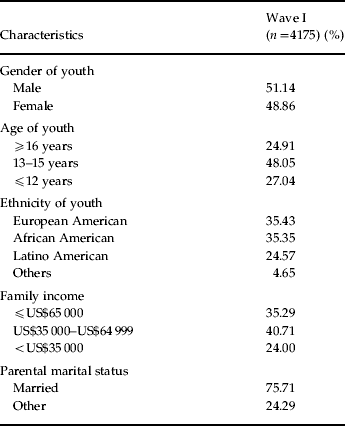
Table 1 presents data on sample characteristics at Wave 1, and shows that the sample was diverse in terms of age, ethnicity, family income and marital status of parents.
Unweighted sample characteristics, Teen Health 2000 (TH2K)
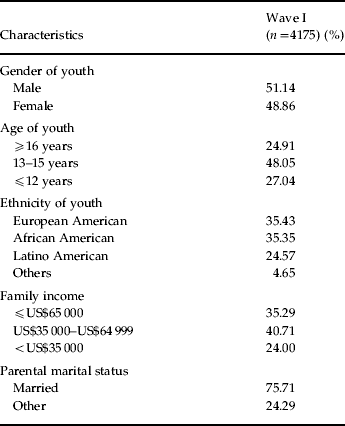
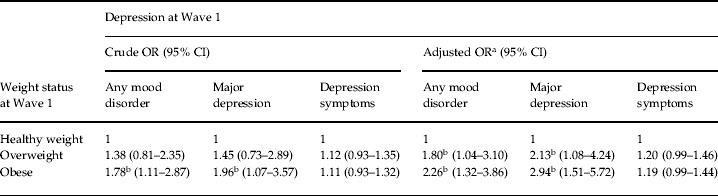
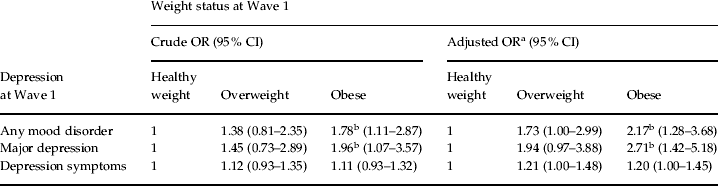
Table 2 presents the unadjusted and adjusted ORs for the depression measures by weight status at baseline, and the same analyses for depression as the exposure and weight status as the outcome. Table 2 reveals that there is no association at baseline between weight status and symptoms of depression. The odds of both mood disorders and major depression are elevated for those youths who are either obese or overweight (top panel). For those depressed, the odds of being obese, but not overweight, were elevated (a twofold risk) for those with any mood disorder or major depression.
Odds ratios for the association between weight status and depression (Wave 1) OR, Odds ratio; CI, confidence interval. a Adjusting for age, gender, family income, diet and physical activity. b ORs statistically significant (p < 0.05).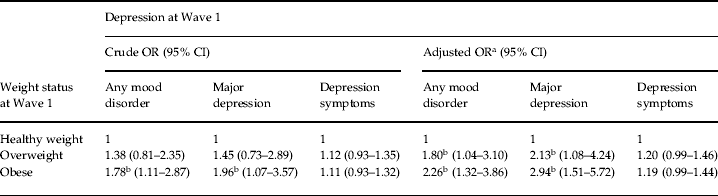
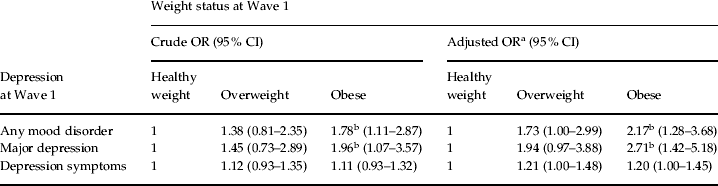
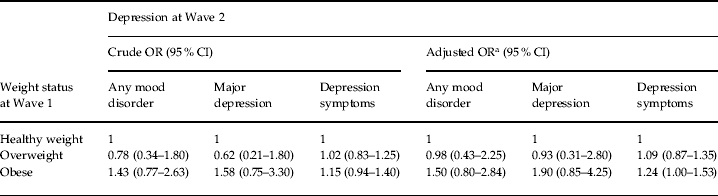
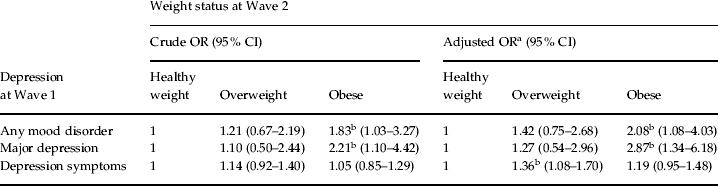
Table 3 presents the results for two-wave analyses. The upper panel presents data on weight status predicting depression at follow-up, with and without adjustment for covariates. The lower panel presents the analyses with depression predicting weight status at follow-up, with and without adjustment for covariates.
Odds ratios for the association between weight status and depression (two-wave analyses) OR, Odds ratio; CI, confidence interval. a Adjusting for age, gender, family income, diet and physical activity at Wave 1. b ORs statistically significant (p < 0.05).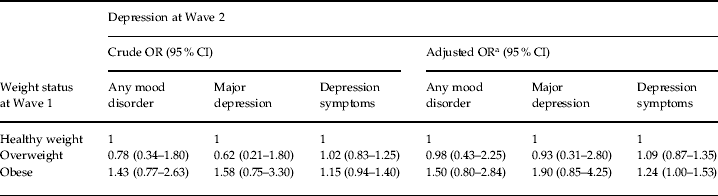
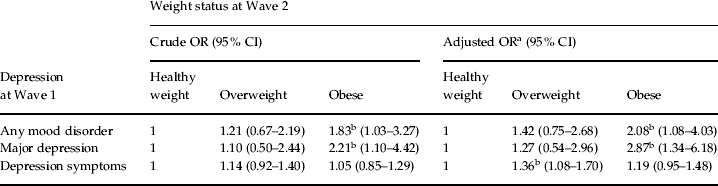
As can be seen, weight status does not predict future risk of depression, whether diagnosed or elevated symptoms. Adjustment for covariates had little effect. However, depression at baseline is associated with increased risk of weight problems at follow-up. After adjustment for covariates, both mood disorders generally and major depression in particular increased risk of obesity, but not overweight, more than twofold. Symptoms of depression at baseline predicted future overweight, but not obesity.
We also examined weight status as a predictor of depression by gender using the same analytic strategy and covariates (other than gender) used in the other analyses. For neither gender did baseline weight status predict subsequent depression, net of the effects of the covariates. When we examined the effect of depression on subsequent risk of overweight or obesity by gender, the results were somewhat mixed. In the adjusted model, major depression predicted subsequent obesity among males only. In fact, there was a sixfold increased risk for becoming obese if a male has major depression at baseline. (Data on gender not shown.)
Discussion
These data are from the first study ever to examine the prospective, reciprocal association between depression and weight during adolescence. It is the first to examine reciprocal effects between depression and adolescent weight, examining DSM-IV mood disorders, major depression and symptoms of depression.
The overall results seem clear. As in the systematic review of studies primarily of adults by Luppino et al. (Reference Luppino, de Wit, Bouvy, Stijnen, Cuijpers, Penninx and Zitman2010), our data are consistent with earlier research indicating that depression among adolescents increases the risk for future weight problems and that the risk is greater for major depression than for symptoms of depression. Blaine (Reference Blaine2008) estimated that the risk for obesity associated with depression was about 2.5 overall among adolescents, very similar to what we found overall in our sample for obesity (the odds for depressive symptoms was much lower). However, contrary to the overall conclusions of Luppino et al. (Reference Luppino, de Wit, Bouvy, Stijnen, Cuijpers, Penninx and Zitman2010) regarding directionality for adults, we found no evidence for reciprocal effects between depression and weight among adolescents compared to adults. In fact, the three studies of adolescents cited in Luppino et al. (Reference Luppino, de Wit, Bouvy, Stijnen, Cuijpers, Penninx and Zitman2010) found that obesity had little effect on depression, thus providing strong support for our results in this regard. Baseline weight status did not increase risk for depression at follow-up in either crude or adjusted analyses. Thus, based on these results, it would seem that there is no significant impact of being overweight or obese on risk of adolescent depression.
There may be several reasons why we find no reciprocal effects. In the studies cited by Luppino et al. (Reference Luppino, de Wit, Bouvy, Stijnen, Cuijpers, Penninx and Zitman2010) for adolescents, separate studies found that obesity increased depression and that depression increased risk for obesity. The follow-up periods in general were considerably longer, and it may be that takes longer for obesity to affect depression (see Mustillo et al. Reference Mustillo, Worthman, Erkanli, Keeler, Angold and Costello2003). All of the studies cited by Luppino et al. (Reference Luppino, de Wit, Bouvy, Stijnen, Cuijpers, Penninx and Zitman2010), as noted earlier, began in adolescence and subjects were followed up as adults, whereas our study focused on subjects during adolescence.
Our analysis of the association between weight and depression at baseline found increased odds for obesity and DSM-IV depression but not depressive symptoms. This was limited for the most part to obesity rather than overweight. Our results are in contrast to those reported by Merikangas et al. (Reference Merikangas, Mendola, Pastor, Reuben and Cleary2012), who found no association between obesity and major depression among 12- to 19-year-olds. They also used the DISC-IV for diagnoses.
As in several previous studies (e.g. Mustillo et al. Reference Mustillo, Worthman, Erkanli, Keeler, Angold and Costello2003; Blaine, Reference Blaine2008), there were gender differences, but these were few. Male adolescents with major depression at baseline had a sixfold increased risk for becoming obese. Female adolescents with depressive symptoms were at about 50% increased risk of overweight but not obesity. There were no effects of gender on the association between obesity and subsequent depression, however measured. Our results for gender do not support the conclusions by Luppino et al. (Reference Luppino, de Wit, Bouvy, Stijnen, Cuijpers, Penninx and Zitman2010) that the association for diagnosed depression is greater than for symptoms for females. Our data for males do, however, support their conclusions. Thus, our most striking finding is the much higher risk of obesity among depressed boys. Merikangas et al. (Reference Merikangas, Mendola, Pastor, Reuben and Cleary2012) also found an increased odds for obesity and depression for males but not females in the 2001–2004 National Health and Nutrition Examination Survey (NHANES). It should be noted that Blaine (Reference Blaine2008) concluded that the association between depression and subsequent weight problems was stronger for girls than boys, contrary to our results and those by Merikangas et al. (Reference Merikangas, Mendola, Pastor, Reuben and Cleary2012) .
Our study has several strengths. The baseline sample (n = 4175) and cohort (n = 3134) were relatively large, larger than any previous prospective study on diagnosed depression and obesity among adolescents. Height and weight were measured, and not based on self-report. The cohort was composed of youths under age 19 years at both baseline and follow-up. The DISC-IV permitted an assessment of DSM-IV mood disorders, major depression and symptoms of depression. We were also able to control for several relevant covariates, contrary to most previous studies.
Limitations
Our study also has limitations. The follow-up period was 1 year, possibly attenuating the association between weight and depression. Our sample was not, strictly speaking, a community-based sample. We were able to complete follow-up assessments with only 75% of those assessed at baseline, raising the possibility of attrition bias. We also did not include data from parent reports of symptoms and episodes of mood disorders in adolescents. We have carefully examined potential biases from these design characteristics in previous publications (Roberts & Roberts, Reference Roberts and Roberts2007; Roberts et al. Reference Roberts, Roberts and Chan2009) and demonstrated that bias from these sources was minimal. We note that the response rate for adolescents in the National Comorbidity Survey Replication Adolescent Supplement (NCS-A) was 75% (Kessler et al. Reference Kessler, Avenevoli, Costello, Green, Gruber, Heering, Merikangas, Pennell, Sampson and Zaslavsky2009).
Our estimate of the association between weight and depression may be attenuated because we did not examine lifetime trajectories of either depression or weight. Data on these factors from early childhood through adolescence are needed but, to our knowledge, no such studies have been performed.
Another potential issue is that we did not include data from parent reports of outcomes or predictors (with the exception of family income). Although there is argument that data from multiple informants are desirable, many studies attest to considerable discordance in parent–child reports of psychopathology and functioning (see Roberts et al. Reference Roberts, Roberts and Xing2007). In a previous paper we demonstrated substantial differences in parent–child concordance across ethnic groups, such that minority parents reported fewer problems, but there were no differences among youths across ethnic groups (Roberts et al. Reference Roberts, Alegria, Roberts and Chen2005). This suggests that reliance on youth reports may be less problematic than use of parent reports.
The TH2K study was not designed to assess the roles of family history or genetics in the epidemiology of psychiatric disorders or obesity among youths. As a result, we could not examine the contribution of these factors relative to those factors examined. Reviews by Kendler (Reference Kendler and Dohrenwend1998) and Rutter et al. (Reference Rutter, Silberg, O'Connor and Simonoff1999a, Reference Rutter, Silberg, O'Connor and Simonoffb) suggest that considerable variance in risk of psychiatric disorders is explained by family history and or genetics. Studies of monozygotic twins have found that there is a genetic influence on obesity (Stunkard et al. Reference Stunkard, Foch and Hrubec1986) but no single gene linked to obesity has been identified. It is possible, indeed plausible, that a gene × environment interaction might better account for the association between depression and obesity (Silventoinen et al. Reference Silventoinen, Rokholm, Kaprio and Sørensen2010).
Conclusions
As noted earlier, the literature suggests two possibilities for a link between depression and obesity. One is that a depressed person, through dysregulated stress systems or unhealthy lifestyles, develops more obesity over time. The other is that obesity, through its negative effects on self-image or somatic consequences, results in development of depression over time. In the case of adolescents, which of these explanations better fit the data depends on a question of fact: Does obesity increase risk for depression or does depression increase risk for obesity, is the association reciprocal or does it even exist? Our results support the first hypothesis, but not the latter. Thus, based on our findings and those of others (Blaine, Reference Blaine2008; Luppino et al. Reference Luppino, de Wit, Bouvy, Stijnen, Cuijpers, Penninx and Zitman2010), the more likely pathway is that depression, through dysregulated stress systems and/or unhealthy lifestyles, increases risk for subsequent problems with weight.
Clearly, more prospective studies are needed to examine the association between obesity and depression within the adolescent population. Prospective studies that examine trajectories of obesity and trajectories of depression from childhood through adolescence into adulthood could better inform us of developmental associations of weight and depression. These studies should also focus on potential moderators and mediators of this association. We examined gender as a moderator and found evidence for a gender effect. We controlled for the effects of physical activity and dieting behavior in our analyses, but clearly these factors may mediate or moderate the association between weight and depression. Few studies have examined the role of body image as a mediator of the association between weight and depression, and none have done so focusing on major depression. Some studies have found that body image is a better predictor of depressive symptoms than weight (Daniels, Reference Daniels2005; ter Bogt et al. Reference ter Bogt, van Dorsselaer, Monshouwer, Verdurmen, Engels and Vollebergh2006) whereas others have reported that poor body image is associated with more disordered eating and fewer health-promoting behaviors such as physical activity and consumption of fruits and vegetables (Holsen et al. Reference Holsen, Kraft and Roysamb2001; Stice, Reference Stice2001; Stice & Bearman, Reference Stice and Bearman2001; Neumark-Sztainer et al. Reference Neumark-Sztainer, Wall, Guo, Story, Haines and Eisenberg2006). Whether such factors are associated with DSM major depression remains to be demonstrated.
Acknowledgments
This research was supported, in part, by grants (MH 49764 and MH 65606) from the National Institutes of Health (NIH) awarded to R.E.R. by the Michael and Susan Dell Center for Healthy Living and by the University of Texas. The original study, except for current analyses and manuscript preparation, was funded by the NIH. Work on this paper was supported by the University of Texas and the Dell Center for Healthy Living.
Declaration of Interest
None.