Introduction
Rice (Oryza sativa L.) feeds more than half of the world’s population and is an important food crop in Asia (Kuenzer and Knauer Reference Kuenzer and Knauer2013). In addition, rice has the highest per-unit yield and accounts for 32.2% of China’s total crop yield (NBSC 2019). Weeds compete with rice for soil nutrients, space, light, and water, and are the most problematic pests (Oerke and Dehne Reference Oerke and Dehne2004). Chinese sprangletop [Leptochloa chinensis (L.) Nees] is a grass weed severely affecting rice growth in paddies in China. Continuous use of acetolactate synthase enzyme inhibitors (such as penoxsulam and bispyribac-sodium) and auxin herbicides (such as quinclorac), which are the most popular rice herbicides among farmers in China for controlling barnyardgrass [Echinochloa crus-galli (L.) P. Beauv.], has resulted in the dominance of L. chinensis (Cheng et al. Reference Cheng, Feng, Lu and Jin2011).
Acetyl-coenzyme A carboxylase (ACCase) inhibitors kill grass weeds by inactivating ACCase and blocking fatty-acid biosynthesis (Devine Reference Devine1997). The ACCase inhibitors include three dissimilar classes of herbicides—aryloxyphenoxypropionates (APPs), cyclohexanediones, and phenylpyrazoline—and target the plastid ACCase carboxyltransferase (CT) domain in grass weeds (Yu et al. Reference Yu, Kim and Tong2010). However, widespread use of these three herbicides for controlling weeds has increased herbicide resistance. To date, more than 48 weed species resistant to ACCase inhibitors have been reported (Heap Reference Heap2019).
Resistance to ACCase inhibitors is caused by two mechanisms: target-site resistance (TSR) and non–target site resistance (NTSR) (Délye Reference Délye2005, Reference Délye2013). The TSR to ACCase inhibitors involves conformational changes of herbicide target-site proteins resulting from amino acid substitution in the CT domain of ACCase (Powles and Yu Reference Powles and Yu2010) or by increased abundance of the target protein due to gene overexpression or amplification. In contrast, NTSR embraces all resistance mechanisms not related to target enzymes (Yuan et al. Reference Yuan, Tranel and Stewart2007). Up to now, 13 amino acid substitutions in the ACCase CT domain have been recognized to confer ACCase-inhibitor resistance in grass weeds: Ile-1781-Val/Leu/Thr (Délye et al. Reference Délye, Wang and Darmency2002, Reference Délye, Zhang, Michel, Matéjicek and Powles2005; Deng et al. Reference Deng, Cai, Zhang, Chen, Chen, Di and Yuan2019; Kaundun et al. Reference Kaundun, Hutchings, Dale and McIndoe2013b), Trp-1999-Cys/Leu/Ser (Deng et al. Reference Deng, Cai, Zhang, Chen, Chen, Di and Yuan2019; Kaundun et al. Reference Kaundun, Bailly, Dale, Hutchings and McIndoe2013a; Liu et al. Reference Liu, Harrison, Chalupska, Gornicki, O’Donnell, Adkins, Haselkorn and Williams2007; Xu et al. Reference Xu, Li, Zhang, Cheng, Jiang and Dong2014), Trp-2027-Cys (Deng et al. Reference Deng, Cai, Zhang, Chen, Chen, Di and Yuan2019; Xu et al. Reference Xu, Zhu, Wang, Li and Dong2013; Yu et al. Reference Yu, Gao, Pan, Yao and Dong2017), Ile-2041-Asn/Val (Délye et al. Reference Délye, Zhang, Chalopin, Michel and Powles2003), Asp-2078-Gly (Délye et al. Reference Délye, Zhang, Michel, Matéjicek and Powles2005), Cys-2088-Arg (Yu et al. Reference Yu, Collavo, Zheng, Owen, Sattin and Powles2007), and Gly-2096-Ala/Ser (Cruz-Hipolito et al. Reference Cruz-Hipolito, Domínguez-Valenzuela, Osuna and De Prado2012; Délye et al. Reference Délye, Zhang, Michel, Matéjicek and Powles2005).
Cyhalofop-butyl is the main ACCase inhibitor used for selective control of L. chinensis in Chinese paddy fields, and it is the only herbicide that is highly effective against L. chinensis and very safe for rice. Because of great reliance on cyhalofop-butyl, the susceptibility of L. chinensis to cyhalofop-butyl has decreased and resistant populations have gradually evolved. It was reported that L. chinensis resistant to cyhalofop-butyl contained the Ile-1781-Leu, Trp-1999-Cys (Deng et al. Reference Deng, Cai, Zhang, Chen, Chen, Di and Yuan2019), and Trp-2027-Cys mutations (Deng et al. Reference Deng, Cai, Zhang, Chen, Chen, Di and Yuan2019; Yu et al. Reference Yu, Gao, Pan, Yao and Dong2017). In recent years, a phenomenon of increasing numbers of L. chinensis populations that cannot be controlled by cyhalofop-butyl has become apparent to farmers in several provinces in China. To sustain herbicide efficacy for weed control, it is necessary to identify the resistance level and the underlying mechanisms.
In this study, we aimed to (1) determine the level of resistance in L. chinensis to cyhalofop-butyl collected from rice fields in China, (2) investigate the resistance mechanism to cyhalofop-butyl in L. chinensis, and (3) develop derived cleaved amplified polymorphic sequence (dCAPS) markers to identify the TSR related to resistance in L. chinensis.
Materials and Methods
Plant Materials
Sixty-six field populations were collected from paddy fields in Jiangsu, Hunan, Hainan, Hubei, Shanghai, and Zhejiang provinces between 2016 and 2018. Farmers found that the recommended field dose of cyhalofop-butyl failed to control L. chinensis in rice fields after several years of successful control. The known susceptible population, LC17041, was collected from Qinglongzui, Dingcheng District in Hunan Province. Seeds from at least 20 mature plants were collected and bulked. Information of the collection locations is shown in Supplementary Table S1.
Cyhalofop-Butyl Single-Rate Test
Seeds were germinated and planted in 9.5-cm-diameter plastic cups (35 seeds per cup). Next, the seedlings were transferred to a greenhouse (temperature maintained at approximately 25 to 35 C night/day temperature with natural sunlight) and watered as needed. The plants were thinned to 20 evenly sized plants per cup at the 2-leaf stage. The plants were sprayed with 90 g ai ha−1 (1×) cyhalofop-butyl (Clincher®, 100 g L−1 EC; Dow AgroSciences, Indianapolis, IN, USA). Herbicide treatment methods and spray facilities were as described by Yu et al. (Reference Yu, Gao, Pan, Yao and Dong2017). The plants treated with water were selected as a control. A single cup was considered an experimental unit, and the treatments were replicated four times. Plant survival was assessed visually at 21 d after herbicide was applied. Plants that died or were severely injured were regarded as susceptible, and plants surviving that produced expanded new green leaves were regarded as resistant.
Cyhalofop-Butyl Dose–Response Experiment
Ten populations of L. chinensis that survived the labeled dose (1×) application of cyhalofop-butyl and the susceptible population were considered further for the dose–response bioassay to evaluate their level of resistance. The plant and spray procedures were performed as described earlier. Initial dose–response experiments were conducted to determine the dose–response rates for different populations. The herbicide application doses are described in Table 1. Aboveground fresh weights of the surviving plants were assessed at 21 d after treatment. Each treatment was replicated four times, and experiments were performed twice.
Herbicide dose used to test the resistance index in Leptochloa chinensis populations.

Statistical Analysis
The herbicide rate causing 50% growth reduction (GR50) was determined by fitting the data to a four-parameter log-logistic curve using Sigmaplot v. 12.5 (Systat Software, San Jose, CA, USA). The fitted model is shown below:
 $$y = C + {{D - C} \over {1 + {{(x/{\rm{G}}{{\rm{R}}_{50}})}^b}}}$$
where C is the lower limit, D is the upper limit, b is the slope of the curve in GR50 (50% effective dose), x is the herbicide dose (g ai ha−1), and y is the percentage of the control. The resistance index (RI), which is used to determine the level of resistance, was calculated as the ratio between the GR50 of each resistant population and the GR50 of the susceptible population.
Identification of Resistant Amino Acid Substitution
The seeds were germinated and planted as described earlier, except each cup only included 1 seedling. Cups were watered as needed, and seedlings were managed as described earlier. Approximately 100 mg of shoot tissue from each individual plant was collected for further analyses. Survivors from dose–response treatments were also selected for identification. Total DNA was extracted using the Trelief™ Plant Genomic DNA Kit (Beijing TsingKe Biotech, Beijing, China) according to the manufacturer’s instructions.
The software Primer Explorer V4 v. 4 (http://primerexplorer.jp/elamp4.0.0/index.html) was used to design two pairs of primers (Table 2) to amplify the entire CT domain of L. chinensis ACCase. The primers were designed based on the description of Yu et al. (Reference Yu, Gao, Pan, Yao and Dong2017). The PCR mixture contained 45 μl of Golden Star T6 Super PCR Mix, 2 µl of each primer, and 1 μl of genomic DNA in a total volume of 50 µl. The PCR program was as follows: 98 C for 2 min, 30 cycles of 98 C for 10 s, 53 C for 10 s, and 72 C for 15 s, followed by a final extension step of 5 min at 72 C. The resulting PCR product fragments were sequenced by a commercial sequencing company (BioSune Biote [Shanghai], Shanghai, China). Ten individual plants from each population were sequenced. The sequence data for the resistant and susceptible populations were compared. The BioEdit Sequence Alignment Editor Software was used to align and compare sequence data for each population.
Polymerase chain reaction primers used to amplify the acetyl-CoA carboxylase gene of Leptochloa chinensis and those used for the derived cleaved amplified polymorphic sequence (dCAPS) technique for screening resistance-related mutations in L. chinensis.

dCAPS Method for Three Resistant Mutations
Three new dCAPS markers were developed for detecting three different mutations (Table 2). A forward dCAPS primer (1781-HinfI-F) was designed to identify the Ile-1781-Leu mutation caused by an ATA–CTA codon mutation, which was introduced by a forced mismatch to create a restriction site for HinfI. Along with primer 1781-HinfI-R, the mutant amplicons were digested by HinfI. A forward dCAPS primer (2027-XhoI-F) was designed to identify the Trp-2027-Ser mutation caused by a TGG–TCG codon mutation, which was introduced by a forced mismatch to create a restriction site for XhoI. Along with primer 2027-Xho1-R, the mutant amplicons were digested by XhoI. A forward dCAPS primer (2041-EcoRI-F) was designed to identify the Ile-2041-Asn mutation caused by an ATT–AAT codon mutation, which was introduced by a forced mismatch to create a restriction site for EcoRI. Along with primer 2041-EcoRI-R, the wild-type amplicons were digested by EcoRI. The PCR procedure for generating the gene fragments and PCR conditions was as described by Pan et al. (Reference Pan, Li, Xia, Zhang and Dong2015). After digestion, the products were visualized on 3% agarose gels.
Results and Discussion
Cyhalofop-Butyl Single-Rate Test
In this research, 66 L. chinensis field populations were screened for their resistance to cyhalofop-butyl. For the single-rate test, 56 populations were severely injured, and no new leaves expanded after treatment with cyhalofop-butyl at the recommended field dose (90 g ai ha−1) compared with the control. Growth of two populations (LC16001 and LC17050) was obviously inhibited, while the remaining eight populations (LC17009, LC18002, LC18006, and LC18011–LC18015) were entirely unaffected.
Cyhalofop-Butyl Dose–Response Experiments
The whole-plant dose–response bioassay results showed no significant differences; therefore, data were combined for the subsequent analyses. Ten field populations tested showed high levels of resistance to cyhalofop-butyl. The GR50 value for LC17050 was 108.4 g ai ha−1, which was the lowest among all resistant populations, but still was higher than the recommended field rate of 90 g ai ha−1. The GR50 values ranged within 108.4 and 1,443.5 g ai ha−1, with RI values of 9.1 to 121.8, and these were compared with the susceptible LC17041 population (Table 3; Figure 1).
The level of resistance to cyhalofop-butyl in 11 Leptochloa chinensis populations.a

a GR50, herbicide dose required to decrease plant fresh weight by 50%; each value represents the mean ± SE. b, slope of the curve in GR50. R, correlation coefficient of the dose–response curve.
RI, resistance index calculated by dividing the GR50 value of the resistant population by the susceptible population; because all 10 resistant populations never achieved 100% mortality, the RIs in the table are the relative values, expressed as “> value.”
Dose–response curves of 11 Leptochloa chinensis population to cyhalofop-butyl. LC17041 was the susceptible populaiton, the others were resistant populations.

Previous studies reported that natural selection of resistance in gramineous weeds required several years of continuous use of ACCase inhibitors (Hochberg et al. Reference Hochberg, Sibony and Rubin2009). Thus, it is speculated that the resistance of L. chinensis populations to cyhalofop-butyl resulted from strong selection pressure, imposed by the past few years of consecutive cyhalofop-butyl applications. An L. chinensis field population resistant to cyhalofop-butyl was first identified in 2014 in Yuhang, Zhejiang Province (Yu et al. Reference Yu, Gao, Pan, Yao and Dong2017). Then, Deng et al. (Reference Deng, Cai, Zhang, Chen, Chen, Di and Yuan2019) found five L. chinensis populations also resistant to cyhalofop-butyl. In this research, resistant populations were collected in Jiangsu, Hunan, Shanghai, and Zhejiang provinces.
Identification of Resistant Amino Acid Substitution
The amplified fragment of the ACCase amino acid sequence in L. chinensis showed 81% similarity to Alopecurus myosuroides plastidic ACCase sequences (AJ310767). A portion of the CT fragment was amplified and sequenced to determine the resistance mechanism. Sequence comparison showed several key amino acid changes in the CT region of the resistant populations (Table 4). Four substitutions at three positions (Table 4) were identified in this research, which included the less-reported Trp-2027-Ser. The changes Ile-1781-Leu, Trp-2027-Cys, Trp-2027-Cys, Trp-2027-Ser, and Ile-2041-Asn were identified in the LC18015, LC16001, LC17050, LC18011, and LC17009 populations, respectively. These results indicated that these key substitutions were the TSR mechanism in the corresponding cyhalofop-butyl–resistant populations. Some researchers reported Trp-2027-Cys (Deng et al. Reference Deng, Cai, Zhang, Chen, Chen, Di and Yuan2019; Yu et al. Reference Yu, Gao, Pan, Yao and Dong2017), Ile-1781-Leu, and Trp-1999-Cys (Deng et al. Reference Deng, Cai, Zhang, Chen, Chen, Di and Yuan2019) substitutions as the main mechanism of resistance in L. chinensis, and our study showed that Trp-2027-Ser and Ile-2041-Asn substitutions also endowed cyhalofop-butyl resistance in L. chinensis. These results indicate that L. chinensis exhibits rich diversity in TSR mechanisms for cyhalofop-butyl resistance. Due to the different cross-resistance patterns associated with different ACCase substitutions, this diversity will make it more difficult to control cyhalofop-butyl–resistant L. chinensis.
Key amino acids in the carboxyltransferase domain of Alopecurus myosuroides and cyhalofop-butyl–resistant and cyhalofop-butyl–susceptible Leptochloa chinensis.

a The known resistance-conferring amino acid substitution is in bold for the resistant populations.
In the whole-plant experiment, the LC18011 and LC17009 populations showed high levels of cyhalofop-butyl resistance. The Ile-1781-Leu, Trp-2027-Cys, Trp-2027-Ser, and Ile-2041-Asn substitutions have been reported to endow APP resistance (Beckie and Tardif Reference Beckie and Tardif2012; Jang et al. Reference Jang, Marjanovic and Gornicki2013; Liu et al. Reference Liu, Harrison, Chalupska, Gornicki, O’Donnell, Adkins, Haselkorn and Williams2007), with resistance more than 100-fold those of another two ACCase inhibitors, fenoxaprop and clodinafop (Jang et al. Reference Jang, Marjanovic and Gornicki2013). Thus, it is not surprising that the LC18011 and LC17009 populations are highly resistant to cyhalofop-butyl. However, in the LC16001 and LC17050 populations, which were weakly resistant to cyhalofop-butyl, the mutation frequencies were under 30%. These results indicated that the resistance level is relevant to the mutation frequency.
Moreover, no known substitutions conferring resistance to ACCase inhibitor were identified in the LC18002, LC18006, LC18012, LC18013, and LC18014 populations. Resistance to cyhalofop-butyl in these populations is suspected to be conferred by the NTSR mechanism. Furthermore, little is known about other resistance mechanisms, except for the insensitive target enzyme in L. chinensis, especially the NTSR mechanism. Compared with the single gene–encoded TSR mechanism, the NTSR mechanism, which is likely encoded by multiple genes, has unpredictable cross-resistance patterns and more complex genetic patterns (Délye Reference Délye2013). As far as we know, this study is the second report on NTSR in cyhalofop-resistant L. chinensis following that of Deng et al. (Reference Deng, Cai, Zhang, Chen, Chen, Di and Yuan2019). Thus, further research is needed to confirm the existence of NTSR in these cyhalofop-resistant L. chinensis populations.
dCAPS Method for Three New Resistant Mutations
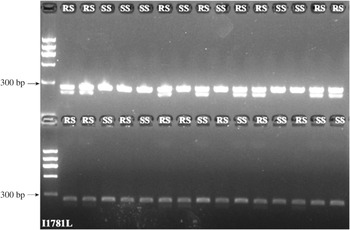
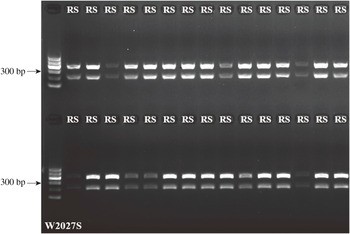
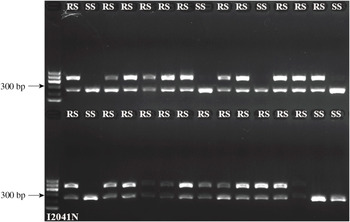
The restriction enzyme used to digest the Ile-1781-Leu mutation was HinfI. The wild-type alleles showed a single undigested 260-bp band (Figure 2), mutant alleles showed a 220-bp band and an undetectable 40-bp fragment, and the heterozygous type showed both bands (Figure 2). The restriction enzyme used to digest the Trp-2027-Ser mutation was XhoI. The wild-type alleles showed a single undigested 377-bp band, mutant alleles showed 190- and 187-bp bands, and the heterozygous type showed both types of bands (Figure 3). The restriction enzyme used to digest the Ile-2041-Asn mutation was EcoRI. Mutant alleles showed a single undigested 443-bp band, wild-type alleles showed a 223-bp band and a 220-bp fragment (Figure 4), and the heterozygous type showed both bands (Figure 4).
The derived cleaved amplified polymorphic sequence (dCAPS) method was developed to detect the Ile-1781-Leu mutations in Leptochloa chinensis. Homozygous sensitive (SS) and heterozygous resistant (RS) genotypes are shown.

The derived cleaved amplified polymorphic sequence (dCAPS) method was developed to detect the Trp-2027-Ser mutations in Leptochloa chinensis. Heterozygous resistant (RS) genotypes are shown.

The derived cleaved amplified polymorphic sequence (dCAPS) method was developed to detect the Ile-2041-Asn mutations in Leptochloa chinensis. Homozygous sensitive (SS) and heterozygous resistant (RS) genotypes are shown.

Eighty plants of the resistant LC18015 population were analyzed using the established dCAPS method. Forty-six heterozygous resistant, thirty-four homozygous sensitive, and no homozygous resistant plants were identified. The results of analyzing the DNA samples using the dCAPS method were consistent with the previous sequencing results. Therefore, this method was confirmed to be accurate and effective in detecting the three ACCase mutations in L. chinensis.
In this study, we established the first dCAPS method to rapidly detect the Ile-1781-Leu, Trp-2027-Ser, and Ile-2041-Asn mutations in L. chinensis. The dCAPS method is useful to detect sequence polymorphisms. However, the results of dCAPS suggested that no homozygous ACCase loci were present. Two copies of the plastidic ACCase gene were identified in L. chinensis (Deng et al. Reference Deng, Cai, Zhang, Chen, Chen, Di and Yuan2019), indicating that the heterozygotes detected were not the “true” allelic heterozygotes and might be the homologous heterozygotes (Warwick et al. Reference Warwick, Sauder and Beckie2010; Yu et al. Reference Yu, Ahmad-Hamdani, Han, Christoffers and Powles2013). Thus, heterozygosity was reported in L. chinensis at the whole-genome level.
Acknowledgments
This work was supported by the National Natural Science Foundation of China (no. 31601652), the National Key R&D Program of China (no. 2017YFD0301505), Hunan Provincial Key Laboratory for Biology and Control of Weeds (2015TP-1016), and Scientific-Innovative of Hunan Agricultural Sciences and Technology (2019LS05 and 2019TD03). No conflicts of interest have been declared.
Supplementary material
To view supplementary material for this article, please visit https://doi.org/10.1017/wsc.2020.15