Introduction
Efferia Coquillett is the largest genus of robber flies (Diptera: Asilidae) in the Americas, with over 230 described species and many undescribed ones, especially south of the United States of America (Fisher Reference Fisher, Brown, Borkent, Cumming, Wood, Woodley and Zumbado2009). About 100 species occur in the Nearctic Region (Wilcox Reference Wilcox1966; E.M. Fisher and J. Wilcox, unpublished data); 11 are known from Canada and 7 from British Columbia (BC) (R.A. Cannings, unpublished data), including the species described here. In North America most species live in arid lands and grasslands in the West, where they are among the most prominent predatory invertebrates.
Hine (Reference Hine1919) and Wilcox (Reference Wilcox1966) arranged the species in eight species groups, based mainly on differences in setation and wing venation. Artigas and Papavero (Reference Artigas and Papavero1997) elevated most of these groups to genera, but Fisher (Reference Fisher, Brown, Borkent, Cumming, Wood, Woodley and Zumbado2009) synonymized these genera, citing significant variability in characters that were used to justify generic status. Fisher (Reference Fisher, Brown, Borkent, Cumming, Wood, Woodley and Zumbado2009) used the unique structure of the male and female genitalia to define a monophyletic Efferia and his assessment is followed here. Although Hine (Reference Hine1919) and Wilcox (Reference Wilcox1966) did not use phylogenetic analyses to define their species groups, and probably not all of these are monophyletic (Fisher Reference Fisher, Brown, Borkent, Cumming, Wood, Woodley and Zumbado2009), the analyses are useful in organizing the numerous species, and I refer to the E. arida group here.
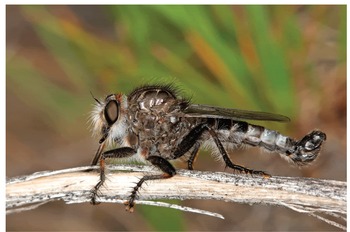
Efferia okanagana sp. nov., male. Oliver, British Columbia (BC). Photograph: Werner Eigelsreiter, with permission.

Specimens of an undescribed species in the E. arida group (Hine Reference Hine1919; Wilcox Reference Wilcox1966) from the Okanagan Valley in BC were found in the Canadian National Collection of Insects, Arachnids and Nematodes in Ottawa, Ontario. The specimens were mixed with those of the morphologically similar species Efferia coulei Wilcox, which is found in the same region at the same season. The predominantly brown coloration and golden postocular bristles of the undescribed species distinctively contrasted with the grey colour and black bristles of E. coulei. Further examination of the specimens revealed other important diagnostic characteristics.
Being familiar with one of the original collection localities of the species (Vaseux Lake, southern Okanagan Valley), I was able to determine the fly's preferred habitat. Colleagues and I subsequently collected more specimens at Vaseux Lake and other localities. These specimens and associated ecological data form the basis of this paper.
Materials and methods
Material
All known specimens were examined and came from the following Canadian collections: Canadian National Collection of Insects, Arachnids and Nematodes (CNC), Ottawa, Ontario (J.M. Cumming); Royal British Columbia Museum (RBCM), Victoria, BC (R.A. Cannings); and Spencer Entomological Collection, Beaty Biodiversity Museum University of British Columbia (UBC), Vancouver, BC (K.M. Needham).
No specimens of the species were found in the large Efferia collection (much of it the Joseph Wilcox Collection) at the California Academy of Sciences (CAS), San Francisco, California, United States of America) or the Eric M. Fisher Collection (EMF), Sacramento, California, United States of America. Wilcox (Reference Wilcox1966) did not come across this species in the many collections he examined during his revision of the genus north of Mexico, including that in the Smithsonian Institution, National Museum of Natural History (USNM), Washington, D.C., United States of America. This suggests that specimens are not in those collections.
All known specimens are included in the type series. Paratypes are deposited in the collections listed here.
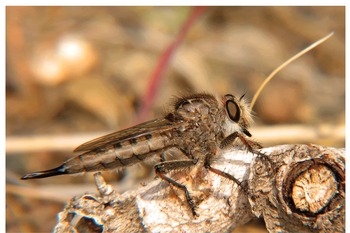
Efferia okanagana sp. nov., female. Oliver, BC. Photograph: Werner Eigelsreiter, with permission.

Terminology
Terminology follows McAlpine (Reference McAlpine, McAlpine, Peterson, Shewell, Teskey, Vockeroth and Wood1981), Cannings (Reference Cannings2002), and Cumming and Wood (Reference Cumming, Wood, Brown, Borkent, Cumming, Wood, Woodley and Zumbado2009).
Specimen preparation and examination
Genitalia were soaked in a vial of cold 10% KOH for 12 h, washed for 15 min in glacial acetic acid followed by 70% ethanol, then dissected in glycerin. For permanent storage, parts dissected from a specimen were transferred to a microvial containing glycerin and pinned under the specimen. Measurements and illustrations were made through a Leica MS5 dissecting microscope and a Leitz Laborlux 12 compound microscope, using an ocular micrometer and a drawing tube.
Body size can be extremely variable in the Asilidae, and is presumably dependent on larval nutrition as well as natural genetic variation among individuals. Body length may also depend on the amount of abdominal expansion or contraction during drying. Ranges of measurements based on the largest and smallest of the specimens examined are given in each species description.
Several measurements are compared to compensate for differences correlated with body size (e.g., length of ovipositor/width at base). Body length is the distance from the anterior extremity of the face (gibbosity) to the apex of segment 8 (male) or segment 7 (female). Head width (dorsal view) is the greatest distance between the lateral margins of the eyes. Face width is the distance between the eyes at the level of the ventral edges of the antennal bases. Vertex width (dorsal view) is the distance between the eyes along a line touching the anterior margins of the posterior ocelli. Gibbosity height (lateral view) is the greatest distance between the anterior margin of the eye and the apex of gibbosity. Wing length is measured from the mesal edge of the tegula to the wing apex. Epandrium length is the distance from the basoventral extreme base to the apex of the apical projection; epandrium width is the greatest width, at about midlength. Ovipositor length is measured along the dorsal margin of the ovipositor.
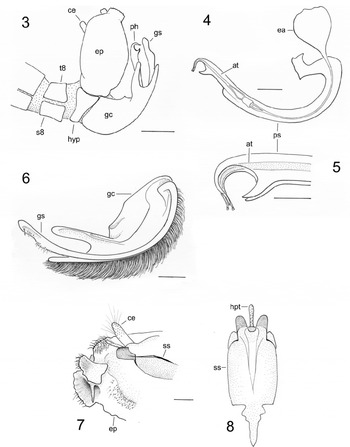
Efferia okanagana sp. nov., adult male. 3, Terminalia, lateral view (scale bar=1mm); 4, phallus, lateral view (scale bar=0.5mm); 5, apex of phallus, ventrolateral view (scale bar=0.25 mm); 6, gonopod, mesal view (scale bar=0.5mm); 7, apex of epandrium, mesal view (scale bar=0.5mm); 8, subepandrial sclerite, dorsal view (scale bar=0.5mm) (at, aedeagal tube; ce, cercus; ea, ejaculatory apodeme; ep, epandrium; gc, gonocoxite; gs, gonostylus; hyp, hypandrium; hpt, hypoproct; ph, phallus; ps, paramere sheath; ss, subepandrial sclerite; s8, sternite 8; t8, tergite 8).

Setae include setulae (short, stubble-like setae), hairs (delicate, flexible, soft setae), bristles (strong, stiff setae), and spines (short, thick setae). Ground colour is the colour of the cuticle, often obscured by the tomentum, the microscopically superficial extensions of the cuticle that are usually called pollinosity (Wilcox Reference Wilcox1966) or pruinosity (McAlpine Reference McAlpine, McAlpine, Peterson, Shewell, Teskey, Vockeroth and Wood1981) in the Asilidae.
For molecular diagnosis, 658 base pairs of the cytochrome oxidase I gene (DNA barcode) were sequenced for four individuals (ENT010-002701 ENT010-002704) at the Biodiversity Institute of Ontario (Guelph, Ontario, Canada). The sequences are available from the Barcode of Life Data Systems (www.boldsystems.org; ASRMA001-10 ASRMA004-10) and GenBank (accession Nos. JN289678 JN289681).
Taxonomy
Efferia okanagana sp. nov.
Type material
Holotype: Here designated, ♂, labelled: “[white rectangular label] CAN, BC, Vernon/ Kalamalka Lake Prov. Park/ Cosens Bay, grassland slopes to N/ 50°11′57.4′′N 119°16′06.7′′W, 452m/ 23.v.1987, R.A. Cannings”. My holotype label “HOLOTYPE/ Efferia ♂,/ okanagana Cannings/ des. R.A. Cannings 2011 [red, black-bordered label]” has been attached to this specimen. CNC. Paratypes: 161 (88♂♂, 73♀♀) here designated. My paratype label “PARATYPE/ Efferia ♂,/ okanagana Cannings/ des. R.A. Cannings 2011 [yellow, black-bordered label]” has been attached to these specimens.
Canada. British Columbia: Kamloops, Batchelor Hills, Lac du Bois Rd, SW jct. Pruden Pass Rd, 50°44′52′′N, 120°25′05′′W, 670m, 20.v.1984, R.A. Cannings (1♂, RBCM), Lac du Bois Rd, SE Grace Lake, 50°45′46′′N, 120°25′29′′W, 780m, 31.v.2010, R.A. Cannings (1♀, RBCM). Okanagan Falls, Nature Trust Thomas Ranch, 49°21′12′′N, 119°33′32′′W, 460m, 26.v.1993, S.G. Cannings (1♂, RBCM). Oliver*, 49°10′50′′N, 119°32′00′′W, 340m, 19.v.1924, P.N. Vroom (1♀, CNC), 25.v.1924, P.N. Vroom (1♀, CNC), 23.v.1959, R. Madge (4♂, 1♀, CNC), 23. v.1959, R. Madge (1♂, 1♀, RBCM). Oliver, Fairview–White Lake Rd, 1.3km N Fairview jct., 49°11′09′′N, 119°35′41′′W, 513m, 19.v.2010, R.A. Cannings (1♂, 1♀, RBCM), 49°11′34′′N, 119°35′58′′W, 634m, 19.v.2010, R.A. Cannings (1♂, 1♀, RBCM). Oliver, Fairview–White Lake Rd, Oliver Mountain area, 49°11′16′′N, 119°35′10′′W, 535m, 19.v.2010, R.A. Cannings, (4♂, 1♀, RBCM). Vaseux Creek, Nature Trust Kennedy property, 49°15′34′′N, 119°30′24′′W, 470m, 15.v.2008, L.R. Ramsay, (1♂, RBCM), 49°15′28′′N, 119°30′29′′W, 398m, 11.v.2009, R.A. Cannings (3♂, 1♀, RBCM). Vaseux Lake, [exact location from Robin Leech, personal communication], 49°16′50′′N, 119°31′00′′W, 413m, 23.v.1959, R.E. Leech, (1♂, 4♀, CNC). Vaseux Lake, E cliff base, 49°17′50′′N, 119°31′35′′W, 387m, 16.v.1980, R.A. Cannings (1♀, RBCM). Vaseux Lake, 49°17′48′′N, 119°31′33′′W, 390m, 12.v.1983, S.G. Cannings (1♀, UBC). Vaseux Lake, above highway, 49°17′54′′N, 119°31′46′′W, 342m, 19.v.1983, G. Sunderland (13♂, 8♀, RBCM; 1♂, 1♀, UBC). Vaseux Lake, 49°17′35′′N, 119°31′30′′W, 367m, 18.v.1984, R.A. Cannings (1♂, RBCM), S.G. Cannings (1♂, UBC), 20.v.1984, R.A. Cannings (2♂, 1♀, RBCM), 21.v.1984, R.J. Cannings, (3♂, RBCM), 1.vi.1984, R.J. Cannings (1♂, 4♀, RBCM), 15.vi.1984, S.G. Cannings (2♂, 1♀, UBC). Vaseux Lake, cliff tops, 49°17′45′′N, 119°30′52′′W, 655m, 17.v.1987, S.G. Cannings (1♂, 1♀, UBC). Vaseux Lake, cliff base, 49°17′32′′N, 119°31′06′′W, 460m, 20.v.1987, R.A. Cannings (1♀, RBCM), S.G. Cannings (2♀, UBC). Vaseux Lake, E side below cliffs, Nature Trust property, 49°17′39′′N, 119°31′27′′W, 365m, 17.v.2010, R.A. Cannings (1♂, 1♀, RBCM). Vaseux Lake, E side below cliffs, N of McIntyre Cr. Rd, Nature Trust property, 49°18′08′′N, 119°31′46′′W, 351m, 17.v.2010, R.A. Cannings (1♂, RBCM). Vernon*, 50°14′00′′N, 119°17′10′′W, 535m, 17.iv.1930, E.R. Buckell (1♂, RBCM). Vernon, Kalamalka Lake Prov. Park, Cosens Bay, 50°11′58′′N, 119°15′53′′W, 420m, 17.v.1985, C.S. Guppy (1♀, RBCM), 50°11′57.4′′N, 119°16′06.7′′W, 452m, 23.v.1987, R.A. Cannings (14♂, 13♀, RBCM; 2♂, 2♀, CNC; 2♂, CAS; 2♂, EMF), 24.v.1987, R.A. Cannings (1♂, RBCM). Cosens Bay, 50°11′54′′N, 119°15′33′′W, 415m, 25.v.1987, R.A. Cannings (4♂, 1♀, RBCM), R.W. Peart (4♂, 2♀, RBCM), Cosens Bay, grassland ridge to N, 50°12′10′′N, 119°00′′W, 592m, 18.vi.1991, R.A. Cannings and H. Nadel (3♀, RBCM), Cosens Bay, S-facing slope, 50°12′03′′N, 119°16′15′′W, 484m, 13.v.1995, S.G. Cannings and P. McAllister (2♂, RBCM), 14.v.1995, S.G. Cannings (3♂, RBCM). Cosens Bay, slope to N, 50°11′58.4′′N, 119°16′11.3′′W, 463m, 12.vi.1995, R.A. Cannings and H. Nadel (6♂, 11♀, RBCM; 2♀, CAS; 2♀, EMF), Cosens Bay, grassland to E, 50°11′54′′N, 119°15′36′′W, 404m, 16.v.2008, L.R. Ramsay (1♂, RBCM), Cosens Bay, S-facing slope NW, 50°12′02′′N, 119°16′15′′W, 473m, 30.v.2010, R.A. Cannings (1♀, RBCM), Cosens Bay, Cosens Bay Trail to E, 50°12′24′′N, 119°14′20′′W, 611m, 1.vi.2010, R.A. Cannings (1♂, RBCM).
*General localities so indicated have had arbitrary coordinates assigned for mapping purposes, based on personal knowledge of the area and its habitat.
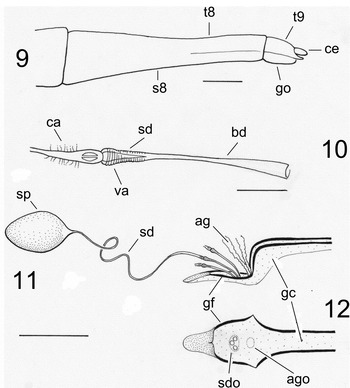
Efferia okanagana sp. nov., adult female terminalia. 9, Ovipositor, lateral view (scale bar=0.5mm); 10, basal region of spermathecal duct (scale bar=0.1mm); 11, base of genital fork (sternite 9, furca) and spermatheca, lateral view (scale bar=0.5mm); 12, base of genital fork, dorsal view (scale bar=0.5mm) (ag, accessory gland; ago, accessory gland opening; ca, caniculi; ce, circus; gc, genital chamber; gf, genital fork (sternite 9, furca), go, genital opening; sp, spermatheca; sd, spermathecal duct; sdo, spermathecal-duct opening; s8, sternite 8; t8, tergite 8; t9, tergite 9; va,.

Type locality
Canada, British Columbia, Vernon, Kalamalka Lake Provincial Park, Cosens Bay, grassland slopes to the north. Most specimens have been collected along the trail indicated by coordinates 50°11′57.4′′N, 119°16′06.7′′W (452m).
Etymology
Named after the Okanagan Valley, BC, the region where almost all the known specimens originate. The type locality lies near the northern end of the valley.
Diagnosis
Efferia okanagana belongs to the E. arida species group (Hine Reference Hine1919; Wilcox Reference Wilcox1966). Species in this group mostly range in dry areas of western North America and fly in spring. The group is characterized by the branching of veins R4 and R5 opposite the base of M2; R5 normally meets the costa slightly anterior to the wing apex. The presutural scutum bears numerous setae at least as long as antennal segments 1–2 and the scutellum usually has many marginal bristles. Males of most species have abdominal segments 1–5 black and 6–7 silvery white, although several species have one or two additional white segments. In females, the cerci are rounded apically and tergite 9 is usually longer than the cerci.
Based on a comparison of the genitalia (e.g., the medial surface of the terminal process of the epandrium), E. okanagana appears most closely allied to E. arida (Williston) and E. pinali Wilcox of the southwestern United States of America. However, I have not dissected examples of all species in the E. arida group, and determining relationships among them awaits a detailed phylogenetic study.
Separating E. okanagana from the broadly sympatric and contemporal E. coulei is the main practical diagnostic issue. In E. okanagana, the general body tomentum is predominantly gold brown and the occipital bristles are strikingly golden (Figs. 1, 2). In E. coulei the same characters are silver grey and black, respectively. In E. okanagana the katatergite bristles are black and those of the coxae are golden; these setae are white in E. coulei. In E. okanagana males, abdominal segment 4 is all dark, sometimes with small dorsal patches of white tomentum; white lateral hair on segment 4 is no longer than that on segment 5. In E. coulei males, segment 4 is white tomentose except for a dark dorsal triangle narrowing posteriorly; long white parted hairs are directed posterolaterally. Abdominal segments 5–7 in E. okanagana males are white tomentose with a dark dorsal patch on the midline of 5; in E. coulei males these segments are all white.
Molecular diagnosis
The DNA barcodes of E. okanagana form a distinct cluster that is approximately 7.0% divergent (uncorrected p distance) from E. coulei, the nearest congener analyzed (J. deWaard, personal communication). However, no other members of the E. arida species group were barcoded because of a lack of suitable material. As noted above, the allopatric E. arida or E. pinali may be more closely related to E. okanagana than is E. coulei.
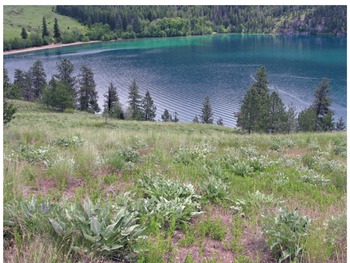
Efferia okanagana sp. nov., type locality, Kalamalka Lake Provincial Park, Vernon, BC. View southeast to Cosens Bay from 50°11′57.7′′N, 119°16′07.8.′′W (454m), 30 May 2010. Pseudoroegneria spicata grassland with Balsamorhiza sagittata (large leaves) and the invasive, introduced Potentilla recta (bright green). Photograph: Robert A. Cannings.

Identification keys
The keys to males and females of species of the E. arida group given by Wilcox (Reference Wilcox1966) are modified here to include E. okanagana. Only the couplets required for the identification of E. okanagana are reproduced; the keys to males and females begin at couplets 10 and 2, respectively. Although not ideal, most of the structure and wording of the original keys is maintained because these are the only identification keys for most Efferia species occurring north of Mexico. A few changes or additions have been inserted in square brackets to clarify some details, and a few words have been omitted.
Males
10. Abdominal segments 1–3 and 4 in part with black hairs, [which are] longer at the sides; venter white-haired. (California, Nevada, New Mexico, Utah) ………E. subpilosa (Schaeffer) Dorsum of abdominal segments 1–3 mostly black-haired, long hairs on sides white………11
11. Venter of abdominal segments 2–3 largely black haired; leg bristles mostly white. (California, Nevada)………E. tolandi Wilcox Venter of abdominal segments largely white-haired; leg bristles mostly black. (British Columbia)………E. okanagana sp. nov.
Females
2. Ovipositor usually 5.5 mm long or longer………3
Ovipositor [5.0]mm long or less………7
7. At most about [12] scutellar bristles; bristles of tibiae and tarsi in part black………8
About 20 scutellar bristles; bristles of tibiae and tarsi largely white………[11]
8. Scutellar hairs black or mixed black and white………9
Scutellar hairs white or yellowish………10
9. Scutellar hairs black………E. prattii (Hine)?
Scutellar hairs mixed black and white………E. okanagana sp. nov.
Description
Male (Fig. 1)
Body length: 13.0–19.3mm.
Head
Width across eyes 2.83–4.05mm; width of frons below antennal bases 0.92–1.32mm; width of vertex (narrowest point between eyes) 0.78–0.88mm; height of facial gibbosity measured from eye margin 0.37–0.63mm. Tomentum white gold on face and along eye margins, thinning on occiput, on gibbosity, and at oral margins, revealing shining black cuticle. Mystax white, often mixed with pale-yellow bristles, especially ventrally; black/dark brown bristles concentrated above mouth, sometimes scattered throughout. Palpal setae dense, black/dark brown, sometimes mixed with golden ones, rarely all or mostly golden. Beard (genal setae) white, more or less pale yellow near eye margins. Orbital setae white, some black; ocellar bristles black. Occipital bristles golden, thickest medially, in some specimens mixed with black or white ones medially; surrounded by white hairs. Proboscis black with white and gold bristles.
Antennae
Lengths of antennal scape 0.36–0.48mm, pedicel 0.18–0.24 mm. Three flagellomeres: F1 elongate, tear-shaped, and laterally flattened, 0.40–0.53mm long, 0.12–0.18mm wide; F2+3 cylindrical, thin, 0.60–0.83 mm long, about 1.5–1.6 times longer than F1; F3 minute. Antennae brown, with thin pale tomentum on F1. Setae mostly white and ventral on scape, often some are black brown; shorter and fewer on pedicel, none on F1.
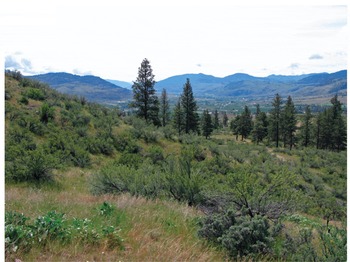
Fairview–White Lake Road, Oliver Mountain area, BC. View south from 49°11′16′′N, 119°35′10′′W (535m), 19 May 2010. Purshia tridentata/Pseudoroegneria spicata habitat; Pinus ponderosa stand in the middle distance. Photograph: Robert A. Cannings.

Thorax
Thorax cuticle brown black, largely covered with tomentum; subshining. Prothorax tomentum brown grey; hairs white, dorsal bristles golden. Scutum with gold brown tomentum mixed with grey, parts shifting to dark brown depending on angle of view. In dorsal view acrostichal stripes dark brown flanking grey medial line; tomentum lateral to dorsocentral setae golden; viewed from posterior, dorsocentral stripes dark brown. Short postpronotal setae mixed black and white. Acrostichal and dorsocentral bristles black, the latter longer, about 1.4 mm long posteriorly; presutural bristles 3–4, usually 3, either golden or black; postalar bristles black, 2–3, usually 3; supraalar setae black, 1–3, usually 2. Most of scutum sparsely covered with fine black hairs; usually white hairs anteriorly and along lateral margins. Scutellum tomentum gold brown with varying amounts of grey; apical scutellar bristles 7–14, black, often with golden tips; a few sometimes all golden; hairs on scutellar disc black, sometimes a few white. Pleural and scutellar tomentum grey mixed with gold brown. Katatergite bristles black; anepisternum hairs sparse, mostly white dorsally, black posteroventrally. Most of the other pleural sclerites bear long fine white hairs, often mixed with black ones.
Legs
Metafemur 3.8–5.2mm long. Base colour of leg segments dark brown–black; basal half of tibiae and tarsi often red brown, the amount of this colour on tibiae decreasing from pro- to meta-tibia. Coxae and trochanters mostly with gold brown to grey tomentum, white hairs and golden bristles, sometimes a few black ones. All leg segments mostly with white hairs and long fine setae, but femora often with black setulae and hairs; often some black hairs on tibiae and tarsi. Most leg spines black, a few golden. Dense golden brush of short setae on ventral face of apical half of protibia and at least first tarsal segment on pro- and meta-tibia.
Wings
Wing 9.8–13.5mm long; membrane hyaline, usually pale brown adjacent to veins. Veins pale to dark brown, usually red brown; short recumbent black setulae along anterior costa, sometimes as far at wing apex; normally some white setulae at costal base. Vein R4 and R5 branch opposite base of M2 (the distance between the r-m crossvein and the branching of R4 and R5 is about the same as the distance between the r-m crossvein and the base of M2). R4 with short recurrent vein near base, vein ending in cell r 2+3; infrequently the end of this short vein is connected to R4+5. Vein R5 curved anteriorly, joining costa just anterior to wing apex. Halter pale brown, knob darker.
Abdomen
Tergite 1 mostly black-haired dorsally, a mix of black and white hairs laterally; usually 3–10 strong golden or black bristles laterally. Tergites 1–4 black dorsally, subshining, with lateral tomentum gold brown, paler apically, extending onto dorsal black areas in some lateral views, especially on basal or apical margins of segments; small basolateral patch of white tomentum on 4. Short hairs on dorsum black; lateral hairs long and spreading; mixed white and black on tergites 2–3, all white on 4. Tergites 5–7 with silver white tomentum, paler and more golden laterally on 5, hairs all white. Tergite 5 dorsally with golden tomentum bordering black basal and mid-dorsal areas; 7 dorsally with black apical band; 8 subshining brown with white hairs. Sternites 1 gold brown, 2–4 brown with gold posterior band, 5–7 mostly silver white; all hairs white. Sternite 8 with long stiff gold white setae apically.
Genitalia (Figs. 3–8)
Epandrium and gonocoxite black with white or pale golden hairs; fringe of gold white setae on venter of epandrium about 0.75 times as long as epandrium width. Dense fringe of setae on ventral margin of gonocoxite brown medially, white laterally, 0.5–0.8mm wide. Width of epandrium in lateral view about half the length (0.42–0.57 mm), widest at midlength; medial face of epandrium apex as in Figure 7. Hypandrium, gonocoxite, gonostylus, and phallus as in Figures 3–6. Details of Efferia genitalia were discussed by Theodor (Reference Theodor1976), Bullington and Lavigne (Reference Bullington and Lavigne1984), and Scarbrough and Perez-Gelabert (Reference Scarbrough and Perez-Gelabert2009).
Female (Fig. 2)
Body length: 12.0–19.2mm. Female coloration and setation much as in male, except on the abdomen and for a tendency towards sparser paler setae on most of the body. Major differences are noted below.
Head
Width across eyes 2.7–4.00mm; width of frons below antennal bases 0.90–1.33mm; width of vertex (narrowest point between eyes) 0.75–1.06mm; height of facial gibbosity measured from eye margin 0.37–0.73mm. Orbital setae white, rarely a few black; occipital bristles golden, in some specimens mixed with a few black ones medially. Antennae as in male.
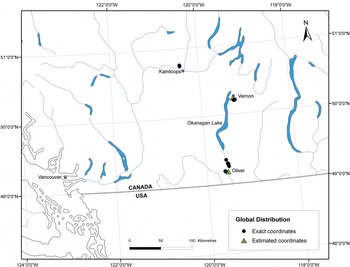
Efferia okanagana sp. nov. Geographical distribution.

Thorax
Short postpronotal setae white, sometimes some black. Acrostichal and dorsocentral bristles black, usually mostly shorter and sparser than in male. Hairs on scutellum disc mixed white and black; when scarce, white ones usually concentrated basally. Katatergite bristles mostly gold or white, sometimes a few black, occasionally mostly black; other pleural setae almost always all white.
Legs
Metafemur 3.5–5.5mm long. All leg segments usually with white hairs and long fine setae; short black recumbent setae rarely on dorsal surface of femora; otherwise as in male.
Wings
Wing 9.0–13.8mm long; otherwise as in male.
Abdomen
Complex tomentum pattern changes with direction and angle of view. In posterodorsal view, segments 1–6 mostly dark brown basally, silver gold apically, the latter band covering about 0.3 times length of tergite 1, 0.25 times length of 2 (which also has a narrow basal band), 0.3 times length of 3, 0.5 times length of 4 and 5, 0.25 times length of 6, and none of 7. Intersegmental membranes have similar silver gold tomentum. Often a brown midline occurs. In anterodorsal view, tergites become mostly gold brown with pale-grey apical bands on at least tergites 2–4. In lateral view. tergites are silver grey ventrally, grey gold basally, and brown apically and ventral to the golden basal patches. Dorsal setulae and hairs mostly recumbent and white mixed with some black, black ones predominating along midline of tergites. Lateral hairs longer, white; tergite 1 mostly white-haired dorsally, with some recumbent black setae apically; white hairs and 5–6 strong golden or black bristles laterally. Tomentum of sternites mottled grey and brown; hairs long and white.
Genitalia (Figs. 9–12)
Ovipositor (mostly segment 8) laterally flattened, shining black, 3.8–5.0mm long (usually about 4.5mm long), about as long as segments 5–7; width at base 0.80–1.04mm, length about 5 times (4.0–5.5) basal width (Fig. 9). Tergite 9+cercus 0.60–0.92mm long; cercus length about half length of tergite 9 (Fig. 9). Genital fork, (sternite 9, furca), spermathecae, and associated structures as in Figures 11 and 12. Spermathecae extending anteriorly to middle or apex of segment 7. Terminal reservoirs of spermathecae ovate; external surface of duct bearing caniculi (Fig. 11).
Immature stages
The larva and pupa are unknown.
Biology
Habitat
All seven species of Efferia known in BC live in the Pacific Northwest Bunchgrass (Tisdale Reference Tisdale, Nicholson, McLean and Baker1982) type of intermontane grasslands of the region. The character and composition of these grasslands vary considerably with soil, altitude, and aspect. Efferia okanagana is an inhabitant primarily of the Lower Grasslands, which are dominated by bluebunch wheatgrass (Pseudoroegneria spicata (Pursh) Á. Löve) (Poaceae) (Fig. 13) and big sagebrush (Artemisia tridentata Nutt.) (Asteraceae) (Nicholson Reference Nicholson, Nicholson, McLean and Baker1982; Tisdale Reference Tisdale, Nicholson, McLean and Baker1982).
However, most of the known localities for E. okanagana are in the southern Okanagan Valley south of Penticton on sandy and gravelly soils, where the Lower Grasslands are represented by a shrub steppe dominated by antelope bitterbrush (Purshia tridentata (Pursh) DC) (Rosaceae) (Fig. 14) rather than by A. tridentata, with needle and thread (Hesperostipa comata (Trin. and Rupr.) Barkworth (Poaceae)) usually common in the herb layer. Antelope bitterbrush plant communities mainly occur in the low-elevation valley bottoms (280–760m) in xeric sites of the driest variant of the Bunchgrass Biogeoclimatic Zone, BGxh1 (Very Hot Dry Bunchgrass). Some antelope bitterbrush plant communities also occur at the margins of the Ponderosa Pine Biogeoclimatic zone, PPxh1subzone (Very Hot Dry Ponderosa Pine). Artemisia tridentata is typically predominant in sites that have a capping of very fine sands and silts; these are considered a different ecosystem (K. Iverson, unpublished data).
The low-elevation grassland on the east side of Vaseux Lake is an example of the P. tridentata – H. comata community. One site where E. okanagana occurs has a scattered shrub layer dominated by P. tridentata with Rhus glabra L. (Anacardiaceae), Philadelphus lewisii Pursh (Hydrangaceae), and Amelanchier alnifolia Nutt. (Rosaceae). The herb layer is predominantly P. spicata and Aristida purpurea Nutt. (Poaceae) with lesser amounts of Erigeron glabellus Nutt. (Asteraceae), Selaginella wallacei Hieron. (Selaginellaceae), Panicum scribnerianum Nash (Poaceae), and Agoseris glauca (Pursh) Raf. (Poaceae). There is a considerable amount of weedy species such as Bromus tectorum L. (Poaceae), Vulpia octoflora (Walt.) Rydb. (Poaceae), and species of Centaurea L. (Asteraceae). The bryophyte and lichen layer is absent. Species present here but absent from the Penticton stand, in addition to those listed above, include Gaillardia aristata Pursh (Asteraceae), Astragalus purshii Dougl. (Fabaceae), and Crepis atrabarba Heller (Asteraceae).
In this region, E. okanagana is absent from many grasslands with finer soils where Pseudoroegneria (Nevski) Á. Löve and A. tridentata predominate. Extensive grasslands around White Lake, Chopaka, and Richter Pass, the Okanagan Lake benches from Penticton to Kelowna, grasslands north of Kelowna, and the sage-dominated silts in the lower South Thompson Valley west of Kamloops to Ashcroft and Cache Creek have not produced any specimens. These habitats are the home of Efferia benedicti Bromley from June to August and E. harveyi Hine from August to October. Interestingly, there are also no records of E. okanagana from the sandy P. tridentata steppe on the east side of Osoyoos Lake, despite considerable fly collecting there over many years. The typical species there is E. albibarbis (Macquart). The grasslands of the Rocky Mountain Trench (upper Kootenay and Columbia River valleys), dominated by P. spicata and species of Festuca L. with P. tridentata steppe in many southern sites, support E. frewingi Wilcox, which in Canada, at the northern edge of its range, is mostly a western Great Plains species.
Records of E. okanagana at the northern boundary of its distribution near Kamloops and Vernon come from Pseudoroegneria habitat; P. tridentata is not found that far north. In sites at Cosens Bay, Kalamalka Lake Provincial Park, Pseudoroegneria is predominant; other grasses include Stipa nelsonii Scribn., Koeleria macrantha (Ledeb.) Schult., Poa canbyi (Scribn.) Howell, and B. tectorum (all Poaceae). Forbs such as Balsamorhiza sagitatta (Pursh) Nutt. (Asteraceae) and the invasive Potentilla recta L. (Rosaceae) are common (Fig. 13). Artemisia tridentata is rare or absent in the sites where E. okanagana has been found.
In contrast, E. coulei (the other E. arida group species in the region) is much more widespread, occurring as far north as the Chilcotin Plateau (about 52°N, 123°W, 200km northwest of Kamloops). This species also is a spring flier, but prefers Middle Grasslands sites (characterized by grasses such as Festuca campestris Rydb.), which are generally more extensive in BC than are the Lower Grasslands and occupy somewhat cooler, moister situations (Nicholson Reference Nicholson, Nicholson, McLean and Baker1982; Tisdale Reference Tisdale, Nicholson, McLean and Baker1982). On the West Bench, Penticton, where E. coulei is common and the only Efferia species in spring, the herb layer is dominated by F. campestris and a low coverage of rabbitbrush, Chrysothamnus nauseosus (Pall.) Britt. (Asteraceae). Secondary species are V. octoflora, B. tectorum, Sporobolus cryptandrus (Torr.) Gray (Poaceae), and Phlox longifolia Nutt. (Polemoniaceae) There is a well-developed bryophyte and lichen layer consisting primarily of species of Cladonia P. Browne (Cladoniaceae), Peltigera Willd. (Peltigeraceae), and Pohlia Hedwig (Mniaceae). Plant species found there but absent from the Vaseux Lake site where E. okanagana is found include Lewisia rediviva Pursh (Portulacaceae), Fritillaria pudica (Pursh) Spreng. (Liliaceae), Ranunculus glaberrimus Hook. (Ranunculaceae), and Geum triflorum Pursh (Rosaceae).
Efferia larvae live in the soil (Lavigne and Holland Reference Lavigne and Holland1969) and a comparison of the general soil characteristics of sites inhabited by E. okanagana and E. coulei (which partition Okanagan grasslands in the spring) is warranted. Soil consistency may be a factor in the presence or absence of E. okanagana. The Vaseux Lake site (E. okanagana) is an alluvial terrace at the foot of metamorphic cliffs; the subsoil is a stony, gravelly alluvium. The surface soil is coarser and with a higher percentage of organics and salts and a lower moisture-holding capability than the soil in the Penticton site (E. coulei), which is deep and medium-textured. A relatively high percentage (more than about 10%) of gravel in the soils characterizes other sites where E. okanagana occurs, such as the east bench of Vaseux Lake (sandy loam, 45% gravel) and Kalamalka Lake Provincial Park (sandy to heavy loam, 8%–17% gravel). The species is absent from sites where gravels are less common, such as West Bench, Penticton (loam to fine sandy loam, 0%–1%), Chopaka (heavy sandy loam and clay, 5%), and Haynes Lease, Osoyoos (loamy sand, 3%) (R.A. Cannings, unpublished data).
Phenology
Thirty-five collection events recording flying adults range from 17 April (1930), Vernon) to 18 June (1991), Vernon, Kalamalka Lake Provincial Park). Thirty-one records are from May and two-thirds of all records fall between 15 and 25 May. The mean and mode of the May records are both 19 May. Seventeen photographs of adults at Oliver were taken by Werner Eigelsreiter (personal communication) between 24 April (2001) and 30 May (2007) (median 16 May).
Efferia okanagana has an early flight period relative to most other sympatric species of Efferia in southern BC grasslands. It flies at about the same time as E. coulei, its E. arida group relative. These two spring species are replaced in about mid-June by E. benedicti and E. staminea (Williston) (E. staminea group) and E. albibarbis (Macquart) (E. albibarbis group), which are the typical summer Efferia species in the region. Two E. pogonias group species fly later in BC: E. harveyi, the only true autumn species, flies from August until late October and E. frewingi Wilcox, a Great Plains species at the northern edge of its range in BC, flies mostly in August. Efferia frewingi is known in BC only from the Rocky Mountain Trench and is the only BC Efferia species that is broadly allopatric with E. okanagana.
In grasslands, ground-hunting robber fly species are most easily collected along trails or dirt tracks. These provide the flies with clear views of potential flying prey and maximum exposure to the sun. Most collections of adult E. okanagana have been made in such situations; when disturbed, they fly from the ground with a strong buzzing of wings, landing a few metres away, and are usually readily located. Where there are no trails, adult E. okanagana are most easily seen when they sit on rocks or pieces of wood. On sunny, warm days they are active from at least 10:00 a.m. to 18:00 p.m.
Oviposition
The ovipositor of E. okanagana is strongly flattened laterally. Efferia species with this type of ovipositor lay their eggs in or on vegetation; those with more cylindrical ovipositors lay eggs directly in the soil (Dennis et al. Reference Dennis, Lavigne and Bullington1986). On 23 May 1987, at Kalamalka Lake Provincial Park, Vernon, females laid eggs in the empty glumes of the previous year's P. spicata florets. As far as is known, E. okanagana has never been collected at a site where this grass is absent.
Prey
Only one specimen of E. okanagana has been captured with prey: a male with a winged ant (Formica sp.) was collected at Vaseux Lake on 17 May 1987. However, at Oliver, BC, Werner Eigelsreiter has photographed adult E. okanagana preying upon insects in five orders: Coleoptera (a click beetle (Elateridae)), Hemiptera (Errhomus calvus Oman (Cicadellidae)), Hymenoptera (species of Andrena F. (Andrenidae) and Hoplitis Klug (Megachilidae)), Lepidoptera (a species of Lampronia Stephens, probably L. aenescens (Walsingham) (Prodoxidae)), and Diptera (Syrphus opinator Osten Sacken (Syrphidae), Machimus Loew (Asilidae), and a species of Tipula L. (Tipulidae)). As well, he photographed a female E. okanagana feeding upon another female.
Distribution (Fig. 15)
Efferia okanagana is known only from Canada, but the range probably includes at least parts of adjacent Washington State where similar habitat occurs. In Canada the species is recorded only from BC in the Oliver, Vaseux Lake, Okanagan Falls, Vernon, and Kamloops areas in the Okanagan and Thompson valleys. Despite much collecting effort, few specimens have been collected. However, it may be more common than records suggest. It is patchily distributed within its area of occurrence and is apparently largely restricted to grasslands dominated by P. spicata and where the soils contain considerable gravel. This habitat occurs mostly at low elevations (280–760m) in the region (K. Iverson, unpublished data) but is much more widespread than the known distribution of the fly. See also the discussion in the Habitat section.
Conservation
The grasslands that support E. okanagana are limited in area and biologically diverse, and have been, and continue to be, degraded. They have received intense attention from conservation programs. For example, the P. tridentata – H. comata ecosystem in the southern Okanagan valley, where most of the E. okanagana sites occur, is assigned the highest priority (S1 Provincial status) under the provincial Conservation Framework goal, and G2 Global status. The ecosystem supports one of the highest densities of species-at-risk of ecosystems in BC (Dyer and Lea Reference Dyer, Lea and Seaton2003; K. Iverson, unpublished data).
Despite some successful attempts to conserve BC grasslands, many areas have been eliminated or reduced in size and condition because of development for agriculture, housing, recreation, and industry; changing fire regimes; disturbance by livestock; and the introduction and spread of invasive plants (Dyer and Lea Reference Dyer, Lea and Seaton2003; Cannings Reference Cannings2006; Lea Reference Lea2008; K. Iverson, unpublished data). In BC in 2010 only about 7.1% of the P. tridentata – H. comata ecosystem remained in good to excellent condition and 71.3% was in only fair condition (K. Iverson, unpublished data). Between 1800 and 2008, 67.5% of the original area (9863ha) was lost (3217ha remains), 40.7% of the losses occurring after 1938 (K. Iverson, unpublished data). As of 2010, about 17.4% of the remaining area of the ecosystem was protected; 56.2% was on First Nations Reserves, 20.0% was in private hands, and 6.4% was on unprotected provincial land.
Despite these adverse trends for the most important habitat of E. okanagana, nothing is known about the vulnerability of the fly. Although egg-laying may occur in grasses other than P. spicata, invasive weeds such as Centaurea diffusa Lam., B. tectorum, and P. recta may negatively affect oviposition by reducing Pseudoroegneria growth,. Overgrazing may be a concern for the same reason, although specimens of this and other species of Efferia in BC appear to tolerate considerable habitat disturbance.
Wildfires within the area of occurrence of E. okanagana increased in frequency from 2000 to 2010 and severely damaged some of this species— habitat (e.g., at Vaseux Lake and the nearby Ecological Reserve 100 at the north end of Osoyoos Lake). These fires tended to burn much hotter than previous fires and, in addition to destroying aboveground oviposition and foraging habitat, may have killed Efferia larvae and pupae in the soil. However, the Vaseux Lake population documented from specimens collected in the 1980s survived a severe fire in 2003.
Efferia okanagana is a rare asilid under significant pressure within its small known geographical area of occurrence. Its large size, predatory nature, and conspicuous behaviour make it an excellent subject for nature interpretation. These traits make it a good candidate for conservation planning and further inventory work. A status report on the species is currently in preparation (Committee on the Status of Endangered Wildlife in Canada, unpublished data).
Acknowledgements
I have known all the dipterists at the Canadian National Collection of Insects, Arachnids and Nematodes to whom this Diptera Festschrift issue is dedicated, and since the early 1980s I have worked to some extent with all of them but Bob Peterson. These colleagues, especially Monty Wood and Dick Vockeroth, strongly influenced my studies of Diptera, and I have long appreciated their help and generosity. Monty still inspires my robber fly studies. As always, I thank my good friend and colleague, asilid guru Eric Fisher (Sacramento, California), for his insight, advice, and specimen loans. Werner Eigelsreiter (Oliver, BC) allowed me to publish his exceptional photographs of E. okanagana. Bob Maxwell (British Columbia Ministry of Environment, retired, Victoria) analyzed soil samples. I also thank my many friends and colleagues listed in the “Type material” section for companionship in the field and for collecting specimens. Jenny Wu (Committee on the Status of Endangered Wildlife in Canada Secretariat, Gatineau, Quebec) prepared the map. Stephanie deWaard, Paul Hebert, and the staff at the Biodiversity Institute of Ontario generated the DNA barcodes; the molecular analysis was made possible by support from Genome Canada through the Ontario Genomics Institute to Paul Hebert. Jeremy deWaard interpreted the analysis. Prey identifications from photographs were made by Andy Hamilton and Jeff Skevington (Canadian National Collection of Insects, Arachnids and Nematodes, Agriculture and Agri-food Canada, Ottawa, Ontario), Chris Thompson (National Museum of Natural History, Washington, D.C.), Lincoln Best (Biology Department, York University, Toronto, Ontario), Greg Pohl (Canadian Forest Service, Edmonton, Alberta), Hume Douglas (Canadian Food Inspection Agency, Ottawa, Ontario), and Fenja Brodo (Canadian Museum of Nature, Gatineau, Quebec).